Kent, October 1814.
The private interview had been arranged by Lady Morrow, which meant it had been arranged with the efficiency of a woman who believed the matter was straightforward and wished it concluded before Christmas. The Duke of Harwell needed a wealthy wife. The Vane family had a daughter of considerable fortune and adequate accomplishment. The geography was convenient, the timing was practical, and Lady Morrow had spent forty years making impractical things practical through the simple application of organization.
She had not, it must be said, consulted either party about their feelings on the matter. Philippa Vane arrived at Harwell House on a Tuesday morning in the second week of October, accompanied by her father and the composed attention of a woman who had been managing difficult rooms since she was sixteen. She wore her best morning dress, dark green, well-cut, the kind of thing that said money without saying new money, though new money was precisely what it was, and she saw no reason to be embarrassed about it. She had her father’s accounts in her head and her mother’s posture in her spine, and she sat in the drawing room of Harwell House and waited for the Duke of Harwell to appear.
He appeared at eleven. He was taller than she had expected and better looking than she had been warned, which was the first surprise. And the second surprise was the expression, not arrogance, precisely, but the quality of a man who had decided what he thought before he entered the room and was not expecting the room to revise him. “Miss Vane,” he said.
“Your Grace,” she said.
Her father and Lady Morrow had arranged themselves in the corner of the drawing room with the transparent subtlety of two people who believed themselves invisible. And the Duke looked at this arrangement and then at her and said, with the directness of a man who considered social performance a waste of time, “Perhaps we might speak privately.”
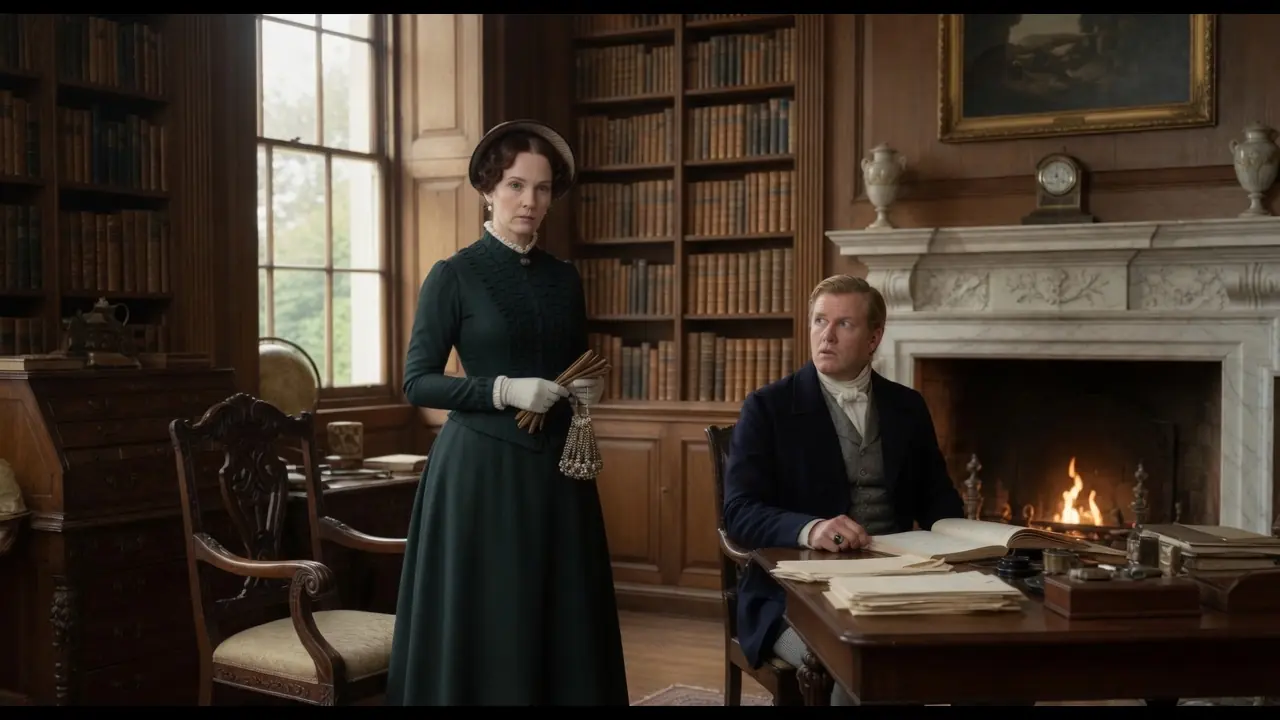
They were shown to the library. It was a good library. She noted this with the automatic attention she brought to books and to numbers and to anything that told her something true about a person. The books had been read.
The spines were broken in. He was not a man who bought libraries for appearance, which was, she thought, a point in his favor. She sat. He sat across from her.
He looked at her with the complete assessing attention of a man conducting an interview, which was, she understood, precisely what this was. “I will be direct,” he said.
“Please,” she said.
“I am looking for a wife,” he said. “My requirements are not complex. I need a woman of sufficient fortune to address certain practical matters relating to the estate. I need a woman who is capable of managing a household of this size and representing the Harwell name in society.”
He paused. “I need a wife who knows her place in the order of things, who understands what is required of a Duchess and who will not—” Another pause, this one weighted. “Who will conduct herself accordingly.”
Philippa looked at him across the library. She looked at the set of his jaw and the quality of his stillness and the particular care with which he had chosen and then not chosen his words, and she understood, with the precision she brought to all important information, that the blank space in his sentence was not about her. “You have been married before,” she said.
Something moved in his expression. “Yes.”
“And your first wife did not conduct herself accordingly.”
The pause this time was long enough to mean a great deal. “No,” he said, “she did not.”
Philippa looked at the fireplace. She looked at the books. She looked at the man across from her who had walked into this interview with a policy built from a wound and had just explained the wound to her without realizing he had done it. She thought about what it meant to be considered for a position because of her father’s money and her mother’s posture, and dismissed as a person before she had said ten words.
She thought about a man who had been hurt and had organized the hurt into a requirement and had called it principle. She thought about the word place and what it meant when a Duke said it to a woman in a library and believed it was honesty. She stood. “Thank you for your candor, Your Grace,” she said.
He looked up, slightly surprised by her standing. She curtsied. It was a perfect curtsy, the depth and duration precisely calibrated, the kind of curtsy that acknowledged rank without conceding anything personal, the kind that said, “I see you clearly and I choose to leave.” She held it for exactly the correct number of seconds.
Then she left the library, collected her father from the drawing room with the composed efficiency of a woman who had concluded her business, and was in the carriage on the way home before Lady Morrow had fully understood what had happened. Her father, who had spent twenty-seven years paying close attention to his daughter, said nothing until they were through the Harwell gates. “Well,” he said.
“He needs a fortune and a function,” she said. “He does not need a person.”
Her father was quiet for a moment. “The man has had a difficult time of it, Philippa. Lady Constance was—”
“I know what Lady Constance was,” she said. “I also know what I am. And I am not a correction for someone else’s history.”
Her father looked out the window at the Kent countryside passing in the October light. “What will you do?”
She looked at the road ahead. “I have been considering the Whitmore Park estate,” she said. “The listing came through last month. It is sound property at a fair price, and the location is excellent.”
Her father was quiet for another moment. “It borders Harwell land.”
“It is excellent property,” she said. “The location is extremely convenient.”
“Philippa.”
“It is purely a business decision, Father.”
He looked at her with the expression of a man who had spent twenty-seven years paying close attention to his daughter and had a comprehensive understanding of what her business decisions looked like. He said nothing further. She looked out the window at the Kent countryside and thought about a library with well-read books and a man who had handed her an insult and called it transparency. And she almost believed that Whitmore Park was entirely about the acreage.
Whitmore Park was purchased in November, which was faster than most property transactions in Kent, because Philippa Vane had her father’s solicitors and her father’s accounts and the determination of a woman who has decided something and is not interested in delay. The Duke of Harwell was informed of his new neighbor by his steward, who mentioned it in passing during the weekly estate review, in the way that people mention things they consider significant while pretending to consider them incidental. “Miss Vane,” the Duke said. He set down the account ledger.
“George Vane’s—”
“Yes, Your Grace. The sale completed on the fourteenth.”
The Duke looked at the window that faced south, toward the boundary line between Harwell and Whitmore, where the old oak trees stood in their November bare state and the land ran flat and clear for a quarter mile. “The boundary survey,” he said, “has it been updated recently?”
“Not since your father’s time, Your Grace.”
His steward noted this and said nothing further, and the estate review continued, but the Duke looked at the south window twice more before it was finished. She was at Whitmore Park by the first week of December, which surprised the county. December was not the time one took possession of a Kent estate. December was for London, for the remaining season entertainments, for the rounds of calls and dinners and the careful social maintenance that kept a family’s position intact.
December in the country was for people who had positions so established they required no maintenance. Philippa arrived on a Monday with three carriages of household goods, a housekeeper she had brought from the Vane house in Manchester, and a surveyor she had engaged in London whose specialty was property boundaries. The county noticed all of this. Kent was a county that noticed things, being prosperous enough and social enough and close enough to London that there was always an audience for the interesting.
She spent the first week learning the house, walking every room, every outbuilding, every acre of the grounds in the December cold with the methodical attention of a woman taking inventory. The estate was sound but neglected. The previous owner had let the drainage go, and the south field was waterlogged, and two of the tenant cottages needed work that should have been done two seasons ago. She noted all of it and had a plan drawn up by Thursday.
On Friday morning, she put on her riding habit and went to look at the boundary line. The oak trees stood along the north edge of the property, old and certain, and beyond them was Harwell land, the same flat December landscape, a tenant farm in the distance, the Harwell chimneys just visible on the horizon. She stood at the boundary and looked at both sides and thought about deeds and precedent and the way a county with long memory operated. She heard the horse before she saw it.
He came from the Harwell side on a gray at a pace that said he had known where she was and had come deliberately. He pulled up at the boundary line and looked at her across it with the expression she recognized from the library, the complete assessing attention, the one that preceded a position he had already decided. “Miss Vane,” he said.
“Your Grace.”
She did not curtsy. They were standing in a field in December. The curtsy was for libraries. He looked at her and then at the oak trees and then back at her.
“I see you have wasted no time.”
“I have wasted no time,” she agreed. “The estate was in need of attention.”
“The boundary survey,” he said. “My steward tells me you have engaged a surveyor.”
“I have.”
“So have I.”
She looked at him. He looked at her. The December wind moved through the oak branches above them. “Then we shall have two surveys,” she said.
“And they will likely agree with each other, in which case the matter is simple, or they will not, in which case the matter is interesting.”
He looked at her for a moment with an expression she had not cataloged before. Not the assessing attention. Something less managed than that. “You are very direct,” he said.
“You told me you valued directness,” she said. “In the library. I took you at your word.”
The gray shifted beneath him. He steadied it with a hand that knew what it was doing and looked at her across the boundary line with the expression that was moving away from managed and toward something she was going to have to think about later. “The South Field,” he said. “The drainage, that work will require access across the Harwell Lane.”
“I am aware. I intended to write to your steward about it.”
“Write to me,” he said.
She looked at him.
“The boundary dispute concerns us both,” he said. “Write to me directly.” He turned the horse. “Good morning, Miss Vane.”
“Good morning, Your Grace,” she said to his retreating back.
She stood at the boundary line for a moment after he had gone in the December cold and thought about the word directly and about the expression that had not been the assessing one, and then went back to Whitmore Park and did not think about either of them for the rest of the day with moderate success. The surveys were commissioned, conducted, and returned with the results she had expected, which was to say with the results that confirmed her legal position and complicated his historical one in the precise way that required further discussion. The boundary line, according to the 1809 deed under which Whitmore Park had been sold, ran twelve feet north of the oak trees. The boundary line, according to the Harwell estate records going back to 1743, ran twelve feet south of the oak trees.
Twenty-four feet of Kent countryside that had apparently been claimed by both estates for seventy years without either party noticing because the previous Whitmore owners had been gentleman farmers with no particular interest in confrontation and the Harwell family had been dukes with no particular experience of anyone contesting their position. Philippa read both surveys at the writing desk in the Whitmore library on a Thursday morning and thought about the twenty-four feet of disputed land, which contained two oak trees, a drainage ditch, and the pleasure of a problem that was both legally interesting and practically significant. She wrote to the Duke. The letter took two drafts.
The first was too warm. The second was precisely correct, factual, specific, and ending with a proposal for a meeting to review the documents together, which was the reasonable next step and also the step that would put her in a room with him again, which she was not going to examine too closely. She sent the second draft. His reply came the following morning, which was faster than she had expected, in a hand she recognized as his own rather than a secretary’s.
“Miss Vane, I have reviewed both surveys. The discrepancy is clear. I propose Thursday next, ten o’clock, at the boundary. Bring the 1809 deed. I will bring the 1743 record. Harwell.”
She read this note twice. She noted that he had written it himself. She noted the absence of social padding, no pleasantries, no performative regret about the situation, just the time and the documents and the expectation of her presence. She found this, against her better judgment, more appealing than elaborate courtesy would have been.
She sent back, “Thursday next, ten o’clock. I will bring the deed. P. Vane.”
Thursday was cold and clear in the way of Kent in December, the kind of morning where everything was sharp-edged and visible and there was nowhere to be imprecise. She arrived at the boundary at five minutes to ten. He was already there. He was on foot this time, the 1743 record in his hand, and he had brought his steward, which told her something about how he had categorized this meeting.
She had brought her surveyor, which told him something back. They spread the documents on the flat top of the boundary wall, her 1809 deed, his 1743 record, and stood on opposite sides of the wall and read each other’s evidence with the focused attention of two people who were both entirely right and entirely incompatible. “The 1743 record predates the deed by sixty-six years,” he said.
“The deed is the operative legal document,” she said. “Precedent is not law.”
“In this county,” he said, “precedent has the force of law in all practical respects.”
“In this county,” she said, “practical force and legal right are different things, and I find the distinction worth preserving.”
He looked at her across the boundary wall with the expression that had been moving in their two meetings incrementally away from the assessing one and toward something that occupied more of his face. “You have done this before,” he said.
“Argued a boundary dispute?”
“Argued,” he said, with something in the word that was not an accusation.
“My father’s business involves a considerable number of negotiations,” she said. “I have been present for most of them since I was eighteen.”
“Your father involves you in his business negotiations?”
“My father involves me in everything,” she said. “He has no sons. He has me. He decided when I was twelve that this was either a liability or an advantage and has proceeded on the assumption of the latter.”
She met his gaze. “He has not been wrong.”
The Duke looked at her for a moment. He looked at the documents. He looked at the two oak trees standing in their disputed twenty-four feet of Kent with the serene indifference of trees that had been there since before either family’s claim. “The drainage ditch,” he said, pointing to the survey map. “It runs along the boundary. If it falls on your side, the maintenance cost falls to you. If it falls on mine—”
“It falls to you,” she said. “Yes, I am aware of the drainage ditch. The ditch has been maintained by Harwell for thirty years.”
“Then Harwell has been maintaining a ditch on Whitmore land,” she said. “And I am grateful for the service.”
He looked at her. The steward to his left appeared to be studying the middle distance with considerable intensity. “Miss Vane,” he said, and his voice had dropped below the formal register into something more direct. “I’m going to make you a proposal.”
She waited.
“The twenty-four feet,” he said. “The disputed strip. It has two oak trees and a drainage ditch and no other practical use to either estate. I propose we agree to a shared boundary at the center of the strip, twelve feet each, and recorded formally, which resolves the legal question, and establish a joint maintenance arrangement for the ditch, which resolves the practical one.”
She looked at him. “You are proposing a compromise.”
“I am proposing a resolution.”
“You have two hundred years of precedent,” she said. “You could contest this through the county court and likely prevail on historical grounds alone.”
“I could,” he said.
“Why don’t you?”
He looked at the oak trees. “Because it would take eighteen months and cost both estates considerably. And at the end of it, one of us would have the twenty-four feet and the other would have a grievance. And we are going to be neighbors for the foreseeable future.”
He looked back at her. “I prefer functional neighbors to legal victories.”
She looked at the documents. She looked at the boundary wall between them. She thought about the proposal, which was fair and practical and the kind of thing a man offered when he had decided he respected the other party enough to settle rather than win. “I accept the proposal,” she said, “on the condition that the formal record reflects the legal basis of the division, not the historical one.”
He was quiet for a moment. “Agreed,” he said.
She extended her hand across the boundary wall. He looked at it, the hand of a woman who worked her own estate, in a glove that was good quality and slightly worn at the right thumb from the pen, and shook it with the brief, firm grip of a man who meant what he agreed to. “Good morning, Your Grace,” she said.
“Good morning, Miss Vane.”
She walked back to Whitmore with her surveyor and the 1809 deed and the satisfaction of a woman who had held her ground and been met with something she had not expected. The neighborhood dinners began in January. Kent society in winter was a closed circuit. The same families, the same houses, the same conversations rotated through the same rooms with the efficiency of people who had been doing this for generations and had perfected it into an art.
Philippa had been received with the cautious warmth of a county that was not sure what to make of her yet. She was wealthy enough to be taken seriously. She was not titled enough to be taken for granted. She was, several people had noted independently, very good at conversation, which in Kent society was either an asset or an inconvenience, depending on whose conversation she was good at.
She and the Duke were at the same dinner three times in January. The first was at the Alderton house, where they were seated at opposite ends of the table and exchanged exactly one remark across the room about the boundary settlement, which was overheard by Lady Alderton and immediately became the most discussed topic at the second dinner of the month. The second dinner was at the Morrow house, which Lady Morrow had arranged with the transparent purpose of a woman who considered the boundary settlement a promising development and intended to encourage it. The third was at Harwell House itself, a formal occasion for twelve, at which Philippa sat two places from the Duke and talked to Sir Gerald Fenwick about drainage systems for forty minutes because Sir Gerald Fenwick was one of the few people at the table who knew anything about drainage systems and the South Field was still giving her trouble.
She was aware during the conversation with Sir Gerald that the Duke was listening. Not visibly. He was managing his end of the table with the precision of a host who had been doing it since he was twenty, but she had developed, over the three dinners, a working understanding of where his attention was directed, and it was, with a frequency she noted and set aside, directed toward her. At the end of the Harwell dinner, in the entrance hall while the carriages were brought, Lady Morrow appeared at her elbow with the materialization of a woman who has been waiting for her moment.
“You handled Sir Gerald beautifully,” Lady Morrow said.
“Sir Gerald knows a great deal about drainage,” Philippa said.
“Sir Gerald knows a great deal about drainage and very little else,” Lady Morrow said, “which makes him extremely useful at dinner and entirely beside the point at every other occasion.”
She looked at her nephew, who was saying goodbye to the last of his guests with the formal warmth of a host who had decided the evening was concluded. “He has not looked at a woman the way he looks at you since—” She stopped. “In some time.”
Philippa looked at her gloves. “I’m aware of the history,” Philippa said carefully.
“The history,” Lady Morrow said, “is a wound that he has been managing as a policy. Policies can be revised.” She paused. “With the right evidence.”
“Lady Morrow,” Philippa said with the composed directness that was her natural register, “I bought Whitmore Park as a business investment.”
“But of course you did,” Lady Morrow said with the serenity of a woman who had been told the same thing in slightly different language three times already and had formed her own opinion. “Good evening, Miss Vane.”
February brought the sustained cold that Kent occasionally produced and that made the boundary ditch a genuine problem. Ice in the drainage channel, water backing up into the South Field, the precise situation she had been hoping to resolve before winter set in and had not quite managed. She wrote to the Duke about it on a Monday morning. He arrived at Whitmore Park on Tuesday afternoon, which was not what she had expected.
She had expected a letter or a message through his steward and was shown into the library, where she was reviewing the drainage plans with her estate manager. “I thought a look at the ditch would be more useful than a letter,” he said by way of explanation.
“It would,” she said.
She introduced her estate manager, dismissed him, and took the Duke out to the South Field in the February cold with the drainage plans under her arm and the focused energy of a woman doing actual work. They walked the length of the ditch in the frost, and she showed him where the ice had backed the water and what the original drainage plan had intended and where the design had failed. And he listened with the complete attention she had come to expect from him and asked two questions that confirmed he understood the problem and one question that suggested he knew the solution. “If you redirected the inlet here,” he said, pointing to the survey map, “the fall would clear the ice before it accumulated.”
“That was my surveyor’s conclusion,” she said. “The work requires access to the Harwell Lane.”
“You have it,” he said. “I’ll speak to my steward today.”
She looked at him. He was looking at the drainage plan with the same focused attention he brought to everything, and his breath was visible in the February cold, and his coat was practical rather than fashionable, which was a detail she had noticed and was not going to account for. “You came yourself,” she said.
He looked up from the plan.
“You could have sent the steward,” she said, “or written.”
He held her gaze. “I told you to write to me directly,” he said. “That implies the same in return.”
She looked at the ditch. She looked at the Harwell land beyond it, visible through the bare February hedgerow. She thought about a man who had told her she needed to know her place and had come personally to look at her drainage problem in February and had said, “You have it,” without making her ask twice. “Thank you,” she said.
“It is a practical matter,” he said. “The ditch affects both properties.”
“Yes,” she said. “It is entirely practical.”
He looked at her for a moment with the expression that was never entirely the assessing one anymore, the one that lived in the space between what he had decided and what the evidence was showing him. They walked back to the house. She offered tea. He accepted, which was the first time he had accepted anything at Whitmore Park, and they sat in the library for forty minutes and talked about drainage and then about the county road bill and then about a book on agricultural improvement she had on the shelf that he had also read.
Neither of them mentioned the interview or the library at Harwell or the curtsy, and the afternoon was entirely practical and entirely not. March in Kent meant the first social events of the spring, the county assemblies, the morning calls that multiplied as the weather improved and people emerged from their winter houses with the accumulated social energy of three months indoors. Philippa had been received with increasing warmth as the county had concluded over the winter that she was serious about Whitmore Park and intended to stay. There were those who remained unpersuaded.
This was to be expected. New money in Old Kent was a recurring story, and it did not always end warmly. She knew the names of the unconvinced. She had been managing rooms since she was sixteen, and she could identify the quality of a reception by the calibration of someone’s smile within thirty seconds of arriving.
She had learned in three months that Mrs. Alderton was genuinely welcoming, that Sir Gerald Fenwick was oblivious and kind, that Lady Morrow was an ally of the most competent variety, and that Lord Ashby, a baronet, fifty-three, who had been at Harwell’s dinner in January, was the kind of man who had never needed to revise a position in his life and considered this a virtue. She had also learned that wherever the Duke appeared, Ashby followed with the gravitational loyalty of a man who had attached himself to a title and confused proximity with equivalence. The spring assembly at the Alderton house was the first large gathering of the season, forty people, the full county, the opening act of a social calendar that would run through to June. Philippa arrived with Lady Morrow, who had developed the habit of arriving at these occasions together without either of them having formally arranged it, which was Lady Morrow’s way of making things official without the inconvenience of discussion.
The Duke was there. He was across the room when she arrived, in conversation with Sir Gerald and two men she didn’t know, and he looked up when she entered with the attention she had learned to identify and had stopped pretending not to notice. The evening proceeded as these evenings did, the circuits of the room, the conversations that overlapped and separated, the careful social choreography of forty people managing their relationships in a public space. She talked about the spring planting with the Aldertons.
She talked about the London season with two young women who were going up in April and were vibrating with the anticipation of it. She talked about the county road bill with Sir Gerald, who had strong opinions, and with the Duke, who appeared at Sir Gerald’s elbow at some point during the bill discussion and stayed, and the three of them talked about roads until Sir Gerald was called away by his wife and then it was just the two of them. And the conversation moved, without either of them directing it, from roads to the South Field drainage to the spring planting at Whitmore to a question he asked about the Manchester estate she had grown up on. That was the first question he had ever asked her about herself rather than about the land.
She answered it. He listened. He asked a second question. She thought, “This is what it looks like when he is actually present.”
She thought, “I should not be keeping notes on what he looks like when he is actually present.”
Lord Ashby arrived at her left shoulder. She had seen him circling for twenty minutes and had noted it with the attention she brought to rooms and had decided it was within the normal range of a social evening. She was wrong about the normal range. “Miss Vane,” Ashby said with the tone of a man about to be charming in a way that required an audience.
There were four people within easy hearing. He had chosen his moment. “Whitmore Park is looking well, I hear. Extensive improvements.”
“Thank you,” she said. “The drainage required attention.”
“Drainage,” he said with a smile at the people within hearing. “Quite. One does wonder whether the improvements are—” He paused with the theatrical timing of a man who had been making these pauses for fifty years. “Whether the investment is proportionate to the likely tenure.”
She looked at him.
“That is to say,” he continued, “Kent has a certain character, an established order. One hopes that new arrivals appreciate the character of the county before embarking on too extensive a program of improvement.”
The word improvement did the work he had designed it to do. In a different mouth, it was neutral. In his mouth, with his pause and his audience and his smile, it meant, “You are new money in Old Kent, and you have overreached yourself, and everyone in this room knows it.” She held his gaze with the composure of a woman who had been managing rooms since she was sixteen and had heard this particular variety of condescension in Manchester boardrooms and London drawing rooms and had developed a comprehensive response to it.
She was formulating that response when she heard the Duke’s voice. “The improvements at Whitmore Park,” the Duke said from her right, in the voice she had not heard before, not the library voice, not the boundary voice, not the dinner party voice, but the one underneath all of them, the one that had two hundred years of Kent in it and knew exactly what weight it carried, “include a drainage redesign that has resolved a problem affecting both the Whitmore and Harwell properties for thirty years.” He looked at Ashby with the complete assessing attention that had been directed at her in the library and was now directed at someone else entirely. “The investment is entirely proportionate, as anyone familiar with the Whitmore land would know.”
Ashby’s smile underwent a rapid recalibration. “Of course, I merely—”
“The county,” the Duke said with the economy of a man who does not need volume, “benefits from landowners who take their property seriously. I think we are all agreed on that.”
He looked at Ashby for one moment longer than was necessary, which was the ducal equivalent of a direct statement. Then he returned to the conversation as though nothing had occurred, and Ashby found someone else to talk to with the haste of a man who has been corrected in public and needs time to recover his position. Philippa stood beside the Duke in the aftermath of this and thought about what had just happened. She thought about it with the precision she brought to important information, the weight of what he had said and how he had said it and the fact that he had said it at all.
He did not look at her. He was talking to the two men from before, the ones she hadn’t placed, and he was talking about the road bill, and nothing about his manner indicated that he had just done something significant. She thought, “And he knows he has.” She thought, “He is waiting to see what I do with it.”
She excused herself from the group and crossed to the far side of the room and stood with Lady Morrow, who looked at her expression and then at the Duke across the room and then back at her expression. “Well,” Lady Morrow said.
“He intervened,” Philippa said.
“I saw.”
“He did not have to.”
“No,” Lady Morrow said, “he did not.”
She accepted a glass of wine from a passing footman with the serenity of a woman who has been waiting for this conversation for three months. “And Ashby will be careful for the rest of the season, which is a useful outcome for everyone.”
Philippa looked across the room at the Duke, who was still in conversation and was not looking at her. “He said the improvements affected Harwell,” she said. “He made it about the land.”
“He made it about the land,” Lady Morrow agreed, “so that Ashby had no graceful way to continue, so that the room understood his position without requiring him to make a declaration, and so that you were defended without being patronized.” She paused. “Which is a very particular kind of intelligence.”
Philippa held her glass and thought about three months of boundary disputes and drainage ditches and February afternoons in the library and a man who had told her she needed to know her place and had spent the subsequent months discovering that her place was considerably more than he had assessed. “He was wrong about me,” she said.
“In the library?”
“Yes,” Lady Morrow said, “and he knows it. He has known it for some time. He’s a man who does his accounting carefully. He required sufficient evidence.”
Philippa thought about the curtsy in the library, the precise, perfect, exiting curtsy, the one that had said, “I see you and I choose to leave.” She thought about the version of herself that had performed it and the version of herself that was standing in this room three months later with a wine glass and a drainage system and a county that was beginning to understand what she was. She looked across the room at the Duke. He looked back.
Not the assessing attention, the other one, the one she had stopped pretending not to notice. She held his gaze for one moment, one beat longer than the social register required, and then turned back to Lady Morrow and said something about the road bill, and the assembly continued around them, and neither of them said anything further that evening, and it cost them both considerably. He called at Whitmore Park on a Thursday morning, three days after the assembly, which was fast enough to mean it had been decided. She was in the South Field when he arrived.
The drainage work was complete, and she was checking the results with her estate manager, which was not the condition in which she would have chosen to receive a Duke, but she had stopped arranging herself for his benefit sometime in February and was not going to resume the practice. She saw him from across the field. He was at the Whitmore gate on foot, and he waited there while she completed her conversation with the estate manager and walked back across the field toward him. She did not hurry.
He did not appear to expect her to. “Your Grace,” she said when she reached the gate.
“Miss Vane.”
He looked at the South Field, at the drainage channel running clean and clear in the March morning. “It’s working.”
“It’s working,” she confirmed.
“The back field at Harwell was dry this morning for the first time in three winters,” he said. “Your surveyor’s redesign solved both problems.”
“I’m glad,” she said.
He looked at her. He looked at the gate between them, which she had not opened. “I owe you an apology,” he said.
She waited.
“In the library,” he said, “in October. What I said, the manner in which I said it, was not—it was not how I should have spoken to you.”
He paused. He was looking at the gatepost rather than at her, which was the only indication that this was costing him something. “I came to that interview with a position formed before I walked through the door, a position that had nothing to do with you and everything to do with—” He stopped.
“Your first wife,” she said.
He looked at her.
“I understood in the library,” she said. “That is why I left, not because you insulted me, though you did, but because I understood that you were not seeing me at all. You were managing a history.”
He was quiet for a moment. “Yes.”
“I am not Lady Constance,” she said. “I am not a correction for Lady Constance. I am not a safer version of Lady Constance.”
“I know,” he said. “I have known it since December.” He looked at the South Field. “You are not a safer version of anything. You are—” He paused. “You are the most unmanageable person I have encountered in ten years of managing a very large estate, and I mean that as a complete accounting of my situation.”
She looked at him. She thought about a man who had walked into a library with a wound dressed as a policy and had spent three months having the policy dismantled by drainage systems and boundary surveys and a woman who knew what her place was and had purchased it at market value. “You defended me at the assembly,” she said.
“Ashby was—”
“You defended me,” she said before he finished the sentence.
He met her eyes. “Yes.”
“Why?”
He looked at her for a long moment. “Because he was wrong,” he said, “and I was the person in that room most qualified to say so and the most obligated to.” He paused. “And because—”
He stopped again. He looked at the gatepost. He looked back at her. “Because you had already made the case better than I could, I wanted it on record.”
She thought about this. She thought about the curtsy in the library, the first one, the exiting one, and about the thing she had decided to do with it now. She opened the gate. “Come in,” she said. “The South Field is worth seeing properly, and I believe I owe you tea given how many times you have provided it.”
He came through the gate. He fell into step beside her on the path toward the house. The March morning was clear and the field was running clean, and the county of Kent went about its prosperous business around them, and nothing had been said that resolved anything, and everything had been said that needed saying first. She thought, “There is more to say.”
She thought, “It will keep until the tea.”
The tea was in the Whitmore library. She had chosen the library because it was where she worked and because it was warm and because she was not going to arrange a drawing room for him as though this were a morning call. It was not a morning call. It was a man who had come through a gate she had opened and who had said, “Because you had already made the case.”
And who was now sitting in the chair across her desk with the expression that had nothing managed in it. Mrs. Holt brought the tea and left with the trained invisibility of a good housekeeper, and Philippa poured and handed him his cup and sat back in her chair and looked at him across the desk. He looked at the books. He looked at the desk, which was covered in estate papers and survey maps and a letter from her father’s Manchester solicitor that she had been answering when the estate manager had come to find her.
He looked at all of it with the attention of a man reading a room. “You work here,” he said.
“Every morning.”
“Not the drawing room.”
“The drawing room is for visitors,” she said. “The library is for work.” She paused. “You are not a visitor.”
“You are my neighbor,” she said, “with whom I have a boundary agreement and a shared drainage ditch. The drawing room would be excessive.”
He drank his tea. “I see.”
“Was that an objection?”
“No,” he said. “It was an observation.” He set the cup down. “In my experience, women who have libraries they work in are either eccentric or formidable. Occasionally both.”
“And which category have you assigned me?”
“I have been revising the categories,” he said, “since approximately December.”
She looked at her tea. She thought about the apology he had offered at the gate, the honest one, the one that had not deflected into explanation or self-justification, the one that had named what he had done and named the reason and stopped there. She had spent three months trying to dislike him with consistency and had found the task increasingly difficult to sustain. And the apology at the gate had been the final evidence that consistency on this particular point was no longer available to her.
“I want to say something,” she said, “about the interview.”
He waited.
“I understood what you were doing,” she said, “in the library. I understood it the moment you said it, that you were not describing me, you were describing what you needed after what you had been through.” She met his gaze. “I did not leave because I was insulted. I left because I understood that staying would have been—I would have argued with you, and arguing with you in that moment would have required you to defend a position you held for reasons neither of us were ready to discuss.”
She paused. “The curtsy was the only honest exit.”
He was quiet for a moment. “The curtsy.”
“It said what needed saying. I see you. I’m not arguing. I’m leaving.”
He looked at the desk between them. “It was the most precise thing anyone has ever done in my presence,” he said. “I thought about it for a week.”
She looked at him. “What did you conclude?”
“That I had managed the interview very badly,” he said, “and that you had managed it very well.” He held her gaze. “And that the woman who curtsied like that was not a woman who knew her place in the sense I had meant it. She was a woman who knew her place in the sense that it meant something entirely different, something about dignity and self-possession and the decision to leave a room before it became a scene.”
“It was not the quality I had advertised for.”
“No,” she said.
“It was a better one.”
She held her cup and looked at the man across her desk and thought about October and November and December and the months since and about what it meant to watch someone revise their accounting in real time and to find that the revised version was something she had not prepared for. “William,” she said.
He stilled. She had not used his name before. She had his title and his grace and occasionally the space where his name would go, and now the name itself was in the Whitmore library and neither of them could put it back.
“Yes,” he said.
“I bought this estate because of you,” she said. “Not entirely. The property is sound and the investment was rational and all of that remains true, but I bought it knowing it was next to yours, and I told myself it was business, and I almost believed it for about three weeks.”
She looked at the survey maps on the desk. “I was angry. I wanted you to see me, not the fortune and the father, not the category I had been assigned, and I thought if I were your neighbor, you would have to see me eventually.”
He looked at her.
“That was not a mature strategy,” she said.
“It was an effective one,” he said.
“It resulted in a boundary dispute and a drainage crisis.”
“It resulted,” he said, “in you being here in this library having this conversation.” He paused. “I consider the investment sound.”
She looked at him for a long moment. He stood up and came around the desk and stood before her chair, and she stood because this was not a conversation for sitting, and they were very close in the Whitmore library with the March morning light coming through the tall windows and the survey maps between them and three months of boundary disputes behind them. “I was wrong about you,” he said, “in the library in October. I was wrong before I met you, and I was wrong in the meeting, and I am asking—”
He stopped. He looked at her with the expression that had nothing of management in it. “I am asking whether I am too late to be right.”
She looked at him. She thought about the curtsy, the first one, the exiting curtsy, the one that had said, “I see you and I am leaving.” She thought about what the curtsy meant now in this room with this man who had stood at an assembly and said anyone familiar with the Whitmore land would know, and had come through her gate and apologized without qualification. She did not curtsy.
She put her hand on his arm, flat and deliberate, and looked up at him and said, “You are not too late.”
He covered her hand with his. He looked at her with the full undefended attention, the one that had been building since December and was now entirely present and entirely permitted. He kissed her. It was not tentative.
It had the honesty of a man who had been revising his position for three months and had arrived at a conclusion he was prepared to act on. She kissed him back with the same precision she brought to contracts and drainage plans and every true thing she had ever decided. And the library was warm and the March morning was outside and the survey maps were still on the desk and none of it required any further management. When they separated, she kept her hand on his arm and looked at him with the expression she had when she was not managing anything at all.
“The boundary agreement,” she said.
“Is settled,” he said.
“The drainage ditch.”
“Is working.”
“The South Field.”
“Is dry.” He looked at her. “Are we doing a full estate review?”
“I am establishing,” she said, “that the practical matters are in order before addressing the impractical ones.”
“And are they in order?”
She looked at the survey maps. She looked at the man who had come through her gate and revised his accounting and said it was a better quality about a curtsy he had spent a week thinking about. “Yes,” she said, “they are entirely in order.”
He looked at her with the corner of his mouth doing the thing it did when he was preventing a smile, which she had cataloged and was now permitted to say she had cataloged. “You are going to be very difficult to be married to,” he said.
She looked at him. “Is that a proposal?”
“It is a preliminary assessment,” he said, “preceding a proposal. I find assessments useful before major decisions.”
“As do I,” she said. “My preliminary assessment is that you are going to find it considerably harder to maintain a policy around someone who lives next door and has read all the same books.”
“I have noticed,” he said, “that my policies have been performing poorly in this neighborhood.”
“They have been performing very badly,” she said. “I would recommend a wholesale revision.”
“I am in the process of one,” he said. He took her hand, the one that had been on his arm, and held it. “Philippa.”
Her name, the specific, irreplaceable sound of it.
“William,” she said back.
And this time it meant everything she had not said since October. April in Kent was the county at its best and most knowing. The gardens coming in, the morning calls multiplying, the social calendar filling with the particular energy of a county emerging from winter and finding itself, as it always did, entirely unchanged and deeply pleased about it. Philippa and the Duke were engaged by the second week of April.
He had asked formally in the Whitmore library again on a Wednesday morning with the directness she had come to trust, and she had said yes with the same directness, and they had shaken hands about it before either of them registered the absurdity of shaking hands upon an engagement. Then he had looked at their joined hands, and she had laughed, and the laugh was small and real and unmanaged. And he received it with the expression she now knew was his version of complete happiness. Her father received the news with the satisfaction of a man who had watched his daughter buy a neighboring estate and had understood exactly what she was doing and had waited with patience for the outcome.
“The Duke of Harwell,” he said from behind the Manchester accounts he had been reviewing when she told him.
“Yes.”
“The man who told you to know your place.”
“He has revised that position considerably.”
“Has he?”
“He came through my gate and apologized without qualification,” she said. “And then he sat in my library and drank my tea and said the curtsy was the most precise thing he had encountered in a decade.” She paused. “I find I cannot hold a man’s October against him when his March is everything it should be.”
Her father set down the accounts. He looked at her with the attention of a man who had been paying attention to this particular person since she was twelve and had never once been bored by what he saw. “Is he good enough for you?” he said.
She thought about it honestly. “He is trying to be,” she said. “That is the best version of the answer.”
Her father nodded. “It is the best version,” he agreed.
He wrote to the Duke that afternoon, a letter that was brief and direct and contained within it the exact dimensions of the Vane fortune that would accompany the match, stated without apology or performance, the way her father stated everything. Philippa read it before it was sent and found it entirely correct and entirely her father. The Duke’s reply arrived the following morning. It was addressed to Philippa, not to her father, which told her something.
It said, “Your father’s letter was generous and entirely beside the point. I am marrying you. The accounts will follow. W.”
She read this twice. She put it in the desk drawer where she kept his letters. There were eleven now, going back to the first note about the boundary survey, and went back to the spring planting schedule with the focused attention of a woman who was extremely pleased and not going to be impractical about it. Lady Morrow called on Tuesday.
She arrived at Whitmore Park at eleven with the energy of a woman who had been waiting to call since the moment she heard the news and had exercised restraint for four days, which was the maximum restraint available to her. “Well,” she said before she had fully sat down.
“Well,” Philippa agreed.
“The library.”
“The library,” Philippa confirmed. “The second time, not the first.”
“He kissed you in the library.”
“I prefer not to confirm the specific details.”
“You have confirmed them entirely,” Lady Morrow said with the satisfaction of a woman receiving information she had been predicting since October.
She accepted the tea Philippa poured with the composure of someone settling in for a full accounting. “He was happy when he called on me yesterday. I have not seen him happy in three years. He showed it the way he shows everything, very quietly and without announcement, but it was there.”
She looked at Philippa steadily. “You are good for him.”
“He is good for me,” Philippa said. “Which is the thing I did not expect.”
“What did you expect?”
Philippa looked at the window, the April garden, the South Field visible beyond it, the boundary line where the oak trees stood in their shared twenty-four feet. “I expected to prove a point,” she said. “I expected to be here and be competent and make it impossible for him to maintain the position he had taken. I expected to be right.”
She paused. “I did not expect to discover that he was also right about certain things and that the things he was right about were the things that made him worth the argument.”
Lady Morrow looked at her for a long moment. “What was he right about?”
“That a woman who knows her place,” Philippa said, “is a formidable thing. He had entirely the wrong definition of place, but the instinct was not wrong.”
Lady Morrow smiled, not the polished social smile, the real one. The one that belonged to a woman of fifty-five who had survived four decades of society and occasionally found it genuinely delightful. “He is going to discover,” she said, “that he has acquired a Duchess who will run his estate better than he does.”
“He has already discovered it,” Philippa said. “He mentioned it at least twice during the formal proposal.”
“During the proposal?”
“He described it as a preliminary assessment.”
Lady Morrow set down her cup. “He proposed to you by conducting an assessment?”
“Followed by a declaration,” Philippa said. “The declaration was excellent. The assessment was also excellent in its way. It was honest.”
She looked at her tea. “I find I prefer honest assessments to elaborate ones.”
“Yes,” Lady Morrow said. “I imagine you do.”
She stood with the efficiency of a woman who had received everything she came for and was not going to overstay. “The engagement dinner, I will host it. The first week of May, the Aldertons, the Fenwicks, the county. A full occasion.”
She paused at the library door. “Ashby will be invited.”
Philippa looked at her.
“Because,” Lady Morrow said with the serenity of a woman playing a long game with complete confidence, “it is better to have him at the table where he must behave than outside it where he will not.” She paused. “And because the sight of Lord Ashby congratulating you on your engagement to the Duke of Harwell will be one of the most satisfying things I have witnessed in recent memory, and I am not above enjoying it.”
Philippa looked at her for a moment. “I find I am not above it either,” she said.
Lady Morrow left. Philippa returned to the spring planting schedule and found to her surprise that she had already finished it and was simply sitting at the desk with a pen and the view of the South Field, which was running clean and dry in the April morning, and the boundary line beyond it and the Harwell chimneys visible on the horizon. She thought about October and the library and the curtsy. She thought about November and the deed of conveyance.
She thought about February and a man in a coat that was practical rather than fashionable looking at her drainage ditch in the cold. She thought about March and the gate and the apology and the library again and his hand over hers. She thought, “I bought this estate as a business decision.” She thought, “I almost believe that now in the way I believe things that were true at the time and have since become something else.”
The engagement dinner at Morrow House was on the fifth of May, which was a Friday, which Lady Morrow had chosen because Friday dinners in Kent were the ones that mattered and she wanted this one to matter in the right way. Forty-two people, the full county. The tables arranged in the long dining room with the precision of a woman who had been arranging tables in this room for twenty years and understood the social geometry of seating as a form of argument. Philippa was seated at William’s right, which was where a future Duchess belonged and also, she understood, where Lady Morrow had put her because it was the most visible position in the room and visibility was its own kind of declaration.
She wore the dark green again, not the same dress, a better one. The one her father had sent from London when she told him about the engagement, cut by someone who understood that dark green on a woman with her coloring was not a choice but a fact. She wore her mother’s pearl earrings, which were simple and correct and the right choice for an occasion that was already saying enough without requiring her to add to it. William arrived at the table and looked at her with the expression she had cataloged and was now permitted to keep and said, “The green again.”
“I find it works,” she said.
“It does,” he said.
He sat. He picked up his wine glass and looked at her over it with the full undefended attention. “Are you prepared for forty-two people’s opinions about our engagement?”
“I have been managing rooms since I was sixteen,” she said. “I am entirely prepared.”
“I know,” he said. “I am asking for my benefit, not yours.”
She looked at him. He was looking at the table, at the forty-two people settling into their places, the Aldertons and the Fenwicks and Sir Gerald and Lady Morrow at the head, and four places down on the opposite side, Lord Ashby, in the perfectly correct position of a man who has been included and is required to behave. “You will be fine,” she said.
“I am always fine,” he said. “I’m occasionally asking whether fine is the correct standard.”
She looked at him. He was not looking at her. He was managing the table with the practiced attention of a man who had been doing this since he was twenty, but the remark was for her and they both knew it. “The correct standard,” she said quietly, “is considerably above fine, and you have been meeting it for some time.”
He looked at her then, the corner of his mouth, the almost smile. “Philippa,” he said.
“William,” she said.
The dinner proceeded. It was everything a Kent dinner in May was designed to be, the conversation, the wine, the social machinery running at full efficiency, the county performing itself for its own benefit with the ease of long practice. Ashby congratulated them at the end of the meal in the drawing room after with the grace of a man who had no remaining options and was making the best of them. He said the right things.
He said them to William first and then to Philippa. And when he said them to Philippa, he met her eyes and she met his with the composed directness that was her natural register and nothing further was required. William beside her said nothing. He did not need to.
His presence was the statement. She thought about the assembly in March, the moment before the intervention, the moment when Ashby had been in full flow and she had been preparing her response and William had spoken before she had the chance to. She had been annoyed about that briefly in the carriage home. The automatic annoyance of a woman who has been managing her own rooms for a long time and does not require a champion.
She had then thought about the specific quality of what he had said. Anyone familiar with the Whitmore land would know, and the way he had said it, and the fact that he had not made her a project or a cause but had simply inserted accurate information into a room that was being given inaccurate impressions, and the annoyance had resolved into something she had been turning over since. She was not a woman who needed protection. She had never needed protection.
She had been right about that in October, and she remained right about it. She was also, she had concluded, a woman who could receive someone standing beside her without it meaning she could not stand herself. Those were not the same thing. She had been treating them as the same thing for so long that the distinction had nearly escaped her.
They were married in June at the church in the village that sat between the Harwell and Whitmore estates, which was geographically convenient and socially correct, and also, Philippa had noted when she saw it in February for the first time, a very beautiful church with a good east window and stone floors that had been there since the fourteenth century. She wore dark green. William had not been surprised. Lady Morrow had not been surprised.
Her father had simply nodded when she told him with the expression of a man receiving confirmation of something he had always known. The village turned out. Kent turned out. Forty-two people from the engagement dinner and a considerable number beyond them because the marriage of a Duke was an occasion, and the marriage of this Duke to this woman was an occasion with the additional quality of a story the county had been following since October with the invested attention of people who had known something was going to happen and had not been entirely sure what.
Philippa walked in on her father’s arm and looked at William at the front of the church and thought about the library in October and the man who had told her to know her place and the curtsy she had given him on her way out of his life. She thought about all the versions of the curtsy. The first, exiting, “I see you and I am leaving.” The second, at the March assembly after Ashby, when she had found William across the room and had made the slight private inclination of acknowledgement that was not quite a curtsy and was not quite anything else.
“I see what you did.” The third, in the library the day he came through the gate, when she had stood from her chair and not curtsied. The deliberate absence of it. “I am not performing for you anymore.”
She had thought about the fourth version. She had thought about where it would happen and what it would mean and had decided sometime in April that it would not be a curtsy at all. She reached the front of the church. William looked at her with the full unmanaged attention.
The expression that had nothing of October in it, nothing of the library assessment, nothing of the man who had organized his grief into a policy. Just this. Just him. Entirely present, looking at the woman who had bought the estate next door and argued the boundary line and fixed the drainage ditch and been right about everything and had chosen him anyway.
She did not curtsy. She took his hand. He held it with the brief, firm grip of a man who meant what he agreed to, and then he did not let go. The wedding breakfast was at Harwell House because it was the larger house and because Kent expected it and because Philippa had looked at the Harwell dining room in March when she had first been shown through the house and had immediately identified three things she intended to change about the arrangement, which she had told William about on the walk back from the East Wing.
And he had looked at her and said, “Before or after the wedding?”
And she had said, “The order is negotiable.”
And he had said, “Evidently everything about you is negotiable except your opinions.”
And she had said, “My opinions are not negotiable. They are correct.”
And that had been the moment she had understood clearly and without further argument that this was going to be the best decision she had ever made. She moved through the wedding breakfast with the ease of a woman on her own ground, which it was not yet technically but was in every way that mattered. She talked with the Aldertons and the Fenwicks and Sir Gerald, who had strong opinions about the summer road program and wanted them heard. She talked with Lady Morrow, who had the expression of a woman who had arranged something that had turned out better than even she had predicted and was exercising restraint about it.
She talked with her father, who found her at the edge of the room in the late afternoon when the breakfast was moving toward its close and who looked at her with the attention that had never in twenty-seven years missed anything important. “Well,” he said.
She looked at the room. She looked at William across it in conversation with two men she now knew, managing the occasion with the precision of a man who had been doing this for twenty years and was doing it today with a quality she had not seen at any of the previous occasions, a lightness, small but real. “He is happy,” she said.
“Are you?”
She thought about the question with the honesty it deserved. “I am,” she said. “I’m also still annoyed about three things he said in February and I intend to revisit them when the appropriate moment arrives.”
Her father looked at her. “Three things?”
“The road bill, the South Field rotation schedule, and a remark about the Manchester accounts that was technically accurate and entirely unnecessary.”
“You are going to be a magnificent Duchess,” her father said.
“I know,” she said. “I intend to be.”
He laughed. The full, genuine laugh of a man who had spent twenty-seven years being proud of this person and had decided today was the correct occasion to let it show entirely. William found her in the East Garden as the afternoon light moved across the Kent countryside in the long, golden way of June evenings that did not want to end. She was looking at the formal beds, the rose planting which had been done by the previous Harwell Duchess and maintained with varying degrees of success since, with the focused attention of a woman already redesigning something.
“The roses,” he said.
“They are in the wrong beds,” she said. “The climbers should be on the south wall and the standards should be—”
“Philippa.”
She looked at him. He was looking at her with the expression that was entirely his own, the one that had nothing of October and everything of the months since. And the June evening was warm, and the Kent countryside was doing what the Kent countryside did in June, which was to be so comprehensively itself that there was no room for anything that wasn’t true. “The roses,” he said, “are yours.”
She looked at him.
“All of it,” he said. “The East Garden and the South Field and the boundary line and the drainage ditch. All of it is yours in every sense that matters. I want you to know that I know that.”
She looked at the roses in the beds that were wrong and thought about knowing her place and what it had meant in October and what it meant in June and how completely one phrase could turn itself inside out over eight months with the right evidence applied to it. “William,” she said.
“Yes.”
“I am going to move the roses.”
“I know,” he said.
“And I am going to revise the rotation schedule.”
“I expected nothing less.”
“And the library at Harwell needs reorganizing. The system has no logical basis.”
“The library,” he said with the same expression, “is yours.”
She stepped toward him. He met her in the middle of the East Garden between the rose beds that were in the wrong places and the long June light and the Harwell chimneys and the Whitmore chimneys visible in the distance in the other direction, two estates on either side of a boundary line they had settled in December and agreed on and were now, in every sense, beyond. She curtsied. It was the fourth curtsy, not the exiting one, not the assembly acknowledgement, not the deliberate absence.
This one was a full, deep, perfect curtsy, the kind that required complete control to execute and complete intention to offer, and she held it for exactly the correct number of seconds and then rose and looked at him directly. He looked at her. He understood it completely. She saw him understand it.
“I see you. I am not leaving. I am here.”
“Philippa,” he said.
And her name in his voice had all of October and November and December and every month since in it, and none of it was a wound anymore.
“William,” she said.
He took her hand. She let him take it. The June evening went on around them, warm and unhurried and entirely indifferent to whether any of it had been practical. And the answer they had both concluded was that it had been, just not in the way she had told herself in October.
The best investments, her father had always said, were the ones you understood better after you had made them than before. She understood this one completely.