Quentin Hayes had spent three weeks memorizing her schedule. He knew she took the executive elevator at 8:47 every morning. He knew she held standing meetings on the 14th floor from 9:00 to 11:00. He knew which hallways she walked and which ones she didn’t.
So he took the others. For three weeks he had been one step ahead of her. He switched shifts. He rerouted his morning walk.
He took the freight elevator, ate lunch at 11:15 before the building filled up, and filed his reports through the internal drop system so he’d never have to hand deliver anything to the 14th floor. He had an entire system built around one goal, making sure Ariana Bellamy never had to see his face. It had worked. Until Tuesday.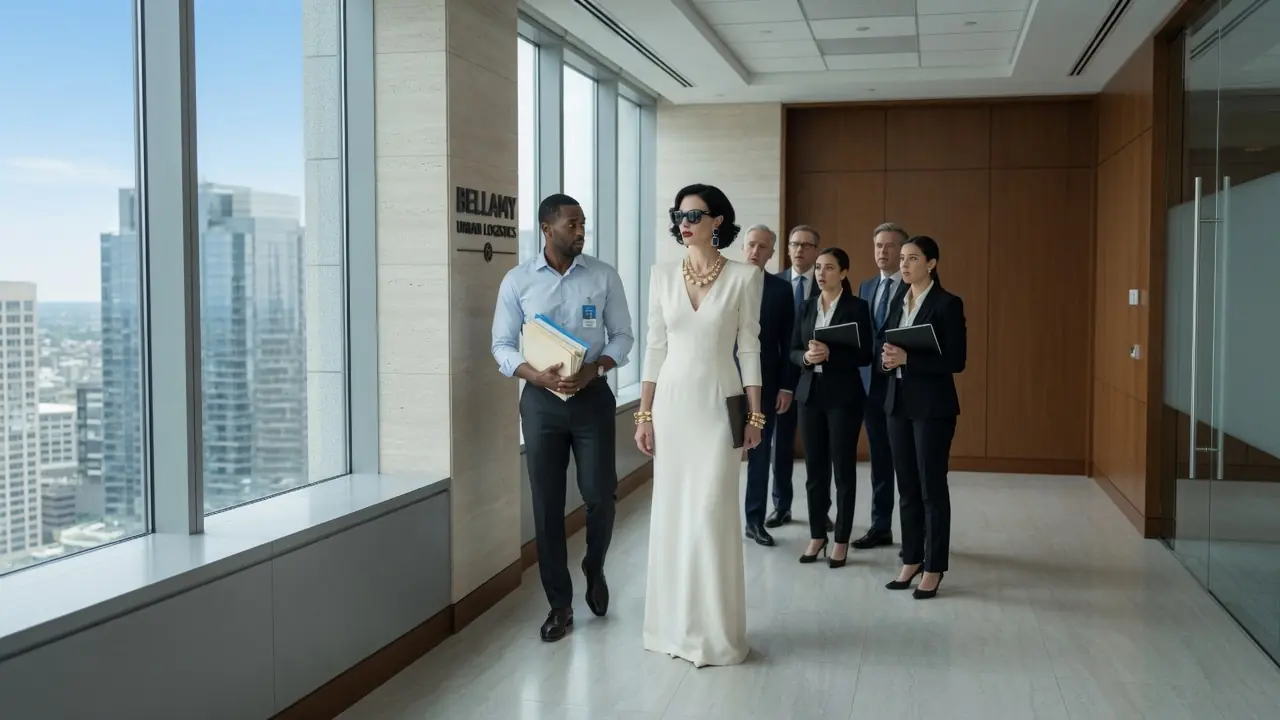
He came around the corner near the records room, files in hand, head down, and walked straight into the tail end of her entourage. By the time he registered what was happening, there was nowhere to go. He looked up and she was already watching him. Not surprised.
Not startled. Watching him the way someone watches a door they’ve been waiting to open. The silence stretched. Then Ariana turned to her assistant and said calmly, like she was reading from a prepared list, “Cancel the external recruitment for the personal assistant position.” She looked back at “Quentin.” “I found who I need.” Nobody in that hallway thought she was talking about his filing skills.
And Quentin, who had spent twelve years becoming invisible, felt every inch of cover he had built collapse in a single sentence. Quentin Hayes woke up every morning at 5:15. Not because he wanted to, because Lenny’s lunch didn’t pack itself, because the crosstown bus ran late on Tuesdays and Thursdays, and because the only hour of the day that belonged entirely to him was the one before his daughter’s alarm went off and the world started asking things of him again. He used that hour to drink coffee standing at the kitchen counter, look out the window at the parking lot below, and remind himself that this, the worn linoleum, the radiator that clicked all night, the stack of repair invoices on the counter was stable.
It was enough. It was his. The apartment was small, two bedrooms, one bathroom, a kitchen where the cabinet above the stove didn’t close all the way. He had patched the wall near the front door twice and replaced the bathroom faucet himself rather than wait three weeks for the building’s maintenance crew.
On weekends, he picked up appliance repair jobs from a guy named Roland who ran a secondhand shop two blocks over, toasters, box fans, the occasional microwave, and that extra cash was what kept Lenny in her after-school program and kept Quentin from doing the math too closely on any given month. His daughter was seven years old and had recently decided that she was an expert on three subjects, dinosaurs, the rules of checkers, and what her father should have for breakfast. She was wrong about the breakfast part, but right about the checkers, and Quentin had stopped letting her win six months ago because she’d looked at him with pure contempt and said, “I know when you’re doing that, Daddy.” He hadn’t let her win since. She beat him anyway.
He loved her in the way that rearranges a person’s entire architecture. Everything he had built since she was born, the careful routines, the quiet job, the deliberate invisibility had been built around her. She was the reason he hadn’t left the city when things got hard. She was the reason he showed up to a job that paid him less than he was worth and kept his head down and didn’t make waves.
She was seven years old and she needed stability more than Quentin needed to be seen and that trade had always felt worth it until the morning Ariana Bellamy walked back into his life. Quentin had taken the job at Bellamy Urban Logistics two years earlier because it was steady, because it offered health coverage, and because the company was large enough that a records and operations support staffer could move through the hallways without accumulating much attention. He was good at the work. He understood logistics systems the way some people understand music intuitively, structurally able to hear when something was slightly off before anyone else registered the noise.
He had reorganized two filing systems, flagged three vendor billing errors, and quietly corrected a routing miscalculation that would have cost the company a significant penalty. All without ever requesting credit or a meeting with anyone above his pay grade. He had reasons for keeping it that way. Quentin was 34 years old.
twelve years ago he had been a scholarship student in operations management at a university where ambition felt like oxygen and the future had seemed wide open. He had been sharp and driven and briefly complete in the way that only happens when you are young and don’t yet know how badly things can go, deeply in love with Ariana Bellamy. They had met junior year. She was already marked for the family business, already being groomed for a life in corporate leadership.
But in those two years she had also been just a person, curious, stubborn, fiercely committed to an idea they had developed together about building equitable delivery infrastructure for underserved neighborhoods. He had believed in the idea. He had believed in her. For a while he had believed that those two things might be enough to build something real.
Then his scholarship was revoked. Then a story circulated about stolen proprietary plans. Then a man named Brennan Sloan placed a document in front of Quentin and explained quietly and without any particular emotion what would happen if Quentin did not sign it. He signed it.
She had arrived forty minutes ahead of her official first day as CEO. A habit she developed specifically because early arrivals showed her things that scheduled visits never could. The 14th floor was running a full internal audit in preparation for a major partnership meeting with a regional freight consortium that afternoon. The kind of meeting where the numbers needed to be clean, the documentation needed to be airtight and every department head needed to walk in with something to show.
At 9:04 a.m. the operations filing system locked. Not the whole system, just the section that housed subcontractor identifiers, delivery route maps and cost allocation records. Which was unfortunately exactly the section that fed into every presentation being prepared for the afternoon meeting. The IT team was called.
The IT team called their supervisor. The supervisor called the operations director Gerald Fitch who responded by standing in the middle of the floor with his jacket half on and saying loudly to no one in particular, “Someone fix this before noon or I will lose my mind.” Quentin heard it from the corridor. He hadn’t been assigned to the audit. He was there to drop off a batch of physical records that needed cross referencing, a routine task he could have handed off at the front desk.
But he heard the noise, recognized the specific pitch of institutional panic and made the mistake of stopping to look. He saw the screen over Gerald’s shoulder, saw the error code, understood immediately what it meant. Duplicate subcontractor entry. Someone had input the same vendor under two different identifier codes.
One active, one flagged for compliance review. When the system tried to reconcile the two records during audit prep, it had locked the entire subcontractor database to prevent a conflict it couldn’t resolve automatically. Every file that pulled from that database was now inaccessible. It was not a complicated problem.
It was the kind of problem that looked catastrophic from the outside and took about four minutes to fix if you knew where to look. Quentin set his files down, sat at an open terminal, and spent four minutes navigating to the duplicate entry, isolating it, and rerouting the active vendor code so the system could distinguish between the two records. The database unlocked. Every file came back online.
Gerald Fitch stared at the screen, then at Quentin, then at the screen again. “Who are you?” “Records support, third floor.” He stood, picked up his files, and turned to leave. He almost made it. Ariana was standing in the doorway, and she was already watching him with an expression that gave nothing away except the fact that she was not surprised.
Not by the system fix, not by him. Quentin turned his face away. Too late. Twelve years changes a person’s face, but it doesn’t change the way they move, the way they hold their shoulders, the particular angle of a jaw.
Ariana had spent enough years being angry at a specific person to have memorized the details. She didn’t say anything in that moment. She stepped aside to let him pass, nodded once at Gerald, and walked into the room to begin her review. Two hours later, in the middle of a full executive briefing, Ariana Bellamy set down her folder and said, “I’ll be bringing on a personal assistant for the next thirty days, effective tomorrow.” She looked across the room.
“Quentin Hayes, records and operations support.” The room went very still. The meeting ended, the room emptied, and within forty minutes everyone in the building had an opinion about what had just happened. The most popular theory circulating by lunch was that Ariana Bellamy had made her first power move as CEO, that pulling a low-level staffer into the executive orbit was a deliberate message to the senior team. Some people respected it.
Some were unsettled. A few of the department heads, the ones who had been quietly angling for closer access, were openly annoyed. Nobody considered the possibility that it was personal. Quentin considered nothing else.
He was called to HR that afternoon. The woman behind the desk, Margo Laird, head of HR, had the careful neutral expression of someone who had formed a strong opinion and was professionally required to keep it off her face. She slid the documents across the desk without making eye contact. “Thirty-day temporary assignment.
Compensation adjustment reflects the role change. You’ll report directly to Ms. Bellamy starting tomorrow at 8:00 a.m.” Quentin looked at the papers. The compensation adjustment was nearly double his current rate for the duration of the assignment. He noticed that immediately and hated that he noticed it because it meant Ariana understood exactly what kind of leverage she had.
He had a daughter in an after-school program. He had a repair job on weekends because his salary didn’t quite reach. He had a lease renewal in six weeks. She had placed the offer at precisely the number that made it very difficult to refuse.
He signed the papers. Ariana’s office on the 14th floor was large and not yet fully moved into. She was standing at the window when Quentin arrived and she didn’t turn around immediately which he understood was intentional. “Close the door.” She said.
He did. “I want to be clear about what this is.” She said still facing the window. “I need someone who understands operations at a technical level. The people in my inner circle know how to manage optics.
They do not know how to find a duplicate subcontractor code in a locked database in four minutes. I need both.” “You have a full executive team.” Quentin said. “I know what I have.” She turned then. Her expression was measured.
The kind of composure that takes years to build and costs something to maintain. “I’m not doing this to humiliate you. I want that said clearly.” “Then say clearly what you are doing.” Something shifted behind her eyes. Not anger.
Something older than anger. “I’m doing my job.” She said. “Which right now requires someone I can trust to be competent. The rest of it.” She paused.
“The rest of it doesn’t belong in this office. I don’t want to be a point someone makes.” He said. “I don’t want to be the name people whisper about in the elevator. I have a daughter.
I need this job to be clean.” “Then do it cleanly.” She said. “Show up tomorrow. Do the work. That’s all I’m asking.” It wasn’t all she was asking and they both knew it.
But Quentin nodded, picked up his copy of the paperwork and walked out. That night he sat on the edge of Lenny’s bed after she fell asleep and stayed there longer than usual listening to her breathe reminding himself what all of this was for. The first week was its own kind of punishment. Not because the work was hard.
The work was actually the easiest part. Quentin understood operation systems, meeting logistics, data flow, and executive scheduling with a fluency that made the tasks almost automatic. He prepared briefing summaries that were clean and precise. He caught a calendar conflict that would have put Ariana in two cities on the same afternoon.
He flagged a vendor invoice with a billing discrepancy before it reached the approval stage. He did all of it quietly and correctly and none of it mattered to the people watching because what they saw was not competence. What they saw was the story they had already decided to tell. By the third day, the whisper network had produced several versions of what was really going on.
The most common one was that Quentin had something on the new CEO, some leverage, and this assignment was the result of a quiet negotiation. Another version suggested the opposite, that Ariana was testing him, giving him enough rope and would remove him publicly once she had sufficient cause. A third version, which Quentin overheard near the copy room, didn’t bother with explanations and simply described the situation using language he had been hearing in various forms his entire professional life. He kept his face neutral and kept moving.
Margo Laird made it her particular project to ensure the assignment was as difficult as possible without crossing any line that could be formally documented. She had taken a dislike to Quentin from the moment she processed his reassignment papers. In her view, the entire appointment was an affront to the procedures she had spent years building and she had no intention of pretending otherwise. She routed requests through Quentin that were clearly below the scope of a personal assistant to the CEO.
Supply orders, catering confirmations for departmental meetings he wasn’t involved in, a request to manually sort through three years of printed correspondence because the digital archive hadn’t been updated. Each task arrived with precise, pleasant instructions and a CC to someone senior enough to notice if it wasn’t completed. Quentin completed every one. He did not complain.
He did not go to “Ariana.” He understood that going to Ariana would confirm every story already in circulation. Ariana for her part kept the professional distance she had promised. Their interactions during that first week were almost entirely task-based. She gave direction.
He executed. She reviewed his work and offered corrections when necessary. She was not unkind. She was not warm.
She moved through their working proximity with a careful deliberateness, like someone navigating a room where the furniture had been rearranged in the dark. But there were moments. A pause that lasted half a second too long when he handed her a briefing document and their eyes met over the papers. A morning where she arrived to find he had already pulled the three reports she was going to ask for and she stood in the doorway looking at her desk for a moment before she sat down not saying anything.
An afternoon where a junior staffer made a comment near the elevator, something low and laughing, and Ariana turned from 12 feet away with a look so flat and precise that the conversation stopped instantly and didn’t resume. She didn’t mention any of it. Neither did he. What they didn’t talk about filled the office more than anything they said.
On Friday evening after the floor had emptied, Quentin was finishing a routing analysis Ariana had requested for Monday. She was still at her desk. The building had gone quiet in the specific way it does after hours. HVAC humming.
The city outside doing its distant work. “You reorganized the vendor tracking format,” she said without looking up. “The old format sorted by contract date. It should sort by renewal window.
Easier to catch expirations before they become problems.” A pause. “That’s how I would have done it,” she said, quietly, almost to herself. Quentin didn’t respond. He saved his file, collected his things, and said good night.
She said good night back, and neither of them added anything to it. He rode the freight elevator down alone, and somewhere between the 14th floor and the lobby, he acknowledged the thing he had been working hard all week not to acknowledge being near her again was not getting easier. It was getting harder. The project came across Quentin’s desk on a Monday, a proposed subcontractor agreement for a new community delivery initiative Ariana was developing.
The initiative was built around the idea that had once belonged to both of them, equitable logistics infrastructure for underserved neighborhoods, last-mile delivery systems for areas the major carriers consistently ignored. Seeing it formalized in a company proposal carrying the Bellamy letterhead landed somewhere in Quentin’s chest that he didn’t examine too closely. He started reviewing the subcontractor list that afternoon. He almost missed it.
The entry was formatted slightly differently from the others, a holding company name rather than an operating company name, an address that resolved to a registered agent service rather than a physical location. On its own, it wouldn’t have flagged anything, but the vendor identifier code had a prefix structure Quentin recognized. Not because he had memorized subcontractor codes, because he had seen that exact prefix once before twelve years ago, on a document he had not been supposed to see. He spent 2 hours following a paper trail that led through three holding companies before terminating at a name he had spent twelve years trying not to think about.
Brennan Sloan. He asked for 15 minutes with Ariana that afternoon. She gave him 12. He laid the documents on her desk without preamble.
“I need you to hold the subcontractor approval on the West Side routing contract. There’s a problem with one of the vendor entries.” Ariana looked at the papers, then at him. “Walk me through it.” He did the identifier prefix, the holding company structure, the registered agent trail. He kept it technical.
He did not say Brennan Sloan’s name, not yet. “This is a significant accusation against a vetted vendor,” she said. “I haven’t accused anyone. I’ve shown you a paper trail that doesn’t resolve cleanly.
That’s your call to make.” “How do you know that name?” she asked when he finally said it. Her voice had changed, still controlled, but thinner. Quentin had known this moment was coming since the afternoon he found the vendor code. He had prepared for it.
He had told himself he would keep it contained, limited to what was relevant to the current contract. He lasted about four seconds. “twelve years ago,” he said, “I found something I wasn’t supposed to find. A financial structure routed through a community development fund’s scholarship money neighborhood project grants.
Someone was pulling from it, systematically running the withdrawals through subcontractor payments that looked legitimate on paper.” He paused. The person running it used my name on several of the routing documents. When I found out, I went to report it. Brennan Sloan found out I knew before I could reach anyone who would listen.
Ariana had gone very still. He told me that if I said anything, the documents with my name on them would surface first. That the story would be that I had stolen proprietary business plans from your family’s company. He had paperwork prepared.
All it needed was my signature. Quentin’s voice stayed level. Your father was scheduled to announce your succession track that month. Brennan told me that if the scandal broke, it would break around you.
That your first step into the company would be defined by a fraud case connected to someone you had personally vouched for. The silence that followed was the kind that changes the shape of a room. “So, you signed?” Ariana said. “I signed, and I left.
I made a backup of every document I had access to before my university account was closed. Not because I planned to use them, but because I could not make myself let the only record of the truth disappear completely. I kept them for twelve years. I never thought I’d have a reason to open that folder again.” She stood up and walked to the window.
Her back was to him, and she stayed that way for a long moment. When she turned around, her expression was not what he expected. It wasn’t anger. It was something rawer than that.
The specific look of someone recalculating twelve years of certainty and finding the math no longer works. “You let me believe you betrayed me,” she said, “for twelve years.” “I thought I was protecting you.” “You didn’t ask me if I wanted to be protected.” He had no answer for that because she was right. Ariana didn’t sign the subcontractor approval. She also didn’t move immediately, not because she was uncertain, but because she understood what moving against Brennan Sloan would require.
Brennan was not simply a financial advisor with a long history in the Bellamy organization. He was a structural fixture, the man who had managed the family’s external relationships for two decades, who sat on advisory boards, who had personal relationships with three members of the company’s board of directors. Removing him was not a personnel decision. It was a political one.
She began pulling archived records quietly through channels she controlled directly. She didn’t tell Quentin everything she was doing, but he could read the shape of it in the documents she requested and the meetings she began scheduling with the company’s internal legal team. Brennan noticed within a week. The response came in stages, the way it always does when someone with resources decides to push back.
First, there were questions, casual ones raised in board-adjacent conversations about whether the new CEO was settling into her role effectively, whether certain decisions, particularly around staffing, reflected sound judgment or personal feeling. Then, the story shifted into something more specific. A version of events had begun circulating among board members and senior external partners, Ariana Bellamy in her first month as CEO had bypassed standard recruitment procedure to install a former personal acquaintance in a position of direct access to executive operations. The implication was left unspoken, but carefully shaped.
Everyone who heard it understood what they were meant to conclude. Within days, a version of the story had filtered down into the company itself. Quentin heard it on a Tuesday from a woman in accounts payable who told him because she thought he should know. He thanked her and went back to his desk and sat there for a few minutes looking at nothing.
That evening, Lenny mentioned it. Not the corporate version, she was seven and the corporate version had not reached her. But, she had heard something at school pickup, something one of the other parents had said within earshot of the after-school line, and she had processed it the way seven-year-olds process things they don’t fully understand, but sense are important. “Daddy,” she said at dinner, pushing rice around her plate.
“Someone said you have a fancy job now because a lady is helping you. Is that true?” Quentin set down his fork. “Who said that?” She named a parent he recognized, someone connected distantly to a senior staffer at the company. The story had traveled fast and had landed in the one place where Quentin had no defenses.
“My job is my job because I’m good at it,” he said. “That’s the whole reason.” Lenny looked at him with the particular scrutiny of a child who is deciding whether to believe something. Then she nodded and went back to her rice. But the question stayed in the room long after dinner was done and she was in bed.
The next morning Quentin told Ariana he thought she should let the investigation go. She looked at him the way she looked at proposals she found structurally unsound. “That’s not a serious suggestion.” “It is. You’ve been CEO for less than thirty days.
You’re about to open a formal inquiry into one of your father’s closest advisers based on documentation surfaced by a record staffer you pulled from the third floor under circumstances that already look questionable.” “I know what it looks like.” “Then you know what it costs.” “I know what staying silent costs,” she said. “I’ve been paying that bill for twelve years without knowing it.” “This isn’t about twelve years ago. This is about right now, about your position, about what happens to the community initiative if the board decides you’re a liability before you’ve had a chance to build anything.” They looked at each other across the desk. “And what about what happens to you?” she asked.
“If I stop, Brennan wins. Your name stays attached to something you didn’t do.” “I’ve lived with that for twelve years,” Quentin said. “I can keep living with it.” “Well, I can’t,” she said quietly. “So don’t ask me to.” Brennan Sloan requested a meeting with Ariana on a Thursday afternoon.
He came alone, which meant he didn’t need witnesses. He sat across from her desk with the relaxed posture of someone who had been having difficult conversations in expensive rooms for 30 years and had never once lost one. He was in his early 60s, silver-haired with the particular kind of confidence that comes not from being right, but from never having been held accountable for being wrong. He didn’t raise his voice.
He didn’t make threats that could be recorded and characterized as threats. He simply explained the situation as he saw it. “You’ve been asking questions about archived financial records,” he said. “That’s your right as CEO.
But the nature of the questions and the person you’ve been consulting in the process creates a problem.” He paused. “I’ve spoken with three board members this week informally. The picture that’s emerging, a new CEO less than thirty days in, pursuing a personal agenda with a former romantic acquaintance installed in her inner circle is not a picture the board finds reassuring.” Ariana kept her expression neutral. “What exactly are you proposing?” “I’m proposing clarity,” Brennan said.
“The assistant arrangement ends. The archival inquiry ends. You redirect your energy toward the operational priorities the board actually expects from you in your first quarter. And this, all of this, stays where it belongs, in the past.”
“And if I don’t?” He smiled the way someone smiles when the answer is obvious. “Then I present the board with a formal motion requesting a performance review of executive decisions made in your first thirty days. The documentation around the Hayes appointment alone is enough to make that conversation uncomfortable. Combined with an unsanctioned inquiry into company financial records that predate your tenure.” He spread his hands.
“I’m not trying to remove you, Ariana. I’m trying to give you a chance to lead without this weight around your neck.” He left 20 minutes later and the office felt different after he was gone. Margo Laird submitted the formal HR notice the following morning. It was precise and procedurally correct. It cited the original posting requirements for the personal assistant position, requirements that specified a minimum of five years executive support experience, a qualification that Quentin’s personnel file did not reflect.
The appointment had not followed standard recruitment procedure and should be reviewed for compliance. The notice landed on Ariana’s desk at 8:15 a.m. By 9:00 it had been copied to two board members. Quentin read it at 9:45 when Ariana handed him a copy without comment. He sat with it for a moment, then he set it on the desk carefully.
“This is the move.” He said. “Yes. If you fight it, it becomes the story. New CEO overrides HR compliance to protect personal appointment.
That’s the headline.” He looked up. “And if you don’t fight it, I’m gone. And Brennan has demonstrated he can reach into your office and remove people.” “I know.” “There’s no version of this where you come out clean.” “I know that, too.” He was quiet for a long moment. Outside the city moved through its ordinary Thursday.
Somewhere across town Lenny was in school, probably arguing about checkers rules with someone. The life Quentin had built, small, careful, deliberately unspectacular, was sitting in a document on a desk waiting to be decided. He picked up his access badge and held it for a moment. Then he set it on the desk beside the HR notice.
“I’ll submit the resignation this afternoon.” he said. “Voluntary, cleaner than a compliance review.” “Quentin.” “It’s the right call, you know it is.” He stood. “I have a daughter who heard a story about her father that wasn’t true, and I won’t let her grow up watching this get worse because I stayed somewhere I was being used as a weapon against you.” “You deserved the truth twelve years ago,” he said. “I’m sorry it took this long to give it to you.” He walked to the door.
She didn’t stop him. And the badge sat on the desk between them like the period at the end of a sentence, neither of them had wanted to finish. Ariana sat in her office for forty minutes after Quentin left. She did not make calls.
She did not review documents. She sat at her desk and looked at the access badge he had placed beside the HR notice, and she thought about a conversation she’d had with her father a long time ago. He had told her that leadership required the ability to absorb losses, that the people at the top made decisions that hurt, and the measure of a leader was how cleanly they made them and how quickly they moved on. She had believed that for a long time.
She had built herself around it. She picked up the badge and turned it over in her hand. “Quentin Hayes, records and operations support.” The photo was two years old and slightly overexposed, and he was looking at the camera with the specific expression of someone who had learned not to take up too much space, even in a photograph. She put the badge in her jacket pocket and reached for her keys.
She drove to his apartment that evening unannounced. She stood outside his door for a moment before she knocked, which she recognized as a significant departure from how she operated. She had spent twelve years making sure she was never the person who showed up somewhere without a plan, without a prepared position, without control of the room. Lenny answered.
She was wearing socks with small dinosaurs on them and holding a checkers piece, and she looked up at Ariana with the direct, unfiltered assessment of a seven-year-old who has not yet learned to disguise her opinions. “You’re the lady from my dad’s work,” she said. “I am,” Ariana said. “He said you’re very serious.” “He’s right.” Lenny considered this.
“Do you want to come in? We have leftover rice.” Quentin appeared from the kitchen doorway, dish towel in hand. For a moment, nobody said anything. Lenny looked between the two adults with the alert attention of a child who understands that something important is happening even without knowing what it is.
“Lenny,” Quentin said, “can you give us a few minutes?” She withdrew with a checkers piece, casting one last evaluating look at Ariana over her shoulder. Ariana stepped inside. The apartment was small and clean and arranged with the careful practicality of someone who had made the most of limited space for a long time. A child’s drawings were taped to the refrigerator.
A shelf near the window held a neat row of repair manuals and a single photograph Lenny maybe 4 years old laughing at something outside the frame. “I’m not here as your employer,” Ariana said. “I don’t have an employer at the moment,” Quentin said. “I know.” She turned to face him.
“I need to say something, and I need you to let me finish before you argue with me.” He was quiet. “You left twelve years ago to keep something from landing on me,” she said. “And then you spent two years working in my family’s company in a job beneath what you’re capable of, keeping your head down, making yourself invisible. And when Brennan came after you, the first thing you did was figure out how to absorb it so it wouldn’t damage me.” She paused.
“You have spent so long being the person who takes the loss quietly that you have forgotten you are allowed to not lose.” “Ariana.” “I’m not finished.” Her voice stayed steady. “I was angry at you for twelve years. That anger was real, and it was mine, and I’m not going to pretend it wasn’t. But I spent twelve years being angry at the wrong story, and I am not going to let Brennan Sloan write another wrong story and call it resolved.” The room was very quiet.
“What are you saying?” Quentin asked. “I’m saying I’m going to the board with documentation, the full paper trail, the archived fund withdrawals, the holding company structure, the routing records with your name on them, and the correspondence that shows how they got there. All of it. She met his eyes.
I need you to be willing to stand in that room and tell the truth. Not for my position, not for the company, for the twelve years.” Quentin looked at her for a long moment. From the other room came the quiet sound of a checkers piece being set down on a board. Lenny playing her own game in patient solitude waiting for the adults to finish.
“If I do this,” he said carefully, “I need it done right. The story has to be about what Brennan did, not about us.” “Agreed.” “And after whatever comes after, I want to be considered for any open position on its actual merits, not as a gesture.” “I wouldn’t have it any other way,” she said, and she meant it. He nodded once. “Tell me what you need.” The internal hearing was scheduled for a Tuesday, which gave them five days.
Quentin spent those five days the way he had spent the best parts of his professional life, methodically, precisely, without wasted motion. He had kept copies of things he should not have kept stored in a password-protected folder on an external drive that had moved with him through three apartments and two cities over twelve years. Not because he had planned to use them, because he had never been able to make himself delete them. The night Brennan had handed him that document to sign, Quentin had gone home and made a full backup of everything on his university account.
Every email thread, every shared file, every draft of the business plan he and Ariana had built together. He had done it at 2:00 in the morning sitting on the floor of a campus apartment before the account was closed. He had told himself it was just in case. He had never believed he’d actually need it.
He had been very careful about being wrong. He organized everything chronologically. The original community fund records showing the systematic withdrawals, the subcontractor payment structures Brennan had used to route the money, the emails showing the sequence of events that led to the document he had signed, and the business plan, the original draft, the one he and Ariana had written together in a university library over three consecutive weekends, the one that had later appeared in modified form as a Bellamy company initiative and been credited to an internal development team. He printed everything and organized it into a binder with the quiet thoroughness of a man who understood that the truth presented sloppily could still lose.
Ariana presented to the board with the binder open on the table in front of her. She did not apologize for the investigation. She did not frame it as a defense of her appointment decisions. She walked the board through the financial records the way she walked through any operational problem systematically, without drama, letting the numbers make the argument.
Quentin testified for forty minutes. He spoke clearly and without embellishment, answered every question directly, and did not look at Brennan Sloan, who was present for the first portion of the hearing, once. Brennan’s attorney requested a recess after the routing documents were presented. The recess lasted 2 hours.
When the hearing reconvened, Brennan Sloan was not in the room. By Thursday, he had submitted his resignation from all advisory positions connected to the Bellamy organization. The board issued a formal statement acknowledging an internal compliance failure and committing to an independent audit of the archived fund records. Margo Laird was required to attend a formal review of the HR procedures surrounding the personal assistant appointment.
She did not lose her position, but she issued a written acknowledgement that the process had not been handled correctly. It was not a perfect resolution. These things rarely were. twelve years of a false record could not be fully corrected in a Tuesday hearing.
But Quentin’s personnel file was updated. The compliance flag was removed, and the documented record of what had actually happened in the year he left now existed somewhere official in a format that could not simply be overwritten by a more convenient story. Three weeks later, Bellamy Urban Logistics posted an open position for a strategic operations supervisor on the community initiatives team. Quentin applied.
He submitted his resume through the standard portal, listed his qualifications, and did not mention his recent temporary assignment or his personal history with the CEO. The hiring panel included two people he had never met and one he had worked with briefly during the audit preparation. The interview lasted an hour and fifteen minutes and covered operational systems, logistics, strategy, and community infrastructure challenges in underserved urban markets. He was offered the position four days later.
He read the offer letter twice standing at his kitchen counter at 5:15 in the morning with a cup of coffee, and then he set it down and stood there for a moment in the quiet before Lenny’s alarm went off. On a Friday evening two weeks after he started the new role, Ariana came to dinner. She brought nothing because Quentin had told her not to bring anything, and she arrived exactly on time. Lenny had set the table with three plates that did not match, arranged with the careful asymmetry of someone who had given the placement serious thought and arrived at her own conclusions.
They ate. Lenny explained at some length the correct strategy for checkers endgames. Ariana listened with the focused attention she brought to everything and asked two clarifying questions that Lenny found satisfying. At the end of the meal, Lenny looked between them with the frank assessment she had been deploying all evening and said, “If you’re my dad’s boss and also his girlfriend, who’s in charge at home?” Quentin set down his fork.
Ariana considered the question with appropriate seriousness. “I think we’d need a vote.” she said. “I vote for me.” Lenny said immediately. “That’s one.” Ariana said.
“Quentin?” “I’m abstaining.” Quentin said. “Then it’s one to zero with one abstention.” Ariana said. “Lenny wins.” Lenny accepted this outcome with the composure of someone who had expected no other result. The following Monday morning, Quentin dropped Lenny at school, watched her disappear through the front doors with her backpack listing slightly to the left, and then drove to the Bellamy building and walked through the front entrance without taking the long way around anything.
Ariana was in the lobby, coffee in hand, reviewing something on her phone. She looked up when he came through the door. She didn’t smile, exactly. It was more the specific expression of someone who has stopped bracing for something to go wrong.
He fell into step beside her at the elevator. “Routing review at 9:00.” she said. “I saw it.” “The West Side projections need to be recalculated before that meeting.” “I know. I flagged it this morning.” “So did I,” he said. The elevator doors opened.
They stepped in together and the doors closed and the building rose around them, steady, ordinary, workable. And for the first time in twelve years, Quentin Hayes was not figuring out how to disappear inside it. He was exactly where he was standing, next to someone who knew the whole truth of him, going to do work that was worth doing. That was enough.
For now, that was everything. Quentin Hayes spent twelve years believing that silence was the most generous thing he could offer the people he loved. He made himself small so others wouldn’t be pulled down with him. He built invisible walls around a life that was just stable enough to hold.
But, here’s what this story reminds us. Dignity is not something you protect by hiding it. A man can do the right thing and still be punished for it. He can swallow the truth to spare someone else and end up carrying the weight of two lives instead of one.
That kind of sacrifice doesn’t just cost the person making it. It costs the people who never got to choose. Ariana didn’t need protecting. She needed the truth.
And when she finally got it, not twelve years later delivered by guilt, but standing in her own office in her own power, she chose to fight for it. Not because she owed Quentin anything, because silence, once you understand the shape of it, is no longer something you can unknowingly choose. The real lesson isn’t about love finding its way back. It’s about what happens when two people finally stop writing the story alone and decide to tell it together, out loud, in the light, with their names on it.