The first thing people heard was the crash.
Not one plate.
Not two.
An entire tray went down in the middle of Mason’s Route 9 Diner at 7:18 on a Friday evening, scattering coffee cups, chicken-fried steak, gravy, glass, silverware, and somebody’s lemon pie across the black-and-white tile floor.
For half a second, everyone froze.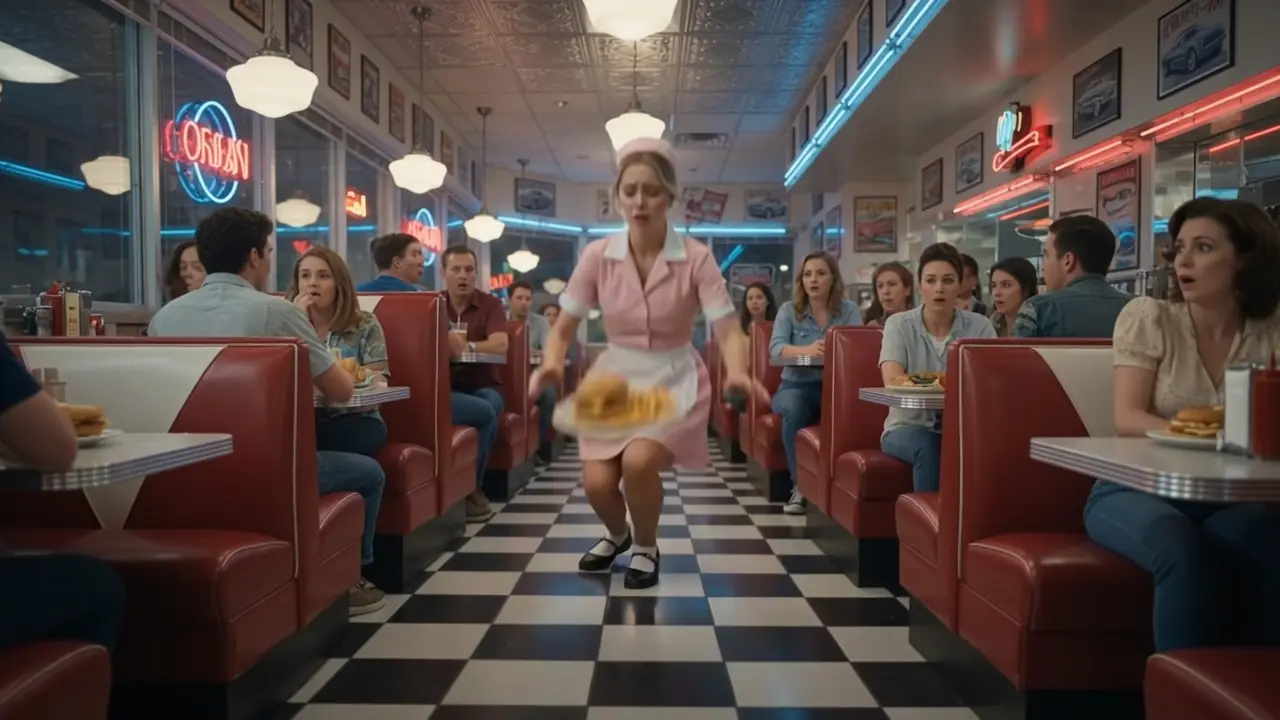
Then somebody laughed.
It came from the corner booth near the jukebox, where three men in work shirts had been drinking coffee too long and tipping too little. One laugh turned into two. A woman at the counter gasped, then covered her mouth as if that could erase the sound she had made.
On the floor, Nora Whitcomb sat with one knee tucked beneath her, both hands shaking, tears already gathering in her eyes.
She was twenty-three, thin from stress more than nature, with auburn hair tied into a messy ponytail and a blue waitress uniform that never fit right no matter how many times she washed it. A streak of gravy ran down her sleeve. Her left knee had scraped against a broken plate, leaving a thin red line across the skin.
But the cut was not why she was crying.
Nora had been holding herself together all day with tape and prayer.
The dropped tray was just the moment everyone heard it break.
Mason’s Route 9 Diner sat outside Springfield, Missouri, off a two-lane highway where truckers stopped for coffee, church families came after Wednesday service, and old men argued about football like the fate of the nation depended on the Chiefs’ offensive line.
The sign out front buzzed red at night.
The coffee was strong.
The pies were homemade.
And the floor was slick whenever rain blew in through the front door, which it had been doing since late afternoon.
Nora had warned the owner twice.
“Mr. Mason, we need a mat by the front,” she said the first time.
He waved her off.
“Just walk careful.”
The second time, she nearly slipped carrying two burgers and a milkshake.
He frowned at her.
“Careful means don’t nearly fall, Nora.”
She swallowed the answer she wanted to give.
She needed the job.
That was the part nobody in the diner knew.
Nora had moved back to Springfield six months earlier after her mother’s stroke. She worked morning shifts at a laundromat, evening shifts at the diner, and slept in the room she grew up in beneath a ceiling fan that clicked every fourth rotation. Her nursing school application sat half-finished on her desk because tuition deposits did not care how badly a person wanted to help people.
She had been late on rent once.
Late on her car payment twice.
And that afternoon, the pharmacy had called to say her mother’s insurance needed one more form before they could refill the blood pressure medicine.
One more form.
Life had become a mountain made entirely of one more thing.
So when she slipped near table six, tried to catch herself, felt the tray tilt, and watched eight plates leave her hands like slow-motion disaster, her mind did not say, Clean it up.
It said, You are done.
The laughter made it worse.
Nora tried to stand, but her shoe slid in spilled coffee, and she sat back down hard. Her face burned. Her knee stung. Her eyes filled before she could stop them.
“I’m sorry,” she said to no one and everyone. “I’m so sorry.”
The kitchen window went quiet.
Two cooks leaned out but did not move.
Mr. Mason came from behind the register with a towel in one hand and irritation already written across his face. He was a small man with a thin mustache, a belt pulled too tight, and the permanent expression of someone counting the cost of every accident before checking whether anyone was hurt.
“Nora,” he snapped. “What happened?”
She flinched.
That was when the big man stood up.
He had been sitting in the back booth with four other bikers, all wearing dark leather vests with patches that read IRON WILLOW RIDERS. Nobody had paid them much attention after the first ten minutes because they had done nothing louder than order coffee, meatloaf, and three slices of blackberry pie.
Still, people had noticed them.
People always noticed bikers.
Especially the largest one.
His name was Jonah “Bear” Callahan, though nobody in the diner knew that yet. He was sixty-one years old, broad as a refrigerator, with a gray beard, weathered white skin, deep-set blue eyes, and tattoos running from his wrists up beneath his sleeves. A patch on his vest read PRESIDENT.
When he stood, the diner seemed to shrink.
The men in the corner stopped laughing.
Mr. Mason stopped walking.
Nora looked up and forgot to breathe.
Bear did not speak at first.
He reached into his back pocket, pulled out a clean dark-red bandana, and walked toward her carefully, stepping around the glass. Then, with a softness that did not match his size, he lowered himself onto one knee beside her.
“Easy, sweetheart,” he said. “Don’t move yet.”
His voice was low and gravelly, the kind of voice that sounded like it had carried smoke, grief, and too many miles.
Nora stared at him.
“I’m fine.”
“No, you’re embarrassed. That’s different.”
A few people shifted in their seats.
Bear looked at her knee.
“Plate got you.”
“It’s nothing.”
“Everything’s nothing until it gets infected.”
He folded the bandana with slow, practiced hands and tied it around her scraped knee. His fingers were thick, scarred, and surprisingly gentle. He did not rush her. He did not make a joke. He did not act like helping her was a performance.
Nora’s lip trembled.
“I ruined all those plates.”
Bear glanced at the broken mess around them.
“Plates were already breakable.”
That made her cry harder.
He looked up at the room.
Nobody laughed now.
Then he turned back to Nora.
“My daughter used to cry like that,” he said softly.
The words came out so tenderly that even the old men at the counter stopped pretending to read the menu.
Nora wiped her cheek with the back of her hand.
“Where is she now?”
Bear’s smile faded.
He looked down at the tile floor, at the coffee running between the black squares, at a piece of pie crust floating in a puddle of gravy.
“Gone,” he said.
The diner held its breath.
“Twenty-two years now.”
Nora’s eyes filled again, but differently this time.
“I’m sorry.”
Bear nodded.
“So am I.”
For a moment, the whole diner seemed to leave them alone.
Then Bear gave a quiet chuckle.
“She was clumsy too.”
Nora blinked.
“She was?”
“Oh, Lord.” His eyes warmed with memory. “Maggie could trip over air and blame the floor with complete confidence.”
A few customers smiled.
Bear continued tying the bandana, securing it carefully.
“One time she carried a birthday cake from the kitchen to the porch, made it four steps, then sneezed and launched the whole thing into the dog.”
Nora laughed before she could stop herself.
It came out wet and shaky, but it was real.
“The dog?”
“Best birthday he ever had.”
A cook behind the window snorted.
Then covered it badly with a cough.
Bear smiled down at Nora.
“She cried for twenty minutes. Thought she ruined everything. My wife told her, ‘Baby, a cake can be remade. A girl cannot.’”
Nora looked at him.
Something in those words went straight through her.
Mr. Mason cleared his throat.
“All right, Nora, can you get up? We need this cleaned before someone slips.”
Bear stood slowly.
The room remembered how large he was.
He turned toward the owner, not angry, not loud, but with a steadiness that made every word heavier.
“She already slipped.”
Mr. Mason blinked.
“I understand that, but—”
“Do you?”
The diner went silent again.
Bear did not raise his voice.
That was what made it worse.
He pointed toward the entrance with one big hand.
“Floor’s been wet since we walked in. She told you. I heard her.”
Nora’s face went pale.
“You heard that?”
Bear glanced at her.
“Sweetheart, I ride motorcycles for a living and slept next to engines half my life. I can still hear a man ignoring a woman from across a room.”
One of the bikers in the back booth, a Black man with a shaved head and silver beard, stood and grabbed the yellow caution sign from near the restroom. Another biker took napkins from the counter and began blocking off the wet area. A third walked to the kitchen and asked for a broom without waiting for permission.
Mr. Mason looked like he wanted to object but did not know which man to object to first.
Bear turned back to him.
“She slipped,” he said calmly. “She didn’t fail.”
The sentence landed in the diner like something holy and practical at the same time.
Nora looked down.
Her tears started again.
Not because she was embarrassed this time.
Because somebody had named the thing correctly.
Mr. Mason’s mouth opened.
Closed.
Opened again.
“Of course,” he said stiffly. “Of course. Nora, take a minute.”
Bear looked around the diner.
“Everybody drops something.”
No one answered.
He kept going.
“Plates.”
His gaze moved to the broken glass.
“Dreams.”
He looked toward the corner booth where the men had laughed.
“People.”
The men looked down.
Bear’s voice softened.
“The important thing is whether somebody helps pick up the pieces or stands around enjoying the sound they made.”
An elderly woman at the counter began clapping.
Only once at first.
Then again.
Her name was Mrs. Lottie James, and she came to the diner every Friday for grilled cheese and tomato soup. She was eighty-two, wore a purple cardigan every time the temperature dropped below seventy, and had no patience left for cowards.
She clapped until the man beside her joined.
Then a trucker near the window.
Then the cooks.
Then nearly the whole diner.
Nora sat on the floor with a bandana around her knee and cried harder.
Bear offered his hand.
She took it.
He lifted her carefully, like she weighed no more than one of the broken plates. She stood unsteadily, and he waited until she had her balance before letting go.
“Thank you,” she whispered.
He nodded once.
“Don’t thank me for doing what people should’ve done already.”
The cleanup took ten minutes.
Not because Mr. Mason ordered it.
Because the diner moved.
One biker swept. Another held a trash bin. Mrs. Lottie made the men in the corner pick up the napkins they had let fall under their table. A young mother took the spilled drink glasses to the counter. Even the man in the linen jacket who had been complaining about his overcooked eggs grabbed a stack of clean towels and started blotting coffee.
Nora tried to help.
Bear pointed at a chair.
“Sit.”
“I work here.”
“Not with that knee.”
“It’s barely bleeding.”
“I once said that about a nail in my boot and spent two weeks wishing I knew when to shut up.”
She sat.
For some reason, that made her laugh again.
Mr. Mason watched from near the register, red-faced and silent.
He was not a terrible man, not in the way stories sometimes prefer. He paid on time. He let Nora take leftovers home for her mother. He donated pies to the church raffle every Thanksgiving.
But he had made the same mistake many small men make when responsibility frightens them.
He treated pressure as permission to be unkind.
That night, under the eyes of a room that had changed without asking him, he seemed to realize kindness was no longer optional.
He walked over to Nora, stopping a careful distance away from Bear.
“You all right?” he asked.
Nora looked at him.
Then at the floor.
Then at Bear’s bandana.
“I think so.”
Mr. Mason rubbed the back of his neck.
“I should have put the mat down.”
Nobody spoke.
He swallowed.
“I should have listened when you told me.”
Nora nodded slowly.
“Yes.”
The word was small, but it took strength to say.
Mr. Mason looked toward the corner booth.
“And whoever laughed, pay your checks and leave.”
The three men looked up.
One started to protest.
Mrs. Lottie pointed her spoon at him.
“Try it.”
He did not.
They left money on the table and walked out into the rain.
The applause was over now.
The diner returned to movement, but not the same kind as before. Conversations resumed softly. Forks scraped plates. The coffee pot hissed. The door opened and shut with the damp sigh of bad weather.
Bear returned to his booth.
Nora watched him go.
The other bikers teased him quietly, but not cruelly.
The Black biker with the silver beard nudged him.
“President out here doing first aid and sermons now.”
Bear grunted.
“Eat your pie, Moses.”
Moses smiled.
“Yes, sir.”
Nora sat near the register, knee wrapped in red cloth, hands folded in her lap. For the first time all night, nobody asked her to hurry. That might have been what undid her most.
After twenty minutes, she stood and walked to Bear’s booth.
He looked up from his coffee.
“You supposed to be walking?”
“I’m supposed to say something.”
“Then say it sitting down.”
She smiled weakly and slid into the empty seat across from him.
His friends went quiet in a way that was polite without being obvious.
Nora touched the bandana around her knee.
“You forgot this.”
Bear looked at it.
His face changed.
“No, sweetheart,” he said. “I didn’t forget.”
She frowned.
“You don’t want it back?”
His hand moved toward his coffee cup, then stopped.
“That was Maggie’s.”
Nora’s breath caught.
His friends stopped smiling.
Bear looked at the window, where rain streaked across the glass and turned the neon sign outside into red blur.
“She tied it around her hair the last day we rode together,” he said.
Nora’s voice dropped.
“I can’t keep this.”
“I couldn’t either. Not properly.”
He looked at her then.
“I carried it in my pocket twenty-two years. Never used it. Never washed it. Never let anyone touch it. Told myself it was memory.”
His smile was sad.
“Sometimes memory is just grief you folded neatly.”
Nora did not know what to say.
So she said the honest thing.
“What happened?”
Bear’s eyes moved to his hands.
The diner seemed to soften around them.
“She was nineteen. Studying to be a nurse. Thought she could fix everybody. Thought I was ridiculous for worrying every time she drove at night.”
He swallowed.
“Drunk driver ran a red light outside Tulsa. She was going to pick up her mother’s birthday cake.”
Nora covered her mouth.
Bear nodded once.
“Cake again. Life has a mean sense of humor.”
Moses looked out the window.
Another biker, thin and pale with a long braid, closed his eyes.
Bear continued.
“For years, I remembered her last through the worst part. The call. The hospital. Her mother falling in the hallway when the doctor said the words.”
His voice roughened.
“But tonight, when you laughed about that dog eating the cake, I remembered her at ten years old with frosting in her hair, yelling that the dog started it.”
Nora’s eyes filled.
Bear looked at the bandana.
“So no. I don’t want it back tonight.”
“Why?”
“Because for the first time in twenty-two years, it did what she would’ve done.”
Nora wiped her cheek.
“What would she have done?”
“She would’ve knelt down next to you before anybody decided whether you deserved kindness.”
That broke something open in her.
Quietly.
Deeply.
She cried without covering her face.
Bear did not reach across the table without permission.
He only set a napkin near her hand.
That kindness, the kind that did not demand gratitude, nearly hurt worse.
Over the next hour, the diner changed in little ways.
Mr. Mason brought Nora a free bowl of soup and did not charge her for the coffee she did not drink. Mrs. Lottie patted her shoulder on the way out and said, “Honey, I’ve dropped more than plates in my life. You’ll survive.”
The cooks cleaned the kitchen without complaining.
A trucker left a twenty-dollar tip under his empty cup.
When closing time came, Bear and the Iron Willow Riders were the last customers there.
Nora tried again to return the bandana.
Bear shook his head again.
“Keep it tonight.”
“At least let me wash it.”
“No.”
“Why?”
He smiled faintly.
“Because then you’ll bring it back.”
She understood then.
This was not a gift yet.
It was a bridge.
Three days later, Nora came to the garage listed on the back of Bear’s club card.
Callahan Auto & Cycle sat at the edge of town beside a tire shop and a field full of old trucks. The garage doors were open. Classic rock played from a radio. Men moved around motorcycles, tool carts, and engines with the easy rhythm of people who had worked together too long to explain every step.
Nora stepped inside wearing jeans, a sweater, and the washed red bandana folded carefully in both hands.
Bear looked up from a motorcycle wheel.
“Well, look who survived the great plate disaster.”
She smiled.
“Barely.”
“How’s the knee?”
“Better.”
“How’s Mason?”
“Annoyingly polite.”
Bear laughed.
“That’ll wear off unless you train him.”
She held out the bandana.
“I brought it back.”
He looked at it but did not take it.
Nora understood enough now not to push.
“I also brought something else.”
She opened her tote bag and pulled out a small container of lemon bars.
“My mother made them. She said to tell you thank you, even though she also said men on motorcycles need more vegetables.”
Moses, from across the garage, called out, “Your mother sounds wise.”
Bear pointed at him.
“You stay out of my vegetables.”
Nora laughed.
The sound filled the garage, lighter than the one in the diner, less surprised by itself.
Bear wiped his hands.
“Your mother all right?”
Nora hesitated.
“She had a stroke last year.”
The room shifted, but nobody intruded.
“I moved back to help. I was in nursing school before that. I’m trying to get back in.”
Bear’s face softened.
“Maggie wanted nursing too.”
“I know,” Nora said quietly. “You told me.”
She looked down at the bandana.
“That’s why I came.”
Bear waited.
“I thought maybe keeping this for a night was enough. But it wasn’t. I kept thinking about your daughter. And about what you said. That she would’ve helped before deciding if I deserved it.”
Her voice shook.
“I don’t think I’ve been doing that for myself.”
Bear leaned against the workbench.
“No?”
“I keep waiting until I deserve rest. Or school. Or help. Or not being yelled at for dropping things.”
She breathed out.
“My mom said I should come tell you that.”
Bear nodded slowly.
“Your mom is very smart.”
“She also said you look like a man who hasn’t eaten enough vegetables.”
The whole garage erupted.
Bear sighed.
“I’m being attacked by strangers and their mothers.”
Nora smiled through fresh tears.
Then she held out the bandana again.
“I don’t know if I should keep it. But I know I shouldn’t take it from you.”
Bear looked at the cloth for a long time.
His hand moved, then stopped.
Finally, he said, “Come with me.”
He led her into the office.
A framed photo sat on the shelf beside an old coffee mug full of pens. In the picture, a teenage girl with messy brown hair sat on the back of a motorcycle, laughing with her head tilted sideways. The red bandana was tied around her wrist.
Nora stared at her.
“She looks kind.”
“She was trouble.”
“Those can both be true.”
Bear smiled.
“They were.”
He took the bandana at last.
For a moment, Nora thought he would put it back in his pocket and the story would close.
Instead, he opened a drawer and removed a small wooden frame with glass on both sides. He placed the bandana inside carefully, not perfectly, letting one corner fold over the other the way it had on Nora’s knee.
Then he set it beside Maggie’s photograph.
Nora watched him.
His eyes glistened.
“I carried it long enough,” he said.
She swallowed.
“What changed?”
Bear looked at the picture.
“I think she finally got where she was going.”
For a while, neither of them spoke.
Outside the office, tools clinked, men laughed, and motorcycles waited to be repaired. Life went on with rude persistence, the way it always does around grief.
Bear cleared his throat.
“You still want nursing school?”
“Yes.”
“Need help with the forms?”
“I can do forms.”
“Tuition?”
She looked away.
“That part is harder.”
He nodded as if she had given him a bolt size.
“Moses.”
The door opened immediately.
“You were listening,” Bear said.
Moses shrugged.
“This office has thin walls and emotional lighting.”
Bear pointed at Nora.
“She’s going back to nursing school.”
Moses nodded.
“Good.”
“Find out what she needs.”
Nora stepped back.
“No. I didn’t come for money.”
Bear’s expression did not change.
“I know.”
“I mean it.”
“So do I.”
Moses spoke gently.
“Our club has a memorial fund.”
Nora looked at him.
“For Maggie?”
Bear nodded.
“Used to give it to medical students every year. Then I stopped.”
“Why?”
“Because I got tired of reading essays from strangers who wanted to heal the world when I couldn’t heal my own house.”
The honesty made the room ache.
Bear looked at Maggie’s photo.
“That was not her fault. And it wasn’t fair to the students.”
Nora shook her head.
“I can’t take your daughter’s fund.”
Bear’s voice softened.
“You wouldn’t be taking it. You’d be waking it up.”
Six months later, Nora returned to nursing school part-time.
Mason adjusted the diner schedule without complaining because Mrs. Lottie told half the town she would boycott the pie if he did not. The Iron Willow Riders held a charity breakfast and raised enough to cover books, uniforms, and the first semester balance. Nora’s mother made lemon bars for the event and wrote “vegetables next time” on the lid.
Bear came to the diner every Friday.
He sat in the same booth.
He ordered meatloaf, coffee, and blackberry pie.
He never let Nora call him sir again.
“Bear,” he would correct.
“Mr. Bear,” she said once.
He glared.
She laughed.
The bandana stayed in the garage office beside Maggie’s photograph. Customers asked about it sometimes. Bear did not always answer. But when he did, he told the truth.
“My daughter’s bandana helped a waitress stand up.”
That was all.
It was enough.
A year after the night Nora fell, Mason’s Route 9 Diner looked mostly the same from the outside. Same buzzing sign. Same cracked parking lot. Same red stools at the counter. But inside, there were new floor mats by the door, a first-aid kit under the register, and a small framed sign near the kitchen window.
Mistakes break dishes, not people.
Nora had written it on a napkin first.
Mr. Mason had it printed.
He never admitted it was his apology, but everyone knew.
On the anniversary of the tray crash, Nora was working a Friday evening shift when a teenage busboy dropped an entire rack of glasses near the dish station. The sound exploded through the diner. The boy froze, face white, waiting for anger.
Nora walked over immediately.
“You cut?”
He shook his head.
“You embarrassed?”
He nodded.
She handed him a broom.
“Good. That part means you care. Now we clean.”
Bear watched from the back booth, coffee in hand.
His smile was small.
Proud.
Nora caught him looking.
“What?” she called.
He lifted his mug.
“Strong work.”
She rolled her eyes, but she smiled all the way back to the counter.
Later, after closing, she drove by Callahan Auto & Cycle. The garage was dark except for the office light. Through the window, she could see Bear sitting beside Maggie’s photograph, not crying, not smiling, just sitting the way people do when grief has become less like a storm and more like weather they know how to live with.
Nora did not knock.
Some moments deserve privacy.
She drove home to her mother, who was waiting with tea and a list of complaints about daytime television. The house was small. The bills were still real. Nursing school was hard, and some days Nora still came home so tired she could barely speak.
But she was not the girl on the diner floor anymore.
Or maybe she was.
Maybe the point was not to stop being the person who fell.
Maybe the point was to learn that falling did not have to be the end of the story.
Sometimes you slip in front of everyone.
Sometimes plates shatter.
Sometimes people laugh.
Sometimes the owner thinks first about the cost of broken dishes.
And sometimes a giant biker with tattoos, scars, and twenty-two years of grief kneels beside you with his daughter’s bandana and reminds the whole room what should have been obvious from the beginning.
A mistake is not a person.
A fall is not a failure.
A broken plate is not a broken life.
Years later, when Nora became a registered nurse, she invited Bear to the pinning ceremony.
He arrived in a clean black shirt, jeans, boots, and his Iron Willow vest. Moses came with him, along with half the club, all sitting in the back row like a row of very emotional thunderclouds. Nora’s mother cried before the ceremony even began.
When Nora’s name was called, she crossed the stage with steady steps.
Bear stood.
Then Moses.
Then every biker behind them.
By the time Nora received her pin, half the room was standing too.
Afterward, outside beneath a bright spring sky, Nora hugged Bear tightly.
“I didn’t drop it,” she said.
He frowned.
“Drop what?”
“My life.”
His face changed.
Then he laughed softly and wiped one eye with the back of his hand.
“No, sweetheart,” he said. “You picked it up.”
At the garage that evening, Bear moved Maggie’s photo and the framed bandana to a new shelf.
Not higher.
Not hidden.
Just centered.
Next to them, he placed a photo of Nora in her white nursing uniform, smiling with tearful eyes and a pin on her chest.
Two daughters in one place.
One gone.
One still walking.
Both loved.
And for the first time in twenty-two years, Jonah “Bear” Callahan looked at his daughter’s bandana and did not feel only what had been taken.
He felt what had been given back.