The little girl stood in the middle of the garage with both hands wrapped around the biker’s fingers.
Her name was Ellie Parker.
She was seven years old, small for her age, with brown hair cut just above her shoulders and a yellow sweatshirt too big at the sleeves. Her cheeks were wet, her nose was red, and she kept looking toward the open garage door as if her pink bicycle might roll back in on its own if she stared hard enough.
The biker holding her hand was known around town as Brick.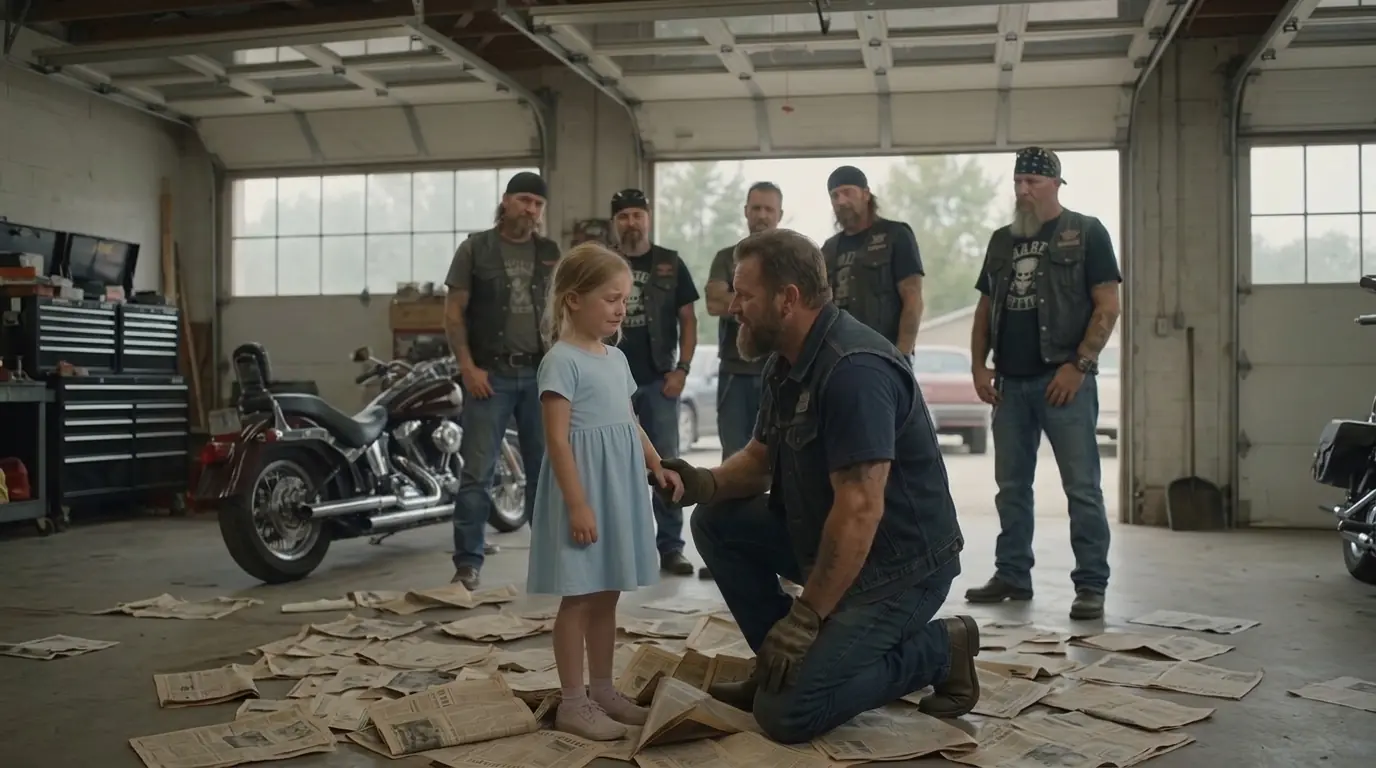
His real name was Caleb Rourke, but almost nobody used it anymore. He was fifty-eight, six-foot-three, heavy through the shoulders, with a gray beard, tattooed arms, and hands big enough to make Ellie’s fingers disappear inside them. Men stepped aside when Brick walked into bars, and strangers lowered their voices when his motorcycle rolled past.
But Ellie was not afraid of him.
She had met him six months earlier when her aunt’s car broke down outside Rourke’s Garage, and Brick had fixed the radiator hose without charging a dime. While he worked, Ellie sat on an upside-down oil bucket and asked him nineteen questions about motorcycles, tattoos, and whether his beard got hot in summer.
Brick answered every question.
Even the beard one.
After that, whenever Ellie and her aunt walked past the garage, she waved through the open bay door. Brick always waved back. Sometimes he gave her a sticker from a parts box. Once he let her press the horn on an old Harley, and she talked about it for three straight days.
That Saturday afternoon, she came to the garage crying so hard she could barely breathe.
Her aunt, Rebecca, followed behind her, pale and angry, one hand on Ellie’s shoulder and the other gripping a phone. Rebecca was thirty-two, tired in the way people get when life keeps demanding strength before breakfast. She worked double shifts at a nursing home and had been raising Ellie since Ellie’s mother died the year before.
Brick saw the child’s face and came out from under the hood of a pickup without wiping the grease from his hands.
“What happened, peanut?”
Ellie tried to answer, but the words broke apart.
Rebecca did it for her.
“Someone stole her bike.”
The garage went quiet.
Not silent exactly. A wrench still clicked near the back. The radio still played some old country song through static. Outside, traffic moved along the state road in front of the building.
But every man in a leather vest stopped what he was doing.
The bike was not just a bike.
Everyone in that garage knew it.
It was pink with white tires, streamers on both handlebars, and a little silver bell shaped like a star. Ellie’s mother had bought it from a yard sale, sanded the rust off the frame, painted it herself, and tied a blue ribbon below the seat because blue had been her favorite color.
She gave it to Ellie three weeks before the cancer came back for the last time.
Ellie had learned to ride it in the empty church parking lot behind Maple Street Baptist, her mother wrapped in a blanket on the tailgate of Rebecca’s truck, clapping even when Ellie only made it ten feet before tipping sideways.
The first time Ellie rode all the way across the lot without falling, her mother cried.
So did Rebecca.
So did Brick, though he claimed afterward that oil fumes were rough on the eyes.
That bike was the last thing Ellie had that her mother had touched with both hands and joy.
Now it was gone.
Brick crouched down in front of Ellie, slow and careful so his size did not overwhelm her.
“Tell me where.”
Ellie sniffled.
“Outside the library.”
Rebecca nodded.
“She locked it to the rack. We went in for story hour. When we came out, the chain was cut and the bike was gone.”
Ellie looked at Brick with desperate faith.
“You can find motorcycles,” she whispered. “Can you find bikes too?”
A few of the men looked away.
The kind of trust in her voice was hard to stand under.
Brick swallowed.
He had been many things in his life. A reckless kid. A factory worker. A soldier once, though he did not talk about that much. A husband before his wife passed. A man who had lost people and learned to keep going because the world did not stop just because your chest did.
But in that moment, kneeling on the concrete with Ellie’s hand gripping his, he became something simpler.
A man being asked for a promise.
He held up two fingers.
“Cross my heart, sweetheart.”
Ellie’s lip trembled.
“You really promise?”
Brick nodded.
“I promise we’re going to look until looking turns into finding.”
Then he stood and turned toward the men in the garage.
The Rust County Riders were not a criminal club, no matter what some people in town liked to whisper when they saw tattoos and leather. They were veterans, mechanics, truck drivers, welders, retired linemen, and men who had lived long enough to understand that family was sometimes built on purpose.
There was Moose, who looked like a bear and baked pies for church fundraisers.
Angel, who had a shaved head, gold glasses, and a voice so gentle people underestimated him until they needed legal paperwork read correctly.
Duke, sixty-four, gray-haired, thin as a fence rail, and still able to hear engine trouble from half a block away.
Rafa, a former firefighter who kept emergency blankets in his saddlebags.
And Little Jim, who was six-foot-seven and hated the nickname more than anyone had ever hated anything.
Brick looked at them.
“Somebody stole Ellie’s bike.”
Moose set down his coffee.
Duke reached for his keys.
Angel took off his glasses and wiped them with a shop towel.
Little Jim looked toward the open garage door with a grin that did not reach his eyes.
“Well,” he said, “that was stupid of them.”
Ellie blinked up at the room.
“Are you all helping?”
Duke winked at her.
“Kid, around here, one crying child means every engine starts.”
Within five minutes, the garage changed from repair shop to command center.
Rebecca gave them the time, the library location, the color, the chain brand, the scratch near the front fork, the blue ribbon under the seat, and the one sticker Ellie had placed on the frame: a glittery moon with half the silver rubbed off.
Angel called the library.
Moose called the pawn shop.
Rafa called a cousin who worked city maintenance and knew where cameras faced near the public buildings.
Duke rode to the library parking lot.
Little Jim went to check the alleys behind the resale stores.
Brick stayed with Ellie until the first wave was organized.
She sat on the old leather couch in the garage office, both feet tucked beneath her, watching men twice her size move because she had asked for help. Rebecca sat beside her, one arm around her shoulders, trying to look grateful and not terrified.
“I should’ve brought it inside,” Rebecca said quietly.
Brick looked at her.
“No.”
“I should have known.”
“No,” he repeated. “A child should be able to lock a bike outside a library and find it there when she comes back.”
Rebecca’s face broke for half a second.
Then she nodded.
Ellie whispered, “What if they painted it?”
Brick crouched again.
“Then we find the paint.”
“What if they took off the ribbon?”
“Then we find the place where they dropped it.”
“What if they broke it?”
Brick hesitated.
That was the question with teeth.
He looked at Rebecca, then back at Ellie.
“Then we fix it.”
Ellie wiped her nose on her sleeve.
“My mom painted it.”
“I know.”
“She said nobody else would have one like it.”
“She was right.”
Outside, motorcycles roared to life one after another.
The sound rolled through the garage like thunder.
Ellie stood and ran to the bay door.
The bikers pulled out in pairs, black jackets, chrome pipes, headlights catching the late afternoon sun. They were not speeding. They were not threatening anyone. They were simply leaving with purpose, and purpose can look powerful when enough people carry it at once.
Ellie watched them ride away.
For the first time since she arrived, she stopped crying.
Brick’s phone started ringing ten minutes later.
Duke had reached the library. The chain was still there, cut clean. The library camera caught a teenager in a red hoodie walking away with the bike at 1:12 p.m. Another camera near the bus stop caught him turning toward the railroad tracks.
Rafa’s cousin found a traffic camera that showed the same hoodie crossing behind Miller’s Feed Store.
Moose called from the pawn shop.
“No bike here,” he said. “But old Franklin says a kid tried to sell him a pink bike last month and he refused because it looked like trouble.”
“What kid?”
“Says he didn’t know his name. Skinny. Red hoodie. Scar above one eyebrow.”
Brick looked at Rebecca.
She stiffened.
“I know that kid.”
“Who?”
“Dylan Marr. Sixteen. Lives over by the old duplexes near the laundromat. His grandmother comes into the nursing home sometimes.”
Ellie looked up.
“Dylan took my bike?”
Rebecca pressed her lips together.
“I don’t know, honey.”
Brick did not like how fast the answer had arrived.
A thief was one thing.
A desperate kid was another.
He had learned not to excuse harm, but he had also learned that most bad choices had a road behind them, and sometimes if you ignored the road, you ended up fixing only the symptom.
Still, the bike came first.
“Stay here,” he told Rebecca. “Lock the office door if you need to. I’ll call when I know.”
Ellie grabbed his sleeve.
“You promised.”
Brick looked down at her.
“I remember.”
He rode out alone at first, then met Duke and Rafa two streets from the laundromat. Moose joined them a minute later, pie crumbs still stuck in his beard because he had apparently eaten under stress. Little Jim came from the alley side, shaking his head.
“No bike in the resale strip,” he said. “But a boy matching Dylan’s description was seen heading toward the old rail yard.”
The rail yard had not been active in ten years.
Now it was mostly rusted fencing, weeds, broken pallets, graffiti, and teenagers who went there to smoke or hide or pretend the rest of town could not reach them.
Brick did not like it.
“Slow,” he said.
They parked a block away and walked in.
No engines.
No shouting.
No dramatic nonsense.
Brick had seen enough men make situations worse because they wanted to feel powerful. This was a child’s bike, not a war. He wanted it back. He did not want a sixteen-year-old cornered into doing something stupid because five bikers made him feel hunted.
They found the pink bicycle behind a stack of old wooden crates.
Or what was left of it.
The streamers were gone.
The blue ribbon was missing.
The front wheel had been removed.
The glittery moon sticker was half-scraped away.
Brick stood looking at it for a long moment.
Rafa muttered something under his breath.
Moose took off his hat.
Duke crouched and touched the frame.
“Paint’s scratched, but not ruined. Fork’s okay. Rear wheel’s good. Chain’s off, but we can fix that.”
Brick exhaled slowly.
“Where’s the front wheel?”
A noise came from behind an old boxcar.
Little Jim turned his head.
“Come out,” he said. “Easy.”
A boy stepped from the shadow.
Sixteen, maybe younger if life had not been so hard on his face. Thin shoulders. Red hoodie. Scar above one eyebrow. He held the missing front wheel in both hands like he could not decide whether to drop it or use it as a shield.
“Dylan?” Brick asked.
The boy’s eyes darted between them.
“I didn’t know it was hers.”
“That supposed to mean something?” Moose asked.
Brick lifted one hand, and Moose went quiet.
Dylan swallowed.
“I thought it was just some rich kid’s bike.”
“It was locked outside the library,” Brick said.
“Rich kids go to the library.”
“So do little girls whose mothers painted their bikes before they died.”
That hit.
The boy looked at the frame.
His mouth opened, then closed.
“I didn’t know.”
Brick stepped closer, but not too close.
“Now you do.”
Dylan’s grip on the wheel tightened.
“I was gonna sell it.”
“We figured.”
“My grandma’s medicine got cut off. They said the insurance thing got messed up. I just needed eighty dollars.”
Rafa looked away.
Duke closed his eyes.
Brick felt the old ache behind his ribs, the one that came whenever a situation was wrong in more than one direction. A child had stolen from a child to help an old woman survive a system adults had built badly. That did not make the theft okay.
It did make the world harder to hate cleanly.
“You got the ribbon?” Brick asked.
Dylan blinked.
“What?”
“Blue ribbon under the seat.”
The boy reached into his hoodie pocket and pulled out a wrinkled blue ribbon, faded at the ends.
“I took it off so nobody would recognize it.”
Brick took the ribbon carefully.
“Too late for that.”
Dylan looked at the ground.
“Are you calling the cops?”
Brick said nothing for a moment.
Then he asked, “You want me to?”
The boy looked up sharply.
“No.”
“Then you’re going to walk with us to the garage. You’re going to carry that wheel. You’re going to tell Ellie what you did. You’re going to help me put the bike back together. After that, we call your grandmother and figure out what’s actually going on with her medicine.”
Dylan stared at him.
“That’s it?”
Brick’s face hardened.
“No. That’s the start.”
The walk back to the motorcycles felt longer than it was.
Dylan kept his head down.
Little Jim carried the bike frame gently, which looked almost funny until you saw his face. Nobody joked. Nobody threatened the boy. Nobody told him he was lucky, though he was.
Brick called Rebecca from the road.
“We found it,” he said.
He heard Ellie gasp in the background.
“Is it okay?” Rebecca asked.
“It needs work.”
A pause.
“Is Ellie listening?”
“Yes.”
Brick chose his words carefully.
“Tell her the bike is coming home.”
When they rolled back into Rourke’s Garage, Ellie ran out before Rebecca could stop her.
She stopped halfway across the concrete when she saw the bike.
For one terrible second, Brick wished he had fixed it before letting her see it. The missing streamers. The scratched paint. The empty fork where the wheel should be. The blue ribbon in his hand.
Ellie’s face crumpled.
“My bike.”
Dylan stood behind the men, holding the front wheel.
Brick stepped aside.
“This is Dylan.”
Ellie looked at him.
Dylan’s voice barely came out.
“I stole it.”
Rebecca’s hand tightened on Ellie’s shoulder.
Ellie stared at him with the directness only children can manage, the kind that has not yet learned to soften truth for adults.
“Why?”
Dylan looked at Brick.
Brick shook his head slightly.
Do it yourself.
Dylan swallowed.
“My grandma needed medicine, and I thought I could sell it. I didn’t know it was your mom’s bike.”
Ellie’s chin trembled.
“You still stole it.”
“Yes.”
“My mom painted that.”
“I know now.”
“She’s dead.”
Dylan’s eyes filled.
“I’m sorry.”
Ellie looked at him for a long time.
Then she asked the question nobody expected.
“Is your grandma going to die too?”
Dylan’s face collapsed.
“I don’t know.”
That was when the garage changed again.
Not loudly.
No speeches.
Just a room full of rough men realizing the day had become about more than a bicycle.
Rebecca sat down slowly on the couch.
“Who is your grandmother?”
“Mrs. Marr. Jolene Marr.”
Rebecca’s eyes widened.
“She’s one of my residents’ cousins. I’ve seen her at the pharmacy arguing with them twice.”
Angel, who had returned from calling around, stepped forward.
“What pharmacy?”
Dylan told him.
Angel took out his phone.
“I can make some calls.”
Moose looked at Brick.
“I’ve got cash.”
Rafa said, “I know a clinic director.”
Duke pointed at the bike.
“And I can make this ride before supper if people stop talking.”
Ellie looked at Brick.
“You can fix it?”
He held up the blue ribbon.
“We can fix what’s broken. We keep what matters.”
She nodded once.
Then she looked at Dylan.
“You have to help.”
Dylan wiped his face with the sleeve of his hoodie.
“Okay.”
The next two hours were the strangest repair job Rourke’s Garage had ever seen.
Duke taught Dylan how to align the front wheel and check the bearings. Little Jim found replacement streamers in an old box from the town parade. Rafa polished the frame gently, working around the scratches instead of erasing them completely because Brick said every bike, like every person, had marks from what happened and did not need to pretend otherwise.
Moose drove to the dollar store and returned with a new star bell, a pack of ribbons, and three candy bars nobody admitted needing.
Brick repainted the scratched section with a careful hand. The color was not perfect, but close. Then Ellie chose where to tie the blue ribbon again, right beneath the seat where her mother had placed it.
Dylan tied the knot.
His hands shook.
Ellie watched him.
“Tighter,” she said.
He tried again.
“Like this?”
She nodded.
“That’s better.”
Meanwhile, Angel sat in the office with Rebecca on speaker, working through the pharmacy problem. It turned out Dylan’s grandmother had missed a renewal notice, then been told she needed a prior authorization from a clinic that had changed systems the same week. The medicine was not denied. It was trapped behind paperwork.
Angel loved paperwork the way other men loved motorcycles.
By six o’clock, he had reached the clinic director, the pharmacy manager, and one very tired insurance representative who probably wished he had chosen a different profession.
By seven, Jolene Marr had her prescription ready for pickup.
Moose paid the temporary cost before anyone could argue.
Dylan heard that and turned away, wiping his face again.
Brick let him have the privacy.
Not all tears need witnesses.
When the bike was finished, Duke rolled it into the center of the garage.
Ellie stood very still.
The pink frame shone under the fluorescent lights. The white tires were clean. New streamers hung from the handlebars. The star bell gleamed. The blue ribbon fluttered beneath the seat, wrinkled but back where it belonged.
The glitter moon sticker still had a scraped edge.
Ellie touched it.
Brick crouched beside her.
“I can replace that.”
She shook her head.
“No. Mom put that one on with me.”
“Then it stays.”
She climbed onto the bike.
For the first time all day, she smiled.
It was small.
Then bigger.
Then real.
The garage erupted in cheers when she rang the bell.
Even Dylan smiled, though he looked like smiling hurt.
Ellie rode in a slow circle around the open bay, Rebecca walking close beside her with one hand hovering near the seat even though Ellie did not need help. The bikers clapped like she had won a race.
When she stopped in front of Brick, she got off and threw both arms around his neck.
He hugged her gently, one big hand on her back.
“See?” he said quietly. “We keep our promises.”
She nodded against his vest.
Dylan stood near the tool bench, unsure where to put himself.
Ellie let go of Brick and walked over to him.
Everyone held their breath.
“You can’t take it again,” she said.
“I won’t.”
“Even if you need money.”
“I won’t.”
She looked down at her shoes.
Then back up.
“You can come ride with me at the church parking lot if you ask first.”
Dylan looked like someone had handed him something too fragile to hold.
“Why?”
Ellie shrugged.
“My mom said everybody messes up. But not everybody comes back to fix it.”
Brick looked at Rebecca.
Rebecca covered her mouth.
Dylan nodded.
“I’ll ask first.”
The next morning, Rourke’s Garage opened late because half the club had been at Jolene Marr’s duplex fixing things they had no business noticing the night before.
A loose porch rail.
A leaking kitchen faucet.
A broken window latch.
A step that dipped dangerously under weight.
Jolene tried to argue with them.
She lost.
Brick also had a long conversation with Dylan on the back steps while Duke replaced the porch light.
Nobody heard the whole thing, but Dylan came away with two agreements.
First, he would work Saturdays at the garage after school, sweeping floors, sorting bolts, washing tools, learning enough to earn money honestly.
Second, if he needed help, he would ask before doing something that made someone else cry.
Brick was not naïve.
He knew one job and one repaired bicycle did not fix everything wrong in a boy’s life.
But it was a beginning.
Beginnings mattered.
A month later, Ellie rode her pink bike in the Memorial Day parade.
The Rust County Riders rode behind her, engines low, flags clipped to their bikes, vests clean, boots polished. Dylan walked beside the garage truck, handing candy to kids from a bucket. His grandmother sat in a folding chair near the pharmacy, wrapped in a blue shawl, clapping when Ellie passed.
Rebecca stood on the sidewalk and cried openly.
Brick pretended not to see because people deserved dignity with their tears.
Ellie had tied two ribbons beneath the bike seat that morning.
One blue for her mother.
One red for the garage.
When Brick asked about it, she looked at him like the answer should have been obvious.
“Family can have more than one color.”
He had no reply to that.
Some sentences come from children carrying truth adults take years to earn.
By the end of summer, Ellie rode better than half the boys in the neighborhood and rang her star bell at every dog she passed. Dylan kept showing up at the garage, sometimes late, sometimes quiet, sometimes angry at things he did not yet know how to name. Brick kept putting a broom in his hand anyway.
The bike became a legend in their small Ohio town.
People told the story differently depending on who they were.
Some said the bikers hunted down a thief.
Some said Brick scared a kid straight.
Some said Ellie’s pink bike was recovered by the meanest-looking men in the county.
But those versions missed the heart of it.
The real story was not about intimidation.
It was about a promise.
It was about a little girl who believed one grown man could help and a whole room of grown men deciding she should not be wrong.
It was about a stolen bike returning home with scratches that became part of its history instead of proof it was ruined.
It was about a teenage boy learning that desperation explains a wound but does not erase the person he hurt.
It was about a brotherhood that looked rough from the outside and somehow knew exactly how gently to handle what mattered.
Years later, when Ellie was too tall for the pink bicycle, she refused to sell it.
Brick hung it from the rafters of Rourke’s Garage above the office door. The blue ribbon had faded nearly white by then, and the red ribbon had gone soft at the edges. The scraped moon sticker still clung to the frame.
Under it, Brick placed a small metal sign.
WE KEEP OUR PROMISES.
Customers asked about it all the time.
Brick never told the short version.
He would lean against the counter, arms crossed over his vest, and say, “That bike belonged to a little girl who needed the world to prove it could still bring something back.”
Then he would look up at the pink frame and smile.
Because on one ordinary Saturday, someone stole a child’s bicycle and thought it was just metal, paint, and two wheels.
They did not know it carried a mother’s hands.
They did not know it carried a little girl’s last bright memory.
They did not know it carried the attention of men who had lost enough in their own lives to understand that small things are never small when love is attached to them.
And they definitely did not know that in Rourke’s Garage, one crying kid meant every engine started.