The little girl stood in front of the claw machine with both hands tucked deep inside the pockets of her yellow hoodie.
Her name was Molly Ellison, and she was seven years old, small for her age, with brown curls, big gray eyes, and sneakers that lit up only when one heel hit the floor just right. She stood beside three children from her class inside Coyote Star Arcade, watching the glowing metal claw swing above a pile of stuffed animals behind scratched glass.
Molly had no game card.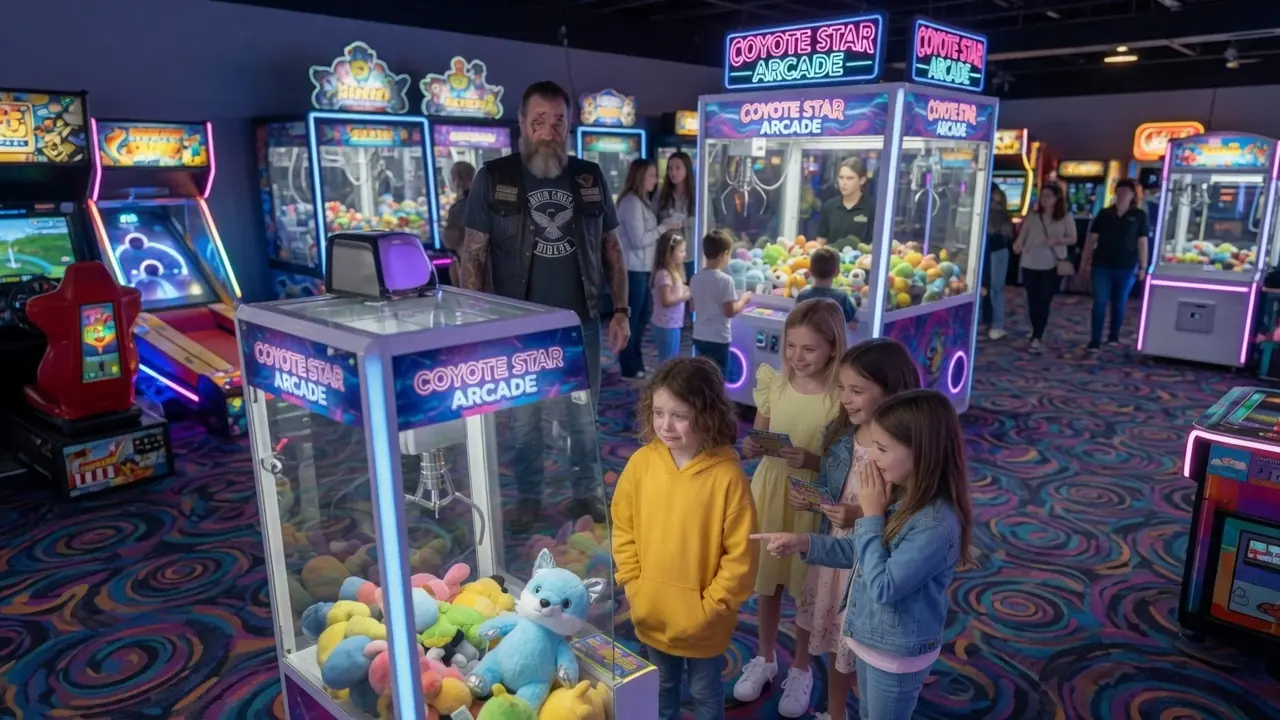
She had three nickels and one penny in her pocket, which she had counted twice in the bathroom before coming back out.
Inside the machine was a sky-blue fox with silver ears, half-buried between a green dinosaur and a yellow bear. Molly had been staring at it for almost ten minutes. Her mother loved foxes, and Molly had imagined giving it to her after her late shift at Juniper Wash, the laundromat beside the old movie theater in Briarvale.
“She’s never gonna get it,” one girl said.
That girl was Kelsey Vance, eight years old, blond, sharp-faced, and already learning the kind of cruelty that sounded like confidence when adults laughed at it. Her father owned Vance Outdoor Supply, and Kelsey wore new shoes so often that Molly once thought maybe rich people’s feet grew faster than everybody else’s.
Molly looked down at her own sneakers.
They had been white once.
Now they were gray near the edges, with one lace tied in a knot because the plastic tip had broken off.
“I wasn’t trying,” Molly said quietly.
Kelsey leaned closer.
“You don’t even have money to try.”
Two other children giggled.
Maddox Vale and Brooke Shaw did not laugh as loudly as Kelsey, but they laughed enough. Sometimes children join cruelty the way grown-ups join gossip, not because they believe in it fully, but because standing outside the circle feels dangerous.
Molly swallowed.
“My mom said I could watch.”
Kelsey tilted her head.
“Your mom says a lot because you don’t have a dad to buy you stuff.”
The words landed harder than the laughter.
Molly did not cry.
She had learned not to, at least not in front of people who wanted it. Her mother, Rachel, cried sometimes when she thought Molly was asleep, and Molly had decided there were already enough tears in their little apartment above Juniper Wash. So she only stared at the blue fox inside the machine and tried to make her face empty.
That was when the arcade door opened.
The bell above it gave a weak little chime, almost swallowed by the music from the racing games and the electronic cheers from skee-ball. A man stepped inside wearing a black leather vest, faded jeans, heavy boots, and a gray beard thick enough to hide half his face.
Tattoos covered both arms, disappearing beneath the sleeves of a dark T-shirt, and a scar cut across his left eyebrow like somebody had once tried to make a permanent argument there. The room changed the way rooms change when people suddenly remember how loud they have been.
Parents noticed him first.
A mother near the prize counter pulled her daughter closer.
Kelsey’s father, Nolan Vance, glanced over, then looked away with the deliberate calm of a man pretending not to be uncomfortable. The teenager working behind the counter stopped refilling paper tickets and watched the biker cross the arcade.
His name was Silas “Gravel” Boone.
Most people in Briarvale knew the vest before they knew the man. It read RAVEN CREEK RIDERS across the back, with a small patch beneath it that said ROAD CAPTAIN. To some people, that meant trouble. To others, it meant noise. To children, it meant motorcycles, chrome, and a little fear mixed with wonder.
Gravel saw the girls before anyone could warn him away.
He saw Kelsey’s smirk.
He saw Molly’s empty hands.
He saw the blue fox in the claw machine and the way Molly looked at it like a person could look at something small and still be asking the whole world for mercy.
Gravel walked over slowly.
The children moved aside without being told.
Kelsey tried to look brave.
She did not quite manage it.
“That one yours?” Gravel asked Molly.
Molly looked up.
The biker was enormous from that angle, all beard and leather and shadow, but his voice was not mean. It was low, rough, and careful. The kind of careful people use around animals that have already been kicked.
“No, sir,” Molly said. “It’s in the machine.”
Gravel looked at the fox.
“Want it?”
Molly’s ears went red.
“I don’t have a card.”
Kelsey snorted.
Gravel turned his head.
The laugh died immediately.
Then the biker looked back at Molly.
“That wasn’t what I asked.”
Molly blinked.
“Yes, sir.”
Gravel pulled a game card from his vest pocket and held it out, but he did not push it into Molly’s hand.
“You want one try?”
Molly stared at the card.
“My mom says I’m not supposed to take money from strangers.”
“Smart mother.”
That surprised her.
Gravel crouched, his knees cracking loudly enough that Maddox giggled before catching himself.
“I’ll tell you what,” Gravel said. “You don’t take money from me. You take a turn from the machine. I already bought the card, and this machine owes me anyway.”
Molly hesitated.
Kelsey folded her arms.
“She won’t get it.”
Gravel glanced at her.
“You running the future now?”
Kelsey’s mouth shut.
Molly took the card with two fingers, like it might disappear if she held too tightly.
The machine beeped when she swiped it.
Gravel stood beside her, not touching her, not leaning over her, not taking control. He only pointed at the glass.
“Don’t chase the fox,” he said. “That claw drifts right when it drops. Aim a little left. Wait until the claw stops swinging. Then push.”
Molly’s hand trembled on the joystick.
The other children watched.
So did half the arcade.
The claw moved across the glass box, wobbly and slow. Molly stopped it above the blue fox, adjusted left the smallest bit, then hit the button. The claw dropped, opened, caught one silver ear and part of the fox’s back, then slipped and dropped it two inches closer to the prize chute.
Kelsey laughed with relief.
“Told you.”
Gravel looked at the machine.
“That was not a miss.”
Molly frowned.
“It fell.”
“It moved.”
He swiped the card again.
“Again.”
Molly looked up.
“My mom said one try.”
“I said one try before the machine insulted both of us.”
The corner of Molly’s mouth twitched.
The second try caught the fox by the middle, lifted it halfway, then dropped it against the chute wall. This time, nobody laughed. The third try pulled the fox up, swung it once, and dropped it straight into the prize slot.
The machine played a tinny victory song.
Molly froze.
For a second, she did not reach in.
She just looked at the prize door like she was afraid the fox might take itself back.
Gravel nodded toward it.
“Go on. It’s yours.”
Molly pulled the blue fox out with both hands.
She held it against her chest.
The smile that broke across her face was so sudden and bright that even Maddox looked ashamed.
“My mom’s gonna love it,” Molly whispered.
Gravel looked at her.
“Then it picked the right kid.”
Kelsey kicked the carpet.
“It’s not fair. She only got it because you paid.”
Gravel turned slowly.
There are men who need to shout to fill a room.
Gravel was not one of them.
“You had turns?” he asked.
Kelsey looked at her father before answering.
“Yes.”
“You got a game card?”
“Yes.”
“You got people here with you?”
Kelsey’s face hardened.
“Yes.”
Gravel nodded.
“Then I’m trying to understand which part of fair got stolen from you.”
Kelsey had no answer.
Her father did.
Nolan Vance stepped forward with the confidence of a man used to people moving when he entered a conversation. He was clean-shaven, athletic, dressed in a quilted vest and boots that had never seen mud. His eyes moved over Gravel’s tattoos and vest before stopping on his face.
“Is there a problem here?” Nolan asked.
“No,” Gravel said.
“It looks like you’re bothering children.”
Molly tightened her arms around the fox.
“He helped me.”
Nolan smiled at Molly without warmth.
“That’s nice, sweetheart, but adults don’t usually buy things for children they don’t know.”
Gravel’s face did not change.
“Adults don’t usually let their children call another child poor and fatherless either. Yet here we are.”
The arcade went quiet.
Nolan’s smile disappeared.
Kelsey stared at the floor.
The teenager behind the counter, whose name tag read Miles, suddenly found deep interest in cleaning the same spot twice.
Nolan lowered his voice.
“You should be careful how you speak to me.”
Gravel looked at him for a long moment.
Then he said, “I was thinking the same thing.”
Nobody moved.
Then the arcade door opened again, and a woman rushed inside wearing a laundromat polo under a winter jacket. Her hair was pulled back messily, her face flushed from cold and worry. She had the tired beauty of someone who did not have time to know she was beautiful.
“Molly?”
The little girl turned.
“Mom!”
Rachel Ellison crossed the arcade quickly, then slowed when she saw the biker standing beside her daughter. Fear flickered across her face before she could hide it. Gravel noticed, and because he noticed, he took two steps back.
Molly ran to her with the blue fox.
“Look! I won it! Mr. Gravel helped, but I did the button.”
Rachel looked at the toy, then the biker, then the watching parents.
“What happened?”
The question carried several others beneath it.
Are you okay?
Did someone hurt you?
How much is this going to cost me?
Molly pointed at the machine.
“They said I couldn’t play because I didn’t have money, and Kelsey said I didn’t have a dad, and then Mr. Gravel said the machine owed him.”
Rachel’s face changed at the word dad.
Not dramatically.
Just enough for Gravel to see something old pass through her eyes.
She looked at Kelsey.
Then Nolan.
Then back to her daughter.
“I’m sorry, baby.”
Molly hugged the fox tighter.
“I didn’t cry.”
That broke her more than if she had.
Rachel crouched and touched her daughter’s cheek.
“You’re allowed to cry.”
“Not here.”
Rachel closed her eyes briefly.
Gravel looked away.
Some moments deserve privacy even in public places.
When Rachel stood, she faced him carefully.
“Thank you for helping her.”
Gravel nodded.
“Yes, ma’am.”
“I can pay you back for the game.”
“No, ma’am.”
“I don’t want charity.”
“It wasn’t charity. Kid had a turn coming.”
Her eyes searched his face, looking for mockery, pity, danger, something.
She found none.
That seemed to confuse her more.
“What’s your name?” she asked.
“Silas Boone. Folks call me Gravel.”
“Molly said that like it was normal.”
“It gets normal after the first ten years.”
Despite herself, Rachel almost smiled.
Then Miles from the counter stepped forward.
“Ms. Ellison, if it helps, he didn’t do anything weird. He buys game cards here sometimes for kids when machines eat credits. He’s okay.”
Nolan Vance made a sound.
Gravel ignored him.
Rachel looked at the blue fox again, then at her daughter.
“Well,” she said, brushing Molly’s curls back, “we should get home before my shift manager thinks I disappeared.”
Molly turned to Gravel.
“Thank you.”
Gravel crouched once more.
“You keep that fox safe.”
“I will.”
“And if anybody tells you having money makes them better than you, remember something.”
Molly waited.
Gravel’s voice softened.
“Money can buy a turn. It can’t buy aim.”
Molly nodded like this was wisdom she intended to carry forever.
Rachel thanked him again, then led her daughter out of the arcade.
As they passed the glass door, Molly looked back once and lifted the fox.
Gravel lifted two fingers in return.
He did not notice Rachel watching him through the window until she was already outside.
He did notice the last name.
Ellison.
That name followed him all the way back to his motorcycle.
Raven Creek Riders kept their clubhouse behind Boone’s Cycle & Tow, a long metal building at the edge of Briarvale where the highway curved toward the hills. It was half garage, half meeting hall, and entirely misunderstood by people who had never stepped inside.
There were motorcycle parts on one side, a long table on the other, old coffee on the counter, and a bulletin board covered with toy drives, funeral notices, veteran fundraisers, and unpaid repair bills Gravel pretended not to see when people were desperate.
The men inside looked up when he entered.
Boone was his last name, but everybody called him Gravel so long that even the mailman had given up. His oldest friend, Cyrus “Patch” Landry, sat at the table reading a manual for a carburetor older than some of the club members.
Patch was Black, seventy, thin as a fence rail, and capable of judging an engine and a man with equal accuracy.
“You look like you saw a ghost,” Patch said.
Gravel hung his vest on a chair.
“Maybe I did.”
He told him about the girl.
Not all of it.
Just enough.
Seven years old. Molly Ellison. Mother named Rachel. No father around, or at least none anyone mentioned gently.
Patch closed the manual.
“You thinking of Daniel?”
Gravel sat down heavily.
“I’m trying not to.”
“You’ve been trying not to for seven years.”
Gravel looked at the wall.
On a shelf near the office sat a sealed brown envelope, worn soft at the edges, with three words written across the front.
For my family.
Nobody touched it.
Nobody asked about it anymore.
Seven years earlier, on a rain-slick road outside Briarvale, a young man named Daniel Ellison had stopped to help when Gravel’s motorcycle slid under a guardrail during a storm. Daniel had been driving a delivery van for a bakery, heading home late, and he could have kept going.
He did not.
He pulled Gravel out of the ditch before the bike caught fire.
He called 911.
He stayed in the rain holding pressure on Gravel’s leg until headlights appeared through the storm.
Then a second car lost control on the same curve.
Daniel pushed the paramedic out of the way.
He did not survive the impact.
Gravel lived.
That was the simple version.
The unbearable version was that Daniel had a small envelope in his jacket addressed to Rachel, but no full address inside. The police report listed him as unmarried, no known children. Gravel had tried to find the woman for months after he healed, but Rachel had moved, the bakery had closed, and the number in Daniel’s phone no longer worked.
Eventually, the search became one more wound he did not know how to close.
Now a girl named Molly Ellison had stood in front of a claw machine being mocked for having no father.
Gravel rubbed both hands over his face.
“What if it’s him?”
Patch looked toward the envelope.
“What if it is?”
“I don’t get to just walk into their life with a ghost.”
“No,” Patch said. “But you don’t get to keep one in a drawer if it belongs to them.”
Gravel said nothing.
Because Patch was right, and right answers are not always easier to carry.
For the next two weeks, Gravel did not go looking for Molly.
Not directly.
He told himself that was respect. He told himself Rachel had enough problems without a biker from nowhere appearing with old grief in his hands. He told himself maybe Ellison was common enough and maybe he was wrong.
Then he saw Molly again outside Juniper Wash.
The little girl sat on the curb beside a basket of folded towels, blue fox tucked under one arm, watching Rachel argue softly with the hood of an old green sedan that refused to start. Steam drifted from the engine. Rachel’s face had the tired expression of a woman calculating repair costs before anyone had named one.
Gravel pulled into the lot in his tow truck instead of on his bike.
Rachel’s shoulders tensed when she saw him.
Then recognition softened her face by a fraction.
“Mr. Boone.”
“Car giving you trouble?”
“It’s fine.”
The car hissed loudly.
Molly looked up.
“Mom, it made a dragon noise.”
Rachel closed her eyes.
“It’s not fine.”
Gravel stepped closer but did not touch the engine.
“May I look?”
She hesitated.
Pride stood between them, stiff and familiar.
“I don’t have much money.”
“Didn’t ask that.”
“I’m telling you before you do.”
He nodded once.
“Fair.”
He looked under the hood for thirty seconds.
“Radiator hose cracked. Clamp’s bad too. I’ve got parts at the shop.”
Rachel crossed her arms.
“How much?”
“Parts cost twelve. Labor costs one cup of whatever coffee you drink to survive this schedule.”
“That is not a real rate.”
“It is today.”
Her eyes narrowed.
“I said I don’t want charity.”
“And I said it’s a radiator hose, not a moral test.”
Molly giggled.
Rachel tried not to.
Failed.
Gravel fixed the hose in twenty minutes. Rachel brought him gas-station coffee from next door and insisted he take a ten-dollar bill too. He accepted it because he understood then that refusing would make the kindness smaller, not larger.
Molly stood beside him, watching every movement.
“Do you fix motorcycles too?”
“Mostly.”
“Can motorcycles get sick?”
“Worse. They get dramatic.”
Molly nodded seriously.
“My mom’s car is dramatic.”
“That car is writing poetry.”
Rachel laughed from near the door.
It was the first time Gravel heard her laugh, and something about it made the old envelope feel heavier.
After that, he became part of their orbit slowly.
Not like family.
Not yet.
More like weather.
He appeared when the sedan needed help. He showed Molly how to tighten a loose pedal on her old bicycle. He brought Rachel a used space heater after noticing the laundromat office was colder than the sidewalk. She argued until he produced a receipt and said she could pay him five dollars a month if it made her feel better.
She did.
Five dollars exactly.
Every month.
At school, the teasing did not stop immediately.
Kelsey Vance told everyone Molly had a biker friend because she still had no dad. Maddox repeated it once and then stopped when Molly looked at him. Brooke stopped repeating anything after Gravel came to Maple Crown Elementary for Family Build Day.
That event was supposed to be simple.
Children and parents would build small wooden cars in the gym, paint them, then race them down a sloped track. Molly had brought a kit from the school supply table because Rachel had to work a double shift. She had been sitting alone when Kelsey leaned over.
“No dad again?”
Molly stared at her wooden wheels.
Then the gym doors opened.
Gravel walked in wearing a clean black shirt, jeans, and no leather vest because Rachel had warned him the school might not handle the full patch experience. Even without the vest, he looked like a man parents were ready to complain about.
The principal, Mrs. Delaney, intercepted him halfway.
“Can I help you?”
Gravel held up a visitor sticker.
“I’m here for Molly Ellison.”
She blinked.
“And you are?”
“A friend.”
“This event is for family members.”
Molly’s voice came from the table.
“He’s my person today.”
The gym went quiet in the special way school gyms do when children sense adult discomfort.
Gravel looked at Mrs. Delaney.
“I can leave if she says leave.”
Molly stood.
“Please don’t.”
Mrs. Delaney’s face softened.
“Then you may stay.”
Kelsey’s father, Nolan Vance, watched from another table with his jaw tight.
Gravel sat beside Molly, knees too high under the tiny cafeteria table, and picked up the wooden car kit like it was a sacred object. He let Molly hammer. He let Molly glue. He let Molly choose the crooked racing stripe and the name painted on the side.
BLUE FOX.
When the car rolled down the track, it did not win.
It came in fourth.
Molly still cheered like it had broken a record.
Gravel clapped once, loud enough to startle three parents.
“Strong run.”
Kelsey’s car won first place because Nolan had clearly built most of it. Kelsey smiled, but not for long. Her father was already checking his phone when the ribbon was handed out.
Molly watched that.
Then looked at Gravel.
Gravel noticed.
“You okay?”
Molly nodded.
“I think winning is louder when somebody sees it.”
Gravel had no answer ready.
Some sentences from children arrive already grown.
That night, he went back to the clubhouse and took the old envelope off the shelf.
Patch watched him.
“You sure?”
“No.”
“Good. Sure people do damage.”
Inside the envelope were three things.
A photograph of Daniel Ellison and Rachel standing in front of a bakery mural, both young, both laughing.
A folded letter.
And a small silver keychain shaped like a fox.
Gravel had never opened the letter. It did not belong to him. But he had carried the envelope across seven years of guilt, waiting for the person whose name he did not know how to find.
Now he knew.
He still waited another week because cowardice sometimes dresses itself as carefulness.
The truth finally came because of Kelsey Vance.
It happened at the Briarvale Winter Carnival, held in the parking lot behind the old courthouse. There were food trucks, a school choir, cheap rides, and a portable arcade booth run by Miles from Coyote Star. Rachel had taken one evening off because Molly wanted to show her she could win a prize without help.
Gravel came with Patch and two other Raven Creek Riders, staying near the back, letting the mother and daughter have their night.
Molly brought the blue fox with her.
She carried it everywhere now.
Kelsey saw it near the ring toss booth.
Nobody knew exactly what she intended. Maybe she only meant to grab it and run. Maybe she wanted to throw it in the trash. Maybe she was angry because Molly had something attention could not buy her.
Whatever the reason, Kelsey snatched the fox from Molly’s hands and tossed it toward a stack of empty crates.
The toy landed in a puddle of melted snow and dirty slush.
Molly froze.
Then her face broke.
Gravel moved before Rachel did, but he stopped himself after two steps.
This was not his scene to control.
Rachel reached the toy first, picked it up, and held it against her coat.
Nolan Vance marched over, annoyed.
“What happened?”
“Your daughter threw my daughter’s toy into the mud,” Rachel said.
Nolan glanced at the fox.
“It’s a toy.”
Molly whispered, “It was mine.”
Kelsey muttered, “She acts like it’s special.”
Rachel looked at her.
“It is.”
Nolan sighed.
“I’m not doing a whole public drama over a stuffed animal.”
Gravel stepped forward then.
Just one step.
Nolan turned.
“Oh, of course. Here comes the biker.”
Gravel said nothing.
Nolan looked at Rachel.
“You really want this kind of man around your child?”
Rachel’s face went still.
It was a dangerous stillness.
“Careful,” she said.
Nolan laughed.
“What? We all see it. You’re a single mom struggling with bills, and some tattooed man shows up playing hero. That doesn’t make him a father figure. It makes him a bad decision with a motorcycle.”
The carnival lights flickered red and gold across the snow.
People had begun watching.
Gravel felt every old judgment in Nolan’s words.
Trash.
Dangerous.
Unfit.
Not the kind of man allowed near children unless something had already gone wrong.
Then Molly stepped in front of him.
“He’s not bad.”
Nolan looked down.
“Molly, you don’t understand.”
“Yes, I do,” Molly said. “Bad people laugh when somebody hurts.”
The words hit harder because they were small.
Kelsey’s face flushed.
Nolan opened his mouth, but Rachel spoke first.
“Mr. Vance, your daughter owes mine an apology.”
Nolan scoffed.
“For a toy?”
“For cruelty.”
That left no easy exit.
Kelsey stared at the ground.
“I’m sorry.”
Molly held the dirty fox.
“You shouldn’t say I don’t have a dad.”
Kelsey looked at her father.
Nolan said nothing.
Kelsey swallowed.
“I’m sorry for that too.”
It was not perfect.
It was a start.
That night, Rachel washed the fox in the laundromat sink while Molly sat on a dryer watching it spin through the machine.
Gravel stood near the vending machine, envelope in his jacket pocket, feeling like the past had finally run out of patience.
Rachel looked at him.
“You’ve been carrying something all night.”
He nodded.
“Yes, ma’am.”
“Is it bad?”
He looked at Molly, who was half-asleep against a laundry basket.
“No. But it’s heavy.”
Rachel dried her hands slowly.
“Then say it.”
Gravel pulled out the envelope.
Her face changed before he spoke.
Because the handwriting on the front was Daniel’s.
For my family.
Rachel did not reach for it.
She only stared.
“Where did you get that?”
Gravel’s voice roughened.
“Your husband gave it to a paramedic the night he died. It ended up with me after the crash report. I tried to find you. I failed.”
Her mouth trembled.
“You knew Daniel?”
Gravel nodded.
“He saved my life.”
The dryer rumbled behind them.
Molly opened her eyes.
“My dad?”
Rachel pressed both hands to her mouth.
Gravel crouched so he was level with the little girl.
“I didn’t know you existed until I met you at the arcade.”
Molly stared at him.
“My dad saved you?”
“Yes.”
“Then why did people say he left?”
Rachel sat down hard on the bench.
“Because I let them.”
Her voice broke.
“I was so tired of explaining. Daniel died before you were born, and people made stories because they didn’t know what else to do. I thought when you were older, I would tell you properly. Then every year you got older, the story got heavier.”
Molly looked at the envelope.
“Did he know about me?”
Rachel cried then.
“Yes,” she whispered. “I told him two days before the accident.”
Gravel opened the envelope with Rachel’s permission.
Inside was the letter.
She read it first, sobbing quietly, one hand over her mouth. Then she handed it to Molly, though Molly was too young to read all of it. Gravel read the first part aloud.
Rachel,
If you are reading this, it means I found some foolish way to scare you before I got the chance to apologize properly. I bought the fox keychain because you said our baby should have something brave and clever watching over him or her. I am terrified, but I am also happier than I have ever been. Tell our child I did not run from them. Tell them I was on my way home.
Gravel stopped because his voice failed.
Patch, who had arrived quietly and stood near the door, looked away.
Rachel took over, reading through tears.
Tell them I wanted to be there for every scraped knee, every bad dream, every school play, every bike ride, every little thing that feels ordinary until you love someone enough to know ordinary is the whole miracle.
Molly’s eyes filled.
“He wanted me?”
Rachel pulled her into her arms.
“More than anything.”
Gravel placed the silver fox keychain in Molly’s palm.
The little girl held it beside the blue stuffed fox, both damp from different kinds of weather.
Then she looked at Gravel.
“Was my dad a biker?”
Gravel smiled sadly.
“No. He was better.”
Molly frowned.
“What was he?”
“A man who stopped in the rain when someone else was hurt.”
For a long time, nobody spoke.
The dryers turned.
The winter wind pushed against the laundromat windows.
Outside, carnival lights blinked above the parking lot, bright and careless, while inside, a little girl who had been told she had no father finally held proof that she had been loved before she was born.
That was the twist no one at the claw machine had known.
Molly was not fatherless because her father had not cared.
She was fatherless because her father had cared enough to stop for a stranger.
And the scary biker who had helped her win a blue fox was alive because of that choice.
After that night, people in Briarvale told the story many ways.
Some said Gravel Boone scared a rich kid into apologizing.
Some said he bought a poor little girl a stuffed animal.
Some said the Raven Creek Riders had adopted a laundromat kid and her mother.
But people like to shrink stories until they fit inside the part they understand.
The real story was bigger.
It was about a seven-year-old girl standing in front of a claw machine with empty pockets while other children laughed.
It was about a biker everyone judged by leather and tattoos noticing the exact kind of hurt adults often miss.
It was about a mother too tired to carry the past alone, a father whose love had been trapped inside an envelope, and a promise delivered seven years late but not too late to matter.
It was about the difference between money and presence.
Between a man who buys his daughter prizes and forgets to watch her smile, and a man who kneels beside a child he does not know and gives her the courage to try.
Years later, Molly kept the blue fox on a shelf above her bed.
Not because it was clean.
The ear was still crooked from the claw machine, and one paw had a faint stain from the winter carnival that never fully came out.
She kept it because it reminded her of the first day someone big and frightening-looking had treated her gently in front of everyone.
Beside it hung the silver fox keychain her father had bought before he died.
And beneath both, taped to the wall in a child’s careful handwriting, was a sentence Gravel once told her while helping repair her bicycle.
A father is not only the man who stands beside you.
Sometimes he is the man who loved you before you could remember.
Sometimes he is the man who saved someone else on his way home.
And sometimes, when life is kind in a strange crooked way, he sends a biker to the claw machine when you need him most.