The sun was a white-hot hammer beating the life out of the Wyoming plains. Silas Thorne felt the crushing weight of the world on his shoulders, and the weight of his daughter pressed against his aching back. May was only four years old. Her breathing was shallow and jagged, and her skin felt like a branding iron against the nape of his neck.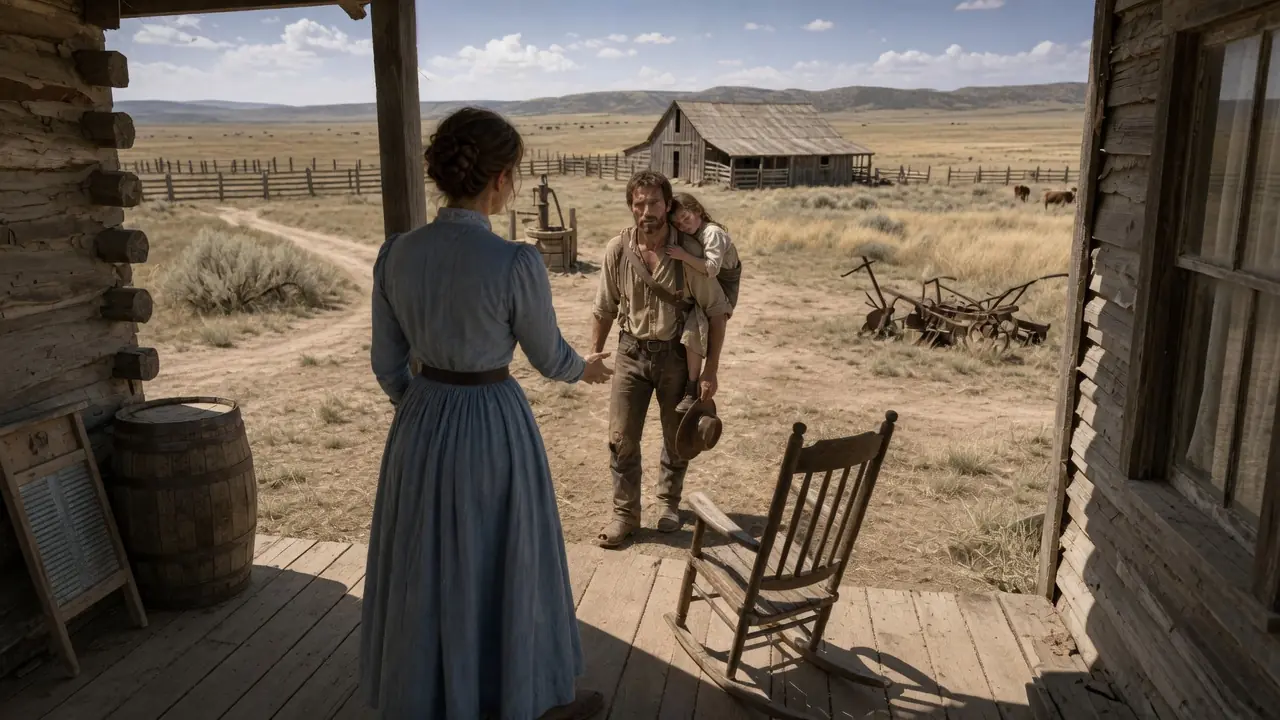
Silas had been walking for three agonizing days. His boots were worn through, and every step tore at the raw skin beneath them. He squinted at the horizon, searching for a miracle. The year was 1888, and the great die-up of the previous winter had been a massacre that left millions of cattle buried beneath suffocating snow.
Silas was a man who had been stripped of everything. He had lost his farm in Nebraska to black clouds of locusts, and he had lost his beloved wife, Sarah, to the relentless grip of fever. All he had left was May. She was his heartbeat, his only reason to take the next step.
In the shimmering distance, a small ranch house flickered like a mirage. A woman stood in front of it, perfectly still, wearing a blue dress that matched the terrifying vastness of the sky. Her arms were crossed tightly over her chest. She watched Silas’s staggered approach with eyes as hard as flint.
Silas stopped at the very edge of the dust-choked yard. He did not want to scare her. A man with nothing was often seen as a man who would take anything. He reached up with a trembling hand and tipped his sweat-stained hat.
“Good afternoon, ma’am,” he croaked. His voice sounded like rusted hinges grinding together in the wind. The woman did not move a single muscle. She studied the man before her, a ghost draped in the grime of a thousand miles, and then looked at the small, limp girl strapped to his back.
May’s eyes were tightly shut. Her tiny pale hand gripped the frayed collar of Silas’s shirt. “You’re a long way from nowhere, stranger,” the woman said. Her voice was steady and sharp. It held the granite strength of a woman who had survived on her own terms.
“I’m looking for honest work,” Silas said, his legs shaking. He took one agonizing step forward. “I can mend any fence the wind can knock down. I can break the wildest horses you’ve got. I can do anything you need, ma’am.”
He paused, his throat closing as he looked at his daughter. “I don’t need much in the way of coin. Just a corner for my girl to rest her head and a bit of milk to keep the life in her.”
The woman stared at him, searching for the truth in his eyes. She looked at his calloused, bloodied hands and noticed how he shifted his weight to shield the child from the sun. A heavy silence stretched between them, thick as the heat. The wind whistled through the dry, dying buffalo grass, the loneliest sound a man could ever hear.
“My name is Clara Higgins,” she finally said. Silas nodded, a flicker of hope sparking in his chest. “Silas Thorne, ma’am. From Nebraska.”
May opened her eyes just a sliver. They were dark and clouded by the heat of fever, filled with a terrible wisdom that no four-year-old should possess. Clara reached out with a trembling hand and touched May’s forehead with the back of her fingers. “She is burning up,” Clara whispered, her voice finally softening.
“Yes,” Silas said, his heart twisting like a knotted rope. “She’s been fading since we left the last watering hole.” Clara looked back at him, her expression a mask of unreadable iron. “I don’t need a ranch hand,” she said coldly.
Silas felt his stomach drop into a bottomless pit. His knees buckled and the world began to spin. He started to turn toward the empty horizon. “Wait,” Clara called.
The word cut through the air. Silas stopped, his breath hitching in his chest. Clara looked him squarely in the eye, her gaze piercing his soul. “I don’t need a man to fix my fences, Silas Thorne, but I have a requirement. A price for the milk and the bed.”
Silas waited, his pulse drumming in his ears. He was ready to sell his soul to save his child. “I want a daughter,” Clara said, her voice cracking for the first time. The words struck Silas with the force of a physical blow. He gripped the leather straps of May’s carrier until his knuckles turned white.
“Ma’am?” he asked, praying he had misheard the madness in her voice.
“You heard me.” Clara lifted her chin in defiance. “I want a daughter to fill this empty house. Not to replace what you’ve lost. Never that. I only want to love her as if she were my own. If you stay here, that is the price of your survival.”
A surge of primal fear rose inside Silas. Was she trying to buy his flesh and blood? Was this the final cruelty of the West, claiming the last treasure he possessed? “I won’t give her up,” Silas growled, his voice low and dangerous.
His protective instincts flared like wildfire.
“I’m not asking you to give her up, you fool,” Clara said. She looked back toward the hollow, silent ranch house. “I’m asking for a family. I’m asking for a reason to draw breath in the morning.”
Her eyes filled with a sudden, sharp pain.
“The winter of ’87 took my husband, Ben. It took my hope and buried it under ten feet of ice. It took the children we dreamed of but never held. You want a job and a life. I want a daughter to love and a legacy to keep.”
She stepped closer. “You stay here. You work this land until your hands bleed into the soil. But you let her be mine, too.”
Silas was too shocked to answer immediately. He searched Clara’s face for any sign of malice. He found only a deep, aching loneliness that mirrored his own. It was the shared language of the broken.
“She needs medicine, Clara,” Silas said, using her name for the first time. “I have herbs and willow bark in the pantry,” she replied. “And I have a feather bed that hasn’t been slept in for a year.” Silas looked at May. The girl’s face was flushed a terrifying shade of crimson. He had no choices left.
“All right,” he whispered, his voice thick with emotion. “We stay. She is yours to love.” Clara did not smile, but the tension left her shoulders.
“Bring her inside. Quickly.” The house smelled of cedar, beeswax, and dried lavender. It was clean, quiet, and felt like a sanctuary. Clara led them to a small, sun-drenched bedroom where the bed was covered by a magnificent handmade quilt, a mosaic of colorful scraps stitched with love and patience.
Silas gently lowered May onto the soft mattress. The child groaned, a small, pained sound that broke his heart. Clara was already moving with purposeful grace. She brought a basin of cool spring water and began bathing May’s face with a linen cloth.
Her movements were incredibly tender. They were the ancient movements of a mother tending to her own. Silas stood in the doorway, feeling like a ragged intruder. He was a man of the trail, a creature of dirt and sweat, and this room felt like a holy place while he was covered in the world’s filth.
“Go to the barn,” Clara ordered without looking up. “There’s a cot in the tack room. Wash the trail off yourself at the pump. I’ll bring you a bowl of stew once she is settled.”
Silas nodded and retreated into the fading light. When he disappeared into the darkness, Clara closed the bedroom door and sat beside May. For the first time in more than a year, she cried without making a sound.
The cool water at the pump felt like a baptism. Silas scrubbed the layers of Nebraska and Wyoming from his skin. He thought about the bargain he had just made. It was strange, beautiful, and terrifying.
In the Wyoming Territory, life was a brutal currency. People did terrible things simply to see the next sunrise. Yet this felt different. It felt like the birth of something sacred.
That night, the wind howled like a banshee across the plains. Three times before dawn, Clara changed the cold cloth on May’s forehead. Twice, May’s breathing grew so faint that Clara leaned close in fear. She prayed until her knees went numb.
Silas sat on the edge of the narrow cot in the barn and ate the beef stew Clara had brought him. It was rich, salty, and filled with the warmth of a real kitchen. It was the first time his stomach had not been cramped with hunger in weeks.
He thought about Sarah. She would have loved the way the stars looked out there, so bright they seemed close enough to touch. A single hot tear rolled down his weathered cheek. He wiped it away with the back of a scarred hand.
Men on the frontier were told tears were a luxury they could not afford. But loneliness was a weight heavier than any mountain. The next morning, the sun rose in a blaze of gold and violet. Silas walked to the main house with his heart thumping. He found Clara in the kitchen, bathed in morning light, carefully feeding May a few spoonfuls of broth.
The girl looked different. Her eyes were clear, and the fire in her skin had faded. “She broke the fever in the middle of the night,” Clara said, her attention entirely on the child. “Thank God,” Silas breathed, leaning against the doorframe.
“You’ll find the heavy tools in the shed,” Clara said in a businesslike tone. “The north fence was trampled by a stray herd. Start there. Work until the sun sets.”
Silas went to work with a ferocity he had not felt in years. The labor was grueling, and the heat was a constant enemy. The ground was dry, stubborn, and packed hard as stone. Yet it felt magnificent to use his muscles for a future.
It felt holy to have a purpose that was not simply walking away from a grave. As the weeks passed, a rhythmic peace developed on the ranch. Silas worked from first light until the stars emerged. He repaired the sagging barn, reinforced the corrals, dug a new well, and struck a vein of water that tasted like life itself.
He tracked down the remaining cattle and nursed them back to health. In the house, Clara took charge of May’s world. She taught the little girl her letters with a charred stick on the porch, showed her how to gather eggs without cracking the shells, and sang old, haunting songs in the purple twilight. One evening, Clara quietly mended the torn sleeve of Silas’s work shirt. She never mentioned it. The next morning, he noticed the careful stitches and smiled for the first time in years.
May looked up and laughed. “Mama fixed it,” she said. The word struck both adults into silence. Clara looked away quickly, but Silas saw tears gathering in her eyes.
From the shadows of the barn, Silas watched May follow Clara like a devoted little shadow. He saw his daughter laughing, a sound he had feared he would never hear again. Her cheeks became healthy and rosy, and her steps grew lively. It hurt him in a quiet, selfish corner of his heart. He sometimes felt as though he were losing the only thing that still belonged to him. Then he saw the joy in May’s eyes and understood that she was finally, truly safe.
His own shattered heart slowly began to mend. One afternoon, a group of riders appeared at the front gate. They were men from the nearby settlement of Medicine Bow. They looked at Silas with narrowed eyes and deep suspicion.
“Who are you, stranger?” one of them barked. He was a mountain of a man with a rusted tin star pinned to his chest. “I’m the ranch hand,” Silas answered, standing his ground.
“Since when does Clara Higgins hire drifters?” the sheriff asked. “She’s been a lone widow since Ben passed in the ice.” Clara walked onto the porch with her jaw set in a hard line. May stood safely behind the folds of her blue skirt.
“He’s with me, Sheriff,” Clara said, her voice like a whip. “He is a good man, and he works harder than any three of you.” The sheriff narrowed his eyes and leaned forward in his saddle. “Folks in town are talking, Clara,” he said.
A couple of the men behind him laughed. One spat into the dirt near Silas’s boots.
“Hard talk,” the sheriff continued. “A lone woman and a nameless drifter living under one roof. It doesn’t look right. It doesn’t sit well with decent folk.”
Silas felt a wave of righteous anger. He wanted to pull the man from his horse and demand that he show Clara respect. But he understood the cruel reality of the world. A woman’s reputation was often the only currency men allowed her to possess.
“He is my partner,” Clara said, her voice ringing across the yard. The sheriff looked genuinely stunned. “Partner? Or is he something else to you, Clara?”
“That is none of your business and certainly not the law’s,” she snapped. The men exchanged dark, knowing looks. They did not like her tone, and they did not like her independence. Yet they had no lawful reason to remain on her land.
“Just watching out for your interests, ma’am,” the sheriff lied. They turned their horses and rode away, leaving a cloud of dust. When it settled, a heavy silence remained. “I should leave, Clara,” Silas said quietly. “I’m bringing nothing but trouble and shame to your door.”
Clara looked at him, then at the little girl she had claimed in her heart. “You aren’t going anywhere, Silas Thorne. Let them wag their tongues until they fall out. They don’t know what it is to be an empty vessel.”
Silas walked toward the porch and stopped at the bottom step. “Why did you really want a daughter, Clara?” It was the question that had kept him awake in the tack room for months. Clara sat on the top step and looked toward the horizon, smoothing the fabric of her blue dress with trembling fingers.
“I had a daughter once,” she whispered. Silas froze, the air leaving his lungs. “Her name was Rose. She was three years old. She died during the terrible winter of 1886.”
Clara’s gaze remained fixed on the horizon.
“The wood ran out. The coal was gone. The cold was a beast that crawled through the cracks in the walls. I held her against my chest until she went cold in my arms.”
Her voice did not shake, which made the confession even more devastating. The agony in her eyes was a hollow deep enough to swallow the world. “I promised God I would never love another living soul,” she continued. “It hurt too much to lose them when the winter came. But then I saw you coming up that trail.”
She finally looked at him.
“I saw a father who would walk through hell for his child, and I saw a little girl who was fading for lack of a mother. I didn’t want to buy her, Silas. I’m not a monster. I wanted to save myself from the silence.”
A massive lump formed in Silas’s throat. In that moment, he realized they were exactly alike, two broken, jagged pieces trying to find a way to fit together. He saw the dignity in Clara’s grief and the courage in her demand. The weeks turned into a golden, crisp autumn. Cottonwood leaves along the creek became shimmering gold. The memory of the great die-up still lay across the territory like a shadow, and every family was preparing for another brutal winter.
The tension in Medicine Bow continued to fester. Rumors about the widow and the drifter grew more poisonous. Some said Silas was a killer hiding from the law. Others said Clara had finally surrendered to prairie madness.
One Sunday, they decided to face the world together. They needed heavy supplies to survive the coming snows. Silas drove the wagon into Medicine Bow with his back straight and proud. Clara sat beside him with her head held high. May rode in the back, singing to a rag doll Clara had sewn for her.
As they entered town, the air turned cold with judgment. Women whispered behind lace fans, their eyes sharp as needles. Men spat into the dirt as the wagon passed. Silas kept his eyes fixed on the road ahead. He felt the crushing weight of their small-mindedness but refused to bend beneath it.
They entered the general store, and the bell above the door rang like an alarm. The owner, Mr. Miller, had a face like curdled milk. He served Silas in heavy, insulting silence.
Clara walked to the rear of the store to examine the winter wool. She wanted the best fabric she could afford for a new coat for May. A woman in a silk dress approached, wearing a false, sharp smile. It was Martha, the mayor’s wife, a woman who thrived on the misery of others.
“Clara,” she said, her voice dripping with artificial pity. “We are all so terribly worried about your situation. Living out there on that isolated ranch with that man.” Clara did not look up from the bolt of wool.
“I am perfectly fine, Martha. Mind your own house.” “But think of your reputation, dear. And that poor stolen child. She should be with proper, respectable people.”
Clara stopped touching the fabric and slowly turned. “That child is loved with a ferocity you could not imagine. She is fed, she is warm, and she is cherished. Can you say the same for the orphans living in the alleys of this town?”
Martha gasped, her face turning purple. She spun on her heel and hurried away. Silas finished loading sacks of flour and grain. He wanted to leave before the tension snapped into violence. But as the wagon began to pull away, a group of men blocked the dusty street.
The sheriff stood in the center with one hand resting on his holster. “Thorne!” he yelled. Silas pulled hard on the reins, his heart hammering.
“What is it now, Sheriff? We’re heading home.” “We received a telegram from the authorities in Nebraska,” the sheriff said. “A man fitting your description is wanted for grand theft.”
Silas felt the world tilt beneath him. “I have never stolen a thing in my life.” “They say a farmhand ran off with a prize horse and a bag of gold around the time you vanished from your county.”
“That wasn’t me!” Silas shouted, frustration boiling over. “I walked every mile to this territory. Look at my feet!”
The sheriff did not look down. He only looked at the man he had already decided was guilty. “We have to take you in until the circuit judge arrives to verify the report.” “No!” May screamed from the back of the wagon.
She jumped up and threw her small arms around Silas’s neck. Clara rose beside him, looking like a warrior queen of the plains.
“This is a lie and a farce!” she shouted at the crowd. “He has been working my land for months. He has not left my sight.”
“Step down, Silas,” the sheriff ordered, drawing his weapon. Silas looked at May, sobbing against his shirt, and then at Clara, trembling with white-hot rage. He knew he could not fight a dozen armed men. He would not risk a stray shot reaching his daughter.
Slowly and painfully, he climbed down from the wagon seat. The men seized him, pinned his arms behind his back, and shoved him toward the dark town jail.
“I’ll take care of her, Silas!” Clara called as they dragged him away. “I promise you. I won’t let them touch her.”
The heavy iron door slammed shut with a finality that felt like death. Silas was plunged into damp, freezing darkness. He sat on the narrow wooden bench with his head in his hands, overcome by a soul-deep despair. Was this the end of his long journey? After all the miles, hunger, grief, and suffering, did the world simply refuse to let a man like him find peace?
Hours crawled by like insects on the wall. Clara, meanwhile, refused to leave town. She demanded that the telegraph operator send another message to Nebraska. “Check again,” she ordered. “Someone made a mistake.”
The operator sighed, but sent the message. The sun went down, and the jail became a tomb of cold air. Then Silas heard the heavy thud of boots. The sheriff appeared at the bars, looking sour and annoyed as he fumbled with the keys.
“You’re a lucky man, Thorne,” he muttered. “What happened?” Silas asked, his voice cracked. “Another telegram came through an hour ago. They caught the real thief in Casper. He had the horse and the gold.”
Silas stood, his body aching from tension. He did not say a single word to the man who had humiliated him. He walked out of the jail and into the crisp night air. The street was empty. The wagon was gone.
His heart sank into the freezing mud. Had the town finally broken Clara’s spirit? Had she realized he was not worth the trouble he brought? Silas started walking toward the ranch, ten long miles away. He did not care if his feet bled through his boots again. He would walk across the whole world to find them.
Then he heard a familiar rhythm, the clip-clop of a horse and the creak of a heavy axle. A lantern flickered in the darkness like a fallen star.
The wagon approached. The horses were low-headed and exhausted. Clara was driving, her face set in a grim, determined mask. May slept beside her, wrapped in the quilt.
Clara stopped the wagon and looked at Silas. She did not offer a platitude or ask whether he was all right. She simply reached out her hand, palm up. Silas took it. The warmth of her skin flooded his soul. It was the hand of a partner, an equal, and a savior.
“Let’s go home, Silas,” she said softly. Halfway back to the ranch, May woke for a moment. She reached out with sleepy little hands. One found Silas, and the other found Clara.
She fell asleep holding both. The drive home passed in a holy silence. Stars formed a canopy of light over the Wyoming plains, and the Big Dipper hung low, guiding them through the darkness. When they arrived, Silas carried May into the house and tucked her into the bed beneath the patchwork quilt. He watched her sleep for a long time. She was his daughter by blood and Clara’s daughter by choice.
The bargain was no longer a desperate contract. It had become a living, breathing reality. Silas entered the kitchen, where a single candle burned. Clara sat at the wooden table waiting for him.
“I thought you wouldn’t come back for me,” Silas admitted. “I thought you’d be better off without the shadow I cast.” Clara looked at him, the candle flame dancing in her eyes.
“I told you before, Silas Thorne. I was an empty house in a dead winter. You and that girl filled these rooms with life again. I don’t care about the rumors or the trouble in town. I don’t care if the whole world stands against us.”
She reached across the table and covered his hand with hers. “I want more than just a daughter now, Silas.” His breath caught in his chest. He looked at the magnificent, iron-willed woman who had saved his child’s life and restored his own spirit.
“I’m only a drifter with nothing to my name but my word,” he whispered. “You have everything I will ever need,” Clara replied. Neither moved. The silence lasted several heartbeats. Then Clara smiled through her tears.
Silas stood, walked around the table, and pulled her gently to her feet. In the profound quiet of the Wyoming night, he kissed her. It was not a kiss of fleeting passion or youthful fire. It was a kiss of promise, survival, and deep respect, the union of two souls who had endured the storm.
The winter of 1888 arrived with a terrifying roar. It was a brutal, relentless season that broke lesser spirits. Snow piled high against the windows and blocked the light, while the wind howled like a wounded beast across the plains. Inside the ranch house, however, the fire never went out. There was seasoned wood stacked beneath the shelter and food stored in the cellar. For the first time in their lives, there was also an abundance of love.
Silas and Clara were married by a traveling preacher the following spring. May wore a dress made from the fine blue wool Clara had bought in Medicine Bow. She served as their flower girl, the bright center of both their lives. Everyone in town stood to watch. Many remembered the day the stranger first arrived carrying his little girl. No one called him a drifter anymore.
May was the daughter they both cherished above everything else. Years later, people still spoke of the man who came from the trail and the widow who had the courage to take him in. They no longer spoke with malice or judgment. They spoke with genuine wonder.
They saw a family that had grown out of dust and ash. They saw a ranch that thrived when others crumbled. Silas Thorne never forgot the road he had traveled. He never forgot the crushing weight of May on his back, the cold of the jail, or the heat of her fever. Yet every time he looked at Clara, he felt like the richest man alive.
He had been a man asking for a job and a little milk. Instead, he had been given a reason to live forever. Family was not always about the blood flowing through a person’s veins. Sometimes it was about the people who saw you at your absolute worst and decided, with everything they possessed, to keep you anyway.
It was about the hard bargains people made to survive the winter, and the grace that transformed those bargains into lasting blessings. The frontier would one day disappear beneath the march of time, but the spirit of that family, forged in fire and ice, would remain. Silas, Clara, and May cherished the people who stayed when the world told them to run. They understood that those people were the true miracles in a wild and beautiful life.