Chapter 1: The Return of the Master
The carriage wheels sank into the mud of the long driveway and Thomas Wickliffe, Earl of Denham, felt the familiar weight of the place settle onto his chest before he had even seen the house. He had not intended to return. Not in April, not in the sharp green light of a spring he had once loved and certainly not alone. But London had become unbearable.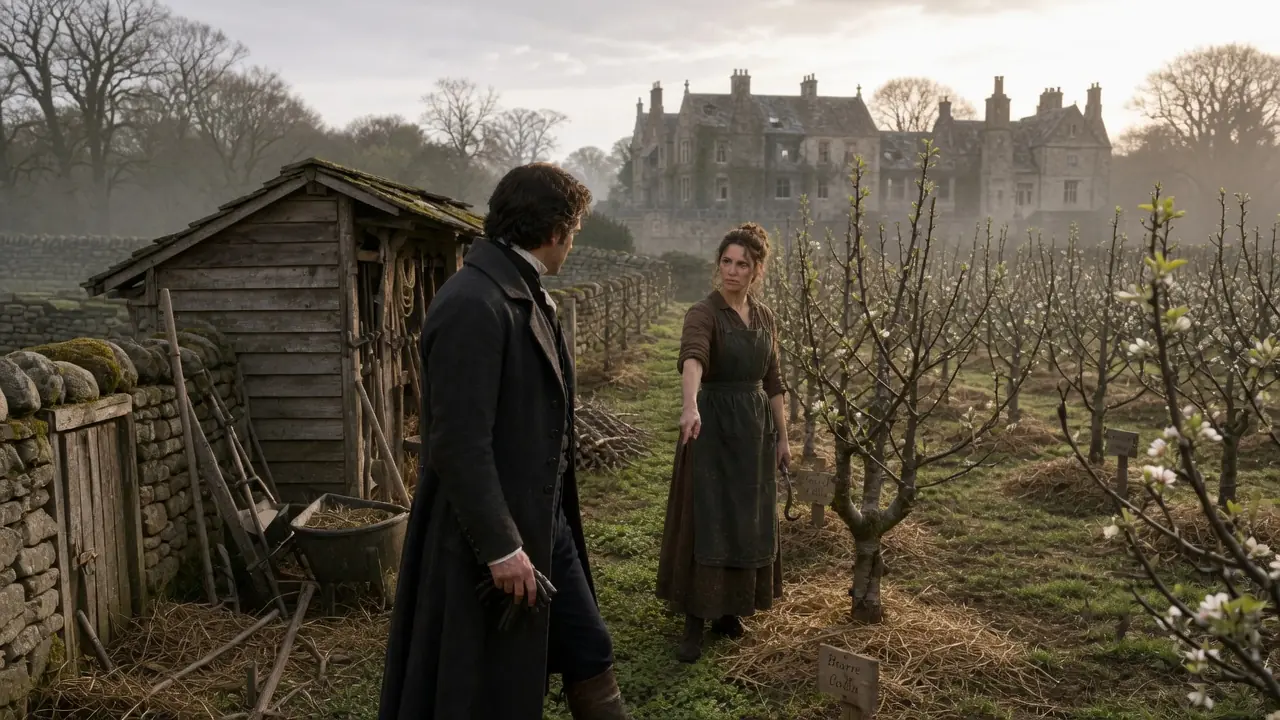
Not because of the noise or the politics or the endless vultures' sympathy of the town, but because in London every room still held the echo of a laugh that would never come again. Denham Hall rose from the mist like a gray monument to better days. The limestone walls were streaked with damp. Three windows on the east wing had been broken by winter storms and never repaired.
And the ivy had crept over the library balcony like a slow green tide. Thomas stepped down from the carriage and stood for a long moment. His greatcoat was heavy on his shoulders, his boots already sinking into the unkempt gravel. He had dismissed his steward six months ago.
The man had written letters, polite, careful letters about crop yields and tenant disputes and the leaking roof over the dairy. Thomas had read none of them. He had set them aside one after another until the pile on his desk in London had become a small monument to his own failure. The estate had run itself, or so he had told himself.
Land did not grieve. Land simply waited. The front door opened with a groan that suggested the hinges had not seen oil since Michaelmas. A single footman, pale and nervous, bowed so deeply that Thomas thought he might topple over.
"My lord, we did not—that is, no word arrived."
"I did not send one," Thomas said.
His voice sounded foreign to his own ears, too flat and too quiet.
"Is the house in order?" The footman hesitated.
That was answer enough. Thomas walked through the entrance hall, and the neglect greeted him like an old, unwelcome friend. Dust filmed the marble floor. The great staircase, where his mother had once stood to welcome guests in silk and pearls, bore a trail of muddy footprints that had been left to dry and harden into a map of carelessness.
A chill hung in the air, and when he passed the door to the morning room, he saw that the hearth was cold and full of ash. He did not go upstairs, not yet. The master suite waited at the end of the gallery, and in that suite, a wardrobe still held her dresses, Catherine's dresses, arranged by color, by season, by the meticulous hands of a maid who had since been dismissed. Thomas could not face the dresses.
He could not face the empty side of the bed. So, he turned instead toward the back of the house, toward the garden door, and stepped out into the pale April light. The walled garden had been his mother's pride. Now, the box hedges had grown shaggy and wild.
The rose arches had collapsed under their own, unpruned weight. And the fountain in the center held nothing but brown rainwater and a single, drowned thrush. Thomas stood at the edge of the fountain and felt something twist in his chest. Not the sharp grief he had carried for two years, but a duller, more insidious pain.
Shame, perhaps. Or the beginning of an anger he had been too exhausted to feel. He walked on. Beyond the walled garden, a path led down through a copse of silver birch to the orchards.
The Denham orchards had once been famous in four counties, acres of apples and pears, plums and quinces, their fruit pressed into ciders that fetched high prices in Bristol and London alike. His grandfather had planted the first trees. His father had expanded them. And Thomas, in the first year of his marriage, had walked these rows with Catherine on his arm, her laughter floating between the branches like music.
He had not set foot here since her funeral. The path was overgrown. Brambles caught at his coat, and more than once he had to step over fallen branches that no one had troubled to clear. But as he neared the first rows of apple trees, he slowed.
Something was wrong. Not wrong in the way of neglect, wrong in the way of unexpected order. The trees nearest the path were pruned, not perfectly, not professionally, but with a careful, deliberate hand. The grass beneath them had been cut, not to the smoothness of a lawn, but to a manageable length, and someone had laid straw mulch around the trunks.
He stopped and stared. A wooden stake beside the nearest tree bore a handwritten label. Ashmead's Kernel, 1812. The letters were neat and practical, the ink faded but legible.
He walked deeper into the orchard. Tree after tree had been pruned, labeled, and mulched. Dead branches had been removed and stacked in tidy piles at the end of each row. A lean-to against the far wall held tools, a pruning saw, a sharpening stone, a coil of twine, all organized with a kind of fierce, unpretentious efficiency.
Thomas stood in the middle of the orchard and felt the first genuine surprise he had experienced in two years.
"You are not supposed to be here."
The voice came from behind him, low and steady and utterly without deference. Thomas turned. She stood at the edge of the apple rows, a woman of perhaps thirty, though it was difficult to tell beneath the dirt on her apron and the sun-darkened skin of her arms. She wore no cap and her brown hair was pulled back in a severe knot from which several strands had escaped.
Her hands were gloveless and calloused and in one of them she held a pruning hook with an ease that suggested she knew exactly how to use it. Thomas stared. It had been a very long time since anyone had told him he was not supposed to be somewhere.
"I beg your pardon?" he said.
"The orchard," she said, as if that explained everything.
He looked down.
Beneath his boots, a fine green fuzz of clover seedlings pressed up through the soil. He stepped back, perhaps more hastily than dignity required.
"Who are you?" he asked.
She did not curtsy. She did not bow her head. She looked at him the way she might look at a weather front, assessing, unimpressed, and slightly inconvenienced.
"Martha Bell," she said. "I keep the orchard."
"You keep it?" he repeated.
"For whom?" For the first time, something flickered across her face, not deference, but a kind of guarded caution, as if she was suddenly aware that this stranger in the mud-stained greatcoat might have the power to undo something she had built.
"For the estate," she said carefully.
"Mr. Hodgson hired me before he left."
Hodgson.
The steward Thomas had dismissed by letter, the man whose careful report still sat unread in London. Thomas felt a slow burn of embarrassment. He had not even known the man's name six months ago. Now he could not remember if Hodgson had written to ask permission before hiring an orchard keeper, or if Hodgson had simply assumed, correctly as it turned out, that the Earl of Denham would not trouble himself to respond.
"I am Thomas Wickliffe," he said.
"Earl of Denham."
Martha Bell's expression did not change.
If anything, she looked slightly more tired.
"I know who you are, my lord," she said.
The title came out like an afterthought, tacked on for form's sake rather than respect.
"The question is, what do you want here?"
Thomas blinked.
"This is my land."
"Aye," she said, "and for two years they have been my trees. I have pruned every one of them. I have grafted new stock onto the old roots. I have rebuilt the south wall with my own hands after the storm brought it down. I have slept in that lean-to during the harvest to keep the boys from stealing the pippins. So, with respect, my lord, what do you want here?" The directness of it struck him like cold water.
In London, everyone had tiptoed around him. They had spoken in hushed voices and averted their eyes as if his grief were a contagious disease. No one had asked him what he wanted. No one had expected him to want anything at all.
"I came to see the estate," he said finally.
"I had not realized anyone was still working the land."
"Someone had to," Martha said.
She shifted her weight, the pruning hook swinging gently at her side.
"The tenants have been managing as best they can, but without a steward and without direction from the hall, things have been patchy. The orchards were going to waste, apples rotting on the ground, the press idle. I could not stand to watch it."
"So you simply took over."
"Someone had to," she said again.
There was no defiance in her voice, only a flat statement of fact.
"The trees do not care who owns them, my lord. They only care who tends them."
Thomas looked around at the neat rows, the careful labels, the pruned branches, and the mulched soil.
He thought of the dusty hall, the broken windows, the drowned bird in the fountain. He thought of Catherine's dresses still hanging in the wardrobe, waiting for a woman who would never wear them again.
"How long have you been here?" he asked.
"Eighteen months."
Eighteen months. He had been in London for eighteen months, sitting in his study with the curtains drawn, reading nothing, writing nothing, speaking to no one except the servants who left trays of uneaten food outside his door. And while he had been slowly dying by inches, this woman had been rebuilding his orchard.
"I should like to see more," he said.
Martha studied him for a long moment. Her eyes were gray, he noticed, the color of rain on slate, and they held no pity. That, perhaps more than anything else, made him want to stay.
"You will need proper boots," she said finally.
"And you will need to stay out of the clover."
Chapter 2: The Weight of Roots
Martha Bell had not wanted to be an orchard keeper. What she had wanted once was to be left alone, to tend her mother's small garden, to press her own cider, to live out her days in the cottage at the edge of the Denham Woods where she had been born. But her mother had died in the influenza outbreak of 1814, and the cottage had belonged to the estate, and the estate had belonged to an absentee Earl who had not answered a single letter in eighteen months. So Martha had done what she always did when the world refused to cooperate.
She had taken matters into her own hands. The orchards had been dying, not dramatically, not all at once, but in the slow, sad way of things left untended. Canker had spread through the pear trees. The plum trees had dropped their fruit before it ripened.
The old press in the barn had seized up with rust, and the cider barrels had cracked and dried. Martha had walked through those rows in the rain, her mother's pruning knife in her hand, and she had felt something rise in her chest that was not grief, but fury. She had not asked permission. She had simply begun.
Now, eighteen months later, she walked the rows every morning before dawn, checking for blight and borers, testing the soil with her fingers, talking to the trees in the low, murmuring voice her mother had used for her seedlings. The trees did not talk back, but they responded with strong branches, with healthy bark, with the first delicate buds of a spring that promised the best harvest in years. And now, the Earl of Denham had returned, and he wanted to see more. She led him through the orchard in silence, partly because she did not know what to say to a man who had neglected his land for two years, and was only now bothering to look at it.
And partly because the orchard required silence to be understood. The Earl, to his credit, did not fill the quiet with nervous chatter. He walked behind her with his greatcoat buttoned against the damp, and he looked at everything. The labels, the pruning cuts, the new grafts, the rebuilt wall, with an attention that surprised her.
"This wall," he said, stopping beside the south boundary.
"You said you rebuilt it yourself." "With help from the Fletcher boy," she said.
"He's twelve and strong as an ox. He carried the stones. I laid them." The Earl touched the wall with one gloved hand.
The stones were rough and uneven, but they held. The mortar was a little crude. She had mixed it herself, guessing at the proportions, but it had set hard, and the wall had stood through two winter storms without so much as a wobble.
"My grandfather built this wall," the Earl said quietly.
"He used to tell me that a good wall was like a good marriage. It needed a strong foundation and the patience to let things settle." Martha did not know what to say to that.
She knew the Earl had been married. Everyone in the village knew. They also knew that his wife had died, thrown from her horse on an autumn ride, her neck broken before anyone could reach her. The village had expected the Earl to grieve, then to recover, then to return.
Instead, he had disappeared into his London house and stayed there like a badger gone to ground.
"It's a good wall," she said finally.
"It'll last another fifty years with care." The Earl nodded.
He did not look at her. He kept his hand on the stones, and for a moment, Martha saw something in his face that she had not expected to see. Not grief, exactly, but the shape that grief leaves behind. A hollow where something had once been.
She looked away. It was not her business to see such things. They walked the rest of the orchard in silence. She showed him the new cider apples she had grafted, Kingston Blacks and Stoke Red, varieties her mother had taught her to love, and the quince trees that had finally taken to the soil after three tries.
She showed him the barn where she had repaired the press, scrounging parts from three different scrap yards, and teaching herself the mechanics by trial and error. She showed him the ledger where she had recorded every expense, every harvest, every gallon of cider sold to the village and beyond.
"I have been keeping accounts," she said, handing him the ledger.
"I have made a profit. Not a large one, but a profit. I have been putting it aside for new trees." The Earl took the ledger and opened it.
His hands were pale and fine, the hands of a man who had not done physical labor in a very long time. But he turned the pages slowly, reading her cramped handwriting, her careful columns of numbers, her notes on weather and pests and yields.
"You've done all of this alone," he said.
It was not a question.
"Mostly." "Why?" Martha considered the question.
She had been asked it before by the village women who thought she should marry, by the Fletcher boy's mother who thought she should find easier work, by the vicar who thought she should spend more time in church and less time in the mud. She had never given a satisfactory answer because the truth was difficult to explain.
"Because the trees don't care about my grief," she said finally.
"They don't care if I'm tired or lonely or frightened. They only care if I water them and prune them and protect them from the frost. And when I do those things, they grow. They bear fruit. They keep living, even when I am not sure I want to."
She had not meant to say so much. The words had come out before she could stop them and now they hung in the damp air between them like smoke. The Earl closed the ledger. His face was unreadable.
"My wife died," he said.
"Two years ago."
"I know," Martha said.
"I have not been able to do anything since. Not properly. Not the way I should." Martha waited.
She had learned in eighteen months of solitude that silence was often kinder than words.
"I came back because I thought the estate would be in ruins," the Earl continued.
"I thought I deserved to see it in ruins. I thought it would match what was inside me." He looked up at the apple trees, at the first pale blossoms beginning to unfurl.
"But it is not in ruins. You have made it thrive."
"The trees made it thrive," Martha said.
"I only helped." For a long moment, neither of them spoke.
A blackbird sang somewhere in the branches, a clear, bright note that seemed to cut through the fog of the morning. The Earl's shoulders, which had been hunched against the cold, relaxed slightly.
"I should like to help," he said, "if you will allow it." Martha felt a flicker of something, fear, perhaps, or the beginning of hope.
She had built something here. She had rebuilt the orchard from the edge of ruin, and in doing so, she had rebuilt something in herself. If the Earl took over now—if he brought in his own gardeners and his own stewards and his own ideas—everything she had done might be undone. Her independence, her purpose, her place in the world.
But he was the Earl. The land was his. And he was looking at her with an expression she could not quite read, not entitlement, not command, but something closer to need.
"You can help with the pruning," she said carefully, "if you follow my instructions." The Earl nodded.
"I can follow instructions." "And you'll need to wear older clothes. That coat will be ruined in an hour." A ghost of something, not quite a smile but the suggestion of one, passed across his face.
"I have older clothes." "Good," Martha said.
She turned back toward the trees, her pruning hook swinging at her side.
"We start at dawn."
Chapter 3: The Shape of Trust
The first week was a disaster. Thomas Wickliffe, Earl of Denham, discovered that pruning an apple tree was nothing like signing a bill in Parliament or writing a letter to one's solicitor. It required strength he did not have, patience he had not cultivated, and a degree of humility he had never been forced to learn. He cut branches that should have been saved.
He left stubs that invited disease. He nearly fell off the ladder three times in the first morning alone. And each time, Martha Bell watched him with an expression of profound forbearance that somehow stung more than mockery would have.
"You're thinking too much," she said on the fourth day, after he had hesitated for a full minute in front of a branching limb.
"The tree knows what it needs. You only have to listen." "Trees don't speak," he said exasperated.
"They do," she said, "just not in words." She took his hand, his hand without asking permission, and placed it on the branch he had been studying.
Her fingers were calloused and warm, and the contact sent an unexpected jolt through him.
"Feel that," she said, "the way the sap is rising. The buds at the tip are strong, but the ones underneath are weak. So, you cut here, above the strong bud, and the tree will put its energy where it belongs." He felt the branch.
He felt the slight swelling of the buds, the faint warmth of living wood beneath the bark. And for the first time in two years, he felt something other than the cold, heavy weight of grief. He felt curious. He felt present.
He felt, absurdly, as if he were learning a language he had forgotten he once knew.
"I think I understand," he said.
Martha released his hand and stepped back.
"Good. Now, do it yourself." He made the cut.
It was not perfect. The angle was slightly wrong, the cut slightly too far from the bud, but it was his. And when he looked at Martha, she nodded once, a small, grudging acknowledgement that felt like a victory. Over the following weeks, they fell into a rhythm.
He arrived at the orchard each morning as the sun rose, wearing a worn linen shirt and a pair of old breeches that had once belonged to his father. She was always there before him, her apron already stained with sap, her hands already dirty. She did not greet him with ceremony. She simply handed him a pruning saw and pointed to the row she wanted him to work.
They talked as they worked, not about grief or loss or the things that kept them awake at night, but about the trees. She taught him the names of the varieties, the sharp, complex Kingston Black, which made the best single-variety cider, the sweet, mild Stoke Red, which blended well with others, the ancient pear tree at the edge of the orchard that she believed was at least two hundred years old. He learned to recognize canker by the sunken, discolored bark and apple scab by the olive green spots on the leaves. He learned that the best time to graft was late winter, that the worst time to prune was autumn, that a frost on a blossom night could destroy an entire year's harvest in a single hour.
In return, he told her about the estate's history, about his grandfather who had planted the first trees, about his father who had nearly bankrupted the estate with his love of horse racing, about his mother who had kept the household running through sheer force of will. He did not talk about Catherine. Not yet. But he found himself wanting to, which was a change he had not anticipated.
The village noticed. Of course they noticed. The Earl of Denham, who had not been seen in two years, was suddenly walking through the orchards every day in his shirt sleeves, his hands covered in dirt, his face turned toward the sun. The servants at the hall whispered behind their hands, the tenants watched from their cottage windows, and the vicar, a man of determined optimism, began making pointed remarks about the healing power of honest labor.
Martha heard the whispers. She had always heard the whispers. About her unwed state, about her rough hands, about her habit of answering gentlemen as if they were no different from anyone else. But the new whispers were different.
They carried a note of speculation that made her uneasy.
"They're saying he's taken an interest in you," said Betsy Fletcher, the mother of the strong-armed boy who had helped with the wall.
Betsy had come to the orchard to buy a basket of early rhubarb, and she had lingered longer than necessary, her eyes bright with gossip.
"Not only in the orchard, mind. In you."
"He has taken an interest in the trees," Martha said flatly.
"That is all." "A man does not spend every day with a woman for months unless he has taken an interest," Betsy said.
"And a woman does not let him unless she has taken one back." Martha counted out the rhubarb in silence, her jaw tight.
She had not let the Earl do anything. He had asked to help, and she had allowed it because the orchard needed the labor, and because she had seen something in his face that first day, something hollow and hurting that she recognized. She knew what it was to lose someone. She knew what it was to walk through the world feeling as if half of yourself had been amputated, and no one else could see the wound.
But that was not the same as taking an interest. It was not the same as caring, and she could not afford to care because the Earl would leave eventually. Men like him always left. They returned to London, to their fine houses and their fine friends, and the women they had worked beside in the orchards became a story they told at dinner parties.
Do you know, I once spent a season learning to prune apple trees. Most amusing. She would not be a story. She would not be a diversion.
She had built too much here to let it be taken apart by a man's careless affection. So she kept him at a distance. She answered his questions, but did not ask her own. She worked beside him, but did not touch him, not even to guide his hand as she had that first week.
She retreated into the crisp, practical efficiency that had served her so well, and she told herself that the flicker of disappointment she saw in his eyes was none of her concern. But Thomas Wickliffe was more perceptive than she had given him credit for.
"You are avoiding me," he said one afternoon, setting down his pruning saw and turning to face her.
The sun was low in the sky, slanting through the branches and casting long shadows across the grass. They had been working in silence for nearly an hour and the tension between them had thickened until it was almost visible.
"I am not avoiding you," Martha said.
"I am working." "You have barely spoken to me in three days. You will not look at me. And when I asked about the quince grafts, you gave me a one-word answer and walked away." He stepped closer and she stepped back, her shoulders pressing against the trunk of an apple tree.
"What have I done?"
"Nothing," she said.
"You have done nothing. That is the point." He frowned.
"I do not understand."
Martha took a breath. The apple bark was rough against her back and the scent of blossoms filled the air, sweet and almost cloying. She had spent eighteen months building walls around herself. Stone walls, yes, but also walls of habit and solitude and the fierce stubborn independence that had kept her alive after her mother died.
The Earl had been chipping away at those walls without even knowing it and she was afraid of what would happen when they fell.
"You are going to leave," she said.
"Eventually. You will go back to London, or you will find something else to occupy your time, and the orchard will go back to being what it was before—a place you visit once a year, if that, to walk among the trees and remember your wife."
His face went pale. She had struck a nerve, and she knew it, but she could not stop.
"And I will still be here," she continued.
"I will still be the woman who keeps your orchard, who rebuilds your walls, who presses your cider and sells it in the village, and who accounts for every farthing in a ledger you will never read. But if I let myself care about you—if I let myself want things I have no right to want—then when you leave, I will not survive it. I barely survived losing my mother. I will not lose myself again for a man who cannot stay." The words hung in the air between them, raw and ugly and true.
Martha wished she could take them back, but she could not. She could only stand with her back against the apple tree and wait for him to speak. Thomas was silent for a long time. He looked at her.
Really looked. Not the way he looked at the trees, but the way one person looks at another when they are trying to see past the surface. Then he took a step closer. Close enough that she could see the flecks of gold in his brown eyes, the lines of weariness around his mouth.
"You are right," he said quietly.
"I have left things. I have left this estate, these people, these trees. I left them because I could not bear to stay, and I told myself that my grief excused me. But it does not excuse me, Martha. It explains me, but it does not excuse me." He reached out and took her hand.
Not to guide it to a branch this time, but simply to hold it. His palm was no longer pale and soft. Weeks of pruning had calloused it, roughened it, made it more like hers.
"I cannot promise I will never leave," he said.
"There are duties I cannot ignore, responsibilities in London that will call me back. But I can promise that I will return. I can promise that this place, this orchard, these trees, and the woman who saved them will be the reason I do." Martha looked down at their joined hands.
Her heart was beating too fast, and her throat was tight, and she was afraid in a way she had not been since her mother's last breath. But she was also, despite herself, hopeful.
"That's a fine promise," she said.
"But promises are just words. What matters is what you do." "Then let me show you," he said.
"Let me stay. Let me help. Not because I am the earl and this is my land, but because I want to be here with you." She should have said no.
She should have pulled her hand away and told him to keep his distance, to go back to the hall and leave her to her trees. But the blossoms were sweet in the evening air, and his hand was warm in hers, and she was so very tired of being alone.
"Dawn tomorrow," she said.
"Don't be late." He smiled.
A real smile, the first she had seen from him.
"I won't."
Chapter 4: The Harvest
The summer came on hot and dry, and the orchard thrived. Thomas threw himself into the work with an intensity that surprised even Martha. He learned to thin the fruit so the branches would not break under the weight. He learned to prop up the heaviest limbs with forked sticks cut from the hazel copse.
He learned to recognize the subtle signs of drought stress, the curling leaves, the dulled color, and to haul water from the well when the rains did not come. In August, they pressed the first of the early apples. The old press groaned and creaked, but Martha had repaired it well, and the juice ran golden into the waiting barrels. Thomas turned the screw until his arms ached, and Martha caught the overflow in a wooden cup and handed it to him to taste.
It was sharp and sweet and alive. And Thomas closed his eyes as he drank it, feeling the sun-warmed fruit become something new in his mouth.
"That's the best thing I have ever tasted," he said.
Martha laughed, a real laugh, open and unguarded.
"You said that about the rhubarb tart last week." "And I meant it then, too." They worked through the harvest together, side by side, and the village stopped whispering.
Or rather, the whispers changed. They became kinder, softer, touched with something that might have been hope. The Fletcher boy carried baskets. Betsy brought pies.
The vicar, unable to contain himself any longer, appeared at the orchard gate one afternoon with a bottle of elderflower wine and a pointed observation that the Lord worked in mysterious ways.
"He does," Martha said dryly, "mostly through pruning hooks."
Thomas laughed.
He laughed more now than he had in years, not the hollow, desperate laughter of grief, but the easy, unforced laughter of a man who had forgotten until recently that joy was still possible. But October brought a different kind of pressure. A letter arrived from London, forwarded by Thomas's solicitor. The House of Lords was debating a bill that would affect the estate's wool tariffs, and his presence was required, not requested, required.
The letter was polite but firm, and Thomas read it three times before folding it and setting it on the kitchen table. Martha found him there that evening, staring at the folded paper as if it might burst into flames.
"London?" she asked.
"London," he confirmed.
"They need me to vote. The tariffs could ruin the tenant farmers if they pass without amendment." Martha sat down across from him.
The kitchen was small and warm, lit by a single oil lamp that cast dancing shadows on the walls. She had never invited him into her cottage before. This was his first time inside, and she had been acutely aware of how small it was, how humble, how different from the grand halls he had grown up in. But he had not seemed to notice.
He had looked around at her shelves of preserves, her bundles of dried herbs, her mother's old rocking chair by the fire, and he had said simply, "This is a good home." Now he was leaving, and she was supposed to be prepared for it. She had told herself she was prepared for it. But the folded letter on the table felt like a door closing.
"How long?" she asked.
"A month, perhaps two. The session may run longer if the debates are heated."
A month? Two months? A winter without him in the orchard, without his careful questions, his clumsy pruning, and the way he looked at her sometimes when he thought she was not watching—as if she were something precious?
"Then you should go," she said.
"The tenants need you."
"And the orchard?" he asked.
"Does the orchard need me?" Martha looked at him across the table.
The lamplight caught the angles of his face, the fine lines around his eyes that had deepened over the summer, the gray that had begun to show at his temples. He was not the man who had arrived in April, hollow-eyed and hunched, drowning in grief he could not name. He was someone else now, someone who laughed, someone who worked, someone who had learned to listen to trees.
"The orchard will keep," she said.
"It kept before you came, and it will keep while you are gone."
She hesitated. The words were harder to say than she had expected.
"But I will miss you."
Thomas reached across the table and took her hand.
His grip was firm and warm and he did not let go.
"I will come back," he said.
"I told you that. I meant it."
"Promises are only words," she reminded him.
"Then let me give you something more than words."
He stood, still holding her hand, and drew her gently to her feet.
"Martha Bell, I have spent two years running from everything that mattered. I ran from this estate. I ran from my tenants. I ran from the memory of my wife because remembering her hurt too much. But I have stopped running, and I have stopped because of you. You showed me that the world does not stop simply because I am hurting. The trees keep growing. The fruit keeps ripening. Life keeps happening whether I am ready for it or not."
Martha's throat was tight. She could feel the tears building behind her eyes and she fought them back out of habit, out of the fierce independence that had carried her through so much. But Thomas saw them anyway.
"I love you," he said.
"I know it is too soon. I know you have every reason not to trust me. I know I am an earl and you are an orchard keeper and the world will have opinions about that. But I do not care about the world. I care about you, and I will spend the rest of my life proving it if you will let me."
Martha stood very still. The oil lamp flickered. Outside the wind moved through the orchard, rustling the last of the autumn leaves. She thought of her mother who had always told her that love was not a feeling, but a choice.
A choice to stay, to work, to tend, to believe that something beautiful could grow from the most unlikely soil. She thought of the apple trees grafted onto old roots blooming in spite of everything.
"You will come back," she said.
It was not a question.
"I will come back," he said.
"Every time, for as long as you will have me." She lifted her free hand and touched his face, his cheek still rough with the day's stubble, warm beneath her fingers.
He closed his eyes at her touch. And she saw something in his expression that she had not seen before. Not need. Not desperation.
But the quiet, steady certainty of a man who had finally found where he belonged.
"Then come back," she said.
"And when you do, the orchard will be waiting. And so will I."
He kissed her then, gently, as if she were something fragile.
Perhaps she was. But she had rebuilt walls and grafted trees and pressed cider from the hardest apples. She had survived loss and loneliness and the slow grinding work of building a life from nothing. She was not fragile.
She was not breakable. She was Martha Bell, keeper of the Denham Orchards, and she had finally found someone worth keeping.
Epilogue: The Root and the Branch
Spring came again to Denham Hall and with it Thomas Wickliffe. He returned from London not with a carriage full of fine clothes and London manners, but with a single valise and a grafting knife he had purchased from a market stall near Westminster. He found the orchard in good order. Martha had kept it through the winter as she had promised.
And he found Martha herself standing by the south wall, her hands on her hips, surveying the first blossoms of the year.
"You're back," she said.
"I said I would be."
She smiled.
It was not a wide smile, not a laughing smile, but the small, private smile of a woman who had been watching the road for weeks and had finally seen what she was waiting for.
"Good," she said.
"The Kingston Blacks need pruning, the quince grafts are struggling, and the cider from last autumn has finished fermenting. I think you should taste it before I decide whether to sell it or keep it all for myself."
Thomas set down his valise and walked toward her, past the labeled trees and the tidy rows and the wall he had helped her rebuild. The blossoms were white and pink against the blue sky and the air smelled of damp earth and new growth and the particular sweetness of a world waking up after a long sleep.
"I have something for you," he said, reaching into his coat pocket.
He pulled out a small wooden box, plain and unvarnished, and held it out to her. Martha looked at the box. She did not take it immediately.
"What is it?"
"Open it and see."
She opened it.
Inside, nestled on a bed of dried apple leaves, was a ring, not gold or silver, but a simple band of polished apple wood carved by hand and finished smooth as silk. A single seed, perhaps from a Kingston Black or a Stoke Red or one of the ancient pear trees, was set into the wood like a jewel.
"I made it myself," Thomas said.
"It took me six tries. The first five broke on the lathe. But I wanted something that came from this place—from the orchard, from the trees we have tended together. I wanted something that would remind you that I am rooted here now, that I am not leaving."
Martha looked at the ring for a long moment. Then she looked at him, at the dirt under his fingernails, the sun on his face, the quiet hope in his eyes. He was not the man who had arrived a year ago, lost and grieving and afraid. He was not the earl who had neglected his land.
He was Thomas, her Thomas, the man who had learned to prune apple trees and listen to the soil and love a woman who answered to no one.
"Put it on me," she said.
He took the ring from the box and slid it onto her finger. It fit perfectly. Of course it did, because he had measured her hand while she slept, pressing a piece of twine around her finger in the dark. The wood was warm against her skin, and the seed caught the light, and Martha felt something shift in her chest.
Not the collapse of a wall, but the opening of a door.
"I have something for you, too," she said.
She led him to the oldest part of the orchard, to the place where the ancient pear tree stood at the edge of the woods. And there, in the space between the pear tree and the wall, she showed him what she had planted while he was gone. A new sapling, small and fragile, its green leaves unfurling toward the sun.
"What variety?" he asked.
"I don't know yet," she said.
"I grafted it myself from a cutting I took the day you left. It might be nothing, or it might be something new. We will have to wait and see."
Thomas looked at the sapling, then at her, then at the ring on her finger. The spring wind moved through the orchard, carrying the scent of blossoms and the distant sound of birdsong. Somewhere in the village, a church bell began to ring.
"We have time," he said.
"We have the rest of our lives."
Martha leaned into him, and he put his arm around her. And together they stood in the orchard that had saved them both, the Earl and the orchard keeper, the grieving man and the practical woman, two people who had learned, at last, that the most beautiful things in life were the ones that took the longest to grow. The sapling swayed in the wind, and the old pear tree dropped a single petal onto Martha's hair, and the world, for once, felt exactly as it should.
The End.