The ballroom at Ashworth Hall was empty now. The last carriage had rolled away an hour ago. The last guest had climbed the great stairs to a guest room or ridden off into the dark with a lantern swinging beside the horse. The servants had put out most of the candles. Only a few still burned in the tall silver stands along the walls.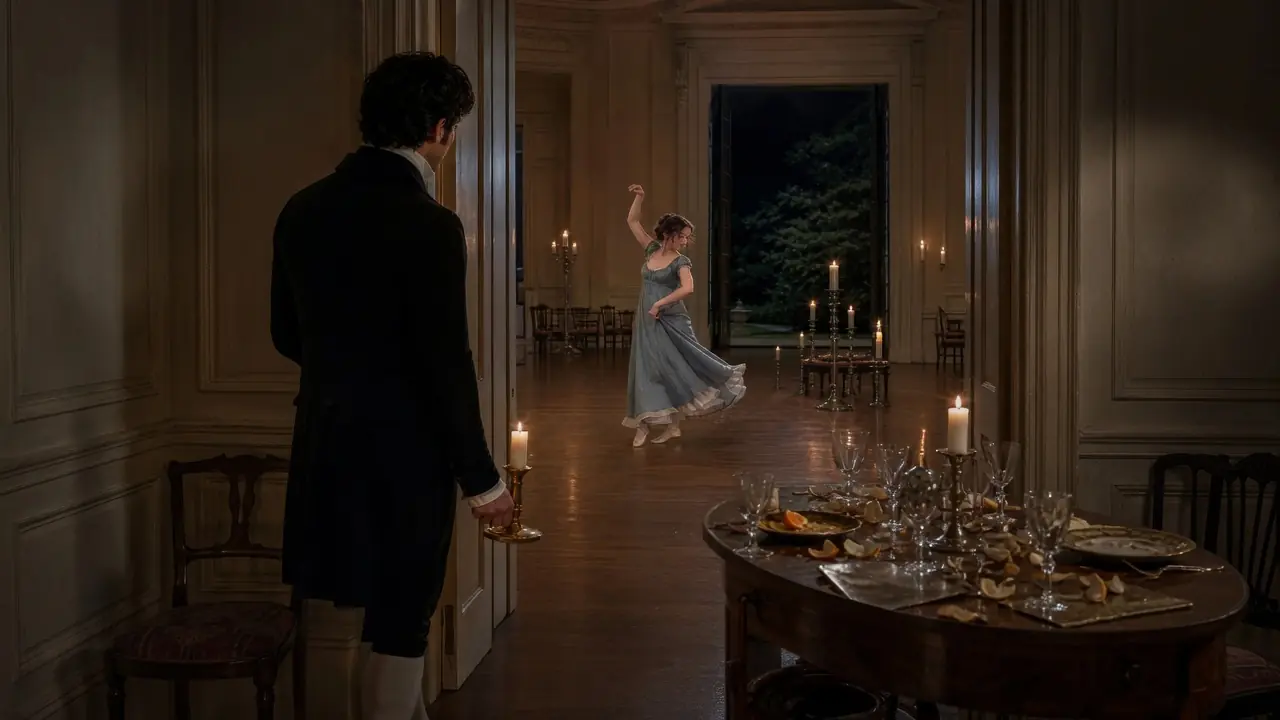
The music had stopped. The violins were in their cases. The men who played them had gone home to their small houses in the village. But the ballroom was not quite empty. A woman stood in the middle of the floor.
Her name was Vivian Ashcombe. She was twenty-four years old. She was the poor cousin of the family who owned the house. She had lived at Ashworth for six years, ever since her father died leaving nothing but debts and her mother followed him a year later from grief. She had a small room at the top of the house, near the servants.
She had two dresses. She wore the better one tonight. The floor under her slippers was polished wood, dark as tea. It smelled of beeswax and something older, something like the smell of old paper. The air held the last ghost of orange peel and wine, along with the sweet powder the ladies had used on their necks.
A tall window at the end of the room stood open to the summer night. She could hear an owl calling from the woods beyond the garden. Somewhere far off, a fox barked once. Her breath made no sound. She began to dance.
There was no music. There was only the sound of her own soft slippers on the wood. There was only the whisper of her skirt and the small in-and-out of her own breathing. She lifted her arms as if a partner held her. She stepped to the left.
She stepped to the right. She turned. Her skirt lifted a little and fell. She turned again. She had watched other women dance all evening.
She had stood near the wall with a cup of warm punch in her hand, and she had watched. And she had counted the tiles on the ceiling when she grew tired of watching. Nobody had asked her to dance. Nobody ever did. She was too poor to be a prize.
She was too proper to be a scandal. She was, in the way of many quiet women at loud parties, invisible. But she loved to dance. She had learned as a small girl in her father's small drawing room before the money went away. Her father had lifted her onto his boots and walked her around the rug.
He had hummed a tune. She could still hear the tune in her head if she listened. She heard it now. She turned again. She smiled a little at nothing.
Her hair had begun to slip from its pins. A curl fell against her cheek. She did not fix it. She did not know that a man was watching her from the shadow of the doorway. His name was Rowan Sterling.
He was the Duke of Marchwood. He was thirty-one years old, tall, dark of hair, with the sort of face that people did not call handsome so much as they called it hard to look away from. He had come to Ashworth as a guest of the family. He had danced with three young ladies because it was expected. He had spoken with two mothers because it was polite.
He had drunk one glass of wine because he did not like the taste of any more than that. He had gone upstairs to his room an hour ago. He had not been able to sleep. He had come back down for a book. The library was two doors past the ballroom.
He had walked through the great hall in his stocking feet, carrying a candle in a brass holder, and he had heard something. A small soft sound. The sound of a slipper on wood. He had stopped. He had listened.
He had turned toward the ballroom, and he had pushed the door open a hand's breadth, and he had looked in. And he had not moved since. He did not know how long he had stood there. His candle had burned down a quarter of an inch. The wax had run over the edge and cooled against his thumb.
He had not felt it. She was not the most beautiful woman he had ever seen. He had met women whose faces made rooms go quiet. He had once, in London, watched a duchess walk across a courtyard and seen three grown men forget what they were saying. This woman was not that.
She was dancing as if the room was still full. She was dancing as if she had been waiting all night for this one hour when nobody would see her. And now that the hour was here, she was going to use every minute of it. He had never seen anything like it. He watched her turn.
He watched her lift one hand, palm up, as if a partner had just taken it. He watched her lower her head a small, polite fraction, as if a partner had just bowed to her. He watched her step and step and step and turn again. The candle wax burned his thumb at last. He did not flinch.
He shifted the candle to his other hand and kept watching. She reached the end of the dance she was hearing. She stopped in the middle of the floor. She stood there breathing, with her arms at her sides and her chin lifted. Then she made a small curtsy to no one.
That was what broke him. The curtsy was not for show. It was not for practice. It was the small, polite ending a woman gives to a partner she has been dancing with. She had given it to the empty air.
She had given it to a man who was not there. He stepped back from the door. He was not a man who acted on feeling. He was a man who thought first, who weighed, who measured. His father had taught him this before his father died, and his father's death had taught him again.
He had inherited the title at nineteen. He had learned very fast that a duke who acted on feeling was a duke who was robbed, cheated, or married to the wrong woman. He had grown up hard. But he stood in the dark hall outside the ballroom with a candle in his hand and wax cooling on his thumb, and he thought, "I want to know her name." He did not go in. He did not speak.
He did not want to frighten her, and he did not want her to know she had been seen. He turned around. He walked back up the great stairs in his stocking feet. He set the candle on the table by his bed. He did not read.
He lay awake until the sky began to gray. She did not know he had watched. She danced two more dances by herself in the empty room, and then she was tired, and she stopped. She walked to the tall window and stood in the smell of the summer garden, and she pressed her forehead against the cool glass for a moment, and she smiled at nothing. Then she climbed the servants' stair to her small room.
She unpinned her hair. She hung her dress on a peg. She was asleep within a minute, and she did not dream. In the morning, the house began to wake around her. She rose at six because that was when she always rose.
She washed her face in cold water from the pitcher on the small table. The water bit her cheeks. Outside her tiny window, a wren was singing on the roof tiles, and she could smell bread from the kitchen far below. She dressed in her plain gray morning gown. She pinned up her hair.
She went down. Her aunt, Lady Marchmont, was already in the breakfast room, though it was early. Her aunt did not sleep well. Her aunt did not do anything well, except say small, cruel things at meals. Her aunt was thin and pale and had a mouth like a closed purse.
Her two daughters, Petra and Cecily, were still upstairs. They would sleep till noon after the ball. "Vivian," said her aunt, without looking up. "You will see to the flowers in the blue drawing room. The Duke of Marchwood remains for another three days.
It would be a shame if he saw wilted lilies." "Yes, Aunt. And the linens for his room are to be changed at once. He is a particular man." "Yes, Aunt. And do keep out of his way, my dear. He has come to look at Petra.
It would not do for him to see the poor cousin lurking in every hall." Vivian did not answer. She poured her tea. The tea smelled of bergamot and something sharp beneath it. Her hand did not shake. She had heard worse from her aunt.
She had heard it every morning for six years. She had learned that the tea was still tea and that the bergamot was still there, whether her aunt spoke or did not speak. "Do you understand me?" said her aunt. "Yes, Aunt. I will keep to the back halls." "Good girl." Vivian drank her tea.
She ate a piece of dry toast. She smelled the wax on the sideboard where the maid had polished it that morning. She listened to the small clink of her aunt's spoon in her aunt's cup. She thought about the dance in the empty ballroom, and she folded that thought up small, like a letter, and she put it away in the pocket where she kept the things she owned. Then she rose and went to see to the flowers.
The Duke was already in the blue drawing room. He was standing at the window with his hands behind his back. He wore a dark coat, plain, well-cut. His hair was still damp at the ends from washing. He did not turn when she came in.
Perhaps he had not heard her. She had learned to move quietly. She set her basket of fresh lilies on the small table by the wall. She began to lift the wilted ones from the tall vase. Their stems had gone brown at the base.
They smelled sweet in the way that old flowers smell, sweet and a little wrong. She laid them in the basket. She did not look at the Duke. "You danced last night," he said. She stopped.
She did not turn to him. She stood with a wilted lily in her hand and a drop of green water running down her wrist and into her sleeve. "I beg your pardon, Your Grace?" "In the ballroom, after the guests had gone," he said. "You danced alone." The room went very quiet. She could hear a clock ticking on the mantel, a bird outside, and her own heart beginning to move faster in her chest. She thought, He must not know it was me.
Then she thought, He does know. He would not have said it if he did not. She turned slowly. She set the wilted lily down on the table. She looked at him.
He had turned from the window. He was looking at her. His eyes were gray, the color of pewter. He was not smiling. He was not frowning.
He was simply looking at her, the way a man looks at a page he is trying to read. "You watched me," she said. She said it flatly, without a question in it. "I did not mean to. I came for a book.
I heard a sound. I looked in." "For how long?" "Longer than I should have." She felt the heat come up her neck. She hated that it came. She hated that she could not stop it. "Your Grace, I did not know I was being seen. It was not a performance."
"I know it was not."
"Then why do you speak of it now?" He was quiet for a moment. He looked at his own hands, then back at her. "Because I have not stopped thinking of it," he said. She did not know what to say to that. Nobody had ever said such a thing to her in her life. She thought of her aunt's voice at breakfast.
Do keep out of his way. She thought of Petra and Cecily upstairs, still asleep in their good beds. She thought of her two dresses. "Your Grace," she said, "if my aunt learns of this, I will be sent from this house within the hour. I have nowhere to go.
I would ask you, as a kindness, not to speak of it again." He looked at her for a long time then. She met his eyes because she had learned, at some point in the last six years, that meeting a person's eyes was the only weapon a poor woman had. "I will not speak of it to anyone," he said at last. "You have my word." "Thank you." She turned back to the flowers. Her hands were not quite steady.
She lifted the fresh lilies one by one and slid them into the vase. And she trimmed each stem with the small knife from her basket. He did not move. She could feel him behind her at the window, watching her the way he had watched her in the ballroom. She did not turn again.
When she was done, she took the basket of dead flowers and she left the room. She did not run. She walked. She got to the servants' stair, and only then did she press her hand against the wall and breathe. The wall was cool.
The stairs smelled of old wood and beeswax and, faintly, of the kitchen far below where someone was frying bacon. Her breath came out ragged. She stood there for a full minute. Then she straightened her back. And she went down to throw the dead lilies on the compost heap behind the kitchen garden.
The Duke did not sleep well that night either. He stood at his window and looked out over the garden. The moon was high. He could see the shape of the yew hedges black against the silver of the lawn. He could see a single lit window down in the servants' wing and he wondered which one was hers.
He did not know her name. He had not asked. He had not needed to. He knew where to find her. He thought about what she had said.
"If my aunt learns of this, I will be sent from this house within the hour." He turned the sentence in his mind. He was a man who paid attention to what people did not say. She had not said, "My aunt would be angry." She had said, "Sent from this house." She had said, "I have nowhere to go." These were the words of a woman who had counted her choices and found that she had one. He had come to Ashworth to look at Petra Marchmont as a wife. It had been suggested by a friend of his mother.
Petra was pretty. Petra was rich. Petra was, he had realized over the course of the ball, entirely uninteresting. He had watched her all evening. She had danced beautifully.
She had smiled at all the right people. She had laughed at all the right jokes. She had asked him three questions about his estate and none about him. She had never once in the whole evening looked at anything as if she was seeing it for the first time. The girl in the ballroom had looked at the empty air as if it held every wonderful thing in the world.
He turned from the window. He sat down at the small writing desk. He drew a piece of paper toward him. He picked up a pen. He set it down again.
He was not a man who wrote romantic letters. He had never written one in his life. He did not know how to begin. He did not write anything. He went to bed.
He slept a little, and when he woke, he had decided what to do. Over the next two days, he found reasons to be in rooms where she was. He did it carefully. He did not want her aunt to notice. He did not want her cousins to notice.
Most of all, he did not want her to feel hunted. So, he moved through the house the way a man moves through a wood when he wants to see a deer. Slow, quiet, at the edge of her sight. He read in the library when she came to dust the shelves. He walked in the garden when she came to cut roses.
He passed her in the long gallery when she was carrying a folded pile of clean linen. And he only nodded. And he went on. He watched her. He learned things.
He learned that she had a habit of touching the frame of a doorway lightly with two fingers as she passed through it. As if she was saying hello to the house. He learned that she spoke to the old butler, Mr. Halston, with real warmth. And that Mr. Halston, who had not smiled in fifteen years, had a small quick smile that appeared only for her. He learned that she carried a book in her apron pocket.
And that when she thought no one was looking, she would slip into a window seat behind a curtain and read for four minutes. And then she would close the book and go back to work. He learned that her name was Vivian. He learned it from a maid who said it in passing to another maid and who did not know he was around the corner listening. "Miss Vivian says the pears need another week." He said the name to himself twice, quietly, testing it on his tongue.
Vivian. Vivian Ashcombe. He had asked no one about her. He had told no one what he was doing. He was not sure yet what he was doing.
On the second day, he was walking back from the stables when he passed the kitchen garden and he saw her. She was on her knees in the dirt. She was pulling weeds from between the rows of carrots. Her sleeves were rolled up. Her forearms were brown from the sun in a way a lady's forearms were not supposed to be.
There was dirt on her cheek where she had pushed her hair back with a soil-covered hand. She was singing under her breath. He could not hear the words, but he could hear the tune. He stopped at the gate. He watched her for a moment.
Then he saw the old gardener, Mr. Peck, coming up the path behind him with a basket of onions. Mr. Peck was seventy if he was a day. He walked with a bad limp. The basket was too heavy for him. Mr. Peck did not see the Duke because Mr. Peck was looking at his feet, which were sore.
The Duke stepped back from the gate. He walked toward Mr. Peck. He said quietly, "Let me carry that for you as far as the kitchen door." Mr. Peck looked up, startled. His mouth opened. He did not know what to say.
A duke did not carry onions. A duke did not carry anything. A duke walked with his hands behind his back and let other men carry things for him. "Your Grace, I could not. It is a heavy basket and a long path.
Let me carry it." He took the basket from Mr. Peck's hands. It was heavy. He was surprised by how heavy. He carried it up the path, past the kitchen garden, past the herb beds, to the small door at the back of the kitchen. He set it down by the door.
He said, "There. Good day, Mr. Peck." He walked away before Mr. Peck could answer. He did not know that anyone had seen him, and he had not done it to be seen. He did it because a man of seventy should not carry a basket of onions up a long path and because he had a strong back and because it was there to be done. Vivian, still on her knees in the carrot rows, had not seen it either.
She had not looked up from her weeding. But Mr. Peck told the cook and the cook told the housekeeper and the housekeeper told Mr. Halston and Mr. Halston, three days later, told Vivian. But that came later. On the second evening, there was a smaller party at the hall. Only the family and the Duke and two neighbors who had ridden over for dinner.
Vivian was not seated at the table. She never was when there were guests. She ate her supper in the housekeeper's room with Mr. Halston and Mrs. Farrow, the housekeeper. She was glad of it because the food was better there and the talk was kinder. After dinner, when the men and women all came into the drawing-room together her aunt called for her.
Vivian, come and play for us. Vivian came into the drawing-room slowly. The Duke was there standing by the fire. Petra sat on the sofa in a pale green dress. Cecily sat next to her.
The two neighbors were in the chairs by the window. Her aunt sat on the small chair by the piano and waved a thin hand at the keys. My niece plays tolerably well. Do sit, dear, something light. Vivian sat.
She lifted the lid of the piano. She placed her hands on the keys. The keys were cold beneath her fingers. The room smelled of the wood fire and of the tallow candles by the door and of the perfume Petra always wore which was too sweet. She began to play.
She played a small light piece by a French composer. It was pretty. It was not hard. She played it well. When she had finished, everyone clapped politely in the way that people clap when a thing has been done correctly and they are relieved it is over.
"Very nice, dear," said her aunt. "Now, Petra, will you sing for us? The Duke has not heard you sing." Petra rose. She came to the piano. She stood beside Vivian, and she said low, so that only Vivian could hear, "Do try to play in time, cousin.
You do have a way of dragging." Then she smiled sweetly at the room. Vivian played. Petra sang. Petra sang well, if a little loud. When she was done, she made a small, pretty bow.
And everyone clapped more warmly this time, and her aunt smiled with all of her teeth. Vivian rose from the piano. She was going to go back to her chair by the wall. She was going to sit down and not be looked at again for the rest of the evening. But her aunt spoke.
"Oh, Vivian, do not sit yet. There is a bit of a stain on the sofa arm. I noticed it earlier. Do go and see to it before you sit again. There is a cloth in the pantry." Vivian stopped.
The room was quiet. The two neighbors looked away in embarrassment. Petra smiled a small, careful smile. Cecily did not look up from the ribbon she was tying and untying on her wrist. The Duke was looking straight at her aunt.
Her aunt did not stop. Her aunt was warm now, warm with wine and with the way the evening was going. "You know, Your Grace," said her aunt, turning to the Duke, "we have always tried to make a place for the poor thing. Her father made such a mess of his affairs, you know. Debt on every side.
She has nothing at all of her own. It has been so kind of my dear husband, God rest him, to keep her here. But of course, she must earn her keep. A little cleaning here, a little playing there. It gives her something to do." There was a silence.
Vivian stood in the middle of the room. Her hands hung by her sides. She could feel the two neighbors looking at her, and then looking away. She could feel Petra's small smile beside her. She could feel her own face, which she had ordered to stay still, and which was staying still, and which cost her something to hold.
She could have cried. She could have run. She did neither. She walked to the sofa. She looked at the arm.
There was no stain. She had cleaned that sofa herself three mornings ago, and there was no stain. She had known there was no stain when her aunt spoke. She stood there for a moment. She looked at the perfectly clean arm of the perfectly clean sofa.
She could feel every eye in the room on her back. Then she turned. She did not go to the pantry. She walked back to her aunt's chair. She gave a small precise curtsy.
She said, "There is no stain, Aunt. I am sure I was mistaken to think one could be there. Please forgive me for delaying the evening." Her voice was very quiet and very clear, and every word was polite, and every word cut. Then she looked at the room. She said, "Good night, Your Grace. Good night, sirs. Good night, cousins." She did not say good night to her aunt. She walked out of the drawing room. She did not run in the hall. She walked.
She held her head level. She could hear a small buzzing in her ears, which was her blood moving fast. She reached the servants' stair. She climbed to her small room. She shut the door.
She sat down on her narrow bed. She did not cry. She stared at the wall for a long time. Downstairs, the drawing room had gone very quiet. Her aunt had gone red at the throat.
She lifted her wine glass and set it down again. She said, "Well, my niece is very tired. She has never learned to bear a little teasing, you know. So sensitive." Nobody said anything. The Duke set down his glass.
He stood up. He crossed to the fireplace. He turned to face the room. His face was still. His eyes were dark.
"Lady Marchmont," he said, his voice low and even. "I will be leaving Ashworth in the morning."
Her aunt's face changed. "Your Grace, surely we had understood you might stay through—"
"I had thought so as well. I find I have made up my mind on a different matter." Petra sat up straighter on the sofa. She looked at him with bright, hopeful eyes. He did not look at Petra. "I will call at eleven tomorrow morning to say my proper farewells. I would ask that Miss Ashcombe be present."
The room was silent. Her aunt tried to smile. "Miss Ashcombe?"
"Your niece," he clarified.
"At eleven, then, Your Grace."
"Good night, Lady Marchmont. Good night, ladies and gentlemen." He bowed. He walked out. The drawing room did not recover for the rest of the evening. Petra grew pale. Her aunt drank another glass of wine too quickly.
Cecily said at one point, "Why does he want to see Vivian?" And no one answered her. Vivian learned of the Duke's request at half past ten o’clock the next morning from Mrs. Farrow, who came up to her small room with her mouth in a tight line and her hands wrung together. "His Grace has asked for you to be in the blue drawing room at eleven o’clock, miss. Your aunt is fit to be tied. She has not slept.
You must come down at once." Vivian sat on the edge of her bed. She had a book open in her lap. She had not read a word of it. "Do you know why?" she asked. "I do not, miss, but I have been in this house forty years, and I know when a thing is about to change, and this house is about to change." Mrs. Farrow paused.
She looked at Vivian. "Miss, I heard something yesterday that I did not tell you. It came from Mr. Peck. Do you know what His Grace did on the path from the kitchen garden?"
"No."
"He took the basket of onions from old Mr. Peck's hands and carried it up to the kitchen door himself because Mr. Peck's leg is bad. He did not know anyone had seen. He did not say a word about it.
Mr. Peck told me last night. Told me in tears, Miss. Said no gentleman had ever done such a thing for him in fifty years." Vivian did not speak. Mrs. Farrow continued, "I thought you should know, Miss, whatever is about to happen down there. I thought you should know what sort of a man he is when he thinks no one is looking." Vivian stood up slowly.
She set the book down on the bed. She smoothed her plain gray morning dress. She said, "Thank you, Mrs. Farrow." She said it as if she had been given something very valuable. Then she went down to the blue drawing room. The Duke was there.
Her aunt was there. Petra and Cecily were there, sitting on the sofa in fresh dresses, their hair done as if for a portrait. The two neighbors were not there. It was a family matter, or her aunt had made it so. Her aunt's eyes glittered when Vivian came in.
Her aunt did not stand. "Ah, here she is at last. Do sit, Vivian. His Grace has been waiting." Vivian sat in the small chair by the door. She placed her hands in her lap.
She looked at the Duke. He was standing at the window as he had been the first day she had spoken with him. He turned to face the room. He was very calm. He looked, Vivian thought, like a man who had made a decision three days ago and had spent the time since then simply waiting for the correct hour.
"Lady Marchmont," he said, "I thank you for your hospitality. It has been a full week and an instructive one. Before I go, I wish to say something in the hearing of your family, and I wish Miss Ashcombe to be present because it concerns her." Her aunt's smile was small and thin. "Of course, Your Grace." "I came to Ashworth to consider a marriage." Petra sat up. Petra's hand went, without her knowing it, to the pale ribbon at her throat.
"I have decided," said the Duke, "that I shall not offer for Miss Petra Marchmont." The room went silent. It was the second time in two days that the room had gone silent because of him. And this silence was thicker than the first. Vivian could hear the clock on the mantel. She could hear a horse in the yard outside.
She could hear her aunt's breath held tight. Petra's face was white. "I thank her for her hospitality and her time," the Duke said. His voice was even. He was not being cruel.
He was stating a fact. "She is a fine young lady. She will make some man a fine wife. She will not make me one." Her aunt tried to speak. Her mouth opened.
Nothing came out. He turned. He looked at Vivian. "Miss Ashcombe." She did not move. "I have known your name for four days.
I did not learn it from you. I learned it from a housemaid who did not know I was listening. I have watched you these four days, and I have watched you carefully. And I would like to say the following in the hearing of your family so that no one may be in any doubt of it later." He walked across the room. He did not walk to her.
He walked to the fireplace. He put his hand on the mantel. He looked into the empty grate for a moment, and then he lifted his head and looked at her. "I intend to court you, Miss Ashcombe, if you will allow it. Openly, publicly, with no secrecy and no shame.
I intend to write to you. I intend to call upon you. I intend to know you. And if after some time, and it may be a great deal of time, for I know I have not earned it, you should wish to consider a proposal from me, I would be honored to make one." He stopped.
Nobody in the room breathed. He said, more quietly, "I do not do this to rescue you. I do not do this out of pity. I do this because I have watched you in this house. And I have watched how you carry a thing that would break most people.
And I have watched how you do not become small under it. I have watched how you speak to the old butler and the old gardener. I have watched how you love the flowers you arrange. And once, in a room where you thought yourself alone, I watched you dance." Vivian closed her eyes. She opened them again.
She was still sitting in the chair by the door. Her hands were still folded in her lap. But something inside her chest, some small locked thing, had cracked open. "I do not ask for your answer today," he said. "I ask only for your permission to call.
Say no if you would rather. Say nothing if you must. Your aunt cannot forbid me. I have already told her that I intend to arrange a place for you outside this house, whether or not you ever wish to see me again. Because a young lady who has served her family faithfully for six years is owed better than a cot in the attic.
I have written to my mother's cousin, Lady Redvers, who has a small house in Bath and would be very glad of your company. That arrangement stands whether or not you accept my suit. That is not conditional. That is a separate matter." Vivian felt her aunt's eyes on her. She felt Petra's eyes.
She felt Cecily's eyes. She stood up. "Your Grace," she said. Her voice was not steady. She let it be not steady.
She did not try to make it steady. "May I speak to you alone?" "Of course." "In the garden, perhaps. I find the air in this room a little close." "Of course." He crossed to the door. He opened it for her. She walked through.
She did not look at her aunt. She did not look at her cousins. She heard behind her the small choked sound of her aunt beginning to say something and then stopping. The garden at Ashworth was at its best in late summer. The roses were still out.
The lavender bordered the paths. Bees moved slow and heavy from one flower to the next. The gravel of the path crunched under Vivian's slippers. She could smell the roses and the lavender and faintly the wood smoke from the kitchen chimney far off. She walked beside the Duke.
They did not touch. He walked at a small polite distance from her elbow. He did not speak. They came to a stone bench at the end of the yew walk. He said, "May we sit?" They sat.
She looked at her hands. She said, "You made me a very grand offer in front of my aunt." "I did." "Why in front of her?" "Because if I had made it in private, she would have said it did not happen. Because if I had made it quietly, she would have found a way to hurt you for it after I left. I made it in front of witnesses so that you would be safe from her tongue when I ride out of that gate this afternoon. Whatever you decide, she cannot pretend she did not hear it.
She cannot punish you for it. If she tries, I will hear of it and I will act." Vivian looked at him. "You thought about this." "I have thought of little else for four days." She turned her face away. She looked at a bee working its way slowly across a rose. She said, "Your Grace, I do not know how to answer any of this.
I do not know how to be looked at. I do not know how to be." She stopped. She began again. "I have been invisible for a very long time. I did not know I minded it as much as I do.
I did not know until you looked at me." He did not speak. He waited. She said, "Why did you carry old Mr. Peck's onions?" He turned his head. He looked at her, surprised. "How do you know of that?" "Mr. Peck told the cook.
The cook told Mrs. Farrow. Mrs. Farrow told me this morning." He was quiet a long moment. He said, "I did not know anyone saw. That is why I am asking. Not the doing of it.
The not wanting to be seen doing it. Why?" He looked down at his own hands. His hands were long and dark at the knuckles from the sun. He said, "Because a man of seventy should not carry a basket of onions up a long path. And because I have a strong back.
And because it was there to be done. I do not think of it as a fine thing. I only did it." Vivian said, very quietly, "That is why." "That is why what?" "That is why my answer is yes. Not to a proposal. I could not say yes to that today.
And you have said you would not ask it today. But yes to your calling. Yes to your writing. Yes to whatever this is that is now beginning." He did not move. He did not reach for her hand.
He said, "Thank you, Miss Ashcombe." Then, after a moment, he said, "Vivian." She smiled. It was a small, shy smile, and she looked down at the gravel path when it came. She said, "Rowan, is it?" "It is." "I do not know if I have ever used a man's first name before." "You have now." They sat on the bench in the yew walk for a long time. A blackbird sang from somewhere in the hedge. The sun was warm on Vivian's shoulders through the thin gray wool of her dress.
She had not felt the sun in a long time. She sat there and felt it. At last he said, "I must go and give my farewells. I will ride to my own estate today. I will write to you tomorrow. Lady Redvers will send a carriage for you within the week. You need not travel alone, and you need not remain in this house one hour past its arrival. Is that acceptable?"
"Yes."
"Good." He stood up. He held out his hand. She looked at it.
She had never taken a man's bare hand in her own before. She reached up and put her hand in his. His palm was warm and dry. He drew her gently to her feet. He did not let go for a moment longer than he needed to.
Then he did let go. They walked back to the house. He went. He rode out at three that afternoon. Her aunt did not come out to say goodbye.
Petra did not come out. Cecily hid in the schoolroom and cried, though Vivian could not tell if she cried for Petra or for herself. Only Vivian and Mr. Halston stood on the front step as the Duke's horse was brought around. The Duke shook Mr. Halston's hand, which had not, as Halston later said, ever been done to him by a duke in his life. Then he turned to Vivian.
He did not kiss her hand. He did not touch her at all. He only said, "Until next week." And she said, "Until next week." He rode down the long drive and out through the gates and was gone. The house was terrible that evening. Her aunt did not come to dinner.
Vivian ate with Mrs. Farrow and Mr. Halston in the housekeeper's room as she always did, and Mrs. Farrow gave her an extra piece of pie, and Mr. Halston, who had not smiled in fifteen years except for her, smiled twice. Petra did not speak to Vivian again. Cecily whispered to her in the hall the next morning, "Is he really going to marry you?" And Vivian said, "He has not asked, Cecily, and I would thank you not to ask again." Four days later, Lady Redvers's carriage came. It was a plain black carriage, well-kept. The coachman was a kind old man with a soft voice, and he handed Vivian up into it as if she was a lady, which was a thing that had never happened to her in her life.
Her small trunk went up on the roof. She had bought no new dresses. She had brought her father's small book of poetry and her mother's silver locket and her two dresses and nothing else. Her aunt watched from the drawing-room window. Her aunt did not come out.
At the last moment, Mr. Halston came to the carriage door. He held out something wrapped in brown paper. He said, "A gift, miss, from the servants of the house, all of us." She took it. She could feel through the paper that it was a book. "Not a word, miss," Mr. Halston said. "Go on. Get on with your life." She got on with her life. She lived in Bath for eleven months. Lady Redvers was a plump, kind woman of sixty with a great many small dogs and a great many old friends and a great many opinions. She had been widowed twenty years.
She was delighted to have a young cousin in the house. She insisted on having new dresses made for Vivian, two of them, then four, then six, and Vivian, who had no way to refuse without hurting her, allowed it. Lady Redvers took her to lectures and to the Pump Room and to small dinners with clever people. Vivian, who had not spoken more than five sentences at any meal for six years, began slowly to speak. The Duke wrote.
He wrote every week without fail. His letters were not romantic. His letters were about his estate, about a new roof on a tenant's cottage, about a book he had been reading, about a horse that had thrown its shoe. He asked her questions. He waited for her answers.
She wrote back. Her first letters were short and careful. Her later letters were long and sometimes funny. He came to Bath three times over those months. He walked with her, always in public places, always with Lady Redvers or a maid nearby.
He did not touch her more than to help her over a puddle. He asked after her health. He asked what she was reading. He listened. He listened as if her answers mattered, which they did, because he was making a decision, and she was making a decision, and both of them were doing it slowly and carefully.
And neither of them was in a hurry. Once in the third month, she asked him if he ever regretted refusing Petra. He looked at her for a long moment. He said, "Vivian, I did not refuse a woman that day. I refused a life.
I would refuse it every day of my life." That was when she knew, though she did not say so yet. The book Mr. Halston had given her on the day she left Ashworth had been a small green book of English poems. Inside the front cover, in Mr. Halston's careful handwriting, was written, "For Miss Vivian, who never once made any of us feel small. From all the servants of Ashworth Hall, God keep you." She read one poem from it every morning. It was the second thing she owned.
He proposed in the eleventh month. It was in Lady Redvers's small back garden in Bath on a September afternoon with the smell of the last roses in the air and the sound of a neighbor's cat mewing on a wall. He did not kneel. He would say, later, that he did not kneel because he did not want to make her cry, and he had seen that she did not cry easily, but that when she cried, she cried at things that were meant to be beautiful, and he did not want her to have to cry that day. He said, "Vivian, I have written to you every week for eleven months.
I have called upon you three times. I have thought of you on the other days more than I have thought of anything else. I do not know how to say this in the way it is supposed to be said. I know only that I do not wish to spend another month without you in my house. Will you marry me?" She said yes.
She said it quickly. She said it without hesitation. She said it the way a person says a word they have been holding on their tongue for eleven months. He smiled. He smiled the way she had never seen him smile before, which was the smile of a man who had made a decision a year ago, and had spent every day since then simply waiting for the correct hour.
He took her hand. He kissed the back of it once, lightly. That was the first time he had kissed any part of her. They stood in the small garden in Bath, and the last of the roses smelled sweet, and the neighbor's cat kept mewing, and the light was going gold at the tops of the walls. They married in October in the small church on the edge of his estate.
The bride wore a plain white dress with lace at the sleeves. The groom wore a dark coat. Mr. Halston came on the coach from Ashworth, and stood in the second row, and cried through the entire ceremony. Lady Redvers came with two of her small dogs, though the small dogs were made to wait in the vestry. Old Mr. Peck, the gardener, came, though he had never been to a wedding in his life, and had had to borrow a coat for it, and he cried, too.
Vivian's aunt did not come. Petra did not come. Cecily wrote a small strange letter of good wishes that arrived 3 days after the wedding and that Vivian read twice and then folded away and did not answer. One year later in the ballroom of the Duke's own estate, Marchwood House, in the county of Somerset, there was a party. It was not a grand ball.
It was a small dance for the tenants and the neighbors held on the first anniversary of the Duke's marriage. Vivian had planned it. She had spent three weeks arranging it. She had insisted that old Mr. Peck, who now lived at Marchwood in a small cottage of his own with a garden the Duke had made for him, sit in the best chair by the fire with a rug over his knees and a glass of good port in his hand. She had insisted that Mr. Halston, who had retired at last from Ashworth, and who lived in a small pretty room upstairs at Marchwood, come down and be introduced to everyone as the man who had first been kind to her.
Mr. Halston, who had spent forty years without smiling, smiled all evening. The ballroom at Marchwood was smaller than the ballroom at Ashworth. It had lower ceilings and warmer wood and windows that looked out over a wide green lawn where sheep grazed in the day. The candles burned. The violins played.
The tenants danced. Their children ran between their legs. A little girl of four in a red pinafore fell asleep on the rug in front of the fire and Vivian did not have her moved. At midnight, the last of the guests began to leave. By one, the servants had begun to put out the candles.
By two, the room was empty of everyone but the Duke and his wife. Vivian stood in the middle of the ballroom floor. The floor was polished wood, dark as tea. It smelled of beeswax and of something older, like the smell of old paper. A tall window at the end stood open to the autumn night.
She could hear an owl calling from the woods beyond the garden. Her breath made no sound. She turned to her husband. He was standing at the doorway. He was watching her, the way he had watched her once before, a long time ago, when she had not known she was seen.
She held out her hand. He crossed the ballroom to her. His boots made a small, quiet sound on the wood. He took her hand. There was no music.
There was only the sound of her soft slippers on the wood, and the whisper of her skirt, and the small in-and-out of both of their breathing, and from somewhere very far away, the last note of a fox barking in the wood. He put his other hand at her waist. She put her free hand on his shoulder. He bowed, a small, polite fraction as a partner does. She curtsied, a small, polite fraction as a partner does.
They looked at one another for a long moment, in which nothing was said, and everything was said. Then, in the empty ballroom after midnight, they began to dance.