It is important, before anything else, to talk about the spade. It leaned against the south wall of the walled garden at Westhaven Hall on a late September morning, when the air still held warmth from the night before and the dahlias were just beginning their slow, dignified bronze surrender. The spade was old, its oak handle worn smooth at the grip, its blade darkened by years of honest use. There was nothing remarkable about it at all, except that on this particular morning, a woman picked it up and handed it to a man she believed to be the undergardener.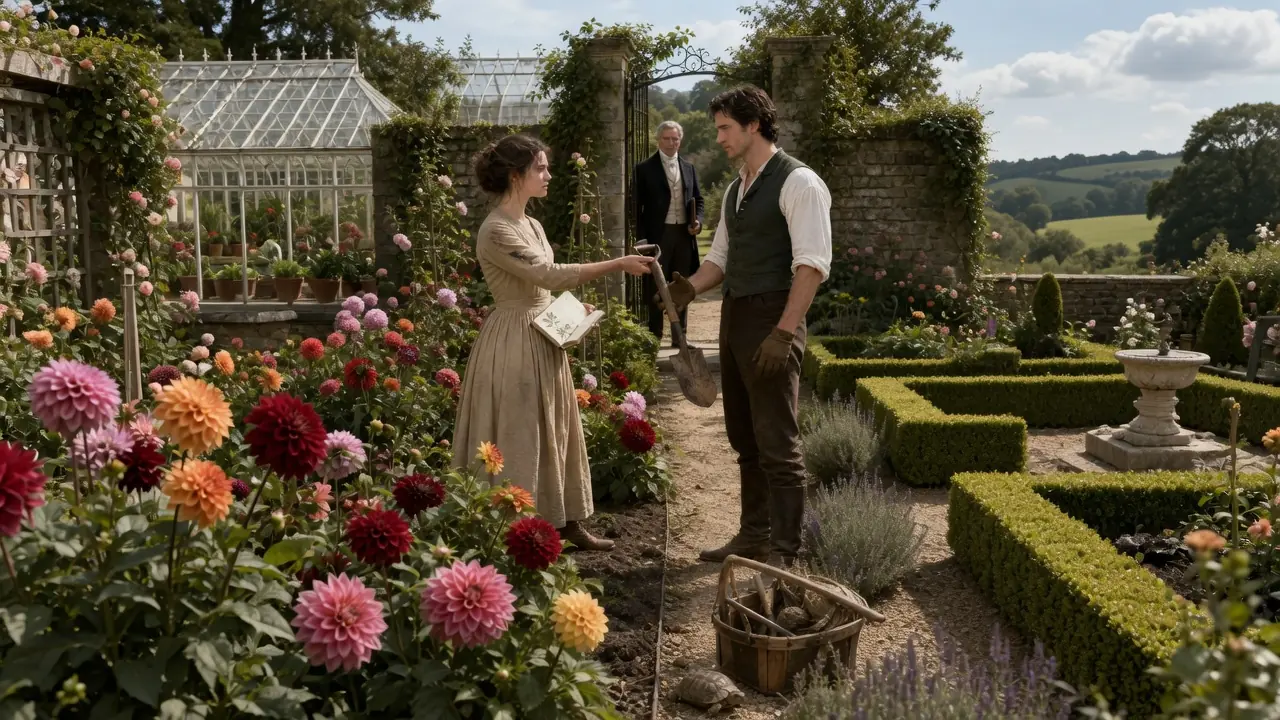
She was quite wrong about that, as it happened. He took the spade without correcting her. From this small transaction - one spade, one woman, and one duke who knew perfectly well who he was and chose, in that unguarded moment, to be something simpler - everything else followed. That is how things often follow from quiet moments when someone ought to say something and stubbornly does not.
This is the story of Lady Theodora Colborne, who knew considerably more about dahlias than about dukes, and Florian Lyle, who had spent twenty-nine years being addressed with immaculate correctness and discovered, for three improbable weeks in September of 1815, that he preferred the alternative rather more than he should. It is a story about a garden, an enormous misunderstanding, and what happens when two people are thoroughly honest with each other before they realize they ought to be careful. It does not end as badly as it might.
The garden, it should be said, was beautiful. Westhaven Hall boasted one of the finest walled gardens in Yorkshire, a distinction no one mentioned to the Duke of Westhaven's face because he was not precisely the sort of man people felt comfortable complimenting about his garden. He was the sort of man people were slightly afraid of. Florian was quiet and exacting, with the particular gravity of someone who had carried a great deal for a long time and had become very efficient about it. His amber eyes had an unsettling habit of attending to what one meant rather than what one said. His household operated with the order of a well-run campaign, his tenants were comfortable, and his finances were in excellent order.
If he had spent most of the past year speaking only about matters that required speaking about, he considered it a reasonable price for a life that functioned. The garden, however, was different. In the garden, Florian Lyle was, as much as he was ever anything, at ease. That was why what happened next was, in retrospect, almost inevitable.
The arrangement had been made by someone who was not one of the principals in the matter, because that is how most consequential arrangements begin. Mr. Hadlow, steward of Westhaven Hall for twenty-three years, had granted Lady Theodora Colborne's request in September without mentioning it to the Duke, because the Duke had traveled to Harrogate for a fortnight and was not expected back before October.
The request itself was entirely reasonable. Lady Theodora, who was staying with her aunt in Ripon, wished to spend several mornings studying the rare dahlia cultivars in Westhaven's walled garden for a botanical record she was compiling. She carried a letter of introduction from Lady Masham of Northallerton, which was a perfectly respectable reference. Mr. Hadlow had said yes. He had not communicated this to the Duke.
The Duke returned from Harrogate three days early because a drainage dispute on the home farm required his attention, and also because Harrogate had begun to feel rather loud and full of people inquiring after his health in the particular manner of people hoping to report it to someone else. On the morning of September twenty-second, he took himself to the walled garden because he always went there when he needed to think. In twenty-nine years, it had never contained anyone unexpected. He found a woman standing in the south bed. She was perhaps twenty-five, with the slight, permanent forward inclination of someone who spent a great deal of time leaning over plants, as though everything interesting happened reliably six inches below eye level. Her dress was the color of dried wheat and entirely practical, the kind chosen for kneeling among root systems without distress.
There were ink stains on her left sleeve that she had plainly stopped caring about some months ago. Her dark hair was caught in a knot that was losing a quiet argument with the morning wind. She held a small notebook open in one hand and was examining a dahlia with the focused precision of a woman who had forgotten entirely where she was. Florian paused inside the gate of his own garden and watched for a moment. She reached out and very gently cupped the head of the dahlia toward her, the way one might turn a sleeping child's face to see it better, then made several notes with her pencil in quick, unhurried strokes.
Without looking up, she said, "Good morning. You must be the undergardener Mr. Hadlow mentioned might be starting this week."
She had heard him at the gate and categorized the sound as someone who belonged there. Florian opened his mouth. He had intended to say, "I am the Duke of Westhaven. This is my garden. Who precisely are you?"
What emerged instead was, "Yes." He was never entirely able to explain this to himself afterward. Something about her absorbed attention, the ink on her sleeve, and the careful way she held his mother's dahlia, as though the flower were a document she was trying not to damage, made him say the wrong thing as simply as if it were the right one. By the time he realized it, the moment had already closed behind him.
She looked up then. Her violet eyes met his with the direct, unguarded simplicity of someone who had never learned to look at people sideways.
"I am Lady Theodora Colborne," she said. "I have Mr. Hadlow's permission to be here. I am recording the dahlia cultivars for a botanical study. I shall not move anything without asking, and I will keep to the south and central beds, where the collection is richest."
She glanced at her notebook and then back at him. "Do you know who planted the Bishop of Llandaff? The label is missing, and I cannot find the records." "My mother," Florian said.
"Ah. Is she nearby? May I speak with her about the history of the variety? Occasionally, the original planting notes tell me more than-" "She died in 1804."
He looked at the dahlia his mother had planted twenty years earlier, which he visited every September and about which he had never managed to say anything intelligent whatsoever. "Yes," he said. "I need to get to the other side of the central bed," she said, already returning to her notes. "There is a spade against the south wall. Would you mind moving the Bishop four inches to the left? I need to see behind the main stem without disturbing the root zone."
The spade leaning against the south wall was his. He had been using it himself that morning before she arrived. He picked it up and moved the dahlia four inches to the left. She was right that it needed moving. He had been meaning to do it for a week, and he stood with his own spade in his own garden feeling rather as though the morning had taken a direction he had not approved.
"Thank you," she said, already moving past him toward the center of the bed. "What is your name, if you do not mind?" "Lyle," he said.
She wrote it in the notebook. "Mr. Lyle. Good. I shall ask Mr. Hadlow to put you on the south border from now on. You seem competent."
She turned the next dahlia toward the light with two careful fingers and returned entirely to her record. Florian stood in his garden, designated apparently competent, holding his own spade. A tortoise named Seneca, who had lived in the walled garden for longer than anyone could determine and moved between the kitchen beds and the south wall with the unhurried confidence of a philosopher who had decided that speed was for other people, emerged from beneath the lavender. He observed the situation and returned to the lavender without comment.
Florian went inside and thought about what had happened for quite a long time. She returned the next day, and the day after that. On the fourth morning, Florian understood that he had begun arriving at the garden earlier than usual, which he declined to examine with any seriousness.
She brought him apple cake on the second morning. "For the garden staff," she said, setting a paper-wrapped parcel on the stone ledge near the gate with the matter-of-fact generosity of someone who gave things away before they could be declined. "It is from the baker in Ripon. It seemed fair, since you have been giving up your time to help me move things about."
"There are only the two of us," Florian said. "Then it is for you." She was already opening her notebook. "I dislike watching people eat. Please pretend I am not here."
He ate the apple cake, dense and lightly spiced in the manner of a baker who understood that autumn was not the season for delicacy, and watched her work in the south bed with the methodical patience of someone conducting a private census of every living thing she encountered. She spoke to the plants occasionally, brief assessments delivered in the same tone she used when writing in her notebook, as though the dahlias were colleagues of uncertain competence. "Your pruning on the standard roses is uneven," she said without looking at him. "I am aware."
"The left side is too aggressive. You have taken more than a third from the northwest cane." "I was working quickly."
"Quickly," she repeated, cataloging this as information of limited value. "The cane will struggle to recover before the frost. You will want to reduce the competing shoot on the southeast side to compensate. Balance the light distribution through the crown, not symmetry for its own sake."
She looked up. "Would you like me to show you?" He had been tending roses since he was twelve years old. He said, "Yes."
She showed him. This involved standing very close to the standard rose and indicating with precise pencil gestures exactly where the pruning should go. She had small hands with ink-stained fingers, and she gestured as certain people do, as though the air held the shape she made in it for a moment longer.
"There," she said. "The goal is not symmetry. The plant does not care about symmetry. It wants light and air moving through in equal amounts, and those are not the same thing."
She considered the crown. "Your left eye is slightly dominant. You are compensating for it in how you assess the tree from a distance." He looked at the rose. "That is very specific."
"I have been watching you work for four mornings." She moved to the next standard. "May I?" He handed her the shears. She accepted them without ceremony and used them with competence.
"I have been keeping botanical records since I was fourteen," she said, making a cut with a small, decisive movement. "My father thought it a reasonable occupation for a girl who intended to spend all her time outdoors regardless. He was practical." "Was?"
"He died two years ago. He was practical about that, too. He said he had enjoyed a good run, left me his notebooks, and told me to keep going." The shears clicked. "His exact words were, 'The garden does not stop for grief, and neither should you,' which was severe, but accurate."
"What was his name?"
"Sir George Colborne. He was a historian. Roman roads, mostly. He was a very poor farmer and a catastrophic estate manager, but he could discourse on military logistics for six hours without repeating himself." She handed the shears back and examined the result. "I absorbed rather a lot."
They worked through the rose standards together for an hour, which was the longest Florian had worked beside another person in the garden in two years. She told him things about the plants he had not known. He told her things about the garden's history - where particular specimens had come from, which beds his grandmother had altered, which paths his father had laid. She wrote these things in her notebook with the seriousness of someone recording matters that deserved to survive. They did matter, he thought. He had not realized how much he wanted to tell them to someone until someone was there to hear them.
At eleven, she closed the notebook, thanked him, and walked back across the lawn toward the gate with the slightly abstracted gait of someone whose mind had already moved to the next problem. She did not say goodbye. She did not look back.
Florian stood among the rose standards and felt, for no reason he could precisely state, considerably more awake than he had been in months. By the end of the second week, she had given him twenty-one recommendations for the improvement of the south garden. They were not delivered as instructions. She would never, she said on the fourth morning, tell a gardener what to do in his own beds, as that would be insufferable. She pronounced the word with the particular emphasis of someone who had personally experienced the insufferable from multiple directions.
Instead, the recommendations appeared as observations in her book, occasionally read aloud while she drew and he worked nearby, in the same tone she used when recording specimen measurements. "The parsley is too close to the mint," she said on the eighth morning, moving along the kitchen garden wall. "They are affecting each other. Eighteen inches farther south, near the improved drainage. You will taste the difference by November."
She made a note without pausing. "The dill is entirely wrong. It wants afternoon sun but shelter from the east. There, by the wall. And the thyme bed is overcrowded. Divide it this autumn, not next spring. If you wait until spring, the center will be dead."
Florian was digging up a parsnip that had gone wild. "Mr. Lyle." "Yes?"
"Are you writing any of this down?" "I have a good memory." She regarded him with skepticism that was, he acknowledged privately, entirely reasonable. From somewhere about her person, she produced a second, smaller notebook, tore out a page, and wrote the recommendations in her quick, decisive hand. Then she gave the page to him.
He implemented all of them before the end of the week.
This came to Mr. Hadlow's attention on Friday morning, when the steward passed through the kitchen garden and found the parsley relocated, the dill moved, the thyme divided, and a new pathway cleared along the south wall that appeared to have materialized overnight. Mr. Hadlow stopped. He looked at the parsley. He looked at the cleared path.
Then he went to find the Duke in the glasshouse, where Florian was examining a Camellia japonica with the focused attention of a man who was not particularly thinking about the camellia. "Your Grace," Mr. Hadlow said in the careful tone of a man with twenty-three years of practice at exactly the right register. "I notice there have been improvements to the kitchen garden."
"Yes." "At, I believe, the suggestion of Lady Theodora Colborne." "She had good recommendations." There was a pause.
"She is under the impression," Mr. Hadlow said, "that you are the undergardener." "I know." Another pause followed, longer and more freighted.
"Shall I clarify the situation to her, Your Grace?" "No." Mr. Hadlow looked through the glasshouse window at the newly relocated parsley, which stood upright and appeared to be thriving in its improved position.
"Shall I move the parsley back?" "The parsley is where it should be. She was right about the drainage." "Yes, Your Grace. Was there anything else?"
Mr. Hadlow considered saying several things. He said none of them. He went and made an entry in the estate accounts under Miscellaneous Garden Improvement, which was technically accurate, and decided that some situations resolved themselves faster than interference would allow.
Outside, through the glasshouse panes, Seneca made his unhurried way from the lavender bed toward the kitchen garden, apparently having decided that the newly organized parsley warranted a personal inspection. He arrived, inspected it, and appeared satisfied. On the eleventh morning, Theodora stood before the east wall and looked at the climbing rose for a long time without speaking. It was an old rose, of the pink Alba family, trained against the stone in a pattern that had taken thirty years to establish. It was also, as three pages of careful notes in her notebook now demonstrated, sick.
A canker had entered the main cane two winters earlier and spread slowly through the lateral branches. The plant was declining. The stone behind it showed faint staining from moisture entering places it should not. "It needs to come down," she said.
Florian, who had been tying back a length of sweet pea on the neighboring section of wall, went still. "The main cane has a significant canker," she continued, pointing with her pencil. "The discoloration is here, and again here. It has been spreading for at least two seasons. If you leave it through another winter, the disease will move into the rootstock and take the whole plant. There is also moisture damage to the mortar behind the main cane, where the stems have grown too tight."
She looked at him. "I know it is old." "My grandmother planted it in 1792," he said. "For my aunt, who died when she was three years old."
She was quiet. She did not fill the silence, which was one of the things he had noticed about her over eleven mornings. "I know it is old," he said again. "I know it needs to come down."
"There are things that could go in its place," she said carefully. "When you are ready. Not now, but when you want them." "Not yet."
"Of course not." He cut the rose down that afternoon. He did it alone after she left, working slowly through the canes with the long-handled shears. The cut wood smelled as old rosewood smells - green and slightly resinous, nothing like the bloom. There was nothing romantic about it at all, only the clean, flat smell of what it was.
When he finished, the east wall was bare stone in the late afternoon light. He stood there for some time, looking at what had been there and was now gone. The next morning, Theodora did not mention the wall. She set up her drawing board on the opposite side of the garden and worked quietly for two hours. At eleven, she came to him where he was turning compost in the north corner and set a folded piece of paper on top of the tool basket.
"When you are ready," she said, and left. He opened it that evening at the desk in his study, with the fire beginning to require attention and the house going quiet around him. It was a small botanical drawing, careful pencil lines depicting a climbing rose he did not recognize, with her handwriting beside it.
Rosa mulliganii. Flowers cream, late June through July. Very vigorous. Fills a wall in three seasons if given good exposure. Scent like almonds, particularly at dusk. I think it would suit the east wall. No hurry at all. Only when you are ready.
He sat with the paper for a long time. Then he placed it in the drawer where he kept things he did not want to lose. Rain arrived on the fifteenth morning in the manner of Yorkshire rain in late September: all at once, with complete conviction and no apology. Theodora looked up from the north bed with the expression of someone who had not checked the sky for several hours because the sky was not a dahlia and had therefore seemed less urgent. The rain was already committed.
"Garden shed," Florian said. She gathered her notebook and drawing board, and they moved quickly across the garden toward the low stone outbuilding near the north gate. Inside, the air smelled of old wood, dried earth, and the sweet, dusty residue of last year's bulbs stored in brown paper along the far wall. Florian pulled the door shut behind them. Rain became immediately loud on the slate roof, and the shed became what small enclosed spaces always become in rain: the whole world contracted to one warm interior, with everything outside suddenly irrelevant.
He found two low wooden stools left by the previous head gardener, who had understood the importance of somewhere to sit during Yorkshire weather. He set them near the wall. Theodora sat on one with her notebook across her knees, and Florian sat on the other while the rain made its thorough argument outside. "How long have you been at Westhaven?" she asked.
"Some years," Florian said. This was true in the way that I am tall is true - technically accurate, while leaving out almost everything that mattered. "Do you like it?" He considered the question genuinely, which he had not expected to do.
"Yes," he said. "The garden particularly." "I can tell." She turned a page in her notebook, not to write but to give her hands something to do while she considered what came next. "You know every plant here. Not only the names, but the histories - where things came from, who planted them, what they meant when they were planted."
She looked at the dried bulbs in their paper bags. "My father was like that about his books. He could tell you the provenance of every one - when he bought it, who had owned it, what he had been thinking about when he read it. He remembered all of that and forgot practically everything else."
"What did he forget?" "Appointments. People's names at dinner. His hat, always his hat, every morning. My mother used to say she had married a very large, very sweet-natured tortoise who happened to know everything about the Hanoverians."
The small sound she made was unambiguously fond. "He would have liked Seneca," Florian said. "Yes." Seneca had spent the previous morning following Sir George Colborne's daughter from bed to bed as though she were a particularly interesting variety of slow-moving plant, and Theodora had been delighted by it.
"He left me seven years of his own observation notes on Roman roads in the North Riding," she said. "That is partly why I am in Yorkshire - to walk the routes he identified and see whether what he wrote matches the ground." She looked at the rain against the small shed window. "It mostly does. He was very precise."
"Are you continuing his work alongside your own?"
"Where I can. They overlap more than one might expect. Historical roads and botanical records - the things that have grown along them, the things that have persisted." She smoothed the page of her notebook. "Do you read? For pleasure, I mean, not instruction."
He thought of what was currently on his desk in the house: three estate ledgers, two volumes of parliamentary proceedings, a history of agricultural improvement, and a translation of Virgil's Georgics, which he had been reading since August and which was the only thing he had read recently that did not require him to make a decision immediately afterward. "Virgil, at the moment," he said. She looked up. "Which?"
"The Georgics." There was a pause. "On farming and bees," she said, with the expression of someone revising an estimate.
"And grain, vines, and seasons," Florian said. "He understood that cultivation moves slowly. The good of the work is not always visible in the season when one does it. One tends things partly for oneself and partly for the person who will tend them afterward."
She looked at him with the expression he had learned to recognize over fifteen mornings: the one she wore when she encountered something surprising and was deciding how to answer it honestly. "At least a gardener is told the truth," she said slowly. "No one flatters a gardener about the garden. People say what they actually think about the parsley."
"Yes," Florian said. He was very aware of what lay beneath that sentence. He had been aware of it for fifteen mornings. "That must be-" She stopped.
"What?" "I was going to say restful, but that is not quite right." She tilted her head, looking for the word as she searched for the correct pencil mark in a drawing. "Clarifying. Knowing what people actually think, rather than what they think you wish to hear."
"Yes," he said. "It is." The rain continued. She looked at the shelves of bulbs with the expression she wore when thinking about something other than what she appeared to be looking at.
"I am told I ought to be in London," she said. "That three months in Yorkshire, drawing dahlias and walking Roman roads, is not a reasonable occupation for a woman of my situation." She said the word situation with the slight distance of someone who did not entirely accept the framing but had chosen not to argue with it at that moment. "My mother writes every week. She has identified three gentlemen she considers promising. She is being very patient, which is worse than if she were impatient."
"And you?" "I intend to go eventually." She looked at the rain. "One must eventually make decisions about one's life that are determined by something other than what one wants to be doing."
She paused. "Do you have family nearby?" "Not nearby," Florian said. Technically and precisely true.
"It is very quiet here," she said. She meant it as an observation, not criticism, and the difference was clear in the way she said it. "I mean the good kind of quiet. The kind in which one can actually hear oneself."
"Yes," he said. Outside, the rain began its gradual retreat. The percussion on the slate shifted from certainty to reconsideration. Theodora stood and smoothed her skirt with both hands. Florian stood as well.
For a moment they were very close in the shed, with the smell of old earth and the sound of rain withdrawing, and there was something in the air between them that had been building for fifteen mornings but had not, until this small space and this particular storm, made itself quite so obvious. She looked at him with those direct violet eyes and said, "Thank you for the company." Then she opened the shed door and walked into the lightening rain with the slightly too deliberate attention of someone concentrating very carefully on where she put her feet. Florian stood in the doorway and noted from the precise angle of her shoulders that she had noticed the same thing he had.
Seneca emerged from beneath the lavender, where he had sheltered from the rain in considerable comfort. He made his way back toward the kitchen garden with the unhurried certainty of someone who had seen fifteen mornings pass and expected to see considerably more. She arrived on the seventeenth morning carrying a small pot wrapped in cloth. "Rosa mulliganii," she said, holding it out to him. "A cutting from Lady Masham's garden. She had too many, and I asked her for one."
She set it carefully in his hands. It was a single stem barely six inches tall, with three small leaves and roots wrapped in damp cloth, entirely unpromising in the way all proper beginnings tend to be. "It will be three years before it covers any real ground," she said, "but the east wall has good southern exposure and shelter from the worst of the east wind." He held the cutting. It weighed almost nothing.
"This is your twenty-second suggestion," he said. She blinked. "I was not counting." "I was."
He looked at the cutting, then at her. "The dill, the thyme, the parsley, the south pathway, the staking of the central dahlia grouping, the standard rose pruning-" "I know what I said." Color appeared along her cheekbones, which he had learned happened when she was caught off balance by something. "All twenty-one were correct," he said. "I implemented all of them."
She looked at the cutting in his hands, then at him. The color remained. "I should not have given you so many," she said. "Why?"
"Because it was not my place. It is not my garden. You did not have to do any of it, and I should not have presumed." She looked toward the east wall, still bare where the old rose had been. "I am sorry."
"Do not be." Florian had spent twenty-nine years being careful about what he said to people, measuring and filtering, ensuring that every word was appropriate to his position. Something about the garden, the mornings, and this particular conversation made him say instead, "You know this garden better than anyone has in years. Not because it belongs to you, but because you have paid attention to it. That is rarer than belonging."
She was quiet for a long moment. "Florian," she said. She had been using his name this way carefully, as though testing its weight each time. "Do you know the name of the previous head gardener?"
"Bartholomew Ennis," he said. "He retired to his daughter's household in Whitby in the spring of 1812." "Who replaced him?" There was a pause.
"No one," Florian said. "Not formally." "You have been tending this garden yourself." It was not a question. He could see her cataloging the depth of his knowledge, the way he knew which beds drained slowly after rain, the fact that the tool basket was his personal one, and that she had not known this until now.
"Mr. Lyle," she said. "Yes?" She opened her mouth, closed it, and made the expression she wore when choosing between two accurate things and selecting the more precise one.
"Will you plant the cutting?" He planted it against the east wall while she watched. He worked the soil with the particular attention of someone who knew the ground - its composition, its drainage, and the way the morning light fell differently on that wall in autumn than in spring. She watched the way she watched everything in the garden, not passively but with her whole concentration, as she had studied his mother's dahlia on the first morning.
"It will flower cream," she said. "You told me." "And it smells like almonds." "In June."
"In June," she agreed. He pressed the soil around the roots and straightened. Together, they looked at the cutting against the bare stone. It was a small green stem with a few leaves. Nothing yet.
"It will be a while," she said. "Most things are," Florian replied. She gathered her notebook and drawing board with slightly more concentration than the task required. He had come to understand that this meant she was working through something in her mind while keeping her hands occupied.
At the gate, she stopped. "I have been invited to dine at Westhaven Hall," she said to the gate rather than to him. "Mr. Hadlow wrote to my aunt. He says the Duke has returned from Harrogate and wishes to meet the botanist who has been making improvements to his garden."
A brief pause followed. "I cannot tell whether that is a compliment or a complaint." "It is an invitation," Florian said with rather more certainty than she could account for. She looked back at him over her shoulder, with violet eyes, ink on her sleeve, and the particular expression of someone about to ask something she had considered for longer than she would admit.
"Will I see you in the garden after dinner?" "Yes," he said. "I expect so." She nodded as though something had been confirmed and went away.
Mr. Hadlow, who had been doing something entirely necessary with a crate of onion sets near the north gate and had not been attending to the conversation in any way, returned to his office and sat for a while looking at his correspondence tray. He was twenty-three years into a stewardship he had always managed with discretion and good sense. He had a strong intuition that the coming fortnight would require rather more of both.
He took out the dinner invitation he had already written, confirmed that the guest list consisted of exactly two people, decided this was correct, and sent it to the post. Theodora arrived at Westhaven Hall on Thursday evening at seven in a deep green velvet dress borrowed from her aunt because her own best dress had acquired, through a process she declined to explain fully, a small but definitive ink stain on the bodice. The borrowed dress was slightly too long and had required nearly an hour of attention from her aunt's maid to achieve a state of presentation Theodora found unfamiliar and constricting, like wearing someone else's handwriting. The hall was larger inside than she had imagined. That was the first indication that something was not precisely as she understood it.
The entrance was marble and candlelit, attended by a butler whose face had been professionally arranged into perfect neutrality and had no intention of moving. "Lady Theodora Colborne," she told him. "Yes, my lady. If you will follow me."
Mr. Hadlow met her at the dining-room door wearing an expression she recognized: the expression of a man being very careful about his expression. "Lady Theodora, thank you so much for coming. His Grace is already within."
"His Grace?" she began. The door opened. The dining room was warmly lit by two branches of candles and a fire that had been burning for hours. It was furnished with the good, unshowy taste accumulated over several generations rather than chosen all at once.
At the head of the table stood the host, dressed in a dark coat and an impeccably arranged cravat, with amber eyes she recognized with immediate and comprehensive certainty because she had looked into them across dahlia beds, rose standards, and one very specific afternoon in the rain. Florian Lyle was the Duke of Westhaven. "Good evening, Lady Theodora," he said. There followed a silence of some quality. It was the highly charged silence of a woman recalibrating an entire month of understanding at considerable speed while managing to keep her face in an arrangement that did not fully express the recalibration.
"You," she said in a voice of great measured restraint, "are the Duke." "Yes." "You are not the undergardener." "I have never been the undergardener."
"You accepted the apple cake that I brought for the garden staff." "It was excellent apple cake." "You moved the parsley." "The parsley needed moving."
"You cut down the rose." "The rose needed-" He paused. "Yes. You were right about the rose."
"I told you to move the Bishop of Llandaff four inches to the left on the morning we met because I needed to see behind it, and you simply did it." "It also needed moving," he said. "I had meant to do it for some time." She looked at him. He met her gaze with the steady amber calm of someone who had prepared for this conversation over several days and was discovering that preparation only went so far.
"You should sit down," Mr. Hadlow said from near the door, where he had positioned himself with the quiet professionalism of a man who had timed interventions across three decades. She sat. She looked at the table, set for two people with excellent silver, two candelabra, and wine almost certainly better than any she had encountered during three months in Yorkshire. She looked at Florian, who had taken the chair opposite and was watching her with an expression that was not, she noticed, composed.
It was the closest she had seen him to uncertainty. This was something she found herself cataloging, as she cataloged everything. "You knew from the first morning," she said. "Yes."
"When I called you Mr. Lyle-" "It is my name. My family name." He paused. "I did not say anything untrue."
"You allowed me to give you eleven, twenty-one, twenty-two suggestions for improving your own garden." "All twenty-two were correct." "You allowed me to show you how to prune your own rose standards."
He looked at her. "You improved them. The left-eye dominance - you were right. I checked it against the results."
She sat with this for a moment. "Why?" she asked. She was not precisely angry, though something in her was working toward anger and had not yet decided whether to arrive there.
"Why did you not say something?" He was silent for a moment. She had learned over seventeen mornings that his silences were not evasions. They were how he ensured he was going to say the true thing rather than the convenient one.
"You told me the pruning was uneven because it was uneven," he said. "You told me the parsley was in the wrong place because it was in the wrong place. You told me the rose needed to come down and then spent two hours on the opposite side of the garden because you understood I needed time with it." He looked at the candles.
"I have spoken to approximately forty people this year, and every one of them, in one way or another, arranged what they said around the fact of my title. You told me about your father and the Roman roads. You gave me a drawing of a replacement rose." He paused.
"You did not flatter me about the garden." "You are a duke," she said. "The garden is extraordinary." "I know it is," he replied. "But you told me where the parsley was wrong."
She looked at him across the length of the table. Outside, wind moved through the Yorkshire darkness. The candles shifted once and steadied. "You should have told me," she said.
"I should have told you on the first morning. I know." "I ordered you about. I gave you lists. I stood in your garden and told you what needed doing."
"Yes," he said. "And the garden is better for every item on those lists." "That is not the point." Yet she felt the corner of the argument beginning to soften, which was inconvenient.
"No," he agreed. "The point is that I should have told you. I know that. I wrote you a letter about it before dinner, in fact, but Mr. Hadlow pointed out that you were already on your way and that the situation had moved past letters."
"There is a letter?" He reached into his coat and produced a folded sheet of the same ordinary working paper he used in the garden, not the heavy formal stationery of the hall. He held it across the space between them. She took it and placed it in her evening bag because reading it at the dinner table would not be right, and because she was still deciding several things.
"All right," she said. "All right," he answered. "I would like wine." "Of course."
"And I would like you to know that the thyme bed has stopped being overcrowded, which I did not fully expect before October. Whatever you did with the division was correctly done." "I followed your instructions precisely." "As I understand it," she said, "you have been following my instructions for three weeks."
"Every one." "That is either very reassuring or very alarming. I have not decided which." A silence followed that was entirely different from the silence at the beginning of the evening.
"Mr. Lyle," she said. He raised one eyebrow. "I shall continue calling you that. I have been doing so for three weeks, and I have no intention of revising my habits because of a title. You may address the situation however you find appropriate."
He looked at her for a long moment. "Theodora," he said. She accepted this, picked up her wineglass, and they had dinner. It was excellent. They spoke about the kitchen garden parsley, which was thriving, the dahlia collection, for which she had eleven additional notes to add to his records, and whether Virgil had understood autumn as well as he understood spring.
Florian thought not. Theodora was not certain she agreed. They disagreed about it with considerable enjoyment for the remainder of the evening. Theodora read the letter later, seated at the small desk in her aunt's spare room while the fire burned low. Her aunt's cat, a large marmalade creature of magnificent self-regard, had claimed the windowsill as personal territory and spent the evening doing nothing of obvious utility while watching her with the expression common to cats and certain philosophers.
The letter was unlike any she had received in twenty-four years of existence. It began:
I owe you an apology, an explanation, and very possibly the cost of the apple cake I consumed under false pretenses on two separate occasions. It continued for two pages in the same register - precise, dryly aware of itself, and bearing the quality of someone being honest while somewhat out of practice at it, and therefore becoming more honest than he had planned. He explained the first morning, the gate, the dahlia, the instant when he had said yes instead of what he should have said, and how it had already felt too late before he understood what he had done. He admitted that the conversation in the rain had been the most useful hour he had spent in several months, which was either a significant compliment or a significant confession. He was not entirely certain which, but thought she ought to know it.
He did not ask her for anything. At the end, he wrote:
If you choose not to return to the garden, I shall understand entirely. However, the cutting on the east wall will require checking in spring, and the thyme bed may need dividing again by February if the winter is mild. I should also very much like, if it is agreeable to you, to argue about Virgil again at a time when you are less correctly dressed. She read it twice. Then she folded it and placed it among her botanical notes, between the pressed specimens in Volume Seven. That was where she kept the things she intended not to lose.
The following morning, she went to the baker in Ripon. Then she went to her aunt's garden shed. She arrived at the walled garden gate at nine, carrying a paper parcel in one hand and, in the other, a small new spade borrowed from her aunt's shed. It was made of good Yorkshire steel, with a clean handle and the correct weight for the work, though slightly too large for her. She had chosen it deliberately.
Florian was already in the south bed, doing something to a dahlia that did not, as far as she could tell, actually need anything done to it. He heard the gate and straightened. He looked at her. Theodora crossed the garden in the September morning light - the same light as on the first morning, with the same smell of turned earth and the same bronze beginning in the dahlias - and held the spade out to him.
He looked at the spade. Then he looked at her. "I thought," she said, "that this time we should both know who is holding it." He took the spade. He held it with the ease of someone who had been holding a spade in that garden for a very long time, which she now understood differently than she had three weeks earlier.
She set the paper parcel on the stone ledge near the gate. "For the garden staff," she said. He looked at the apple cake, then at her. "There are only two of us."
"Yes," she said. "Then I suppose it is for you." He looked at her with his amber eyes in the early light, the new spade in his hand, and something in his expression shifted beyond the careful steadiness she had come to know. It moved into something less guarded. Nothing dramatic, merely present, as things become present when they stop being avoided.
"The cutting on the east wall appears to have taken," he said. "I checked from the gate. There is new growth at the second node." "I noticed it yesterday."
"Good." She opened her notebook to the Rosa mulliganii page and added a line.
New growth confirmed. Second node. Late September. He turned toward the east wall with the new spade in hand, and she moved to the south bed. The garden returned to its morning work around them - Seneca emerging from the lavender with unhurried authority, the dahlias attending to their slow bronze business, the light traveling in its ordinary way across the old stone walls.
They worked in the particular kind of quiet that is not the absence of something, but the presence of it. At eleven, Theodora said without looking up from her drawing board, "The Bishop of Llandaff will need moving again in spring. Its root zone is expanding into the north path." "I know."
"I shall write it on the list." "I assumed you would." She wrote it down, tore out the page, and passed it across the garden without ceremony. Florian took it without ceremony, read it, and put it in his coat pocket, where it would be available when required. This was exactly where every one of the previous twenty-two suggestions had gone.
The twenty-third suggestion on the list read:
In future, if you are a duke, please say so at the beginning. Directly beneath it, she had added:
Although, in fairness, the parsley truly was in the wrong place. He read both items. Then he looked at her. "Agreed," he said, on both points.
She was already drawing. Three years later, the Rosa mulliganii covered the east wall of Westhaven's kitchen garden in a pale cream curtain. It flowered from late June through July and smelled in the evening precisely as Theodora had promised - of almonds, warm stone, and something that was probably only summer but felt like more than that. The seventh volume of Theodora Colborne's botanical record contained a long entry on the variety, with pencil drawings completed in four stages across three growing seasons. Each was more confident than the last, as she learned the particular habit of that particular plant in that particular light.
Beside the final drawing, in handwriting slightly different from the rest - more deliberate, as though the writer had been attending to the words in a way he did not always need to - someone had added:
First scented evening. 23 June 1818. T and F in the garden. Rose exceptional. Argument about Virgil resumed and remains unresolved.
Theodora had not written that note. She had, however, read it over Florian's shoulder while he wrote it. "The argument is not unresolved," she had said. "You simply have not conceded yet."
"I am a duke," he had replied. "I am constitutionally incapable of conceding." "You conceded about the parsley." "That was different."
"You conceded about the thyme, the rose standards, the east wall, and the Bishop of Llandaff." After a pause, he said, "Those were botanical matters." "And Virgil is a poetic matter. I shall give you until October."
He had not conceded by October. He had, however, commissioned a second tortoise, younger than Seneca and already possessed of opinions, and named him Marcus after the emperor. Theodora had said that anyone as philosophically serious as Seneca required someone with whom to disagree, and this had seemed correct. Mr. Hadlow, who by that point had accepted that some situations required a man to revise his understanding of his duties, recorded the second tortoise in the estate accounts under Garden Staff. This was not strictly accurate, but was true in the way most true things in a garden are true: essentially.
In the kitchen garden, the parsley grew in the correct position, where the drainage had been improved, and tasted as though nothing had ever been wrong with it. The spade still leaned against the south wall each morning. There were two of them now.