The morning fog clung to the tall windows of Silverton Manor like a heavy gray shroud, as if the house itself wished to hide from the world. Miss Arabella Winters stood alone in the formal drawing room, her hands folded tightly before her, her worn gray traveling dress standing out against the faded luxury around her. The chandeliers no longer shone as they once had, and the furniture carried the quiet sadness of a home that had forgotten how to be warm. At twenty-six, Arabella wondered whether accepting this position had been the worst decision of her life.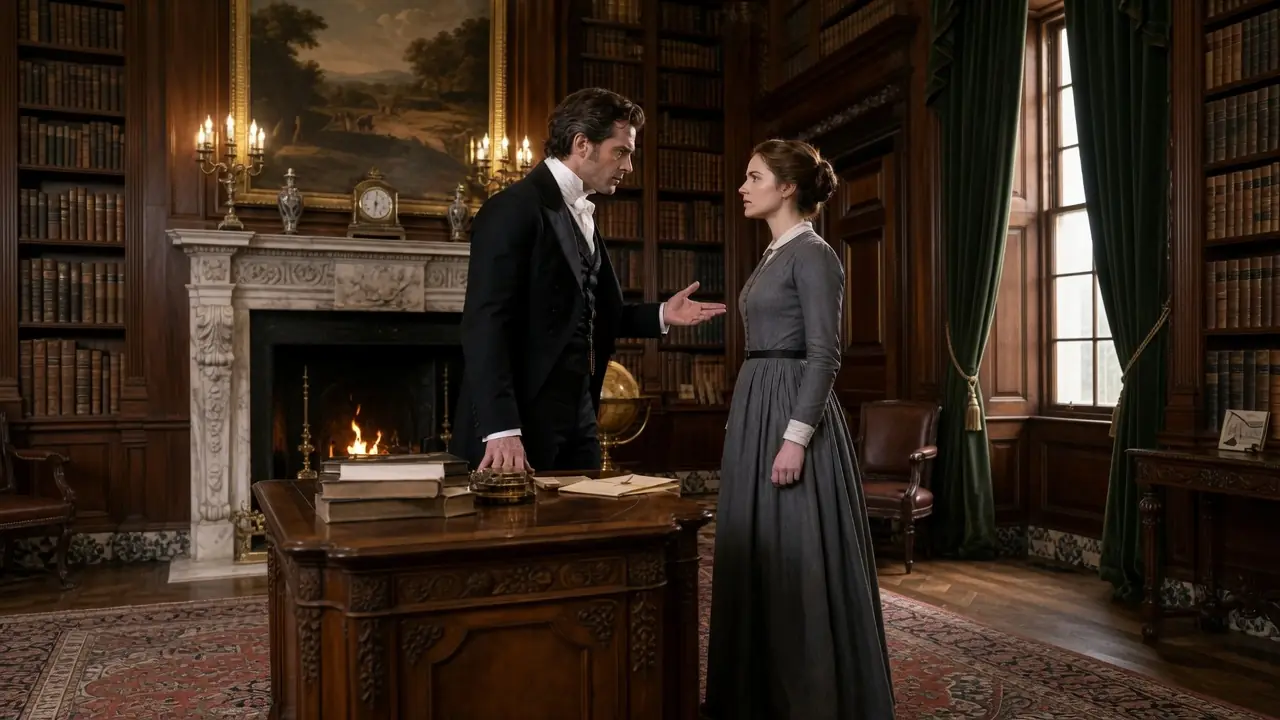
The agency in Boston had warned her clearly. Five governesses had left in less than two years. The Duke of Silverton was said to be cold, demanding, and impossible to satisfy, while his children were described as difficult and distant. The house itself was rumored to swallow hope whole, but Arabella had no choice.
Her father's gambling debts had destroyed their family name, and after his death, there was nothing left for her. A woman with her education but no fortune could not afford pride. The door opened sharply, and Arabella felt her body stiffen despite her effort to remain calm. Edmund Hartwell, Duke of Silverton, entered the room without greeting.
He was tall and broad-shouldered, perhaps thirty-five, with dark hair already touched by gray and eyes like a winter storm over open plains. His black coat was perfectly pressed, his white cravat tied so tightly it looked painful. Grief sat on him like armor that had never been removed. He did not offer his hand.
Instead, he slowly circled her, his gaze sharp and judging, as if she were an object brought for inspection rather than a person.
"Miss Winters," he said at last, his voice cold and exact. "The agency claims you speak five languages."
Arabella lifted her chin slightly. "Six, Your Grace."
He stopped walking. "Six?"
"Yes, Your Grace. English, French, Italian, German, Latin, and Ancient Greek."
His mouth tightened. "Not very convenient for a woman of your background."
The familiar sting of shame burned in her chest, but she kept her voice steady. "My father valued education before his circumstances fell apart."
"I am aware of your father," the Duke replied sharply. "Richard Winters, a merchant who lost everything at card tables and died owing half of New York City."
The words struck with practiced cruelty. Arabella had heard them before, whispered in polite rooms and spoken aloud in cruel ones. Still, she forced herself not to flinch.
"He sent me to a convent school in France when I was eight," she said. "I remained there until I was twenty-six. The sisters gave me a full education."
"A convent," the Duke said with open disdain. "And now you expect me to believe that a ruined merchant's daughter has mastered what scholars struggle with?"
"I expect nothing, Your Grace," Arabella replied quietly. "Only the chance to teach."
"I understand."
"You will follow my curriculum. You will not fill their heads with foolish dreams. The world is harsh, and they will be prepared for it."
Arabella thought of the sisters who had taught her with patience, of the books that had saved her when nothing else remained, and of three children who had lost their mother and, in another sense, their father at the same time.
"I will teach your children," she said, "but I will not teach them to be empty."
The Duke's eyes darkened. For a long moment, she thought she had sealed her fate. Then he turned away.
"You begin tomorrow at eight. Mrs. Dalton will show you to your room."
He left without another word. Arabella exhaled slowly, her hands trembling. She had challenged a duke in his own home, yet she did not regret it. Something in this house was deeply broken.
Mrs. Dalton, the housekeeper, soon led her through long corridors lined with stern portraits. At last, they stopped before the schoolroom.
"Master James is thirteen, Master Oliver is ten, and Miss Caroline is seven," Mrs. Dalton said softly. "Their mother died four years ago. Fever took her quickly."
The children waited inside. James stood the moment Arabella entered. His posture was perfect, his dark hair neatly combed, his gray eyes serious beyond his years.
"I am James Hartwell," he said formally. "I hope my conduct will meet expectations."
Arabella's heart tightened. This was not a child. This was a soldier.
Oliver sat by the window, shoulders tense, his fingers stained with ink. He watched her with open suspicion. Caroline sat very still at the smallest desk, her hands folded and her eyes empty.
Mrs. Dalton had said she had not spoken since her mother's death. Arabella knelt beside Caroline instead of towering over her.
"Good morning," she said gently. "My name is Arabella."
A flicker of awareness crossed the child's eyes. Arabella stood and faced them all.
"I know many governesses have come before me. I cannot promise I will stay forever, but while I am here, I will see you, not as problems, but as people."
James's rigid posture wavered. Oliver's gaze softened just slightly. Caroline stared, unblinking.
Arabella began with a simple question. "What do you love most in the world?"
James looked lost. "I do not know."
"Nothing," Oliver muttered.
Arabella gently coaxed him until he revealed a hidden sketchbook. Inside were drawings of stunning beauty, landscapes full of feeling and faces alive with emotion.
"These are extraordinary," she said.
No one had ever told him that.
When she asked Caroline, the girl pulled out a small carved wooden bird. Arabella knew at once that it had been made by her mother.
"It is beautiful," she said.
For the first time, Caroline nodded.
Their first lesson ended with French. James answered perfectly. Oliver admitted in careful French that he loved to draw. Caroline wrote on her slate that she loved her mother.
The room fell silent. Something changed that morning.
Days passed, and the children began to soften. James asked questions. Oliver drew openly. Caroline hummed when she thought no one was listening.
The Duke watched from the shadows, saying nothing.
Three weeks later, Arabella was summoned to his study. A formal dinner was planned with important guests from France. She was ordered to attend only if needed.
That evening, as the conversation turned technical, Arabella realized the Duke was struggling. His answers grew uncertain. A mistake was made, and offense flickered across the ambassador's face.
Arabella made a choice. She spoke.
Her French was flawless, clear, and precise. She corrected the misunderstanding with grace and calm authority. The room went still.
She moved effortlessly through language after language, answering questions with quiet confidence. Shock filled every face at the table. The Duke's expression darkened with fury.
When the dinner ended, he rose sharply.
"Miss Winters," he said coldly. "You will come with me now."
Arabella followed him, knowing everything had changed and that whatever waited behind the library door would decide her future at Silverton Manor.
The library door closed behind them with a heavy sound that seemed to echo through Arabella's chest. The room was dim, lined floor to ceiling with books that looked untouched, their spines stiff and unread. A fire burned low in the grate, casting restless shadows across the Duke's rigid form.
He stood with his back to her, both hands gripping the edge of his desk so tightly that his knuckles were white. For a long moment, he said nothing. The silence stretched thick and dangerous.
"You humiliated me," he said at last, his voice low and controlled. "In my own house, before guests whose opinions matter greatly."
Arabella drew a slow breath. "I prevented a serious misunderstanding, Your Grace. The ambassador was offended. Another moment, and the damage would have been real."
He turned sharply, his storm-gray eyes blazing. "Do not presume to instruct me on diplomacy. You forgot your place. You are a governess."
"I did not forget," she said quietly. "I chose."
That answer struck him harder than any raised voice. He stepped closer, towering over her.
"You think your clever words and convent learning place you above judgment? You think speaking a few languages makes you exceptional?"
"I do not think myself above anyone," Arabella replied. "But I will not pretend to be small to protect another person's pride."
His lip curled. "You parade your education as if it erases your lack of birth. Your father's disgrace follows you into every room you enter."
The words cut deep, sharp, and precise, finding every old wound. For a brief moment, the room blurred. Then something inside her settled, hard and unyielding.
"I speak six languages, Your Grace," she said, her voice firm. "Not to impress you and not to shame you, but because when I lost everything, knowledge was the one thing no one could steal from me."
He froze.
"I learned because books did not abandon me," she continued. "Because words gave me shelter when people did not. And because the sisters who taught me believed I was worth the effort."
His anger faltered, confusion flickering through it.
"You judge my birth," she said. "Yet you judge your children more harshly than any society ever could."
His eyes darkened. "You know nothing of my family."
"I know your children are afraid," Arabella said softly. "James fears mistakes. Oliver hides who he is. Caroline has disappeared into silence. That is not discipline. That is grief left alone."
The Duke turned away, his shoulders tense.
"You overstep."
"Perhaps," she said. "But someone had to."
He faced her again, his voice colder than before. "You are dismissed. You will leave tomorrow morning."
The words landed heavily, but Arabella did not bow her head.
"As you wish, Your Grace," she said. "But remember this: your children do not need perfection. They need you."
She left before he could respond.
That night, Arabella packed her small trunk with steady hands. Each folded dress felt like a farewell she had not been ready to make. Her future stretched uncertain and bare. Without a reference, work would be scarce, but she had survived worse.
A soft knock came near midnight. James stood in the doorway, his face pale and tight with emotion.
"Is it true?" he asked. "That you are leaving?"
"Yes," Arabella said gently.
He stepped inside, his voice breaking. "Please do not go. You are the only one who ever asked what we love."
She pulled him into an embrace. "You must remember what you have learned," she whispered. "You are worthy even when you fail."
He nodded, clinging to her like a drowning child.
When dawn came, gray and cold, Arabella dressed in her traveling clothes and descended the stairs, prepared to say her final goodbyes. But the entrance hall was not empty.
The Duke stood there, his appearance uncharacteristically disordered, his eyes shadowed with exhaustion. The children stood close together beside him. Caroline was crying silently, tears sliding down her cheeks.
"Miss Winters," the Duke said hoarsely. "I owe you an apology."
Arabella stopped, stunned.
"I was wrong," he continued. "About you, about my children, and about myself."
He drew a breath that seemed to cost him everything.
"I cannot read as others do. Words blur. I learned to hide it with anger."
Silence filled the hall.
"I punished my children for weaknesses I hated in myself," he said. "And I nearly drove away the one person who helped them heal."
He turned to the children and knelt before Caroline.
"I love you," he said simply.
Her lips trembled. "Papa."
The word broke him.
When he rose again, his eyes were wet. He faced Arabella with a humility she had never imagined.
"I ask you to stay," he said. "Not as an order. As a request."
Arabella's heart raced. "Your Grace..."
"Edmund," he said quietly.
She nodded. "Then I will stay."
Hope returned to Silverton Manor that morning, fragile but real. For the first time since Arabella had arrived, the house felt less like a tomb and more like a place where life might begin again.
Silverton Manor did not change all at once. It changed the way dawn changes night, slowly and almost without notice, until one morning Arabella realized the air felt lighter when she opened her window. The house no longer seemed to hold its breath. Footsteps echoed with less weight, and doors no longer closed like final judgments.
Arabella remained as governess, but nothing about her position felt ordinary anymore. Edmund no longer avoided the schoolroom. At first, he only listened from the corridor, standing still as a statue while Arabella taught.
Then one morning, he stepped inside and took a seat at the back, silent and watchful. The children noticed at once. James stiffened, fear returning to his eyes. Oliver hid his sketchbook beneath his chair, and Caroline froze.
Arabella did not stop the lesson. She continued calmly, explaining a French passage about courage and truth. She spoke as if Edmund were not there at all.
Slowly, the children relaxed. Edmund watched something unfamiliar unfold. His children laughed softly. They spoke without fear. Caroline wrote on her slate and slid it toward Arabella with a shy smile.
That night, Edmund asked Arabella to teach him.
They sat in the library where anger had once filled the air. Arabella placed a simple book before him and spoke gently, guiding him through each word without judgment. His hands shook at first. Shame sat heavily in his chest.
But she did not rush him. She never sighed. She never corrected him harshly. For the first time in his life, reading did not feel like failure.
Days turned into weeks. Edmund practiced each evening. Some nights were quiet and focused. Other nights were filled with frustration and sudden anger that rose without warning.
Arabella remained steady through all of it. She reminded him that learning was not weakness.
The children watched their father change. James no longer jumped when Edmund entered a room. One afternoon, he made a mistake in arithmetic and waited for anger that never came.
Instead, Edmund said, "Mistakes are part of learning."
James stared at him as if the world had shifted beneath his feet.
Oliver began leaving his drawings out in the open. One evening, Edmund asked him to explain a sketch of the hills beyond the estate. Oliver spoke with excitement, his words tumbling out fast and eager.
Edmund listened, truly listened, and praised the boy's eye for detail.
Caroline began to speak in short sentences, at first only to Arabella, then to her brothers. One evening, she took Edmund's hand and led him to the garden without a word. She pointed to a bird resting on a stone wall.
"Mama liked birds," she said softly.
"I know," Edmund replied. "So do I."
That night, he wept alone in the study, but the tears did not feel like destruction. They felt like release.
Society did not welcome the changes at Silverton Manor. Lady Constance arrived unannounced one afternoon, her sharp eyes sweeping over the brighter rooms and relaxed children with suspicion.
"This house has lost its discipline," she said coldly. "And I see the cause standing before me."
Arabella met her gaze without fear. "The children are thriving."
"Thriving is not the same as obeying," Lady Constance snapped.
Edmund stepped forward. "They are my children, and I decide what they need."
Lady Constance left in silence, but letters followed. Whispers spread. A duke too close to his governess. Children allowed opinions. A household forgetting its place.
Edmund read the letters and set them aside.
"I have lived by fear long enough," he told Arabella one evening as they walked through the gardens. "I will not let it rule us again."
Their walks became a quiet ritual. They spoke of books, of ideas, and of the future. Arabella spoke of the convent, of the sisters who had taught her not just languages but patience and mercy.
Edmund spoke of his wife, Rosalind, of loving her deeply and losing her suddenly.
One evening, he stopped walking. "I am afraid," he said simply.
"So am I," Arabella replied.
He looked at her, then truly looked at her, and something unspoken passed between them. Not desperation. Not escape. Choice.
When he asked her to walk beside him, not as an employee but as a woman he admired, Arabella hesitated only a moment.
"Yes," she said.
Their courtship was quiet, careful, and full of conversation rather than grand displays. The children noticed before anyone else.
"Are you going to leave us?" Oliver asked one night.
"No," Arabella said. "I am choosing to stay."
James smiled in a way that reached his eyes.
The proposal came in the library on a winter evening. Edmund spoke without titles or pride.
"You taught me how to learn," he said. "How to feel. How to be a father again. Will you be my wife?"
"Yes," Arabella said, her voice steady. "With all my heart."
The wedding was small. The chapel filled with light. The children stood beside them, not as ornaments, but as family.
Caroline whispered during the vows, "Mama is smiling."
After the marriage, Silverton Manor became something new. Arabella opened a small school on the estate for village children, and Edmund supported it fully. James prepared for university with confidence.
Oliver's art began to draw attention beyond the estate. Caroline helped younger children learn to read. Years passed, and Silverton Manor filled with laughter.
The walls remembered joy again.
One evening, long after the house had gone to sleep, Edmund and Arabella sat together watching the fire.
"You once silenced me with truth," Edmund said quietly.
Arabella smiled. "You listened."
"And that," he said, "changed everything."
The house that once held sorrow now held life, and the woman once called unworthy had become its heart.