Marcus Webb stepped onto his front porch at 7:43 in the morning with a mug of coffee in his hand and stopped. The road in front of his house was buried. Buried under black hoods and chrome grills and the low growl of engines that had never once turned down a dirt road in their lives. Black Escalades, silver Bentleys, a Rolls-Royce the color of gunmetal parked directly across from his mailbox.
His neighbor Ray Cutler stood in his yard in a bathrobe, phone raised, mouth open. Eli appeared at Marcus’s hip blinking at the road in pajamas. Then one of the front doors opened. A woman stepped down from the lead vehicle.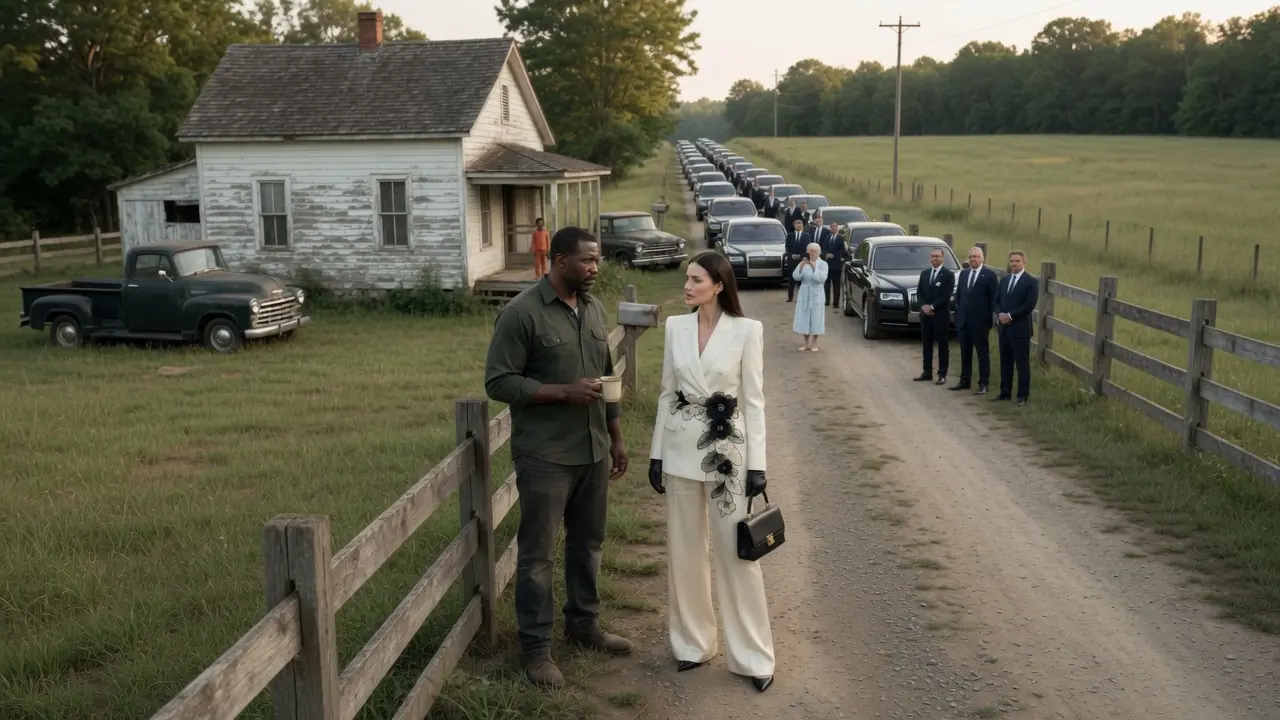
She wore a red dress, fitted and sleek, the kind of red that didn’t apologize for itself, and a cream-white coat over her shoulders. Her heels struck the dirt road with the deliberate sound of someone who had never adjusted her pace for terrain. She walked straight across the road and stopped in front of Marcus. “I came to find you.
You forgot me that fast? Last night you were the one who let me into your house.” Marcus’s mouth opened, closed. He looked at the convoy of cars, looked back at her. Nothing connected.
Eli tugged his father’s shirt. “Dad, who is she?” Marcus shook his head. “I have no idea, buddy.” Who was this woman? And what did she want from a man living quietly on a dirt road in Tennessee?
To understand how a woman like Claire Harmon ended up on a dirt road in Clover Ridge, Tennessee at 11:17 on a Tuesday night with a dead GPS and 8% battery left on her phone, you had to go back to the night before, to the rain, and to the choice she made when everything else ran out. It started with her father. Edward Harmon had pressed a folded piece of paper into her hand the morning she left Chicago. His grip firmer than she expected from a man who had spent the last two months losing weight he couldn’t afford to lose.
His handwriting had written three things: Clover Ridge, Tennessee, Marcus Webb. “Find him, Claire. He’s the only one left.” She hadn’t taken a driver, hadn’t told Steven. She pulled out of the Harmon Capital parking garage at 2:00 in the afternoon in a rented sedan and drove south into weather that got worse with every hour.
By the time she crossed into Tennessee, the rain was arriving in heavy horizontal sheets the wipers couldn’t keep up with. The GPS lost signal somewhere past a town called Fairview. Her phone was down to 8%. She turned off the highway where she thought the map had told her to turn.
The road narrowed. Then it narrowed again. Then it became a channel of dark mud hemmed in by trees, and her front tire sank into it with a soft final sound she felt before she heard it. She sat with the engine off and the rain hammering the roof.
Claire Harmon, chief executive of a $2.4 billion company, sat in the dark in a ditch in rural Tennessee and did not know what to do next. That was the part she would not tell anyone. Then she saw the light, one window two hundred yards off through the trees, yellow and faint. She pulled her coat up, opened the door into the rain and ran.
The porch light was on. She knocked. The man who opened the door was tall and broad-shouldered, his dark brown skin catching the yellow of the porch light with the build of someone who worked with his hands. In the dim yellow light and the heavy curtain of rain, he could not see her clearly.
She was soaked through, her hair flat against her face. “My car got stuck,” she said. Her voice came out steadier than she felt. “I need to wait out the rain.” He did not ask her name.
She woke before 5:00. She found an outlet in the hallway, charged her phone to 11%, called Steven. Then she folded the clothes the man had lent her and placed them on the bed corners even. She pulled the front door shut behind her as carefully as she could.
The boy found the empty bedroom first. He stood in the doorway and looked at the folded pile on the bed. “She left,” he said. His father looked at the clothes, the folded edges, the corners pulled neat.
“Looks like it,” he said. Back on the porch in the morning light and the impossible presence of forty-some luxury vehicles idling on his dirt road, Marcus was still trying to make the pieces fit. The woman in front of him mentioned the clothes. She said they had been left folded on the bed and that she was sorry she hadn’t had a way to say thank you at the time.
Something in Marcus shifted, not recognition of her face, which he had never really seen, but recognition. Claire paused. She said the name the way you say a name you’ve been carrying for weeks, carefully, like something breakable. “A physician.
He specialized in neurosurgery. His name is Marcus Webb. My father knew him a long time ago. He says he’s the only one who can help.” Eli looked at his father.
Marcus’s expression did not change. He looked at Claire Harmon for a moment and then at the road full of cars, and then he looked back at her. “Come inside,” he said. “I’ll put on more coffee.” He turned and walked back into the house without waiting to see if she would follow.
She did. Steven Cole followed her already reaching for his phone. Ray Cutler, still standing in his bathrobe across the street, watched the whole convoy of vehicles settle into idle and took 16 photographs. Inside the small kitchen with the morning light coming through the window over the sink and the coffee maker running and Steven Cole sitting rigidly on a wooden chair that was not built for a man wearing a suit that cost what it cost.
Claire told him everything. Her father, Edward Harmon, was sick. A brain tumor situated in a location that made conventional surgical approaches extraordinarily dangerous. The best neurosurgeons in Chicago had reviewed the case.
Then specialists from New York, then two physicians flown in from Germany, men who had between them operated on more than three hundred similar cases. All of them had said the same thing. The tumor was inoperable. The location, the density, the proximity to critical neural pathways.
To go in was to risk leaving her father with no language, no memory, or no life at all. The prognosis without intervention was three to six months. Edward had listened to every one of them. He had thanked them.
And then one evening he had asked Claire to sit with him and told her about a conversation he’d had twelve years ago in a coffee shop in Boston. He remembered the young doctor clearly. Marcus Webb had been, in Edward’s words, the most quietly extraordinary physician he had ever met. Not because of his credentials, but because of the way he thought.
The questions he asked, the way he described the brain as something to be understood before it was touched. Edward had walked away from that conversation believing that if he ever faced something the others couldn’t handle, Marcus Webb was the name he would call. But Marcus Webb had disappeared. Not gradually, not with a forwarding address.
He had simply stopped. No active medical license, no hospital affiliations, no record of professional activity after a certain date. The private investigator Claire had hired found a Nashville apartment vacated eight years ago and a car registered to a Clover Ridge address in a DMV record from three years back. That was the trail.
That was all of it. “The man has vanished,” Claire said. She was looking at Marcus directly the way she always looked at people she was speaking to fully without reservation. “No one has been able to find him.” Marcus was looking at his coffee cup.
Eli eating cereal at the end of the table had gone still in the particular way children go still when they understand more than the adults in the room have said. Marcus set the cup down slowly. “What address were you going to when you got stuck last night?” Claire reached into her coat and took out a piece of paper folded twice the creases worn the handwriting in the slightly uneven print of a man whose hands had been shaking when he wrote it. She read out the address.
Marcus recognized it without effort. It was the apartment he had left eight years ago when he left Nashville. When he left everything. He did not say this.
He picked up his coffee cup and looked out the window at his yard where his truck sat with a cracked tail light he hadn’t gotten around to fixing. Eli watched his father’s face with the quiet precision of a child who has learned to read it. Claire was watching him, too. In the particular way that intelligent people understand things before they have all the evidence not through logic, but through the quality of someone’s silence, she was beginning to understand that she had found what she was looking for.
She looked at Marcus Webb sitting across the kitchen table at the work-roughened hands wrapped around the coffee cup at the quiet that lived in his face like something he had chosen and then forgotten he had chosen. And she understood without being able to say precisely how that the address on her father’s paper had not been wrong. She had just been looking for the wrong version of the man. She stood up from the table and followed Steven toward the hallway meaning to give him a file he’d been asking about since they’d arrived.
The door to the room at the end of the hall was open. The room she’d slept in the night before and she was almost past it when something on the wall of the adjacent room caught her eye. She stopped. The room was used for storage cardboard boxes, a toolbox, a broken lamp that had been waiting to be thrown away.
But on the wall above a narrow desk in a dark wood frame that had been placed there and then apparently forgotten was a diploma. The glass had a thin film of dust on it. The paper behind it was still bright. Doctor of Medicine Neurosurgery and General Surgery.
The Johns Hopkins University School of Medicine awarded to Marcus James Webb. Claire stood very still. She looked at the diploma for a long moment. She looked at the name.
She looked through the doorway toward the kitchen where she could see the back of a man in a work shirt standing at the sink rinsing his coffee cup with the unhurried ease of someone who had done it ten thousand times and expected to do it ten thousand more. An electrician’s truck sat in the driveway tools on the counter, a child’s drawings held to the refrigerator with magnets. This was who he had become. Not a reduction of what he had been something else entirely.
Something chosen. “You,” she said. Her voice came out different than it usually did. Quieter, stripped of its professional register the board-meeting polish she’d been carrying since she learned to walk into a room.
Just the word and the breath behind it. “You’re him.” Marcus turned off the faucet. He dried his hands on a dish towel. He turned around and looked at her standing in the doorway.
“I don’t practice anymore,” he said. Four words level as a table. She stepped into the kitchen. “My father is dying.” She didn’t say it like a plea.
She didn’t say it like a tactic the way she sometimes deployed information precisely and for effect in negotiations. She said it the way you say a thing that is simply true and that you’ve been carrying for a long time without putting it down because there has been nowhere to put it. Marcus looked at her. Not the way he had looked at her on the porch trying to place her face.
Not through the blur of this morning’s confusion. He looked at her the way you look at someone when you are actually seeing them. The tension at the corners of her eyes, the set of her jaw that was working very hard to stay set, the hands that were not quite loose at her sides. And Claire looked at him not as a CEO looks at a resource to be acquired.
Not as a desperate daughter looks at her last option. She looked at him the way you look at someone who is standing on the same side of something as you even if neither of you asked to be there. From the doorway at the end of the hall, Eli appeared. He looked at both of them at his father’s stillness at the woman’s face and then quietly turned and went back the way he came.
That afternoon after Steven had stepped outside to make calls and Eli had retreated upstairs, Marcus sat across from Claire at the kitchen table and told her about Sarah. He didn’t plan to. It wasn’t Claire’s question that started it. She hadn’t asked not directly.
It was Eli who had come downstairs to return a library book and found an old photograph on the counter one Marcus had left there weeks ago when sorting through a box and hadn’t managed to put away. Eli set it on the table without understanding what he was carrying then went back upstairs. The photograph showed a younger version of Marcus in a white coat smiling in the unguarded way he almost never smiled now. His smile was wide and unguarded the kind that changed his whole face.
Beside him was a woman blonde her head tilted toward his laughing at something outside the frame. She had the kind of face that was easy to read from across the room. Claire didn’t ask, but she didn’t look away. Sarah had been thirty-four years old.
She had been on her way home from her sister’s house on a Thursday evening in March when a truck ran a red light at a wet intersection. The call came into Vanderbilt Medical Center at 8:47 p.m. By the time the name on the intake form resolved into the woman it belonged to, Marcus was already moving. He operated on her himself. There was no one else that night with his level of experience with the specific type of intracranial hemorrhage she had sustained.
He scrubbed in because the alternative was to stand in the hallway and wait while someone with less experience worked on his wife and he could not do that. He did everything correctly. Every decision, every technique, every response to every complication. He was the best surgeon in the building that night.
It had not been enough. Sarah died at 12:19 a.m. He stopped after that. Not gradually, he stopped the way a machine stops when you cut the power. He took a leave that became a resignation, left the Nashville apartment because every room in it still had her in it and drove south until he stopped moving in Clover Ridge, a small town where no one knew his name and there was a school within walking distance for Eli.
He had been a good doctor. He still knew that. But every time he tried to imagine standing over an operating table again, to imagine looking down at someone’s open skull, the lights above him, the instruments in his hands, he saw Sarah’s face and his hands would not cooperate. He told Claire this quietly without emphasis.
When he stopped, the kitchen was very still. Outside the October wind moved through the yard. Claire was quiet for a moment then. My father didn’t tell me to find you because you were the best on paper.
He said you were the only doctor he ever met who looked at a patient like a person, not a case, not a problem. A person. She paused. He said the conversation you two had in Boston was one of the clearest things he remembered from that decade.
He said you talked about the brain like it was something worth protecting. Marcus didn’t answer. But for the first time since Claire had walked up his porch steps, he pulled out a chair and sat down at his own table. Not standing, not keeping the careful distance of someone who hasn’t decided yet sitting across from her.
Outside Steven Cole stood in the yard with his phone and did not come back in. Claire laid out what she was asking simply and without ornamentation because it was not a speech she had prepared so much as a fact she had been living with for months. She needed him to come to Chicago to review her father’s case, to look at the scans, the surgical assessments, the notes from four different specialist teams and tell her if there was anything the other physicians had missed. Anything the imaging showed that no one had been willing to act on.
She was not asking him to promise an outcome. She was not asking him to decide right now whether he would operate. She was asking him to look. That was all, just to look.
Marcus said he couldn’t. His medical license had lapsed. Not revoked. Never that, just allowed to expire by a man who had not expected to need it again.
He had no current hospital privileges. He hadn’t touched a patient’s chart in years. He laid these out not defensively, but simply the way you lay out facts that are just facts. Claire pushed.
She did it the way she pushed in board-meetings, not with volume, but with precision. She outlined the options available She told him the Harmon Center had a credentialing pathway for emergency consultants that she had already spoken with their legal team, that it could be arranged within forty-eight hours. She told him she would handle every logistical obstacle and that money was not a constraint and had never been the point. Marcus listened to all of it.
He let her finish. Then he said, ““Money isn’t the problem.”” Steven tried a different approach, framing it as a records review, technically advisory, not requiring active licensure. He had rehearsed it. You could hear the rehearsal in the phrasing.
Marcus looked at him steadily. “You know that’s not what this is,” Marcus said. Steven stopped talking. The kitchen went quiet.
Claire had reached the edge of what logic and resources and professional persistence could accomplish. She had pressed as far as that territory extended and she was standing at its border. Then Eli came downstairs. He had been listening from the landing, not sneaking, just present in the way children are when they’ve decided something is important.
He came to his father’s side, put his hand on Marcus’s arm and said quietly, quietly enough that Claire could hear every word. “Dad, if someone’s dad is sick, you help. That’s what you always tell me.” Marcus looked at his son for a long moment. Something moved through his face that was not quite any of the things Claire had seen there before.
Not the measured stillness, not the professional detachment he had been maintaining since the moment she stepped off that lead car. Something that was just him. Then he looked at Claire. “I’ll review the files,” he said.
“All of them. If I look at everything and I don’t see anything that changes the picture, I go home and we don’t discuss this further. That’s the deal.” Claire said, “Yes.” Without hesitation, without qualification, without looking at Steven to check if it was reasonable, she just said, “Yes.” There was a beat of silence in the small kitchen. The coffee maker had finished its cycle.
The yard outside the window was still. The forty-some vehicles on the dirt road had gone quiet as if they were waiting, too. Marcus stood up from the table and went to the hallway to get his coat. They flew to Chicago that evening.
Marcus wore the only suit he owned, charcoal gray, bought for a funeral, worn only once since. Eli stayed in Clover Ridge with Gloria, who arrived at the house within forty minutes of Marcus’s call, already carrying a casserole dish and asking no questions that weren’t necessary. Harmon Medical Center occupied the upper four floors of a building on North Michigan Avenue. The room where Edward Harmon was being treated was a corner suite on the top floor with windows looking out over the city in three directions and the kind of quiet that comes from very good soundproofing and a great deal of money.
Marcus walked through it without comment. He noticed the equipment, cataloged it without appearing to, said nothing. Claire walked beside him. She was used to leading in every room she entered without thinking about it.
She found that in this one she didn’t know whether to lead or follow and so she walked beside him, which was something she didn’t usually do, either. Edward Harmon was propped against the pillows in a way that suggested effort. He was thinner than the photographs Marcus had seen in news profiles and the tremor in his hands was visible from across the room. But his eyes were the same eyes Marcus remembered from the coffee shop in Boston, sharp, present, the eyes of a man who had not stopped paying attention.
He looked at Marcus for a long moment. “I knew you’d come,” Edward said. His voice was rougher than it had been, but the cadence was the same. “I just didn’t know Claire would find you quite like that.” A faint pause, something that might have been a smile.
“She doesn’t do anything the normal way.” Claire, standing in the corner, said nothing. Marcus pulled a chair to the side of the bed and sat. “I’m going to read everything, all the imaging, all the notes, all the operative assessments. I’m not making any promises.
I’m just going to read.” Edward nodded. “That’s all I’m asking.” The files were 412 pages thick. Marcus sat beside the bed and read. An hour passed.
Two hours. Claire stood outside the room. Steven brought her coffee she didn’t drink. The nursing staff moved in and out quietly and Marcus sat still and turned pages.
When he finally looked up, he asked Claire to come in. He had the MRI films spread across the light box on the wall, multiple sequences, the tumor visible as a brighter mass against the gray tissue surrounding it. He pointed to a specific sequence taken at a particular angle that the other teams had included in the workup, but had not apparently spent significant time analyzing. There was an asymmetry, small, subtle, easily read as artifact, easily attributed to scanner variance, but it wasn’t.
Marcus traced it with the tip of one finger without touching the film. The margins of the tumor on this sequence showed a narrow plane of differentiation on the posterolateral aspect, a boundary thin, but real, between the tumor tissue and the adjacent eloquent cortex. Every surgical assessment had treated that margin as fully adherent. This said otherwise.
“This isn’t an inoperable tumor,” Marcus said. He said it quietly, without drama. ““This is a tumor that no one has approached from this angle. The posterolateral access route is narrow.
It requires specific positioning, longer decompression time and a level of precision that goes beyond standard technique. He paused. But the margin is there.”” Claire was looking at the films. She had no neurosurgical training and could not read what he was pointing to with the facility he read it, but she could read him and what she saw in his face, in the steadiness of his posture, in the quality of his attention, was not performance.
“What’s the difference?” she said between can’t and won’t. Marcus looked at her. “I’ll do it,” he said. There were forty-eight hours of preparation.
Marcus worked through them methodically, reviewing the imaging again with the Harmon Center’s chief radiologist, consulting with the anesthesiology team on positioning protocols, going through every prior surgical note for information about the specific anatomy he would be working in. He built the approach in stages the way he had always done, committing each decision to paper before moving to the next. He spent six hours with a simulator. He talked through the posterolateral access route with the chief resident until they both had it exactly right.
He did not sleep much. He ate when someone put food in front of him and forgot about it when they didn’t. The night before the surgery, he was sitting alone in the family waiting room on the third floor with the lights on low and the city fully dark outside the windows. He had a cup of hospital coffee he had stopped tasting an hour ago and a yellow legal pad on his knee covered in approach diagrams, the lines clean and spare the way he had always thought through operations that required something beyond standard technique.
He had filled four pages. He looked at them and then looked out at the city spread below the windows of other buildings going dark one by one. He thought about the margin he had seen in the MRI, thin, but real. It was there.
He heard her come in the particular rhythm of those heels, even muted now on hospital carpeting. He did not turn around right away. He heard her cross the room, heard the quiet sound of a chair being pulled out. Claire sat down across from him without asking.
She looked at the legal pad, at the pages of diagrams and did not ask about them. She looked at his face for a moment, the kind of look that registered something without commenting on it, and then looked out the window at the city. For a while neither of them said anything. Outside the city moved in its quiet nighttime way and the waiting room was very still.
Then she said, “I drove out there alone because I didn’t want anyone with me who might say there was a chance I wouldn’t find him. If I’d brought a team, someone would have said something practical. Probability of success, alternate contingencies, and I couldn’t hear that. I just needed to be looking.
Does that make sense to you?” “Yes,” he said. She looked at him. “Are you scared?” He was quiet for a moment. “Yes.
I’ll be scared tomorrow. Every time I’ve been in an OR, I’ve been scared. The good ones are, but you still do it because someone needs it done.” She was quiet after that. Not the quiet of someone who has run out of things to say, the quiet of someone allowing themselves to be exactly where they are without managing it.
Marcus had not seen her do that before. He had seen her control and redirect and deflect with an efficiency he recognized as its own kind of talent. This was different. This was Claire Harmon sitting in a hospital waiting room the night before her father’s surgery, not pretending it was anything other than what it was, not performing steadiness for the room, not managing her own fear into something that looked acceptable, just sitting with it the way a person sits with a thing they have decided to stop fighting.
They sat there for a long time. The coffee went cold. The legal pad stayed open on his knee. Neither of them moved to leave.
The surgery began at 7:15 in the morning. Claire was in the family waiting room on the third floor by 6:55. She sat in the chair she had sat in the night before and did not open her laptop. She did not read the briefing summaries Steven had printed for her.
She did not check her phone for messages from the board or the three client calls that had been rescheduled around this day. She sat and she waited and that was the only thing she did. She had been in rooms where billions of dollars changed hands and she had held herself completely still for those two but this was different. This required something she did not have a professional word for.
Steven sat two chairs down and stopped offering her coffee after the second time. At 8:20 her phone rang a video call from Clover Ridge. Eli’s face appeared on the screen sleep-warm and serious with Gloria visible in the background moving around the kitchen. “Is my dad in surgery?” Eli asked.
“He’s helping my dad.” Claire said. “Yes.” Eli considered this with the particular gravity he brought to large things. ““Is he going to be okay?”” Claire looked at the closed doors of the surgical suite across the hall. “I think so.” she said.
“I really think so.” Eli seemed to weigh this carefully. Then “He’s really good, you know even if he stopped for a while.” “I know.” Claire said. In the operating room Marcus stood at the table and did not think about Sarah. He had thought going in that he would have to manage it that he would have to apply some act of will to keep the thought from arriving but it didn’t come.
What came instead was the work. The anatomy as he had mapped it across four pages of diagrams the night before, the instruments in his hands which felt after years away from an operating table like coming back to a language he had never actually forgotten. The precision of it, the demands of it the way every decision led to the next one and there was no room for anything that wasn’t the work. His hands were steady.
Not because the fear was gone; the fear was there as it always was keeping him careful but because someone was waiting outside that door and the work was real and he was the person in this room who could do it. Nine hours and 18 minutes after the first incision Marcus Webb stepped out of the surgical suite. He was tired in a way that went below the surface the specific exhaustion of prolonged fine concentration of standing at a table and making decisions at the limit of what hands can do. His scrub cap was still on.
His mask was down around his neck. Claire stood up from her chair the moment the door opened. She crossed the room and stopped in front of him and looked at his face at the exhaustion in it at the steadiness that lived behind the exhaustion that had been there the whole time. He nodded.
One nod unhurried not performed. She nodded back. Behind her Steven Cole exhaled so completely he had to put a hand on the wall. Edward Harmon’s recovery was steady.
The tumor had been fully resected. The posterolateral approach had held. In the weeks that followed the neurological assessments became baseline facts. His language processing was intact.
His memory was clear. The tremor in his hands had reduced significantly. Six weeks after the surgery Edward called Marcus from the hospital suite. “I want to ask you something not as a patient as someone who has a reasonably good read on people after sixty-seven years.
Would you consider coming back? Not to Chicago not to anything that doesn’t make sense for your life, but back to medicine, to the work because the world you walked away from is smaller without you in it and I think you know that.” Marcus was standing in his kitchen in Clover Ridge looking out the window at his yard. “I’m not ready to say yes to that.” he said. “I know.” Edward said.
“I just wanted you to hear that the door exists.” On a Saturday in late November a plain dark blue sedan turned off the county road and pulled up in front of the house. No advance call no Steven Cole no driver. Claire turned off the engine and sat for a moment looking at the front yard. Marcus was painting the fence.
Eli was helping his brush loaded too heavy so paint dripped on the grass. The two of them moved together with the easy rhythm of people who had learned each other’s pace over years the boy reaching up the father leaning down without thinking about it. Marcus worked in the even strokes of someone who was not in a hurry. Claire got out of the car.
They sat on the front steps after Eli went inside for a snack he had become urgently committed to. The late November afternoon was still the light thin and gold through the bare oaks. “You didn’t recognize me.” Claire said because it was too dark and too rainy. ““I remember the clothes.”” Marcus said.
“Folded on the bed. I thought about that the next morning. That was the only way I knew how to say thank you. I didn’t want to wake you up.
You were already gone before I thought to wonder about it.” A moment passed, the kind of quiet that doesn’t need to be filled. “My father asked if I thought you’d come back to medicine.” Marcus looked at the fence board he’d missed on the last pass a thin streak of bare wood in the white. ““What did you tell him?”” “I told him I didn’t know.” looked at him. “But I thought you would eventually because of the way you were in that operating room.
It wasn’t something you stopped being good at. It was something you stopped letting yourself have.” Marcus didn’t answer. He stood up and went inside and came back with two mugs of coffee. He held one out.
She took it. He sat back down. The screen door banged and Eli settled between them with an apple and crackers and started describing something that had happened at school, a disagreement during recess that had resolved itself in a way he found deeply satisfying. Claire listened.
She did not check her phone. She sat with paint on the bottom of her boots and listened to an eight-year-old tell the story of his week. The road in front of the house was still and empty under the bare oaks. No convoy, no cameras, no machinery of another life pressing in.
Just the steps, and the coffee warm against their palms, and Eli between them talking without pausing for breath, and the afternoon light going slowly, peacefully away.