"Beat me at this," said Edmund, Duke of Ravenholt, turning a carved knight idly between two fingers, "and I shall marry you. I make the wager freely, for I have never lost a game in my life, and I do not intend to begin tonight with a lady's companion."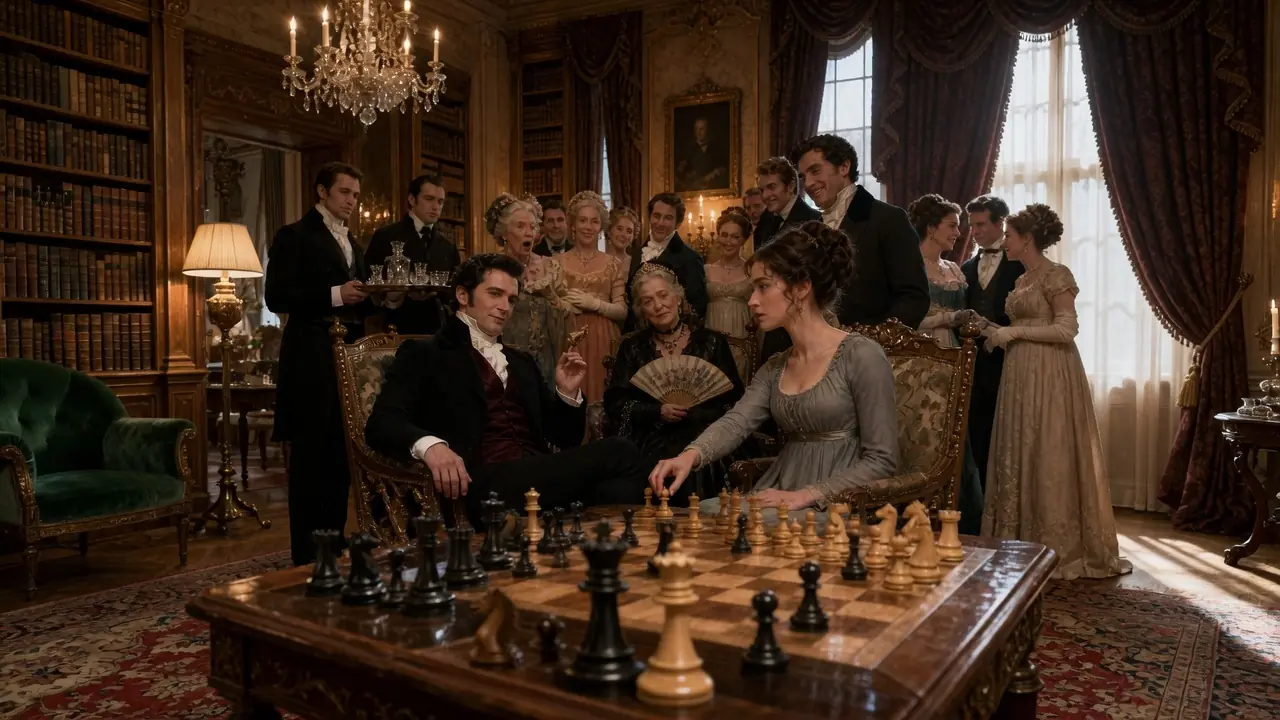
The drawing room of Hartsmere laughed obligingly, as such rooms always laughed at a duke. The candles threw their gold across the chessboard between him and the young woman seated opposite, and he expected her to bluff, to demur, to fold her hands, and decline the impertinence of the thing. That was what they did. They simpered, or they fled.
Camilla Brent did neither. She lifted her gray eyes to his, and there was nothing in them of the flutter he had braced himself to pity.
"I should warn Your Grace," she said, "that I do not play to be gallant. If you wager your hand, you ought to mean it. I shall hold you to your word."
A ripple went around the room. The duke had hosted a dozen such house parties, and he knew the particular silence that falls when the company senses that the entertainment has turned upon the host. He found, to his mild irritation, that he was smiling.
"Then mean it I shall," he said. "White is yours. Begin, Miss Brent, and let us see how long the companion lasts against the master."
She moved a pawn without hesitation. He answered. She moved again, and he settled back in his chair with the easy condescension of a man who had spent his life being deferred to and had come to mistake deference for proof.
She did not play the way the young ladies of his acquaintance played, which was to say she did not play to lose handsomely. She played as though the board were a country and she meant to take it. Her openings were quiet, almost dull, and then a piece he had dismissed as harmless would unfold its purpose three moves later, and he would feel the ground shift beneath a position he had thought secure.
He leaned forward. He stopped speaking to the room. The candle nearest his elbow guttered, and he did not notice it.
He had been schooled as a boy by a tutor brought from the Continent at no small expense. He had beaten that man before he was sixteen and had never lost to a living soul since. Over the years, he had come to think of chess the way he thought of everything else that bore his name: as a thing the world had arranged for him to win.
He set a trap for her queen, an elegant one, the sort that had ended a hundred games against lesser players in this very room. She did not take the bait. She did not even appear to see it as bait. She simply declined it, the way one declines a dish one does not care for, and made instead a small sideways move of a pawn that he understood, a beat too late, had quietly dismantled the whole of his design.
"That was well done," he heard himself say, and was surprised to find that he meant it.
"Your Grace nearly had me," she answered without looking up. "Three moves ago, you did not press it. You assumed you had time." A faint smile touched her mouth. "You have, I think, a great deal of time in your life, and so you have never learned to fear the want of it. It is your only weakness as a player. It is rather a large one."
No one spoke to the Duke of Ravenholt so. He ought to have been affronted. Instead, he found that he wanted to hear what else she had observed about him, and that the wanting was a kind of hunger he had not known he carried.
"You hesitate, Your Grace," she observed, not unkindly.
"I consider," he said.
"Of course." A faint, maddening warmth touched her mouth. "Consider carefully. I am told you do not lose."
He had walked into a great many drawing rooms in his nine-and-thirty years and walked out the unquestioned victor of whatever contest the evening offered. He could not, in that moment, remember the last time anyone had made him think. The sensation was so unfamiliar that it took him several minutes to recognize it as pleasure.
The room had drawn close around them. He was distantly aware of the rustle of silk, of an elderly lady murmuring that it was not at all the thing, and of his own friend Carrow grinning like a fool over his shoulder. None of it reached him. There was only the board and the woman bent over it, a few dark curls slipping loose at her temple, her whole grave attention fixed upon the squares as though nothing in the world existed but the next true move.
He played his bishop. It was a strong move. He knew it was a strong move.
She took it with a pawn he had forgotten and quietly, almost gently, slid her rook into the long open file. He saw, with the cold clarity of a man watching his own carriage roll toward a ditch, exactly how the next six moves would unfold and that there was nothing whatever he could do to stop them.
"You see it," she said softly. It was not a question.
"I see it," said the Duke of Ravenholt.
He could have knocked the king over and laughed it off as a jest. The room would have let him. The room would have agreed at once that it had all been in fun, that of course a duke did not truly stake himself across a chessboard against a companion of no fortune.
He looked at the inevitable ruin of his position, and then he looked at her face, lit gold by the failing candle. He found that he did not wish to laugh it off at all.
He reached out and laid his own king gently on its side.
"The game is yours, Miss Brent," he said, and his voice was steadier than he had any right to expect. "And so, it would seem, am I."
The room erupted. He scarcely heard it. He was watching her, and for the first time all evening, her composure faltered. A flush rose in her cheeks, and she looked at the fallen king as though she had not quite believed until that moment that he would let it fall.
He did not sleep that night. This was itself a novelty. The Duke of Ravenholt usually slept the sound, untroubled sleep of a man who had never been seriously contradicted.
Instead, he lay in the dark of the great bedchamber and replayed the game move by move. He found that he could not regret a single one of his defeats upon that board, for each had been the work of a mind he wanted, with sudden and uncharacteristic urgency, to know better.
He thought of the curl that had slipped loose at her temple. He thought of the way she had said, "You assumed you had time," as though she had read not merely his game, but the whole arrogant arithmetic of his life.
By the time the gray light came to the windows, he had arrived, with the cold certainty he usually reserved for matters of business, at a conclusion that should have alarmed him and instead made him impatient for morning: he had no wish whatever to be released from the wager.
He found her the next morning in the long gallery, where she had supposed herself unobserved. She stood at the tall windows with a book she was not reading, and when she heard his step, she straightened her spine like a woman bracing for an apology.
"You have come to take it back," she said.
"I have come," said the duke, "to discover whether you take it back. You won a husband at chess, Miss Brent. I am told that is not what young ladies dream of. The room thought it a great joke. My aunt thinks it a scandal. I find I do not greatly care what either thinks, but I should like to know what you think."
She turned from the window. The morning light was kinder than the candlelight had been and crueler. It showed him the plainness of her gown, the carefulness of a young woman who had learned to want very little because very little had ever been offered her.
"I think," she said slowly, "that you are a proud man who has never once been refused, and that you mistook the sting of losing for the beginning of love. By tomorrow, you will be very glad I had the sense to release you from a wager made in vanity before a laughing room."
"That is a great deal of thinking," he said, "for a woman who has not asked me a single question."
"Then ask me to ask you one."
"Ask me," said Edmund, "why I did not knock the king over and call it sport. I had only to laugh. You knew I had only to laugh. Why do you suppose I let it fall?"
She did not answer. She was watching him very carefully now, the way she had watched the board, looking three moves ahead and trusting nothing she had not proved.
"Because for the length of one game," he said, "I was not a duke. I was a man being beaten by a finer mind than his own, and I had not known until last night how starved I was for the company of one. They defer to me, Miss Brent. The whole of my life is people agreeing with me. You sat across that board and did not care one whit for my title. You took my bishop, and you have not once, since the moment we met, told me a single thing you did not believe to be true."
He paused.
"I have never in my life been so thoroughly defeated, and I have never been so glad of anything."
The book slipped from her hands. He bent and caught it before it struck the floor. When he rose, they were standing very near, and he held the book out to her, but for a moment neither of them took it.
"You will tire of being beaten," she said, but her voice had lost its certainty.
"Then I shall study," he said, "and improve, and lose to you more cleverly each year. We shall both grow old at that board and never once be bored. Marry me, Camilla. Not because I scoffed and lost, but because I have met the one person alive who will tell me the truth across a chessboard, and I have not the smallest intention of letting her go play against anyone else."
She looked down at the book between their hands. It was Philidor, a treatise on chess openings, much worn, its spine cracked from reading.
"You play the Sicilian," she said unsteadily, "very badly."
"I know it," he said.
"I could teach you."
"I am counting upon it."
"They will say I trapped you," she said, the old wariness flickering back. "A companion of no fortune who lured a duke to a wager and would not let him cry off. My name will not survive it. Yours will. That is how the world keeps its accounts, Your Grace, and I have lived too long on the wrong side of its ledgers to forget it."
"Let them say it," he answered. There was iron beneath the warmth now, the iron of a man who had decided a thing and would not be moved. "I have spent nine-and-thirty years being agreed with, deferred to, flattered, and never once contradicted by a soul who did not want something of me. You wanted nothing. You took my bishop, told me the truth, and would have walked out of that room last night and never thought of me again. That, Camilla, is the rarest thing I have encountered in the whole of my gilded life."
He paused, gentler now.
"I will not let the gossip of people who have never said a true word to me decide whom I am to spend my life beside. And as for your name, you shall have mine. I am told it carries a certain weight. Let us put it to better use than it has ever been put before and dare the county to whisper."
She looked at him for a long moment, and he watched the worry in her fight the hope. Then he watched the hope win.
A laugh broke from her, half a sob. She pressed her free hand briefly to her mouth, and when she lowered it, she was smiling at him the way she had smiled over the fallen king, as though the impossible had, against all sense, turned out to be true.
"Yes," she said. "Yes, you ridiculous, arrogant, generous man. I will marry you. But I warn you, Your Grace, I shall not let you win to spare your feelings. Not ever."
"I should leave you the moment you did," said the Duke of Ravenholt.
He meant it. She knew he meant it, and that, he thought, was the whole of why he loved her.
They were married before the leaves turned. The signet ring he placed beside her wedding band that morning had sealed three centuries of Ravenholt decrees, and he gave it into her keeping without a flicker of doubt, for he had learned across a candlelit board that her judgment was surer than his own.
In the years that followed, the great house at Ravenholt became known for two things: the warmth of its mistress, who turned no honest soul from the door, and the chessboard that stood always set in the window of the long gallery.
The servants said the Duke and Duchess played at it most evenings. They said he lost rather more often than he won, and that he had never in living memory looked happier than when he was losing.
She beat him at the board on the last evening of his life, when he was an old man laughing in the firelight. He laid his king down gently, the way he had laid it down on the first night, and took her hand.
"The game is yours, my love," he said. "It always was."
She held his hand, and they sat in the warm light, two gray heads bent close. In all those long, good years, neither of them had ever once been bored.