Chapter 1: The Woman No One Watched
In the parish of Alderbrook, there were people who mattered and people who were useful, and the difference between the two was not always stated aloud, though everyone understood it. Those who mattered had carriages and pews with cushions, names that appeared in county lists, and mothers who spoke of connections as though the word itself were a currency. Those who were useful kept the parish running. They mended, cooked, taught, tended, sang, visited, read prayers at bedsides, carried broth to the fevered, and wrote polite letters so that the village's decent face might remain smooth.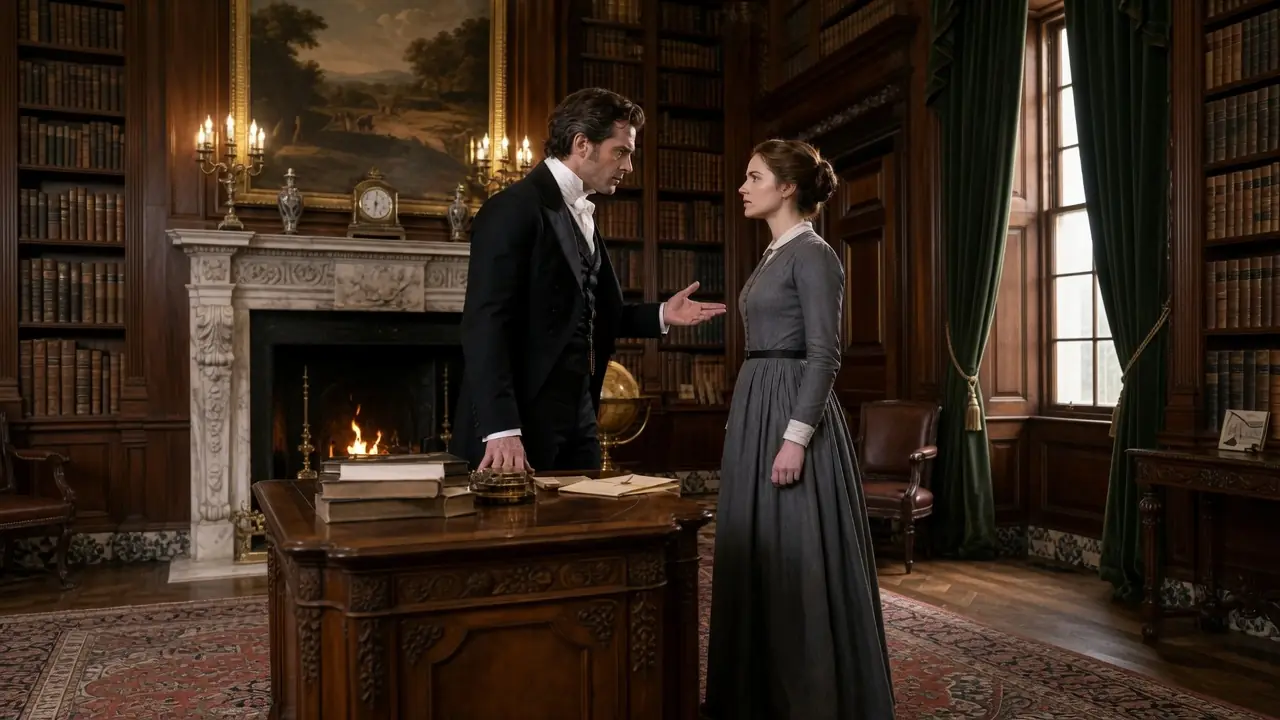
Miss Rebecca Collins belonged to the second class, and had belonged to it so long that she scarcely remembered how it felt to be young enough to dream of the first. At twenty-seven, she was the vicar's sister, which placed her in a small, respectable niche. She was not poor, not in the way that required begging or barter, but she was certainly not comfortable. Their little vicarage stood at the edge of the green, respectable enough from the road, though drafts had their own opinion of its respectability, and the kitchen ceiling had been threatening to stain for two winters.
Rebecca knew precisely how much coal could be spared, how many candles might be burned and how many shillings might be stretched into soup for the sick. Her brother, the Reverend Thomas Collins, was a conscientious man with a tender heart and a quick mind. He had ideas about charity, about fairness in parish matters, about the dignity of the poor, ideas that were admired in theory and resisted in practice. He preached plainly.
He visited diligently. He did not flatter the rich. For this he was respected, though not cherished by the families who believed it their natural right to be cherished. Rebecca, however, had learned early that her brother's position did not secure her own.
She was not invited as a guest of consequence. She was invited as the vicar's sister, as a woman who could be relied upon to help, to listen, to smooth, to mend. And she did help. She kept the parish lists and wrote out the notices in her neat hand.
She attended births and deaths. She coaxed stubborn children into Sunday shoes and persuaded weary mothers that they were not failures for being tired. She read to old Mr. Dyer when his sight faltered. She sat with Mrs. Hawks when grief made the days too long, because she was always there, she was rarely seen.
If Rebecca had possessed some bright beauty, a sharp wit for drawing room amusement, or a fortune to make her valuable, she would not have been overlooked. But her attractiveness was of a quiet sort, soft brown hair always pinned with care, eyes more thoughtful than bright, and a smile that came quickly when others needed it. She had never been the girl whose entrance made a room turn. She had always been the woman who found the lost shawl, who remembered the child's name, who refilled the teacup before anyone thought to ask.
In the summer of Mr. Mercer's first full year at Mercer Hall, a subtle change entered Alderbrook, the kind of change that begins as a murmur and becomes by degrees a certainty. Mr. Andrew Mercer had inherited Mercer Hall from his father the previous autumn. His father's death had been expected, though mourned. Andrew's succession had been anticipated, and still it altered the village in ways that could not be measured by rent rolls and estate accounts alone.
A new squire meant new rules, new favor, new patronage, or new neglect. Tenants watched the hall with careful hope and careful fear. Andrew Mercer was not what the village expected. He was young, twenty-six, perhaps twenty-seven, and tall, with dark hair that curled slightly when damp, and an expression that suggested he took little for granted.
His manners were correct without being soft. He was not given to easy laughter, though when he did smile, it was as if he meant it. The older ladies found him respectful, but puzzling. The younger found him interesting in a way they pretended not to.
His mother, Mrs. Mercer had remained in London for most of the winter, leaving her son to settle the estate. Rumor said she disliked the country. Rumor also said she would return soon and set everything right, which in village language meant secure her son a wife of proper consequence. In the meantime, Andrew Mercer attended church each Sunday with quiet steadiness.
He sat in the Mercer pew with his steward behind him, listened without fidgeting, and spoke afterwards with courtesy to the vicar. Thomas Collins found him intelligent and unexpectedly serious. Rebecca found him, at first merely another parish gentleman whose presence demanded propriety. The first time she truly noticed him was at the Harvest Supper.
The harvest supper was a village institution held in the schoolroom behind the chapel. Its decorations were made of honest wheat sheaves and late flowers. Its tables were lined with loaves, pies, and jugs of ale. It was an evening of laughter and music, of proud farmers and weary laborers, of women in their best gowns, and children who looked as though they might burst from the effort of sitting still.
Rebecca had attended every harvest supper since she was sixteen. She always did the same tasks, oversee the bread, soothe the anxious, ensure the old were seated comfortably. That year she was helping Mrs. Hardwick distribute portions when she felt, without understanding why, that she was being regarded, not stared at with the boldness of rudeness, not assessed with the coolness of calculation, but regarded as if she were quite simply present. She looked up and met Mr. Mercer's eyes across the room.
He did not look away at once. There was nothing improper in it. Indeed, he inclined his head slightly, as if acknowledging that she existed, which should not have unsettled her. Yet it did.
Rebecca felt warmth rise to her cheeks and returned to her bread basket with an absurd sense of having been caught at something. After that, she noticed him more often than she would have expected. He asked her brother thoughtful questions about parish needs. He listened when Rebecca answered rather than turning his gaze away as though her voice were merely background.
He thanked her—thanked her when she brought a ledger or explained some difficulty about the widow's allowance. It was all entirely reasonable. It was also entirely new. Rebecca began to be aware of small moments.
But human vanity is stubborn, and even the most modest heart can stir when it is noticed. The parish, however, noticed, too. Whispers began at the milliners, where Mrs. Allen had a particular gift for turning observation into story. They grew in the kitchen at the hall, where servants saw more than their betters believed.
They reached the dairy, the inn, the schoolroom, and finally the vicarage itself. One evening, after an exhausting day of visiting three fevered cottages and soothing the parish clerk's wife over a quarrel about pew arrangements, Rebecca returned to find her brother seated in the little parlor with a look of concern that did not belong to illness or rent.
"Rebecca," he said carefully, "have you spoken much with Mr. Mercer lately?" Rebecca paused, startled.
"Only when he has spoken to me in company, in the ordinary way." Thomas's gaze held hers.
"People are remarking upon it." "People remark upon everything," she replied with an attempt at lightness.
"Yes," he said, "but this remarking is of a particular kind." Rebecca's hands tightened around the cloth she carried.
"What kind?"
"The kind that assumes intentions." A quiet, uncomfortable silence fell.
Rebecca was suddenly aware of how narrow her life was, how easily gossip could fill it. She had done nothing wrong. She knew that. Yet the mere fact of being spoken of made her feel as if she had stepped too close to the edge of something dangerous.
"Thomas," she said softly, "I do not seek his attention. I have not encouraged it." "I know you have not." His voice gentled.
"That is why I am worried." In Alderbrook, a vicar's sister could be respectable, but she could also be vulnerable.
And once a village decided upon a story, it rarely let the truth interfere.
Chapter 2: The Squire's Burden
Mr. Andrew Mercer had not expected to find peace in Alderbrook, but neither had he expected to find unrest. When his father died, Andrew did not feel grief in the way that novels described. He felt instead a sudden weight, the estate, the tenants, the accounts, the reputation. His father had been a man of old habits and old expectations.
There were debts that were not spoken of publicly and promises that had been made privately. Andrew inherited not only land but a complicated web of obligation. His mother wrote frequently. Her letters were always affectionate, always certain of what was best.
She spoke of Bath, of London, of dinners and alliances. She spoke of the daughters of men whose names mattered. She spoke of estates joining estates as though human affection were a pleasant accessory rather than a force that could ruin lives. Andrew read her letters with a mixture of duty and irritation.
He loved his mother, but he did not share her view that marriage was merely a sensible arrangement. He had seen too many arranged unions that produced bitterness disguised as propriety. And yet he knew what the world expected of him. In the county, Mercer Hall was a known name.
His father had been the sort of man who sat in the right committees, supported the right causes, and never embarrassed his class with excessive kindness. The county expected Andrew to be the same. But Andrew had been shaped by different influences. His father, for all his reserve, had once told him, "It is easy to be respected. It is harder to be just." Andrew did not always know how to be just, but he wished to try. When he arrived at Alderbrook as master of the hall, he threw himself into the estate management with quiet energy. He walked the fields, spoke with tenants, examined the cottages. He discovered that one tenant's roof had been patched so often that it might as well have been woven from hope.
He discovered that the steward had been managing the accounts with a discretion that bordered on complacency. He began to change things slowly, carefully. It made him popular with those who benefited. It made him resented by those who preferred the old ways.
In the midst of this, he encountered Miss Rebecca Collins. At first, she was simply the vicar's sister, sensible, calm, always with papers in hand. But the more he spoke with her, the more he realized she possessed a clarity that surprised him. She understood the parish not in theory but in detail.
She knew who was proud and who was desperate, who would accept help, and who would starve before admitting need. More than that, she spoke without performance. Andrew had been raised among women who understood social value. Many of them were not foolish, some were even kind, but they had all been trained to be seen.
Rebecca Collins did not try to be seen. She simply was. He found himself seeking her out under the excuse of parish matters, a question about the school funds, a concern about the widow's allotment, an inquiry regarding the sick. He told himself he was doing what a responsible squire ought to do.
He believed it until one afternoon when he realized he had arranged a visit to a cottage precisely because he knew she would be there. The moment of recognition unsettled him. He returned to the hall that evening and found a letter waiting, a thick scented packet bearing his mother's familiar seal. He broke it open.
"My dear Andrew, I am pleased to hear from Mrs. Bellingham that you have settled the estate satisfactorily, but satisfactory is not sufficient. The county is watching, and you are not a boy with time to waste. I will be in Alderbrook within the month, and expect you to have a clear plan. Bath this winter perhaps, or London earlier, if you are sensible. Lord Winthrop's niece is said to be accomplished and well-connected. The Fletchers have a daughter with excellent prospects." The letter went on. It named families, fortunes, and connections with the precision of a contract. Andrew folded it slowly. His chest felt tight.
He knew his mother meant well. He knew she loved him. But her world was built upon the belief that a man's happiness mattered less than his position. He thought of Rebecca Collins.
He thought of her quiet competence, her steady kindness, her refusal to act as though she were for sale. He did not yet admit even to himself that he was becoming attached. That word attached felt too much like surrender. But he could not deny that the thought of pleasing his mother by marrying someone he barely knew filled him with a coldness he did not wish to live with.
A few days later he encountered Rebecca in the churchyard. She was alone kneeling near the grave of an elderly woman who had died the previous week. She had been placing small winter flowers on the mound, her gloved hands careful, her posture composed. Andrew paused, feeling suddenly as though he had intruded on something private.
But she looked up and met his gaze without embarrassment.
"Mr. Mercer," she said, rising.
"Good afternoon." "I did not mean to disturb you." "You have not," she glanced at the grave.
"Mrs. Larkin asked me once some months ago if anyone would remember her. I promised her I would." The simplicity of it struck him. Rebecca did not speak of her own virtue, did not dramatize the moment. She merely stated a fact.
"You keep many promises, it seems," he said quietly.
She smiled faintly.
"Only the small ones. The large promises are more frightening." He felt in that instant that she had spoken to something in him, something he had not yet dared to name. He found himself walking beside her as they left the churchyard, speaking of parish matters at first, and then gradually of books. Rebecca confessed she had always liked poetry, but rarely had time for it. Andrew admitted to his own surprise that he kept his father's old volumes not from sentiment alone, but because he found comfort in the familiar lines.
Their conversation was not flirtatious. It was something more dangerous. It was honest. That night, Andrew lay awake longer than he wished to admit, thinking of a woman the world had taught him to overlook, and finding he could no longer do so.
Chapter 3: The Parish Tightens Its Grip
If there is one thing a village cannot endure, it is uncertainty. Alderbrook could accept that Andrew Mercer, the new squire, was kind to tenants. It could accept that he attended church faithfully and spoke politely to the vicar. It could even accept that he did not host grand dinners immediately, for grief and transition excused a great deal.
But it could not accept that his interest might settle upon Miss Rebecca Collins. Not because Rebecca was unworthy, for most people would have conceded that she was kind, but because kindness was not a currency the village believed could purchase Mercer Hall. The attention Andrew paid her began to alter Rebecca's life in ways she had never anticipated. At the market, she noticed the pause of conversations as she approached.
At the school, she saw Miss Hargreaves, the school mistress, watch her with a mixture of curiosity and warning. Even Mrs. Hardwick, usually brisk and affectionate, began to weigh her words as though each syllable might be used in evidence. Rebecca tried to pretend it did not matter. But the quiet comfort of her invisibility had been stripped away, leaving her exposed.
Her brother worried. Thomas Collins was not blind to the parish's tendency toward judgment, and he knew how easily it could turn cruel. One afternoon he returned from visiting a tenant with a troubled look.
"Rebecca," he said, shutting the parlor door.
"I heard something today. Mrs. Briggs says that Mrs. Mercer will be arriving within a fortnight."
Rebecca's stomach tightened.
"That is hardly extraordinary. She is his mother."
"Yes," he said, "and she will have opinions." Rebecca's hands trembled slightly as she poured tea.
"Then Mr. Mercer will do what is expected of him." Thomas watched her carefully.
"Is that what you believe?" Rebecca did not answer at once.
She had not allowed herself to imagine otherwise. To imagine that he might choose her, truly choose her, was to invite ruin. Before she could respond, there was a knock at the door. Their maid, nervous with excitement, announced that Mr. Mercer had called.
Rebecca's breath caught. Thomas looked at her, concern deepening. Andrew entered with his usual restraint, but his expression suggested strain. His coat was immaculate, his posture controlled, but the lines near his eyes had sharpened.
He spoke first to Thomas about parish business, a donation to the school, repairs to a cottage roof, but his gaze flicked toward Rebecca more often than courtesy required. When Thomas excused himself briefly, Rebecca found herself alone with the squire in the small parlor. She did not know what to do with her hands. She folded them, unfolded them.
Finally, she clasped them together. Andrew spoke softly.
"I have heard rumors." Rebecca's heart sank.
"Then you know what the parish does with idleness." "I do." He hesitated, then continued.
"My mother is coming." "I have heard," Rebecca replied, her voice steady by force.
Andrew's gaze held hers.
"I did not ask for her to come now." Rebecca managed a small smile.
"We do not always choose the timing of our difficulties." He looked at her with a mixture of admiration and frustration.
"You speak as though you have already accepted defeat." Rebecca's throat tightened.
"I speak as someone who understands the world." Andrew's expression shifted.
For a moment he looked younger, less controlled, as if he were about to say something unguarded. But then Thomas returned, and the moment slipped away like water through fingers. From that day the village watchfulness became sharper. Mrs. Mercer arrived with a carriage and a maid, and the air of a woman accustomed to being obeyed.
She was handsome still, her hair arranged with elegant precision, her gown of rich silk, appropriate for traveling, but unmistakably superior to anything in Alderbrook. She attended church the first Sunday after her arrival. Her gaze moved over the parish like a surveyor, marking boundaries. She spoke warmly to the vicar afterwards, complimented his sermon, and then, when introduced to Rebecca, smiled with impeccable politeness.
"Miss Collins," she said, "how fortunate your brother is to have you." Rebecca sensed the meaning beneath the words.
How fortunate indeed, for it meant Rebecca had no need to seek a husband, and therefore no excuse to imagine one. Mrs. Mercer hosted a small tea at the hall later that week, and invited the neighboring gentry. Rebecca attended only because her brother could not reasonably refuse. She wore her best gown, carefully mended, and arranged her hair with quiet skill.
She looked, Rebecca thought, with painful honesty, like what she was, a vicar's sister. The room glittered with subtle wealth, fine lace, polished shoes, jewelry worn as casually as confidence. Young ladies laughed softly, their voices trained. Older ladies exchanged news, their eyes assessing.
Andrew moved among them with correct ease. Yet Rebecca noticed, with a flutter of something she did not wish to name, that he watched her more than he watched them. It did not help her. It only made her more visible.
A young woman named Miss Caroline Fletcher, pretty, polished, and very eligible, made a point of speaking to Andrew. Mrs. Mercer watched with satisfaction. When Andrew turned away, Caroline's gaze flicked to Rebecca with a small, cool curiosity. Later, as Rebecca stood near a table of refreshments, Mrs. Mercer approached.
"My son tells me you are greatly involved in parish matters," she said smoothly.
"I try to be helpful."
"Quite admirable." Mrs. Mercer smiled.
"It must be gratifying to be so needed." Rebecca understood then that Mrs. Mercer's politeness was a weapon.
She was not openly cruel. She did not need to be. She merely reminded Rebecca of her place with every word. The tea ended.
Rebecca returned home with her brother, feeling as though she had walked through a room of mirrors that reflected only what she lacked. That night she lay awake, listening to the wind press against the vicarage windows. She told herself she would endure. She always had.
But endurance, she realized, was not the same as peace.
Chapter 4: The Choice That Costs
The crisis came not in a grand declaration, but in a village dispute, because in Alderbrook, politics was seldom about parliament and almost always about pride. A newly appointed parish overseer, Mr. Pell, a man who believed authority should be exercised loudly, decided that the poor relief fund was being distributed too freely. He claimed that certain families were receiving more than their due. He implied with unfortunate boldness that the vicarage's influence had made the system sentimental rather than sensible.
Rebecca knew at once what lay beneath it, resentment. Some men disliked that a vicar spoke of dignity and fairness. Others disliked that a woman, particularly a vicar's sister, kept records that could contradict them. At the parish meeting held in the schoolroom, tensions rose swiftly.
The farmers argued, and the overseer accused. The poor tenants sat silent, shoulders hunched. Rebecca sat near her brother, her ledger in her lap, her heart thudding. She did not speak unless asked.
She never did at such meetings. It was not considered proper. But when Mr. Pell insinuated that the vicarage could not be trusted with the accounts. Rebecca felt something inside her tighten; her cheeks burned.
Thomas began to respond, his voice calm, but strained. Before he could, Andrew Mercer rose. His voice was not loud, but it cut through the room with authority.
"If there is any question of the accounts," he said, "then we will review them in full. And if there is any question of distribution, we will consider not only the numbers, but the realities behind them. Poverty is not a crime." Mr. Pell bristled.
"It is not a crime, no, but charity must be managed." "Indeed," Andrew replied, "and I have found Miss Collins's management of parish matters to be the most precise in the village." The room shifted, heads turned.
Rebecca felt the heat in her face intensify, not from shame this time, but from the sudden, dangerous intimacy of being defended. Mr. Pell's lips tightened.
"Miss Collins is a vicar's sister," he said, as if that explained everything.
Andrew's gaze did not waver.
"She is also competent." The meeting ended without resolution, but the village did not forget what had been said.
By the next morning, gossip had transformed Andrew's defense into proof of attachment. Rebecca could endure whispers. She could endure subtle contempt, but she could not endure the idea that her brother's work might be undermined because of her. And so, in the clear chill of the following afternoon, she made a decision.
She requested properly through her brother that Mr. Mercer meet her in the vicarage garden. The garden was modest, bordered by a low hedge visible from the lane. No one could claim impropriety. Everyone, however, could observe.
Andrew arrived with the restrained tension of a man who knew he was stepping into a moment that would alter everything. Rebecca stood near the winter bleached rose bushes. Her hands were gloved. Her posture was composed.
Only her eyes betrayed the strain.
"Miss Collins," he said quietly.
"Mr. Mercer." She took a breath.
"You have put yourself in difficulty on my account."
His brows drew together.
"I spoke what I believe."
"I know." Her voice softened.
"But belief does not spare consequences." Andrew's gaze held hers.
"Rebecca." He stopped as if realizing he had used her name.
She did not chastise him. She only continued steadier now that she had begun.
"You are expected to marry well," she said.
"Your family will demand it. The county will demand it. And if you continue to be seen as partial to me, the parish will not blame you. It will blame me." Andrew's jaw tightened.
"Let them."
Rebecca shook her head.
"I cannot." She swallowed.
"I will not have my brother's ministry made harder because I was foolish enough to believe kindness might mean more than it should." Andrew stepped closer, still maintaining the careful distance propriety required.
His voice dropped.
"Do you believe I am merely kind?" Rebecca's throat tightened so sharply she could scarcely speak.
"I do not know what you are," she managed, "but I know what the world will make of it. And I cannot live inside a story that others write about me." For a long moment, Andrew said nothing. The garden seemed too still, the air too sharp. Then he spoke, each word deliberate.
"If I were to end it," he said, "if I were to step back as you suggest, would you feel relieved?" Rebecca's eyes stung.
"I would feel safe."
"That is not the same thing."
She could not answer. Andrew's gaze searched hers.
"If I were free of my mother's expectations," he said quietly, "if the county did not exist, what would you choose?" Rebecca's breath trembled.
"That is not the world we live in."
"No," he agreed.
"But it is the world I am deciding whether to defy." Rebecca's heart hammered.
"You would not be happy," she whispered.
"Not with the weight of resentment. Not with losing your mother's approval." Andrew's expression softened.
"And would you be happy, Rebecca, if I let you vanish again simply because it is easier?" The word struck her. vanish because that was what she had always done.
Made herself smaller, quieter, unseen, so that others might move through life without discomfort. She looked down at her hands. When she lifted her gaze, her eyes were bright but steady.
"If you cannot honorably declare your regard," she said, "then it must end." "Not because I do not value you." She paused, forcing herself to continue.
"But because I will not be used as a quiet amusement before you choose the woman you are meant to choose." Andrew's shoulders tightened as if the truth pained him.
"And if I declare it?"
Rebecca held his gaze.
"Then you must be prepared to accept what follows for both of us, and you must be certain it is not pity, not rebellion, not frustration." "It is not," he said with sudden intensity.
Then he caught himself, restraining it, but the feeling remained in his eyes.
"It is respect, admiration, and something that has taken root despite my every attempt to be sensible." Rebecca's chest ached.
"Mr. Mercer."
"Andrew," he said, and then carefully, as though placing something fragile into her hands, "Rebecca, will you allow me to speak to your brother?" Her breath caught.
This was the precipice. Beyond it lay either security or ruin. She nodded once, barely able to trust her voice.
"Yes."
The visit was arranged for the following morning. Andrew arrived punctually. Thomas received him in the parlor with visible caution. Rebecca remained seated, hands clasped, her face composed with effort.
Andrew spoke plainly without flourish. He acknowledged the difference in their stations. He acknowledged the certainty of disapproval from his family. He spoke of Rebecca's character, her understanding, her steadiness.
"I wish to offer for her," he concluded, his voice firm.
"I know what it will cost, but I also know what it would cost me to choose otherwise." Thomas looked between them, his expression tightened, then softened.
"My sister," he said, his voice quiet, "is dearer to me than any notion of ambition. If you harm her, even unintentionally, I will never forgive you." "I do not intend to harm her," Andrew said. Thomas's gaze sharpened.
"Intention is not always enough." Andrew nodded.
"Then I must offer more than intention. I offer honor. I offer truth. And I offer her the only thing I think worth offering: a choice." Thomas turned to Rebecca. His eyes, so often burdened, were tender.
"Rebecca," he said softly, "what do you choose?" For a moment, the room seemed to hold its breath.
Rebecca's palms were damp inside her gloves. Her heart thudded painfully. She thought of Mrs. Mercer's cold politeness, of the county's contempt, of the parish gossip that would turn sharp. She thought of her brother's precarious respectability, of the vicarage roof, of the life she had built from small duties and small comforts.
Then she thought of Andrew's gaze in the churchyard, of his defense at the meeting, of the way he had spoken to her as though she were not invisible. And she realized she did not want to vanish again.
"I accept," she said, her voice steady, "if he remains certain."
Andrew's gaze held hers, almost fierce in its conviction.
"I remain certain." The consequences arrived swiftly.
Mrs. Mercer's disapproval was immediate, deeply wounded, and delivered with perfect composure. She did not scream. She did not faint. She simply made it clear that her son was making a disastrous choice.
"You will be pitied," she told him.
"And she will be suspected." Andrew did not waver.
"Then let them pity. Let them suspect. I have lived too long under others' opinions." Mrs. Mercer left Alderbrook within a fortnight, returning to London with a chill that promised long-term estrangement. In the parish, gossip flared once more, bright as flame. Some were delighted, some were scandalized, some were simply eager to be proven right about whatever they had predicted.
Rebecca bore it with quiet fortitude. Her life changed, but she did not become suddenly grand. She continued to visit the sick. She continued to manage parish lists.
She continued to smile at children. The difference was that now when she walked through the village, people saw her, some with envy, some with grudging respect, some with softened affection. Andrew, too, changed in subtle ways. He became more openly involved in parish matters, not to impress, but to anchor.
He repaired cottages. He adjusted rents for families in hardship. He insisted on honest accounting from the overseer. Mr. Pell resigned within two months, muttering about newfangled notions, and was quietly replaced by someone less eager to turn charity into a weapon.
The wedding took place in spring. It was not a grand county spectacle. It was not a London triumph. It was a village marriage conducted with modest elegance.
The church was decorated with simple flowers. The music was played by the schoolroom girls and the vicarage's old harmonium. Rebecca wore a gown of pale ivory that had been altered from an older silk, but it suited her because she carried it not as a costume, but as a truth. When Andrew took her vows, his voice did not tremble, but his gaze did not leave her face.
Rebecca felt in that moment something close to astonishment, that she had been chosen, not despite who she was, but because of it. Afterwards, when they walked out into the bright spring air, the village watched. Some faces were still stiff with disapproval. Some were openly smiling.
Many were simply thoughtful, as if uncertain how to reconcile their old assumptions with what stood before them. Rebecca heard a child whisper, "That's Miss Collins." And then, after a pause, "No, that's Mrs. Mercer." It struck her then that the village story had shifted. She was no longer merely useful. She was no longer merely invisible.
She was at last known. And in the quiet weeks that followed, in the routines of the hall and the parish, Rebecca found that love was not the thunderclap she had imagined in youth. It was steadier than that. It was Andrew remembering which cottages needed extra coal.
It was Rebecca speaking gently to a tenant's wife, now with the authority to make help real. It was Andrew's hand brushing hers at the table, not in display, but in reassurance. There were still difficulties. Mrs. Mercer did not write often, and when she did, her words were cool.
County invitations came slowly, then more readily, as curiosity overcame snobbery. There were still people who would always believe Andrew had married beneath him, as though love were a staircase. But in Alderbrook, where politics had once been sharpened into gossip, something softened over time, because even the proudest village cannot deny what it witnesses daily, that a woman's worth, long ignored, had become impossible to overlook, and Andrew Mercer, wealthy, burdened, expected to choose advantage, had chosen instead the quiet strength that had been beside him all along. Rebecca Collins had spent her life making herself small so that others might be comfortable.
Now without becoming loud or vain or grand, she simply stopped vanishing. And that in the end altered the parish more than any gossip ever could. The End.