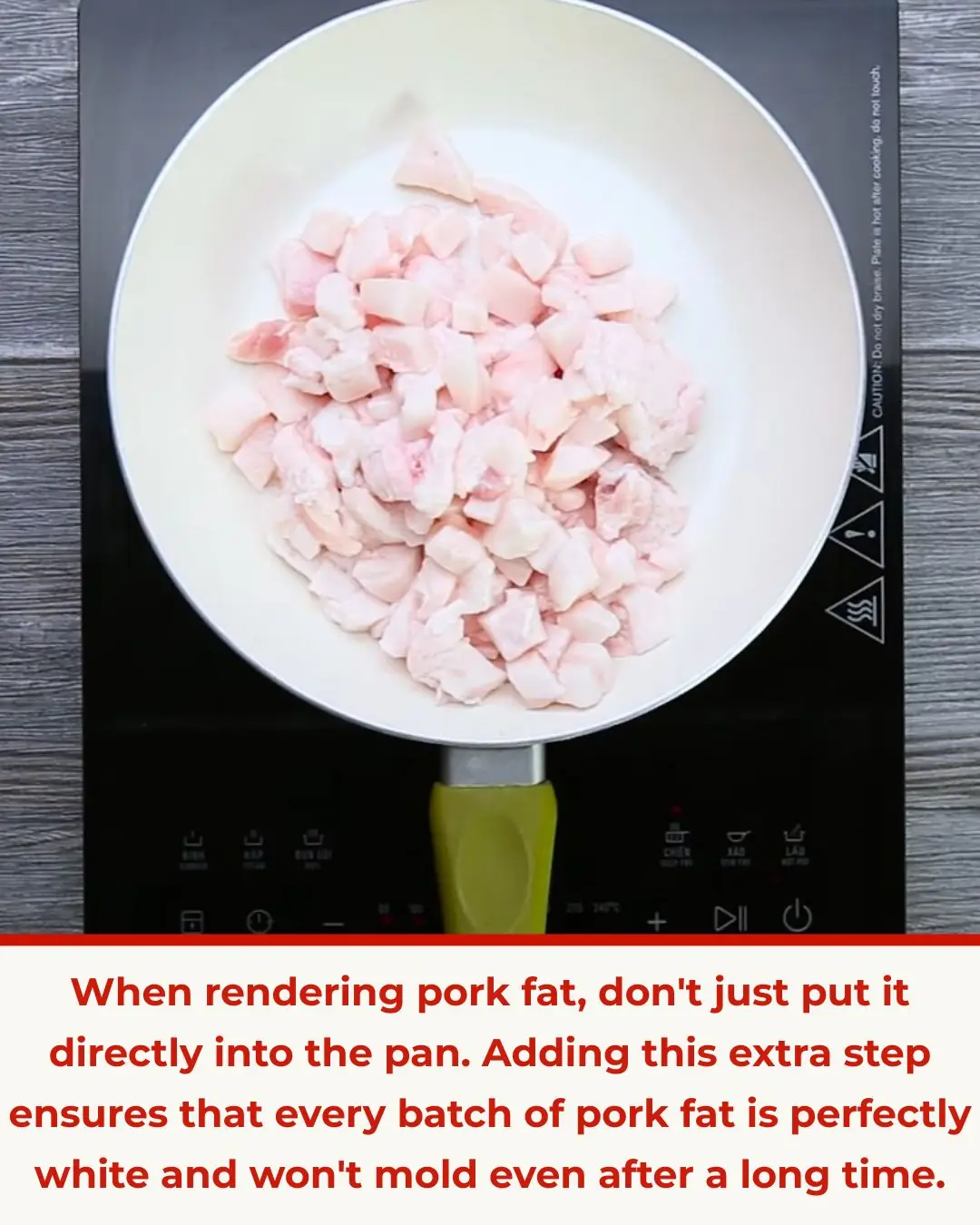
When rendering pork fat, don't just put it directly into the pan. Adding this extra step ensures that every batch of pork fat is perfectly white and won't mold even after a long time.
Tips 20/12/2025 16:24

1. Hand-Pressed Peanut Oil
Many people prefer hand-pressed peanut oil for its distinctive aroma, but it is also a “fertile ground” for aflatoxin—a highly potent carcinogen. Unlike refined oils, hand-pressed oils are not thoroughly processed, creating conditions that allow aflatoxin to persist.
Aflatoxin can also be present in peanuts, corn, or other moldy grain products. During storage, foods should be kept in a dry, well-ventilated place, and any items showing signs of mold must be discarded without hesitation.
If chopsticks or cutting boards accidentally come into contact with foods containing aflatoxin, there is no need to throw away the entire set. Aflatoxin requires a nutrient-rich environment to grow, and it is difficult for the toxin to form on wooden or plastic kitchen utensil surfaces. After washing, utensils should be thoroughly dried by air-drying or heat-drying; cutting boards should be cleaned, stored upright, and disinfected regularly.
2. Betel Quid (Areca Nut)
Betel quid has been classified by the World Health Organization as a Group 1 carcinogen, meaning it is a confirmed cause of cancer, primarily oral cancer. Chewing betel quid is also highly addictive, and once the habit begins, it is difficult to quit.
Oral cancer is a common type of head and neck cancer, with approximately 300,000 new cases worldwide each year and nearly half resulting in death. In China alone, there are about 58,000 new cases annually, with men accounting for more than 70%.
The good news is that oral cancer is relatively easy to detect early, and the cure rate can reach up to 90% if diagnosed at an early stage. However, in the intermediate to advanced stages, the five-year survival rate drops to only 55–65%. Therefore, staying away from betel quid is essentially protecting one’s own life.
3. Cooking Oil Fumes
Cooking oil fumes are a major source of indoor air pollution and pose serious health risks.
Notably, lung cancer has surpassed breast cancer to become the most common cancer among women, even though very few women smoke. One important contributing factor is exposure to cooking oil fumes.
These fumes contain toxic substances such as benzo[a]pyrene and acrolein, which increase the risk of lung cancer. Studies show that non-smoking women who are exposed to cooking oil fumes for long periods during stir-frying have a 3.79 times higher risk of developing lung cancer.
Ways to reduce risk include: turning on the range hood before cooking and keeping it running for several minutes after finishing to allow fumes to dissipate; limiting stir-frying, deep-frying, and pan-frying; and opting instead for steaming, boiling, baking, or cold mixing. If the range hood is weak, a microwave or oven can be used as an alternative to open-flame or coal-based cooking.
4. Raw Fish and Freshwater Seafood
If you have ever traveled to southern coastal regions, you may have tried raw fish, raw fish porridge, or freshwater seafood.
Caution is needed regarding the Chinese liver fluke (Clonorchis sinensis), a parasite commonly found in freshwater fish and classified as a Group 1 carcinogen. Eating raw freshwater fish is the primary cause of infection with this parasite.
Currently, nearly 70 species of freshwater fish are known to potentially carry liver flukes. Therefore, raw consumption should be avoided. When preparing fish at home, cutting boards, knives, and utensils for raw fish should be kept separate from those used for cooked food to prevent cross-contamination.