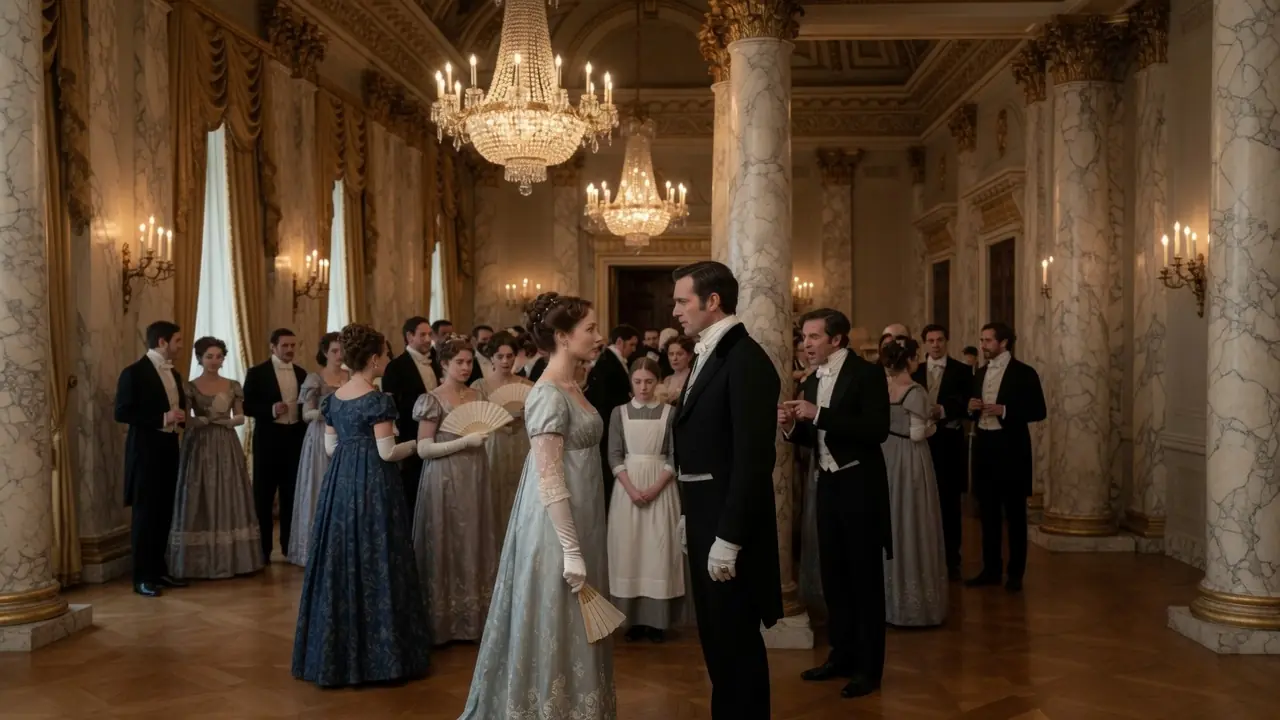
“Upon what evidence, sir, is this claim established?”
The words were not spoken aloud. They rested instead in the stillness of the ballroom, where music continued and conversation did not falter.
Yet something finer had shifted.
A young maid stood near the edge of the room, pale beneath the weight of a charge she could neither answer nor escape.
The gentleman who had spoken against her did so with confidence enough for three witnesses, and none present found cause to question him.
It was not done to interfere.
Reputation, once touched, seldom recovered its former shape, and those who valued their own guarded it by silence.
The company understood this well. Eyes lowered. Fans stirred.
No one moved until Miss Lillian Earnshaw did.
She stepped forward with no alteration to her composure, as though the act required neither courage nor consideration, and addressed the matter with a clarity that did not seek permission.
Her voice, when she spoke, carried neither urgency nor hesitation, only the quiet insistence of reason where none had yet been applied.
“Upon what evidence, sir, is this claim established?” she repeated.
The question was simple.
Its effect was not.
A pause, slight yet unmistakable, passed through the room.
It was enough.
Then another voice answered.
“My authority is sufficient evidence.”
Wilfred Wentworth, Duke of Kellington, did not raise his tone. He did not need to.
The weight of his words settled upon the matter with the certainty of judgment already rendered.
He was not a man accustomed to contradiction, nor one inclined to invite it.
Miss Earnshaw inclined her head as courtesy required.
“Your Grace,” she said, with proper form and perfect steadiness, “authority may conclude a matter. It does not, of itself, prove it.”
It was at that moment the room understood that what had begun as a minor disturbance had become something far more dangerous.
For the Duke of Kellington was a man whose words shaped reputations, and Miss Lillian Earnshaw had chosen, in full view of society, to stand against it.
The Harwood ball was, by every measurable standard, a success. The candles were numerous, the flowers fresh, the musicians competent, and the guest list curated with the particular care that separated an evening worth attending from one merely worth mentioning.
Ladies moved through the rooms in careful rotation, their conversations shaped by what was appropriate to say, and more importantly, by what was not.
Gentlemen observed the same discipline in different form, their exchanges governed less by warmth than by the calculation of association.
Who stood beside whom, who acknowledged whom first, and who did not acknowledge at all.
Miss Lillian Earnshaw understood these calculations. She had grown up among them, had watched them operate with the precision of a mechanism built for a single purpose, and had long since ceased to find them either surprising or compelling.
She stood near the far end of the room, beside a column that afforded her a clear view of the whole without placing her at its center, and observed.
Not with disdain. She was not given to disdain.
But with the quiet attention of someone who found the truth of a room more interesting than its surface.
The gowns were beautiful. The manners were practiced.
Beneath both, people were doing what they had always done.
Protecting what they had and watching carefully for threats to it.
She held her glass with a light hand and did not pretend otherwise.
Her mother, stationed some distance away in conversation with Mrs. Pelham, had already directed two meaningful glances in her direction, reminders that standing apart was not the same as standing well, and that a young woman without a fortune could not afford the appearance of indifference.
Lillian acknowledged the second glance with the faint inclination of her head that meant she had received the message and returned her attention to the room.
The evening was proceeding exactly as such evenings did.
Then, near the service corridor at the eastern wall, it stopped.
The disruption was not loud.
That, perhaps, was what made it effective.
Mr. Aldous Crane, a man of moderate estate and immoderate confidence, had positioned himself near the doorway through which the household staff moved in and out, and he was speaking with the air of someone accustomed to being heard without needing to raise his voice.
Before him stood a young maid, not more than eighteen, her face carefully still in the way of those who have learned that any visible reaction will be used against them.
Crane was informing those within earshot that the girl had taken something from him.
A watch, he said, though his certainty seemed to require no particular evidence to sustain it.
He gestured toward her with the ease of a man disposing of a minor inconvenience, and the room, understanding its role, arranged itself accordingly.
Conversations did not stop. They adjusted.
Voices dropped a note and redirected the way water moves around an obstacle without pausing to consider it.
A few guests near the edge of the gathering turned slightly toward the scene, then turned away with equal care, their expressions arranged into the particular blankness that meant they had seen and chosen not to.
The maid stood without moving.
She did not speak, which was correct, and she did not weep, which was wise, and neither quality protected her.
Crane addressed the nearest footman with the expectation of a man whose instructions had never been questioned, and the footman looked at the floor and said nothing.
The hostess’s attendant appeared at the corridor entrance, assessed the situation in a single glance, and assumed the posture of someone preparing to resolve it in the simplest available direction.
Lillian set her glass on the nearest surface and moved.
She did not move quickly. Haste would have made the approach seem emotional, and emotion in such a room was disqualifying.
She crossed the distance between herself and the scene with the pace of someone engaged in ordinary movement, and she arrived before the attendant had completed her first step toward the maid.
She did not look at the maid.
She looked at Crane.
“Forgive the interruption,” she said, though her tone suggested she was forgiving it herself, not requesting his forgiveness for it. “I could not help but hear the charge you have made against this girl. Before the matter proceeds further, what is the nature of your evidence?”
Crane turned to her with the expression of a man who had not expected the obstacle and did not welcome it.
In his experience, the charge was sufficient.
The accused’s inability to disprove it served as confirmation enough.
He looked at Lillian with brief assessment and made the error of concluding she could be managed.
“I am missing a watch,” he said, his tone closing around the words like a door. “She was near my coat. The connection requires no elaboration.”
“It may not require it,” Lillian replied, “but it would benefit from it. Being near a coat is not the same as taking from one. If you have seen the item in her possession, or have a witness who has, that is material. If the proximity is the whole of your reasoning, that is a different matter.”
A stillness had settled over the nearest portion of the room.
Not silence, exactly, but a narrowing of attention, the subtle compression of a space in which something unexpected was occurring.
Those close enough to hear had stopped performing inattention and were now performing the opposite with equal care.
Crane’s color rose slightly.
He was not a foolish man, but he was an unused one, unused to being asked to support what he had merely asserted, and the unfamiliarity showed.
“The girl’s account of herself is the concern,” he said, shifting the ground, “not mine.”
“Her account of herself has yet to be requested,” Lillian observed.
She did not say it with heat. She said it the way one might note that a step had been missed in a sequence.
Plainly, without accusation, as simple fact.
She turned, then, briefly to the maid.
“Have you anything to say in this matter?”
The girl’s composure, which had held through Crane’s address and the room’s arranged indifference, flickered once at being directly spoken to.
“No, miss,” she said, in a voice controlled to evenness. “I have taken nothing.”
It was not a declaration.
It was too quiet for that.
But it was something.
And in a room that had offered her nothing, it landed with a weight disproportionate to its size.
Crane straightened.
“The word of a servant against that of a gentleman is not a resolution,” he said.
Around him, a few heads inclined with the fractional agreement of people who found the principle convenient.
Lillian did not argue the principle.
“Then the matter ought to wait,” she said, “until your watch is either found or confirmed missing by search, and the girl’s person and quarters examined properly, rather than her dismissed on an assertion alone.”
The argument had not collapsed, but it had developed a fault line, and those close enough to see it exchanged glances with the careful blankness of people who would discuss it thoroughly in the carriage home.
Then a different voice entered.
He had been present for less of the exchange than most.
He had heard enough.
Wilfred Wentworth, Duke of Kellington, was not a tall man by exceptional measure, but he occupied space with the particular economy of someone who had never needed size to be the largest presence in a room.
He was somewhere past forty, spare in build, dark in coloring, and possessed of an expression that had long since settled into something that was not severity exactly, but was not accessible either.
The face of a man for whom most situations had already been categorized and resolved before they required his attention.
He was known, among those who discussed such things in low voices, as someone whose judgment operated without deliberation and without reversal.
Families had been removed from tenancies on his word.
Matters brought before him in dispute were generally concluded before the second party had finished speaking.
It was not that he was unjust in any declared sense.
It was that he was final.
He moved to the edge of the exchange with no apparent urgency and addressed Crane in a voice that expected to be the last one used on the subject.
“The matter will be settled in the appropriate manner. The household will see to the girl.”
He did not look at Lillian when he said it.
He looked at Crane and then at the attendant, and the direction of his attention was instruction enough.
The attendant stepped forward.
The maid, who had held herself so precisely still, seemed to diminish by a fraction.
Not in body, but in the particular way a person does when the last possibility closes.
Lillian spoke.
“Your Grace.”
She waited until he turned.
When he did, she met his gaze with an evenness that did not waver and did not soften.
“I do not question the authority to resolve the matter. I question whether the matter has been properly examined before resolution is applied. The charge has not been evidenced. The accused has not been searched. A dismissal under these conditions does not settle the question. It only moves it.”
Something passed through his expression.
Not surprise, precisely, but a slight involuntary adjustment.
The look of a man who had stepped onto ground he expected to be firm and found it less so than anticipated.
It was gone in an instant.
“Disorder,” he said, “is not improved by prolonging it.”
“Nor is it resolved by misplacing it,” she replied.
She inclined her head as she said it.
The courtesy was precise.
The substance of the words was unchanged by the form of their delivery.
The Duke regarded her for a moment.
There was nothing warm in it and nothing dismissive either.
Then there was a slight finality, a decision concluded.
“The matter is ended,” he said, and his tone did not invite response.
He turned, and by turning closed the subject with the certainty of a man for whom turning was a sufficient act.
The attendant guided the maid toward the corridor.
The maid did not look back.
The room resumed.
The carriage home was quiet, which suited Lillian well enough.
Her mother made three observations about the evening, each one more pointed than the last, and Lillian received them without argument, which her mother had learned to recognize as something other than agreement.
By the time they reached home, the conversation had ended, and Lillian sat with her hands folded and her thoughts arranged in the particular order that came after events worth examining.
She did not regret what she had said.
She had offered Crane the means to prove his charge, and he had not had them.
She had given the girl a voice in a room that had allocated her none, and the girl had used it with more restraint than the room deserved.
That the Duke had ended it was expected.
Men of his standing did not allow the ground beneath them to remain unstable longer than necessary, and what she had introduced was, from his position, precisely that: instability where he required order.
That was not something she could have left alone and remained herself.
She did not review the exchange for what she might have said differently.
She reviewed it for whether the maid would be safe, and what the morning would bring for a girl dismissed without proof and without appeal, and whether anything could be done about it that would hold.
She was still considering this when she retired.
In another part of the city, in a house of considerably greater proportions, Wilfred Wentworth dismissed his secretary, declined the brandy that had been set out, and stood for a moment at the window of his study with the particular stillness of a man whose mind had not followed him home from the evening in the manner he preferred.
The ball had been unremarkable.
The incident had been minor.
He had resolved it in the only sensible direction, as he resolved all such matters: cleanly, without extended debate, without the inefficiency of sentiment applied where procedure was sufficient.
This was not something he second-guessed.
He did not make a habit of second-guessing, and he did not intend to begin now over a maid’s dismissal and a young woman’s inconvenient principles.
Yet the voice remained.
Not its tone. He had heard composed voices before.
Not its precision. He had heard precise arguments advanced by people who understood argument as a tool of position.
What remained was something he did not immediately have a word for, which was itself unusual.
Miss Earnshaw had not been performing courage.
She had not been performing anything.
She had simply said what she found to be true in the presence of a man whose word had never been measured against truth in quite that way, and she had done it without the particular quality of fear that most people, whether or not they displayed it, carried into his vicinity.
He did not find this admirable.
He found it irregular.
And irregular things, in his experience, required attention, not because they moved him, but because they indicated something in the surrounding arrangement that had not been properly accounted for.
He went to bed with the matter filed under that heading and did not revisit it.
Or so he told himself, which was, for the moment, almost enough.
The maid’s name was Agnes Burrell, and she had been in service for four years without a mark against her name.
Lillian learned this the morning after the ball, not through any channel that required particular effort, but through the straightforward means of asking.
Her mother’s lady’s maid knew a woman who had worked in the Harwood household two seasons prior, and by mid-morning Lillian had a name, and by afternoon she had an address: a narrow room above a draper’s shop on Cutters Lane, where Agnes had gone after the dismissal with nowhere else immediate to go.
Lillian arrived without announcement and without ceremony, which Agnes plainly had not expected, and sat across from her in a room that contained two chairs and very little else.
And listened.
The story was not complicated.
Crane had mislaid his watch himself, as Agnes told it, had left it in the card room during the early part of the evening, a fact confirmed by the footman who had found it on the table and set it aside for collection.
Agnes had been nowhere near it.
She had been in the linen corridor at the time Crane claimed the theft occurred, a fact attested to by two other members of the household staff who had seen her there and said so to no one because no one had asked.
That was the whole of it.
A watch misplaced by carelessness, recovered quietly, and a girl dismissed on an accusation that had already been voided by fact before it was ever spoken aloud.
Lillian sat with this for a moment.
Then she asked whether Agnes had any other position in prospect.
She did not.
Lillian said she would make inquiries, and she meant it.
Agnes looked at her with the guarded expression of someone who had been offered things before and learned to hold them lightly until they materialized.
Before she left, Lillian asked one further question.
Whether Agnes knew of others who had found themselves in similar circumstances, dismissed or penalized under decisions made from the Duke of Kellington’s estates or by those acting in his name.
Agnes was quiet for a moment.
Then she named three.
A tenant on the Kellington estate in Surrey, removed from land his family had worked for two generations on grounds of unpaid rent that his neighbors maintained he had paid in full.
A seamstress contracted for work at one of the Duke’s properties, dismissed mid-commission without payment on the word of a steward whose accounting no one had reviewed.
A young footman released without a character reference following a disputed incident who had not found subsequent employment in eighteen months.
Agnes did not deliver these accounts with bitterness.
She delivered them the way people do who have absorbed enough of how the world operates to be past surprise.
Lillian thanked her, walked home in a thoughtful silence that her maid understood better than to interrupt, and spent the evening making notes in a small book she kept in her writing desk.
She was not impulsive.
She understood that a pattern, to be useful, required more than three points of evidence and the testimony of a dismissed servant.
She also understood that useful and necessary were not always the same thing, and that the question before her was not whether she had enough to act on, but whether she had enough to act correctly.
She decided she did not.
Not yet.
She began instead to gather more.
The market on Thursday drew a broad crowd: tradespeople, household staff running commissions for their employers, and a scattering of gentlewomen moving between the better stalls with the efficiency of those who regarded shopping as a task rather than a recreation.
Lillian was among the latter, or would have appeared so to anyone observing her.
In fact, she had come partly for the butter and partly because she had heard, through the same careful network of quiet conversations, that a dispute was expected that morning between a cloth merchant named Harker and a steward employed by the Kellington estate.
Harker had been assessed a penalty for late delivery on a contract, the delivery having been delayed by flood that had made the road impassable.
A fact Lillian had established was not in dispute by anyone except the steward responsible for collecting the penalty.
She positioned herself near the adjacent stall and listened before she did anything else, which was habit and also sense.
The steward, a compact man named Rowe, whose manner suggested he had been given a great deal of small authority and intended to use all of it, was reading from a document with the fixed expression of someone who regarded the document as final regardless of what was said to him.
Harker was a broad man of perhaps fifty, red-faced not from temper but from the effort of sustained patience, and he was explaining, for what was evidently not the first time, that the road had been closed.
Rowe continued reading.
Lillian moved closer.
“Mr. Rowe,” she said, pleasantly and without preamble, “I wonder if I might ask a question about the contract terms.”
Rowe looked at her with the brief assessment of a man who was not expecting intervention from that direction.
“The matter is a private one, madam.”
“It is taking place in the public market,” she noted, “and the question is a simple one. Does the contract allow for circumstances beyond the merchant’s control, flooding, road closures, acts of weather, to constitute valid grounds for extension?”
Rowe’s expression tightened.
“The delivery date is fixed.”
“The date is fixed,” she agreed. “I am asking whether the contract contains a relief clause for circumstances of the kind Mr. Harker has described. Such clauses are standard in most commercial agreements of this nature.”
She did not know this with absolute certainty, but she knew it with sufficient certainty to say it, and Rowe’s hesitation confirmed the rest.
He looked at the document again, which was the look of a man who knew the answer and preferred not to give it.
Harker was watching her with the cautious attention of someone who had learned not to invest in assistance until it proved itself.
The moment stretched.
Then, from the edge of the small crowd that had formed with the quiet efficiency of people who had nowhere particular to be, came a voice she recognized without needing to look.
“What is the nature of the delay?”
The Duke of Kellington stood at the periphery, not as though he had arrived for this purpose, but with the settled quality of a man who, having arrived anywhere, immediately became its point of gravity.
He was addressing Rowe, not her, and Rowe straightened with the visible relief of a man receiving rescue from an unexpected direction.
“The merchant claims flooding, Your Grace. The penalty stands under the delivery terms.”
Lillian turned.
“Your Grace.”
She kept her tone even and her expression composed, the same as the first time, as though the interval between that evening and this morning had not altered the terms of her address to him.
“The merchant does not claim it. The flooding is documented. The eastern road was closed for eleven days by order of the parish surveyor, which is a matter of record. The penalty was assessed without reference to that record.”
The Duke looked at her.
It was brief and direct, the look of someone processing a variable they had not expected to encounter twice in the same form.
“You are familiar with parish surveyor records, Miss?”
“Earnshaw,” she supplied. “And yes. When a matter seems worth examining, I examine it.”
Something in his expression shifted, not toward warmth and not toward openness, but toward a quality she could not immediately name.
He turned back to Rowe.
“Produce the contract.”
Rowe produced it.
The Duke read it with the speed of a man who read documents the way other men read weather, efficiently and without sentiment.
He handed it back.
“The clause is present,” he said. “The penalty does not apply.”
He said it to Rowe, and Rowe nodded, and that was all.
He did not look at Lillian again.
He moved on through the market with the unhurried pace of someone who had dealt with a minor matter and was proceeding to whatever came next.
He did not acknowledge that her intervention had precipitated the resolution, and she did not require him to.
But Harker exhaled beside her with the depth of a man set down after a long carrying, and thanked her in a voice that did not know quite what register to use for gratitude offered to a gentlewoman in a market.
She told him it was nothing, which was not entirely true, and bought her butter, and did not watch the direction in which the Duke had gone.
The parish vestry meeting three weeks later was, on its surface, a routine matter of poor relief allocation, a quarterly proceeding attended by local landowners, clergy, and the occasional interested party with standing enough to participate.
Lillian attended because her father had held a seat on the vestry before his death, and she had continued the habit of observation, and because she had heard that an estate matter connected to Kellington land would be among the items raised.
The matter concerned a widow named Mrs. Pell, whose cottage sat at the boundary of Kellington-held land, and whose access to the shared well had been restricted following a boundary re-survey.
The restriction had been applied by an estate agent, and its effect was practical and immediate.
The nearest alternative water source was nearly a mile distant, and Mrs. Pell was not young.
Lillian had spoken with her the previous week and had since reviewed the survey documents, which she had obtained through the vestry clerk with the polite persistence that most clerks found easier to satisfy than to resist.
The Duke arrived after the preliminary items had been addressed with the punctuality of someone who attended precisely as much of a proceeding as required him.
He took a seat on the landowner’s side of the room and said nothing while the preliminary matters concluded.
When Mrs. Pell’s case was introduced, the estate agent who had implemented the restriction offered a brief summary that was accurate in its facts and carefully selective in its framing.
Lillian waited until he had finished.
Then she addressed the vestry chairman with the particular courtesy one employed when making a point that was going to be uncomfortable for someone in the room.
She presented the survey documents. She showed the margin notation, a small but unambiguous marking that placed the well itself on common ground rather than within the re-surveyed boundary.
She explained Mrs. Pell’s situation without editorializing it because editorializing would have given those present a reason to respond to her tone rather than her argument, and she had no interest in that exchange.
She finished and waited.
The room was quiet with the quality of quiet that follows a point no one immediately wishes to answer.
Then the Duke spoke.
Not to the chairman and not to the estate agent.
To her.
“Your reading of the margin notation assumes the surveyor’s intent rather than the legal boundary as drawn.”
It was not a dismissal.
It was a counterargument.
Lillian looked at him with the slight steadiness of someone recalibrating and answered it.
“The intent of the notation is supported by the surveyor’s accompanying letter, which I have also obtained. He states clearly that the well was excluded from the private boundary deliberately on grounds of shared historical use.”
A pause.
“You have the letter with you,” he said.
It was not quite a question.
“I have a copy,” she replied.
He held out his hand.
She crossed the room and gave it to him, and the transaction was noted by everyone present and commented on by no one.
He read it.
The estate agent watched the Duke with the expression of a man calculating how the ground had shifted.
The vestry chairman studied the table.
The Duke finished reading and placed the copy on the surface before him with the precise flatness of someone arriving at a conclusion.
“The access restriction will be reviewed,” he said, and the weight with which he said it made clear that “reviewed” did not mean delayed.
He did not say she was correct.
He did not say anything further to her at all.
But for the second time, a matter she had brought into clear light had concluded in the only direction the evidence permitted.
Afterward, in the vestry corridor, she found herself aware, with the particular clarity of something that had been peripheral and was now direct, that she had begun to prepare her arguments with him specifically in mind.
Not against him, precisely, but with full knowledge of how his reasoning operated and with the intention of being ahead of it.
This was a new thing.
She examined it briefly, filed it without a label, and walked out into the gray afternoon.
That same afternoon, the Duke rode back from the vestry along the northern road, which was longer than the direct route and served no practical purpose, a fact he did not examine closely.
His thoughts moved with the ordered efficiency he applied to everything, and yet they returned more than once to the letter she had produced.
Not to its content, which was clear enough, but to the fact of its existence in her possession.
She had obtained a surveyor’s accompanying letter from a proceeding completed months ago relating to an estate matter that had no direct bearing on her own circumstances because she had decided the matter was worth examining.
He did not know many people of whom that was true.
He knew people who pursued advantage and people who pursued principle when the principle was personally convenient and people who performed both with enough consistency to make the performance indistinguishable from the real thing.
He did not immediately know which category applied to Miss Earnshaw, which was unusual because he generally knew within a single encounter.
What he did know was that she prepared, that she gathered and verified and arrived at a proceeding with the material already in hand rather than the intention alone.
That was discipline of a particular kind, and he recognized discipline the way one craftsman recognizes the work of another, not with admiration necessarily, but with the precise acknowledgement that the thing had been done properly.
She had on three separate occasions now engaged with him without alteration: no increased deference, no visible anxiety, no adjustment of her position to accommodate his.
He had not decided what to make of this.
He was, however, aware that he had not dismissed it, which was different from his usual practice and different enough to register as a thing worth noting.
Not a warm noting.
A careful one.
He did not alter his pace, and he did not examine the thought further.
When he arrived home, he attended to the correspondence that had accumulated in his absence with the same thoroughness he applied to everything.
But that evening, when his secretary mentioned a vestry matter requiring follow-up correspondence, the Duke instructed him to address it that same night rather than the following morning.
The secretary noted this.
The Duke was not typically given to urgency in vestry matters and said nothing, which was why he had kept the position as long as he had.
The proof took eleven days to assemble, and Lillian assembled it the way she did everything that mattered: methodically, without announcing her intentions, and with the patience of someone who understood that a case presented before it was complete was worse than no case at all.
She began with the footman.
His name was Thomas Graves, and he had been the one to find Crane’s watch on the card room table the night of the ball.
He had set it aside on the mantelpiece, he told her, meaning to hand it to the butler for safekeeping, and had been called away before he could do so.
He had not come forward at the time because no one had asked him directly, and because coming forward uninvited in a room where a duke had already rendered a verdict was not something a footman did if he valued his position.
Lillian did not fault him for this.
She asked him whether he would be willing to state what he had seen before witnesses if the occasion were properly arranged.
He was quiet for a moment, in the way of someone measuring the distance between what was right and what was safe.
Then he said he would.
She thanked him and moved on.
The second piece was the linen corridor testimony: the two housemaids who had seen Agnes at the time Crane claimed the theft occurred.
One of them, a woman named Dorothea, had since left the Harwood household for a position elsewhere, which made her less exposed and consequently more willing to speak plainly.
The other was still in service and required more careful handling.
Lillian approached her not through the house, but through the church, where the girl attended on Sunday mornings, and sat beside her after the service in the manner of a woman with no particular agenda.
She listened to her for twenty minutes before she asked anything at all.
By the end of the conversation, she had what she needed: a clear and detailed account, freely given, and a willingness to repeat it.
The third element was the watch itself.
Crane had collected it from the Harwood mantelpiece two days after the ball, a fact recorded in the household’s effects log by the butler, who maintained such records with the thoroughness of a man who had learned that small details became important at unpredictable moments.
Lillian obtained a written confirmation of this from the butler through the same clerk who had helped her at the vestry, a man who had by now developed a philosophical acceptance of her requests.
The log entry predated any formal inquiry into the maid’s dismissal, which meant the watch had been recovered before anyone had examined whether it had truly been taken.
Taken together, the three elements formed a case that was not merely probable but complete.
The watch had never left the card room.
Agnes had not been where Crane said she was.
The recovery of the item had been documented and collected without reference to the accusation it was supposed to have resolved.
She held all of this in her writing desk for two days before deciding where to present it.
This was the part that required the most care because the evidence was not the difficulty.
The difficulty was the venue.
Presenting it privately, to Crane alone, would resolve nothing.
A man who had not required evidence to make the accusation would not require it to withdraw one.
Presenting it to the Harwood household in isolation would accomplish the restoration of Agnes’s name within a single house and no further.
What the matter required was witnesses of sufficient standing to make the reversal permanent, not a spectacle but a record.
The Kellington estate’s quarterly tenant review was scheduled for the following Thursday, held at the assembly room on Mercer Street, attended by landowners, solicitors, and members of the local magistracy.
Crane held a small property on the outskirts of the estate’s territory and would be present.
The Duke would preside.
It was not a comfortable venue, and Lillian was not unaware of what she was risking by entering it with this purpose.
A young woman of no particular fortune, who had already been noted for unconventional interventions, presenting a formal challenge to an accusation that a duke had already resolved in a room full of men who regarded the duke’s word as settled ground.
The personal cost of this, if it went wrong, was not small.
She thought about Agnes in the room above the draper’s shop without a character reference and without a position, and packed the documents into her folio with the quiet finality of someone who had already made the decision and was simply completing the preparation.
The assembly room on Mercer Street held perhaps forty people when Lillian arrived, which was more than she had anticipated and precisely enough to make the proceedings matter.
The quarterly review moved through its initial items at the pace such meetings set for themselves: measured, procedural, attended to by those for whom the details were financially relevant and endured by those for whom they were not.
Lillian sat in the second row of the observer’s section and waited.
She had sent word to Agnes the previous day through Dorothea, and Agnes was present, seated near the back of the room with the stillness of someone who had learned to make themselves small in spaces where their presence was not assumed.
The Duke sat at the presiding table with two solicitors and the estate’s senior land agent, and he managed the proceedings with the efficient precision she had come to recognize as his natural register.
Nothing prolonged. Nothing unaddressed.
Each matter concluded before the room had time to form an opinion about its direction.
When the formal items were exhausted and the meeting moved toward its closing remarks, Lillian stood.
She did not raise her voice, and she did not apologize for the interruption.
“If the assembly will permit,” she said, addressing the room rather than the Duke specifically, “I have a matter of record to submit for correction. It pertains to a dismissal that occurred at the Harwood Ball six weeks ago, and it involves documentation that was not available at the time the matter was resolved.”
The room’s quality of attention shifted in the way she had learned to recognize, the particular compression of a space in which something outside the expected order was occurring.
Crane, who was seated to her left and slightly ahead, turned with a sharpness that confirmed he understood immediately what was coming.
The Duke looked at her.
His expression did not change, but there was, in the set of his attention, something that had not been there in their earlier encounters.
A quality that was not quite resistance and not quite expectation, but occupied the narrow ground between them.
“The floor is not open for general submissions at this stage,” he said.
It was not a refusal.
It was a test of whether she would insist.
“I am aware,” she replied. “The matter is one of factual record concerning a member of this estate’s extended household, and the documentation I hold establishes that the original charge was false. I am not asking for debate. I am asking for two minutes to enter evidence into the record, so that a woman dismissed without proof may have that proof correct her standing.”
The room was very still.
The Duke held her gaze for a moment, longer than was strictly procedural, shorter than was notable, and then inclined his head by a degree.
“Proceed.”
She presented it without theater.
The footman’s statement first, identifying the watch on the card room mantelpiece at a time that predated any claim of theft, witnessed and signed.
Then the household effects log entry, confirming Crane’s collection of the watch two days after the ball, before any formal inquiry had been made.
Then the accounts of the two housemaids, placing Agnes in the linen corridor at the time the accusation specified.
She laid each document on the table before her as she addressed it, not to the Duke, but to the room, because the room was the record and the room needed to receive it.
When she finished, she did not editorialize.
She said only that the documentation was complete and that she offered it for the record, and then she waited.
Crane had gone the particular color of a man watching a structure he built on carelessness come apart in public.
He said nothing.
There was nothing to say that would not compound the damage.
Around him, the room processed what it had just heard with the careful efficiency of people revising assessments they would not admit to having held.
The Duke sat without speaking for a moment that was longer than any he had taken in any proceeding she had witnessed him preside over.
She watched him without expression, but she watched him with the full attention she had given nothing else in the room.
Because what happened in this moment was not about the documents or about Crane or even entirely about Agnes.
It was about whether a man who had never publicly reversed himself could, under the weight of clear and documented truth, choose correction over the protection of his own prior word.
He looked at the documents.
He looked at Crane.
He looked, briefly, at Agnes near the back of the room, who had not moved.
Something resolved in his expression.
Not visibly, not in any way that the room could have named, but Lillian was close enough and had paid sufficient attention to recognize the particular quality of a decision being made by a man who found the making of it costly.
“The dismissal of Agnes Burrell from the Harwood household on the evening of the fourteenth,” the Duke said, his voice carrying its customary evenness but weighted now with something deliberate, “was made on grounds that this documentation establishes were unsupported. The charge is retracted. The record will reflect that her departure was without cause and her character is unimpeached.”
He did not look at Crane when he said it, which was, in its way, a judgment of its own.
He addressed the senior solicitor at his side.
“Arrange a letter of character for Miss Burrell’s future use under the estate’s correspondence and see that she is informed of any suitable positions within the household’s network.”
The room absorbed this.
It did so with the particular quality that a room uses when something has occurred that it will be discussing for months.
Not loudly. Not with visible agitation.
But with the small, precise adjustments of people recalibrating a known quantity.
The Duke of Kellington had reversed a judgment.
In public.
On documented grounds.
Those who had understood his authority to be absolute now understood it to be something more specific, and in its way more durable.
Authority capable of correction was authority that could be trusted to have examined what it concluded.
This was a different thing from what he had been before, and the room, whether or not it could have articulated the distinction, felt it.
Agnes, at the back of the room, sat with her hands folded in her lap and her eyes level and bright, and did not allow herself anything more than that in public, which Lillian respected without comment.
Lillian gathered her documents from the table with the same composure with which she had placed them there.
She did not thank the Duke.
She did not offer him the look of approval that the room might have expected from someone whose position had just been vindicated, because approval was not what she felt and was not what the moment required.
What she felt was something closer to the quiet, clean satisfaction of a matter correctly concluded.
Not her victory over anyone.
But the simple restoration of what had been true the whole time.
She returned to her seat.
Across the table, the Duke’s attention had moved back to the remaining procedural items, and he addressed them with his customary efficiency.
But once, only once before the meeting closed, his gaze crossed hers in the brief, unplanned way of two people occupying the same space without having arranged to look at each other, and neither of them looked away first.
It lasted less than a second.
It was not nothing.
The weeks that followed did not resemble what had come before.
There was no single occasion that marked the change, no conversation in which terms were renegotiated between them.
It was more gradual than that and more precise.
They encountered each other at a dinner at the Forsyth house, where they were seated four places apart and exchanged perhaps twelve words, none of them remarkable, all of them attended to with a care disproportionate to their content.
They stood near each other at a gallery exhibition, not by design, or not entirely, and he said something about the composition of the third painting that she disagreed with, and she said so.
His response was not dismissal but engagement, and the exchange lasted longer than either of them had intended.
She noticed in these interactions that he had stopped treating her reasoning as an obstacle to be removed and had begun treating it as a thing to be answered.
That was a different form of attention entirely, and one she did not take lightly.
He was precise in conversation, not cold but exact, with a quality of focus that disposed of pleasantries not out of rudeness but because he genuinely had no use for them.
She found she respected this more than she was entirely comfortable admitting.
He noticed, though he would not have used that word, preferring something more neutral, that she never adjusted her position to align with his.
Not from stubbornness, which would have been a legible quality he could have categorized and set aside.
From conviction, which was not the same thing and which operated at a different depth.
At the Forsyth dinner, he watched her across the table argue a point about enclosure reform with a retired magistrate twice her age, and she did it without heat and without concession and with the patient persistence of someone who had no particular need to win but would not stop being correct simply because it was inconvenient.
He looked away before she looked up.
He did not examine why.
She, for her part, was aware, with the growing clarity of something that had moved from peripheral to central without her having made a conscious decision about it, that she had begun to read rooms with reference to whether he was in them.
Not because his presence changed what she said or how she said it, but because there was a quality to the exchanges they had, a specific kind of engagement that did not occur with anyone else, and she had become, without intending to, accustomed to it.
This was not something she welcomed unreservedly.
He was a man whose authority had caused real harm, whose reversals, however genuine, were recent, and whose world operated on principles she had spent the better part of two months standing against.
That she found his company, in some specific and unannounced way, something other than disagreeable was a fact she held carefully and did not yet know what to do with.
One evening in late October, she crossed the reading room at the Forsyth Library, where a small gathering had assembled after dinner, and found him standing at the window with a book closed in his hand, looking out at the street below with the particular stillness of a man whose thoughts had taken him somewhere his expression did not reveal.
He heard her approach and turned, and for a moment, brief, unguarded, before the customary composure resettled, there was something in his face that she had not seen there before.
Not warmth, exactly.
Recognition.
The specific quality of a man who has turned toward a sound and found, without surprise, that it is the one he expected.
He said, “Good evening.”
She said, “Good evening.”
They stood for a moment in the small, charged silence of two people who have run out of argument and not yet found what comes next.
Then the gathering recalled them both, and they moved apart, and neither said anything further that night.
But the silence followed her home, and she thought it had followed him, too.
It began as such things often did, not with a single blow, but with accumulation.
A comment at the Alderton card party.
Nothing direct, nothing that could be taken hold of and answered, but present enough to be felt.
A withdrawal of an invitation that had previously been reliable.
Two matrons at the Pendleton afternoon who had always been civil choosing on the same occasion, and without apparent coordination, to be civil at a distance.
Lillian noticed each of these things with the attention she applied to all information and did not immediately draw conclusions from any one of them because individual data points were not patterns.
But by the third week of November, the pattern was sufficiently established that ignoring it would have required a deliberate effort she was not willing to make.
The charge being circulated, never stated plainly because plainness would have made it answerable, was that she was difficult.
That she involved herself in matters outside her proper scope.
That her interventions, however she chose to frame them, constituted a form of social presumption that reflected poorly on her family and suggested an instability of judgment not becoming in a young woman of her station.
No one said this to her face, which was precisely the mechanism by which such things operated most effectively.
They were said around her, and the effect was atmospheric.
A gradual cooling, a series of small exclusions, a recalibration of how the room arranged itself when she entered.
Her mother said nothing for two weeks, which meant she was preparing to say a great deal.
When she finally spoke, she did so on a Tuesday evening after supper with the careful composure of a woman who had rehearsed the conversation and was determined to complete it.
She was not unkind.
She was, in fact, kinder than the occasion required, which made the substance of what she said harder to dismiss.
The family’s position, she explained, was not secured by any of the usual means.
Not fortune, not connection, not the kind of social weight that could absorb repeated controversy without diminishment.
What they had was reputation of the modest, careful kind that required maintenance.
And Lillian had been, however principled her intentions, spending it.
Her younger sister Margaret was seventeen and would need to be presented in the spring.
Her brother Edward held a position whose continuation depended, in part, on the goodwill of men who moved in the same circles as those Lillian had been publicly inconveniencing.
Her mother did not ask her to abandon her principles.
She asked her to consider whether the expression of those principles in the specific manner she had chosen was sustainable and what the cost of its continuation would be to people who had not chosen it themselves.
Lillian listened to all of this without interruption.
It was not that she disagreed with the reasoning.
She had applied the same reasoning herself more than once over the preceding weeks.
It was that hearing it stated plainly by her mother made it real in a way that private reasoning did not.
She thought about Margaret, who was gentle and deserved a season unmarked by her sister’s reputation for disruption.
She thought about Edward, who had never asked anything of her except ordinary sisterly affection and reciprocated it without calculation.
She said she understood, and she meant it.
The conversation ended with her mother squeezing her hand once and leaving the room with the relieved precision of a woman who had delivered something difficult and found it received.
Lillian sat in the empty room for a long time afterward.
She was not angry.
She was not, precisely, resigned.
She was something more complicated than either.
A person who had seen clearly the cost of continuing and the cost of stopping, and was measuring them against each other with the thoroughness she applied to everything and finding that the calculation did not resolve neatly.
Agnes had her character letter and a new position secured through the estate’s network as the Duke had instructed.
The Harker penalty had been dropped.
Mrs. Pell had her well.
The things she had set out to correct had, in their specific forms, been corrected.
What she had not corrected, and could not correct by any individual act, was the broader structure.
The system of judgments made without appeal, the stewards operating on presumed authority, the pattern of harm done efficiently and concluded without review.
That would require either continued intervention or something more durable than intervention.
She was not positioned to provide the latter.
She decided, with the quiet finality she brought to decisions that cost her, to withdraw.
Not permanently, not from everything, but from the specific form of visible challenge she had been conducting and from the particular proximity to the Duke’s affairs that had defined the last three months.
She would be present in society.
She would be appropriate.
She would not disappear because disappearing would accomplish nothing and confirm everything being said about her.
But she would stop appearing in rooms where confrontation was likely, and she would stop presenting herself as a woman who intended to continue being inconvenient.
The decision felt correct in its logic and wrong in some other register she did not examine.
She filed the second feeling under the heading of things that did not change the facts and moved on.
The Duke became aware of her withdrawal the same way he had become aware of most things relating to her: indirectly, through absence rather than presence, and with a precision that surprised him by its immediacy.
She was not at the December vestry meeting, which she had attended without fail since autumn.
She declined the Forsyth dinner.
She was present at the Alderton assembly but positioned differently, more centrally, more correctly, more deliberately within the expected pattern of a young woman conducting herself without irregularity.
He observed this from across the room and said nothing.
He returned home and sat with it in his study until well past midnight, which was not his habit.
He was not, initially, inclined to name what he was doing as sitting with something.
He was, he told himself, considering a practical matter.
The question of whether the changes he had been, over the past weeks, quietly implementing in his estate’s administrative practices were sufficient or whether they required formal restructuring.
This was a legitimate question, and it occupied his attention as he intended it to.
It occupied approximately forty percent of his attention.
The remainder was less disciplined.
He had spent three months being challenged by a woman who brought evidence to proceedings and asked questions that required answers and stood in front of him without flinching.
And he had found, gradually, unwillingly, and with a thoroughness he could not now undo, that this was a thing he valued in a way that had nothing to do with the practical utility of her corrections.
She had changed how he saw his own judgments.
Not dramatically. He was not a man given to dramatic revision.
But in the specific, permanent way that a precise instrument, once calibrated by a more precise one, cannot return to its prior setting.
He had reviewed, since October, fourteen decisions made by estate agents in his name and had found seven that required correction and had corrected them.
He had introduced a requirement that penalties above a certain threshold be reviewed by two agents before implementation.
He had instructed his solicitors to add relief clauses to all new contracts as standard practice.
He had done these things not because they were required of him and not because anyone was watching, but because they were correct.
And because a woman with a surveyor’s letter and a footman’s signed statement had shown him, in terms that admitted no alternative interpretation, that correctness was not guaranteed by authority alone.
He had also, in doing these things, become aware of how much of his prior conduct had operated on the assumption that it was.
The accounting of this was not comfortable.
He did not make it comfortable by minimizing it, because minimizing it would have been dishonest, and he had arrived, somewhere over the course of the preceding months, at a point where dishonesty in his own accounting was no longer something he could sustain with his full faculties.
He had caused harm, not from malice, but from the carelessness of a man so long unopposed that he had ceased to examine whether opposition might occasionally be correct.
Agnes Burrell had lost six weeks of employment and nearly lost her character reference permanently on a charge he had supported without evidence, because supporting it had been the most efficient resolution available.
This was not a record he could revise, but it was one he could refuse to extend.
He had the formal restructuring drawn up by his senior solicitor in the second week of December and presented it at the January quarter sessions before the full assembly of landowners and magistrates.
A written framework for estate decisions with defined grounds for penalty, a process for challenge, and a named reviewing officer whose conclusions would be recorded and available.
He did not present it as reform driven by external pressure.
He presented it as a correction to practice that examination had shown to be insufficient, because that was what it was, and because dressing it as anything else would have been the kind of performance he had spent three months learning to find inadequate.
The room received it with the particular quality of attention that greets a powerful man voluntarily constraining his own authority.
Some with surprise, some with reassessment, and a few whose respect operated on the principle that a man willing to correct himself was more trustworthy than one who was not, with something approaching approval.
It cost him something.
The ease of unchallenged efficiency.
The clean finality of judgments made without appeal.
These were not nothing, and he did not pretend otherwise.
What he gained in their place was less immediate and less comfortable, and he had come to understand it was more worth having.
He called on the Earnshaw household on the fourteenth of January.
He sent no prior notice because prior notice would have given her the opportunity to be absent, and he had decided that the conversation required her presence and his in the same room without the intermediary of careful scheduling.
Her mother received him in the front parlor with the expression of a woman managing the collision of extreme surprise and extreme composure, and he was courteous to her with the specific courtesy he reserved for situations that required it.
He asked whether Miss Earnshaw was at home.
She was.
She came into the parlor with the careful steadiness he recognized, and her expression when she saw him contained, for just a moment, something unguarded.
Not alarm. Not pleasure.
But the brief, unarmored quality of genuine surprise before composure reasserted itself.
Her mother withdrew to a chair near the window, close enough to satisfy propriety and distant enough to permit conversation, and the Duke sat across from Lillian with the deliberate positioning of a man who had come to say specific things and intended to say them.
He did not begin with pleasantries beyond what courtesy required.
“I am aware,” he said, “that the better part of three months of conduct on my part, and the response it generated in the people around you, has damaged your standing in a way you did not seek and should not have been required to absorb.”
Lillian looked at him steadily.
“I made my own choices,” she said. “You are not responsible for the consequences I accept.”
“I am not responsible for the choices,” he said, “but I am responsible for the conditions that made them costly. My record, prior to your intervention, gave people every reason to regard challenge as unusual and those who offered it as irregular. That is a circumstance of my own making.”
She said nothing, which was not the same as having nothing to say.
He continued.
“I have restructured the estate’s administrative practices formally before the quarter sessions, not as a private adjustment, but as a matter of record, with terms that can be examined and applied consistently, and with a mechanism for challenge that does not depend on someone appearing in a public room with a folio of documents.”
Something shifted in her expression.
Not softened, but precise.
The look of someone receiving information they are taking seriously.
“I know,” she said. “I read the published record.”
Of course she had.
He moved forward.
“I have also reviewed fourteen prior decisions and corrected seven. The tenants affected have been informed. The seamstress contracted for estate work has been paid in full. The footman released without a character reference has been given one with a letter of explanation for the gap in his employment record.”
She was quiet for a moment.
Outside the window, a cart moved along the street below, and the parlor held its stillness with the quality of a room in which something important is being carefully handled.
“Why are you telling me this?” she asked.
The question was genuine, not a challenge, but an inquiry with the direct simplicity she applied to things she actually wanted to know.
“Because I am here to call on you properly,” he said, “and I will not do that by presenting myself as something I have not demonstrated. I am not asking you to take my intentions on credit. I am telling you what has been done so you have the record and can assess it as you see fit.”
Her mother, near the window, had become very still.
Lillian held his gaze with an evenness that gave nothing away and missed nothing.
“And if the record is assessed and found adequate,” she said, measuring the words with her characteristic precision, “what is it you are proposing?”
“That I call on you regularly with your family’s knowledge and consent, and conduct myself in a manner that earns what I am not yet in a position to ask for.”
He said it without ornament because ornament would have diminished it.
Lillian was quiet for a moment that was longer than comfort and shorter than refusal.
“I will tell you my condition,” she said, “and I ask that you receive it plainly.”
He inclined his head.
“I will not attach myself to a man who has corrected his conduct under external pressure and may revert when that pressure is removed. What you have done is necessary and correct. It does not, of itself, tell me what you are when no one is presenting evidence before witnesses.”
She paused.
“Consistent conduct over time, in circumstances where revision would be easier than correction, that is what I would require. Not performance. Not the appearance of fairness. The practice of it, whether or not I am in the room.”
He held her gaze without flinching.
“That is a fair condition,” he said. “I accept it.”
It was not a declaration, but it was not nothing.
And they both understood the distance between where they were and nothing was not as great as it had been three months ago.
He came the following Tuesday and the Tuesday after that, and by the third visit, her mother had stopped managing her composure quite so carefully and had begun offering tea with the ease of a woman who had decided to find the development welcome.
The calls were correct in every formal particular.
Afternoon hours. The parlor.
Her mother, or occasionally her aunt, present at the appropriate distance.
He did not use the visits to continue advocacy for himself, which she noted and respected.
He used them for conversation, the kind that had begun at the Forsyth Gallery and the parish vestry and the reading room window.
The kind in which neither of them adjusted their reasoning to accommodate the other, and both of them were consequently required to think.
They disagreed about enclosure reform and the obligations of large landholders toward parish infrastructure, and he was wrong about the second matter and she told him so.
He revised his position over the course of two visits with the thoroughness of a man who changed his mind slowly and completely.
She told him about her father, who had kept vestry records for twenty years and had believed that local accountability was the only kind that held, and he listened with the specific quality of attention that does not perform interest but simply has it.
He told her once, briefly, without elaboration, that his own father had operated on the principle that hesitation was weakness and that he had spent thirty years administering that principle before understanding what it had cost the people beneath it.
He did not ask for her response to this.
He offered it as information and she received it as such.
What passed between them in the silence afterward was not sympathy exactly, but something adjacent, the recognition of two people who had each, in different ways, been shaped by the weight of what authority could do when it was not accountable.
Margaret’s season proceeded without incident.
Edward’s position was secure.
Lillian moved through the spring with the particular freedom of a person who has weathered the worst of a storm and found the ground still solid beneath them.
Society, which had spent three months cooling toward her, began the gradual process of recalibration that follows a powerful man’s regular and publicly noted visits to a particular household, because society’s assessments were, as she had always known, less fixed than they appeared.
She did not find this satisfying in any clean sense.
She found it instructive, which was its own kind of satisfaction.
On the last Tuesday in April, he arrived at the usual hour and sat in the usual chair and was offered tea by her mother, who withdrew on this occasion to a slightly greater distance than was strictly standard, not enough to violate propriety, but enough to constitute a kind of permission.
He did not immediately speak, which was unusual, and Lillian set down her cup and waited with the patience she had learned was the correct instrument for moments that required it.
When he spoke, he did so with the precision of a man who had prepared and was not going to waste the preparation.
“I have called on you for fourteen weeks,” he said. “In that time I have not asked you to revise your opinion of me, and you have not been required to. I believe you have formed it on the evidence available, as you form everything, and I believe I know what it is.”
He paused.
“I am asking you formally, and with your family’s knowledge, to consider whether you would accept my intentions toward you in a permanent capacity.”
Lillian looked at him, not as she had looked at him in the vestry, not as she had looked at him across the assembly room table, but with something quieter and more complete.
The look of a woman who has examined a thing from every available angle and found it sound.
“I would,” she said.
It was not more than two words.
It did not need to be.
He reached across the small distance of the table and covered her hand with his once, briefly, with the care of a man handling something he understood the value of.
And she did not withdraw it.
Outside, the April afternoon continued with ordinary indifference to the fact that two people had, after three months of visits and three months before that of argument, arrived at the only resolution their particular natures could have reached.
Not through convenience.
Not through arrangement.
But through the slow, exacting work of becoming worthy of each other.
Authority had not softened into sentiment.
It had been tempered by something stronger than itself.
And love, when it came, came not as rescue or surrender, but as the quiet, deliberate recognition of two people who had each looked at the other clearly and found, in what they saw, sufficient reason to stay.