World’s Smallest Quantum Computer Operates Using a Single Photon
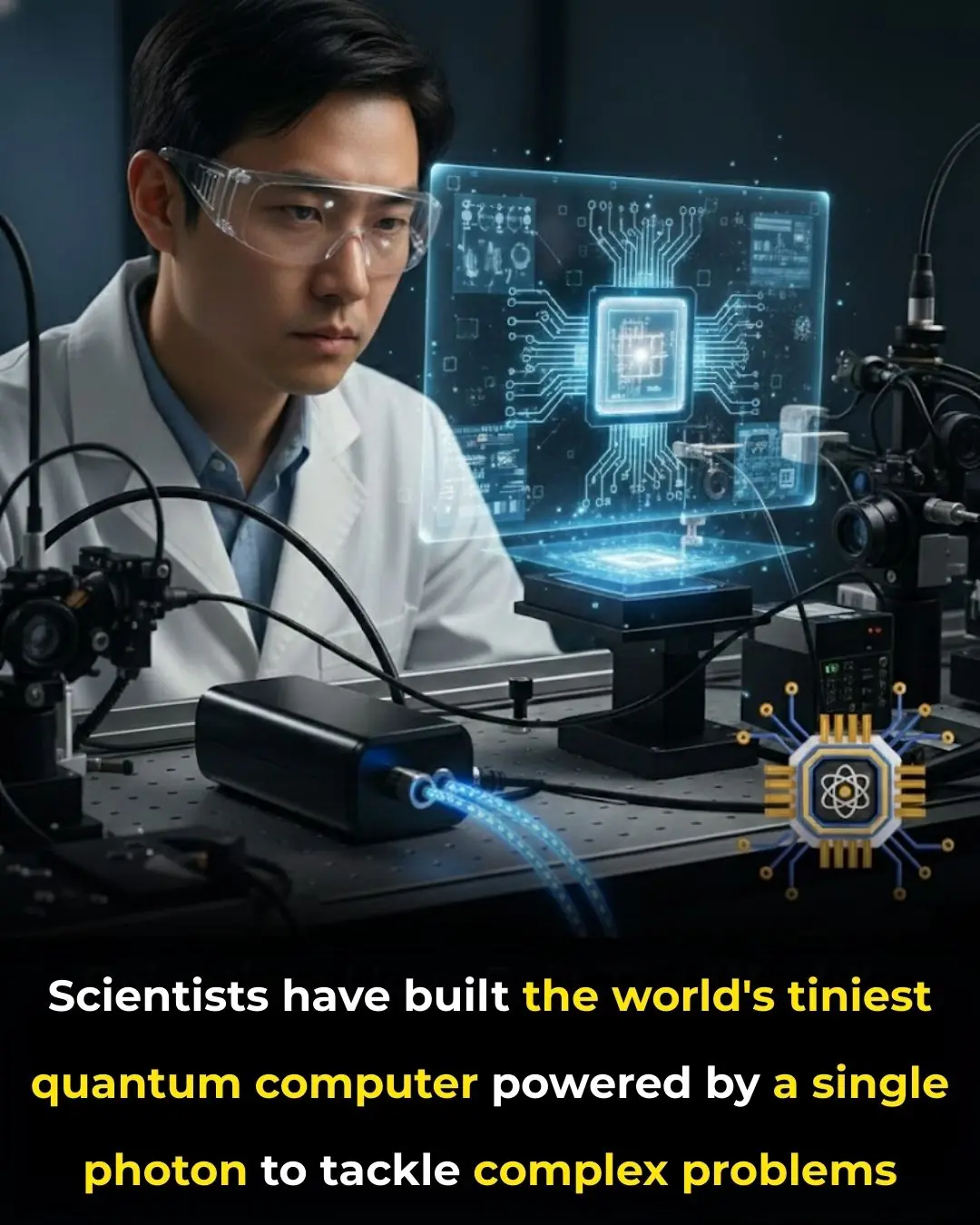
Researchers at National Tsing Hua University (NTHU) in Taiwan have reached a remarkable milestone in quantum science by developing what is considered the world’s smallest quantum computer, powered by just a single photon. This breakthrough challenges conventional assumptions about quantum computing, which typically relies on large-scale, cryogenically cooled systems and complex multi-particle synchronization.
The project was led by Professor Chih-Sung Chuu, whose team successfully built Taiwan’s first optical quantum computer. Unlike traditional quantum devices that require multiple qubits interacting simultaneously, this system performs quantum computation using one high-dimensional photon that repeatedly circulates through an optical fiber loop. By exploiting the photon’s multiple degrees of freedom, the researchers demonstrated that complex computational tasks can be executed without increasing the number of particles involved.
One of the most striking achievements of this work is the ability to encode 32 dimensions of information into a single photon. This approach is often described as transforming a “one-seater vehicle into a 32-seater,” highlighting how information density can be dramatically increased without expanding physical hardware. Using this method, the quantum computer was shown to solve problems such as prime factorization, a task that underpins modern cryptography and is widely used as a benchmark for quantum computational capability.
In addition to its compact design, the system operates at room temperature and can be placed on a desktop, eliminating the need for bulky dilution refrigerators and extreme cooling environments required by superconducting or trapped-ion quantum computers. This significantly lowers the cost, energy consumption, and engineering complexity associated with quantum hardware, making the technology more accessible for research and potential commercial applications.
Crucially, the NTHU team’s approach addresses one of the most persistent challenges in quantum computing: multi-photon synchronization. Coordinating multiple quantum particles without losing coherence is notoriously difficult and prone to error. By relying on a single photon instead of many, the system bypasses synchronization issues while maintaining quantum advantages through high-dimensional encoding.
The implications of this development extend far beyond laboratory demonstrations. Single-photon, high-dimensional quantum computing could have a transformative impact on fields such as artificial intelligence, cybersecurity, and drug discovery. In cybersecurity, for example, advances in quantum factorization may influence encryption standards, while in chemistry and materials science, quantum simulations could accelerate the discovery of new compounds and pharmaceuticals.
Overall, this achievement represents a significant step toward scalable, energy-efficient, and practical quantum computing. While further work is required to improve stability, error correction, and real-world integration, the NTHU team’s success demonstrates that the future of quantum computing may not depend solely on larger and more complex machines, but on smarter ways of harnessing quantum properties at the most fundamental level.
Sources
-
National Tsing Hua University (NTHU), Taiwan – Official research announcements and press releases
-
Nature Photonics – Reviews and research on high-dimensional photonic quantum computing
-
Nature Physics – Articles on single-photon quantum information processing
-
MIT Technology Review – Coverage of emerging quantum computing architectures
-
IBM Quantum Research – Background on quantum computing principles and applications
If you want, I can:
-
Adjust the academic level (popular science vs. scholarly)
-
Add in-text citations (APA/MLA/Chicago)
-
Expand further to 1.5–2 pages with deeper technical explanation