Who let this filthy cockroach in here while I’m teaching?
Derek Lawson glared at Jerome, who was mopping the floor near the carpet.
“Every time I see you, I want to vomit. You stink. Everything about you is disgusting.”
Jerome continued mopping.
“Almost done, sir.”
The mop snagged on the edge of the carpet. Water spilled onto the carpet. Derek stepped in the water while kicking. His foot slipped. He stumbled.
Forty students saw.
Silence.
His face flushed. He slammed the mop against his knee.
“You just embarrassed me here in my practice room.”
He grabbed Jerome by the collar and pulled him onto the carpet.
“I’m going to teach you a lesson, you cockroach. A real lesson.”
A gleaming black belt. A phone raised.
Jerome stood still. Empty-handed.
No one there knew what was about to happen next.
Lawson Combat Academy sat on the corner of Westheimer and Dunlavy. A two-story brick building with tinted windows and a neon sign that buzzed every night at six. Inside, the walls were lined with championship banners, framed photos of Grant Lawson shaking hands with UFC fighters, and a glass trophy case that hadn’t been unlocked in years.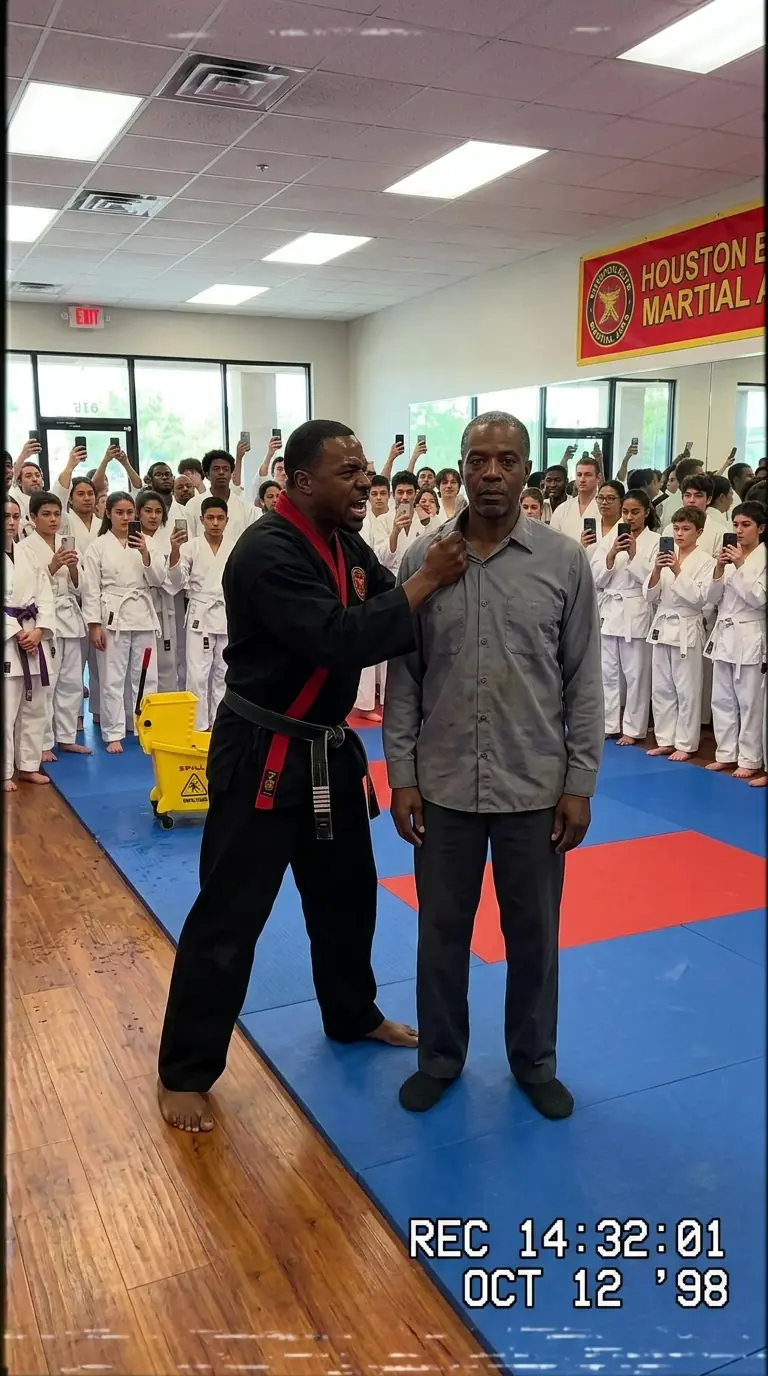
The air always smelled like sweat, rubber mats, and the faint chemical bite of floor cleaner. This was Houston’s most expensive martial arts gym. Monthly dues ran four hundred dollars. The parking lot was full of Range Rovers and BMWs. The students were lawyers, real estate agents, tech founders. People who trained to feel dangerous, not to be dangerous.
And every morning at four a.m., before any of them arrived, Jerome Adams unlocked the back door and started mopping.
Jerome was thirty-eight, quiet, built lean, not bulky — the kind of frame people mistook for skinny until they watched him carry two fifty-pound bags of sand across the parking lot without slowing down. He wore the same gray uniform every shift, name tag pinned crooked, work boots worn flat at the heels.
He had no social media, no photos on his phone, no friends at the gym. The front desk girl knew his name. The other cleaning staff knew he never complained. That was it.
What none of them knew — what Jerome never told anyone — was that he had spent twelve years in the United States Army. Not as infantry, not as support, but as a combatives instructor. Hand-to-hand combat. The man who taught soldiers how to control, restrain, and neutralize threats with zero weapons and zero wasted movement.
He had trained at Fort Moore, earned his level-four certification — the highest tier in the modern Army Combatives Program. He had taught grappling, joint locks, takedowns, and chokeholds to over three thousand soldiers across four bases. Three commendations. An honorable discharge after a shoulder injury that took eleven months to heal.
When Jerome left the Army, he didn’t look for glory. He looked for quiet.
He found a one-bedroom apartment off Telephone Road, a janitor job that paid fourteen dollars an hour, and a garage where he could train alone at night. Shadow drills, hip escapes, single-leg entries against a heavy bag bolted to the wall.
He never told anyone because no one ever asked.
Derek Lawson was twenty-eight, Grant Lawson’s only son. Born into the gym. First black belt at nineteen. His Instagram bio read: “Undefeated, unmatched, unstoppable.” Fifty thousand followers watched him post highlight reels of spinning kicks and knockouts — all against beginners or students half his skill level.
Derek was six-foot-one, two hundred twenty pounds, thick neck, loud voice. He walked through the gym like he owned it because one day he would. He called students by their last names. He called Jerome “boy” or “janitor” or nothing at all.
He had never competed outside the academy, never entered a sanctioned tournament, never fought anyone who could actually fight back. But the cameras didn’t show that. The comments didn’t know that. And Derek liked it that way.
To Derek, Jerome was furniture. A mop with legs. Something to step over on the way to the mat. He never once looked Jerome in the eye until the night Jerome’s mop touched the edge of his carpet.
There was one other person who mattered: Brenda Shaw, thirty-two, a paralegal who trained at Lawson three nights a week. She was the only student who said “thank you” when Jerome held the door. The only one who noticed when Derek’s jokes about the janitor stopped being jokes.
She never said anything to Derek. She didn’t have the standing. But she started keeping her phone charged to full every class. Just in case.
Every night after his shift, Jerome would finish mopping the training room, stop for a moment, and look at the mat under the fluorescent lights. His hands would flex once — an old habit. Then he would turn off the lights and leave.
He hadn’t stepped on a mat in six years.
That was about to change.
It started on a Friday.
The five o’clock class was full. Twenty-two students spread across the mat, working through a kickboxing drill. Derek stood at the front, barking corrections, slapping pads, playing the role of the coach who never needed coaching.
Jerome was mopping the hallway just outside the training room. He kept his head down, working in steady strokes, staying out of sight the way he always did.
Then Derek spotted him.
“Hey. Janitor.”
Jerome looked up.
“Come here. Bring the mop.”
Derek pointed at a scuff mark on the edge of the mat.
“You see that? That’s been there since Tuesday. What exactly am I paying you for?”
“I’ll get it right now, sir.”
“You’ll get it right now,” Derek mimicked in a high-pitched whine.
A few students laughed.
Jerome knelt down and started scrubbing the mark with a rag.
Derek stood over him, arms crossed, watching like a man inspecting a stain on his shoe.
“Faster. I’ve got a class to run.”
Jerome scrubbed harder. The mark came off.
But Derek wasn’t done.
He reached down, grabbed the rag from Jerome’s hand, and threw it across the room.
“That’s not clean enough. Do it again. Use your hands this time.”
The laughter stopped. A few students looked away. Brenda Shaw’s grip tightened around her phone.
Jerome stared at the spot on the mat. Then he placed his bare palms on the surface and wiped.
“There you go.” Derek patted Jerome on the head like a dog. “Good boy. Now get out of my sight.”
Jerome stood up. His hands were shaking. Not from fear. Not from weakness. From something he had spent six years learning to keep locked inside a cage.
He picked up his mop, turned, and walked down the hallway without a word.
Behind him, Derek was already laughing with the students. The moment was over for him. A joke. A bit. Content.
But Brenda saw Jerome’s face as he passed her. She had seen a lot of expressions in courtrooms — anger, grief, defeat. This wasn’t any of those.
This was control.
The Friday incident should have been the end of it. A bad moment. A cruel joke. Something everyone quietly agreed to forget.
But Derek didn’t forget.
He replayed it.
That night he sat in his apartment scrolling through his phone. He had filmed the whole thing — Jerome kneeling, wiping the mat with his bare hands, the head pat. He uploaded it to TikTok with the caption: “When the janitor tries to join the big boys.”
By morning, it had two hundred thousand views. The comments poured in. Some people called it disgusting. Most people laughed.
Derek read every single one, sorting by most liked, skipping anything negative. He screenshotted the funniest replies and posted them on his Instagram story.
He called his friend Travis that afternoon.
“Bro, the janitor video blew up. Two hundred K overnight.”
“No way.”
“I’m telling you, people love this stuff. The mop, the kneeling, the head pat — comedy gold.”
Travis laughed. “You should do more.”
Derek leaned back in his chair. “Oh, I’m going to.”
The following week, it got worse. Not slowly, not gradually. It got worse the way a fire gets worse when someone pours gasoline on it and calls it entertainment.
Monday, Derek made Jerome hold a kick pad during a demonstration. Not as a training partner, but as a prop. He told the class Jerome was the perfect dummy because he already looked like one.
Jerome held the pad steady. Didn’t flinch.
Derek kicked it so hard Jerome’s arms buckled backward and he stumbled into the wall.
Students laughed. Phones came out.
Derek posted it that night with the caption: “Even the mop can be useful sometimes.” Three hundred thousand views.
Tuesday morning, Jerome found his hours cut. The front desk girl handed him the schedule without making eye contact.
“Derek said you’re disrupting the evening classes. These are your new shifts.”
Jerome looked at the paper. Three fewer shifts per week. Fourteen dollars an hour times fifteen fewer hours. His rent was due in nine days.
He nodded, folded the schedule, put it in his back pocket, walked to the supply closet, picked up his mop, and started his shift twenty minutes early to make up for lost time.
That same afternoon, Derek cornered Jerome in the storage room. No cameras this time. Just the two of them between shelves of cleaning supplies and stacked floor mats.
“Listen, janitor. My dad’s been talking about cutting the cleaning staff. Budget stuff.” Derek picked up a bottle of bleach, examined it like it bored him, and set it back down. “I could put in a good word for you. Keep your job safe.” He smiled. “All you got to do is show up when I ask and do what I say. On camera. Simple.”
Jerome looked at him. “I just want to do my job, sir.”
Derek’s smile disappeared. “That wasn’t a question.”
He walked out.
Wednesday, Derek invented the janitor challenge.
He brought three of his black belt friends to the gym after hours. The rules were simple: pin Jerome to the mat as fast as possible. First one under thirty seconds wins a hundred dollars.
They grabbed Jerome from the hallway while he was emptying trash cans, dragged him onto the mat without asking.
The first one shot a double-leg takedown. Jerome went limp on purpose, let his body drop, and waited until they let go.
The second yanked his arm behind his back and wrenched it. Jerome didn’t resist.
The third sat on his chest, slapped the mat, and counted to ten while the others cheered.
Derek filmed all three rounds, posted them as a compilation: “Janitor Challenge — who can break the mop?” Five hundred thousand views in forty-eight hours. Brand deals started showing up in his DMs.
Jerome went home that night with carpet burns on both elbows and a deep bruise across his left shoulder blade.
He sat on the edge of his bed for a long time. Didn’t ice anything. Didn’t call anyone. He looked at his hands — the same hands that had taught three thousand soldiers how to survive — and pressed them flat against his knees until they stopped shaking.
Then he stood up and walked to the garage.
He didn’t train. He just stood there in the dark looking at the heavy bag, the old gloves on the nail, the combatives manual with the cracked spine on the shelf.
Eleven minutes.
Then he turned off the light and closed the door.
Grant Lawson, Derek’s father and owner of the academy, watched every video. Not as a father concerned about his son’s character — as a businessman tracking numbers.
“The janitor content is outperforming everything,” Grant said over dinner. “Your technique reels pull twenty K. The janitor stuff hits five hundred K. That’s twenty-five times the return.”
“I know,” Derek said, refilling his glass. “I want to take it bigger. A live one.”
“Live how?”
“Live stream, Friday night. Full class watching. I bring the janitor on the mat, spar with him in front of the whole class. Not a real fight, just enough to look good. Chat goes crazy. Donations come in and I break a hundred K followers before the month ends.”
Grant cut his steak. Chewed. “He’s not going to sue us?”
“Dad, he’s a janitor making fourteen dollars an hour. He can’t afford a sandwich, let alone a lawyer.”
Grant swallowed, set down his fork. “Do it.”
Thursday, Derek posted an Instagram story. Black background, white text: “Friday night live. I’m giving the janitor a lesson he’ll never forget. 8:00 p.m. Be there.”
Forty thousand views in two hours. The comments split hard. Most people cheering. A handful calling it cruel. All of them drowned out by laughing skulls and fire emojis.
Brenda Shaw saw the story at nine that night. She sat in her car outside her apartment and read it three times. Her stomach turned.
She plugged her phone in, opened camera settings, and switched video resolution to the highest available.
Then she texted a number she hadn’t used in months — a law school friend now working at a legal aid non-profit.
The message was three lines: “I need your help. Something bad is about to happen at my gym. It involves a man who doesn’t deserve any of it.”
The reply came fast. “What kind of bad?”
Brenda typed and deleted three answers. Then she sent: “The kind that gets filmed.”
Friday was twenty hours away.
Derek had his cameras, his script, and his audience.
Jerome had nothing but a pair of hands and a lifetime of knowing exactly what they could do.
Thursday night, eleven p.m.
Jerome sat in his garage under a single bare bulb. He had seen the story — “Friday Night Live. A lesson the janitor will never forget.” The cockroach emoji. Forty thousand people already waiting for the show.
He knew what was coming. Not a prank. Not a challenge. A public beating dressed up as entertainment.
He opened the metal cabinet in the corner. Inside: worn combat gloves, a roll of athletic tape, and a green notebook — his field manual from Fort Moore. Every page in tight block letters: takedown sequences, choke transitions, escape chains.
He read page after page. The rear naked choke setup he had taught to five hundred soldiers in a single year. The arm lock that needed three pounds of pressure and two seconds to end any fight without throwing a single punch.
Then he closed the notebook, taped his hands, and for the first time in six years, Jerome Adams stepped in front of the heavy bag and moved.
His body remembered everything.
At midnight, his phone buzzed. Brenda.
“He’s coming for you tomorrow. You know that.”
“I know.”
“What are you going to do?”
A long pause.
“Whatever he makes me do. I’ll be there, front row, camera ready.”
Jerome hung up.
The heavy bag still swung from his last combination. The chain creaked in the quiet.
Friday was eight hours away.
Friday. Six p.m.
The parking lot was full before the front doors even opened. Word had spread. Not just through the academy — through Houston.
Derek’s Instagram story had been reposted, screenshotted, stitched on TikTok. “Friday night live. I’m giving the janitor a lesson he’ll never forget.”
By five-thirty, the post had crossed a hundred thousand views. People who had never set foot inside Lawson Combat Academy were showing up just to watch.
By six-fifteen, there were over forty people packed around the mat. Students in gi pants and rash guards, friends of friends in streetwear, a few people who had driven in from Katy and Sugar Land after seeing the story.
Derek had set up three cameras on tripods — one wide, one tight on the mat, one on a gimbal held by Travis. The live stream went live at six-twenty. The viewer count started climbing: two thousand, four thousand, eight thousand.
Derek stood at the center of the mat in a pressed black gi, his belt tied tight, his name embroidered on the chest. He shadowboxed for the camera, bouncing on his toes, rolling his neck. He looked like a man about to perform. Because that’s exactly what he thought this was.
Jerome was in the back hallway putting away the mop. He hadn’t changed clothes. Gray uniform, work boots, name tag still pinned to his chest.
Brenda was in the second row, phone out, recording. She had switched to 4K that morning. Her hands were steady. Her jaw was not.
At six-thirty, Derek clapped his hands.
“All right, you all know why you’re here.”
He pointed at the hallway. “Somebody go get the janitor.”
Two students walked to the back. They came back with Jerome between them. Not dragging him, but not giving him a choice either.
Jerome stepped through the crowd. Forty-something faces — some grinning, some recording, a few uncomfortable, none of them speaking up.
Derek looked him up and down. Mop water stains on his pants, worn boots, hands hanging loose.
“Ladies and gentlemen, tonight’s volunteer.”
Derek spread his arms wide. “The janitor is going to learn what it feels like to step on a real fighter’s mat.”
Someone in the back whistled. Someone else yelled, “Give him the lesson.”
Jerome didn’t look at the crowd. He looked at Derek. Same steady eyes from the garage. Same quiet breath.
“You ready, Roach?” Derek said.
Jerome didn’t answer.
He stepped onto the mat.
The live stream chat exploded. Fire emojis. Skull emojis. “This is going to be good.”
The viewer count hit ten thousand.
Derek settled into his stance. Orthodox, left foot forward, hands high, chin tucked. Textbook. He bounced twice, feinted a jab, and smiled for the camera.
Jerome stood flat-footed, hands at his sides, no stance, no guard. His weight centered. His breathing unchanged.
To the crowd, he looked like a man waiting to get hit.
To anyone who had trained at Fort Moore, he looked like something else entirely.
Derek attacked first. A fast roundhouse kick aimed at Jerome’s ribs. The same kick that had buckled Jerome’s arms on Monday.
This time, Jerome wasn’t holding a pad.
He sidestepped. One step. Clean.
The kick sailed past his hip by two inches. Derek’s momentum carried him off balance for half a second.
That was all Jerome needed.
He closed the distance in one stride, dropped his level, and shot a single-leg takedown so fast the crowd didn’t process it until Derek was already airborne.
Jerome’s shoulder drove into Derek’s hip. His hands locked behind Derek’s knee. He lifted and turned in one fluid motion.
Derek hit the mat on his back. Hard.
The sound echoed off the walls.
A collective gasp sucked the air out of the room.
Derek scrambled. He rolled to his stomach, tried to push up, tried to create space.
But Jerome was already on him.
Side control. Textbook.
Jerome’s chest pressed across Derek’s back. His right arm threaded under Derek’s chin. His left hand locked behind Derek’s head.
The rear naked choke. The same technique he had drilled ten thousand times at Fort Moore. The same hold he had taught in classrooms and field exercises and combat simulations for twelve years.
He didn’t squeeze. Not yet.
He held the position and waited.
Derek clawed at Jerome’s forearm. His legs kicked. His face pressed sideways against the mat.
“Get off me!” Derek shouted. “Get off me!”
Jerome didn’t move.
He adjusted his grip by a quarter inch. His breathing was the same as it had been when he walked onto the mat. Slow. Even. Controlled.
Five seconds passed.
Derek’s struggles weakened. Not because he was losing consciousness. Jerome wasn’t applying full pressure. He was demonstrating something. Control so precise it was surgical. Enough force to hold. Not enough to harm.
Ten seconds.
Derek’s hands stopped clawing. They started tapping.
Tap. Tap. Tap.
The universal signal. I give up. I submit. Stop.
Jerome held for one more second. Not out of cruelty, but long enough for every camera in the room to capture it.
Then he released.
He stood up. Stepped back. Walked off the mat.
He didn’t say a word. He didn’t look at the crowd. He didn’t flex, didn’t celebrate, didn’t acknowledge a single camera.
He picked up the mop from the hallway and carried it toward the storage closet like a man finishing his shift.
The gym was silent. The kind of silence that doesn’t mean peace. It means shock.
Three full seconds. Nobody breathed.
Then someone in the back row started clapping.
One person.
Then two.
Then a wave that rolled through the room like thunder.
A few students were on their feet. One woman had her hand over her mouth. A man near the door said out loud to no one in particular, “Who the hell is that guy?”
The live stream chat was a wall of text moving so fast it was unreadable.
“What just happened? Who is he? Play it back. Bro got humbled in forty seconds.”
The viewer count had jumped to fourteen thousand during the fight. It would hit two hundred thousand by morning from replays alone.
Derek sat on the mat alone. His gi was twisted. His belt had come loose. His hands were flat on the floor beside him.
He didn’t stand up for a long time.
Grant Lawson stood at the back door. He had watched the whole thing. His arms were crossed. His face showed nothing, but his phone was already in his hand, scrolling through his contacts to find the family lawyer.
Brenda lowered her phone. Her recording was four minutes and eleven seconds long, starting from Derek calling for the janitor and ending with Jerome walking away with the mop. Every frame was steady. Every word was audible.
She saved it twice. Once to her phone. Once to the cloud.
She opened Twitter, typed two words and a hashtag in the caption: “Watch this. #janitortakedown” and attached the video.
By midnight, it had two million views. By Sunday, twenty million. By Monday, the whole country knew Jerome Adams’ name.
But before the fame came, before the interviews and the headlines and the hashtag, something else arrived first.
A phone call from a lawyer.
And not the kind who helps.
The call came Saturday morning at 7:15.
Jerome was sitting at his kitchen table with a cup of black coffee and a phone that hadn’t stopped buzzing since midnight.
He didn’t recognize the number. He answered anyway.
“Mr. Adams, this is the law office of Whitfield and Crane, representing the Lawson family. We’re filing a civil complaint against you for aggravated assault, intentional infliction of emotional distress, and tortious interference with business operations. You will be served by end of day. We strongly advise you to retain counsel.”
The line went dead.
Jerome set the phone on the table. The coffee had gone cold. He hadn’t taken a sip.
By noon, it was everywhere.
Grant Lawson held a press conference outside the academy. Navy suit. His lawyer to the left. Derek to the right, left arm in a sling, right hand clutching a tissue he never used.
“Last night, an employee of this academy — a janitor — viciously attacked my son during a routine training demonstration,” Grant said into a cluster of microphones. “My son suffered physical and psychological injuries at the hands of a man we trusted to clean our floors. This was not self-defense. This was assault. And we will pursue the fullest extent of the law.”
Derek stepped forward. His voice cracked. Rehearsed, but effective.
“I was just trying to teach a class. He came at me out of nowhere. I thought he was going to kill me.” He touched the sling, looked down. “I can’t sleep. I can’t train. I keep seeing his face.”
The clip ran on three Houston news stations by four p.m.
KHOU: “MMA gym janitor accused of attacking instructor’s son.”
Fox 26: “Black belt assaulted by cleaning staff. Family files suit.”
Not one outlet mentioned who started the confrontation. Not one mentioned the months of TikToks. Not one mentioned the janitor challenge.
The law firm’s PR agency had done its job. The story was framed before anyone could ask a question.
The internet split down the middle.
Brenda’s video had twenty million views by Sunday. But the law firm press conference had reached two million. Polished, media-ready, backed by a PR agency and a lawyer who had handled three prior sports injury settlements.
The comment sections became war zones.
“He assaulted a student in his own gym. Lock him up.”
“Did you watch the full video? They dragged him onto that mat.”
“Doesn’t matter who started it. That chokehold could have killed him. The janitor is a trained killer walking around public. He should be in prison.”
“He used zero strikes. Watch it again. Zero.”
“The Lawsons are rich. Of course they’re spinning this.”
“Rich or not, you can’t choke someone out and call it self-defense.”
The arguments looped endlessly. Talk shows picked sides. A retired MMA fighter posted a breakdown video calling Jerome’s technique “the cleanest rear naked choke I’ve seen outside competition.” A Fox News commentator called it “vigilante violence disguised as victimhood.” Both clips got a million views.
Nobody moved an inch.
And while the internet debated, Jerome’s real life was collapsing.
Monday morning, he was fired. The termination letter was one paragraph: “Due to conduct unbecoming of an employee and pending legal action, your employment is terminated effective immediately. Please return all company property.”
He returned the uniform, the keys, and the name tag. The front desk girl didn’t look at him. Nobody in the building did.
Tuesday, his landlord called. “Jerome, I’m not trying to make things harder, but your face is on the news. Other tenants are asking questions. I’m going to need you to start looking for somewhere else.”
Wednesday, his bank account showed four hundred twelve dollars. Rent was nine hundred, due in six days.
Jerome sat in his apartment with the lights off. Termination letter on the table. Rent notice on the counter. Phone face down, still buzzing with calls from reporters, podcasters, and strangers who had found his number through public records.
He had no lawyer, no income, no family in Houston, no one in his corner except a paralegal who had already risked her own gym membership to press record.
Brenda called Wednesday night.
“Jerome, listen. My friend Angela — the one I texted before Friday — she connected me to someone. His name is Nathan Cole, former JAG officer, military lawyer. He does pro bono work for veterans. He’s already seen everything. Not just the fight — the TikToks, the janitor challenge, the storage room, all of it. He wants to meet you tonight.”
“I can’t afford—”
“You don’t have to pay him. He wants to help.”
Jerome was quiet for a long time.
“Jerome?”
“Tell him I’ll be here.”
Nathan Cole arrived at nine p.m. Fifty-one years old, tall, gray at the temples, sport coat over a polo, a leather messenger bag that looked like it had survived a deployment. Fourteen years in the Army JAG Corps, now in private practice specializing in veterans’ rights and civil defense.
He sat at Jerome’s kitchen table, opened his laptop, and played every video in chronological order. The head-pat video. The kick-pad video. The janitor challenge compilation. The Instagram story promoting Friday night live. And finally, Brenda’s recording — four minutes and eleven seconds from “Somebody go get the janitor” to Jerome walking away with the mop.
Nathan closed the laptop. Folded his hands.
“Three things,” he said.
“First, they pulled you onto that mat. You didn’t volunteer. You didn’t consent. In Texas, that’s coercion, and it voids any claim that you initiated contact.
“Second, I’ve watched the fight frame by frame. You used zero strikes. Not one. Every technique you applied was a control hold at partial pressure. You could have caused real damage, and you chose not to. That’s not assault. That’s textbook restraint.
“Third,” he pulled a folder from his bag and slid it across the table. “Lawson Academy has three prior complaints filed with the Texas Department of Licensing and Regulation. All from former students. All alleging a pattern of bullying and physical intimidation by staff. All three were settled quietly with non-disclosure agreements. No press coverage.”
Jerome opened the folder. Three names. Three complaints. Three settlements.
“How did you find this?”
“Public records. The filings are indexed. The Lawsons just assumed nobody would look.”
Nathan leaned forward.
“Jerome, you’re not the defendant in this story. You’re the evidence. Every video they posted, every dollar they earned off your humiliation, every student they silenced — that’s a pattern. And patterns win cases.”
He extended his hand.
“I’ll take your case. No fee. No conditions. The only thing I need from you is the truth.”
Jerome looked at the hand, then at the letter on the table, then at the notice on the counter, then at the four hundred twelve dollars in his bank account that wouldn’t cover half his rent.
He shook it.
Brenda, standing in the doorway with her arms crossed, exhaled for the first time in six days.
The Lawsons had filed first. They had the money, the PR, and the narrative.
But Nathan Cole had the footage. Every second of it.
And he knew exactly what a jury would see when they watched it.
The hearing was scheduled for Wednesday, nine a.m., Harris County Civil Court, room 4B.
Jerome arrived at eight-thirty wearing the only suit he owned — the charcoal one he had worn the day he was honorably discharged. It was eight years old. The sleeves were a half inch short. The tie was army green. He had ironed it the night before on his kitchen table using a towel as a board.
Nathan Cole walked in beside him carrying two binders and a laptop. He looked like a man who had done this a hundred times. Because he had.
The courtroom was packed. Local press in the back row. Three camera crews in the hallway. Members of the Houston MMA community filled the left side. A group of veterans — eight men and women in jackets with unit patches — filled the right. They had driven from as far as San Antonio.
Jerome didn’t know any of them.
They knew him.
Brenda sat in the second row, phone off, hands folded. She had already submitted her footage as evidence.
Grant Lawson sat behind the plaintiff’s table in a tailored navy suit. Derek sat next to him. No sling this time. Their lawyer, Harold Whitfield, was a silver-haired man with cufflinks and a reputation for winning settlements before they reached trial.
Whitfield went first.
He painted Jerome as a weapon. A man with military combat training who had been hiding in plain sight waiting for an opportunity to unleash violence on an unsuspecting civilian.
“Your honor, the respondent is a former army combatives instructor. A man trained to incapacitate, restrain, and neutralize human beings with his bare hands. He applied a rear-naked chokehold on my client — a technique designed to render a person unconscious — in front of forty witnesses, including minors. This was not self-defense. This was assault.”
Derek took the stand.
“I was running a regular Friday class,” he said, eyes down, voice soft. “I invited him to participate. I thought it would be fun. Like a team-building thing. He agreed. And then he just attacked me. No warning. I was on the ground before I knew what happened. I tapped out because I thought I was going to die.”
Whitfield nodded. “No further questions.”
Nathan Cole stood up. He buttoned his jacket. He didn’t rush.
“Mr. Lawson,” Nathan said, “you stated that Mr. Adams agreed to participate. Is that correct?”
“Yes.”
“Voluntarily?”
“Yes.”
Nathan opened his laptop and turned the screen toward the courtroom.
“Your honor, I’d like to enter exhibit A — a video recording captured by an attendee of the Friday session.”
He pressed play.
The courtroom heard Derek’s voice through the speakers.
“Somebody go get the janitor.”
Two students walking to the hallway. Jerome being brought back between them. Derek’s voice again: “Tonight’s volunteer.”
Then: “You ready, Roach?”
Nathan paused the video.
“Mr. Lawson, is that your definition of voluntary participation?”
Derek’s mouth opened. Nothing came out.
“Let me rephrase. At any point during this video, does Mr. Adams say yes? Does he nod? Does he raise his hand? Does he sign a waiver?”
Silence.
“The answer is no, he doesn’t. Because he wasn’t asked. He was summoned.”
Nathan let the silence sit for three seconds. Then he continued.
“Your honor, I’d now like to enter exhibits B through F.”
He played them one by one. The head-pat video from TikTok. Two hundred thousand views. Derek’s caption: “When the janitor tries to join the big boys.” The kick-pad video. Three hundred thousand views. Caption: “Even the mop can be useful sometimes.” The janitor challenge compilation. Five hundred thousand views. Caption: “Who can break the mop?” The Instagram story: “Friday night live. I’m giving the janitor a lesson he’ll never forget.”
Each video played in full. The courtroom watched in silence. A woman in the press row put her hand over her mouth. One of the veterans in the right section shook his head slowly and looked at the floor.
Nathan closed the laptop.
“Your honor, this is not a case of one isolated incident. This is a documented, monetized pattern of harassment spanning multiple weeks. The plaintiff filmed himself humiliating Mr. Adams repeatedly, posted the content for profit, and then organized a live event specifically designed to publicly degrade him. When Mr. Adams, under coercion, on camera, in front of forty people, used the minimum force necessary to protect himself, the plaintiff’s family responded by suing him.”
He paused. Turned to Derek.
“Mr. Lawson, how much ad revenue did your TikTok account generate from videos featuring Mr. Adams?”
Derek looked at his lawyer.
Whitfield objected. The judge overruled.
“I don’t… I don’t have the exact numbers.”
“I do.” Nathan pulled a printed document from his binder. “Exhibit G. TikTok creator fund payment records subpoenaed from the platform. Your account received six thousand eight hundred dollars in the ninety days prior to the incident. Seventy-one percent of that revenue came from videos featuring Jerome Adams. You earned four thousand eight hundred twenty-eight dollars from his humiliation.”
The number hung in the air like smoke.
Nathan turned back to the judge.
“Finally, your honor, exhibit H.”
He held up the folder.
“Three prior complaints filed against Lawson Combat Academy with the Texas Department of Licensing and Regulation. All from former students. All alleging bullying, intimidation, and coerced physical contact by staff members. All three settled with non-disclosure agreements and financial payments.”
Whitfield stood up. “Your honor, those settlements are confidential.”
“The filings are public record, your honor. The settlements may be sealed. The complaints are not.”
The judge reviewed the documents for a long moment. The courtroom was still.
Then she asked for the fight video to be played one more time at half speed.
Everyone watched.
Jerome’s sidestep. The single-leg takedown. The transition to side control. The rear naked choke applied with partial pressure, held for exactly as long as necessary, released the moment Derek tapped. No punches. No kicks. No strikes of any kind. No expression of anger on Jerome’s face. No words spoken.
Just precision.
The judge removed her glasses.
“The court finds no basis for the plaintiff’s claims. The video evidence clearly shows the respondent was brought onto the mat without consent and under coercion. The force used was proportional, controlled, and defensive in nature. The respondent applied zero strikes and released the hold immediately upon submission.”
She looked at the Lawson table.
“Furthermore, the court is forwarding the prior complaints and the evidence of systematic harassment to the Texas Department of Licensing and Regulation for independent review. The case is dismissed.”
The gavel came down.
The veteran stood first. Then Brenda. Then half the courtroom.
Not applause — not in a courtroom — but the sound of forty people exhaling at the same time.
Jerome sat still. His hands were flat on the table in front of him. He didn’t move for a long time.
Nathan put a hand on his shoulder.
“It’s over.”
Jerome looked at him. His eyes were wet. He didn’t wipe them.
“No,” he said quietly. “It’s not.”
He was right.
What came next was bigger than any courtroom.
The fallout was swift and it was thorough.
The Texas Department of Licensing and Regulation opened a formal investigation into Lawson Combat Academy within seventy-two hours of the ruling. The three prior complaints, previously buried under non-disclosure agreements, were reopened.
Within a week, twelve more former students came forward. Their stories were different in the details, but identical in the pattern: public humiliation during classes, coerced sparring with unmatched opponents, and retaliation against anyone who pushed back.
One former student, a nineteen-year-old college freshman named Tyler Brooks, told the Houston Chronicle that Derek had made him spar with a black belt twice his experience level during his second week. When Tyler lost, Derek posted the clip with the caption: “First-timers shouldn’t skip the tutorial.” Tyler quit the next day. He never trained again.
The investigation found that Lawson Academy had failed to maintain proper safety protocols, had no formal consent process for sparring sessions, and had allowed an instructor — Derek — to use students in content creation without written authorization.
The academy’s operating license was suspended pending review.
Grant Lawson tried to get ahead of it. He issued a statement calling the investigation “politically motivated” and announcing that Derek would be stepping back from teaching to focus on “personal growth.”
It didn’t work.
Three sponsors pulled their deals within forty-eight hours. The academy’s Google rating dropped from 4.6 to 1.9 in a single weekend. The parking lot that had been full of Range Rovers was empty by the following Monday.
Derek’s TikTok account was permanently banned for violating the platform’s policy on bullying and harassment. His Instagram lost eighteen thousand followers in four days. The brand deals — the energy drinks, the supplement company, the gi manufacturer — all sent termination notices.
His inbox, once full of collaboration offers, was now full of legal disclaimers.
He deleted every video he had ever posted. Every clip. Every story. Every caption with a cockroach emoji.
But the internet doesn’t forget. Fan accounts had already downloaded and reposted everything. The janitor challenge compilation alone had been mirrored on over two hundred accounts.
By the end of the month, Lawson Combat Academy closed its doors. The neon sign on Westheimer went dark. Grant Lawson put the building on the market. He didn’t hold a press conference this time.
Jerome’s life moved in the opposite direction.
The courtroom video — Brenda had recorded it on her phone from the gallery — spread almost as fast as the fight clip. Nathan’s cross-examination became a viral moment of its own. The line “You earned four thousand eight hundred twenty-eight dollars from his humiliation” was quoted in op-eds, podcast episodes, and legal commentary channels across YouTube.
A veterans organization in Houston launched a crowdfunding campaign for Jerome. It raised sixty-two thousand dollars in five days. Jerome used part of it to pay his rent. The rest he set aside for something else.
The call came from the Fifth Ward Community Center — a nonprofit gym on the east side of Houston that served low-income families. They had seen the videos. They had read about Jerome’s military background. They wanted to offer him a position: head instructor of a new self-defense program for youth ages ten to seventeen. Salary. Benefits. A mat with his name on it.
Jerome said yes.
He named the program Ground Up.
The curriculum wasn’t about fighting. It was about control. How to de-escalate. How to protect yourself without becoming the aggressor. How to stay calm when someone is trying to make you lose your composure.
The same principles Jerome had lived by every day he mopped that floor.
The first class had fifteen kids. By the second month, there were forty.
Brenda Shaw volunteered as the program’s administrative coordinator. Nathan Cole joined the board.
On the first day, Jerome knelt in front of the group so he was at eye level with the smallest kid in the front row.
The kid looked nervous.
Jerome smiled.
“First lesson,” he said. “A real fighter never throws the first punch.”
The kid nodded.
Jerome stood up, walked to the center of the mat, and began.
That evening, after the last student left, Jerome stayed behind. He mopped the floor of the training room. Same steady strokes. Same rhythm. Same quiet.
But this time, when he looked up, the sign on the wall read: “Jerome Adams, Head Instructor.”
He smiled, wrung out the mop, turned off the lights.
Same hands. Same man. Different floor.
Six months later, Ground Up had a waiting list.
What started as a single class of fifteen kids in a community center gym had grown into a full program — four sessions a week, three age groups, two volunteer assistant coaches, and a wall of handwritten thank-you notes from parents who said their children came home standing a little taller.
Jerome didn’t advertise. He didn’t need to. The story did the work.
The forty-two-second clip had been viewed over fifty million times across every platform. It had been featured in documentaries about online bullying, used in college ethics courses, and cited in three separate op-eds about the failure of social media platforms to protect vulnerable individuals from monetized harassment.
Nathan Cole used the case to push for a state-level policy review. Within four months, Texas introduced new guidelines requiring martial arts academies to implement formal consent protocols for all sparring and demonstration activities. The regulation was informally called the Adams Rule.
Jerome never asked for that. He found out from a news article.
Brenda Shaw left her paralegal job six months after the trial. She enrolled in law school at the University of Houston. Her admissions essay was four pages long. She didn’t mention Jerome by name. She wrote about the moment she realized that holding a camera steady was the most important thing she had ever done. And that she wanted to do more than record injustice. She wanted to fight it.
The veterans who had filled the courtroom that Wednesday didn’t disappear. Eight of them formed a volunteer network that connected former service members with community programs in Houston. They called it Second Detail. Jerome was their first success story. He wouldn’t be their last.
And Derek Lawson?
Six months after the academy closed, a receipt surfaced online. It was from a small gym in Beaumont, Texas — ninety miles east of Houston. The receipt showed a monthly membership. Beginner’s class. White belt. No last name on the sign-in sheet. Just “D. L.”
A few people recognized him from a blurry photo someone posted on Reddit.
The comments were split. Some called it a publicity stunt. Some called it karma. A few said it was the first honest thing he had ever done.
Jerome was asked about it once during a local news interview in the community center parking lot. The reporter held up her phone with the Reddit photo.
“Is that Derek Lawson? And if it is, what would you say to him?”
Jerome looked at the photo for a long moment. Then he looked back at the camera.
“I’d say it takes more courage to start over than it ever took to show off. And if he’s really starting from white belt, then he’s learning the first thing I teach every class.”
“Which is?”
“Respect the mat. Respect the person standing across from you. Everything else comes after.”
The reporter asked if Jerome had any anger left.
Jerome shook his head.
“I mopped floors for three years in a place that treated me like I was invisible. I’m not angry. I’m just glad someone finally looked down and saw who was standing there the whole time.”
The camera held on his face for three seconds.
Then he turned and walked back inside.
The kids were waiting.