He handed her divorce papers at her mother’s funeral.
She was eight weeks pregnant with the son he had always wanted.
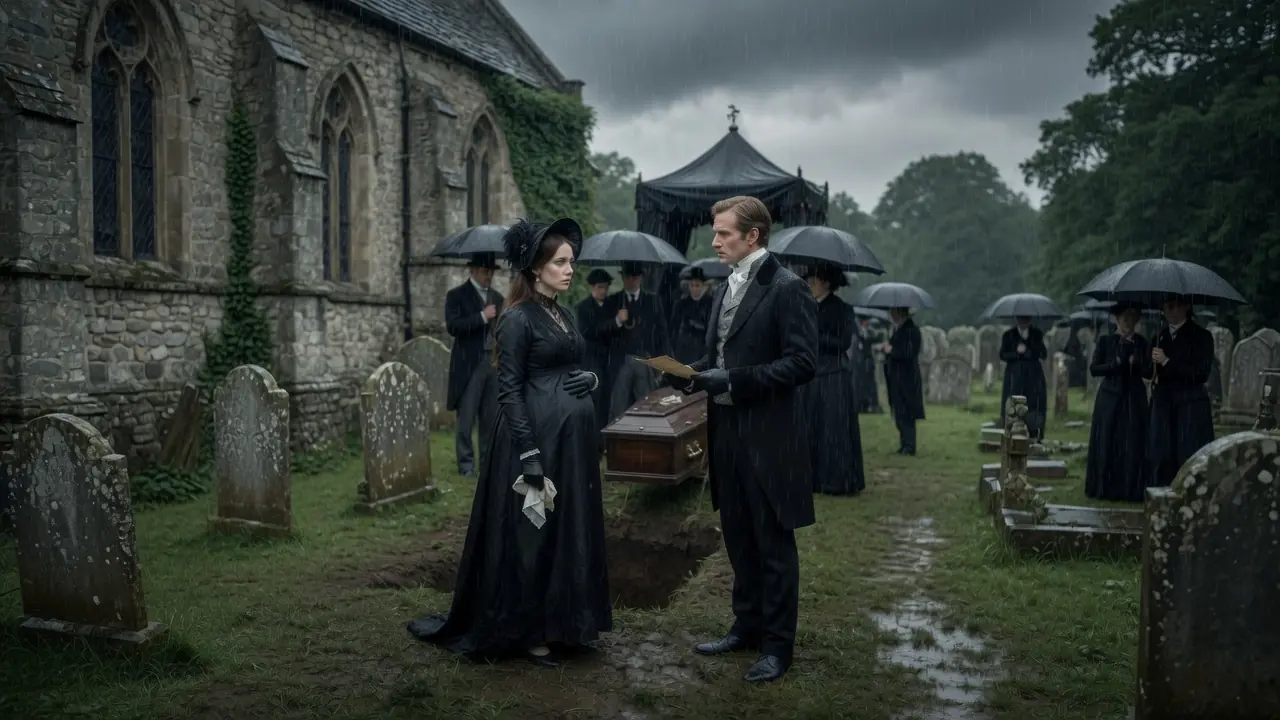
The rain fell on Isabelle Chen’s mother’s casket like accusations, each drop a reminder that some losses arrive in multiples. She stood at the graveside in a black dress that did not fit quite right anymore, though no one had noticed.
No one ever noticed Isabelle unless she was failing at something, especially not her husband.
Marcus stood three feet away from her, close enough to maintain appearances, but far enough that no one would mistake them for a couple in mourning together. His jaw was set in that familiar way that meant he had already made a decision and was simply waiting for the appropriate moment to announce it.
Isabelle had seen that expression before: when he decided to take the promotion that required moving away from her family, when he decided they should stop trying for children after the third miscarriage, and when he decided that separate bedrooms were more practical.
She knew what was coming even before the last mourner had left the cemetery.
Her mother’s funeral drew a small crowd. Margaret Chen had been a quiet woman who had lived a quiet life, the kind of person who left the world softly, like a candle burning down rather than being snuffed out.
The attendees were mostly neighbors from her mother’s apartment building and a few distant relatives who had made the trip out of obligation rather than grief. They offered Isabelle their condolences in hushed voices that all sounded the same, their hands briefly touching her shoulder before moving on to the refreshment table someone had set up under a black tent.
Marcus did not offer condolences.
He stood under his own umbrella and checked his phone with the kind of focused attention he used to give Isabelle in their first year of marriage.
Back when she thought she mattered to him.
Back when she still believed love could survive disappointment.
The funeral director was packing up his equipment when Marcus finally approached her.
Not to comfort her.
To inform her.
“We should talk,” he said.
And those three words carried the weight of an ending.
Isabelle looked at him. Really looked at him for the first time in months.
He was handsome still, in that sharp-featured way that photographed well. His suit was expensive, perfectly tailored, the kind of outfit that announced success before he even opened his mouth.
Everything about Marcus was calculated for effect, including, she realized now, the timing of this conversation.
“Now?” she asked, though she already knew the answer. “At my mother’s funeral?”
“It has been over for a long time, Isabelle. You know that.”
His voice was flat, businesslike, the same tone he used with vendors who had missed a deadline.
“I’ve been patient. I’ve given you space to grieve, but we can’t keep pretending this marriage is something it’s not.”
The rain was getting heavier. Around them, the few remaining mourners were hurrying to their cars, black umbrellas bobbing like crows taking flight.
The cemetery workers were waiting at a respectful distance, ready to fill in the grave once the family had left. They had done this a thousand times. They knew the rhythms of grief, the choreography of burial.
“You couldn’t wait one more day?”
Isabelle’s voice came out smaller than she intended.
“I’ve waited three years,” Marcus said.
And there was something almost like frustration in his tone, as though she had failed to understand a simple concept he had explained repeatedly.
“Three years since you stopped being the woman I married. Since you let yourself go, since you gave up on everything that mattered.”
The words hit her like physical blows, each one landing precisely where she was already bruised.
She wanted to argue, to defend herself, to point out that the miscarriages had broken something inside her that she did not know how to fix. That watching her mother slowly fade from Alzheimer’s over the past two years had drained whatever energy she had left.
That his constant criticism and growing distance had made her feel like she was disappearing even while she was still alive.
But she had learned that defending yourself to Marcus was like trying to convince a wall to move.
He had already decided who she was, and nothing she said would change his mind.
“I filed the papers,” he continued, reaching into his jacket pocket and pulling out a manila envelope that looked too ordinary to contain the end of a marriage. “Your copy is here. My lawyer will be in touch about the details, but it is straightforward. No children, no shared assets of significance. You can keep the apartment and whatever is left of your mother’s estate. I’m not interested in fighting over furniture.”
Isabelle took the envelope with numb fingers.
It was thin, surprisingly light.
Seven years of marriage reduced to a few sheets of paper that probably weighed less than her wedding invitation had.
“You planned this,” she said quietly.
“I’ve been planning this. I’ve been realistic,” Marcus corrected. “There’s a difference. You’re the one who has been living in denial, pretending we could recover from this. We can’t. We’re not compatible. We never were, really. I just didn’t see it until you stopped trying to be what I needed.”
There it was again.
That phrase.
What I needed.
As though her worth was measured entirely by her ability to meet his expectations.
“I’m pregnant,” Isabelle said.
The words came out before she had fully decided to say them.
They had been sitting in her chest for two weeks, ever since the doctor’s appointment she had gone to alone, expecting nothing.
After three miscarriages and two years of empty months, she had stopped hoping.
The positive test had felt like a cruel joke at first, another chance for her body to fail her.
But the follow-up appointment had confirmed it.
Eight weeks.
Strong heartbeat.
The doctor had used the word “viable” with careful optimism, as though afraid to jinx it by being too enthusiastic.
Isabelle had been waiting for the right moment to tell Marcus. She had been terrified, actually.
Terrified that he would not care. Terrified that he would care too much and she would miscarry again and disappoint him one final time.
Terrified that even a baby would not be enough to fix what was broken between them.
She had certainly never imagined telling him like this, at her mother’s graveside in the rain, while he handed her divorce papers.
Marcus’s expression did not change immediately. He stood there, processing the information with that same analytical look he got when reviewing quarterly reports.
Then, slowly, something flickered across his face.
Not joy.
Not even relief.
Something harder to name.
“How long have you known?”
His voice was careful now, controlled.
“Two weeks.”
“And you’re telling me now? At your mother’s funeral? Right after I’ve told you I want a divorce?”
He laughed, but it was a cold sound, empty of humor.
“That’s manipulative, Isabelle. Even for you.”
She felt the accusation like a slap.
“I’m not trying to manipulate you. I’m telling you because it’s true. I’m pregnant. Eight weeks. The doctor says everything looks good so far.”
“So far?” Marcus repeated the words like they proved his point. “After three miscarriages, you expect me to believe this one will be different? You expect me to put my life on hold, to stay in a dead marriage because maybe, possibly, you might actually carry a child to term this time?”
The cruelty of it took her breath away.
She had known Marcus could be cold, but this was something else.
This was active contempt.
The kind that comes from someone who spent years building a case against you in their mind and is now finally free to present all the evidence.
“I thought you wanted children,” she whispered. “You said you wanted a family.”
“I did. I do.”
Marcus’s jaw tightened.
“But not like this. Not with someone who is going to fall apart every time something goes wrong. Not with someone who can’t handle the pressure. You’ve proven over and over that you’re not strong enough for this.”
“I’m pregnant, Marcus. Right now, today. This isn’t theoretical.”
Isabelle’s hand moved instinctively to her stomach, a protective gesture she was not even aware of making.
“This is your child.”
“If it survives.”
The words hung in the rain-soaked air between them.
“If you don’t lose it like you lost the others. If you can actually do this one thing right.”
The funeral director approached them hesitantly, clearly uncomfortable, but needing to move things along.
“I’m sorry to interrupt, but we need to close up the gravesite. If you need more time—”
“We’re done here,” Marcus said firmly.
He looked at Isabelle one more time, his eyes flat and final.
“The papers are filed. The process has started. Whether you’re pregnant or not doesn’t change anything. We’re over.”
He walked away then, his footsteps steady on the wet grass.
His umbrella, a black circle, retreated toward the parking lot.
He did not look back.
Isabelle stood alone beside her mother’s grave, clutching the divorce papers in one hand and pressing the other against her stomach, where a tiny heartbeat was proving itself real for the eighth week in a row.
The cemetery workers were approaching with their equipment, ready to finish the job of burial.
She thought about her mother, who had spent the last two years of her life forgetting things in a specific order: names first, then faces, then the shape of her own history.
But even at the end, even when she could not remember Isabelle’s name, Margaret Chen had known the feeling of being loved.
She had responded to gentle touches, soft voices, the sensation of someone caring.
Marcus had never learned that language.
He had never understood that love was not about meeting expectations or maintaining standards.
He had treated their marriage like a business contract, and when Isabelle had failed to deliver the terms he had decided on, he had simply terminated the agreement.
The rain was soaking through her dress now, cold water running down her back and pooling in her shoes.
But Isabelle could not make herself move because leaving this gravesite meant driving home to an empty apartment where Marcus’s things would already be gone.
His closet cleared out.
His presence erased as efficiently as he had erased their relationship.
It meant facing the reality that she was pregnant and alone. It meant understanding that the father of her child had looked her in the eye on the worst day of her life and told her she was not worth staying for.
The funeral director touched her shoulder gently.
“Miss, we really do need to close up now. I’m sorry.”
Isabelle nodded, unable to speak.
She took one last look at her mother’s casket already being lowered into the earth and felt something crack open inside her chest.
Not her heart breaking.
That had happened so gradually over the past three years that she had barely noticed each small fracture.
This was something different.
This was the moment she realized she had lost two people today: her mother to death, her husband to indifference.
And the only person left was the one she had not even met yet.
The one whose heartbeat was the only proof she had that she was capable of creating something that could survive.
Five years had taught Isabelle Chen that survival looked nothing like she had imagined. It did not come with dramatic revelations or sudden strength.
It came in small, unglamorous moments.
Learning to assemble a crib alone at two in the morning. Figuring out how to negotiate a raise while visibly pregnant. Discovering that she could, in fact, handle pressure when there was no other choice.
Her son was named Daniel, and he had her dark hair and curious eyes that did not belong to Marcus at all.
She had been terrified throughout the entire pregnancy that she would see her ex-husband in every feature, that the baby would be a living reminder of rejection.
Instead, Daniel looked like himself.
Like possibility.
The divorce had been finalized before she had even started showing. Marcus had moved to Seattle for a corporate position and never asked about the pregnancy.
Not once.
She had given birth alone, except for her best friend Sarah, who had held her hand and told her to breathe and cried almost as hard as Isabelle did when Daniel finally arrived, healthy and screaming and real.
And Isabelle had sent Marcus one email after the birth.
No explanation. No plea for reconciliation.
Just a photo of Daniel and a single line.
He’s here. He’s healthy. I thought you should know.
Marcus had never responded.
Now Isabelle stood in the lobby of the Grandfield Hotel, smoothing down her navy dress and trying to remember how to breathe like a person who belonged in spaces this expensive.
She was here for a pharmaceutical conference where her company was presenting research she had helped develop.
Five years ago, she had been a junior researcher, barely holding on to her position. Now she was leading projects, publishing papers, being invited to speak.
She had built this life from nothing.
From grief and rejection.
And those terrible months after Daniel was born, when she had been so exhausted she would sometimes forget to eat.
She had built it anyway.
The conference hall was already filling with people in business attire, name badges glinting under crystal chandeliers.
Isabelle found her company’s booth and began setting up the display materials, arranging brochures with hands that had learned to stop shaking years ago.
“Isabelle Chen.”
The voice made her freeze.
She knew that voice. It had told her she was not strong enough. It had handed her divorce papers at her mother’s grave.
It had walked away without looking back.
She turned slowly.
Marcus looked older. Not dramatically so, but enough that she could see the years in the lines around his eyes, the slight gray threading through his hair.
He was still handsome in that calculated way, still wearing suits that announced success.
But something about him looked diminished somehow, as though the confidence he had carried had developed hairline fractures.
“Marcus,” she said.
Her voice came out steady.
That surprised her.
“I didn’t know you would be here.”
He was staring at her like she was a ghost, or maybe a puzzle he could not solve.
“You’re with Morrison Pharmaceuticals now?”
“For three years. I’m lead researcher on the cardiovascular project.”
“Lead researcher,” he repeated, like he was testing the words for truth. “That’s impressive. You’ve done well.”
The compliment felt like an insult somehow, carrying the implication that her success was unexpected, that she had exceeded his low expectations.
“What are you doing here?” Isabelle asked, though she could already see his conference badge.
“Director of Operations, Vertex Medical Solutions. Presenting on supply chain innovations. We’re partnering with Morrison on distribution for the new trials.”
Marcus shifted his weight, a gesture of discomfort she had never seen from him before.
“I saw your name on the presenter list. I almost didn’t believe it.”
“Why wouldn’t you believe it?”
He had the grace to look uncomfortable.
“I just meant it’s a small world. I didn’t expect to run into you.”
The silence between them stretched awkward and thin. Around them, the conference crowd was growing louder.
People greeting colleagues and examining displays.
Normal professional sounds.
But nothing about this moment felt normal.
“How have you been?” Marcus asked finally.
Isabelle almost laughed at the absurdity of the question.
“I’ve been raising our son,” she said quietly. “Alone.”
The words landed like a door slamming.
Marcus’s face went carefully blank, that mask he wore when processing information he did not like.
“You actually had the baby.”
“His name is Daniel. He’s four years old. He starts kindergarten next fall.”
Marcus opened his mouth, closed it, opened it again.
For maybe the first time since she had known him, he looked genuinely at a loss for words.
“I sent you a photo when he was born,” Isabelle continued.
Her voice was still steady, still calm, which felt like its own kind of victory.
“You never responded.”
“I thought you were trying to manipulate me. To guilt me into coming back.”
“I was trying to tell you that you had a son.”
The anger surprised her, rising up after years of being carefully buried.
“A healthy son. The heir you always wanted. The family you said you needed. And you couldn’t even send a single message acknowledging his existence.”
“I didn’t think—”
Marcus stopped, ran a hand through his hair.
“After the miscarriages, I assumed.”
“You assumed I would fail again.”
Isabelle felt five years of silence breaking open inside her.
“You assumed I was too weak, too broken, too much of a disappointment to actually carry a pregnancy to term. You walked away from your own child based on an assumption.”
“That’s not fair, Isabelle.”
“Fair.”
The word came out sharp enough that a few nearby conference attendees glanced over.
Isabelle lowered her voice.
“You divorced me at my mother’s funeral. You told me I wasn’t worth staying for. You called me manipulative for telling you I was pregnant. And now you want to talk about fair.”
Marcus’s jaw tightened.
That old, familiar gesture of decision-making.
“I made the choice I thought was right at the time. The marriage was over. A baby wouldn’t have fixed that.”
“I never asked you to fix anything. I just told you the truth. And you chose to walk away from your own flesh and blood because you had already decided I was a failure.”
“Where is he?” Marcus asked suddenly.
“Daniel?”
“Where is he now?”
“With my friend Sarah. Why?”
“I want to meet him.”
Isabelle stared at her ex-husband, this man who had once told her she was not strong enough for motherhood, and felt something shift inside her chest.
Not forgiveness.
Not even close.
But a kind of clarity she had been missing.
“No,” she said simply.
Marcus blinked.
“What?”
“No. You don’t get to meet him. Not like this. Not because you ran into me at a conference and suddenly remembered you have a son.”
“I have rights.”
“You have nothing,” Isabelle interrupted, and her voice was ice. “You signed away any claim to rights when you divorced me while I was eight weeks pregnant. You never asked about him. Never sent support. Never acknowledged his existence. You have no legal claim and no moral standing.”
“He’s my son.”
“Biologically, yes. In every other way that matters, no. He has never asked about you. He doesn’t know your name. He has a life full of people who actually showed up for him. You’re not part of that life, and you don’t get to be just because it is suddenly convenient.”
Marcus’s face was reddening now.
That old frustration returning.
“You can’t keep a child from his father.”
“I’m not keeping him from anyone. You kept yourself from him for five years when you chose your pride over your family. When you decided I wasn’t worth the inconvenience of uncertainty.”
Isabelle picked up her briefcase, suddenly done with this conversation, done with giving Marcus any more of her energy.
“I have a presentation to prepare for. If you want to discuss Daniel’s future, you can contact my lawyer. Otherwise, I have nothing more to say to you.”
She walked away before he could respond, her heels clicking against marble floors, her heart hammering against her ribs.
She made it to the women’s restroom before her hands started shaking, before the reality of what had just happened hit her fully.
Marcus wanted to meet Daniel.
After five years of silence, of absence, of pretending his son did not exist, he suddenly wanted in.
And Isabelle had said no.
She looked at herself in the restroom mirror, this woman in the navy dress with her makeup intact and her posture straight.
She barely recognized herself.
Five years ago, she would have crumbled under Marcus’s certainty, would have second-guessed herself, would have wondered if she was being unfair.
But that woman had died at her mother’s grave.
The woman looking back at her now had built something real from nothing.
She had raised a beautiful, curious, gentle boy who knew he was loved without condition.
She had created a career and a life that belonged entirely to her.
Marcus could walk into conference halls and expect doors to open.
But he could not walk back into Daniel’s life without earning it.
And earning it would require him to become someone he had never been.
Someone who understood that love was not about meeting expectations.
Someone who knew that strength looked like showing up even when things were hard.
Someone who could see worth in imperfect, messy, real human connection.
Isabelle fixed her lipstick, squared her shoulders, and walked back into the conference hall to give her presentation on breakthrough cardiovascular research.
Marcus was nowhere to be seen.
Three months after the conference, Isabelle received a letter from a law firm she did not recognize.
Her first instinct was panic, the kind that comes from years of bracing for the next crisis.
She opened it standing in her kitchen while Daniel ate cereal at the table, his legs swinging and his face smeared with milk.
The letter was not what she expected.
Marcus had retained a family lawyer, not to fight for custody, as she had feared, but to establish a trust fund for Daniel.
A substantial one.
The letter outlined the terms in careful legal language, but the essence was simple.
Marcus wanted to provide financial support. He was not asking for visitation rights.
He was not demanding anything.
He was just offering money.
Isabelle read the letter three times, trying to find the trap.
There had to be a trap.
Marcus did not do anything without calculating the return on investment, but the terms were straightforward.
Monthly payments deposited into a trust Daniel could access at eighteen. No strings. No requirements. No contact necessary.
It felt wrong somehow, like Marcus was trying to buy absolution with a checkbook.
She called the lawyer that afternoon after dropping Daniel at preschool.
“Mrs. Chen, thank you for reaching out,” the lawyer said, his voice professionally warm. “I assume you have questions about the trust arrangement.”
“I have one question,” Isabelle said. “Why now? Why is he doing this now?”
There was a pause.
“I can’t speak to my client’s motivations beyond what he’s authorized me to share, but Mr. Whitmore did mention that seeing you at the conference made him realize he had made certain errors in judgment. He wants to correct what he can.”
“Money doesn’t correct abandonment.”
“No,” the lawyer agreed quietly. “It doesn’t. But it is what he’s offering.”
Isabelle spent a week thinking about it.
She discussed it with Sarah over wine after Daniel was asleep. She lay awake at night running scenarios, trying to predict consequences, trying to decide what Daniel deserved.
In the end, she accepted the trust.
Not because she forgave Marcus, but because Daniel’s future should not be limited by his father’s past failures.
The money would pay for college, for opportunities, for choices.
She would make sure Daniel understood where it came from and what it meant.
That his father had provided financially, but not emotionally.
That money was the easiest thing to give when you could not give yourself.
She drafted a response through the lawyer.
Professional. Brief.
Accepting the terms and establishing clear boundaries.
No contact. No visits.
Financial support only.
She thought that would be the end of it.
She was wrong.
The second letter arrived six weeks later.
This one was not from the lawyer.
It was handwritten.
Marcus’s familiar angular script filled two pages of expensive stationery.
Isabelle almost threw it away without reading it, but curiosity won the way it always did.
The letter started with an apology.
Not the kind Marcus used to give when they were married.
Those perfunctory, “I’m sorry you feel that way” non-apologies that shifted blame while pretending to accept it.
This one was different.
Specific.
Detailed.
He apologized for divorcing her at her mother’s funeral, for calling her manipulative when she had told him about the pregnancy, for walking away without ever asking if she was okay, for assuming she would fail, for never responding to the photo of Daniel, for five years of silence.
He did not make excuses.
He did not try to explain it away.
He just acknowledged that he had been cruel when she needed compassion and absent when she needed support.
The second page was harder to read.
Marcus wrote about his life in Seattle, the promotions he had achieved, the success he had built, the complete, unechoing emptiness of coming home to an expensive apartment where no one waited for him.
He had dated, but nothing stuck.
Work had filled the void for a while, but lately even that satisfaction felt hollow.
Seeing Isabelle at the conference had shattered something, he wrote.
She had looked confident, accomplished, at peace.
Everything he had told himself she could never be without him.
And learning about Daniel, seeing the evidence of her strength, had forced him to confront a truth he had been avoiding for five years.
He had been wrong about everything.
Wrong about Isabelle.
Wrong about what mattered.
Wrong about what made a life worth living.
He was not asking for forgiveness, he wrote. He knew he did not deserve it.
He was not asking to be part of Daniel’s life because he understood he had forfeited that right.
He just wanted Isabelle to know that she had been right all along.
About love. About family. About what it meant to be strong.
And he was sorry it had taken him five years and her obvious success to finally see it.
Isabelle cried reading that letter, not because it changed anything, but because it confirmed what she had already known.
Marcus had been capable of growth all along.
He just needed to lose everything first.
She did not respond to the letter.
There was nothing to say that would not sound like either forgiveness or condemnation, and she felt neither.
She felt something more complicated, a kind of sad acknowledgement that people could learn the right lessons at the wrong time.
But life had a way of complicating clean endings.
Four months after the second letter, Isabelle’s company announced a major partnership with Vertex Medical Solutions, Marcus’s company.
The collaboration would require regular meetings, joint presentations, coordinated research.
They would be working together whether they wanted to or not.
The first meeting was scheduled for a Tuesday in November.
Isabelle walked into the conference room at Morrison’s headquarters with her research team, her presentation materials, her professional armor fully in place.
Marcus was already there, sitting across the table with his team.
His eyes met hers briefly, and she saw something new in them.
Uncertainty, maybe even fear.
Good, she thought.
He should be uncertain.
The meeting was professional, focused, productive.
They discussed timelines and protocols and resource allocation.
Marcus contributed insights without grandstanding. He addressed Isabelle’s points with respect and never talked over her, never dismissed her expertise.
It was strange seeing him like this, collaborative instead of combative.
Afterward, as the teams were packing up, Marcus approached her carefully, maintaining appropriate distance.
“That went well,” he said. “Your research is impressive.”
“Thank you.”
Isabelle kept her tone neutral.
“I know this is awkward, working together. I want you to know I’ll keep everything professional. I won’t make this difficult for you.”
“I appreciate that.”
Marcus hesitated, then said quietly, “I got your acceptance of the trust terms. Thank you for letting me do at least that much.”
“It’s not for you. It’s for Daniel.”
“I know.”
He looked like he wanted to say more, but Sarah was approaching with a question about the next meeting.
And the moment passed.
Over the following months, Isabelle and Marcus fell into a rhythm.
Professional emails. Efficient meetings. Collaborative problem solving.
He never pushed for personal conversation, never asked about Daniel beyond ensuring the trust payments were processing correctly.
He never tried to leverage their work relationship into something more.
It was almost disappointing how well he respected her boundaries.
Then came the breakthrough.
Isabelle’s research team made a discovery that could revolutionize treatment for a specific type of heart condition.
It was the kind of finding that made careers, that saved lives, that rewrote medical textbooks.
The data was solid.
The implications were enormous.
But bringing it to market would require resources Morrison did not have alone.
It would require partnership, funding, clinical trials on a scale that demanded collaboration.
And it would require trusting Marcus’s company with her life’s work.
The decision kept Isabelle awake for nights.
This research was hers, her team’s, the culmination of everything she had built from the ashes of her divorce.
Sharing it with Vertex meant sharing it with Marcus.
Trusting him with something that mattered.
She called a meeting.
Just the two of them.
No teams. No witnesses.
She needed to see his face when she asked the question that mattered.
They met at a coffee shop halfway between their offices.
Neutral ground.
Marcus arrived exactly on time, looking nervous in a way she had never seen before.
“I have a proposal,” Isabelle said after they had ordered and settled into a corner booth, “about the cardiovascular research. But I need to know something first.”
“Anything.”
“Why did you really set up Daniel’s trust? The truth, not the lawyer’s version.”
Marcus was quiet for a long moment, staring into his coffee like it held answers.
“Because I saw what you built without me. And I realized that the strong person in our marriage was never me. It was always you. You survived everything I put you through and became someone remarkable. I wanted to contribute something to that, even if it was just money. Even if I didn’t deserve to.”
“And the letter?”
“The apology? I meant every word.”
He looked up at her then, and his eyes were raw with something that looked like genuine regret.
“I was arrogant, Isabelle. I thought strength meant never bending, never showing vulnerability, never admitting mistakes. You taught me that real strength is showing up anyway, loving anyway, trying anyway, even when you might fail.”
“You learned that lesson five years too late.”
“I know.”
Marcus’s voice was barely above a whisper.
“I know I can’t fix what I broke. But I want you to know that meeting Daniel isn’t something I expect. It’s something I know I haven’t earned. Maybe I never will. But if there’s ever a time when you think he might benefit from knowing where he came from, I’ll be ready. Not because I deserve it, because he might need it someday.”
Isabelle felt something shift in her chest.
Not forgiveness exactly, but something close to it.
Understanding, maybe.
Recognition that people could be terribly wrong and genuinely sorry simultaneously.
“The research,” she said, steering back to safer ground. “I need a partner to bring it to market. Someone who can handle the logistics I can’t. It is going to save lives, Marcus. Real people who are dying from conditions we can now treat. But I need to trust that you will respect my work, that you won’t try to take credit or push me out once it becomes profitable.”
“You have my word,” he said. “And I’ll put it in writing, whatever terms make you comfortable. This is your discovery, your legacy. I would be honored to help bring it to the world, but only as a partner. Never as someone trying to diminish what you’ve accomplished.”
They worked out the details over the next several weeks.
Contracts that protected Isabelle’s intellectual property.
Agreements that kept her as lead researcher with final say over all decisions.
Marcus kept every promise, respected every boundary, proved himself trustworthy in ways that mattered.
The clinical trials launched the following spring.
The results were even better than they had hoped.
Lives were saved.
Treatments improved.
Isabelle’s name appeared in journals and medical conferences. She was offered positions at prestigious institutions. Her research team expanded.
And through it all, Marcus remained exactly where she had asked him to be.
A professional colleague.
A reliable partner.
Someone who had learned too late, but was learning anyway.
Two years after the conference encounter, Isabelle stood in her kitchen making dinner while Daniel worked on homework at the table.
He was seven now, losing teeth and asking impossible questions about how the world worked.
He looked up from his math worksheet with those curious eyes that saw everything.
“Mom, do I have a dad?”
Isabelle’s hand stilled on the cutting board.
They had had versions of this conversation before, but something about the directness of it tonight felt different.
More important.
“Yes,” she said carefully. “You do.”
“Where is he?”
“He lives in Seattle. He works with Mommy sometimes on research projects.”
Daniel processed this with the seriousness he brought to everything.
“Does he know about me?”
“Yes, sweetheart. He knows about you.”
“Does he want to meet me?”
Isabelle sat down beside her son, choosing her words with the care they deserved.
“It’s complicated, Daniel. Your father made some mistakes when you were born. He wasn’t ready to be a dad, but he is trying to do better now. He helps make sure you have money for college and things you need. And if you ever want to meet him, when you’re ready, we can talk about that.”
“Do you hate him?”
The question surprised her.
“No, I don’t hate him. I’m not married to him anymore, and he hurt my feelings a long time ago, but people can make mistakes and still be good at other things. Your father is very smart. He helps sick people get medicine. He just wasn’t good at being a husband or a dad.”
Daniel nodded, already moving back to his math problems with the resilience of childhood.
The conversation was over as quickly as it had started.
But Isabelle sat there a moment longer, realizing something important.
She had told Daniel the truth without bitterness. She had acknowledged Marcus’s failures without poisoning their son against him.
She had left space for possibility without forcing anything.
That night, she sent Marcus an email, simple, professional, but with a personal note at the end.
Daniel asked about you today. I told him the truth, that you made mistakes but you are trying to do better. That someday, if he wants to, he can decide whether to meet you. I thought you should know. Not because you have earned it, but because he deserves to know his options.
Marcus responded the next morning.
Thank you for that. For being fair when you did not have to be. For raising him to be curious and kind. For being the parent I should have been. If the day ever comes when he wants to meet me, I will be ready. And if it does not, I will understand that, too. You have given me more grace than I deserve.
Isabelle read the email twice, then archived it and went back to her research.
The happy ending, she realized, was not reconciliation or forgiveness or Marcus suddenly becoming the father Daniel deserved.
The happy ending was this.
She had built a life that did not need Marcus to be complete.
She had raised a son who was loved and secure and curious about the world.
She had created work that mattered and helped people and made her proud.
Marcus’s regret was his own burden to carry.
His relationship with Daniel would be whatever Daniel decided it should be when he was old enough to make that choice.
And Isabelle was free.
Free from bitterness.
Free from waiting for apologies that could not change the past.
Free from needing Marcus to acknowledge her worth before she could believe in it herself.
She had found her happy ending not in someone else’s redemption, but in her own strength.
That was enough.
More than enough.
It was everything.