"Do as I said, or you can quit."
Harper Vance did not raise her voice. She did not need to. The control room went silent, forty engineers frozen mid-motion, machines humming behind them like an audience holding its breath. Emmett Hargrove looked at her for a long moment, said nothing, then closed his laptop.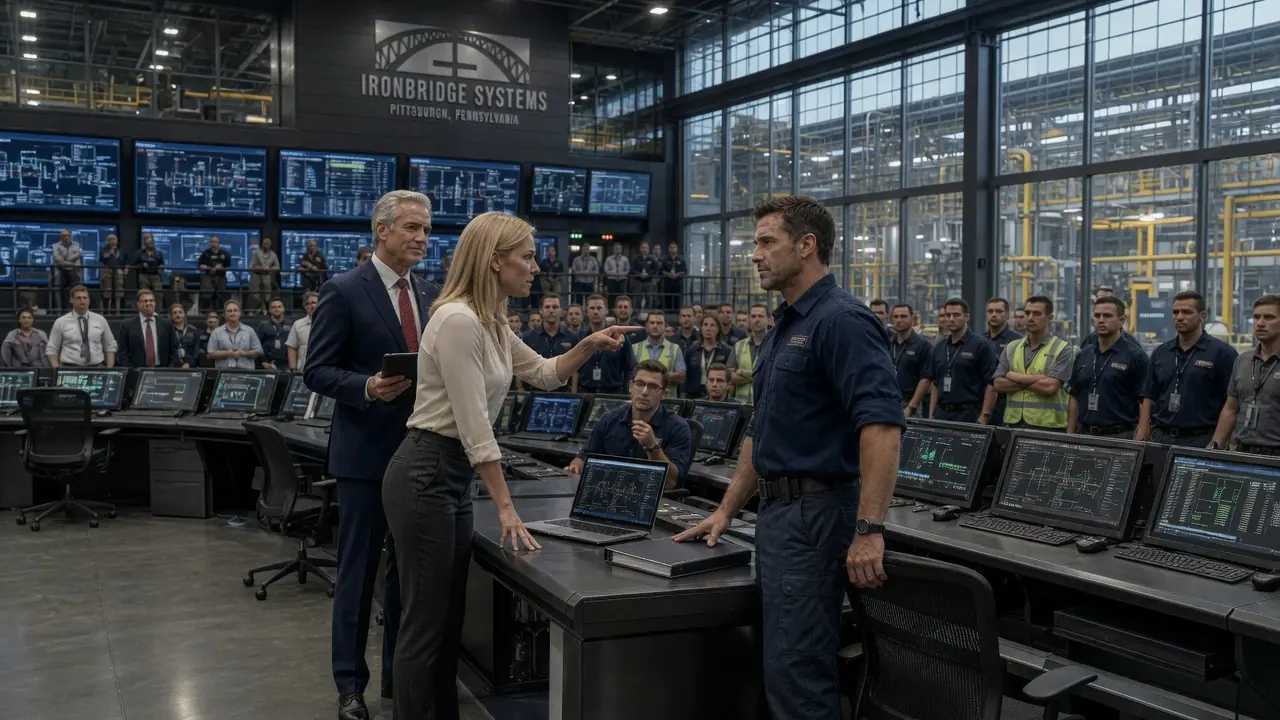
He did not argue. He picked up the black folder beside his keyboard and stood, the chair rolling back an inch on its own. Nobody moved to stop him. Nobody understood yet what he was actually carrying out the door.
Two weeks earlier, Pittsburgh had not yet turned cold enough for Emmett Hargrove to wear the jacket that still hung unworn by his front door. It had belonged to his wife, a habit rather than a garment, kept because Georgia liked to see it there when she left for school. He made oatmeal at six every morning, packed her lunch in the same blue box, checked her backpack for the folder that needed signing, and drove eleven minutes to Ironbridge Systems, where his badge read Senior Maintenance Technician and nobody asked what that title used to mean.
Georgia was eight, sharp in the way children get when they have learned early that adults can disappear without warning. She did not remember her mother. Not really. Only a smell of lavender soap and a photograph Emmett kept on the refrigerator, curling slightly at one corner from three years of steam. He never told her more than she asked. She never asked much.
That was the arrangement they had built together. Quiet and workable, like most of what Emmett built. The house itself told the same story: a workbench in the garage with every tool hung in its outline, a calendar on the kitchen wall with Georgia's soccer practices circled in blue marker, nothing else on it. He had learned the hard way that a life could be run on very little if a person was willing to do the same small things at the same small times every day without asking whether that was enough.
At Ironbridge, the arrangement was different. Harper Vance had inherited the company nine months earlier after her father, Walter Vance, collapsed at his desk on a Tuesday afternoon and never woke up. She had spent those nine months in rooms full of men who had known her father longer than they had known her, nodding at things she was expected to already understand, learning to read a balance sheet the way other people learn a second language, late at night, badly alone.
Sterling Reed Holdings wanted to acquire Ironbridge's control systems division, and the acquisition came with a deadline: full migration of the plant safety architecture within ten days, verified and signed off before the buyer's technical team arrived to inspect it. The number ten had followed Harper into three consecutive nights of sleep that never quite arrived.
Two board members had already suggested gently, in the careful language people use when they mean something less gentle, that perhaps the company needed someone with more experience steering it through a transaction this size. Harper had smiled through both conversations, then gone home afterward and sat in her car in the driveway for eleven minutes before going inside. Not crying, just sitting, letting the engine tick as it cooled.
She had grown up watching her father run this company on instinct and stubbornness in roughly equal measure, and she had assumed, wrongly, that some version of that instinct would simply arrive once the title did. It had not arrived yet. She was beginning to suspect it worked differently than that.
Bennett Cross, the company's chief operating officer, had built the timeline himself. He walked Harper through it in a conference room with a view of the river, tapping a laser pointer against slides that promised efficiency, growth, and a future Ironbridge could not otherwise afford.
He had known her father for twenty-two years. He said her name the way people say the names of children they used to babysit, familiar and faintly condescending, and Harper let him because it was easier than fighting a tone nobody else in the room seemed to notice.
What he did not put on any slide was the clause in his own contract, the one that activated a payout and a seat on Sterling Reed's executive board the day the deal closed on schedule. He had negotiated it eight months earlier, quietly, through a lawyer who did not share an office with Ironbridge's counsel.
Emmett had read the migration plan twice before he said anything. Then he walked into Bennett's office unannounced and told him without heat that ten days was not enough time to test a safety interlock system that controlled pressure valves for the entire east wing.
Bennett told him the schedule was not up for discussion. Emmett said it would be eventually, one way or another, and left before the conversation could turn into something neither of them could walk back.
She asked Bennett about him afterward, mildly, in the elevator.
Bennett waved a hand. "Hargrove's been here longer than the carpet," he said. "Good with valves. Not much for the bigger picture."
Harper filed the description away without quite believing it, the way she had learned to file away most things Bennett told her in passing.
The meeting where it happened was supposed to be routine, a project status review with the operations team crowded into the control room because the main conference room was already booked for something with the buyer's attorneys. Bennett presented the revised, faster timeline as though it were already settled, as though the room's presence was a formality.
Emmett, standing near the back with his arms crossed, said it was not safe. Bennett said safety was not his department's concern this quarter, and somebody near the front laughed uncomfortably and stopped.
Harper had not planned to say anything. She had spent the morning on the phone with Sterling Reed's counsel, listening to a voice explain patiently the penalties written into the agreement for any delay past the agreed date, and the deadline felt less like a number by then and more like a hand around her throat.
When Emmett said again, calmly, that he would not certify a system he had not tested properly, something in her broke loose that had nothing to do with him and everything to do with the last nine months.
That was when she said it.
"Do as I said, or you can quit."
She watched something shift behind his eyes. Not anger. Something closer to disappointment. And she almost took it back. Almost.
Then Bennett said, low enough for only her to hear, "We don't have time for hurt feelings, Harper."
She let the moment pass instead of correcting it, and would think about that choice specifically more than any other decision she made that month.
Emmett closed his laptop, picked up his folder, and walked out. He did not slam the door. He did not raise his voice on the way. The room stayed quiet for eleven full seconds after he left, which felt, to everyone standing in it, considerably longer.
What she did not know, what almost nobody in that room knew except the one person standing very still near the door with her arms full of folders, was that Emmett had written the original interlock code himself seventeen years earlier, sitting across a drafting table from a much younger, much less certain man named Walter Vance, who had hired him straight out of a training program and never once in seventeen years told his daughter the name of the engineer who designed half the system she now owned.
Adele Whitlock, Ironbridge's director of human resources, had been in that room the whole time. She watched Emmett's jaw tighten at the sound of Walter's name in his own mouth, an accident of frustration more than a confession. And she watched Harper's expression change, too, the way a person's face changes when a fact rearranges the furniture of everything they thought they understood.
Emmett had not meant to say it. It slipped out sideways, defending the code instead of himself.
"I built that interlock system with your father back when this building still had a coal furnace in the basement," he said, and immediately looked as though he wished he had not.
He did not elaborate. He did not need to. Walter Vance had been dead nine months, and hearing his name spoken with that kind of familiarity in that voice, in that room, hit Harper somewhere she had not guarded.
Adele set the folders down very carefully on the nearest desk, the way a person sets something down when their hands have started to shake slightly and they do not want anyone to notice. There was a document sitting in a locked drawer in her office, dated fourteen years back, with Walter's signature on it and a confidentiality clause wrapped around it tighter than anything else in the building. She had read it exactly once the week she was hired and never again because she had promised she would not need to.
Harper asked Emmett to repeat what he had said. He did not. He picked his folder back up, said the interlock system needed nine more days of testing minimum, and walked out before Bennett could turn the meeting into a referendum on his attitude.
Harper stood there a moment longer than she meant to, staring at the space where he had been standing, aware that Adele was watching her instead of the door.
Later that day, when the meeting had scattered and the room had emptied, Harper found Adele still in the hallway.
"Do you know something about him?" she asked.
Adele held her gaze for a second too long before answering.
"I know he's not who Bennett thinks he is," she said, and then excused herself before Harper could ask what that meant.
That evening, in an office three floors above the one where Bennett kept his laser pointer and his revised slides, Bennett Cross closed his door and made a call that would not appear on any Ironbridge phone log. Sterling Reed's lead negotiator answered on the second ring. Bennett confirmed the ten-day timeline was still holding, confirmed his own executive placement was still contingent on it, and hung up before either of them said anything that could later be quoted back to him in a deposition neither man yet imagined would exist.
He did not mention Emmett Hargrove by name. He had already decided the man was a problem he would solve without needing anyone's permission, least of all Harper's.
The next morning, a memo arrived in Emmett's inbox signed by Bennett, reducing the testing window to five days and instructing all safety signoffs to route through Bennett's office directly instead of the standard chain that had existed since before either of them worked there.
Emmett read it twice at his kitchen table while Georgia ate cereal across from him, humming something from a cartoon he did not recognize, swinging her feet under the chair because they did not reach the floor yet. He did not say anything to her about it. He never brought Ironbridge home if he could help it.
At work, he replied to the memo with four words.
Testing continues as scheduled.
He copied nobody.
He knew the moment he sent it that this was the kind of small refusal that eventually stops being small. The kind that either gets forgotten or gets remembered at exactly the wrong time.
Harper found the exchange forwarded to her inbox by Bennett with a note attached.
This is the insubordination I mentioned.
She read Emmett's four words three times. They did not read like insubordination to her. They read like a man standing exactly where he had said he would stand and refusing to be talked into standing anywhere else.
She almost walked down to the control room floor to talk to him directly. She got as far as the elevator before Bennett caught her in the hallway with two board members trailing behind him, already talking about quarterly projections, and the moment closed over like water closing over a stone.
That night, Emmett stayed late running diagnostics nobody had asked him to run, checking valve responses against decade-old baseline data because the new schedule did not allow for a second look, and he intended to give it one anyway. Alone, on his own time, with the plant floor lights dimmed to half and the hum of machinery the only company he had.
Harper stayed late, too, two floors up, staring at a spreadsheet Bennett had built to justify the accelerated timeline and finding, for the first time, a column of numbers that did not add up the way they should have. She did not know what she was looking at yet. She only knew it made her uneasy in a way the deadline itself had not. The particular unease of noticing a door left slightly open in a house she had thought was locked.
Georgia's school held a Friday assembly that week, the kind with construction paper decorations and a stage too small for the choir crowded onto it, risers creaking under twenty pairs of restless feet. Emmett sat in a folding chair near the back, phone silenced, watching his daughter mouth the words to a song about kindness. She had been practicing in the shower for a month, off-key and completely unbothered by it.
Afterward, she handed him a drawing she had made in art class of their house with three stick figures standing in front of it. One of them was wearing a triangle skirt that Georgia explained very seriously was supposed to be her mother, even though she had never seen her wear one, only imagined it from the photograph on the refrigerator.
Emmett folded it carefully into his jacket pocket. He did not cry in front of her. He waited until she had fallen asleep in the back seat on the drive home, street lights sliding across her face in slow orange bands, and then he let himself feel the whole week for about ninety seconds before he put it away again. The way he put most things away, folded small enough to carry without anyone noticing the weight.
Back at Ironbridge, Harper had asked one of the finance analysts quietly after hours to pull the full Sterling Reed contract package, not just the summary Bennett had circulated to the board. The analyst hesitated before agreeing, glancing toward Bennett's office door as though it might hear them through two floors and a hallway.
Harper did not ask why he hesitated. She already suspected the answer.
The next Tuesday, standing at the east wing control panel and running a pressure test Bennett had not authorized, Emmett found a fault in the secondary shutoff valve that the accelerated schedule would have missed entirely. It was small, the kind of flaw that sits quietly for months until it is not small anymore. A hairline stress fracture in a housing seal that had another eighteen months of rated life left in it under normal load, and considerably less under the load Bennett's new schedule would put on it.
He documented it, photographed it from three angles, and sent the report through the standard safety channel instead of Bennett's office, exactly as the old protocol required and exactly as the new memo forbade.
Harper received a copy because the old protocol still served her by default, and nobody had thought to change that yet. She read it standing in her kitchen at eleven at night, coffee gone cold beside her laptop, the report's clinical language doing nothing to soften what it actually described.
She understood finally what the four words had meant.
Testing continues as scheduled.
He had not been defying her. He had been protecting something she had not known was at risk. Something with her father's fingerprints all over it, whether she recognized them yet or not.
She thought about walking it down to Bennett's office herself the next morning. She thought about a lot of things that week that she did not end up doing, and lay awake longer than usual, wondering why that had become such a habit lately.
Georgia had a loose tooth that week, and she spent most of dinner working it back and forth with her tongue, narrating the process in careful detail while Emmett tried to eat around her commentary. He told her not to force it. She told him she was not forcing it, she was helping it along, which was different, and he let the distinction stand because arguing with an eight-year-old about dental philosophy felt like the one fight he could afford to lose that week.
Later, after she had gone to bed, he sat at the kitchen table with the fault report open on his laptop, reading it again as though a fourth pass might reveal something the first three had not, and found nothing new. Only the same small crack in the same seal, patient and unimpressed by how much noise it was about to cause.
Bennett heard about the fault report before Harper had finished her coffee the next morning. He called it a stunt over breakfast with two board members, told them Emmett Hargrove was manufacturing delays out of some grudge nobody could name, painting a picture of a disgruntled technician settling old scores on the company's dime.
By the time Harper arrived at the office, the narrative had already taken a shape she had not chosen and could not easily unmake.
She pulled Emmett into a private meeting that afternoon, the two of them alone for the first time since the control room, the door closed against a floor full of people pretending not to watch through the glass. She asked him plainly if the fault was real. He said yes. She asked if it could wait nine more days. He said no, not safely. Not with the load the new schedule would put on it.
She asked why he had not just done what she had told him to do, why he had chosen the memo she hated writing over the order she had actually given.
He looked at her for a long moment before answering, the kind of look that made her feel briefly like the only other person in the building.
"Because you would have had to live with what happened if I did," he said, "and I don't think you would have forgiven either of us for it."
Nothing about the sentence was warm. It was not meant to be. But it stayed with her longer than anything Bennett had said in nine months of board meetings, longer than any spreadsheet or slide or promise about the future Sterling Reed was supposed to buy them, and she left that conversation without having decided anything, which felt at the time like its own kind of decision.
Bennett moved faster than either of them expected. By Thursday, a written violation notice sat on Harper's desk, alleging that Emmett had deliberately delayed a shipment verification the week before, costing the company an amount large enough to trigger automatic termination review under company policy.
Harper read it twice. The numbers were precise. The dates exact. Everything arranged to look unimpeachable, built by someone who understood exactly how much scrutiny a document needed to survive and had given it precisely that much and no more.
She almost caught it, almost noticed that the delay in question had happened on a day Emmett was documented by his own safety report timestamp running the diagnostic Bennett himself had originally requested before the schedule changed. But the board meeting was in twenty minutes, and Bennett was already standing in her doorway telling her the vote on Sterling Reed depended on showing the buyer's team that Ironbridge could enforce its own standards. Any hesitation now would read as weakness to people already nervous about the deal.
She signed the termination that afternoon, the pen moving faster than her better judgment. She did not let herself think about it as she did, the way a person avoids looking directly at something too bright.
Word traveled through the building before Emmett's supervisor even called him upstairs. By the time he reached the office, half the floor already knew, watching him from behind monitors they pretended to be working at, conversations dying as he passed.
He listened to the explanation without interrupting. He collected the folder he had been carrying all week, the one with Georgia's drawing still tucked inside it, and walked out through the same doors he had walked out of two weeks earlier.
Except this time, nobody expected him back, and the silence that followed him out was heavier than the first one had been.
Harper watched from the glass-walled office above, the same view Bennett liked so much, and said nothing to stop him. She told herself it was out of her hands now, that the process had simply run its course the way processes were supposed to. She did not entirely believe it, and stood at the window longer than the moment required, watching the parking lot until his truck pulled out and disappeared past the gate.
Adele had joined Ironbridge fourteen years earlier as a junior personnel coordinator, hired by Walter Vance himself in an interview that had lasted eleven minutes and consisted mostly of him asking whether she could keep a secret without needing to know why.
She had said yes, mostly because she needed the job, and had spent the next fourteen years discovering that Walter meant it literally. The folder he handed her that first month was meant to sit in a drawer indefinitely, unopened, unmentioned, a small locked weight she carried through every promotion and reorganization the company went through without him.
She had never once regretted agreeing to it. She had more than once wondered what would happen the day it finally mattered.
That evening, three floors above the empty control room, Adele Whitlock's phone rang. The number belonged to a law firm in Philadelphia she recognized immediately because she had spoken to them exactly once, fourteen years earlier, when Walter Vance had them draw up a trust document she had been asked to safeguard and never mention again for as long as she worked at Ironbridge.
The attorney on the line explained carefully that Ironbridge's merger due diligence process required full disclosure of any shareholder holding more than ten percent of company equity, and that this notice requirement had just been triggered by Sterling Reed's own legal team combing through corporate records nobody at Ironbridge had thought to check first.
Adele sat very still after she hung up, phone still warm in her hand. The confidentiality clause she had guarded for fourteen years contained, buried in its final paragraph, a single exception. It dissolved automatically the moment a material corporate transaction required disclosure of the trust's beneficiary.
That moment, according to the attorney, had already arrived, two days too late for the man it concerned most.
She did not sleep much that night, running the timeline backward in her head, wondering if fourteen years of silence had cost someone something it should not have.
In the morning, she asked Harper for fifteen minutes, closed the office door behind her, and set a folder on the desk that had been sitting in a locked drawer since before Harper had finished college.
Harper opened it expecting something related to Bennett's spreadsheet, the numbers that still had not added up in her head. Instead, she found her father's signature, a trust agreement dated the year she had graduated, and a name she had just watched walk out of the building the day before.
"Emmett Hargrove holds twelve percent of Ironbridge Systems," Adele said, keeping her voice level with visible effort. "Your father set it up himself fourteen years ago. He never told anyone, including Emmett, until the trust matured on its own schedule. It matured last spring. Nobody was supposed to know until it did."
Harper read the document twice, the way she seemed to read everything important lately, as though a second pass might soften what the first had already made true.
Her father had trusted this man with a piece of the company he had built from a single machine shop on the north side, back when the whole operation fit in a building a quarter this size. Her father had never told her, and she had signed his termination less than twenty-four hours earlier over a report she had not had time to question properly.
She asked Adele why he had not told her himself that day in the control room when he mentioned Walter's name.
Adele shook her head slowly.
"He wasn't protecting the shares," she said. "I don't think he even thinks about them, honestly. I think he was protecting the interlock system. That's the only thing he ever raised his voice about in seventeen years. And even then, he didn't really raise it."
Harper sat with that for a long moment, hands flat on the desk to keep them from shaking. Then she asked where he lived, and Adele told her, and neither of them said anything else about it because there was not anything left to say that the folder had not already said better.
Bennett, informed within the hour that the shareholder disclosure had gone through, understood immediately what it meant for the vote he needed pushed through before anyone could organize opposition against him. He moved the emergency board session up two days, citing the buyer's own impatience as justification, and made certain the agenda item covering shareholder consent for material transactions was worded vaguely enough that most of the board would not think to ask who exactly still held a stake large enough to matter.
Harper drove to the address Adele gave her that same evening. A modest house on a quiet street with a jacket hanging visible through a window by the front door, porch light already on though the sun had not fully set.
Georgia answered before Emmett reached the hallway, eight years old and unbothered by strangers, informing Harper with total confidence that her father was in the kitchen and that dinner was almost ready if she wanted to stay, as though this were the most ordinary offer in the world.
Emmett appeared behind his daughter a moment later, wiping his hands on a dish towel, and the easy warmth in his face flattened slightly when he recognized who was standing on his porch.
"Georgia," he said. "Go wash up for dinner."
She went, glancing back once, curious, before disappearing down the hall.
Harper apologized before he could say anything. It came out plainer than she had planned, no cushioning, no version of events that made her look better than she had actually been. She told him about the trust, about her father, about the fault report that should have cleared him and had not because nobody had given it the twenty minutes it needed.
Emmett listened without interrupting, the same way he had listened to his own termination notice two days earlier. Arms crossed loosely, not defensive so much as tired.
"I don't want the twelve percent," he said finally, once she had finished. "I never asked for it, and I'm not going to start using it now just because it's convenient. What I wanted two weeks ago was for someone to believe me about the valve before it turned into a headline. That's all I ever wanted out of any of this."
Georgia, halfway through setting a third plate at the table without being asked, glanced between them and said nothing, the way children do when they understand more of a room than adults expect them to.
Harper looked at the small, ordinary kitchen, the drawing taped crookedly to the refrigerator beside an older photograph curling at one corner, and felt something in her chest that had nothing to do with Sterling Reed or her father's company at all. Something quieter and considerably harder to name.
She told him about the board vote two days out and what it would mean if it passed before he exercised any standing as a shareholder, how Bennett had already moved to close the window before Emmett could walk through it.
Emmett was quiet for a while, jaw working the way it had in the control room two weeks earlier. Then he asked if she would bring him the interlock test data if he came, the full set, not the summary.
She said yes before she had finished thinking it through, and meant it more than she had meant most things she had said in that office in the past nine months.
Before she left, Georgia reappeared in the doorway, freshly washed, hair damp at the temples, and asked Harper if she liked spaghetti because that was what they were having and there was plenty. Harper said she did, and meant it, and stayed exactly four minutes longer than she had planned.
She stood in a kitchen that smelled like garlic and tomato sauce, watching Emmett correct his daughter's grip on the pasta spoon without once looking away from the conversation he was still having with Harper over her head. It was the first time in nine months that Ironbridge Systems had not been the largest thing in the room.
The board convened on a Thursday morning, twelve members around a table Bennett had chosen for its view of the river, the same view he had used to sell the original timeline two weeks earlier. Sunlight cut flat across the polished wood. He opened with confidence, citing the buyer's schedule, the momentum already built, and the risk of losing the deal entirely if Ironbridge appeared unable to make decisions under pressure. It was the story he had been rehearsing since the moment he heard about the disclosure.
Emmett walked in seven minutes after the meeting began. Harper was beside him. Adele trailed with a folder of her own. Three sets of footsteps silenced the room faster than anything Bennett had said in the previous seven minutes combined.
Bennett's expression did not change immediately. It changed when Harper introduced Emmett not as a former employee, but as a shareholder entitled, under the very trust agreement Bennett's own legal team had just triggered, to a voice in any vote involving asset transfer of this size.
What followed took less time than Bennett had clearly hoped it would. Emmett laid out the fault report, the time-stamped diagnostic, and the termination notice built on numbers that did not match his own documented location that day, setting each document on the table in the order that made the contradiction impossible to miss.
Adele confirmed the trust's authenticity and the date it had matured, her voice steady now in a way it had not been the night before.
Harper, watching Bennett's composure fracture across the table, produced the spreadsheet she had found weeks earlier, the column of numbers that had not added up, now cross-referenced against a Sterling Reed executive offer letter Adele had found buried in the same discovery documents that surfaced the trust. A letter with Bennett's name and a start date contingent on deal closure, written in language nobody could later claim was ambiguous.
Bennett tried briefly to argue his way through it, calling the offer letter routine, calling the fault report a misunderstanding blown out of proportion by people who did not understand engineering timelines. He reminded the board twice how close they were to losing the deal entirely, how a delay now would signal instability to a buyer already nervous about the transition, how none of this would matter in six months if Sterling Reed walked away because Ironbridge could not manage a boardroom disagreement without falling apart.
For a moment, watching two of the younger board members glance at each other, he seemed to think it might still work.
It did not.
Nobody at the table believed him by the time he finished the sentence. And one of the older board members, a woman who had served alongside Walter Vance for over a decade and remembered exactly what kind of company he had meant to build, asked him flatly whether he intended to keep talking or let the room vote.
The board voted nine to three to suspend him pending a full review, and two security staff walked him out through the same doors Emmett had walked through twice already.
At the door, Bennett turned back long enough to tell Harper she would regret choosing a maintenance technician over the deal that would have saved the company's future, his voice carrying down the hallway after the door had already started to close.
Nobody answered him. The door closed the rest of the way on its own weight, and the room exhaled all at once, the way a room does after holding something too long.
The weeks that followed moved slower than the two before them, in the particular way that recovery always does after a crisis resolves itself and the adrenaline has nowhere left to go.
Bennett's severance and departure were handled through legal channels, quiet and final, with no headline attached to either. The kind of ending that mattered enormously to the people inside it and barely registered anywhere else.
The Sterling Reed deal was renegotiated on a longer, safer timeline. The interlock system was tested properly this time, certified without a single shortcut, exactly the way Emmett had said it needed to be from the very first meeting.
Harper offered him his position back within the week. Not the one he had left, but a new one: Director of Systems Integrity, with a salary and an office that matched what he had actually been doing under a smaller title for longer than anyone at Ironbridge had understood or bothered to ask about.
He accepted on the condition that Georgia's school pickup stayed non-negotiable, 3:15 every day, no exceptions for board meetings or buyer visits or anything else the job might eventually ask of him.
Harper agreed without needing to think about it, and meant that, too.
She stood in front of the full staff two days later and said without hedging that she had been wrong, that the violation notice had been false, and that the man she had told to do as she said or quit had been the only person in that room actually protecting the company from a mistake that could have cost far more than a deadline.
Emmett stood near the back, arms crossed the same way they had been the day this started, and said nothing. Though something in his face had changed since then, something less braced than before, something closer to the way he looked at Georgia across the kitchen table on ordinary mornings.
Months passed the way they do when nobody is watching for the exact moment things shift. Emmett and Harper found themselves in the same rooms, often technical reviews, mostly, occasionally a lunch neither of them had planned that stretched longer than either expected. Conversations wandered away from valves and schedules into territory neither of them named out loud.
Georgia started asking casually whether Harper would be at dinner on Fridays, and Emmett stopped correcting her when she did, stopped pretending the question needed correcting at all.
Adele watched it happen from her office down the hall, satisfied in a way that had nothing to do with corporate compliance, and told no one, the way she had kept quiet about things for fourteen years already and had gotten by now rather good at it.
Georgia lost the tooth eventually on a Wednesday over a piece of toast and insisted on showing it to Harper the next time she came by, holding it up between two fingers with the particular pride children reserve for small violent achievements. Harper admired it appropriately, gravely, the way the moment seemed to require, and Emmett watched the two of them from across the kitchen with an expression he did not bother trying to arrange into anything more careful than what it actually was.
Nobody made an announcement. There was not a moment either of them could point to and call the beginning. It simply accumulated, the way trust does when it is not rushed. One small, ordinary evening at a time, one dinner and then another, one Friday that became most Fridays until the accumulation was simply the shape of their lives and neither of them could remember exactly when it had started being that way.
On a late afternoon in October, the two of them stood by the window of the office that used to be Bennett's, the city going gold and then gray as the sun dropped behind the bridges. The company was named for the river catching the last light in long orange threads.
Harper did not say anything about the twelve percent, or the trust, or her father, who would have liked this view. She thought, though maybe not as much as the two people standing in front of it now liked it.
Neither of them had been looking for this. Neither of them looked away.