Every morning, David Carter pushed a mop through the halls of a naval training facility. Invisible, unremarkable, just another janitor that decorated officers walked past without a second thought. When Rear Admiral Hale decided to make him the punchline of a joke in front of a room full of recruits, he expected easy laughter. What he got instead were two quiet words that drained the color from his face because those words weren't just a call sign.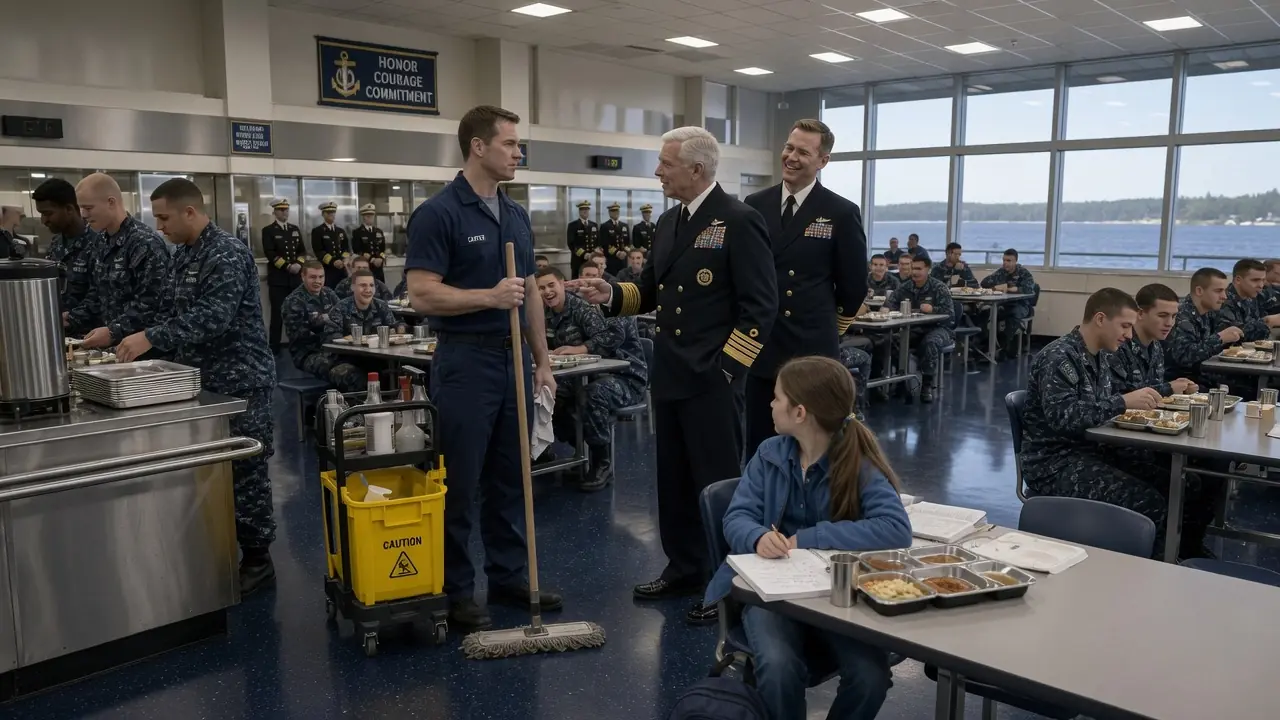
They were the key to a secret that powerful men had spent years making sure would never surface. And the janitor holding that mop was the only one left who knew the whole truth. The Naval Training Command facility sat along the edge of Coastal Base where the salt air never quite left your lungs and the sound of boots on concrete was as natural as breathing. It was the kind of place that ran on routine.
Formations at dawn, drills through midday, inspections that could make a grown man sweat through pressed cotton. And somewhere in the middle of all that military precision, a man named David Carter pushed a mop. He wasn't loud about it. That was the first thing anyone noticed if they noticed him at all.
He moved through the mess hall the way water moves through stone, not forcing anything, just finding the path. His cart rattled faintly as he steered it between the long rows of tables. Wiping down surfaces with the same quiet focus that most people reserve for things that actually matter to them. To the men who filed past him in uniform, he was furniture, background, part of the base the same way the walls and the ceiling were part of it.
Necessary for structure, but not worth a second glance. David was 38 years old, broad-shouldered in a way that a janitor's uniform couldn't quite hide with hands that were a little too steady and eyes that moved a little too carefully for a man whose job was simply to clean. He had a stillness to him that wasn't passivity. It was the kind of stillness that comes from a long time spent learning how not to react, how to breathe through the thing that would make other men flinch.
Most people on the base had stopped wondering about it. A few of the older non-commissioned officers gave him slightly longer looks when he passed, but nobody said anything. Nobody asked. Sitting at the end of the table closest to the side wall, away from the crowd, was Mia Carter, 9 years old with her father's steady dark eyes and a backpack that had a small embroidered eagle patch stitched to the front pocket.
Something David had put there himself years ago without explaining why. She was working through a math worksheet with the kind of focus quiet that mirrored her father in an uncanny way. Occasionally glancing up at the recruits who moved through the hall with trays and noise and that particular nervous energy that new trainees always carried in their first weeks. She shouldn't have been there.
David knew that. Her regular babysitter, Mrs. Patterson, had called that morning with a back injury that wasn't getting better and there hadn't been time to arrange someone else. The base was the only option.
He'd cleared it with his supervisor quietly and kept Mia tucked at the far end of the hall with strict instructions. Stay seated. Don't bother anyone. Finish your homework.
She had agreed with the same no-nonsense nod she always gave him, which always made him feel like he was raising someone twice her age. A few of the officers noticed her when they filed in for the midday inspection. Whispers moved along the walls. He brought his kid, murmured a lieutenant to the man beside him.
Both of them keeping their voices low, but not low enough. To a base inspection? A petty officer glanced over, said nothing, looked away. The unspoken judgment was thick in the room.
That a man who cleaned floors had no business bringing personal complications into a professional space. David heard every word. He kept wiping the table. Rear Admiral Richard Hale entered through the far doors at precisely 1200 hours, flanked by two junior officers who moved with the careful attention of men carrying fragile things.
Hale was 61, trim, decorated in a way that meant the decorations had actually been earned. He had the look of a man who had spent years in difficult places and come back carrying something that never fully left. His reputation on base was one of sharp intelligence and even sharper expectations. Recruits straightened without being told when he walked into a room.
Senior officers found reasons to agree with him. He moved down the length of the hall with the practiced ease of a man who had conducted a thousand inspections, pausing at tables, checking posture, asking short questions that received short answers. The room had a current running through it. The low electric tension of men trying to perform composure in front of someone who could see through performance.
Hale reached the center of the hall and paused. His gaze swept the room in a measured way of someone cataloging the space automatically, a habit built over decades of entering rooms that might not be safe. His eyes landed on David. And then, because Mia was beside him, lingered there a beat longer than anywhere else.
One of the senior officers leaning near Hale, a commander named Preston Walsh, leaned slightly and murmured something that made Hale's mouth curve faintly. Walsh had a habit of filling silences with commentary that he thought was charming. He wasn't wrong about his audience. Hale glanced at David again and walked toward him.
David didn't stop wiping the table. He heard the footsteps. He tracked them to way he tracked most things without turning his head, reading them through sound and peripheral detail. When Hale stopped a few feet away, David straightened, not snapping to attention, just straightening, a different thing entirely.
Hale studied him for a moment. The posture registered, shoulders level, weight balanced, no tension in the hands. Not the posture of a janitor who is nervous about being approached by an admiral. Hale's eyes moved to the mop, then back up.
"Carter, right?" he said, reading the name badge. "Yes, sir." David said. There was something in his voice that was flat in the wrong way, not disrespectful, but unlayered, like someone who had burned through every nervous register a long time ago and was running on something more fundamental. Hale caught it.
His head tilted slightly. Behind him, Walsh was already grinning. "The man's got parade ground posture for a janitorial position." he said, loud enough for the nearest tables to hear. A few recruits snorted.
A couple of officers allowed small smiles. Hale played to the room. It wasn't cruelty, exactly. It was reflex, the easy authority of a man who had never had to second-guess his place in any room he entered.
He looked at David with the amused expression of someone asking a question they already knew the punchline to. "So, Carter." He let the pause sit for just a moment. "What was your call sign? Mop Warrior?" Laughter broke through the hall.
It came fast and easy, the way laughter does when the most powerful person in the room has given permission for it. Recruits who hadn't even heard properly laughed anyway, because the people beside them were laughing. Officers who were too senior to laugh openly allowed their mouths to move. Walsh was already half-turned, enjoying the ripple he'd helped start.
David didn't laugh. He didn't tighten. He didn't look away. He set down a cloth he was holding slowly, the way a man puts down something he doesn't need anymore.
Then he looked directly at Admiral Hale, not through him, not past him, at him with the specific measured quality of a man who has decided that this is the moment and there won't be another one. Lone Eagle, sir. The laughter didn't fade gradually. It stopped like something had been cut.
The silence that followed was the kind that has texture to it. The kind you can feel shift the air in a room. Walsh's grin did something complicated on his face, not quite disappearing but losing its shape like a photograph left in heat. A few recruits exchanged glances.
Most of them had no idea what they were watching, only that something had changed and they didn't know why. Hale's face was a different story. The change was small, which is exactly why it was impossible to miss if you were paying attention. His jaw shifted.
His breathing, which had been the loose even breathing of a man entirely in control of his environment, pulled slightly shorter. His eyes, which a moment ago had been doing the easy work of a man performing authority in front of an audience, were now doing something else entirely. They were working, calculating, searching David's face with a focus that was completely different from anything that had come before it. The Admiral's color shifted fractionally.
One of them was David. The third was a senior intelligence officer near the door who had gone very still in the particular way of someone who has just heard a word they never expected to hear in this context, in this building, in this decade. Mia had been watching since the moment the tall man in the decorated uniform walked toward her father. She wasn't afraid.
Her father hadn't tensed, so she hadn't tensed. But she was watching. She was always watching. She had her mother's curiosity and her father's patience.
And between those two things, she noticed most of what happened in any room she sat in. She watched the admiral's face change. She leaned across the table and tugged the edge of her father's sleeve, pulling him down just slightly. "Daddy," she whispered.
Her voice was barely above a breath. "Why did that man look scared?" David didn't look at Hale when he answered. He reached over and straightened the collar of Mia's jacket with one hand. The gesture unhurried and ordinary.
"Some names carry weight," he said quietly. Hale turned without addressing the room. He didn't dismiss anyone with the usual formal language. He simply moved toward the side corridor and paused at the threshold, his back to the hall.
"Carter," he said not loudly, "step outside." It wasn't a question, but it also wasn't quite the tone of a superior addressing subordinate staff. It was something else, something that pulled from a register Hale didn't often use. David picked up his cloth, folded it once, and set it neatly on the cart. He looked at Mia.
"Stay here," he said. "Don't move from that seat." She nodded once, already turning back to her worksheet. But her eyes followed him until he stepped through the door. Behind him, the officers in the hall exchanged looks that ranged from puzzled to uneasy.
Walsh opened his mouth, thought better of whatever he'd been about to say, and closed it again. The room settled into a silence that nobody quite knew what to do with. Outside, the corridor was narrow and quieter. The sound of the hall reduced to a low murmur behind the door.
The salt air was faint here, replaced by the smell of industrial floor cleaner and recycled ventilation. Hale stood with his back to the wall, arms at his sides, and studied David Carter's face the way a man studies a photograph that doesn't match his memory of it. He looked older than the file photo, which made sense. He looked leaner, which also made sense.
His eyes were the same. That particular quality that Hale had seen in very few men across his entire career, the quality of someone who had been somewhere that most people don't come back from, and had found a way to live with what they brought back. Hale's voice was stripped of its performance register. What was left was quieter and more honest than anything the admiral had offered inside.
"You're supposed to be dead," he said. David met his gaze with the steady patience of someone who had rehearsed this moment in the privacy of his own mind, and had decided long ago exactly how he would hold himself when it arrived. A flash came and went behind his eyes. Smoke, so thick it was more solid than air.
The taste of dust and copper. The particular sound a radio makes when someone cuts the signal deliberately. A desert sky going orange at the horizon while the ground below it was on fire. He pushed it back, the same way he always pushed it back.
Not buried, just set aside. "I didn't die," David said. His voice was even almost gentle. "I just stopped being useful." The words landed in the space between them with quiet weight.
Hale was quiet for a long moment. Then something shifted behind his eyes. Not emotion exactly, but the specific expression of a man whose understanding of a situation has just been revised in a way that carries significant consequences. He was calculating, reconstructing, running a timeline against known facts, and finding the gaps between them suddenly visible in a way they hadn't been before.
Because Lone Eagle wasn't just a call sign. It was a designation attached to a classified black ops unit that had been officially dissolved and erased from every record Hale had ever had access to. The unit's final operation had produced a casualty report. The casualty report had listed every member.
And somebody, someone with the authority and the access and the deliberate intent had made sure that the report, the unit, and every trace of what happened had disappeared in the layers of classification that most people at Hale's rank couldn't reach on a direct request. Lone Eagle was on that list. Lone Eagle was supposed to be in a grave in a desert somewhere that had no name on any official map. And Lone Eagle was standing in front of him in a janitorial uniform.
Looking at him with the undisturbed calm of a man who had made peace with something Richard Hale was only now beginning to understand the shape of. Hale's jaw was tight. His next breath came slightly slower than the one before it. Because if the casualty report was wrong, and it was standing right in front of him, then the question wasn't just what happened.
The question was who decided what the record would say, and why. The day after the encounter in the corridor, Admiral Hale arrived at his office 40 minutes before anyone else on his staff. He dismissed the aid who tried to bring him coffee. He closed the door.
The archive terminal in the corner of his office was old, a relic from a previous renovation that newer installations had simply built around. It required a physical access card and two separate authentication codes. Hale used both without hesitation, settled in the chair in front of it, and typed two words into the search field. Operation Iron Talon.
The system processed for longer than it should have, which in itself was information. When the files appeared, they were incomplete in the specific way that deliberate incompleteness looks. Records that don't have gaps so much as edges that don't quite line up, timestamps that follow too cleanly for organic documentation, summary reports that reference supporting documents filed under classification levels that even Hale's current clearance didn't reach. The skeleton of an operation was there, enough to confirm it had existed, enough to tell the broad shape of it, not nearly enough to tell the truth of it.
The squad designation was listed. Six operators, desert theater, classified extraction objective. Mission status, failed. Casualties, total.
Every name on the roster was followed by the same three letters, KIA. Every name except one. Next to the last entry on the list, where a name had been, there was a redaction bar, thick and black and permanent. Where the status field would have been, there was a single notation, classification level restricted.
Access requires joint authorization, Pentagon intelligence oversight. Hale leaned back in his chair and looked at the ceiling for a long moment. He'd been handed this report once, years ago, during a period when three other major operations were unfolding simultaneously and his attention had been pulled in the urgent direction, as attention always was during active operational cycles. He'd signed off on it as part of a batch of quarterly reviews.
He remembered the date range. He did not remember the specific file. That was the part that sat uneasily in his chest now, because either he'd been kept from the truth deliberately, routed away from the details that mattered, given a report designed to produce a signature without producing understanding, or he had simply not looked closely enough when it counted. He wasn't sure which of those was worse.
He printed nothing. He closed the terminal. He sat with what he now knew and what he still didn't. And he felt the specific discomfort of a man who has built his entire professional identity on the premise that he operated with integrity, confronting the possibility that integrity without awareness is just a clean conscience sitting on top of something rotten.
Across the bay in the long gray corridor of the maintenance wing, David Carter was 3 hours into his morning shift. He moved through the section methodically, supply room first, then the east corridor, then the training wing bathrooms, then back around to the common areas before the lunch cycle brought its particular mess. He had done this route so many times that his hands worked without active direction, leaving his mind to do what it needed to do. He thought about Mia's math homework, which she'd asked him about last night, and which he'd worked through with her at the kitchen table until she understood it not just as a procedure, but as a concept, because that was how you actually learned anything.
He thought about whether she needed new sneakers before the end of the month. He thought about whether the squeaking wheel on the supply cart needed a replacement bolt or just lubrication. He did not think about the admiral's face. He did not let himself think about the desert.
In the recruit training corridor, a group of 12 first week trainees were rotating through equipment familiarization. David moved to the edge of the space with his cart, working on the section of flooring near the wall, keeping himself small and background the way he always did. The recruits paid him the attention they paid most things that weren't instructors or authority figures, which was none. One of them, a young man about 20 years old with a lean build and careful observing eyes that didn't quite fit the easy loudness of most of his squad, was having trouble with the buckle sequence on the tactical vest the group was rotating through.
His jaw was set with the particular tension of someone who refuses to ask for help in front of peers. He worked the buckle, missed it, worked it again. David registered this without turning his head. He'd watched it happen twice.
On the third rotation of the buckle, without stopping his work on the floor, he said quietly toward the wall and not toward the recruit, "Thumb on the release tab first, then press, not pull." The young man froze, glanced toward the sound, looked at David who was still facing the wall with his mop. Slowly, the recruit tried it again. Thumb on the tab, press. The buckle released cleanly.
He blinked. He stared at David's back for a moment. Most of the other recruits hadn't heard it or had noticed. This one did.
His name was Ethan Brooks, 20 years old, 12 days into his training cycle, and he had grown up in a household where man's usefulness was measured by what he could do, not what he wore or what he was called. He watched David Carter move to the next section of floor with the same unhurried precision, and something registered in the back of Ethan's mind. A small flag that went up and stayed up. He turned back to the equipment and didn't say anything, but he didn't forget it, either.
Mia's school was a 20-minute drive from the base, a public elementary with a small playground and a cafeteria that smelled like garlic bread on Wednesdays. She was in fourth grade, quiet in the way that teachers sometimes mistook for shyness until they called on her and found out it was the opposite. She was quiet because she was always listening, and she answered questions with the unhurried confidence of someone who has already processed the information from three angles before speaking. Her classmates mostly liked her, or at least gave her the neutral non-hostility of children who don't have strong feelings about someone.
But there was a girl named Britney Walsh, Commander Walsh's daughter, as it happened, who attended the school because her father's house made the district convenient, who had recently developed the particular social cruelty of a child who has learned that status is transferable and is experimenting with how far it carries. "My dad says your dad works for our dads," Britney said at the lunch table with the specific pleased expression of someone delivering information they know will land badly. "He's the janitor." She said the last word with a little extra length as though she were turning it over to look at the underside. Two other girls at the table looked at Mia to see what she would do.
Mia finished chewing her sandwich, set it down on the wrapper, and looked at Britney with an expression that was almost entirely neutral. "Your dad makes people laugh," Mia said. "Mine makes people quiet." She picked up her sandwich again. The two other girls exchanged a glance.
Britney's pleased expression did something uncertain and then resolved into offense, which she wore for the rest of lunch but didn't know how to convert into a second attack. When David picked Mia up that afternoon, she didn't mention it. He noticed she was a little quieter than usual in the car. He didn't push.
He made her the specific dinner she liked, rice and stewed chicken with the pepper the way his mother had made it. And while they ate, he asked about math. She told him. The quiet thing lifted slowly.
By the time they were doing dishes together, she was telling him about the book her teacher had read aloud, doing a small impression of the way the teacher did different voices, and David was laughing in the soft way that only Mia could produce. He heard about the lunch table incident 3 days later from her teacher in a brief phone call. He thanked the teacher and hung up. He sat for a moment in the break room, hands flat on the table in front of him.
He didn't escalate it. He didn't call Walsh. He did not begin to compose the complaint in his head that part of him wanted to write. He thought about Mia's face at dinner, about how she'd worked her way back to laughing by the end of the night on her own power.
He thought about what it would cost her versus what it would cost him. He folded the anger down and put it somewhere it wouldn't get anyone hurt. He went back to work. That night, after Mia had gone to sleep, David sat at the kitchen table with a glass of water and let himself go back.
Just a little. Just far enough to check on the things he kept walled away most of the time. The desert came in images the way it always did. Never complete sequences.
The mind protects itself from that, or at least his did. Just frames. A sky going from blue to amber. A ridge line in the middle distance.
The weight of a rifle that he hadn't held in years translated now into the weight of a mop handle that was slightly too short for his height. The faces of men he had served beside. Men whose names were on a casualty report somewhere in a restricted archive. Men who had followed his lead into a situation that someone else had poisoned before they arrived.
He remembered the satellite device. It was the size of a thick paperback, military spec, encrypted to a frequency that wasn't standard issue. They found it in the third building they cleared in a case that had no business being there. It had been transmitting.
He'd pulled the data. He'd understood maybe 20% of it in the field. Enough to know it was shipment routing encoded connected to contractor designations he recognized from stateside briefings. Enough to know it was wrong.
He hadn't had time to do anything with it. The ambush had come 20 minutes later. Communications had dropped first, then air support had gone unresponsive, then he'd heard the secondary unit's frequency go silent in the way that only happens when someone with authority turned a switch. He told his team to move.
He'd covered the retreat himself. He remembered the specific moment of the explosion. Not as pain, which is how most people imagine it, but it's a white compression like the world making a fist and then nothing and then somewhere different with different faces and a long time of not knowing who he was or where he was or what day it was. By the time he'd put himself back together enough to understand the situation, the shape of it had been clear.
He was documented as dead. His unit was documented as dead. The operation was sealed. Anyone who might have recognized him had either been told he was gone or had a reason to maintain that story.
He had made a choice then, not a dramatic one, not a plan, just a decision about how to keep himself and eventually his daughter alive while carrying information that someone with significant power wanted buried. He drank his water. He checked the time. He went to bed.
In his office, Admiral Hale was reviewing personnel transfer records with a particular focus of someone looking for a pattern. The records went back nine years. He was looking for names connected to Operation Iron Talon. Not the operators whose files were sealed, but the oversight chain, the command structure, the people who'd sign things.
He found one name three times in places it shouldn't have been unless it was deliberate. The name was on an authorization log, a quarterly review batch, and a classification elevation request. All within the same six-week window around the operation's official closure. The name was Jonathan Pierce.
At the time of the operation, Pierce had been a two-star. He was now a Pentagon official with an office two floors below the Secretary of Defense and a political network that extended through three congressional committees and two private defense contractors. Hale closed the folder. He sat very still.
He thought about the signed report. His signature, his name, his implicit credibility attached to a document that had told a false story about a man who was alive and mopping floors on Hale's own base. He thought about what it meant to reopen something this old, this buried, this deliberately obscured. He thought about what it would cost him.
And then he thought about David Carter's face in the corridor. Not angry, not performing dignity, just carrying it the way a man carries something he stopped expecting anyone else to acknowledge. Hale reached for his phone. Then he stopped, put it down.
He would need to be careful about who he called and in what order. He would need documentation before conversation. He would need to operate within the narrow margin between due process and the kind of inquiry that powerful people could find reasons to terminate before it produced results. He pulled the folder back toward him and began making notes in longhand.
Old habit, not transmittable, not locked. The scratch of his pen on the legal pad was the only sound in the office. Outside, the base had gone quiet with the particular hush of a military installation at night. Organized, regulated silence.
The sound of a place that runs on order. Somewhere in the maintenance wing, the cleaning crew that worked the second shift was making its way through the east corridor. David Carter was not on second shift. He was home, asleep, his daughter's nightlight visible under her door in a thin stripe of yellow across the hallway floor.
But his name was at the center of something that was beginning, slowly and with considerable weight, to move. The week after Hale began his quiet investigation, the base shifted in the way that bases shift when something unseen is moving through the structure of them. Not visibly, not loudly, but in the particular way that long-serving officers feel in their posture before they can name what's changed. Conversations in certain corridors grew shorter.
Senior staff who had easy access to Hale's calendar suddenly found scheduling more difficult. And two officers who had served alongside Hale for years separately found reasons to stop by his office and say, with the careful casualness of men delivering a message they'd been asked to deliver, that certain archived operations were archived for good reason. "Some things get buried because they need to be." One of them said, a captain named Gerald Ford, standing with his coffee and his studied nonchalance near Hale's window. "Not everything buried was buried wrong." Hale had listened with his hands flat on his desk and his expression giving nothing away.
He thanked Ford for stopping by. He waited until Ford was gone before he wrote the visit down in his legal pad with a timestamp. He was being warned, which meant someone already knew he was looking. Commander Blake Thornton had been at Naval Training Command for 2 years, and in that time he had done the work of a man who understands that rank is only part of how power moves.
The other part is connection, knowing whose name to mention in which room, understanding which alliances carry weight and which ones are decorative. Thornton was 39, sharp-featured, the kind of polish that comes from family that had been sending men into the military for three generations and expected results in return for the investment. His father, Rear Admiral George Thornton, retired, had been on the oversight chain for operations in the same theater as Iron Talon during the relevant years. Blake had grown up hearing his father's name spoken with a particular reverence that military families use, and he had built his own career in that shadow, using it when it was useful, deflecting questions about it when it wasn't.
He had noticed David Carter the same way most people on base had noticed him, which was to say barely. But when Hale had called David outside after the mess hall incident, Thornton had been near enough to watch Hale's face coming back through the door. He'd read something in it that he couldn't name precisely. It had unsettled him in a quiet way that unsettling things do before you understand why you're unsettled.
He made a call that evening, not to his father. The old man's health had made those conversations difficult, but to someone who kept in contact with people who had managed the operational records from that period. The response had come back inside 12 hours. It was two sentences.
The second sentence contained David Carter's original designation. Thornton had read it twice, put his phone face down on his desk, and spent the next 20 minutes very still. The training floor incident happened on a Thursday. It was a physical conditioning drill, one of the harder ones in the first month rotation, designed less to build fitness than to reveal what a recruit does when his body is asking him to stop and his brain hasn't decided yet.
The hall was loud with effort, commands, the rhythmic punishment of bodies being pushed past comfortable limits. Recruit Darius Webb, 19 years old, 6 ft of lean muscle and determination, had been pushing past his own limit for about 4 minutes longer than he should have. He'd been hiding the signs, the slight drift in his coordination, the breathing that had gone from controlled to mechanical to something thinner, in a way that recruits hide things when they're afraid that stopping means failing. It was the kind of hiding that instructors who were paying attention catch early.
Instructors who were performing authority for an audience sometimes don't. Commander Thornton was running this drill. He was watching the group with a broad sweep attention of a man who is satisfied with the general picture. He did not notice Darius until Darius's knees went.
The recruit didn't collapse dramatically. He folded slowly, like something had been removed from the center of him, and he was on his hands and knees before anyone reacted, and then on his side, and his breathing had the specific shallow ragged quality that anyone with field medical training recognizes immediately. Thornton looked at him. "Brooks, get him water." he said.
He did not move from where he was standing. "Walk it off, Webb. Everyone else, keep moving." David Carter was at the edge of the training floor with his cart, working the corner section near the equipment wall. He'd been watching Darius for the last 6 minutes.
He had seen the coordination drift, the breathing change, the specific way the recruit's eyes had lost their focus while his body kept going on stubbornness alone. He had moved his cart slightly closer over those 6 minutes, not consciously deciding to, just responding to what he was reading. When Darius went down, David was already moving. He crossed the floor without hurry, but without hesitation, the way you move when speed matters, but panic doesn't help.
He crouched beside the recruit, two fingers to the pulse point at the throat, reading it in the efficient way of someone who has done this in conditions that made this look simple. The pulse was rapid and shallow. The skin was cooling wrong. He turned Darius onto his back, lifted his chin gently to open the airway, and with his free hand, checked the recruit's eyes.
Dilated unevenly, which meant the heat stress had gone further than exhaustion. "He needs fluids now and somewhere cool." David said, not loudly, to Ethan Brooks, who was crouching with a water bottle and looking uncertain about what he was witnessing. "Get the medic. Don't run.
Walk fast. Keep your voice level. Don't tell the rest of the room." Ethan moved. Thornton had come across the floor by then.
He stopped several feet away, taking in the scene. David Carter on the floor beside his recruit, competent hands doing competent things in a way that did not match any category Thornton had prepared for this man. "What do you think you're doing? Thornton's voice carried the particular edge of authority that has been surprised and doesn't like the feeling.
David didn't look up. He was monitoring Darius's breathing, which was steadying slowly. "Keeping him conscious," he said. "You're a janitor." The word was delivered flatly.
"Stay in your lane." Several recruits had stopped. They weren't dramatic about it. The drill had given them a reason to slow down and they'd taken it. They watched.
The ones closest to Darius watched the most carefully. David looked up at Thornton then. It was a brief look, not defiant, not performing, just erect. The kind of look that does its work without requiring any words around it.
Then he looked back at Darius and kept his hand on the recruit's shoulder, monitoring. Hale was in the doorway of the training floor. He had come through from the east corridor following a briefing and had stopped when he registered the configuration of people. He stood there quietly and watched the whole scene without announcing himself.
The base medic arrived 90 seconds later. She assessed quickly, confirmed heat exhaustion with possible early heat stroke, and had Darius on a stretcher in under 4 minutes. His vital signs were stabilizing. "He'll be fine." As David stood and retrieved his card, Ethan fell in a step near him for just a moment.
He didn't say anything dramatic. He looked at the ground and said, quietly enough that only David could hear it, "How did you know?" David paused. "You watch people long enough," he said, "you see what they're about to do before they do it." Ethan nodded once, like he was filing that away. He went back to his squad.
Thornton had moved away. His expression smoothed back into authority, but his eyes had followed David Carter to the door and they stayed there a beat longer than necessary. That evening, Mia found the badge. She hadn't been snooping.
She was looking for her father's phone charger, which sometimes migrated to his jacket pocket, and she'd been working through the small shelf of his work bag methodically. The badge was in the inner zip pocket of a jacket he rarely wore. Not hidden exactly, just set away. It was metal, small enough to sit in a child's palm, with a raised surface pattern that had been scratched down deliberately.
Not worn down, scratched. The insignia was gone, but the shape where it had been was still faintly readable if you held it at the right angle in the light. She brought it to the kitchen table where David was making tea and set it carefully in front of him without saying anything. He looked at it for a moment, then he sat down across from her.
He didn't explain everything. He wasn't ready to explain everything, and she wasn't old enough to carry everything. But he told her some of it, that he'd done a different kind of work before he cleaned floors, work that required him to go to difficult places and make difficult choices. But something had gone wrong.
That he had decided afterward to choose a quiet life over a complicated one, and that she was the biggest reason why. Mia looked at the badge for a long time. Then she looked at her father. "Did you do the right thing?" she asked.
Not about the operation. She didn't know enough to ask about that. About staying quiet. About the choice.
David was quiet for a moment. "I did the right thing for you," he said. "I'm still deciding about the rest of it." Mia nodded slowly with the gravity of child who is processing something she knows is important. Then she said, "Sometimes doing the right thing costs everything." In a specific tone of someone trying out a sentence to see if it fits, and David recognized it as something he'd said to her once a long time ago, when she'd asked him why some people get treated unfairly.
He looked at her across the table. "Yeah," he said, "it does." Thornton found David in the East Maintenance Corridor the following afternoon. He didn't bring anyone with him. That was the first thing David noticed.
No witnesses, no audience. The second thing was the specific quality of Thorne's composure, which was held too carefully, which meant whatever was underneath it was less composed than the surface. "You've been here 8 months." Thornton said, stopping a few feet back from where David was working. His voice was level and conversational.
The tone of a man who wants the delivery to sound casual. "Quiet. Kept to yourself. Minding your business." He paused.
"People appreciate that." David kept working. He said nothing. "What happened this week with Hale in the mess hall? That's the kind of thing that creates noise." Thornton continued.
"And noise has a way of landing on people who didn't ask for it." Another pause, shorter this time. "Some ghosts should stay buried." The corridor was empty in both directions. The ventilation system ran a low constant hum. David finished the section he was working on, straightened, and turned to face Thornton.
He looked at him with the same directness he'd used with Hale in the mess hall. Not aggression, not intimidation. Just full, unblinking attention. "Some ghosts bury themselves." David said.
He picked up his cart and moved to the next section. Thornton stood in the corridor for a moment. His jaw was tight. Something moved through his expression that wasn't quite anger and wasn't quite fear, but was the thing that lives between them when a person realizes that the leverage they assumed they had isn't holding the way it should.
He walked back the way he'd come. His footsteps were slightly faster than they'd been on the way in. Hale made his decision that evening. He sat with his legal pad, his notes, the fragments of a case that was still largely made of suggestions and negative space.
Things missing from records rather than things present in them. It wasn't enough for an official inquiry. Not yet. but it was enough to justify asking for one. He thought about Gerald Ford's visit.
He thought about the way Thornton had been watching David Carter in the training room. He thought about the signed report with his name on it and the redacted line where a living man's name had been replaced with classification markings. He picked up his phone and called the base's internal legal affairs office. He asked for the officer handling historical case reviews.
He said he had concerns about the integrity of a closed operational record and wanted to open a formal internal inquiry. He gave the case reference for operation Iron Talon. There was a pause on the line. Then the officer said he would need to log the request and have it reviewed before a formal inquiry could be assigned.
Hale said that was fine. He gave his name and rank and told the officer to log it correctly. He hung up. He looked at his legal pad.
The name Jonathan Pierce was written at the top of the third page, circled once with three lines of notes below it that were written small and closely. Outside, the base ran its evening routines, formations, dismissals, the particular quiet that settles over a military installation as the day's shift ends and the night cycle takes over. Somewhere on the grounds, David Carter was finishing his last section of the maintenance wing, his cart wheels making their familiar small noise on the concrete floor. His face carrying the same composed expression it carried through everything.
Something had started that couldn't easily be stopped. Hale knew it. Thornton knew it. And in the way that men like David Carter know things, not from information, but from the particular sensitivity of someone who has spent years watching the terrain for changes, David knew it, too.
Three days after Hale submitted the inquiry request, a closed-door review was formally convened in one of the base's secured conference rooms. It was not announced broadly. The officers present were five in number. Hale, two legal affairs staff, an intelligence liaison whose clearance was high enough for the archive material, and a recorder.
Thornton was not invited. This was deliberate. The formal tone of the proceedings did not entirely cover the tension sitting underneath them. Legal Affairs had processed the case reference and come back with a flag notation.
The archive file for Operation Iron Talon carried a congressional oversight marker that meant any inquiry automatically generated a notification to the Pentagon Intelligence Oversight Office. Hale had been informed of this before the session began. He had said he understood. He had sat down and opened his folder anyway.
The first hour covered the structure of the operation, the mission objective, the squad composition, the theater context. It was dry, and it was necessary, and it established the foundation. Hale walked through it with the focused patience of a man who has decided he is going to finish something regardless of the cost. The second hour was where it got complicated.
Satellite logs from the operation's active window had been sourced from a secondary archive, not the primary record, which had been stripped, but a technical backup maintained by a signals intelligence unit that hadn't known to wipe it and hadn't been asked to. The liaison had located it after Hale's initial request and had processed it with the careful thoroughness of someone who understood she was handling material that had implications far above the immediate room. The logs showed two things clearly. First, that rescue capable air support had been on station and available during the operation's critical window, not delayed, not rerouted, but on station and holding, waiting for authorization that never came.
Second, that a cancellation order had been issued. The order carried an authorization code. Tracking authorization codes through redacted material required the kind of cross-referencing that takes time, and the liaison had spent three evenings doing it. The code traced to a command-level terminal in the regional oversight office.
The terminal was registered to a specific user during that operational period. The name at the end of that chain was Admiral Jonathan Pierce. The room was quiet when the liaison finished her presentation. The two legal affairs officers exchanged a look that communicated several things without requiring words.
Hale looked at the document in front of him with the expression of a man who has been hoping to be wrong about something and has just been confirmed right. Pierce was no longer in field command. He was now a senior Pentagon official protected by the kind of institutional and political architecture that doesn't fall over easily. His connections ran through defense contractor relationships, congressional committee friendships, and a public record of decorated service that had been carefully constructed over 30 years.
Touching him was not a simple thing. Touching him from the position of a base-level internal inquiry was an act that required either extraordinary courage or extraordinary evidence. Hale looked at the authorization code on the document. He thought about David Carter's face in the corridor.
He thought about his own signature on the original report. He said, "Quietly but clearly, we continue." Thornton was not handling the pressure of the inquiry's existence well, and the signs of it were visible to anyone paying close enough attention. He pulled three separate personnel files from the administrative office under reasons that didn't quite hang together. He requested access to an archive communications log and was told the request required additional authorization, which he pushed back on in a way that made the administrative officer document the exchange.
He was seen in the records room after hours by night maintenance worker who noted it without knowing what it meant. He was also moving faster in his conversations, speaking over people where he'd previously waited, and carrying the specific tight-jawed expression of a man whose internal calculation is running on numbers that aren't balancing. Ethan Brooks had been watching. Ethan was 12 days further into his training cycle now, enough time to have developed a reasonable feel for the basis social geography, who deferred to whom, which officers had weight and which ones performed it, where the real authority sat versus where the official authority was displayed.
He was observant in a way that people from difficult backgrounds often are, trained by necessity to read rooms and movements and intentions before acting. He had noticed Thornton outside the records room. He had heard a fragment of a conversation between Thornton and a staff officer that had ended abruptly when Ethan appeared around corner. He had watched Thornton's body language in the days since the inquiry was whispered about, and he had noticed the acceleration, the tightness, the specific behavior of a man trying to control something that was getting away from him.
He didn't know what to do with what he was noticing. He wasn't sure it was his place to do anything. He had no formal standing, no rank, no established relationship with anyone in a position to act on information, except that there was one person on this base who had looked at a recruit going down on a training floor and known what to do without needing permission or authority to do it. One person who had given him a six-word correction that worked, spoken to a wall without requiring any acknowledgement in return.
One person whose posture and stillness and economy of movement said, to anyone paying the right kind of attention, that there was a great deal more here than what was on the surface. Ethan waited until he saw David alone in the maintenance corridor during a late afternoon shift. He approached directly without pretending to have a different reason for being there. "I think someone is messing with records," he said.
"Thornton, I've seen him in areas he shouldn't be, and I heard him tell someone to lose a file request." He paused. "I don't know who to tell." David looked at him, not assessing. He'd already assessed Ethan weeks ago and come to his conclusions. This was something else, something quieter.
"You already know who to tell," David said. "You came here." Ethan nodded slowly. "I don't know what's happening, but I know you're in the middle of it. Write down what you saw," David said.
"Times, locations, exactly what you heard. Don't share it with anyone yet. Don't act different around Thornton." He paused. "Can you do that?" Ethan said yes.
He went back to his barracks and wrote three pages in his personal notebook with a date and time on each paragraph. The satellite log evidence was enough to shift the inquiry in a higher gear, but it was not enough on its own to reach Pierce. What changed that calculation was a secondary discovery that the intelligence liaison made on the fourth day of her cross-referencing work. Buried inside a logistics archive that had never been specifically connected to Iron Talon was a set of coordinates and timestamps that matched the operations window exactly.
The coordinates were routing waypoints. The timestamps showed movement. And the contractor registration codes attached to the routing entries matched two private defense companies that had been active in the theater during the relevant period. Both companies had received significant Pentagon contract awards in the 18 months following the operation.
Both companies had Pierce listed in their historical board advisory records. The liaison brought this to Hale in a sealed folder. He read it twice. Then he said, "This goes outside the base." The warning came from Mia on a Wednesday afternoon.
David had arranged for her to take the school bus home on days he worked late with a neighbor, Mrs. Callaway, meeting her at the stop. It was a routine Mia had done dozens of times. The bus stop was three blocks from their house on a residential street with consistent foot traffic in the afternoon hours.
Mrs. Callaway called David at 4:47 p.m. to tell him that a car had been idling at the end of the block when she arrived to meet Mia and had pulled away when Mia got off the bus. She hadn't thought anything of it. A car parked on a residential street wasn't unusual.
Except that it had been there when she arrived 10 minutes early and left only after Mia was inside. She thought he should know. David thanked her. He hung up.
He stood in a maintenance corridor with his hand still on the wall where he'd braced it during the call, and he let himself feel what he was feeling without pushing it down for 30 seconds. Just 30 seconds. A controlled burn, the way you manage fire. You don't smother it, you contain it.
Then he called his daughter, heard her voice, heard her tell him about a drawing she was working on, and he said he'd be home for dinner. He went back to work, but something had shifted in the space behind his eyes. A recalibration, a tightening of the aperture. For himself, he had made his peace with the risk long ago.
He had chosen visibility when he decided to say two words in a mess hall instead of letting a moment pass. For Mia, there was no peace to make. There was only the specific fury of a father and the specific discipline required to make sure that fury served a purpose. The note was slipped under the door of his apartment that same evening.
A piece of folded plain paper, no envelope. Block printed in capital letters, four words and a period. "You survived once. Don't test fate again.
He photographed it with his phone. He put in a sealed plastic bag. He put Mia to bed and sat at the kitchen table and looked at the bag on the table and understood clearly that whoever had sent it was operating on the assumption that he was still isolated, still alone with what he knew, still the single point of failure in a system that had tried twice to erase him. They didn't know about Hale's inquiry.
They didn't know about Ethan's notes. They didn't know that logs were already in the hands of a legal affairs liaison with a clearance high enough to understand them, which meant they were working from an old picture of the situation. That was useful. Hale came to David's apartment that evening.
He came alone in civilian clothes without calling ahead. He knocked twice. David let him in without visible surprise. They sat at the kitchen table.
The sealed bag with the note was visible between them. Hale looked at it and then looked at David. "You need to know what we found," Hale said. He told him about the satellite logs, the authorization code, the contractor connections, the full shape of what the inquiry had uncovered and where it was pointed.
David listened without interrupting. His expression moved through several things quietly. Recognition, the particular expression of a person hearing the confirmation of something they already knew but had never had corroborated from outside themselves, and then something else. Something that was neither satisfaction nor grief but carried elements of both.
When Hale finished, there was a silence between them that sat comfortably for a moment in the way silences do between two people who have stopped needing to perform anything for each other. "They didn't just leave you behind," Hale said. His voice was level and honest in the specific way of a man delivering something he has been carrying for a while. "They needed you gone." David looked at the table, then out the window at the dark street where a street light made a small orange circle on the pavement.
I know, he said. Hale stayed another 20 minutes. When he left, David locked the door, checked the windows in the routine way he had built into his evenings, and went to look in on Mia. She was asleep, one arm thrown out sideways, her backpack on the floor with a small embroidered eagle patch facing up toward the ceiling light.
He stood in her doorway for a moment, then he went to bed. The morning after Hale's visit, David drove Mia to school himself. He didn't explain why. He just said he had time, which was technically true and also beside the point.
She buckled her seatbelt, pulled out a library book, and didn't ask questions. She had a child's instinct for when her father needed things to feel ordinary, and she gave him ordinary without making it a performance. He watched the street the entire drive. A gray sedan two blocks from the school was moving slightly too slowly for traffic.
He clocked its plates without appearing to look. He pulled into the drop-off line, said goodbye to Mia, watched her walk through the school doors, and sat still for a moment. The gray sedan had pulled to the curb half a block back. It was still there when he drove away.
He went to the base and started his shift. His hands worked the corridor floors while his mind ran the calculation he needed to run. What he knew, what he still needed to confirm, and what he could no longer afford to delay. By mid-morning, Hale had arranged a secure meeting in a legal affairs conference room.
Present were Hale, intelligence liaison Captain Sandra Okafor, and a military prosecutor from the Judge Advocate General's Corps named Philip Garrett, operating out of a regional office two states away with no prior connection to anyone at this base. That distance had been deliberate. Hale had selected him specifically because of it. Garrett was in his mid-40s, thin, with reading glasses he kept pushing up in the quiet manner of someone most comfortable when facts were doing the talking.
He had been briefed by Okafor the previous evening and driven through the night to be here. He sat across from Hale with a folder open and asked his questions in the careful sequence of a man building an architecture he intended to be weight-bearing. Hale told him everything. He didn't soften the parts that reflected poorly on his own oversight.
He said plainly that he had signed off on a quarterly review batch that included the Iron Talon closure report without examining it at the level it required. He said he believed he had been routed away from its details deliberately. The batch had been submitted during a window of simultaneous active operations when attention was most fractured and signatures were most automatic, but acknowledged he could not yet confirm that with documentary evidence. He said the man listed as killed in that report was alive, employed as maintenance staff on this base, and that multiple pieces of recovered evidence pointed to his abandonment being a deliberate command decision rather than an operational failure.
When Hale finished, Garrett was quiet for a long moment. He removed his reading glasses and turned them over in his hands once, which seemed to be something he did when he was processing rather than thinking. Then he looked up. "Tell me about Pierce." Hale told him everything he had found.
The authorization code, the contractor advisory records, the timing of the Pentagon contract awards against the operations closure date, the political architecture around Pierce's current position. All of it, laid out in the sequence Okafor had helped him organize over three evenings of careful cross-referencing. Garrett went through everything methodically. The satellite logs, the code trace, the contractor documentation.
He asked precise questions at two points, noted the answers without comment, and worked through each item with the focused patience of a man deciding whether a foundation was solid enough to bear the weight of what he intended to build on it. At the end of the meeting, he closed his folder and sat back. "This is enough to proceed," he said. "But, I want the civilian witness on record before anyone has the opportunity to move against him." Hale knew this.
He already knew who Garrett meant. David's memory had been returning in pieces all week. Not because he was pulling it back deliberately, but because something about the inquiry being open, about saying things out loud in his own kitchen that he had only ever said to himself, had loosened a seal he'd kept pressurized for a long time. Details surfaced the way deep water things surface when pressure changes.
Slowly, in fragments, sometimes catching him off guard in the middle of ordinary moments. A particular angle of light through a corridor window, the weight of his hand braced against a wall, the sound of communications equipment in a room he was cleaning. The satellite device had been in a metal transit case inside the third building their team cleared. Standard contractor equipment on the outside, the kind that moved through logistics checkpoints without triggering scrutiny because its registration code matched a legitimate supply chain entry.
What was inside wasn't standard. The device was running an active encrypted transmission on a frequency their mission equipment wasn't supposed to encounter in that theater. Shipment routing data filled its display. Coordinates, container identifiers, timestamps, contractor reference codes cycling through a pattern systematic enough to indicate a regular and sustained operation.
Not a single shipment, a pipeline. He had transferred what he could to a secondary data unit. A personal device not listed on any manifest carried since an earlier operation had taught him to carry things that didn't officially exist. He had secured it before the ambush came.
It had survived the blast inside the lining of his tactical vest. A detail that had seemed like luck at the time and had revealed itself over years to be something else. He had kept the unit for eight years in the same jacket where Mia had found his badge. And in all that time he had not used it because using it had always meant becoming visible again.
Visible had meant danger he couldn't manage with a daughter in the picture. The picture had changed. He was already visible. The calculation was different now.
He retrieved the device that evening and brought it to Okafor through the contact protocol Hale had established. She handled it with gloves and documentation and the quiet professionalism of someone who understood exactly what she was holding. When she ran the data, the shipment routes matched the contractor reference codes from the logistics archive she had already sourced. The pattern they described was not ambiguous.
Weapons movement through contractor channels to buyers on multiple sides of an active conflict across a sustained 14-month window. The kind of arrangement that requires authorization from someone with access, motive, and protection from oversight. Garrett received the analysis by encrypted message that night. He forwarded a copy to a secure archive outside the military's chain of command before he went to sleep.
The false accusation came the following morning and it came fast which told David that someone on Thornton's side was tracking the inquiry closely enough to know that the window for disruption was narrowing. He was midway through his rounds when two base security officers appeared at the end of the maintenance corridor with a specific manner of men executing an unpleasant assignment with minimum personal investment. One held a printed form on a clipboard. Both of them were doing the thing that people do when they have been told to do something they find uncomfortable.
Keeping their faces very neutral, making the transaction feel procedural rather than personal. "David Carter." The first officer said. "Yes." David said. "We have a complaint alleging unauthorized removal of military property from the equipment storage facility.
You need to come with us." He set his card against the wall with the practiced ease of someone who has learned to make unhurried movements in moments that invite panic. He went with them. The route to the security office passed through the central corridor of the training wing where morning recruit rotation was moving between sessions. Ethan Brooks was among them.
He saw David walking between the two officers with the printed form visible and his jaw tightened. But his expression stayed level. He had learned from watching David that staying level is how you stay useful. Mia was there, too.
A teacher development day had brought her back to the base and she was seated at the far end of the common area with her book, her backpack on the floor beside the chair. The small eagle patch visible on its front pocket. She looked up when her father came through the corridor. She took in the security officers on both sides of him.
She took in a printed form. Her expression moved through several things quickly. Confusion, then understanding, then something that a different child might have let become tears. She did not fall apart.
She sat up straighter in her chair and watched with the careful, memorizing attention of someone filing what they're seeing away for later. Thornton was near the security office entrance, positioned in the deliberate way of a man who wanted to witness something without appearing to have arranged it. When David passed him, Thornton's voice dropped to a register only David could hear. "You should have stayed dead." David did not stop walking.
He did not turn his head. His expression remained exactly what it had been, level, unhurried, fully present. He walked through the security office door, sat in the chair indicated, and waited. Nine minutes later, Hale came in.
"Release him," Hale told the security officers. No excess volume, no room for discussion. "The complaint has been reviewed and found without evidentiary foundation. Document the dismissal and file it with the base commander's office." He looked at David.
"Come with me." In Hale's office, with the door closed, Hale set a folder on the desk. Inside was a reconstruction of David's original personnel file, name, rank, service history, operational designations, built by Okafor from independent military records, cross-referenced and verified. All of it, including the call sign. "Your file was deliberately falsified," Hale said.
"We have a chain of custody. We have the authorization code. We have the contractor data from your device." He paused. "Everything has already been forwarded to Garrett.
He is operating entirely outside this base's command structure." David looked at the folder the way you look at something you stopped believing would ever exist. "Pierce will know by end of day," Hale said. "He already knows something is moving," David said. "The accusation this morning wasn't improvised." "Thornton," Hale said.
"Thornton is managing his own fear," David said. "Pierce is managing his legacy. Those are different problems." Hale held his gaze. "Garrett wants you in Washington.
Formal testimony. Closed hearing. End of the week." David thought about Mia in the corridor, sitting up straighter in her chair, not falling apart, watching everything with the steady attention that was so entirely his. He picked up the folder, held it for a moment with both hands, and set it down carefully.
"I'll be there." he said. The hearing room was on the fourth floor of a federal building two blocks from the Pentagon. Smaller than the word implied, rectangular with flat fluorescent light, and the institutional smell of recycled air. David arrived in a dark suit that had been pressed carefully and fit him the way clothes fit a person who has never stopped carrying themselves with physical precision.
Hale was in full dress uniform beside him. Okafor carried a briefcase organized to a standard that would survive any evidentiary challenge. Garrett was already inside, speaking quietly with two panel members. Five senior officials sat on the panel.
Representatives from military oversight, the Inspector General's office, and a congressional defense subcommittee. Everyone had been verified against Pierce's known network. The selection process had taken four days. Thornton sat at the far end of the table with a legal representative beside him.
His posture compressed in the way of a man holding himself together through all rather than ease. He did not look at David when David entered. Admiral Jonathan Pierce entered 3 minutes later through the same door, which meant he had to pass behind David's chair on his way to his designated seat. David did not turn around.
He heard the footsteps, registered their cadence, and kept his eyes on the panel. Pierce was 66, silver-haired, moving with the ease of a man who had spent decades in rooms exactly like this, and had never once been on the uncomfortable side of the table. He nodded to two panel members who gave small nods in return. He settled into his chair and looked at David once.
David looked back. Something passed between them. Not hostility exactly, but the specific recognition of two people who understand exactly what they are to each other and what this room means. Pierce broke the look first.
He reached for the glass of water in front of him and took a measured sip. The panel chair called the proceedings to order. David's testimony took 40 minutes. He spoke the way he did everything, without excess, without performance, without the narrative embellishment that frightened people add to their accounts to make sure the listener feels the weight.
The weight was in the facts and he trusted them. He described the operation from ingress through the ambush. He described the satellite device, the data transfer, the secondary unit he had carried. He described the communications blackout and the specific timeline of air support going unresponsive.
He described the decision to cover the team's retreat and waking up in an unfamiliar location with no documentation of his existence. He used precise language throughout, time markers, directional details, equipment specifications. The room was quiet in the way rooms get quiet when no one wants to be the first to break the atmosphere. The panel asked clarifying questions at four points.
David answered each one in the same register. His voice never shifted, never rose, never carried the emotional coloration that might have given Pierce's legal team an opening. Pierce's attorney made a note and kept his pen moving. Okafor presented the satellite log data after David's testimony.
She walked the panel through the coordinates, the timestamps, the cancellation order, and the authorization code trace with the methodical precision of an instructor who has designed her presentation for the least experienced person in the room. The rescue coordinates, she explained, had not been altered by enemy interference or environmental disruption. The alteration had been made through the regional oversight terminal during a 47-minute window while the operation was in its critical phase. The coordinates fed to the support unit placed them 6 km outside the extraction zone.
Close enough to maintain plausible operational confusion, too far to affect the outcome. It was not a mistake. It was a decision. Pierce's attorney objected to the characterization.
The panel chair noted the objection and asked Okafor to continue. Pierce waited until Okafor finished before he spoke. He took a moment first, a small pause that looked like composure but functioned as preparation. His delivery, when it came, was measured and confident.
The confidence of a man who had prepared for this and believed his preparation was sufficient. He acknowledged the operation. He acknowledged the outcome. He expressed appropriate gravity for lives lost in difficult operational circumstances, and he did it well.
The language was precise, the tone calibrated, the acknowledgement broad enough to feel sincere without being specific enough to constitute admission. He had clearly rehearsed this part. Then he shifted his register slightly, not dramatically, just enough, and suggested that the testimony they had heard, while clearly sincere, was the account of a man who had experienced significant psychological trauma over an extended period of isolation and should be understood in that context. A man who had been cut off from support systems, from institutional grounding, from the kind of structured environment that helps individuals process extreme experiences accurately.
A man who, with the best intentions in the world, might be constructing a coherent narrative from fragments that trauma had reassembled. He did not use the word unreliable. His attorney had presumably advised against that specific word, but the architecture of what he was building was clear to everyone in the room. And several panel members who had been leaning slightly forward during David's testimony now sat back fractionally.
Pierce saw it. He continued. He referenced the psych evaluations Thornton had submitted, documents prepared by a physician whose connection to Thornton's office Garrett had already documented but not yet entered into record. He suggested the satellite data, while technically compelling, required expert interpretation and could support multiple readings of command intent under operational pressure.
He was good. David had expected him to be good. He was not good enough. Hale had saved the comm logs for this moment.
The timing was deliberate. Let Pierce build his counter narrative to its natural stopping point. Then present the material that made it impossible. Garrett nodded to Okafor.
She opened a separate file on the presentation system. The encrypted communication logs recovered from the signals intelligence backup archive were 11 minutes and 43 seconds of audio, authenticated by two independent forensic teams. The voice was Pierce's, not a probability match, but a confirmed identity supported by voiceprint analysis and contextual corroboration. The panel heard Pierce authorize the extraction cancellation in real time.
They heard him give the altered coordinates. They heard near the end of the relevant segment a two-sentence exchange in which he confirmed the team was expendable given current exposure risk. The silence after the recording ended was different from the silence before it. The earlier quiet had been attentive.
This one was heavier. It had texture. It pressed against the room's walls. Two panel members had gone very still in the way of people managing reactions they hadn't prepared for.
The subcommittee representative had set down her pen and was looking at the table. Pierce's attorney was writing rapidly. Pierce himself was looking at a point in the middle distance with an expression that had lost its earlier ease. The composure was still there, technically, held by practice rather than confidence.
At the far end of the table, Thornton had briefly closed his eyes. Pierce attempted to have the recordings classified under national security provisions. He made the argument with the authority of a man who had used that mechanism successfully before, active operational sensitivity, potential for foreign intelligence exploitation. Garrett stated plainly, without emphasis, that independent copies had already been secured through the IG's office and the congressional subcommittee representative before the hearing began.
The classification attempt would affect copies within the military's chain of custody. It would not affect the copies that existed outside it. Pierce's attorney requested a recess. The panel chair denied it.
The panel chair announced that the hearing's closed, that a full criminal investigation would be opened by the Inspector General's office in conjunction with the JAG prosecutor's office, operating independently of any command structure in which Pierce had held authority. Pierce was not arrested. That required a process the investigation would need to complete before charges could be formally filed. But he was escorted from the building by two military police officers.
Not in handcuffs, but flanked in the particular manner that communicates clearly to anyone watching that a man's authority has left the building slightly ahead of him. Garrett came to stand beside David in the corridor while they waited for the elevator. He was quiet for a moment, watching the hearing room door settle closed down the hall. Then he said, "What you gave us with that data device changed the scope of this.
We came in expecting to document one man's misconduct in a single operation. What the contractor routing data shows is broader than that. It goes further than Pierce, further than Iron Talon. Procurement reviews have already been formally requested based on what we found.
David nodded. He had understood that from the moment Okafor ran the analysis and the reference codes began matching across multiple contract cycles. One operation doesn't generate a 14-month routing pipeline. A relationship does.
The IG's office want a follow-up session next week, Garrett continued. Additional questions on the routing data and the contractor designations. I'll be there, David said. Hale appeared beside them.
He looked at David in the way of a man who has decided to say something directly rather than carry it any longer. I owe you more than an apology, he said. David looked at him. Not with absolution.
That wasn't his to give and he knew Hale didn't want it framed that way. With a straightforward acknowledgement of one man receiving another man's honesty. One soldier recognizing another's reckoning. I know, David said.
They rode the elevator down in silence. Outside, the winter afternoon was gray and flat. The city moved through it with the indifference of a place that doesn't pause for individual reckonings. The car Hale had arranged was waiting at the curb.
David got in. The city slid past the windows. Broad streets, stone buildings, the atmospheric weight of a place where things that affect other places are decided and where those decisions are sometimes wrong and rarely corrected and occasionally, in rooms like the one they had just left, brought back into the light. He thought about tomorrow's shift, the East Corridor, the supply cart's wheel.
He thought about Mia's fractions and the kitchen table and teaching a thing not just as a procedure but as a concept. He thought about the small ordinary things that constitute a life and how they had not stopped being real during any of the years he spent carrying what was buried. They were still there. They'd always been there and they would be there when he returned.
In a house 20 minutes from the base, Mia Carter sat cross-legged on the couch with a bowl of cereal she had made herself, the television on low, the room quiet except for the news anchor's even voice filling the background. She had been patient all day, patient through the long hours of not knowing, through the afternoon that stretched without a call and without a clear signal of how things had gone in a building 200 miles away that she couldn't see and couldn't visit and could only imagine from the outside. She watched a replay of the brief press statement accompanying the investigation announcement. A journalist voiceover described the involvement of a civilian witness whose testimony had been central to the proceedings.
The screen showed a brief exterior shot of the federal building. In the background, barely visible against the gray winter afternoon, two figures walked out through the main entrance. One in uniform, one in a dark suit. Mia leaned forward.
She looked at the figure in the dark suit for a long time. The way he held himself, the specific angle of his shoulders, the unhurried movement she would have recognized from across any room in any building in any city. "That's my dad," she said quietly, not to anyone, just to the room, to herself, to the fact of it. She sat with it the way she sat with most things, not loudly, not dramatically, just with the full, still weight of a child who has been watching her father carry something she didn't entirely understand and has just seen the first evidence of what that carrying was for, what had cost, what had protected.
She set her cereal bowl on the table. She went to the kitchen, rinsed it, put it in the sink, and came back to the couch. She picked up her book. She settled in.
She would wait for him to come home. The investigation announcement hit the news cycle the way a stone hits still water. The first ripple clean and visible, the ones after spreading wider than anyone expected. By the following morning, defense correspondents were filing pieces about procurement irregularities, and Commander Blake Thornton had arrived at the base 40 minutes early.
The kind of detail that looks like diligence from the outside and panic from the inside. He'd spent most of the night on his phone. His father's name was in the documentation. Not prominently, not yet, but Thornton understood enough about how these investigations moved to know that quiet didn't mean safe.
By mid-morning, he had drafted a statement painting David Carter as a disgruntled civilian with a dangerous obsession, and submitted it anonymously to two media contacts. One of them flagged it to Garrett's office within the hour. Ethan Brooks had been watching Thornton for 3 days, the way David had taught him, without announcing it, keeping notes. He had seen Thornton leave the records room at a time it had no business being occupied, and overheard him tell a junior staff officer to lose a specific file request.
He brought his notebook to Hale's office that afternoon. Hale read it twice, then called Internal Affairs. David came home that evening to find his front door slightly ajar. Not broken.
The lock had been worked cleanly, which was a different kind of message than a broken door. A broken door says anger. A clean lock says capability. He stood at the threshold for a moment and read the apartment the way he had been trained to read spaces.
Sightlines, disturbed surfaces, the particular quality of silence in a room where someone has recently been present and recently left. They had gone through his desk. The files he kept, utility bills, Mia's school records, nothing that mattered to anyone except him. Had been replaced with the surface precision of people who are careful, but not careful enough.
A folder sat 2 in from where he kept it. The photograph of Mia on his desk had been moved and replaced at a slightly different angle. Nothing was taken. That was the point.
Nothing needed to be taken. The message was in the entry itself. We can reach you here. We can reach you anywhere you think belongs to you.
He photographed everything methodically without disturbing anything further. He called Mia at Mrs. Callaway's, heard her voice telling him about a drawing she'd been working on, told her he'd pick her up in an hour. Then he sat on the edge of the couch and gave himself 30 seconds.
The same controlled burn as before, contained and purposeful. The kind of anger that doesn't help anyone if it runs loose, but is useful if it's directed. Then he stood up and called Garrett. Internal Affairs arrested Thornton the following morning.
Obstruction of justice, evidence tampering, and the anonymous media submission which Garrett's office had traced back through metadata Thornton hadn't thought to scrub. Two officers arrived at his office at 7:45. By 8:00 he was in a vehicle leaving the base. Ethan heard about it during morning formation and stood in his line without reacting visibly.
Feeling the quiet satisfaction of having done something useful with what he had observed. The investigation had expanded. Pierce's connection to the defense contractors wasn't advisory. It was structural.
Shell company routing tied him to profit distributions from contract awards that had grown significantly in the 18 months after Iron Talon's closure. He hadn't just buried David to protect himself. He had profited from what the burial protected. The Navy sent a delegation to discuss handling the matter.
Hale thanked them for coming and told them David Carter would receive a full public restoration of his service record and that the form of it was not a negotiating point. The formal offer reached David separately. Reinstatement, rank restored, commendation ceremony, full benefits. David read it, folded it once, set it on the kitchen table.
"I didn't fight for medals." He told Hale the following day when Hale asked him about it. They were standing in the corridor outside the base commander's office. The same corridor where Thornton had once cornered him with that quiet threat. What felt now like a different chapter of a story that had ended.
"I fought for my men. The ones who made it out. The ones who didn't." He paused and the pause carried the specific weight of names he still said in his own mind sometimes late at night when the apartment was quiet. "A ceremony doesn't change what happened to them." Hale nodded and didn't argue.
He had understood somewhere in the middle of all of this that David Carter was not a man who needed the institution's validation to know what he had done and what it had cost. That evening Mia sat beside David at the kitchen table while he helped her with fractions. She worked through three problems on her own, checked her answers, found she'd gotten two right and one wrong and went back to find the wrong step without being told to. When she finished she set her pencil down and looked at him with a direct, unhurried attention she brought to questions that mattered.
"Are you a hero?" she asked. The question sat in the kitchen air between them. Outside the window the evening was dark and ordinary. A neighbor's porch light, a car passing, the muffled sound of a television from the apartment above.
Nothing about the moment was dramatic. That was the thing about the most important questions. They tended to arrive in ordinary rooms at ordinary times, wearing no particular announcement. David looked at his daughter for a long moment.
He thought about the men he had served with, about the ones who had made it out of that desert because he had covered the retreat and stayed behind, about the ones who hadn't made it at all, whose name sat on a casualty report that had finally been forced into the light. About the nine years since mopping floors, making dinners, sitting at this table working through homework. "I'm your dad," he said. "That's enough." Mia looked at him with the steady eyes that were so entirely his and nodded once, slowly, like that was exactly the answer she had expected and had needed to hear said out loud anyway.
Three weeks after Thornton's arrest and two weeks after Pierce was formally charged, a ceremony was held in the same mess hall where it had all begun. The tables had been moved. The room had been arranged with a particular formality of space being asked to hold something significant. Chairs sat in rows, a podium at the front, the base's command staff assembled on one side and a full recruit cohort on the other.
The ketchup bottle that had sat on the center table since the day David wiped it down and Hale made his joke, nobody had moved it, which was the kind of small institutional amnesia that happens in busy places, sat now on a side table against the wall. It was the only thing in the room that hadn't been repositioned. David stood near the back of the room in the same dark suit. Mia stood beside him, her hand in his, the eagle patch backpack on her shoulders.
She had insisted on wearing it. He hadn't argued. Hale walked to the podium. He looked out at the room, recruits sitting with the upright attention of young people who had been told this mattered and decided to believe it, senior officers with the careful expressions of men navigating institutional accountability, a few faces from the IG's office, Ethan Brooks in the second row with his hands folded and his eyes forward.
Hale did not use notes. He stood at the podium and spoke plainly in a register of man who has thought carefully about what he needs to say and decided the truth is the only version worth delivering. "8 months ago, I stood in this room and I made a joke at a man's expense. I did it because he was a janitor and I was an admiral and the room was full of people waiting to see what I'd do with that difference." He paused.
"He told me his call sign and I froze because I knew what that name meant and I had signed a document that said he was dead. The room was quiet. I laughed at a man I should have saluted," Hale said. "And everything that has happened since, the inquiry, the testimony, the charges, started because he was disciplined enough and patient enough to let me figure that out myself.
Another pause. "I want the record, this room and every recruit sitting in it to understand what kind of man David Carter is. Not because the Navy needs the story cleaned up, but because the truth is better than the version we've been carrying." He turned from the podium and looked directly at David at the back of the room. "David Carter, call sign Lone Eagle.
Your service record is hereby restored in full to this command and to the permanent record of this branch." He held eye contact for a moment. Then he brought his right hand up and saluted. In the second row, Ethan Brooks stood up. He came to attention and saluted.
One recruit beside him stood, then the row behind them, then the next. Not on command, not in unison, not with the mechanical precision of a drill. One by one with the particular quality of a voluntary thing. Young men and women choosing to stand, choosing to raise a hand, choosing to say without words that they had been watching and they understood what they had seen.
The senior officer stood. The command staff stood. The room stood. David looked at all of it from the back.
He did not come forward. He did not perform anything. He stood with his daughter's hand in his and received it quietly in the way that he received most things without requiring the moment to be larger than it was, without diminishing it either. Just letting it be what it was.
Mia looked up at him. She didn't say anything. She tightened her hand in his. He looked down at her and something moved across his face that wasn't quite a smile and wasn't quite anything else that has a name.
Just the expression of man who is exactly where he is supposed to be standing next to exactly the right person. Afterward, when the room had loosened and people were moving and talking in the way that follows formal things, Hale found David near the side wall, near the ketchup bottle as it happened, which neither of them mentioned and both of them noticed. "Why stay a janitor?" Hale asked. It wasn't rhetorical.
It was the question of a man who genuinely did not understand the answer and had decided to ask it plainly. David looked at him. "Because I choose peace," he said, "not power." He looked at the room around them. The recruits dispersing, Ethan talking to another young recruit near the door, Mia examining something on the side table with a focused curiosity she brought to everything.
He looked like a man filing something away in a place he intended to keep it. Six months later, in a rented space in a low-income neighborhood 20 minutes from the base, David Carter opened a training center. Not military. Not structured around the things that military training is built around.
Something quieter and more fundamental. Discipline as a daily practice. Integrity as a choice made repeatedly in small moments. Resilience as as the thing you develop not from avoiding difficulty, but from moving through it with your values intact.
He ran on evenings and Saturday mornings for kids who needed somewhere to be and something to reach toward. The fees were sliding scale. Several sessions cost nothing. The space was simple, clean floors.
He had mopped them himself the first morning, which Mia had found funny in a way that made her laugh for a full minute, leaning against the doorframe with her hand over her mouth and her eyes bright. A few pieces of equipment, a water cooler in the corner, good light from the east-facing windows in the morning. On the wall at the far end, hung at the height where the kids who came could see it from anywhere in the room, was a simple rectangular plaque. Dark wood, plain lettering.
Lone Eagle not forgotten. Not broken. On a Saturday in early spring, Mia sat in a folding chair along the wall and watched her father instruct a group of eight kids, ranging from 9 to 14, some quiet, some loud, all of them trying the particular earnest way of young people who haven't yet decided whether effort is worth it and are looking for evidence. David moved among them with the same quality he brought to everything.
Patient, precise, present. Speaking not at them, but to them in a register of someone who genuinely believes the person in front of him is capable of more than they currently know. He had a way of giving a correction that didn't diminish. It just redirected.
A hand position adjusted, a stance corrected, a concept explained from a different angle until the understanding arrived. He never showed frustration when it took time. He just waited and tried again. Mia watched him.
She had her library book in her lap, but she wasn't reading it. She was watching her father the way she had always watched him, taking in the stillness, the economy of movement, the full attention he gave to whatever was directly in front of him. She knew more now than she had known a year ago about what he had carried, about what it had cost, about what it meant that he had chosen this room and these kids and this quiet ordinary irreplaceable work over everything the Navy had offered him. He glanced over at her once mid demonstration and caught her watching.
He raised an eyebrow. The small wordless question he had been asking her since she was old enough to have opinions. She gave him a small nod back. She was fine.
He was fine. They were exactly where they were supposed to be. She opened her book. Outside, the spring morning was coming through the windows at the angle that makes everything look recently arrived.
The street sounds of a neighborhood waking up. Ordinary. Irreplaceable. On the wall, the plaque caught the light.
Not forgotten. Not broken. If the people trusted to protect us are the very ones who decide who gets erased, how would any of us ever know?