The wagon dropped Clara Bellamy at the edge of Millstone Bend just before sundown, in a cloud of dust so thick it seemed to hang around her like the town itself was already trying to keep her out.
She stood in the road with one carpet bag, one patched coat, and twelve dollars folded inside the hem of her skirt. That was all she had left after three hard years of widowhood, city rooms, laundry work, and men who thought a woman alone should be grateful for any little corner of the world they let her stand in.
Millstone Bend was not much of a place.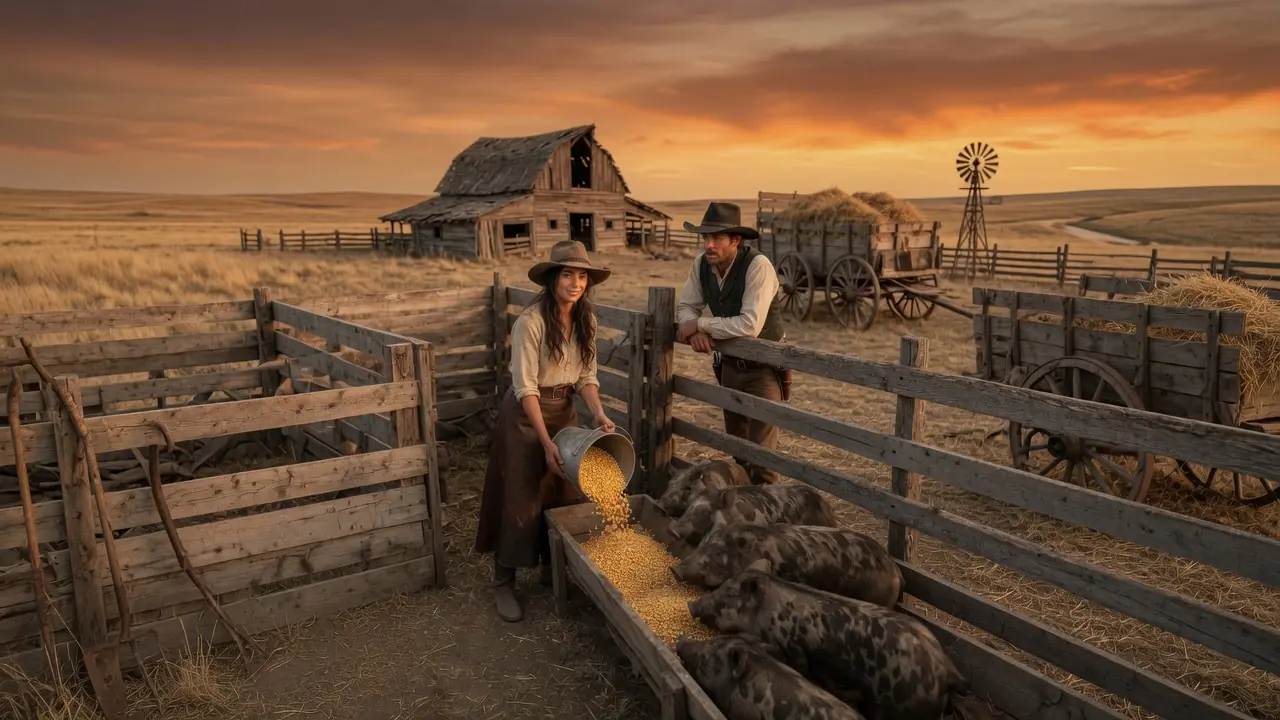
A dry goods store leaned toward the street as if it had grown tired of pretending to be upright. The church had a cracked window and no paint left on the front steps. The saloon across the road looked better cared for than both of them combined, which told Clara what kind of town she had come to before anyone said a word.
A woman came out of the store wiping flour from her hands.
She was broad-shouldered, sharp-eyed, and carried herself like she had been disappointed by most people and expected to keep being disappointed. She looked Clara over from bonnet to boots, then glanced at the carpet bag in her hand.
“You’re the one answering Elias Ward’s notice.”
Clara nodded.
“I am.”
The woman gave a short laugh with no humor in it.
“Then you either don’t know what kind of place you’re walking into, or you’re desperate enough not to care.”
Clara held the woman’s stare.
“I’ve been desperate before. It didn’t kill me.”
That seemed to surprise her.
The woman introduced herself as Mae Tillman, owner of the dry goods store and unofficial keeper of Millstone Bend’s opinions. She said Elias Ward’s farm had gone through three hired women in less than two years. One cried herself sick before leaving. One lasted nine days. The last one packed before dawn and walked four miles to town rather than wait for a ride.
“His place will break you if you let it,” Mae said.
“Then I won’t let it.”
An old man sitting on a crate near the porch snorted.
“Everybody says that at first.”
Clara looked at him.
“Then I suppose I’ll have to be different from everybody.”
Nobody answered that.
A farm boy named Ben Sutter agreed to take her out to the Ward place because his wagon was already loaded with feed going in that direction. He did not talk much during the ride, which Clara appreciated. She had spent too many years around people who used words to fill silence they were afraid of.
The road narrowed after the first mile.
Fence posts leaned along the track like drunk soldiers. Wire sagged loose in places or disappeared entirely. The land around them had once been worked, that much was clear, but drought had stripped the pastures thin and left the fields cracked open under a sky that looked too big and too empty.
“Bad country?” Clara asked.
“Good country once,” Ben said. “Before three dry years and one dead woman took the heart out of it.”
Clara did not ask what he meant.
She knew grief when she saw the work it left undone.
The Ward farm appeared below a low ridge, and even with the sun going down behind it, Clara could see the shape of ruin.
The farmhouse had once been white but had weathered into a tired gray. One porch post was missing, and the roof dipped in the middle like a back bent from labor. The barn had a hole in one side wide enough for daylight to pass through, and the hog pen near the back fence looked barely strong enough to hold animals that had lost the energy to escape.
A few cattle grazed in the distance.
Too thin.
Too quiet.
The whole place seemed to be holding its breath, waiting for someone to finally admit it was finished.
Elias Ward came out of the barn as the wagon rolled into the yard.
He was tall, lean, and sun-darkened, with shoulders that still remembered strength even if the rest of him looked worn down to bone and habit. His beard was uneven, his shirt sleeves patched, and there was dust in his hair like he had stopped noticing what the day put on him.
He looked at Clara.
“You’re Mrs. Bellamy.”
“Yes.”
“You’re smaller than I expected.”
Clara climbed down before he could decide whether to offer help.
“I work the same size every day, Mr. Ward.”
Something almost like amusement crossed his face, then vanished.
“Elias,” he said. “Mr. Ward was my father.”
“Then Clara will do for me.”
Ben unloaded the sacks of feed and left before the awkwardness in the yard could settle too hard. Elias stood with his hands at his sides, watching Clara as if waiting for her to ask to be taken back to town.
She did not.
She looked at the house, then the barn, then the hog pen, then the broken fence line stretching toward the far pasture.
“The notice said room, board, and wages,” she said. “Cooking, housework, hogs, poultry, garden, and whatever else needs doing.”
“That is what it said.”
“It did not mention the farm was dying.”
“No,” Elias said. “It did not.”
He said it plainly, without defense.
That made Clara respect him a little more than she meant to.
“How bad?”
Elias looked toward the fields.
“Bad enough that you should turn around if you have somewhere better to go.”
“I don’t.”
“Then bad enough that I owe the bank in Jasper Ridge more than this place could bring if they sold it tomorrow.”
Clara absorbed that.
“My wife died three years ago,” Elias continued. “Fever took her in six days. Same year the first crop failed. Year after that, the creek ran dry early. Year after that, sickness took half the hogs and left the rest worth less than feed.”
His voice stayed flat.
Not because it did not hurt.
Because he had repeated the facts so often they had become stones in his mouth.
Clara nodded.
“My husband died of fever too.”
Elias looked at her then with something more human in his face.
“I’m sorry.”
“So am I. But sorry doesn’t plant corn, and it doesn’t mend fences.”
For the first time, he looked directly at her.
“No. It doesn’t.”
“Then show me where I’m sleeping,” Clara said. “After that, show me the pantry, because I expect you haven’t eaten anything fit for a working man in some time.”
Elias blinked.
Then he stepped aside.
The farmhouse was worse inside than out.
Dust lay thick on the sideboards. The curtains had not been washed in a season or more. The kitchen stove worked, but only after Clara bent down and learned where the draft caught wrong. The pantry held flour, beans, cornmeal, salt pork, two jars of peaches, and enough neglect to make a meal harder than it needed to be.
Her room was a narrow space off the kitchen that had probably once belonged to hired help.
It held a cot, a washstand, and a small window that looked toward the hog pen. Clara set her carpet bag on the cot and decided it would do. A woman who had slept in city boarding houses with rats in the walls did not complain about a room with a window.
She made supper from what she found.
Beans stretched with salt pork. Cornbread crisped in a skillet. Peach juice stirred into water because the well water tasted tired and metallic. It was not much, but it smelled like someone had remembered a house was meant to hold more than grief.
Elias stood in the doorway when she set the table.
He looked almost confused.
“Sit,” Clara said.
He sat.
He ate carefully at first, like a man trying to prove he was not starving. Then hunger overruled pride, and he finished the plate quicker than he intended. Clara noticed his hands tremble when he reached for the cornbread, but she was kind enough not to look directly at it.
“This is good,” he said finally.
“It’s food.”
“Better than what I’ve been making.”
“I guessed that.”
He looked at her across the table.
“You speak plain.”
“I spent too many years with people who didn’t. It wasted time.”
The next morning, Clara saw the whole truth in daylight.
The barn roof needed more than patching. The south fence had collapsed in three places. The hog trough leaked. The garden was a square of hardened dirt with three brave onion shoots trying to survive out of spite. The cattle were not hopeless, but they were close. The hogs were underfed, restless, and smart enough to know the pen would not hold them long if they put real effort into escape.
Clara walked the property with Elias following a few paces behind.
He said little.
That suited her.
She was not looking for commentary. She was looking for what could be saved, what had to be sacrificed, what needed fixing first, and what could wait without making the whole place worse.
At the far fence, she stopped.
“This place isn’t cursed.”
Elias stared at her.
“I didn’t say it was.”
“You looked like you believed it.”
He looked away.
“Some days I do.”
Clara bent and picked up a length of old wire half-buried in dirt.
“Curses are what people call problems when they’re too tired to solve them.”
His face tightened.
She expected anger.
Instead, he looked tired.
“That what you think I am? Too tired?”
“Yes,” she said. “But not useless.”
The honesty hit him harder than comfort would have.
He said nothing.
Clara pointed toward the barn.
“We start there. Rain will come eventually, even if this county forgot what it looks like. If that roof goes, you lose the barn, and if you lose the barn, the bank won’t have to do much of anything. The place will finish itself.”
Elias studied the roof.
“And after that?”
“The hog pen. Then the fences. Then the feed. Then the field.”
“You say that like it’s simple.”
“It isn’t simple. It’s just next.”
That first week was nothing but hard work and small victories.
They patched the barn roof with scrap boards, old shingles, and tar that had nearly dried in its bucket. Clara blistered her palms until they split, then wrapped them in cloth and kept working. Elias tried twice to tell her to rest, and both times she ignored him so completely he stopped wasting his breath.
They rebuilt the hog pen with salvaged rails.
They boiled old grain with kitchen scraps to stretch the feed. Clara gathered wild greens along the creek bed and mixed them into mash because she had grown up poor enough to know animals could eat things rich farmers walked past. The hogs began to gain strength in small, visible ways, not enough to impress anyone yet, but enough to prove the body remembers health when someone offers it a chance.
At night, Clara kept records in an old ledger she found behind a flour bin.
Feed used.
Fence repaired.
Animals treated.
Hours traded.
Weather.
Everything.
Elias watched her write one evening while the lamp smoked between them.
“What are you keeping all that for?”
“So we know what’s working.”
“What if none of it works?”
“Then we’ll know that too.”
He laughed once, short and rough.
“You always this stubborn?”
“No,” Clara said. “I used to be worse.”
By the second week, Millstone Bend began talking.
Mae Tillman came out under the excuse of delivering mail that could have waited another day. She stood in the yard and looked at the roof patch, the hog pen, and the new line of fence posts waiting near the barn.
“You’re still here,” she said.
“I am.”
“Town had a pool going.”
“On how long I’d last?”
Mae looked mildly embarrassed, which Clara enjoyed more than she should have.
“Some said three days. Some said a week. Old Mr. Haskins said you’d leave once you smelled the hog pen.”
“The hogs smell better than some men I worked laundry for.”
Mae barked out a laugh before she could stop herself.
Elias heard it from the barn and looked over.
There was something in his expression Clara had not seen before.
Not happiness exactly.
Something close to remembering it.
Mae left with less skepticism than she arrived carrying. That mattered in a town like Millstone Bend. A place could turn on a person through talk, but it could also turn toward them the same way, slowly, mouth by mouth, until doubt became curiosity and curiosity became reluctant respect.
The first real help came from a neighboring farmer named Jonah Rusk.
He had a square face, tired eyes, and a manner that suggested kindness made him suspicious of himself. Elias had once helped him save cattle during a winter freeze, back before everything fell apart. Clara persuaded Elias to ride over and ask for feed, not as charity, but as trade.
“You repair his west fence,” she said. “I help his wife with preserving. He gives us grain and hay enough to carry the animals two weeks.”
“That sounds like begging dressed up.”
“No,” Clara said. “Begging leaves one man smaller. Trade leaves both standing.”
Elias looked at her a long time.
Then he saddled the horse.
Jonah agreed.
Not warmly.
Not quickly.
But he agreed.
Three days of work on the Rusk place brought them enough feed to steady the cattle and hogs through the next stretch. It also brought something Clara had not expected so soon. Word that Elias Ward was working again. Not simply moving through chores like a ghost. Working with purpose.
That kind of word traveled.
It traveled to the store, then the church steps, then the saloon, then across fence lines and supper tables.
The Ward place was not saved.
Not by any fair measure.
But it was no longer quietly dying without resistance.
That alone changed how people looked at it.
Elias changed too, though slower.
At first, he merely followed Clara’s plans because she had plans and he had none. Then he began offering thoughts of his own. A low corner of the east pasture that held moisture longer than the rest. A patch of creek-bottom soil that might take late beans. A stand of dead cottonwood that could be split into fence posts if they were careful.
One afternoon, while they worked the east fence, Clara caught him standing still with one hand on the wire.
“What?”
“I was just thinking.”
“That sounds dangerous.”
He almost smiled.
“My father used to say this ground had a stubborn streak. Said it would give if a person argued with it the right way.”
“Your father sounds like he understood land.”
“He did.”
“And you?”
Elias looked across the pasture.
“I used to.”
That admission landed quietly.
Clara did not press it.
Some men could say more if you let them say less.
By the end of the first month, the farm looked different enough that even a stranger might have noticed. The roof still showed patches, but rain would no longer fall straight through it. The fences were uneven but standing. The hogs had begun pushing one another at the trough with actual appetite. The cattle no longer looked like shadows wearing hide.
The house changed too.
Not beautifully.
Not quickly.
But honestly.
Curtains were washed. Floors scrubbed. The kitchen smelled of bread more often than dust. Clara opened windows that had been stuck for years, and the first time fresh wind moved through the sitting room, Elias stood in the doorway like a man watching someone disturb a grave.
“That room was Lydia’s favorite,” he said.
Clara’s hand paused on the window latch.
Lydia was his wife.
He had not said her name until then.
“She liked morning light,” he added.
“Then the room should have some.”
He swallowed.
“I shut it up after she died.”
“I know.”
“It felt wrong to let anything in.”
Clara looked at the sunlight crossing the floor.
“Maybe it’s wrong to keep everything out.”
Elias did not answer.
But he did not close the window.
Spring planting came late because the soil took time to prepare.
They worked eleven acres that had nearly hardened beyond usefulness. They spread manure, turned dirt, broke clods, and picked stones until Clara’s back ached so badly she had to lower herself into chairs with both hands. Elias worked beside her with a concentration that seemed to return strength to him piece by piece.
They planted corn, wheat, beans, and a half-acre of vegetables meant for winter stores.
Clara made every row count.
Elias teased her once for measuring too carefully.
She told him seeds did not forgive laziness.
He stopped teasing and started measuring.
For a brief time, the farm existed in a fragile kind of peace.
The work had been done.
The seed was in the ground.
The hogs were fattening, the cattle steadier, and Elias had begun to speak of autumn as though he might live to see it with something other than dread.
Then Ben Sutter rode out from town with a warning.
A storm was building beyond the western ridge.
Not a gentle rain.
Not the soft blessing every farmer wanted after drought.
The kind of storm that came hard after years of dry ground, with rain too fast for soil too cracked and tight to drink. Water would run, not soak. It would find the low places. It would pool where crops had just begun to rise.
Clara knew before Elias said it.
“The main field is the low place.”
He nodded.
“If it floods, we lose the planting.”
“And if we lose the planting?”
His silence answered.
The bank in Jasper Ridge had already sent two notices. The loan had been extended once after Lydia died. It would not be extended forever. A failed crop would turn a struggling farm into paperwork.
Clara walked the edge of the field, eyes tracing the land.
“Drainage channels.”
Elias frowned.
“What?”
“We cut channels from the low spots to the gully past the south fence. Give the water somewhere else to go.”
“By hand?”
“Yes.”
“Clara, that field is eleven acres.”
“I can count.”
“The storm could be here in two days.”
“Then we start now.”
He looked at her like she had asked him to hold back the sky.
She faced him squarely.
“I don’t know how to stop rain. I do know how to move water once it falls.”
They dug until dark.
The soil fought every shovel. Their hands blistered and reopened. They cut one main channel along the field’s eastern edge and two smaller branches across the lowest sections, sacrificing several rows of wheat on purpose because losing six rows was better than losing the field.
By midnight, they had barely done enough to prove the idea.
Not enough to save the crop.
Elias stood at the field’s edge, breathing hard.
“We need hands.”
“Who would come?”
He looked toward town.
“People who understand that storm won’t only fall on us.”
He rode into Millstone Bend before dawn.
Clara stayed behind and kept digging.
She expected no one.
That was the safer expectation.
But by sunrise, wagons appeared on the road.
Jonah Rusk came first, carrying two shovels and an expression that suggested he regretted arriving early enough to be praised. Mae Tillman came behind him in work boots and a faded dress, her hair tied tight under a scarf. Ben brought his father. Two farmers Clara did not know came because their own low fields faced the same threat.
Mae climbed down and picked up a shovel.
“Well,” she said, looking at Clara’s dirt-streaked face, “show us where you want this water to run.”
Clara stared at them for a moment.
Then she pointed.
The next two days became the kind of labor people remembered years later because their bodies never fully forgot it.
Men and women dug in lines across the field under a sky growing darker by the hour. Some came for half a day and left to tend their own land. Others stayed longer than they intended. No one called it charity. No one mentioned pity.
It was trade, warning, shared risk, and stubbornness.
It was a valley remembering that disaster did not ask permission before crossing property lines.
By the third evening, the channels were ugly but functional.
They tested them with buckets from the well, watching water move along the trenches toward the gully. It was not perfect engineering. It was desperate, practical work cut into dirt by exhausted people with more reason than resources.
The storm arrived after dark.
Rain hit the roof hard enough to drown conversation.
Wind slapped loose boards against the barn. The yard turned to mud within an hour. Lightning showed water racing over the ground in shining sheets, looking for the lowest place to destroy.
Clara sat at the kitchen table with Elias through the night.
Neither slept.
Neither said much.
At one point, when thunder shook the window glass, Clara’s hand found his on the table and held it without thinking. He did not pull away. His fingers closed around hers, rough and warm, and they sat like that while the sky tried to take back everything they had built.
Just before dawn, the rain softened.
They went to the field in wet coats and muddy boots, walking side by side in silence.
Clara had prepared herself for ruin.
She told herself she had done what could be done.
She told herself trying was not failure, even if the result still broke them.
Then they reached the rise and saw the field below.
Water stood between rows, but it was moving.
Slowly.
Brown and heavy.
But moving.
It ran along the channels they had cut, down the main trench, out past the south fence, and into the gully where it could do no harm.
The crops were battered.
Some rows had gone under.
But the field had not drowned.
Elias took two steps forward, then stopped.
“It held.”
His voice cracked.
Clara pressed one hand to her mouth.
The sound that left her was half laugh, half sob.
“It held,” she said.
Elias turned toward her, and for the first time since she had known him, he looked not like a man surviving grief, but like a man who had reached the other side of it and could see land beneath his feet.
He pulled her into his arms there in the mud.
Not carefully.
Not politely.
Like relief had knocked the manners out of him.
She held on just as hard.
By noon, they were riding to check the neighbors’ fields.
Jonah had lost part of his low ground but saved more than he would have without the channels. Ben’s father had copied the design in time to spare his corn. Mae’s sister, who owned land near the creek, said the trenches they dug behind her garden kept water from washing through the cellar.
Word spread faster than floodwater.
The Ward place had not just saved itself.
It had shown the valley how to fight back.
That mattered when the bank letter came three weeks later.
The bank in Jasper Ridge announced it would send an assessor at harvest to determine whether the property showed enough improvement to extend the loan. If not, the balance would be called due. Elias read the letter twice, and Clara watched the old fear move through him like a cold wind through an open door.
“We don’t have enough money,” he said.
“No.”
“Then what do we have?”
Clara reached for the ledger.
“Proof.”
She had recorded everything.
Fence repairs.
Feed trades.
Drainage work.
Hog weights.
Cattle condition.
Planting dates.
Storm damage and survival.
Letters came from the neighbors without her asking twice. Jonah wrote that Elias Ward’s field drainage had saved half his crop. Mae wrote that Clara Bellamy had turned a farm the town considered finished into a working property again. Ben’s father wrote that the Ward farm was once more a reliable trade partner.
The harvest came in better than anyone expected.
Not rich.
Not easy.
But enough.
The corn filled more bins than Elias had seen full in years. The wheat, though reduced by storm damage, was good. The beans from the replanted rows produced late but steady. The hogs sold at a price that made Elias stand at the market yard and stare at the receipt as if numbers had become a language he had forgotten.
The assessor arrived in a black coat, carrying a leather notebook and the personality of a locked drawer.
His name was Mr. Halden.
He walked the farm without warmth. He measured fences. Inspected the barn. Checked the hog pen. Asked about yields, livestock, loan terms, and water control. Clara answered half the questions because her ledger held half the answers.
At first, Mr. Halden looked annoyed by that.
Then he looked impressed despite himself.
“You kept these records?”
“I did.”
“Why?”
“So no one would have to take our word for what changed here.”
He studied her for a moment.
Then wrote something in his book.
The decision took two weeks.
Those two weeks were harder on Elias than the storm had been. He mended things that did not need mending. Checked the field twice a day. Walked fences at dusk. Sat awake at night while Clara pretended not to notice how often he stared at the door as if the letter might enter by itself.
When it finally came, Ben delivered it with a grin he tried and failed to hide.
Elias opened it in the yard.
Clara stood beside him.
His eyes moved down the page.
Then he went still.
“What?” Clara asked.
He cleared his throat.
“They’re extending the loan.”
Clara let out a breath.
Elias kept reading.
“Better terms. Lower interest. They cite improved productivity, documented management, livestock recovery, and flood mitigation measures.”
His voice gave out for a moment.
Clara took the letter and read it herself because she had learned never to trust good news until she saw the ink.
It was true.
They were not safe forever.
No farm ever was.
But they had time now.
Time was more valuable than mercy.
Elias laughed then, rough and disbelieving.
He caught Clara by the waist and lifted her clean off the ground before remembering himself and setting her down quickly, face flushed like a boy.
“I’m sorry.”
“I’m not,” Clara said.
He looked at her.
Something changed in the space between them.
Or maybe it had been changing for months, and the letter simply gave them both permission to see it plainly.
Mae arrived that evening with a bottle of blackberry brandy and a pie wrapped in cloth.
“I heard,” she said, stepping into the kitchen without waiting to be invited. “Whole town heard. Jasper Ridge clerk talks when he’s impressed, and apparently today he was impressed.”
Clara smiled.
“Come in, then.”
Mae set the pie down.
“I told you when you arrived I’d thank you if you were still here in a month. Seems I was aiming too small.”
Elias poured three glasses.
“To what?” he asked.
Mae looked at Clara.
“To the woman too stubborn to leave.”
Clara lifted her glass.
“And to the man who finally remembered how to stay.”
Elias met her eyes.
He did not look away.
Winter came gentler than expected.
Snow fell soft instead of cruel. The barn held. The fences stood. The hogs stayed warm. The house no longer sounded empty when the wind moved through it.
By then, Clara and Elias had stopped pretending their partnership was only practical.
They did not rush it.
They were both old enough in grief to know the difference between loneliness and love. Loneliness grabs for anything warm. Love waits until the work is done, then stays to wash the dishes.
One evening, Elias found Clara at the kitchen table updating the ledger.
He stood in the doorway longer than necessary.
She looked up.
“You’re hovering.”
“I know.”
“Are you planning to say something?”
“I’m trying.”
She set down the pen.
“That sounds serious.”
“It is.”
He came to the table and sat across from her.
“I hired you because I needed someone to cook, feed hogs, manage chores, and do the hundred things I no longer had the strength to do right.”
“I remember the advertisement. It was not very romantic.”
He smiled faintly.
“No. It was desperate.”
“Yes.”
“I thought you’d leave.”
“I know.”
“I thought everyone leaves eventually when they see the worst of a place.”
Clara’s face softened.
“Not everyone.”
Elias reached into his pocket and pulled out a plain gold ring.
It was simple.
No stone.
No decoration.
Just honest metal warmed by his hand.
“I bought this in Jasper Ridge after the bank letter came,” he said. “I’ve carried it for eight days like a fool, trying to find a way to ask without making it sound like I’m asking because the farm runs better with you in it.”
“And are you?”
“Yes,” he said. “But not only that.”
She laughed softly.
He took a breath.
“I’m asking because I love you. Because this house feels like a home again when you’re in it. Because I don’t want a future that only has your handwriting in the ledger and not your hand in mine.”
Clara was quiet.
Then she reached across the table and placed her hand in his.
“I did not come here looking for a husband.”
“I know.”
“I came here because I had nowhere better to go.”
“I know that too.”
She looked toward the window, where the dark yard lay quiet beneath winter stars.
“But somehow, this broken farm became the first place in years that did not make me feel like I was simply surviving.”
Elias’s thumb moved across her knuckles.
“So?”
“So yes,” Clara said. “I’ll marry you.”
They married in spring under the big cottonwood beside the house.
Mae officiated because the circuit preacher was late and Mae had apparently married three couples in younger days and saw no reason to let a missing preacher delay good sense. Jonah stood as witness. Ben grinned through the whole ceremony. Several neighbors came because the Ward farm had become everybody’s favorite proof that a thing could look finished and still not be done.
Clara wore a blue dress she had altered herself.
Elias wore his good coat, brushed clean twice and still carrying a faint smell of barn because some truths cannot be pressed out of wool.
His vows were plain.
“I promise to keep building,” he said. “Even when the work looks too hard. Even when the weather turns. Even when grief tries to convince me nothing good lasts. I promise not to shut the windows again when the light is trying to come in.”
Clara’s voice trembled only once.
“I promise to stay,” she said. “Not because staying is easy, but because some things are worth the stubbornness they ask of us. I promise to work beside you, argue honestly, hope carefully, and never let this place forget what it survived.”
Mae wiped one eye and blamed dust.
There was no dust.
In the years that followed, the Ward farm became known across the county.
Not as the biggest farm.
Not the richest.
The smartest.
The one people visited when their own fields flooded, their fences failed, or their hope started thinning out like bad pasture. Clara helped neighbors plan drainage channels. Elias taught men how to trade labor without making it feel like charity. Mae told the story at the store so often that she began improving it just for entertainment.
“She arrived with one bag and enough stubbornness to scare the devil out of a fence post,” Mae would say.
Clara always denied the finer embellishments.
But not the stubbornness.
A young widow named Ruthie Crane came to them one autumn with a failing patch of land and three children to feed. Clara brought her inside, poured coffee, opened the ledger, and said the same words she wished someone had once said to her.
“Tell me what you have left. We start there.”
That became the way of it.
Not charity.
Not pity.
Trade.
Knowledge.
Hands when the storm came.
A meal when the work ran long.
One neighbor refusing to watch another drown just because the water had not yet reached their own door.
Years later, when Clara and Elias sat on the repaired porch watching their little boy chase fireflies through a yard that had once been dust and broken boards, Elias asked her if she ever thought about the day she arrived.
“I do,” she said.
“What do you think?”
“I think I nearly lied when I said the place was what I expected.”
He laughed.
“It was worse?”
“Much worse.”
“And you stayed anyway.”
She leaned against his shoulder.
“I was tired of letting bad luck decide where I belonged.”
Across the yard, their son held up a jar with one flickering firefly inside and shouted for them to look.
They did.
The house behind them stood straight now. The barn roof was whole. The fences ran clean and solid over three miles of land. The field beyond the south pasture moved green in the evening wind, fed by channels that had once been dug in desperation and later became the pattern half the valley copied.
Nothing about it had been easy.
That was why it mattered.
The county remembered the story in different ways.
Some said Elias Ward hired a woman to cook and feed hogs, and she saved his farm before he knew saving was possible. Some said Clara Bellamy arrived with nothing but a bag and an attitude sharp enough to cut wire. Some said the storm made the farm famous. Others said the ledger did.
Clara knew better.
The story was not about one woman saving one farm.
It was about what happens when a person looks at a broken thing and refuses to call broken the same as dead.
It was about a man who had nearly let grief bury him, then stood up when someone finally asked him to work like the future still existed.
It was about neighbors who stopped betting on failure and picked up shovels instead.
That was the part worth remembering.
Because drought comes.
Debt comes.
Storms come hard and without apology.
But sometimes, if people are stubborn enough, honest enough, and willing enough to stand beside one another in the mud, a dying place can breathe again.
And sometimes a woman steps off a wagon with twelve dollars in her hem, looks at the worst farm in the county, and decides the whole county is wrong.
That was how the Ward farm came back.
One fence post.
One shovel line.
One meal.
One storm.
One impossible decision to stay.