“My sister owes five hundred thousand dollars,” my mother said, her voice so cold that the entire kitchen seemed to freeze around me. “You will pay it by Friday, Claire, or you are no longer our daughter.”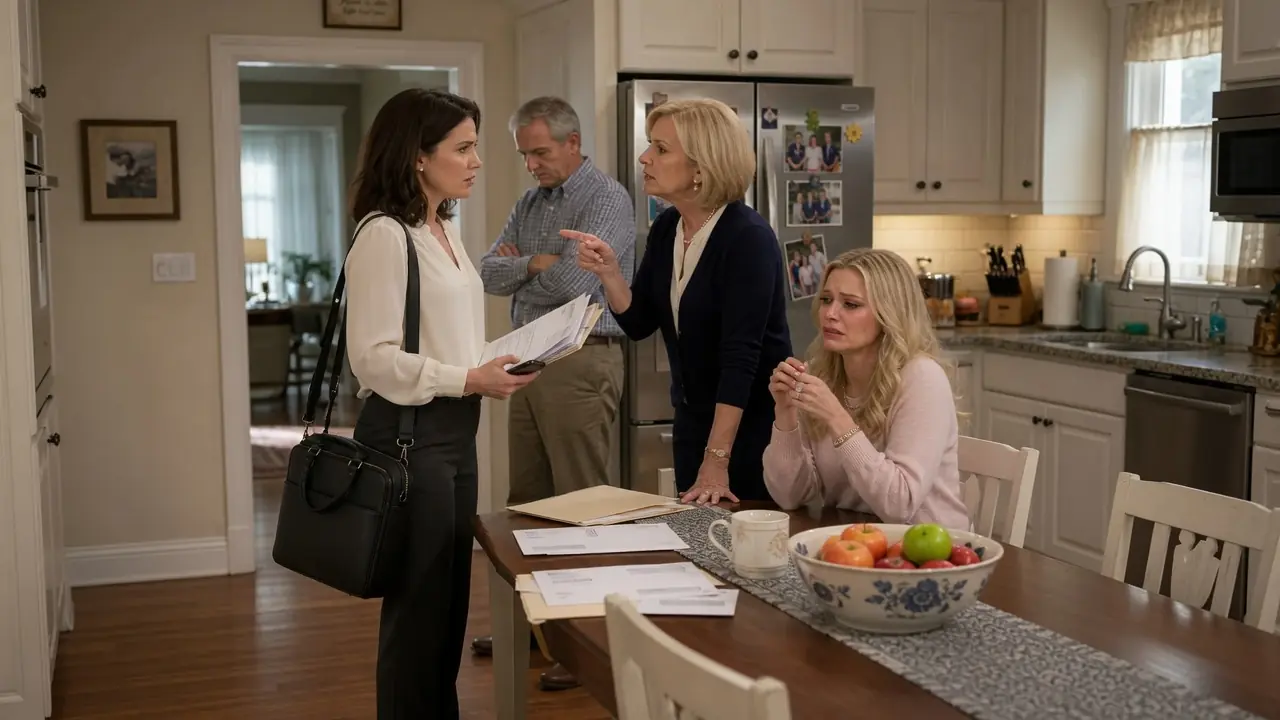
For several seconds, I honestly believed I had misunderstood her. I was still wearing the navy blouse and black trousers I had worn to work, and the strap of my laptop bag was digging painfully into my shoulder. I had driven almost two hours through heavy evening traffic because my mother had called me crying so hard that I could barely understand her. I had assumed someone had died.
Standing in that kitchen, I realized something had died.
It just was not a person.
It was whatever remained of my belief that my family would never deliberately destroy me.
Brittany sat at the kitchen table with swollen red eyes, perfect pale-pink nails, and a diamond ring twisting nervously around her finger. The ring was from her husband, Eric, who had left her six months earlier after years of arguments about money, debt, and the luxurious life she insisted she deserved. My father stood beside the counter with his arms folded, staring at the gray floor tiles as though the pattern between them was more important than what was happening directly in front of him. My mother, Linda, stood near the sink with her back straight and her lips pressed into the thin, determined line I had feared since childhood.
I lowered my bag onto the floor.
“What do you mean Brittany owes half a million dollars?”
Brittany sniffed and rubbed a tissue beneath her nose. “It was a business investment.”
My father gave a short, bitter sound from the counter.
“It was gambling,” he muttered.
My mother’s head snapped toward him. “Not now, Robert.”
“When would be a better time?” he asked quietly.
She stared at him until he looked away again.
That was how my parents’ marriage had always worked. My mother decided what the truth was allowed to sound like, and my father survived by speaking only when he believed she would tolerate it. Sometimes he offered a weak objection, but the moment she turned her attention toward him, he retreated. He called it keeping the peace.
I had spent most of my life learning that peace in our family meant surrendering to my mother before she had to raise her voice.
I looked at Brittany. “What business investment?”
She pushed her long blond hair behind one ear. “My event-planning company.”
“You do not have an event-planning company.”
“Yes, I do.”
“You have an Instagram page and a business card.”
Her lower lip trembled. “I had clients.”
“You planned two birthday parties and a bridal shower.”
Brittany’s expression crumpled as though I had slapped her. My mother immediately stepped closer to the table and placed a protective hand on her shoulder.
“There is no reason to humiliate her,” Mom said.
“I am trying to understand how three small events created five hundred thousand dollars in debt.”
“They didn’t,” Dad said.
My mother glared at him again, but this time he kept speaking.
“She started betting online after Eric left. Sports, cards, casino games, anything she thought would give her fast money. Then she started borrowing to replace what she lost.”
Brittany’s voice rose. “I was trying to save the business.”
“You were trying to win back money you had already lost,” Dad replied.
“I had investors waiting.”
“You had lenders waiting.”
“Robert,” my mother warned.
I looked from one face to another. The details began assembling themselves into an ugly picture, and with each new piece, I felt the floor beneath me becoming less stable. Brittany had borrowed from private lenders, maxed out credit cards, and taken advances against projected business income that did not exist. She had persuaded my parents to sign documents they claimed not to understand, and somehow their house had become collateral for part of the debt.
“How much of the five hundred thousand is secured against this house?” I asked.
My father rubbed his forehead. “Almost three hundred.”
My stomach tightened. “You signed for that?”
“I thought it was a temporary business loan.”
“You signed without reading it?”
“Your sister was upset,” Mom said sharply. “She was trying to rebuild her life after her husband abandoned her.”
“Eric left because she emptied their retirement account.”
Brittany burst into fresh tears.
My mother’s eyes hardened. “That is enough.”
“No, I don’t think it is.”
The room went silent.
I had been the quiet daughter for most of my life. Brittany had been the beautiful one, the emotional one, the daughter whose pain entered every room before she did. I was the dependable one, which meant my suffering was always treated like something I could manage privately. If Brittany cried, the family gathered around her.
If I cried, my mother told me to calm down before I embarrassed myself.
I turned toward her. “Why exactly did you ask me to come here?”
She did not hesitate.
“Because you have money.”
The sentence was so blunt that for a moment it almost made me laugh.
“I have savings,” I said.
“You have more than savings.”
“How would you know?”
“You told your father you were preparing to buy a house.”
I looked at Dad. He still would not meet my eyes.
The betrayal was small compared with everything else happening in that kitchen, but it still hurt. I had told him six months earlier that I was close to having enough for a substantial down payment on a small house outside Philadelphia. I had asked him not to mention the amount because I knew my mother would immediately begin measuring it against Brittany’s needs.
He had promised me.
Now I understood that his promises lasted only until my mother demanded something else.
“I have two hundred and forty thousand dollars,” I said slowly. “Most of it is invested, and the rest is for a house.”
My mother nodded as if we were discussing a solution we had already agreed upon. “You can withdraw it.”
“That is not five hundred thousand.”
“You have retirement accounts.”
I stared at her. “You want me to empty my retirement?”
“You are thirty-five.”
“That does not make it free money.”
“You have a high salary.”
“I worked twelve years to reach that salary.”
“You can earn it again.”
I let out one bitter laugh. “And Brittany cannot?”
Brittany looked up from her tissue. “You know I can’t pay it, Claire.”
“Why not?”
“They will ruin me.”
I looked straight at her. “You ruined yourself.”
She began sobbing so loudly that my mother wrapped both arms around her. Dad closed his eyes, and for one second I saw something like shame cross his face. It disappeared as quickly as it came.
My mother stroked Brittany’s hair. “Do you see what you are doing to her?”
“What I’m doing?”
“She is already terrified.”
“She stole, lied, gambled, and put your house at risk.”
“She made a mistake.”
“A mistake is missing a payment. Half a million dollars is a campaign.”
Mom released Brittany and stepped toward me. “Family fixes mistakes.”
“Then let Brittany fix hers.”
“She can’t.”
“That does not make it mine.”
My mother’s face changed. Her voice became quieter, which was always more dangerous than shouting.
“You have never understood what your sister has been through.”
I almost answered immediately, but the words caught in my throat because I had heard some version of that sentence for as long as I could remember. Brittany had been sensitive. Brittany had needed more support. Brittany had struggled with confidence, anxiety, heartbreak, and disappointment.
I had struggled too.
The difference was that I had not been permitted to make my struggles everyone else’s emergency.
When I was seventeen, I worked evenings at a grocery store to save for college applications. Brittany crashed my mother’s car after sneaking out to a party, and the money I had saved was used to pay the insurance deductible. Mom promised they would repay me.
They never did.
When I was twenty-three, Brittany quit her job because her manager was “toxic,” and I covered three months of her rent while she searched for something that felt right. When I was twenty-seven, she planned a destination wedding she could not afford, and my parents pressured me into paying for the photographer because family memories were priceless. When I turned thirty, I canceled my birthday trip because Brittany needed money for fertility treatments she later admitted she had never scheduled.
Every rescue became evidence that the next rescue was reasonable.
Every refusal became proof that I was selfish.
“I have spent my entire life understanding what Brittany goes through,” I said. “No one in this family has ever been required to understand what she puts me through.”
My mother’s face tightened. “You have always been jealous of her.”
The accusation hit harder than I wanted it to. I had heard it whenever I resisted giving Brittany something she wanted, but that night the words felt especially cruel. They reduced every sacrifice I had made to envy and every boundary I had attempted to set to bitterness.
“Jealous of what?” I asked. “The debt? The divorce? The fraud?”
“Her ability to be loved.”
The room became completely still.
Even Brittany stopped crying.
My mother seemed surprised by her own words, but she did not apologize. She lifted her chin instead, as though cruelty became acceptable if she defended it confidently enough.
I looked at my father.
For one second, I honestly believed he would stop her. I believed he would finally say that she had gone too far, that I was also his daughter, and that no family had the right to threaten one child into financial destruction to rescue another. His lips parted slightly.
Then he looked down at the floor.
Something inside me finally broke.
It did not break loudly. There was no dramatic explosion, no sudden scream, and no satisfying crash of glass against a wall. It was quieter than that.
It was the sound of a final thread snapping after holding too much weight for too many years.
My mother folded her arms. “You will transfer whatever you can by Friday. We will arrange the rest through loans in your name.”
I stared at her. “Loans in my name?”
“You have excellent credit.”
“How convenient.”
“This is not a joke.”
“No, it isn’t.”
“If you refuse, then you are making your choice.”
I felt strangely calm. “What choice?”
“Your sister or your money.”
“That isn’t the choice you’re offering.”
“It is exactly the choice.”
“No. You are asking me to choose between destroying my life and losing a family that is willing to destroy it for me.”
My mother’s eyes flashed. “You will pay, or you are no longer our daughter.”
For a moment, I heard nothing except the refrigerator humming behind her. I thought about all the birthdays, holidays, graduations, and Sunday dinners that had made up my idea of family. I thought about my father teaching me to ride a bicycle and Brittany crawling into my bed during thunderstorms.
I thought about my mother sitting beside me in the hospital when I had my appendix removed at fourteen.
Then I thought about her standing in that kitchen, calculating the value of my future as though it were an available family asset.
“Then I choose not to be your daughter anymore,” I whispered.
My mother’s expression shifted from certainty to shock.
Brittany lifted her head. “You can’t mean that.”
“I do.”
“You would walk away over money?”
I turned toward her. “No, Brittany. I’m walking away because you all decided my life was worth less than your consequences.”
She stared at me, and something nervous flickered across her face. Until then, she had seemed frightened about the debt. Now she looked frightened of me.
I bent down and picked up my laptop bag.
My mother stepped in front of the doorway. “You are not leaving until we settle this.”
“It is settled.”
“You have until Friday.”
“I’m not paying anything.”
Brittany pushed herself up from the chair. “Claire, stop being dramatic.”
I almost laughed at the absurdity of hearing that from her. “You forged my signature on a five-hundred-thousand-dollar loan, and I’m being dramatic?”
The words left my mouth before I could stop them.
Brittany froze.
My mother frowned. “What did you just say?”
Brittany’s face lost all color. “Wait. What do you mean you already know?”
The question slipped out too quickly.
The second our eyes met, I saw it.
Pure panic.
Her mouth opened as if she wanted to reach into the air and pull the words back, but it was too late. My father slowly lifted his head, and my mother looked between us with genuine confusion.
“Brittany,” she said. “What is Claire talking about?”
My hands were shaking, but not from fear anymore. It was anger, the kind that settled deep inside my chest and made everything suddenly very clear. I reached into my laptop bag and removed a thick gray folder.
“Three weeks ago, I received a call from the fraud department at my bank.”
Brittany began shaking her head.
I placed the first document on the kitchen table.
“Someone tried to open a business credit line using my name, my Social Security number, and a forged electronic signature.”
My mother stared at the page. “What?”
“The application listed me as a silent partner in Brittany’s company.”
“It was a misunderstanding,” Brittany said quickly.
I laughed once, but there was no humor in it. “A misunderstanding is receiving the wrong order at lunch. This is identity theft.”
Dad walked toward the table and picked up the document. His eyes moved rapidly across the printed lines, and his face became grayer with each one.
“How did she get your Social Security number?” he asked.
I looked at my mother.
She blinked. “Why are you looking at me?”
“Because you keep copies of our old tax returns and medical documents in the filing cabinet upstairs.”
Brittany spoke too quickly. “I didn’t take anything from the cabinet.”
No one had accused her of doing that yet.
My father looked at her. “Then how did you get the number?”
She pressed both hands against the table. “Claire has sent it to me before.”
“No, I haven’t.”
“For insurance paperwork.”
“You were never responsible for my insurance paperwork.”
“I don’t remember exactly.”
“I do.”
I removed another set of pages from the folder. “After the bank contacted me, I checked all three credit reports. I found two credit cards I never opened and a personal loan I never signed.”
My mother’s fingers tightened around the edge of the table.
“What is the total?” she asked.
“Eighty-six thousand dollars.”
The kitchen seemed to tilt.
My mother turned toward Brittany so quickly that one of the chairs scraped across the tile. “Tell me that is not true.”
Brittany burst into tears again, but the sound had changed. Earlier, she had cried like someone seeking comfort. Now she cried like someone cornered.
“I was going to pay it back.”
“With what?” I asked. “More stolen money?”
“I had a plan.”
“You had three fraudulent accounts.”
“The business was about to improve.”
“You do not have a business.”
“That is not fair.”
“No, Brittany. Finding out that my sister secretly borrowed eighty-six thousand dollars in my name is not fair.”
She covered her face with both hands. “I panicked.”
The refrigerator hummed behind us. A car passed outside, its headlights briefly sliding across the kitchen wall.
No one spoke.
Then I removed the final document.
“Here is the part that matters most.”
Brittany dropped her hands.
I held up a copy of the lender’s guarantee agreement. My name appeared beneath several pages of obligations, promises, and default provisions. At the bottom was a signature that looked almost like mine.
Almost.
“The lender holding the five-hundred-thousand-dollar debt sent copies of the paperwork after my attorney contacted them. My name is listed as a personal guarantor.”
My father slammed his palm against the counter. “What?”
“My signature was forged on this too.”
That was the moment everything finally broke open.
Dad shouted at Brittany, demanding to know what she had done and how many documents existed. Mom kept insisting there had to be some mistake, even while the evidence sat directly in front of her. Brittany sank into the chair and repeated the same words again and again.
“I panicked. I panicked. I panicked.”
As though panic explained months of preparation.
As though panic had found my private information, studied my signature, completed credit applications, and arranged a guarantee large enough to destroy the life I had spent twelve years building.
My father picked up the guarantee agreement. “Did you sign our house over too?”
Brittany cried harder.
“Answer me.”
“I thought I could pay everything before anyone found out.”
“You used our home?”
“You signed the forms.”
“You lied about what they were.”
“I didn’t lie.”
“You told us it was a temporary line for vendor deposits.”
“It was supposed to be.”
“You put our home behind gambling debt.”
Brittany looked toward my mother. “Mom, please.”
My mother stood completely still, and for one foolish second I thought she was finally seeing what Brittany had done. I thought she might apologize to me or at least admit that demanding my money had been wrong.
Instead, she turned toward me and whispered, “Claire, please. If you report this, your sister could go to prison.”
The final piece clicked into place.
She knew.
Perhaps she did not know every forged account or every stolen dollar, but she knew enough to understand that the documents were fraudulent. She had called me to that house, pretended there had been a family emergency, and planned to frighten me into paying before I discovered the full truth.
“You are worried about prison?” I asked quietly.
“She has never been in trouble before.”
“I am worried that my own family tried to bury me alive financially.”
“We were going to make sure you did not lose anything.”
“You demanded my savings.”
“To clear the debt.”
“You wanted me to pay for the crime committed against me.”
My mother reached toward me. “I was trying to protect both of my daughters.”
I stepped back before she could touch me.
“No. You were protecting the daughter who stole from me from the daughter who never asked you for anything.”
Her hand fell to her side.
Dad looked at Mom. “How much did you know?”
She did not answer.
“Linda, how much did you know?”
“I knew there were documents.”
“What documents?”
“She told me Claire had agreed to help with the company.”
I stared at her. “You believed that?”
“At first.”
“And after that?”
Mom looked toward Brittany.
My father’s voice became louder. “After that, Linda?”
“She admitted the signature was not exactly authorized.”
“Not exactly authorized?” I repeated. “You mean forged.”
“I told her it was wrong.”
“But you still called me here to demand payment.”
“I was trying to keep the family together.”
“You were trying to keep Brittany out of prison.”
“She is your sister.”
“I am your daughter.”
My mother began crying, but I felt nothing when I saw her tears. They were not tears for what had been done to me. They were tears because the plan had failed.
Brittany rose so quickly that her chair fell backward.
Her mascara had begun running down her cheeks, and for the first time in her life, she looked like what she truly was: messy, desperate, and out of excuses.
“You won’t do it,” she said.
“Do what?”
“Report me.”
“I already hired an attorney.”
Her breathing became shallow. “You love me.”
The words hurt more than the lies.
Because I had loved her.
I had defended her when Eric accused her of overspending. I had sent money when she claimed she could not afford groceries. I had answered midnight calls, listened to her promises, and believed every speech about a fresh start.
I had been a sister to her long after she had stopped being one to me.
I reached into my bag and removed my phone.
“I thought you might say that.”
Brittany looked confused.
I unlocked the screen and pressed play.
Her voice filled the kitchen.
“Just tell Mom to scare Claire. She’ll pay if she thinks she’s losing the family.”
My mother covered her mouth.
Dad turned slowly toward her.
The recording continued.
“She has the money just sitting there,” Brittany’s voice said. “She doesn’t even need it. Once this is handled, I can breathe again.”
Then another voice came through the speaker.
My mother’s voice.
“I’ll talk to her. But your father cannot know about the forged signature.”
No one moved.
The silence after that recording was heavier than any scream.
My father looked at my mother as though he did not recognize the woman standing in front of him. “Linda, you knew?”
She began crying harder. “Not all of it.”
“But enough,” I said.
“How did you record that?” Brittany demanded.
“My attorney advised me to document every conversation after the bank called.”
“You were spying on us.”
“You called me three days ago.”
My mother’s expression changed. She remembered the conversation.
She had accidentally called me while Brittany was in the room, then left the phone connected after telling me she would call back. At first, I assumed the line had simply remained open in her pocket. Then I heard Brittany’s voice.
I listened for almost four minutes.
Those four minutes ended every excuse I might have made for them.
“You trapped us,” Mom said.
I stared at her. “You called me.”
“You knew we did not realize you were listening.”
“You knew I did not realize you were planning to blackmail me.”
“That is not blackmail.”
“You threatened to remove me from the family unless I paid a debt created through identity theft.”
“I was emotional.”
“You rehearsed the threat.”
Mom flinched.
The recording included that part too.
Brittany had suggested several versions, and my mother had chosen the one she believed would frighten me most. She knew exactly which wound to target because she had created it. For years, she had taught me that family love could be withdrawn whenever I disappointed her.
That night, she planned to use the fear she had built inside me as collateral.
My father sat down heavily in the fallen chair after setting it upright. He rubbed both hands over his face and seemed to age ten years in a few seconds.
“Claire,” he said, “we can fix this.”
“No.”
“We can sell the house.”
“You can deal with the debt attached to your names. You cannot fix what was put in mine without telling the truth.”
“We can negotiate with the lender.”
“My attorney already contacted them.”
His hands dropped. “You have done all of this already?”
“I had three weeks.”
My mother stared at me as if preparation were another betrayal. “You came here knowing?”
“I came here hoping I was wrong.”
“Then why bring the documents?”
“Because I knew I probably wasn’t.”
Brittany lowered herself into the chair. “What happens now?”
“Tomorrow morning, I file a police report.”
My mother inhaled sharply.
“I am formally disputing every fraudulent account. My attorney is submitting affidavits to the lenders and credit bureaus. I am removing myself from every forged document, and I will cooperate with any investigation.”
“You would really do that to your sister?” Mom asked.
I picked up the folder. “No. Brittany did this to me. I am refusing to disappear under it.”
“She could go to jail.”
“She knew that when she forged the first signature.”
“People make desperate choices.”
“Then desperate people face consequences.”
My mother’s voice grew louder. “You have no compassion.”
I looked at her. “Compassion without accountability is permission.”
Dad whispered my name, but I kept speaking.
“If any of you contact my job, my bank, my landlord, or anyone connected to the investigation, my attorney will handle it. Do not ask relatives to pressure me. Do not send Brittany to my apartment. Do not use my personal information again.”
Brittany’s face crumpled. “I said I was sorry.”
“No. You said you were going to pay it back after you were caught.”
“I am sorry.”
“You are afraid.”
“Isn’t that enough?”
“No.”
I lifted my laptop bag onto my shoulder.
My mother moved toward the doorway again, but this time my father stood.
“Let her leave, Linda.”
She looked at him in disbelief. “You are taking her side?”
“There should not be sides.”
“There are always sides.”
“Then we chose the wrong one.”
The words shocked all of us.
My father had spent decades avoiding direct conflict with my mother. Hearing him oppose her felt like watching furniture move by itself. He looked terrified after saying it, but he did not take it back.
Mom stepped away from the door.
I walked into the hallway, and Dad followed me.
“Claire, wait.”
I turned.
For the first time that night, he looked truly ashamed. Not uncomfortable or frightened of my mother, but ashamed of himself.
“I should have spoken up.”
“Yes.”
“I did not know about the forged accounts.”
“You knew they wanted my savings.”
“I thought we were asking for help.”
“She said I would no longer be your daughter.”
He closed his eyes. “I should have stopped her.”
“You have spent my entire life saying that after the fact.”
His face tightened.
The truth hurt him, but I had protected him from truth for too long.
Whenever my mother favored Brittany, Dad privately told me he disagreed. Whenever I was pressured into giving something up, he apologized after the money was gone. He had built his identity around being the gentler parent, but gentleness without courage had never protected me.
It had only made his betrayal quieter.
“I am sorry,” he said.
I wanted those words to mean more than they did.
I wanted them to repair the years of looking away, the broken promises, and the way he had allowed my mother to build one daughter into a queen while turning the other into a sacrifice. Some apologies come too late. They arrive after the damage has already changed the shape of your life.
“I believe that you are sorry,” I said. “That does not mean I trust you.”
He nodded slowly.
I opened the front door. Cold night air struck my face, and it felt cleaner than anything inside the house.
Behind me, my mother shouted, “If you leave now, do not come back.”
I stopped with one hand on the porch railing.
Then I turned and looked at all of them one final time.
“That is the first honest thing you have said tonight.”
I walked to my car.
My hands began shaking after I locked the doors.
Until that moment, anger had held me upright. Alone inside the car, it gave way to grief. I pressed my forehead against the steering wheel and cried for the sister I thought I had, the mother whose approval I had chased, and the father who had never been brave enough when bravery mattered.
Then my phone rang.
It was Maya Chen, my attorney.
Maya and I had met eight years earlier when our companies worked on the same corporate acquisition. She was sharp, calm, and almost impossible to intimidate. When the bank called me about the suspicious credit application, she was the first person I contacted.
“How did it go?” she asked.
“They admitted enough.”
“Did you get it recorded?”
“Yes.”
“Are you safe?”
“I’m in my car.”
“Drive home. Do not stop anywhere unfamiliar, and do not answer their calls tonight.”
I looked back at the glowing windows of my parents’ house. “My mother knew.”
Maya was silent for a moment. “I’m sorry.”
“She helped plan the threat.”
“Then the recording matters.”
“I don’t want to destroy them.”
“You are not destroying them.”
“It feels like I am.”
“That feeling is why they believed the plan would work.”
I closed my eyes.
Maya’s voice remained steady. “You are allowed to protect yourself even when the person hurting you shares your last name.”
I drove home.
The next morning, I met Maya at the police station.
The detective assigned to financial crimes was named Samuel Ortiz. He listened without interrupting while I explained the bank call, the fraudulent accounts, the forged guarantee, and the family confrontation. When I played the recording, his expression became still.
“Do you believe your mother helped obtain your identifying information?” he asked.
“I don’t know.”
“Did she have access?”
“Yes.”
“Did your sister?”
“Through my mother’s house, yes.”
“Has your sister ever had permission to sign documents on your behalf?”
“Never.”
He reviewed the paperwork and asked for copies of my credit reports. He explained that the investigation would take time because multiple lenders and electronic applications were involved. He also warned me that Brittany might attempt to describe the situation as a family financial agreement.
“She will say you promised to help,” he said.
“She has no evidence of that.”
“She may create some.”
The thought made my stomach turn.
Maya placed a hand on the folder. “That is why all communication goes through me now.”
By noon, formal disputes had been filed with the three credit bureaus. Fraud affidavits went to the banks, the private lender, and the company servicing the personal loan. I froze my credit and changed every password connected to my finances.
I also learned how much damage could be done before anyone noticed.
The fraudulent credit cards had been opened using an old address and electronic statements. Minimum payments were made for several months, preventing the accounts from immediately appearing as delinquent. The personal loan had been deposited into an account controlled by one of Brittany’s business entities.
She had not acted impulsively.
She had acted carefully.
That discovery hurt almost as much as the theft itself.
During childhood, Brittany had always been described as reckless. She forgot homework, lost jewelry, and acted before thinking. My parents used that image to excuse her because carelessness seemed less cruel than intention.
But the fraud had required planning.
She had researched lenders, created accounts, copied information, and practiced my signature. She had made repeated decisions over many months, each one depending on her belief that I would eventually absorb the consequences.
Three days after I filed the report, the family messages began.
My aunt Carol called first.
“Your mother says you are trying to send Brittany to prison.”
“I reported identity theft.”
“She says it was a family loan.”
“It was not.”
“She says you agreed to help.”
“Ask her to show you my agreement.”
Carol sighed. “Claire, sometimes being right is not worth losing everyone.”
I looked around my apartment. Boxes of house brochures and mortgage documents sat beside the desk, reminders of the future I had almost lost.
“Then they should not have made losing me the price of telling the truth.”
My aunt lowered her voice. “Your mother is not sleeping.”
“Neither am I.”
“Brittany is talking about hurting herself.”
My chest tightened, but I recognized the familiar structure. Crisis entered the room, and responsibility was immediately placed in my hands.
“If Brittany is in danger, call emergency services.”
“She needs her sister.”
“She needs professional help.”
“You are so cold.”
“No. I am finished being controlled by emergencies I did not create.”
Carol hung up.
The next call came from my cousin Denise, who wanted to know whether I could simply pay the debt and recover the money from Brittany later. An uncle sent me a message about forgiveness. A family friend wrote that my mother had sacrificed everything for me.
None of them asked what losing two hundred thousand dollars, my retirement funds, and my credit would do to my life.
They saw my stability as proof that I could survive being harmed.
They saw Brittany’s chaos as proof that she should be protected from consequences.
Maya sent cease-and-desist letters after my mother contacted my employer.
She told the receptionist there was a family emergency and demanded to speak with my supervisor. When that failed, she left a voicemail claiming I was suffering from emotional instability and making false accusations against my sister.
My supervisor, Daniel Ross, called me into his office.
I expected suspicion.
Instead, he closed the door and placed the printed voicemail transcript on his desk.
“Is there anything the company needs to do to protect you?” he asked.
Relief hit me so suddenly that my eyes burned.
I explained the situation without sharing unnecessary details. Daniel listened carefully, then informed security that my family members were not permitted inside the building. Human resources documented the contact in case further interference occurred.
“You have worked here for nine years,” he said. “Your record speaks for itself.”
That simple sentence nearly broke me.
My family had spent so long treating my reliability as an available resource that I had forgotten reliability could also earn trust.
A week later, Brittany was arrested.
The police did not arrive at my parents’ house with flashing lights, as my mother later told relatives. Brittany went to the station with an attorney after investigators requested an interview. She was charged and released pending further proceedings.
My mother called from an unfamiliar number that night.
“You have done it,” she said when I answered.
I almost ended the call immediately.
“Brittany was arrested.”
“I know.”
“She was photographed like a criminal.”
“She has been charged with crimes.”
“She is your sister.”
“You keep saying that as though it stopped her.”
“You could have handled this privately.”
“How?”
“We could have sold the house.”
“That would not remove fraudulent debt from my name.”
“We could have paid it.”
“With my money.”
“With family money.”
“There is no family money. There is Brittany’s debt, your house, and the future you wanted to take from me.”
My mother’s breathing became uneven. “Your father has moved into the guest room.”
“That is between you and Dad.”
“He blames me.”
“You helped plan it.”
“I was trying to save our daughter.”
“You had two daughters.”
She became silent.
For once, I did not fill the silence for her.
“You have always been stronger,” she finally whispered.
The words revealed more than she intended.
“That is not a compliment,” I said.
“I meant you could recover.”
“You decided my ability to recover gave you permission to hurt me.”
“I knew you would be okay.”
“You did not know that. You simply cared less if I wasn’t.”
She began crying.
I ended the call.
The investigation uncovered more than I expected.
Brittany had used my identity because my credit score was high, but I was not the only person whose information she had misused. She had opened a smaller account using my father’s details and falsified income records for a former business partner.
She had also lied to the private lender about contracts with three luxury hotels.
The contracts did not exist.
The lender’s representatives were not sympathetic people. Their interest rates were aggressive, and some of their collection methods appeared designed to frighten borrowers. Still, the evidence showed that Brittany had repeatedly misrepresented her assets and expected future income.
Her gambling records told the clearest story.
During one eleven-week period, she deposited nearly one hundred and forty thousand dollars into online betting platforms. Every major loss was followed by another loan, another advance, or another fraudulent application.
She was not trying to save a business.
She was chasing the moment when one impossible win would erase every previous lie.
My parents’ house entered foreclosure proceedings because the secured loan had already defaulted.
My mother told relatives that I had caused them to lose it.
For a while, several people believed her.
Then part of the criminal complaint became public, including details about the forged guarantee and recorded conversation. The family narrative shifted. People who had accused me of cruelty began sending careful messages saying they had not understood the full situation.
I did not answer most of them.
Their apologies were less about regret than embarrassment.
My father began texting every Sunday.
At first, the messages were simple.
Hope you’re okay.
Thinking about you.
I’m sorry.
I ignored the first four.
On the fifth Sunday, he wrote, I gave the detective access to the filing cabinet. Your mother had moved several of your old tax documents into a separate folder. I should have protected them. I should have protected you.
I stared at the message for a long time.
Then I replied, Thank you for cooperating.
It was not forgiveness.
It was the first honest step I could offer.
Several months later, Brittany’s attorney requested a meeting about a possible plea agreement. I was not required to attend, but prosecutors allowed me to submit a statement describing the impact of the fraud.
Writing it was harder than I expected.
The financial damage could be measured in dollars, legal fees, delayed plans, and damaged credit reports. The emotional damage had no clear number. I wrote about waking in the night to check bank accounts, feeling afraid whenever an unknown number called, and questioning every family memory for signs that I had always been valued only for what I could provide.
I wrote about losing the ability to hear the word sister without feeling suspicious.
Brittany eventually accepted a plea deal.
She admitted to identity theft, forgery, and fraud-related charges connected to my accounts and the loan guarantee. The agreement included restitution, probation after a period of confinement, mandatory treatment for gambling addiction, and restrictions on opening or managing financial accounts.
My mother called the sentence barbaric.
My father called it inevitable.
I called it the consequence of choices made long before I walked into that kitchen.
The court allowed me to speak before sentencing.
Brittany sat beside her attorney wearing a plain gray suit. Her hair was pulled back, and there were no diamonds on her fingers. She looked smaller than I remembered.
When I approached the podium, she lifted her eyes toward me.
For one dangerous moment, I saw the little girl who used to climb into my bed during storms.
Then I remembered the recording.
“She has the money just sitting there. She doesn’t even need it.”
I unfolded my statement.
“My sister believed that because I had been responsible, I could afford to be victimized,” I began. “My family believed that because I was stable, the damage done to me mattered less than the consequences she might face.”
The courtroom remained quiet.
“I have been asked many times whether I love my sister. I did, and part of me probably still does. Love is the reason betrayal hurts, but love cannot be used as evidence that the victim should accept more harm.”
Brittany began crying.
I kept reading.
“I do not want revenge. I want the truth entered into the record. I did not lend this money. I did not invest in her company. I did not authorize her to use my identity. When my family discovered what had happened, they did not protect me.”
My mother sat in the back row, staring straight ahead.
“They tried to frighten me into paying.”
The prosecutor glanced toward her.
“I am rebuilding my finances, but I am also rebuilding my understanding of family. I now know that sharing blood with someone does not create an obligation to let them destroy you.”
When I finished, Brittany whispered, “Claire.”
I returned to my seat without looking at her.
After the hearing, my father waited near the courthouse entrance.
My mother had already left.
“You spoke well,” he said.
“I spoke honestly.”
He nodded.
His hair had become noticeably grayer during those months, and the skin beneath his eyes sagged with exhaustion. He told me he and Mom were separating, though neither had filed for divorce. He had moved into a small apartment after the house was sold.
“I keep thinking about all the times I stayed quiet,” he said.
“So do I.”
“I thought silence kept the family together.”
“It only kept the pattern alive.”
“I know that now.”
I studied him. “Why did you always protect her?”
“Your mother?”
“Brittany.”
He took a long breath. “When she was young, she was fragile. At least that was what your mother said. You seemed capable of handling disappointment.”
“So you gave me more of it.”
His eyes filled with tears. “Yes.”
It was the first time he admitted it without an excuse.
I did not hug him.
But when he asked whether he could buy me coffee, I agreed.
Repairing my credit took almost six months.
Every fraudulent account was eventually removed, but the process required affidavits, police documents, lender disputes, conference calls, and repeated explanations. I paid thousands of dollars in legal expenses and delayed buying a house.
Even after my reports were corrected, I continued checking them every week.
Trust returned more slowly than numbers changed.
My mother never called after the sentencing.
She sent one letter through my father. It was six pages long and described her loneliness, the loss of the house, and the humiliation she felt when friends learned about the recording.
She mentioned my pain in one sentence.
I did not respond.
For years, I had believed healing required a conversation in which my mother finally understood me. I imagined her apologizing without excuses and admitting that I had deserved protection too.
Eventually, I accepted that waiting for that moment kept my life tied to her refusal.
Closure did not arrive when she understood.
It arrived when I stopped needing her to.
Nine months after the kitchen confrontation, I found a small brick house in a quiet neighborhood near my office. It had two bedrooms, a narrow backyard, and an old maple tree beside the driveway. The kitchen needed work, and the upstairs bathroom had tiles from the 1980s.
I loved it immediately.
On closing day, I sat alone in the empty living room with the keys resting in my palm. Sunlight entered through the front windows and formed bright rectangles across the hardwood floor.
I thought about the money I had nearly lost.
More importantly, I thought about the life my family had assumed I did not need because I was single and did not have children. They had looked at my savings and seen unused resources.
I looked around that room and saw years.
Early mornings, late projects, missed vacations, careful budgets, and every quiet decision that had brought me there.
My life had never been empty.
It had simply belonged to me.
Dad helped me move a month later.
He arrived with a rented truck, two boxes of tools, and no expectations. We painted the kitchen, repaired a loose stair railing, and spent an entire afternoon assembling shelves incorrectly before admitting we needed the instructions.
Sometimes conversation felt easy.
Other times, the past entered the room and sat between us.
One evening, while we ate pizza on the living-room floor, he said, “Your mother still believes you chose money over the family.”
I set down my slice.
“What do you believe?”
“I believe we chose Brittany over you long before that night.”
The answer hurt.
It also helped.
He looked toward the unfinished wall. “I don’t expect you to forgive me because I finally understand.”
“I don’t know what forgiveness looks like yet.”
“That is fair.”
“But I appreciate that you are not demanding it.”
He nodded.
That was how our relationship began again.
Not with a dramatic reunion, but with small conversations that did not require me to pretend. He kept texting every Sunday, and I began answering more often.
Sometimes it was only, I’m okay.
Sometimes we met for coffee.
My relationship with Brittany remained different.
She wrote several letters during treatment. The first focused on her fear, the second on her marriage, and the third on how gambling had changed her thinking. I read them but did not respond.
The fourth letter was shorter.
I used your love for me as part of the plan because I thought love meant you would always rescue me. Mom taught me that, but I chose to believe it because it benefited me. I am sorry for stealing your identity, your money, and your right to feel safe around your own family. I do not expect you to answer.
I read that paragraph several times.
It was the first apology she had given me that did not ask for something in return.
I still did not respond.
Not then.
A year after the confrontation, I received an invitation to speak at a financial-fraud awareness event organized by my bank. At first, I refused because I did not want my life turned into an inspirational lesson.
Then the organizer told me most victims of family identity theft never reported it.
They were frightened of destroying relationships, being blamed by relatives, or proving disloyal.
I agreed to participate.
Standing before the audience, I described the warning signs I had missed: unexpected credit inquiries, family members asking unusually specific questions about income, and emotional pressure connected to secrecy. I explained the importance of freezing credit, reviewing reports, saving messages, and seeking legal advice.
Then I spoke about the part no financial checklist could solve.
“When the person who steals from you is family, everyone may focus on what reporting will do to them,” I said. “Very few people ask what silence will do to you.”
Several people lowered their heads.
“Protecting yourself is not revenge. Telling the truth is not betrayal. A family relationship does not turn fraud into generosity.”
After the event, a woman approached me.
Her adult son had opened accounts in her name, and her husband wanted her to pay them quietly. She had been too ashamed to contact the police.
“Did you ever stop feeling guilty?” she asked.
I thought about my mother, Brittany, the lost house, and the Sundays my father spent trying to rebuild something he had helped damage.
“Not immediately,” I said. “But eventually I understood that guilt can be taught by people who benefit from your lack of boundaries.”
She began to cry.
I gave her Maya’s business card.
That night, I returned to my house and sat on the back steps beneath the maple tree. The air smelled like fresh grass, and lights glowed in neighboring windows.
My phone vibrated.
It was a message from Dad.
Hope the event went well. Proud of you.
I typed, It did. Thank you.
Then another message appeared.
This one came through the monitored communication service Brittany was permitted to use.
I heard about your talk. I’m glad you’re helping people. I’m still sorry.
I stared at the screen.
For more than a year, I had imagined what I would say if I ever answered her. Some days, I wanted to tell her she had destroyed our relationship forever. Other days, I remembered shared bedrooms, thunderstorms, and whispered promises.
Healing had not erased either truth.
I finally typed, I believe you are sorry. I am not ready for a relationship. Continue treatment because you want to change, not because you want me back.
Her reply came several minutes later.
I understand.
There was no demand, excuse, or emotional threat.
I placed the phone beside me.
Maybe someday we would speak again.
Maybe we would not.
For the first time, I understood that the decision did not need to be made out of fear.
My mother remained silent.
At family gatherings, she told people that I had become cold and unforgiving. Some relatives believed her, while others quietly stopped inviting her after she repeatedly attempted to turn every conversation toward my betrayal.
That word almost became funny.
Betrayal.
She used it to describe my refusal to accept being robbed.
I stopped correcting the story.
Anyone who wanted the truth could ask me directly. Anyone who preferred her version had already chosen the relationship they wanted.
Two years after the night in the kitchen, I hosted Thanksgiving at my house.
Dad came early and brought a pie. Maya arrived with her husband, Daniel from work brought wine, and several friends filled the dining room with laughter.
There were no threats, tests, or demands disguised as love.
No one measured my worth by what I was willing to surrender.
After dinner, Dad stood beside the kitchen window and looked around the crowded room.
“You built a good life,” he said.
“I had one before.”
He nodded. “You did. We just refused to see it.”
That sentence stayed with me.
My mother had said I did not have real responsibilities because I was single and childless. She believed my time, money, and future were less important because they did not resemble Brittany’s.
But a life does not become real only when other people depend on it.
A woman living alone is not an unfinished family.
Savings are not abandoned money.
Strength is not consent to be wounded.
After everyone left, I washed dishes while music played quietly from the living room. Dad had forgotten his scarf on the back of a chair, and Maya had left half the pie in my refrigerator.
The house felt peaceful.
Not empty.
Peaceful.
I thought about the moment my mother ordered me to choose between my money and my family. At the time, walking out felt like losing everything I had known.
Now I understood that I had not chosen money.
I had chosen truth.
I had chosen the future I had worked for, the name Brittany had stolen, and the dignity my mother believed she could use as leverage.
Most of all, I had chosen to stop auditioning for love that disappeared whenever I said no.
I am still healing.
I still check my credit more often than necessary. Unknown calls sometimes make my stomach tighten, and certain family memories carry a sadness they did not have before.
But I no longer confuse grief with regret.
Walking away from people who share your blood does not make you cruel.
Sometimes it is the first honest, loving thing you ever do for yourself.