On a cold October morning in northern Vermont, just before the sun had fully climbed over the hills, a thin layer of fog sat low across an old apple orchard. The trees stood in crooked rows, their branches twisted from age and weather. Some of the limbs were bare, and some still carried apples, small and spotted, hanging there like the last signs of a farm that had almost given up. The grass between the rows was too high. The soil was hard from years of heavy equipment.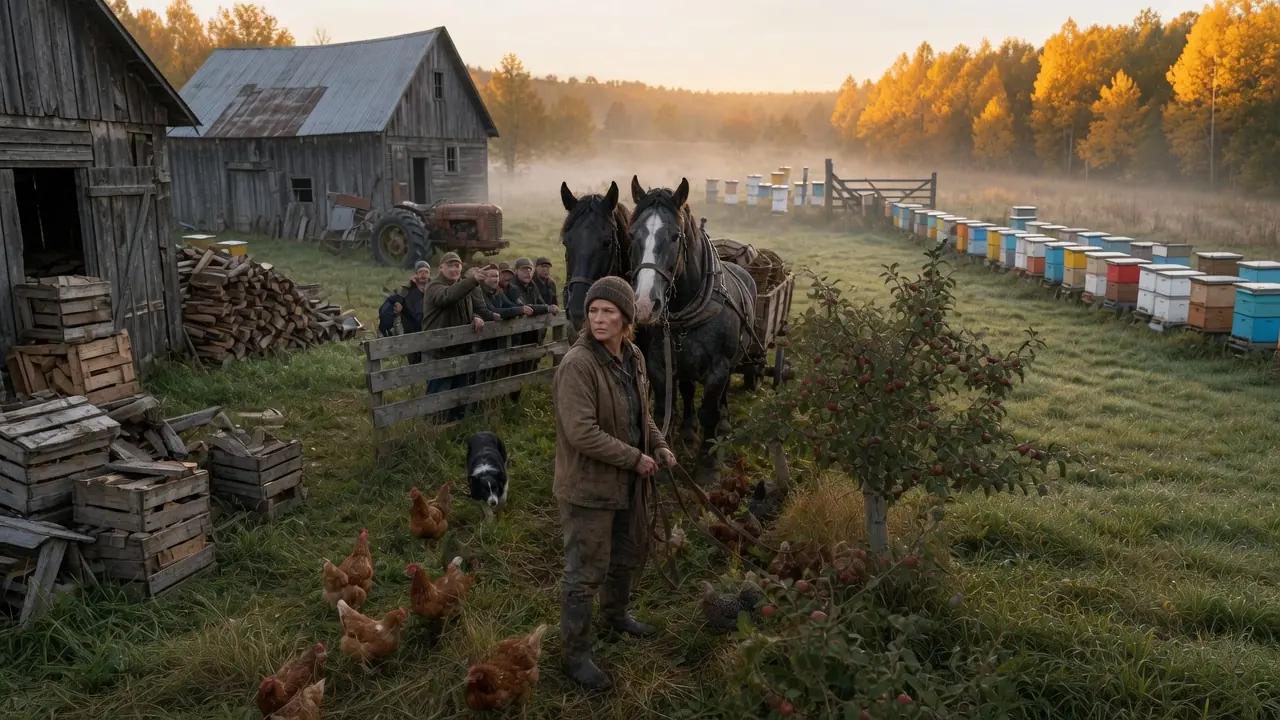
An old tractor sat beside the barn with a cracked seat, a dead battery, and more rust than paint. But if you stood near the fence that morning, you wouldn't have heard an engine. You would have heard hooves. Two massive Percheron draft horses moved slowly between the apple trees, their breath visible in the cold air. Behind them, a small wooden wagon creaked over the ground, loaded with baskets of compost and old tools.
Not far away, a black-and-white border collie circled a loose flock of chickens, keeping them moving through the grass. Along the far edge of the orchard, rows of beehives sat facing the early sun. And walking behind all of it, wearing muddy boots, a wool hat, and a faded brown jacket, was Clara Whitmore. She was 42 years old. She had no agriculture degree, no fancy farm background, no investors, no big equipment loan.
For most of her adult life, she had been an accountant for a food company in Burlington, Vermont, spending her days in front of spreadsheets, invoices, payroll reports, and quarterly budgets. But one year earlier, Clara had inherited her father's failing apple orchard. And everyone told her the same thing: "Sell it. " Her neighbors said it gently. The bank said it professionally.
A few local growers said it with a shrug, like the decision had already been made. The orchard was too old. The equipment was too worn-out. The trees needed too much work. The soil had been neglected for too long.
The labor costs alone would eat her alive. One man who had grown apples in the area for almost 35 years told her, "You're not saving an orchard, Clara. You're buying yourself a heartbreak. " But Clara didn't sell. Instead, she brought in two horses, one rescue dog, a flock of chickens, and 40 beehives.
Her father had expanded the orchard in the 1980s, back when small family farms still had a fighting chance, they weren't rich, they never were. But the farm always had enough. There were enough apples to sell at the roadside stand, enough cider to press in the fall, enough hay in the barn, enough eggs in the kitchen, enough work to keep everybody tired, and enough beauty to make the tiredness feel worth it. Clara remembered the sound of her father's boots on the porch before sunrise. She remembered the smell of warm cider in the little farm store.
She remembered customers coming back every October, year after year, because they said the Whitmore apples tasted like Vermont itself. But life moved on. Clara left for college. Her brother moved west. Her mother passed away after a long illness.
Her father kept the farm going as long as he could, but age caught up with him. The orchard started slipping a little each year. A broken fence didn't get fixed. A field didn't get mowed. The tractor needed repairs, so her father put it off.
A few bad harvests made everything harder. Then a few more bad years came behind them. By the time Clara's father died, the orchard was still standing, but barely. When Clara opened his old farm records, the numbers told a brutal story. The farm had lost money three years in a row.
Fuel costs were up. Repair costs were up. Labor costs had almost doubled. The tractor had broken down twice in one season. Several sections of the orchard had low fruit set, meaning the trees flowered, but not enough apples formed.
The soil in the older rows was compacted. Rainwater sat in shallow puddles instead of soaking in. Weeds and tall grass were competing with the trees for nutrients, and the trees themselves looked tired. A local consultant walked the property with her that November. He was kind, but direct.
He told her the practical thing would be to remove a large portion of the old orchard and replant with younger trees on a more modern system. He said, "You could start over. It'll take years, but that's the cleanest path. " Clara looked at the rows her grandfather had planted, the trees her father had pruned every winter, the place where her family had spent nearly every fall of her childhood, start over. It sounded simple when someone else said it, but to Clara, it felt like erasing the last living piece of her family.
For a few weeks, she almost gave in. She met with a realtor. She talked to the bank. She even had a conversation with a larger orchard company that was interested in buying the land. Then one evening in December, while cleaning out the attic above the barn office, Clara found a wooden box tucked behind old crates and broken picture frames.
Inside were her grandfather's notebooks. They weren't organized, and they weren't fancy, just old farm notes written in pencil. Some of them faded from time. There were weather observations, harvest numbers, tree varieties, repairs, animal feed records, notes about bees, notes about horses, and notes about chickens in the orchard. One line stopped her cold.
"Let the animals do what machines rush through. " Clara sat there on the attic floor and read for almost two hours. Her grandfather had used draft horses in the orchard before tractors became the standard. Not for everything, but for the jobs where a heavy machine caused more damage than help. The horses pulled wagons, moved compost, hauled pruned limbs, and worked in places where the soil stayed soft.
He kept beehives on the property to help with pollination. He ran chickens under the trees during certain parts of the year to scratch through fallen fruit, eat bugs, and break up pest cycles. And he had used farm dogs not just as pets, but as working partners that could move animals exactly where they needed to go. To most people, it would have looked old-fashioned. To Clara, it looked like a system.
And that was when something changed. She wasn't going to rebuild the orchard by trying to outspend bigger farms, she couldn't. She didn't have their money, their machines, or their labor crews. So she asked herself a different question. What if the answer wasn't bigger equipment?
What if the answer was quieter help? For the next two months, Clara studied everything she could find. She visited a small horsepower vegetable farm in New York. She talked to an old teamster in Vermont who still worked with draft horses. She spent weekends with a local beekeeper learning what bees needed through the seasons.
She called orchard owners who used chickens for pest control. She watched videos late into the night and filled a notebook with plans, costs, schedules, and mistakes to avoid. By February, she had made the decision. She sold the newest piece of equipment her father had owned, a utility vehicle that still had some value. She used part of her savings.
She negotiated with the bank for a little breathing room. Then she bought two trained Percheron draft horses named Amos and June. Amos was calm and dark gray with a white blaze down his face. June was slightly smaller, black, steady, and stubborn in a way Clara came to respect. They had spent most of their lives pulling wagons and doing light farm work for an older couple who could no longer keep them.
Next came the dog. Clara adopted a 2-year-old Border Collie named Scout from a rescue group. Scout had too much energy for apartment life, too much focus for a backyard, and exactly the kind of mind that belonged on a farm. He didn't know chickens yet, but he knew how to watch movement. He knew how to listen.
And he wanted a job more than he wanted anything else. Then Clara made a deal with the beekeeper named Martin Ellis, who lived 20 miles away. Martin agreed to place 40 hives along the orchard's sunny edge in exchange for access to the nectar flow and a share of the honey sales. Finally, Clara brought in a flock of chickens. Not hundreds, not at first, just 60 birds, hardy and active, the kind that could handle cool weather and spend the day scratching under trees.
When the neighbors saw what she was doing, the jokes started almost immediately. One man said, "Looks like Clara is opening a petting zoo. " Another asked if she was planning to harvest apples or host birthday parties. Even the feed store clerk raised his eyebrows when she ordered horse tack, chicken netting, and beekeeping supplies all in the same month. But Clara had been an accountant for almost 20 years, she knew numbers, she knew systems.
She knew that small costs repeated every day could sink a business. She also knew that small savings repeated every day could save one. So, she built her plan around that. The horses would reduce how often she needed the tractor. They would pull compost through the orchard without compacting the soil as badly as heavy machinery.
They would haul pruned branches out of tight rows. They would help move apple bins during harvest in areas where the tractor struggled. The chickens would rotate through sections of the orchard in portable fencing. They would scratch fallen leaves and fruit, eat insects, disturb pest habitat, and leave manure behind. Scout would help move the chickens from one section to another without Clara spending half the day chasing birds.
The bees would support pollination during bloom, and the honey would become a second product for the farm stand. It sounded simple when she explained it. It was not simple to live it. The first month was chaos. Amos refused to step through one narrow section of the orchard because a loose piece of plastic was flapping from a fence post.
June figured out how to lean against a gate until the latch popped open. Scout got too excited around the chickens and sent half the flock scattering into the raspberry patch. Clara spent one freezing afternoon crawling under low branches trying to herd hens back into their enclosure while Scout watched her like this was all part of the job. The bees were their own challenge. A late cold snap slowed the early spring buildup and Clara worried they wouldn't be strong enough by apple bloom.
Martin told her to be patient. Bees didn't work on human schedules. They worked on weather, light, temperature, and instinct. The horses needed daily care whether Clara was tired or not. Feed, water, hooves, harness, training, trust.
There were mornings when her hands were numb before sunrise and her shoulders hurt before breakfast. And more than once, Clara stood in the barn alone and wondered if everyone else had been right. But she kept going. By March, the orchard began to change in small ways. Not in dramatic ways, and not the kind of change you could film in one afternoon, but real change.
The horses moved slowly and that forced Clara to slow down, too. She noticed broken branches she would have missed from a tractor seat. She noticed where water collected after rain. She noticed which trees had healthy buds and which ones needed serious pruning. The orchard stopped feeling like a failed business on a spreadsheet and started feeling like a living place again.
By April, the chickens were working under the trees in tight rotations. They scratched through old leaves, pecked at larvae and insects, broke apart fallen fruit, and spread manure in thin, natural layers. Scout learned to move them gently instead of charging at them like a rocket. Clara learned to trust his body language. When Scout lowered his head and slowed his steps, the chickens moved like water, then came bloom.
For an apple grower, bloom is a beautiful thing. It is also terrifying. Those few weeks can decide the season. The old trees burst into pale pink and white flowers, and for the first time in years, the orchard looked alive all at once. Clara walked the rows before sunrise, coffee in one hand, notebook in the other, watching the temperature, the wind, and the bees.
At first, she didn't see much. Then the sun warmed the hives. One by one, the bees came out. Within an hour, the orchard was humming. They moved through the blossoms with quiet urgency, from tree to tree, row to row.
Clara stood under one of the oldest apple trees, the one her grandfather had planted closest to the barn, and listened. It was not loud, not in the way a tractor is loud. It was softer than that, but it filled the whole orchard. That was the first morning Clara cried. Not because everything was fixed, it wasn't.
She cried because, for the first time since her father died, the farm didn't feel like it was ending. By early summer, the signs were impossible to ignore. The grass was more controlled in the rotated areas. The soil under the older rows had begun to soften where compost had been added, and heavy equipment had stayed out. The trees held more young fruit than they had the year before.
Clara's fuel bill was lower. The tractor still had to be used sometimes, but not every day, and not for every job. At the farm stand, she added a small hand-painted sign. "Whitmore Orchard: Apples, Eggs, Honey, Animals at Work. " At first, customers smiled at it like it was cute.
Then they started asking questions. They wanted to see the horses. They wanted to know why chickens were in the orchard. They wanted to buy the honey before it was even bottled. Parents brought kids to watch Scout move the flock from one fence section to the next.
Older visitors told stories about farms they remembered from childhood before everything got bigger, faster, and louder. Still, not everyone was convinced. The same grower who had told Clara she was buying herself a heartbreak stopped by in July. He stood near the fence and watched Amos and June pull a wagon of compost down the center row. He didn't say anything for a while.
Then he said, "That's a lot of work for something a tractor could do in 10 minutes, " Clara nodded. "You're right," she said. "But the tractor doesn't leave the soil better when it's done. " He looked at the horses, then at the trees, then at the chickens scratching under the branches, he didn't argue. By August, Clara had a waiting list for eggs.
The honey sold out in two weekends, but the real test was still coming, harvest. That fall, the orchard gave her more fruit than anyone expected. It was not a miracle crop, not some impossible overnight transformation, but the best harvest that farm had seen in years. The apples were cleaner, the fruit set was stronger, the older trees, the ones the consultant had suggested removing first, produced enough to make Clara stop in the middle of the row and just stare. She called her brother, who flew in from Oregon for harvest week.
Together, they picked apples from the same trees they had climbed as kids. They loaded bins onto wagons pulled by Amos and June. Scout rode in the back of the farm truck like he owned the place. The chickens followed their rotation schedule. The bees prepared for winter.
And then came the video. Clara's brother filmed a short clip on a foggy morning in October. It showed Amos and June walking slowly through the orchard, pulling a wagon stacked with wooden apple crates. Clara walked beside them with one hand on the lines. Scout trotted ahead through the mist.
The trees glowed orange and gold in the background. He posted it online with the caption, "My sister saved our dad's orchard with horses, bees, chickens, and one very serious dog. " No one thought much of it. By the next morning, it had been shared thousands of times. By the end of the week, people were driving from other towns to visit the farm stand.
Some came for apples. Some came for honey. Some came because they had seen the horses. Some came because, in a world where everything felt automated and rushed, the sight of a woman rebuilding a farm with animals felt like something they didn't know they missed. Local newspapers picked up the story.
A regional food magazine sent a photographer. A small farm podcast invited Clara on as a guest. But the moment that stayed with Clara came on a quiet afternoon after the crowds had gone. The older grower who had warned her in the beginning came back. He walked the rows with her, hands in his jacket pockets, looking closely at the ground.
Finally, he stopped beside one of the oldest trees and said, "Your father would have liked this. " Clara didn't answer right away. She just looked across the orchard at the horses, the chickens, the hives, and Scout sitting proudly near the gate. Then she said, "I hope so. " One year after Clara Whitmore almost sold her family's orchard, the numbers looked completely different.
The farm had cut fuel and equipment repair costs dramatically. The tractor was still there, but it was no longer the center of the operation. Apple production had improved. Egg sales brought in weekly income. Honey became one of the most popular items at the farm stand.
Weekend visitors paid for small guided tours where Clara explained how each animal had a job. The horses moved compost, hauled apples, and protected the soil from constant heavy machinery. The chickens helped clean the orchard floor, eat pests, and fertilize the ground. The bees supported bloom and gave the farm a second harvest in jars of golden honey. And Scout, the rescue dog nobody knew what to do with, became the farm's busiest employee.
By the end of that first year, Whitmore Orchard was not just surviving. It was breathing again. Clara didn't become rich. That was never the point. She still worked long days.
She still worried about weather. She still had bills, broken fences, sick animals, and hard decisions. Farming did not suddenly become easy because she chose an older way, but it became possible. And maybe even more than that, it became meaningful again. Because Clara didn't save that orchard by pretending the past was perfect.
She saved it by taking what the past still had to teach and using it with discipline, planning, and a whole lot of muddy work. She used her accounting brain to track costs. She used her father's records to understand the land. She used her grandfather's notes to remember what animals could do. And she used every ounce of patience she had to let the farm heal at the speed living things heal.
It did not happen overnight or on demand, but steadily. It happened one hoof step, one wing beat, one bee, one tree, and one season at a time. The truth is, not every answer in farming has to come from a bigger machine. Not every problem needs a louder engine, a stronger chemical, or a more expensive system. Sometimes the help is quieter.
Sometimes it comes with hooves. Sometimes it comes with feathers. Sometimes it comes with wings. Sometimes it comes in the form of a dog that just needed a job. Clara Whitmore didn't have the perfect background.
She didn't have the money people thought she needed. She didn't have the confidence of her neighbors when she started. What she had was an old orchard, a stack of family notebooks, a plan, and the stubborn belief that land remembers how to live when somebody finally gives it the chance. And in 12 months, she turned a failing Vermont apple orchard into a place that made people slow down, pull over, and rethink what progress really looks like. Because sometimes the future of farming does not arrive with flashing lights and brand-new equipment.
Sometimes it walks through the fog on four strong legs. Sometimes it hums in the blossoms. Sometimes it scratches under the apple trees. And sometimes it waits patiently for one person brave enough to listen.