Evelyn Hawthorne had never believed in wishes. To her, everything in life carried a price tag. Airplanes, contracts, loyalty, even silence. But on this particular night, her $70 million private jet had died in the middle of a snow-covered hangar, and the deal that would save her entire company was only hours away from slipping through her fingers. When the outside mechanic finally walked in wearing an oil-stained jacket and the tired face of a single father.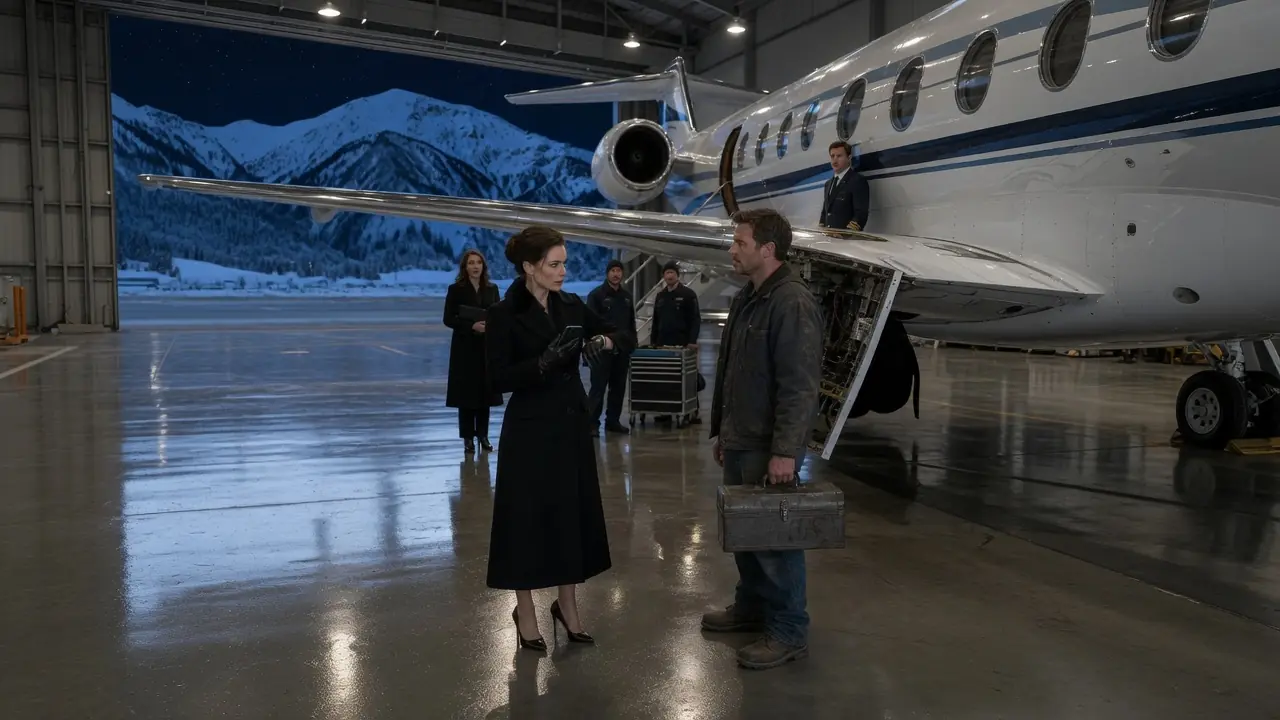
Evelyn looked at him with cold impatience and said the plane had to fly, that he could name his price, that he could ask for anything he wanted. Nolan Pierce looked back at her, almost smiling, and said his daughter needed a mother. The Aspen Ridge Executive Airfield sat high in the Colorado mountains, its runway dusted with fresh snow, and its hangar lights throwing long silver reflections across the fuselage of Evelyn's private jet. It was well past midnight, the kind of hour when most executives were asleep, but Evelyn Hawthorne stood beneath the wing in a tailored coat, checking her watch every few minutes as if she could will time to slow down. She was supposed to be airborne already, headed for Seattle to sign a partnership agreement that would inject new capital into Hawthorne Aerolux before the board could vote to strip her of control.
If she signed before 8:00 in the morning, the company would survive intact. If she missed the window, a dormant clause in the shareholder agreement would activate, handing emergency authority to her chief operating officer. Minutes before departure, the aircraft's auxiliary power system and cabin pressure sensors both flagged failures at once, an unlikely coincidence that made the lead pilot refuse to fly. The regular maintenance crew, the one Hawthorne Aerolux kept on retainer for exactly this kind of emergency, was nowhere to be found, having been quietly directed to another airfield hours earlier under the pretense of an urgent inspection. The airfield manager, sweating despite the cold, admitted there was only one person left who might be able to fix the plane on such short notice, a freelance mechanic who sometimes worked the overnight shift.
Evelyn barely looked up when Nolan Pierce arrived in an aging pickup truck, his jacket faded, his toolbox scarred from years of use, his eyes tired in the particular way that only comes from raising a child alone. She asked without warmth whether he was truly the best person available, and no one answered her. Nolan simply asked for the error codes, the last maintenance log, and the name of whoever had signed off on the final inspection, and something about the calm certainty in his voice unsettled her more than any panic would have. Grant Blackwood called twice in the span of 10 minutes, urging Evelyn to switch to a video conference instead of flying, but she knew the investors expected her in the room, not on a screen, and the pressure in her chest tightened with every passing second. Desperate and out of options, Evelyn turned to Nolan and said the words she would later regret, telling him to fix her plane and she would grant him one wish, whatever he wanted, no matter the cost.
Nolan did not lift his head from the panel he was inspecting when he answered that his daughter needed a mother, and for a moment, the entire hangar seemed to hold its breath. Evelyn stared at him, certain she had misheard, certain that a man in a stained jacket had just made a joke at her expense in front of her own staff. Evelyn's expression hardened instantly, and she assumed the man was mocking her, testing the limits of what a desperate woman with a corporate jet would tolerate at 2:00 in the morning. She warned him coldly that she had no patience for cheap jokes, that every minute he wasted was a minute closer to losing everything she had spent years building. Nolan did not raise his voice or try to explain himself with any urgency, only saying that she had asked what he wanted.
His wife, Grace, had passed away almost three years earlier, a slow illness that had drained the color out of their house long before it finally took her. And in the time since, Nolan had rebuilt his entire life around a single goal, making sure Avery never felt like something essential had been permanently removed from her world. He worked odd repair contracts at small airfields because the hours were flexible enough to get her to school in the morning and be home before dark. Sacrificing the kind of career he once had in exchange for a life that could bend around a child's needs. There were nights he sat at the kitchen table long after Avery had gone to sleep, staring at old photographs, wondering whether he was doing any of it right, wondering whether a father alone could ever be enough.
The line about needing a mother had not been calculated or clever. It had simply been the truth sitting closest to the surface of a tired man's mind when a stranger with more money than sense asked him to name a wish. Nolan began his inspection methodically, tracing wires, checking sensor readouts, cross-referencing part numbers against the maintenance history displayed on a tablet. Something about the failure pattern struck him as wrong because three separate systems were reporting critical faults simultaneously, yet the underlying mechanical readings did not match the severity the software claimed. He suspected, quietly at first, that someone had engineered these failures deliberately to keep the aircraft grounded rather than allowing an accident to occur naturally.
The kind of layered fault he was looking at rarely happened by accident since a genuine mechanical breakdown almost always left a trail of smaller warning signs in the days before it surfaced, and this aircraft had none of that history. Instead, the failures had appeared all at once, clean and simultaneous, the kind of pattern that came from someone who understood the system well enough to make a lie look exactly like the truth. Nolan had seen this kind of manufactured emergency only once before in his career, and the memory of it settled into his stomach like a stone even before he had any proof to back up the feeling. Evelyn's patience thinned further, convinced he was stalling to inflate his fee, and she instructed her assistant to prepare a contract offering triple his usual rate if the jet was airworthy within 40 minutes. Nolan barely reacted to the money, asking instead to see the original maintenance records rather than the summary Evelyn's staff had printed for him.
When she refused, citing internal confidentiality, he told her plainly that if she wanted him to repair something someone else was trying to hide, she would have to let him look exactly where that person did not want her looking. It was a small sentence, delivered without drama, but it was the first thing all night that made Evelyn actually stop and pay attention. Working with quiet precision, Nolan removed the auxiliary control panel and began comparing serial numbers stamped on the internal components against the paperwork in front of him. He discovered a control module that had clearly been installed within the last three days, yet the official maintenance log claimed the same part had been replaced nine months earlier. Such a discrepancy was more than unusual, because if a component had been swapped outside of proper protocol, the aircraft could be flagged as legally unfit to fly, which would guarantee Evelyn missed her window in Seattle regardless of anything else that happened that night.
Evelyn called Grant directly, demanding to know where her maintenance team had gone and why no one had flagged this replacement. Grant sounded appropriately surprised, suggesting it was likely a minor operational error, and gently urged her not to place too much trust in an outside mechanic she had never worked with before, offering to handle the board himself while she focused on the flight. Nolan overheard the name Grant Blackwood through the speakerphone and went still for a moment. His jaw tightened in a way that Evelyn noticed even in her exhaustion. Years earlier, Nolan had crossed paths with Grant during an investigation that ultimately ended his career in commercial aviation, though he said nothing about it yet, choosing his words carefully.
Evelyn asked directly whether he knew Grant, and Nolan answered only that he knew men like him. They were men who wore expensive suits and left other people to clean up the wreckage of their decisions. The vagueness irritated her, yet everything Nolan had uncovered so far was too precise to dismiss as coincidence or incompetence. Clara Whitcomb, the company's in-house counsel, joined the situation by video call from her home office, her hair still damp from sleep, warning Evelyn that granting an unauthorized contractor access to sensitive flight data could expose the company to liability. Nolan calmly produced the temporary repair authorization Evelyn herself had signed less than an hour earlier, pointing out that if she wanted the aircraft fixed correctly, she needed to let him do the job she had hired him for in the first place.
It was a small moment, but it marked the instant a man everyone in the room had dismissed began using the CEO's own paperwork to pry open a door no one wanted opened. While Nolan continued his work beneath the fuselage, his phone buzzed quietly in his jacket pocket, and he stepped toward the edge of the hangar to answer it. On the other end was Avery, his 15-year-old daughter, her voice small over the line as she asked whether he would make it home before her class presentation in the morning. Nolan kept his tone light, telling her he might be running late, then asking in quick succession whether she had eaten dinner, locked the front door, and finished preparing her notes for school. The call lasted less than a minute, but it revealed the entire architecture of his life.
He was a man who had to remember everything alone, from unpaid bills to breakfast to the quiet loneliness that settled into a house after a mother was gone. Evelyn, standing closer than she realized, caught fragments of the conversation despite herself. The words he had spoken earlier about his daughter needing a mother no longer sounded like an insult. They sounded instead like something true that had slipped out before he could stop it. When Nolan returned to the panel, he offered a brief apology if his earlier remark had offended her, insisting he had meant no disrespect toward a woman clearly under enormous pressure.
Evelyn asked, almost against her own will, why he had said it at all if he had not meant it as a joke. Nolan answered simply that sometimes people joke about the thing they are too afraid to ask for honestly. And the sentence landed somewhere Evelyn had not expected. She had grown up in a household where affection was negotiated like a merger, where her parents spoke to each other and to her almost exclusively through schedules, inheritance discussions, and quiet contests for control. She had everything money could purchase and almost nothing that resembled being wanted for reasons that had nothing to do with usefulness.
Composing herself quickly, she reminded him that tonight they had exactly one objective, which was getting the aircraft into the air. And Nolan returned to his work without another word. As the night wore on, Nolan traced the sabotage further, discovering that the aircraft's secondary flight data system had been deliberately manipulated to trigger an automatic lockout of the takeoff sequence. Mechanically, the jet was not nearly as damaged as its warning lights suggested. But without correctly clearing the fault through proper protocol, it would remain grounded regardless of how many parts were replaced.
He requested access to the electronic maintenance history, and Evelyn approved it over Clara's objections, watching as the data revealed that the final login before the failures began had used an administrative credential registered to the office of the chief operating officer. Evelyn did not want to believe it, since Grant had worked beside her for eight years and had once helped her own father expand Hawthorne Aerolux into new markets. Nolan pointed out how carefully the failure had been designed, severe enough to ground the aircraft convincingly, yet subtle enough to avoid looking like outright sabotage to anyone who was not looking closely. Grant called back moments later, his tone sharper this time, warning Evelyn that she was placing her company in the hands of a man with no verifiable background in commercial aviation security. He reminded her, almost casually, that Nolan Pierce had once been removed from the industry for what he called a false safety report.
A detail clearly meant to end the conversation before it went any further. Evelyn turned to Nolan, and the hangar seemed to grow colder around them as everyone waited for his reaction. He did not deny the accusation, admitting quietly that he had indeed been pushed out of the industry. Though he framed it differently, he said he had been punished for telling the truth to the wrong people at the wrong time. It was the first moment all night that Evelyn saw something like real pain behind his composure, and she found herself wanting to know the rest of the story rather than dismissing it as Grant intended.
Nolan explained, briefly and without self-pity, that years earlier he had discovered a private aviation company falsifying safety inspection reports to save money on necessary repairs. When he reported it through proper channels, the executive who had signed off on the falsified paperwork was none other than Grant Blackwood. And within months, Nolan found himself blamed for a technical failure he had never caused. His reputation had been dismantled before he could defend it properly. Evelyn began to understand that Grant was not simply threatening her company tonight.
He had already destroyed one honest man's career to protect himself, and now history seemed to be repeating itself in her own hangar. Just as Evelyn began piecing together the full shape of the conspiracy, the board convened an emergency call that filled a large screen wheeled into the hangar for the occasion. Grant appeared alongside several major shareholders, including a representative for Sterling Kingsley, the founder of Kingsley Capital Group, a man known throughout the industry for buying distressed companies at a fraction of their worth. Grant announced to the assembled board that Evelyn had failed to protect the Seattle agreement, arguing that a chief executive who could not even get her own aircraft off the ground clearly lacked the competence to run a private aviation company. One shareholder referenced the emergency clause buried deep in the company charter, reminding everyone that if Evelyn failed to reach Seattle before the deadline, negotiating authority would automatically transfer to the chief operating officer.
That transfer would allow Grant to sign away a significant ownership stake to Kingsley Capital at a steeply discounted price, effectively handing away a piece of the company Evelyn's own father had built from nothing. Cornered and short on hard proof, Evelyn watched her authority slip away in real time while Nolan stood quietly beneath the wing of the aircraft, absorbing every word of the conversation above him. Grant spotted him through the video feed and could not resist a small, cutting remark, calling him an airfield mechanic playing hero in front of people far above his station. Out of pride and exhaustion, Evelyn nearly ordered Nolan out of the hangar entirely rather than let him embarrass her further in front of the board. Instead, Nolan calmly placed a small data chip on the table in front of the camera, explaining that it had been removed from the aircraft's backup system and might still contain login records from before anyone had a chance to alter them.
Clara asked whether he was certain the data would hold up, and Nolan answered honestly that he was not certain at all, only that if he was wrong. Evelyn would lose a single flight, but if he was right, she was about to lose her entire company. For the first time that night, Evelyn chose to trust the man everyone in the room had spent the evening dismissing. The decision did not come easily, and for a long moment she simply stood there with the small chip resting in her palm, aware that everyone on the screen was watching her hesitate. Grant pressed his advantage, reminding her gently, almost kindly, that the board only wanted what was best for the company, and that clinging to unverified claims from an unknown contractor could look desperate rather than decisive.
Sterling added his own quiet pressure, suggesting that further delay would only confirm the very instability he and the other shareholders feared. Evelyn thought, briefly, of her father, of the countless nights he had told her that leadership meant making the hard call when no one else would. And of how he had never once told her the hard call had to feel comfortable in order to be correct. She looked once more at Nolan, at the steadiness in his face that had not wavered once, despite every insult thrown his way that night, and something in her settled. She nodded to Clara and told her to plug in the chip.
Working quickly against the clock, Nolan connected the recovered chip to an older backup terminal kept in a corner of the hangar for exactly this kind of emergency. He explained his findings in plain language rather than technical jargon, making clear that while the primary system could be edited after the fact, the secondary backup preserved timestamps and access records that were far harder to erase completely. Three critical details emerged from the recovered data, each one more damning than the last. The failure sequence had been triggered exactly 17 minutes after Evelyn confirmed her flight schedule to Seattle. The access credentials used belonged unmistakably to an account tied to Grant's private office, and a hidden lockout command had been embedded specifically to make routine inspections falsely report the aircraft as unsafe to fly.
Grant immediately denied any wrongdoing, suggesting his credentials could easily have been stolen by someone else within the company. Nolan calmly pointed out that the system required both a physical security badge and a biometric scan located inside Grant's own private office, making it extraordinarily unlikely that anyone else could have accessed it so conveniently. Clara reviewed the access logs herself and confirmed that Nolan's explanation matched the security protocols exactly, and the board members on the call began exchanging uneasy glances. Sterling Kingsley tried to interject, insisting that technical details should not delay an urgent business decision, but Evelyn noticed how uncharacteristically anxious he sounded for a man usually so composed. Pressing further into the hidden data, Nolan uncovered a second file buried deep within the encrypted archive, a draft agreement stating that if Evelyn missed her flight deadline.
Grant held authority to transfer 41% of the company's operating shares to Kingsley Capital at well below market value. Evelyn stood frozen as the full scope of the plan became clear, realizing this had never truly been about a mechanical failure at all. It was a calculated attempt to seize control of everything her family had built, disguised as an unfortunate technical accident that anyone might have overlooked. Grant's tone shifted from confidence to thinly veiled threat, warning that he would pursue legal action against Nolan for unauthorized access to confidential systems. Nolan simply held up the repair authorization Evelyn had signed hours earlier, replying evenly that he had been hired by the chief executive herself to fix the aircraft.
And it turned out the most broken part of the evening had never been sitting inside the engine at all. Once the truth was laid bare before the entire board, Evelyn moved quickly to suspend Grant's system access and forward every piece of recovered evidence directly to the legal department. Yet, the immediate crisis was far from resolved since she still needed to reach Seattle before the deadline expired in only a few remaining hours. Nolan explained that the aircraft could still fly once the false lockout was removed, the mismatched module properly replaced, and a final pressure test completed to confirm everything met safety standards. The backup maintenance crew finally arrived, but they hesitated visibly in front of a system that had clearly been tampered with, forcing Nolan to guide them through the repair procedure step-by-step himself.
Evelyn stood beside him now, no longer barking orders the way she had at the beginning of the night, quietly asking what he needed from her instead. Nolan answered dryly that he needed silence and a better flashlight than the one currently dying in his hand, a small joke that eased the tension in the hangar just enough for everyone to breathe. Evelyn ended up holding the flashlight herself while Nolan worked beneath the auxiliary panel, an image that would have seemed impossible only hours earlier, a billionaire executive crouched beside the very mechanic she had initially dismissed without a second glance. Her knees ached against the cold concrete floor. Her expensive coat was now streaked faintly with grease.
And yet she found she did not mind nearly as much as she expected to. There was something oddly grounding about the work itself. There was the smell of metal and oil, the low hum of instruments slowly coming back online, and the simple physical proof that a problem could be solved with steady hands and enough patience rather than money alone. She watched Nolan's fingers move with practiced certainty through wires and connectors. And she thought, not for the first time that night, that she had spent her entire career surrounded by people who could talk about solutions far more easily than they could actually produce one.
When the aircraft systems finally powered back on and every indicator turned green across the board, a wave of quiet relief moved through the hangar. Evelyn remembered the promise she had made at the very start of the night and told him softly that she still owed him a wish. Nolan did not look up from his work as he answered that he knew. He added that wishes spoken in moments of desperation were rarely ones a person should be asked to collect immediately. Evelyn asked whether the words about his daughter needing a mother had been something he genuinely wanted.
And Nolan was quiet for a long moment before answering that no child should ever be handed a stranger as a prize. He said only that he wished for someone good enough that Avery would stop believing family was something that simply ended once tragedy arrived. And Evelyn found she had no response ready for a sentence like that. With the technical crisis behind them, a new problem emerged. Since the lead pilot remained hesitant to fly while an internal investigation into the sabotage was still ongoing, Evelyn needed someone certified to operate the aircraft once its systems had been restored.
It was Nolan who quietly revealed he still held a valid commercial pilot license along with test flight certification from years earlier, credentials he rarely mentioned after leaving the world of corporate aviation behind. Evelyn was startled once again by how much capability had been hiding beneath the surface of a man she had spent the night underestimating. Nolan agreed to fly only under the condition that a properly certified co-pilot joined him and that every safety procedure was documented in full, refusing to cut corners even under pressure, which made the moment feel earned rather than reckless. During the flight to Seattle, Evelyn sat toward the rear of the cabin, unable to sleep despite the exhaustion pressing down on her shoulders. Through the open cockpit door, she watched Nolan work with calm, practiced precision, a striking contrast to the quiet, guarded mechanic she had first met only hours before.
In a brief exchange once the aircraft leveled out, Evelyn admitted she had never really known what a family was supposed to feel like since her father built an empire but turned every dinner into another business meeting and her mother had left when. Evelyn was still a child. She had grown up believing that survival meant needing absolutely no one, a lesson reinforced at every turn by the world she had been raised in. Nolan told her he had believed something similar after losing his wife, convinced for a while that isolation was simply the price of surviving loss. He described, quietly and without asking for sympathy, the months after Grace died when he had stopped answering calls from old friends, certain that grief was something meant to be carried alone rather than shared.
It was Avery, barely 13 at the time, who had finally told him she was tired of watching him disappear into himself while pretending everything was fine for her sake. That single sentence from his own daughter had done more to change him than any conversation with an adult ever could have, and he had spent every year since trying to prove to her that he had actually listened. He added that a child, however, does not allow an adult the luxury of turning grief into a permanent wall, and. Evelyn sat with that thought in silence for the rest of the flight, beginning to understand exactly why his earlier words had unsettled her so deeply. The aircraft touched down in Seattle with time to spare, and Evelyn walked into the meeting with Nolan and Clara close behind her.
Grant, though stripped of his access, still attempted to join the call remotely, insisting loudly that Evelyn had relied on illegally obtained information to make her case. Sterling Kingsley was present as well, clearly hoping the sabotage itself could be used as proof that Hawthorne Aerolux suffered from serious governance failures, potentially voiding the very agreement Evelyn had flown through the night to sign. But Evelyn had changed her approach entirely, choosing transparency instead of concealment, presenting the evidence openly, and explaining that the failure had been a deliberate act of internal sabotage, already documented and forwarded to legal counsel. She stated plainly that her company had not lost control of anything, insisting instead that it had simply removed the one person actively trying to sell it out from underneath her. One of the Seattle partners, an older man who had built his own career on due diligence rather than charm.
Asked pointedly why the board should trust a company that had nearly missed a signing deadline because of an internal betrayal no one had caught in time. Evelyn answered without flinching, saying that any company could be infiltrated by someone willing to lie convincingly enough, but very few companies could prove, within hours, exactly how the lie had been constructed and who had built it. She reminded the room that the true measure of an organization was not whether it could avoid every threat, but whether it had people inside it willing to chase the truth even when it was inconvenient, expensive, or embarrassing. It was not a rehearsed line, and it did not sound like one, which was precisely why it landed as hard as it did. When Nolan was asked to confirm the technical findings, Sterling could not resist a dismissive remark, questioning aloud whether the room was truly meant to take direction from a freelance mechanic.
Evelyn answered before Nolan could speak for himself, stating firmly that they were listening to the only person in the entire building who had told the truth from the very beginning of the night. Clara then presented the documentation proving Grant no longer held any authority to represent the company in negotiations, and the remote board members had no choice but to suspend him immediately pending a full investigation. The Seattle partners, visibly impressed by how quickly and openly Evelyn had handled the crisis, agreed to proceed with the agreement exactly as planned. The deal was signed. Hawthorne Aerolux avoided the hostile takeover entirely, and Sterling left the meeting quietly, his opportunity to acquire the company at a bargain price gone for good.
Evelyn turned to Nolan afterward and told him simply that he had not just repaired an aircraft that night, he had repaired her entire company. Once the crisis had fully passed, Evelyn flew Nolan back to Colorado aboard the very aircraft he had saved, arriving just as the first light of morning spread across the mountains. The hangar felt different now, quieter, no longer filled with the panic and shouting of the night before. Evelyn handed him an envelope containing an extremely generous payment along with an offer for a senior position within the company's flight safety division. Nolan looked over the offer carefully and thanked her sincerely, but did not sign anything right away, clearly weighing something more important than money or title.
Evelyn reminded him gently that he still had a wish left to collect, one he had never actually spent. Nolan admitted that the version of himself from years earlier might have asked for money or a title or a chance to reclaim everything the industry had once taken from him. Instead, he asked Evelyn to reopen the old technical case that had ended his career to formally investigate Grant Blackwood's role in falsifying those original reports and to publicly restore his reputation if the investigation confirmed he had been wrongfully blamed. Evelyn agreed without hesitation, then asked quietly what had truly been behind the remark about Avery needing a mother. Nolan smiled, the expression tired but warm, explaining that Avery did not need a woman walking through their front door simply because her father had won some kind of desperate bet in the middle of the night.
"What she needed," he said, "was to see her father brave enough to trust someone again after everything they had both survived. " Evelyn felt something shift in her chest at those words. The fairy tale framing of the entire night suddenly replaced by something far more honest and far harder earned. True to her word, Evelyn launched an internal investigation within weeks, and Clara uncovered the original records tied to Nolan's case buried deep in the company's archived files. The evidence confirmed that Grant had falsified data years earlier at a different firm, deliberately shifting blame for a technical failure onto Nolan in order to protect a lucrative contract that would have collapsed under real scrutiny.
The findings were shared publicly within the industry, and Nolan's name was formally cleared after years of quiet damage that had followed him from job to job. Certifications once frozen were reinstated, and colleagues who had distanced themselves from him years earlier began sending quiet apologies, some sincere and some clearly motivated by self-interest now that the truth had surfaced. Grant was removed from every position he held at Hawthorne Aerolux, and soon found himself facing civil litigation over both the sabotage and the years-old fraud finally brought into the light. There was no need for dramatic confrontation or exaggerated punishment. There was only the simple, satisfying image of a man walking out of the building without his badge, his phone silent, and no one left willing to answer his calls.
Word of the scandal spread quietly through the tight circles of private aviation, the kind of industry where reputations traveled faster than any official statement ever could. Executives who had once courted Grant's favor at industry dinners now avoided mentioning his name at all. And the company that had originally employed him during Nolan's downfall reopened its own records once journalists began asking uncomfortable questions. Grant tried for a time to frame himself as a scapegoat, insisting publicly that Evelyn had manufactured the entire investigation to protect her own position. But the documented evidence left little room for that version of events to survive scrutiny.
Sterling Kingsley attempted to distance himself from the entire affair, but the attempted takeover drew scrutiny from regulators who began examining his firm's other dealings more closely. Evelyn used the aftermath of the crisis to clean house entirely, removing employees whose loyalty had always been tied to money rather than any real sense of integrity toward the company her father had built. Nolan eventually accepted the position of director of flight integrity at Hawthorne Aerolux, but only under the condition that his schedule would always leave room for Avery, no matter how demanding the company's needs became. Evelyn agreed immediately and went further, introducing a new company-wide policy stating that no employee should ever have to sacrifice their family to prove their loyalty to the organization. It marked a profound shift in Evelyn herself, a woman who had once viewed family as a liability, now beginning to understand it as the very thing capable of making people better, steadier, and more honest in the decisions they made.
Nolan had not simply saved himself that night. He had quietly reshaped the culture of a company that had once looked down on people exactly like him. Months later, Hawthorne Aerolux held a small gathering, nothing like the extravagant galas the company was known for, but a modest ceremony to launch a new aviation scholarship fund for employees' families and for those who had lost loved ones within the industry. Evelyn named the fund after Nolan's late wife, calling it the Grace Pierce Flight Foundation, a gesture that surprised him more than any amount of money ever could have. Avery appeared briefly near the end of the gathering, just enough to add warmth without pulling a child too deeply into matters far beyond her years.
She met Evelyn for the first time that day, and there was no forced moment, no sudden talk of family roles, only a simple, genuine thank you from a teenager who said. Evelyn had helped her father laugh again more than he had in a very long time. Evelyn felt something rise in her chest at those words, though she kept her composure, aware that she was not meant to replace anything Avery had lost, only perhaps to be the first person in years who had helped their small family open its doors again. Nolan noticed the way Evelyn held herself in that moment, gentle and careful, and understood she was learning something he himself had needed to relearn after losing. Grace, that healing rarely announces itself, it simply appears quietly in rooms where people finally choose to trust one another again.
In the weeks that followed, Evelyn found herself thinking often of that first night in the hangar, of how certain she had been that a wish could be granted the same way a bonus or a promotion could, handed over and forgotten. She began spending more time away from the boardroom than she had in years, sitting in on safety briefings Nolan led, asking questions instead of issuing directives, listening in a way her father's company had rarely taught her to do. The employees noticed the shift long before the press ever did, whispering that the woman who once measured everything in numbers had started measuring some things in patience instead. Nolan, for his part, never asked her to change, and perhaps that was precisely why she did. It happened slowly, without any grand announcement, the same way ice thins before it finally gives way to spring.
The final scene unfolded back at the hangar. The same aircraft, now gleaming under the soft light of late afternoon, fully repaired and resting peacefully where chaos had once filled every corner of the building. Evelyn asked Nolan whether he still remembered the wish he had made that night, and he admitted that he did, though he suspected now that he had gotten the wording wrong from the very start. When Evelyn asked what the real wish had been, Nolan looked toward Avery standing a short distance away and said quietly that he had wished for his daughter to see that even after loss, a family could still find a way to begin again. Evelyn smiled at that, and there was no rushed promise, no forced declaration of love, only the quiet sense of a door finally left open.
The two of them stood there a while longer, watching the sunlight shift slowly across the hangar floor. Neither one was in any hurry to name what was growing between them, both aware that some things were better left to unfold in their own time rather than being forced into a single dramatic sentence. Somewhere behind them, Avery laughed at something one of the ground crew said, the sound carrying easily across the quiet space. And Nolan turned toward it the way a man turns toward the one sound in the world he never wants to stop hearing. Evelyn Hawthorne had once believed she could repay Nolan Pierce with nothing more than a single wish granted in a moment of desperation.
In the end, it was the quiet single father from the hangar who taught her that the most valuable things in life are never simply given away. They are built slowly through trust, through kindness, and through the long journey of a single flight that finally brought two broken people home. Years from now, when people inside the company told the story of that night, they rarely remembered the exact numbers involved in the deal that had once seemed like the only thing that mattered. What they remembered instead was the image of a chief executive kneeling on a cold hangar floor, holding a flashlight for a man in an oil-stained jacket, and the strange quiet certainty that something real had begun in that unlikely ordinary moment.