Dean Mercer was bent over an old pickup engine when three black SUVs rolled up outside Mercer Works. Clare Vaughn stepped out in a white blazer, eyes moving across cracked concrete, a faded sign, and shelving thick with old parts. Tyler Knox climbed out behind her and laughed. All this trouble for a mechanic? A few others joined in.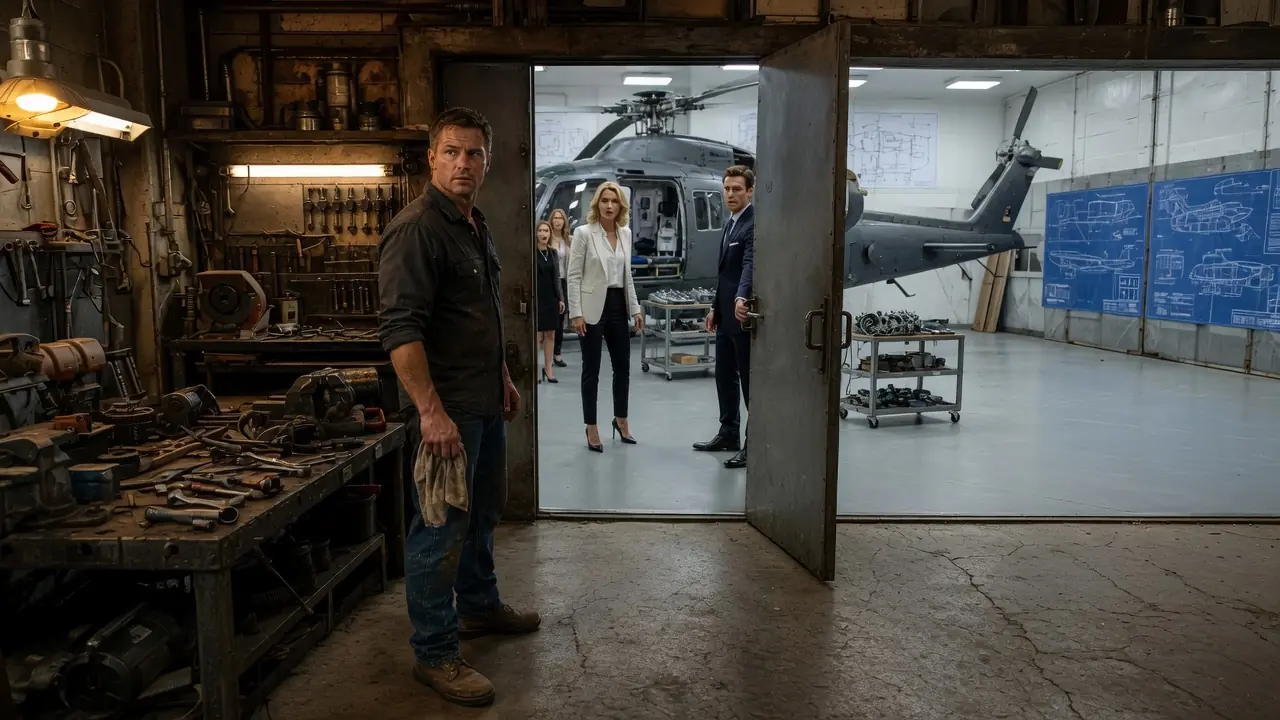
Dean wiped his hands on a shop rag and said nothing. But when Tyler pushed open the heavy steel door at the back of the workshop, the one Dean never unlocked for anyone, every voice in the lot went quiet. Inside, under yellow light, sat a nearly finished rescue helicopter. Why would a struggling mechanic spend years hiding a rescue helicopter inside his old workshop? The answer changes everything.
Mercer Works sat at the edge of Doyle's Creek like something the town had quietly decided to forget. The sign out front had been white once, but the years had bleached it to the color of old bone, the letters soft at their edges. The roof was corrugated tin, warped in two places from a storm three winters back that Dean had never gotten around to properly fixing. Grease lived in the cracks of the concrete floor the way roots live under pavement. It was deep, permanent, and completely unbothered by the occasional pass of a mop.
Along the east wall, transmissions sat in rows waiting for attention. Along the west, oil drums and spare belts and hydraulic fluid canisters shared shelving with invoice binders and a $3 yard-sale coffee maker. This was Mercer Works. This was where Dean Mercer had spent the better part of 10 years keeping the working vehicles of Doyle's Creek alive. He was 39, though most people who didn't know him might have guessed a few years older.
Not from hardness in his face, but from the economy of it, the way his eyes settled on things before he spoke about them. The way he moved without hurry, even when he had reason to hurry. He ran the shop alone, taking in diesel pickups, farm equipment, backup generators, the occasional riding mower, he didn't advertise. His reputation had done its own quiet traveling through the county for years. Dean Mercer fixed things right the first time and charged what the work was worth, not what the customer could be talked into paying.
That combination in a town like Doyle's Creek was worth more than any billboard. The Vaughn Development convoy arrived on a Thursday morning in September with the confidence of money that had never once questioned its own welcome. Three polished SUVs moving down the gravel access road and stopping in a loose formation outside the bay doors like punctuation at the end of a sentence that had already decided its conclusion. Clare Vaughn, 42, had built her company's reputation on turning forgotten corners of midsize towns into commercial corridors, parking structures, mixed-use retail blocks, developments that looked inevitable from a distance and unstoppable up close. She was methodical and well-prepared, and she had sent her team ahead three days earlier to map the parcel and pull county records on every structure inside the proposed development zone.
Mercer Works sat directly within that zone on a half-acre her projections needed for the corner entrance of a planned retail anchor. She had come to buy it. Tyler Knox handled acquisitions. He was younger than Clare by nearly a decade, sharp in the manner of a person who had learned that sharpness could substitute for patience if applied fast enough. and he looked at the exterior of Mercer Works the way someone looks at an inconvenient puddle with mild irritation and the expectation that it would soon be stepped around.
He got out of the lead vehicle, surveyed the scene for approximately five seconds, and delivered his assessment to Clare in a low voice. "He's just a mechanic. Offer him enough to disappear. " Clare said nothing to that. She had learned not to make conclusions in the first 30 seconds.
Von Development wanted the parcel. The offer she named was firm and she said so. Dean listened to the full proposal before he said a word. Then he said one sentence, "I'm not selling. " Tyler smiled the way people smile when they think they're talking to someone who hasn't understood.
"Mr. Mercer, the assessed value of this property. " Dean said, "I know what it's worth. " He looked at Clare when he said it, not at Tyler. Tyler glanced around the bay, at the toolboxes, the parts bins, the worn hydraulic lift, the hand-lettered price board near the door, and delivered his assessment with the particular cruelty of someone who believes cruelty is just candor. "You're protecting a junk shop," Dean didn't answer.
He looked instead toward the heavy steel door set into the cinder block wall at the back of the workshop. Painted gray, two deadbolts, a padlock, a hand-printed sign that read simply private, and his gaze rested there for a moment in a way that Clare, watching more carefully than Tyler was, noticed. He wasn't looking at storage. He was looking at something he was still keeping. Tyler noticed it too for the wrong reasons and walked to the door without asking.
He found it locked, looked back at Dean, and said, "What are you hiding back there? " He said it like a dare. Dean said, "That part of the shop is mine. " Tyler tapped the door twice with his knuckle and walked back toward Clare, already composing his next move by the time he reached the parking lot. The Vaughn group left without what they came for, but with other things.
Parcel maps, aerial photographs, and the name of the lending institution that held the note on Mercer Works. That was Naomi Castle's work. Naomi was Clare's operations coordinator, precise and quiet, and considerably more thorough than any situation required. And while Tyler had been studying the exterior of the shop, she had been running the county property records on her phone. What she found was useful and she suspected already known to Tyler.
Dean Mercer was behind on his property taxes by just over $14,000. And the payment window was closing. The county had sent two notices. The bank that held his business loan had begun making inquiries. The situation was not yet urgent, but it would become so, and Tyler Knox had spent eight years learning to time his offers to arrive exactly when urgency peaked.
Brooke Ellis drove out to Mercer Works on a Friday afternoon in a sedan that smelled of new leather and old coffee. the relationship manager at Doyle's Creek Community Lending. Three years into working with Dean, genuinely respecting the steadiness with which he ran his accounts and also carrying a manila folder she wished someone else had been asked to deliver. She sat across from Dean at the workbench and went through the numbers in the careful apologetic language of a person delivering news they have no appetite for. the tax balance, the loan review schedule, the 60-day window before the bank's compliance team would have to act, he thanked her.
She drove back to town. That evening, Nolan arrived just after 6 with two sandwiches in a paper bag and began sweeping the floor without being asked because that was the kind of person he was. He was 17, with his mother's eyes and his father's quietness, and he had been working part-time at the hardware store in town to help cover household costs without ever once framing it as help. They ate at the workbench while the last of the day's light faded outside, and Dean told him about the Vaughn visit, about Tyler's offer, about the remark about the junk shop. Nolan listened without interrupting, then said, "Why don't you just tell them what's inside the back room?
" Dean looked at the paper bag between them for a moment and said, "Because some dreams aren't ready for strangers. " Nolan didn't push. He knew his father well enough to know when a sentence was a door closing gently rather than a wall going up. After Nolan left, Dean stayed in the shop until after midnight. He walked to the steel door, worked the padlock, slid the deadbolts back, and pushed it open on its track.
He stood in the darkness of the second room for a long moment, listening to the quiet of it, and then he reached up and pulled the overhead cord. The fluorescent panels flickered and caught, and what they revealed, occupying nearly the full length of the 60-foot space, was a helicopter, a full-frame rescue aircraft draped in canvas tarps, its tail assembly extending toward the far wall. Its main rotor folded back along a padded cradle rack. Dean walked to it slowly, not in the way a man approaches a machine, but in the way a man approaches something built with a grief so specific it had become its own kind of fuel. He pulled the tarp from the cockpit section and let it fall.
Along the side of the aircraft, running in block letters beneath the crew door rail, read the name he had painted there three years ago in the color of a clear winter sky, mercy Air Rescue. He stood there looking at those three words for a long time before he went home. What Dean Mercer had been before he became the man who fixed trucks at the edge of Doyle's Creek was not a secret so much as a piece of information the town had never thought to ask for. He had grown up two counties north in a family that worked heavy machinery and by his mid-20s had taught himself the principles of mechanical engineering from library books and evening courses and sheer unrelenting curiosity. The kind that does not stop for gaps in formal credentials.
He earned his aerospace engineering degree at 30, working his way through it slowly across seven years of night classes and correspondence modules while pulling shifts at a regional maintenance facility that serviced agricultural aircraft. He did not treat those seven years as a sacrifice. He treated them as evidence. The program that eventually hired him was a regional emergency aviation initiative. A consortium of counties and rural hospitals struggling for decades with the brutal reality of mountain geography.
People in remote areas dying from conditions that were survivable. If only there had been a faster way to reach them. Dean joined as a systems engineer and within three years had become its lead designer responsible for the aircraft configuration, the medical cabin layout, the rotor efficiency adaptations that allowed the craft to operate effectively at higher altitudes where conventional rescue helicopters were unreliable. He was not famous for this work. He was known within the program the way essential people are known quietly widely with the particular respect that comes from watching someone solve the problems everyone else had been working around.
He met Paige in the second year of the project. She was a flight nurse assigned to the rescue program on rotation through the regional hospital system. 28, direct in the way of people who have spent significant time in emergencies. Warm in the way of people who have also spent significant time keeping strangers alive. She asked better questions than anyone he had worked with.
And she asked them with the authority of someone who understood that the answers would cost lives if they were wrong. He fell in love with her in the methodical, irreversible way that engineers sometimes fall in love. Slowly at first, then all at once with complete confidence in the conclusion. It was Paige who first said it aloud that they should build their own, not as a career move, not as a business, as something closer to a calling. She had worked the rescue circuits long enough to know exactly where the gaps were.
the mountain communities with no air access, the rural counties where a medical helicopter was 40 minutes out at best, and the 40 minutes was often the difference between a good outcome and a funeral. She believed with the certainty of someone who had seen both the problem and the solution up close that it was possible to build a light cost-efficient rescue aircraft that could be operated at the county level without federal infrastructure. She believed Dean could build it, he believed her. They began planning it in the evenings at a drafting table Dean set up in the second bedroom of their first house, acquiring components over time. a decommissioned airframe from a program that had lost its funding, a turbine assembly from a rebuild yard in Colorado, navigation systems from a retired training aircraft.
They called the project Mercy Air. Paige had named it without deliberation, the way she named everything directly with confidence that the word was right. She got sick in the third year. It happened the way illness sometimes does to the healthiest people. Without warning, without logic, without the graduated severity that allows for adjustment, the diagnosis was aggressive.
The timeline was brutal. She fought it with the same focused intensity she had brought to everything else in her life. And she almost won. And then she didn't. She died on a morning in April in a hospital room that was calm and clean and completely insufficient for the size of what it was asked to hold.
Dean did not return to aviation engineering. After that, he sold the house, moved to Doyle's Creek, where his uncle had left him a property at the edge of town, opened the workshop, and became, to the world's understanding, a mechanic. He brought the helicopter with him piece by piece on a rented flatbed trailer. He built out the back room. He kept working on it, not on any schedule, not with any particular urgency, but steadily in the late evenings after the shop closed on Sunday mornings when the rest of the town was somewhere else.
He replaced the hydraulic system. He rebuilt the engine from a better donor aircraft. He designed the medical cabin from scratch, informed by every conversation he'd ever had with Paige about what a rescue interior actually needed versus what standard designs assumed it needed. He was not building it to sell. He was not building it to be admired.
He was building it because Paige had believed it would bring people home. And that belief had not died with her, and he did not know how to let it go. On a night not long before the Vaughn convoy arrived, Dean had sat in the second room and rested his hand on the co-pilot seat, the one where. Paige had sat the one afternoon he'd taken her up in a borrowed trainer to show her the instrumentation. She had left her blue rescue lanyard on the armrest.
He still kept it there. The city inspection was Tyler's idea, filed through a county contact he maintained for exactly this kind of leverage. The notice arrived at Mercer Works on a Monday morning. A structural and zoning compliance review scheduled for Thursday, prompted by a formal complaint regarding unpermitted modifications to the rear portion of the building. The complaint was technically legitimate.
Dean had expanded the back room years ago without pulling the proper permits because at the time he hadn't been thinking about compliance and hadn't imagined anyone would ever come to look. The inspection gave Tyler what he needed, an official reason to walk through every part of the property. They arrived Thursday morning in force. Clare, Tyler, Naomi, Brooke and a city inspector named Roland Fitch, who was thorough and expressionless, and clearly wished he were somewhere else. Dean met them at the bay doors without ceremony.
He had spent the two days since the notice deciding what he was going to say, and he had arrived at the decision to say very little and let what was behind the door speak for itself. Roland Fitch worked through the front bay systematically, checking clearances, ventilation, and the electrical panel in the manner of a man who had done this several thousand times. Tyler watched Dean throughout. He was looking for anxiety. He did not find it.
When Roland reached the steel door, he noted it on his clipboard. "What's the use of this space, " he asked. Dean said, "Workshop, private project. " Roland said he'd need to see it. Dean unlocked the padlock, slid the deadbolts, and pushed the door on its track.
He reached in and pulled the overhead cord. The lights came up and the room was revealed. Tyler stepped in first, already composing something dismissive, and the sentence he had been building simply stopped existing. Clare came in behind him and went still. Naomi followed, then Brooke, then Roland Fitch, who stopped moving entirely for the first time since he had arrived.
The helicopter stood the length of the room. Matte gray, complete in its framing, its rotor assembly extended and locked in display position, its crew doors open to show the medical cabin beyond. The walls were papered with engineering drawings, detailed, precise, the kind that take years to produce. And along the workbench that ran the full south wall lay the instruments of someone who understood aerospace at a level you could not fake with weekend enthusiasm. There were aviation-grade torque wrenches, calibration tools, structural test fixtures, a hanging rack of component documentation that Naomi, who had an engineering background before she moved into operations, recognized immediately as real.
Tyler recovered first because Tyler always recovered first, he laughed. "A mechanic building a helicopter," he said, "That's insane. " Nobody else laughed. Clare had walked the length of the aircraft and was standing at the nose reading the block letters painted along the crew door rail. She turned back to Dean who had remained near the door and asked quietly, "You built this?
" Dean said, "Rebuilt, there's a difference. " He said it without pride, without performance. He said it in the flat informational tone of a person correcting a minor inaccuracy. It was into this silence that the front door of the main bay opened and an older voice carried through, "Dean. " The voice was deliberate, the voice of a man who had spent decades in environments where speaking carefully was not affectation but safety protocol.
Standing in the bay door was Warren Hail, 67, white-haired, lean, with the posture of a man who had spent his life near machinery that would kill you if you got careless. He looked past Dean into the second room at the helicopter illuminated under the fluorescent panels, and something in his face went quiet with recognition. Warren Hail had not retired so much as gradually slowed. From chief operations coordinator for a federally funded emergency aviation program to consultant to occasional adviser to the particular category of person who still picks up when the right number calls. He walked into the back room without being invited which was a liberty Dean allowed only because Warren had earned it and stood before the helicopter for a full 30 seconds without speaking, clare watched him.
She had the instinct sharpened by years of negotiation for knowing when someone in a room had context she was missing. Warren had it the way he moved around the aircraft, Stopping at specific points, crouching to examine the undercarriage, and running a finger along the edge of the stabilizer housing told her he was not impressed by novelty. He was reading the aircraft the way you read a document written by someone whose work you have known for a long time. He stood up and looked at Clare and said, "That man designed half the rescue systems your company would like to buy if you had any idea they existed. " Clare said, "What does that mean?
" Warren said that Dean had been the lead engineer on the mountain rescue aviation initiative that had been quietly operating in three states for the better part of a decade before funding cuts reduced it to a single operational unit. The stabilizer system on this aircraft, the one Naomi had been studying, was an evolution of a design Dean had originated for that program. One that had been subsequently adopted by two commercial rescue operators without proper attribution or compensation because that was how the industry treated the work of people who prioritized the work over the credit. Clare looked at Dean. Dean was leaning against the door frame with his arms crossed, not defensive, simply present.
He had heard Warren describe his own résumé before, and he found it mildly uncomfortable each time, less from false modesty than from genuine disagreement about what in that résumé was important. Tyler had pulled out his phone and was searching in the way that indicated he was attempting to verify Warren's claims and finding them inconveniently accurate, he looked up. "If all of that's true, why is he running a grease shop in a town nobody's heard of? " The question was meant to be corrosive. It landed differently than he intended.
Warren looked at him without particular feeling and said, "Because his wife died, and this was how he kept his promise to her. " The room absorbed that for a moment. Warren walked to the tail section and pointed to a small bracket assembly machine to tolerances. No standard repair shop had any business attempting it. He said, "That stabilizer design saved more pilots than your software ever will.
" He was speaking to Tyler, but he was not really speaking to Tyler. He was speaking to the room. Dean said then without being asked in the same quiet informational tone he had used throughout. "Paige believed it could do more than fly. She believed it could bring people home.
" He was not making an argument. He was not appealing for sympathy. He was stating a fact he lived inside the way you state the address of the house you have lived in for years. Clare felt the sentence settle into the room. She had not expected to feel anything on this property visit, she was recalibrating.
Tyler was also recalibrating but in a different direction. He had come to this property looking for a piece of land with a clearance problem. What he had found was a functional prototype with defensible engineering documentation and a designer whose credentials were legitimate enough to make the intellectual property extremely valuable. He took a photograph of the stabilizer schematic with his phone. He did not ask permission.
Dean saw him do it and said nothing. He had been watching Tyler since the man arrived, and he understood with the calm precision of an engineer exactly what Tyler was now thinking. Warren also saw it. He waited until Tyler had moved to the far end of the room to examine the medical cabin, then crossed to Clare and said quietly, "Be careful with him. " Clare said, "He works for me.
" Warren said, "I know, be careful anyway. " Tyler Knox moved fast when he found something worth moving fast toward. By the following Monday morning, he had drafted a proposal framework that reframed the entire Mercer situation as an intellectual property consolidation. Not a land buy, but a combined purchase of the parcel, the prototype, and a full assignment of any design patents or pending applications associated with the Mercy Air system. The offer to Dean, he suggested, would be structured as a buyout plus a consulting arrangement.
Dean would receive a lump sum, sign a comprehensive non-disclosure and non-compete, and be contracted for 18 months to support the technology transfer. After that, the project would belong to Vaughn Development. Tyler used the word transition 14 times in 35 minutes. Clare listened without indicating agreement or disagreement, which was a technique she had developed over many years, and which Tyler had learned not to misread. She asked two questions, whether Dean had existing legal protection on the designs, and whether he had any interested parties.
Tyler said the documentation was in Dean's name, but most of it likely predated formal patent filing and was vulnerable to a well-resourced challenge. He said Dean had no interested parties. He was wrong on both counts. Dean brought the situation to Warren that same evening. They sat in the main bay with two mugs of coffee on the workbench between them and Dean walked through the Vaughn offer as Tyler had relayed it through a third party.
The kind of staged casualness designed to feel like informality and function like pressure. Warren listened until Dean finished, then said, "They want the aircraft, the designs, and they want you tied up for 18 months, so you can't rebuild anything they'd have to compete with. " Dean said that was my read. Warren said, "Don't touch it. " Dean said he hadn't planned to, but the pressure mounted from another direction.
Tyler had been in contact with Doyle's Creek Community Lending through a Vaughn Development subsidiary that had recently become a significant depositor at the institution. The nature of the contact was indirect and deniable, but the message was clear. An expedited review of the Mercer loan file would be appreciated. Brooke received the communication through two layers of institutional language and felt the weight of it. It was the way you feel the weight of something placed carefully rather than dropped.
She did not act immediately. She told herself she was waiting for the appropriate compliance window. She was also if she was honest with herself, hoping the situation would resolve before she had to become part of it, it didn't. The 30-day window narrowed to 1two days, then to a week. Dean had made a partial payment on the tax balance, $3,000 from the shop account, leaving just over $11,000 still outstanding, and it was not enough.
Naomi had been following the situation with increasing discomfort. She had discovered that Tyler was also in quiet contact with the county planning office, requesting an expedited zoning review of the Mercer property on the grounds that the aircraft construction constituted unpermitted commercial aviation manufacturing activity. A legal argument of uncertain merit but certain disruption and disruption was the point. She compiled what she had found in a single document and held it for two days before deciding what to do with it. Warren issued his warning in the language of a man who had watched this particular pattern before.
He told Clare in a call she had initiated to ask about the technical validity of the Mercy Air system. "Men like Tyler don't steal machines, they steal lifetimes. " Clare said "He's pursuing a legitimate business opportunity. " Warren said "He's pursuing a foreclosure. " Clare did not respond immediately.
She had been thinking since the day in the back room about the name painted on the side of that helicopter about what it meant that someone had spent six years in a room behind a locked door building something that would never make them famous. Named after the thing it was supposed to do. She had not built her company on sentiment, but she had built it on the ability to recognize value that other people were misreading, and she was beginning to suspect she was in the presence of something she had been misreading badly. Nolan came to the shop on a Thursday night and found his father sitting on a stool in the back room, looking at the helicopter, the way a person looks at a decision they have not yet made. Dean had been running numbers.
The numbers were not good. He could fight the zoning challenge. Warren had a contact who could help, but the fight would take time and the tax deadline would not wait. He was considering whether it might be necessary to begin disassembling the aircraft, not to surrender it, but to move it somewhere unreachable before foreclosure proceedings could attach to it. Nolan sat down beside him on the step at the entry to the room and looked at the helicopter for a moment.
Then he said, "Mom wouldn't want you to let them take it. " Dean looked at his son. He said, "She wouldn't have wanted me to break it apart either. " Nolan said, "Then don't do either one. " He said it with the quiet certainty of someone who has not yet been worn down by the complexity of the world.
Dean heard it as the thing it was, not naivety but clearness. Sometimes the clearest thinking in a room belongs to the person who has not yet learned to complicate the obvious. Dean made the call to Clare the next morning. He was not calling to negotiate or to appeal. He told her he was willing to offer a public technical demonstration of the Mercy Air system, not a flight.
The certification for that was still in progress, but a full operational review of the avionics, the rotor dynamics, the medical cabin systems, and the efficiency metrics. He told her she could invite whoever she felt was appropriate. He said if the system didn't speak for itself, he would have his answer, and so would she, clare said yes. She also told him before she ended the call that she was halting the county zoning review petition. Dean said, "I appreciate that.
" She said, "Don't thank me yet, " He didn't. The demonstration was scheduled for a Saturday in early October in the open lot behind Mercer Works. A gravel and grass expanse Dean spent two evenings clearing. Word moved through the county in the manner of words that attach themselves to unusual things. And by Thursday, there were calls from the regional newspaper in Hartley and from a county commissioner's office.
The final count was 31 people. A panel of three aerospace engineers Warren had assembled from a university contact. Two representatives from the county emergency services office. A reporter from the Hartley Register, six Vaughn Development personnel, including Clare and Tyler, Brooke Ellis, Naomi, and a scattering of Doyle's Creek residents who had somehow been informed and appeared in the gravel lot that morning. Carrying their coffee in the determined unofficial manner of people who have decided something interesting is happening and will not be excluded from it.
Dean arrived two hours before anyone else and spent those hours completing the final pre-demonstration systems review. It was the kind of review that revealed nothing new but confirmed everything he already knew. The aircraft was ready, and he had known it was ready for the better part of a year. The question had never been the helicopter. The question had always been the room.
By 8, the lot was filling. Tyler arrived with two Vaughn attorneys and set himself up near the front with the expression of a man attending a performance he expects to be mediocre. Warren arrived with the three engineers, all of whom went directly to the aircraft without social preamble and began their own examination with the focused intensity of people for whom machinery is language. At 8:30, Dean opened the cargo doors at the back of the workshop, and with a hand winch and a wheeled dolly system he had built for exactly this purpose, moved the helicopter out into the morning light for the first time. There was a sound in the crowd.
Then, It was not a gasp, not applause, but a collective intake. The sound a group makes when a thing they have been told about is suddenly physical and present and larger than description allowed for. The matte gray aircraft sat in the October light with the solidity of something built to matter. The Mercy Air Rescue lettering catching the angle of the low morning sun. Dean began without introduction.
He connected the ground power unit, ran the pre-start sequence, and brought the turbine engine online. The sound the engine made was the sound of an argument being settled, low and certain and authoritative. It was the voice of something built right. The main rotor began to turn slowly at first, then accelerating through its engagement speeds with a smoothness that one of Warren's engineers noted in his pad and underlined. Tyler had said nothing since the aircraft emerged from the bay.
Dean walked the panel through each system in sequence. the rotor dynamics, the stability compensation system, the descendant of the design Warren had identified, and the fuel efficiency configuration that allowed the aircraft to operate at a range significantly beyond standard rescue helicopter parameters. He opened the medical cabin and demonstrated the self-leveling patient platform, a piece of engineering that Paige had described to him in terms of what it needed to accomplish for an injured person during transport and that he had spent three years figuring out how to, build. It was by any objective measure better than anything currently in production. One of Warren's engineers said so, not dramatically, but as a technical observation delivered in the manner of someone who has just confirmed a measurement.
The crowd in the gravel lot had gone quiet in the way that crowds go quiet when they realize they are watching something real. It was not performance or demonstration, but something built at great cost in private without audience and brought out into the light because its time had finally come. Tyler said looking at the medical cabin, "The certification process alone will take years. " He said it not as an objection, but as a diminishment, "The last available tool," Warren, standing 3 ft away, said without turning. "The FAA will certify this faster than you think if the right people file the right applications.
I know the right people. " One of the engineers spoke up. "The stabilizer design alone is worth licensing to three major operators I can name right now," another said quietly. to no one in particular, "Where did you build all this? " Dean looked at the workshop.
At the faded sign, at the tin roof with the two warped places from the winter storm, at the oil stains on the concrete that no mop had ever touched, he said, "Right here between oil changes, overdue bills, and the memory of my wife. " The gravel lot held that for a long moment. Clare turned from the aircraft and looked at Dean with the expression of a person who has completed a recalculation and is prepared to stand behind the result. Naomi, standing to her left was writing in her notebook. The reporter from the Hartley Register had stopped typing.
Warren was watching Dean with the unhurried satisfaction of a man who had been waiting a long time for a specific morning. The rotor continued to turn in the October air, slow, steady, and undeniable. In the weeks that followed, things settled into the shape that significant things take when the drama is finished and the actual work begins. Clare returned to Van Development's offices and spent four days restructuring the Mercer situation entirely. The retail development proposal for the Doyle's Creek parcel was formally withdrawn.
In its place, she drafted a partnership agreement for Mercy Air Rescue, a term sheet that Warren reviewed and that Dean's own attorney reviewed and that both of them found, to their cautious surprise, to be fair. The terms were specific. Clare's development capital would fund the certification process, the first operational aircraft build, and the establishment of a dedicated facility on an expanded Mercer Works property. Dean would retain full technical control of the design and all engineering decisions. The project would prioritize service to rural and underserved emergency zones for a minimum of five years before any commercial licensing discussions could begin.
Dean read the agreement three times and signed it on a Tuesday morning at the workbench in the main bay with Warren sitting across from him drinking coffee from the $3 yard-sale machine. Tyler Knox was not part of what came next. Clare had reviewed Naomi's compiled document, the one Naomi had held for two days before deciding what to do with it. and the picture it assembled of Tyler's conduct was sufficient to end his involvement with the Mercy Air project and to begin a separate internal review of his methods across several other acquisitions. He vacated the project without public event.
The industry was large enough that his departure from a single deal would not define him. But Clare made certain that the specific nature of his conduct, the bank pressure, the zoning maneuver, the unauthorized photograph of Dean's engineering schematics was documented and retained, not because it would necessarily be used, but because some things need to be written down. Brooke Ellis came to the shop one afternoon and asked to speak to Dean privately. She stood in the bay with her hands folded and said she was sorry that she had known what was being done through her institution and had moved too slowly to push back on it. Dean said he knew she'd been caught in something not entirely of her making and that it was fine and that he'd need a new business account for the Mercy Air entity if she was still in a position to help.
She was, and she did. Naomi published a long- form account of the whole sequence of events in the Hartley Register under the title The Mechanic Who Hid a Rescue Helicopter in his workshop. It ran on a Sunday, was picked up by a regional outlet by Monday, and reached a national wire service by Thursday, which was more coverage than anyone had anticipated. Dean declined three interview requests and one documentary inquiry before the attention began to settle. He declined them all with the same brief courtesy that the story was about the project, not about him, and that the project would speak for itself when it was flying.
Warren filed the initial certification documentation within the month working through a contact in the certification office who had it turned out already encountered a version of the Mercy Air stabilizer design in another manufacturer's application and had been curious about its origins ever since. The review process was formal and thorough and proceeding. On a Saturday in November, Dean and Nolan hung the new sign above the workshop bay. White letters on a dark panel. Mercer Works Mercy Air Rescue and Nolan held the ladder while Dean set the bolts.
They didn't say much. They didn't need to. The day ended the way good days at that latitude end in November. The light went amber, low and quick. The air carried the smell of cut grass and cold and something metallic drifting in from the fields beyond town.
The heavy steel door at the back of Mercer Works stood open. The helicopter was visible from the access road, now no longer under its canvas tarp, standing in the lit space of the back room with the calm confidence of something that had always belonged there. Clare stood in the doorway of the main bay and looked at Dean and said, "You could have built this anywhere, " He smiled. Not the performance of a smile, but the real small kind that takes you by surprise, he said. "No, it had to be here.
This is where I learned how to keep going. " Outside, the evening wind moved through the rotor blades, slow and light, like the first breath of something that had been holding itself ready for a very long time. Nobody at Doyle's Creek called Dean Mercer just a mechanic after that. Not because the word had changed, but because they had finally looked at the man it was attached to.