During an argument about a broken dishwasher, my wife accidentally said she wished she had married Daniel instead.
Then she spent the rest of the night crying, apologizing, and telling me Daniel was “just a name that came out wrong.”
I did not yell.
I did not throw anything.
I did not ask who Daniel was.
Because I already knew.
And by the time she realized I knew, I had already started taking my life apart piece by piece so she could never use it against me again.
My name is Grant Holloway. I was forty-one years old when my marriage ended in the quietest and most violent way possible.
Not with shouting.
Not with slammed doors.
Not with some dramatic scene in the driveway.
It ended in the kitchen, under a flickering ceiling light I had been meaning to replace for three weeks, while my wife stood barefoot on the tile with her arms crossed and told me I was impossible to live with.
Her name was Erica.
We had been married for nine years.
No children.
One house.
Two dogs.
A joint savings account.
A small landscaping business I had built from a pickup truck, a secondhand mower, and a willingness to work in weather most people complained about from behind windows.
Erica used to say that was what she loved about me.
“You make ugly things grow,” she told me once, years earlier, standing beside me in a client’s garden while I planted hydrangeas in soil everyone else had given up on.
I believed she meant me too.
That I could make something good grow out of both of us.
By the end, I realized I had spent nine years watering dead ground.
The argument started over the dishwasher.
That still sounds ridiculous to me.
A marriage can survive illness, debt, grief, layoffs, family drama, sleepless nights, and all the ordinary storms life throws at two people.
But sometimes the thing that cracks it open is a dishwasher that will not drain.
I had come home at seven-thirty after twelve hours laying stone edging around a dentist’s office in ninety-degree heat. My shirt was soaked through. My knees hurt. My hands had that permanent ache they got during busy season.
The first thing I saw when I walked into the kitchen was dirty water pooled across the floor.
The second thing I saw was Erica standing by the sink, furious.
“You said you fixed it,” she snapped.
“I said I cleaned the filter.”
“That means fixed to most people.”
“No, it means I cleaned the filter.”
She threw the wet towel into the sink.
“That is exactly what I mean, Grant. Everything with you is technical. Everything is literal. You never just take responsibility.”
I looked at the dishwasher.
Then at the water.
Then at my boots, which had tracked dust across the floor she had clearly already mopped once.
“I just got home,” I said.
“That is always your answer. You just got home. You are tired. You had a long day. Meanwhile, I live in this house too.”
I should have stopped there.
I should have said nothing.
But exhaustion has a way of making a man less careful with pain.
“I know you live here,” I said. “You remind me every time something is wrong.”
Her face changed.
Not hurt.
Sharper than hurt.
That look people get when they are not responding to what you said but to the entire private argument they have been rehearsing alone.
“You know what?” she said. “I am tired of this. I am tired of being married to a man who thinks paying bills and fixing things is the same as being a husband.”
I stared at her.
She kept going.
“Daniel listens. Daniel actually sees me. Daniel would never make me feel like this.”
The room went silent.
The dishwasher hummed weakly, still trying and failing to drain.
Erica’s mouth opened.
She knew.
The second the name left her lips, she knew.
I watched the realization move across her face like a shadow.
Very carefully.
“Daniel,” I said.
Her eyes widened.
“No. Grant, no. That is not what I meant.”
I nodded once.
Not because I believed her.
Because something inside me had just clicked into place.
“Grant, listen to me.”
I stepped around the puddle, opened the lower cabinet, and pulled out a wrench.
“What are you doing?” she asked.
“Turning off the water line.”
She made a sound somewhere between disbelief and panic.
“Are you seriously going to fix the dishwasher right now?”
“No,” I said. “I am stopping it from getting worse.”
That was the last honest sentence I said to her for a while.
She followed me through the kitchen, still talking.
“I said a name. That is all. People say things when they are angry.”
“Do they?”
“Yes. You know they do.”
I shut off the valve beneath the sink.
Her voice broke.
“Daniel is nobody.”
That was when I looked up at her.
“Nobody with a name.”
She started crying then.
Too fast.
Too hard.
Like she thought tears could flood the room before the truth had time to stand up.
“Grant, please. I was trying to hurt you. I was angry. I grabbed the first name I could think of.”
That was almost funny.
Because Daniel Reeves was not some random name.
He was her coworker.
A regional sales manager at the flooring company where Erica worked.
The man she had told me was “too intense” but “mostly harmless.”
The man who had come to our Fourth of July barbecue two summers ago and complimented the pergola I had built myself.
The man who had once clapped me on the shoulder and said, “Erica is lucky. I can barely keep a fern alive.”
I had laughed.
I remembered that clearly.
The way a man remembers stepping over a snake without realizing it until later.
I stood, wiped my hands on a towel, and looked at my wife.
“I am going to shower.”
“Grant.”
“I am covered in dirt.”
“Please do not walk away from me.”
“I am not walking away.”
I stepped around her.
“I am cleaning up.”
She followed me down the hall.
“Grant, I swear to God, there is nothing going on.”
I stopped at the bedroom door.
For a second, I almost asked.
How long?
Where?
How many times?
In our house?
In his car?
On the business trips?
But I did not.
Questions asked too early give dishonest people time to practice answers.
So I said only, “Okay.”
Then I closed the bathroom door.
I showered slowly.
Not because I was calm.
Because if I moved quickly, I might break something.
By the time I came out, Erica was sitting on the edge of the bed, eyes red, hands twisted in her lap.
“I love you,” she said.
I looked at her.
I had heard that sentence a thousand times from her mouth.
That night it sounded like a borrowed coat that no longer fit.
“I know,” I said.
I went to the guest room.
I did not sleep.
But I planned.
The next morning, Erica made coffee the way she used to when we were first married.
Two mugs.
Mine with no sugar.
Hers with too much cream.
She set mine in front of me and smiled carefully.
“I thought maybe we could talk tonight.”
“Maybe.”
Her eyes searched my face.
She was looking for anger.
Anger she knew how to fight.
Silence frightened her.
Good.
I drank the coffee, kissed neither her cheek nor her forehead, and left for work.
That day, I did three things.
First, I called my brother Mason.
Mason was a quiet man, a CPA with the emotional range of a closed filing cabinet and the loyalty of a guard dog. He had warned me once, years earlier, that Erica was “too good at making problems sound like someone else’s responsibility.”
I had told him to be nicer.
He had been right.
When he answered, I said, “I need you to hold something for me.”
He did not ask if I was okay.
He said, “How bad?”
“Marriage bad.”
“Bring it over.”
Second, I called an attorney named Ruth Calder.
I got her number from a client whose divorce had been so clean that his ex-wife still looked confused two years later. Ruth’s office was above an old bank downtown. No billboard. No dramatic slogan. Just a frosted glass door and a receptionist who looked like she had watched entire families collapse and never spilled a drop of coffee.
Ruth could not see me until Friday.
I took the appointment.
Third, I started writing things down.
Not feelings.
Facts.
Dates.
Trips.
Receipts.
Names.
I wrote Daniel Reeves at the top of the first page and circled it once.
Then I began remembering.
February: Erica started “staying late” every Thursday because the sales team was restructuring.
March: she bought new perfume and said it was because the old one made her sneeze.
April: she began keeping her phone face down.
May: she went to Cincinnati for a three-day flooring expo, though later I found out the expo ended after one day.
June: she stopped changing clothes in front of me.
July: Daniel sent her flowers at work for “closing the Mitchell account,” and she told me everyone on the team got them.
August: she said she needed space, but not separation, just emotional space, whatever that meant.
September: the dishwasher.
Daniel.
Nobody with a name.
When I looked at the list, I felt something colder than anger.
Pattern.
That is what hurt.
One moment could be explained.
A pattern could not.
For the next week, I became predictable.
I woke up at five-thirty.
Fed the dogs.
Went to work.
Came home.
Ate dinner.
Slept in the guest room.
Spoke politely.
Answered only what she asked.
Erica tried every version of herself.
Soft Erica.
Angry Erica.
Wounded Erica.
Practical Erica.
The version who cried by the sink because she “missed us.”
The version who snapped that I was punishing her with silence.
The version who climbed into the guest room doorway wearing the old college sweatshirt of mine she used to sleep in, hoping nostalgia could do what honesty could not.
I gave her nothing she could grab.
Meanwhile, I worked.
On Thursday night, while she was in the shower, I photographed every bank statement in the desk drawer. Mortgage papers. Business documents. Insurance policies. Tax returns. Vehicle titles. Password reset forms. Retirement statements.
I found things I had not known existed.
A credit card in her name only.
Three hotel charges in Columbus on nights she said she was out with clients.
A jewelry store receipt for a man’s watch I had never received.
And one transfer from our joint savings account to her personal checking for $4,800, labeled simply: consulting expense.
I stared at that one for a long time.
Then I photographed it twice.
Friday morning, I sat across from Ruth Calder and told her everything.
She listened without sympathy, which I appreciated.
Sympathy has its place.
Planning requires cleaner air.
When I finished, she folded her hands on the desk and said, “Do not confront her with evidence until we know what she can access.”
“I have copies.”
“Good. Get more.”
She slid a yellow legal pad toward me.
“We are going to separate three things: property, business, and emotion. Emotion is not useful to me unless it affects behavior. Property and business are where she can hurt you.”
That was exactly the kind of language I understood.
Ruth asked about the house.
The mortgage was in both names.
The down payment had been mine, from the sale of land my father left me.
The landscaping business was incorporated before the marriage but had expanded significantly during it.
The truck was under the business.
Her car was in both names.
The joint savings account held most of our emergency fund.
Ruth took notes.
Then she looked up.
“Does she know you are here?”
“No.”
“Keep it that way.”
I drove from Ruth’s office to Mason’s house.
He opened the door before I knocked.
I handed him a folder and a flash drive.
He took them without comment.
Then he said, “You want coffee?”
I almost laughed.
“No.”
“You want me to say I told you so?”
“No.”
“Good. I will save it for Christmas.”
That did make me laugh.
A little.
It was the first time all week.
Two days later, Mason called me.
“I found something ugly.”
I was sitting in my truck outside a client’s house, eating a gas station sandwich.
“How ugly?”
“Ugly with decimals.”
He had gone through the statements I sent him.
The $4,800 transfer was not alone.
There had been eight transfers over eleven months, all from the joint account into Erica’s personal account, then partial payments made toward the hidden credit card.
Total: $31,600.
Some of it was hotels.
Some of it was dining.
Some of it was cash advances.
One charge was for a weekend resort in Hocking Hills.
I remembered that weekend.
I had been mulching a school courtyard in the rain because the principal needed it done before Monday.
Erica had told me she was visiting her mother.
“Print everything,” I said.
“Already did.”
“Mason.”
“Yeah?”
“Thank you.”
He was quiet for a moment.
Then said, “Do not go home angry.”
“I am not angry.”
“That is what worries me.”
He was not wrong.
Anger burns.
What I felt had stopped burning.
It had hardened.
The first crack in Erica’s control came the following Tuesday.
She was on the patio, speaking into her phone in the low voice she used when she thought walls respected secrets.
I was in the garage, sharpening mower blades.
The back door was half open.
I heard her say, “He knows something, Daniel. I am telling you, he is different.”
I turned off the grinder.
Silence filled the garage.
Then Daniel’s voice came faintly through the phone speaker, not clear enough for words, but clear enough to know he was talking fast.
Erica said, “No, you listen to me. You said you were going to leave her after Labor Day. Then after your daughter’s recital. Then after the holidays. I am not blowing up my life just to be your side piece forever.”
I closed my eyes.
There it was.
Not suspicion.
Not pattern.
Proof, spoken in her own voice.
She was not confessing to me.
That made it cleaner.
I backed away from the garage door and went inside before she could see me.
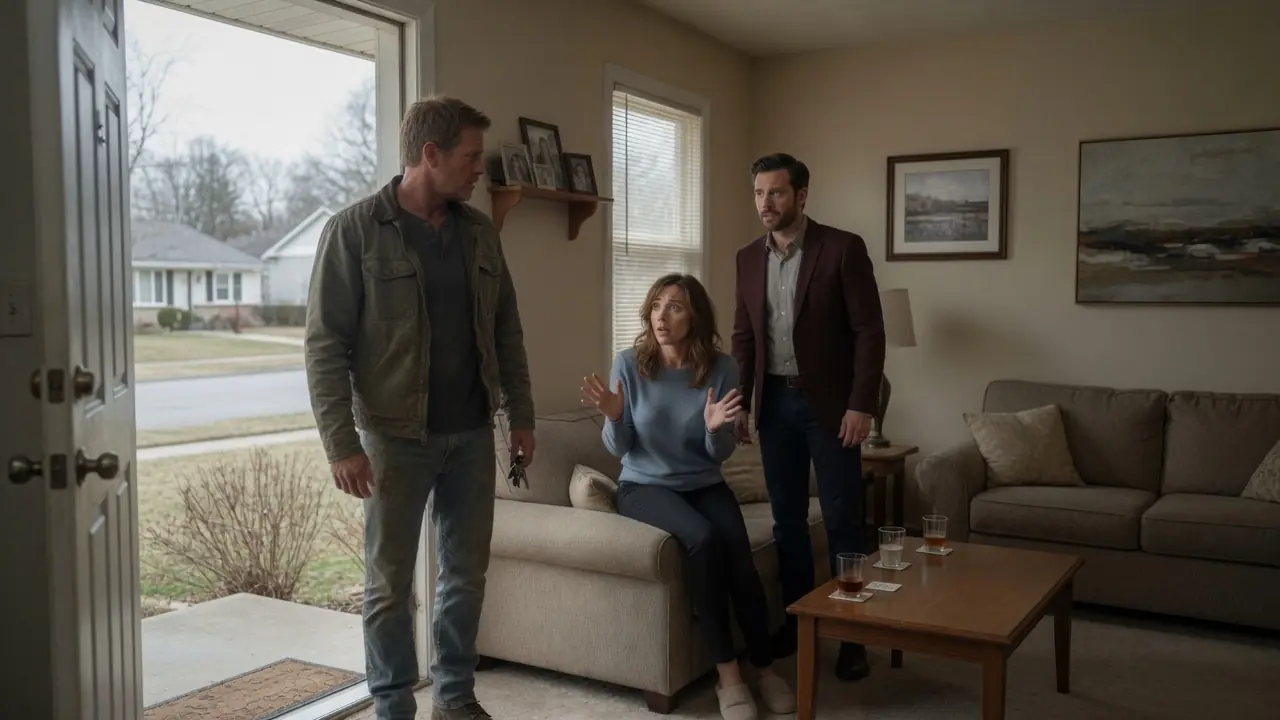
That night at dinner, she barely touched her food.
I ate slowly.
“How was work?” I asked.
She looked startled.
“Fine.”
“Daniel doing okay?”
Her fork hit the plate.
Not loudly.
But enough.
“What?”
“Daniel. From work.”
She swallowed.
“I don’t know. Fine, I guess.”
I nodded.
“Good.”
She stared at me.
I finished my chicken.
The next morning, I installed a lockbox in the tool shed and moved my business checkbooks, spare keys, old client contracts, and equipment titles into it.
The day after that, Ruth filed preliminary protections for the business assets.
The day after that, Mason opened a separate operating account for the company and moved all new deposits there.
I did not touch the joint account except for documented household expenses.
Architecture.
That was what Ruth called it.
Build the structure before the storm.
The storm arrived on a Sunday.
Daniel’s wife called me.
Her name was Marissa Reeves.
I had met her once at a company holiday dinner. Soft-spoken, sharp-eyed, kind in a way that looked gentle but probably was not. She had a teenage daughter from a previous marriage and a five-year-old with Daniel.
Her voice was calm when she introduced herself.
Too calm.
The calm of a woman holding a cracked cup very carefully.
“I think we need to talk,” she said.
“Yes,” I replied.
We met in a park thirty minutes later.
Public.
Quiet.
A place with benches and no reason for either of us to perform.
Marissa brought a folder.
I brought one too.
For almost an hour, we compared the ruins of two marriages like people comparing storm damage after a tornado.
She had messages.
I had financial records.
She had hotel screenshots.
I had dates.
She had one photo of Daniel and Erica sitting too close at a bar during a supposed work conference.
I had the Hocking Hills receipt.
Neither of us cried.
Not then.
At the end, Marissa closed her folder.
“He told me she was unstable,” she said.
I laughed once.
“He told her he was leaving you.”
“Of course he did.”
She looked toward the playground, where a little boy was trying to climb up the slide instead of down.
“I am going to file.”
“So am I.”
She nodded.
“Good.”
We were strangers.
But for one strange hour, we were allies in a war neither of us had started.
That evening, when I came home, Erica was waiting in the living room.
She had been crying.
For real this time.
Not strategic tears.
Collapse tears.
“Marissa called Daniel,” she said.
I hung my jacket by the door.
“I imagine she did.”
Erica stood.
“You met with her?”
“Yes.”
“You had no right.”
I looked at her.
That was the wrong sentence.
Even she seemed to know it after saying it.
“No right?” I repeated.
She pressed her lips together.
“I mean, you are making everything public.”
“You made it shared when you chose a married man.”
Her face crumpled.
“It was not supposed to be like this.”
That sentence exhausted me more than anything else she had said.
“It was not supposed to be found out,” I said.
She hugged herself.
“I loved you.”
I believed her.
That was the worst part.
I believed that in some damaged, selfish, insufficient way, she had loved me.
But love that requires another person to stay blind is not love worth preserving.
“Maybe,” I said. “But you loved yourself more.”
She sat down like her legs had gone weak.
“Can we go to counseling?”
“No.”
“You will not even try?”
“I tried for nine years. I just did not know I was the only one in the room.”
She cried harder.
I went to the guest room.
Not because I felt nothing.
Because I felt too much, and none of it could help me now.
The papers were served the following Thursday.
Ruth arranged it at Erica’s office.
Not for cruelty.
For clarity.
A neutral public place where she could not scream, break things, or rewrite the moment before witnesses.
Erica called me twelve times that afternoon.
I did not answer.
Then came the texts.
Grant, please.
We need to talk.
You are making a mistake.
I was confused.
Daniel manipulated me.
I still love you.
Please do not do this.
By evening, the tone changed.
You cannot take the business.
Half of that house is mine.
You do not get to destroy me.
I forwarded everything to Ruth.
She replied: Do not engage.
So I did not.
That night, Erica came home furious.
Not sad.
Furious.
She walked into the kitchen with mascara under her eyes and divorce papers in one hand.
“You planned this.”
“Yes.”
The answer stopped her.
She had expected denial.
“You planned this while pretending everything was normal.”
“Yes.”
“That is sick.”
“No,” I said. “That is what people do when they finally understand they are not safe with the person sleeping beside them.”
Her face twisted.
“I never hurt you like that.”
I stared at her.
“You took money from our savings to pay for hotels with him.”
She went silent.
“You brought his name into my kitchen and then lied to my face.”
Her eyes dropped.
“You let me build a life around someone who was already halfway out the door.”
“I was confused,” she whispered.
“No. You were comfortable.”
The words hit harder than shouting would have.
She sat at the table.
For a moment, she looked like a stranger who had wandered into the wrong house and found judgment waiting.
“I do not know where to go,” she said.
“You can stay in the guest room for two weeks,” I said. “After that, Ruth will communicate arrangements.”
She looked up.
“You are letting me stay?”
“I am not cruel.”
“No,” she whispered. “You are worse. You are finished.”
She was right.
Two weeks later, Erica moved into an apartment near her office.
She took her clothes, her books, the framed art from the hallway, half the kitchen items, and the dining table her mother had given us.
I kept the dogs.
She asked for them at first.
Then missed three scheduled visits in a row.
After that, she stopped asking.
The divorce took five months.
Marissa’s took four.
Daniel lost his job when the company discovered he had approved vendor expenses for trips that were not business-related. Erica kept hers, but barely. Her reputation did not survive cleanly. Some people blamed Daniel more. Some blamed her. Most simply enjoyed the story because people love wreckage when it belongs to someone else.
I did not enjoy it.
That surprised some people.
They expected satisfaction.
Revenge.
A man wronged should want blood, apparently.
I wanted quiet.
Ruth protected the business. Mason protected the books. The settlement gave Erica a portion of the home equity, less the documented funds she had taken from the joint account for the affair-related expenses. She fought that at first.
Then Ruth put the hotel records on the table.
Erica stopped fighting.
I refinanced the house in my name.
The day the divorce finalized, I came home, stood in the kitchen, and finally replaced the flickering ceiling light.
It took twelve minutes.
I had put it off for three months.
When the new light came on, the room looked different.
Not better.
Just honest.
No shadows hiding in the corners.
No soft flicker making everything look uncertain.
I stood there for a long time with the ladder still open beside me and the dogs lying on the floor, watching me like they knew something had ended.
Maybe they did.
For the first few months, I did not date.
I worked.
I rebuilt the savings account.
I cooked badly.
I painted the guest room.
I learned that silence in a house can either accuse you or keep you company, depending on what you have survived.
Some nights were hard.
Not because I wanted Erica back.
Because betrayal leaves echoes.
You hear a song in a grocery store and remember dancing barefoot in the living room before you knew the person holding you would one day look you in the eye and lie without blinking.
You find an old receipt in a jacket pocket.
You reach for two coffee mugs.
You stop halfway.
Healing is not a straight road.
It is a thousand small corrections.
One morning, almost a year later, I ran into Erica outside a hardware store.
She looked thinner.
Tired.
Older in a way that had nothing to do with age.
She saw me loading bags of mulch into my truck and stopped.
“Grant.”
“Erica.”
She looked at the truck.
“Business good?”
“Good enough.”
“That is good.”
Silence.
Then she said, “I am sorry.”
I nodded.
“I know.”
“I did love you.”
“I know that too.”
Her eyes filled.
“I just did not know how to be honest.”
“That is not something I can fix.”
She looked down.
“No. I know.”
For a moment, I saw the woman I married.
Not the liar.
Not the woman who said Daniel’s name in my kitchen.
The woman I once planted hydrangeas beside.
It hurt.
But it did not pull.
That was how I knew I was free.
“I hope you are okay,” she said.
“I am getting there.”
She nodded.
Then walked away.
I did not watch her go.
That evening, I drove home, let the dogs into the yard, and sat on the back steps with a beer.
The garden along the fence had been neglected during the divorce. Weeds everywhere. Dead stems. Hard soil. A mess.
A year earlier, that would have felt symbolic.
Now it just looked like work.
Work I knew how to do.
The next Saturday, I spent six hours clearing it.
Pulled weeds.
Turned soil.
Cut back what was dead.
Planted new hydrangeas.
Not because of Erica.
Because I liked them.
Because ugly things could still grow if the ground was honest and someone stopped pretending weeds were flowers.
By late summer, the first blooms came in blue.
Deep, clean blue.
I stood there one morning before work, coffee in hand, looking at them in the soft light.
My phone buzzed.
Mason.
Breakfast Sunday?
I typed back.
Yeah.
Then another text came in.
Ruth Calder, of all people.
Final certified copy came through. You are officially and completely done.
I looked at the garden.
At the dogs chasing each other through wet grass.
At the house that was mine now, not because a court said so, but because the lies had finally been cleared out of it.
I thought about the night Erica said Daniel’s name.
At the time, I believed it was the moment my life cracked open.
Maybe it was.
But cracks are not always endings.
Sometimes they are where poison drains out.
People think betrayal destroys trust in other people first.
It does not.
It destroys trust in yourself.
You wonder how you missed it.
How you explained away signs.
How you slept beside someone and did not hear the lie breathing next to you.
That is the hardest thing to rebuild.
Not love.
Judgment.
But it comes back.
Slowly.
Fact by fact.
Boundary by boundary.
Day by day.
I am forty-two now.
The business is stronger than it has ever been. The house is quiet, but not empty. The dogs still sleep in the hallway like unpaid security guards. The hydrangeas came back better than I expected.
Sometimes I think about dating.
Sometimes I do not.
Either way, I am no longer afraid of being alone.
That is the gift nobody tells you about.
When someone betrays you badly enough, and you survive it, you learn the difference between loneliness and peace.
Loneliness asks why no one is beside you.
Peace reminds you that the wrong person no longer is.
And if I ever do love again, it will not be because I need someone to complete the house.
The house is standing.
The garden is growing.
The light in the kitchen no longer flickers.
And the man who once tried to fix a marriage already broken beyond repair has finally learned a better skill.
Knowing when to stop fixing.
Knowing when to walk away.
Knowing that sometimes the most powerful thing a quiet man can do is say nothing, gather the truth, and build a door where there used to be a wall.