The ledger was bound in dark green leather, its spine cracked, and its corners softened with a century of use. It was one of dozens Helena Gascoinne had unearthed from the bottom of a heavy oak chest in the Blackwood Manor Library, a room so long neglected that the air itself seemed to have turned to dust. The entry that gave her pause was dated 1798, written in the elegant sloping hand of the steward of that time. It recorded the renewal of a lease for a tenant farmer named Mr. Albright for the Southfield farm. The terms were standard, the sum unremarkable, but beside it in the margin was a fainter annotation in a different, more forceful script, revised per HG.
HG was His Grace, the previous Duke of Blackwood, father of her current employer, and beneath that a single cryptic number significantly lower than the official rent recorded in the main column. It was nothing. A private note, a calculation, perhaps an error corrected. Helena was an archivist, a cataloger of history, not an auditor. Her father, a country vicar with a passion for forgotten texts, had taught her to respect the sanctity of the past, to organize it, not to interpret it.
A task as defined by the current Duke in their one and only interview was brutally simple. "Bring order to this chaos. I want to know what is in this library. That is all." She had been at Blackwood for two months. Two months of silence, punctuated only by the rustle of turning pages, the scratch of her pen, and the distant mournful cry of rooks in the ancient oaks that crowded the manor.
The house itself was a study in faded grandeur. Its stone walls were solid, its proportions magnificent, but a creeping damp stained the tapestries in the long gallery, and entire wings were shut up, their furniture shrouded in white cloths like a congregation of ghosts. The estate was in decline. Everyone from the grim-faced housekeeper, Mrs. Finch, to the boy who weeded the neglected gardens knew it. The Duke was trying to halt the slide, they whispered, but he was one man fighting a tide of his father's making.
Helena had seen the Duke only a handful of times since her arrival. He was a tall, severe man with dark hair and eyes the color of a winter sky. He moved with a contained energy, as if holding himself back from some great impatient stride. He was always on his way somewhere else, to London to meet with his man of business, to the far-flung boundaries of the estate, to survey the struggling farms. He moved through his ancestral home like a visitor, his presence casting a chill that had nothing to do with the manor's pervasive damp.
He had never spoken to her beyond a curt nod in a hallway. She was part of the furniture, another quiet object in his vast, decaying house. She did not mind. Invisibility was a cloak she had worn for much of her life, as the unmarried daughter of a poor clergyman. She had learned to occupy the quiet corners of other people's rooms, to make herself useful and small. Here in the library, her smallness was a strength. The room was her sanctuary, a world of paper and ink that demanded nothing of her but her intelligence and her patience.
She turned the page of the ledger. Another lease renewal, this time for a family named Croft, and again the same annotation in the margin, revised per HG, followed by a different, lower number. A curiosity sharpened within her. She set the green ledger aside and pulled another from the chest, this one from a decade later. She flipped through the pages, her fingers skimming over the columns of names and figures. There it was again and again, a pattern, subtle but persistent, stretching across twenty years of the old Duke's tenure. Two sets of books, one official and one secret, kept within the same volume. Why? What did it mean?
She felt a prickle of unease, the feeling of having trespassed. This was not her concern. Her job was to list, to label, to create a catalog. "That is all," the Duke had said. His tone had left no room for initiative. She closed the ledger and placed it carefully on the long refectory table she used as her desk. The late afternoon sun slanted through the tall, grimy windows, illuminating motes of dust dancing in the air. For the first time since her arrival, the silence of the library felt less like peace and more like concealment. The house was holding its breath. It was keeping its secrets.
Over the next few weeks, the small unease grew into a quiet obsession. Helena continued her work cataloging the collections of poetry and philosophy, but her mind was on the ledgers. During her breaks, she would return to them, cross-referencing names and dates with other estate documents. She found rent rolls, letters from the steward, even the old Duke's personal almanac where he noted weather and crop yields alongside cryptic financial figures.
The picture that emerged was chilling in its simple, methodical cruelty. The old Duke, a man lauded in society for his charm and generosity, had been systematically defrauding his own tenants. The official ledgers, the ones shown to the steward and the man of business, recorded fair, standard rents. But the marginalia, the secret figures, told the true story. The tenants, many of whom could not read or write, were paying a higher rent in cash or in kind, a portion of which was siphoned off directly to the Duke before it was ever officially recorded. It was a second hidden tax on their labor.
Helena felt a cold weight settle in her stomach. This was not a historical curiosity. The tenants in those ledgers were the fathers and grandfathers of the tenants struggling on the land today. This was a living wound, a poison that had been seeping into the soil of Blackwood for a generation. What was she to do? To say nothing felt like a complicity she could not bear. It would make a lie of her work, a mockery of the order she was trying to create from the chaos. The truth was the most important thing in any archive. But to speak, to whom? The only person with the power to act was the Duke. A man who looked at her as if she were a piece of furniture. A man fiercely protective of his family's name, a name she was about to tell him was built on a foundation of lies.
She spent a week in silent deliberation. The knowledge was a physical weight. Every time she walked past a tenant farmer tipping his cap, his face worn with worry, she felt the burden of her silence. She saw the Duke's father's portrait in the main hall, a handsome, smiling man with kind eyes, and felt a wave of revulsion. Finally, she knew she had no choice. Integrity, her father had taught her, was not a thing you possessed. It was a thing you did.
She began to work with a new purpose. She did not merely think about the evidence. She assembled it. She took clean sheets of paper and transcribed the damning entries, creating a clear chronological summary of the fraud. She noted the ledger numbers, the page numbers, the dates. She worked late into the evenings, the library lit by a single oil lamp, the vast room falling into deep shadow around her. The house seemed to watch her, its silence now expectant.
When she was finished, she had a slim, damning dossier. It was cold, factual, and irrefutable. Holding it in her hands, she felt a tremor of fear. This piece of paper could destroy a man's memory and threaten the future of his son. She took a deep breath. It was time.
She requested an interview with the Duke through Mrs. Finch. The housekeeper looked at her with an expression of shrewd curiosity. "His Grace is very busy, Miss Gascoinne. He leaves for London again in two days." "It is a matter of some urgency regarding the archives," Helena said, her voice steady. Mrs. Finch nodded slowly. "I will see what I can do."
The summons came the next evening. The Duke would see her in his study after dinner. The study was the heart of the Duke's cold authority. It was a masculine room, paneled in dark wood, smelling of leather and old paper, and the faint, sharp scent of whiskey. A fire burned low in the great hearth, doing little to warm the cavernous space.
Arthur Sinclair stood by the window, looking out into the blackness of the night. He did not turn when she entered. "Mrs. Finch said your business was urgent." His voice was flat, impatient. "It is, Your Grace." She walked forward and stopped a respectful distance from his desk. Her hands, holding the slim sheaf of papers, were perfectly still.
He turned then, and his gray eyes swept over her, cool and dismissive. He was dressed for dinner, his black coat and white cravat stark and formal. He looked tired. Lines of strain etched around his mouth. "I have little time for trivialities, Miss Gascoinne. The estate's finances are in a precarious state. I am attempting to secure a loan to see us through the next year."
The irony was so bitter it almost made her gasp. He was trying to borrow money to fix a problem created by stolen money. "What I have to say concerns the estate's finances, Your Grace. It concerns the archives." He raised an eyebrow, a flicker of interest in his impassive face. "Indeed. Have you found a lost Rembrandt? A first folio of Shakespeare?"
"I have found a system of fraud," she said quietly. "Perpetrated by the late Duke, your father, against the tenants of this estate for a period of more than twenty years." Silence. A log shifted in the fireplace, sending up a shower of sparks. The Duke's face, which had been merely cold, became a mask of stone. Not a muscle moved. One second. Two seconds. Three.
"Repeat what you just said." His voice was dangerously soft. "I have discovered evidence in the estate ledgers," she began again, keeping her tone even and factual, "of a consistent discrepancy between the official rents recorded and the actual amounts collected. The extra funds were diverted directly to your father. I have compiled a summary of the findings." She stepped forward and placed the papers on the polished surface of his desk.
He did not look at them. His eyes were fixed on her face, and they were no longer the color of a winter sky. They were the color of ice. "You are a librarian, Miss Gascoinne, hired to sort books. You are not an accountant. You are not a magistrate. You are a clerk." "I am an archivist," she corrected him gently. "My duty is to the truth of the record."
"The truth?" He gave a short, sharp laugh devoid of all humor. "You have been here two months. You look at a few old books and you presume to understand the history of this family. You presume to cast aspersions on the memory of my father, a man who was respected and admired by all." "The evidence is on those pages, Your Grace."
"I will not look at them," he snapped, his control finally breaking. He took a step toward her, his height and his anger filling the room. "I will not dignify this... this fantasy with my attention. Do you have any idea what you are accusing him of? What you are accusing me of? My father loved this estate." "He bled it dry," Helena said, her own voice rising slightly despite her resolve. "The reason this estate is failing is not because of poor harvests or bad luck. It is because your father stole from the people who trusted him. The proof is in your own library."
He stopped directly in front of her, so close she could see the faint tremor of fury in his clenched jaw. "This is a lie. This is the work of an overimaginative, bored woman who has overstepped her station. I brought you into this house to perform a task, a simple task, and you repay my trust by fabricating this... this filth."
The injustice of it stung, but she held his gaze. She would not be intimidated. She had come too far for that. "It is not filth. It is the truth. Look at the papers." "No." He turned away from her, striding back to the fireplace. He braced his hands on the mantelpiece, his back rigid. "You are dismissed, Miss Gascoinne. Your employment here is terminated. I want you gone by morning."
He was speaking to the fire, not to her. He could not even look at her. A strange calm descended upon Helena. She had known this was a possibility. She had in some way expected it. "Do you know what I think?" he said, his voice low and vibrating with rage. "I think you saw an opportunity, a failing estate, a desperate duke. Perhaps you thought this information could be valuable, that you could use it."
The accusation was so vile, so far from the truth of her intentions, that it broke through her composure. All she had wanted was to right a wrong, to give a name to the suffering she saw around her. "I want nothing from you, Your Grace," she said, her voice clear and cold. "Only for you to see what is right in front of you."
He finally turned back, his face a sneer of aristocratic contempt. "I see a disloyal employee who I was foolish to hire. I can hire fifty like you." The words hung in the air between them. Brutal and dismissive. Fifty like you. Fifty quiet, impoverished, educated women who could be hired and fired at a great man's whim. In his eyes, she was not a person. She was a function, a replaceable part in the machinery of his life.
And in that moment, something inside Helena Gascoinne settled into a hard, clear certainty. She had done her duty. She had brought the truth to light. He could choose to be blind, but she would not stay to watch him. "Then do it," she replied. Her voice was not loud, but it cut through the tension in the room like a shard of glass.
She turned without another word and walked toward the door. She did not look back. She heard the sharp intake of his breath, a sound of pure shock, as if he had expected her to weep, to beg, to protest. She did none of those things. She simply opened the door, stepped into the hall, and closed it quietly behind her, leaving the Duke of Blackwood alone with the truth he refused to see.
Arthur Sinclair stood frozen, staring at the closed door. The quiet click of the latch was louder than a gunshot in the sudden ringing silence of the study. Then do it. The sheer unmitigated audacity of it. He had expected tears, hysterics, a pleading for her position. He had expected a woman of her class to crumble. She had not crumbled. She had simply agreed with him and left. His fury, which had been a hot, roaring fire, banked into something colder and heavier.
He strode to his desk, his hand hovering over the sheath of papers she had left there. His first instinct was to sweep them into the fire, to watch the neat, damning script blacken and curl into ash, to erase her words, her accusation, her very presence from his house. He was the Duke of Blackwood. His father had been the Duke of Blackwood. Their name, their honor, was the bedrock on which this house, this land, this life was built. And this woman, this nobody, this penniless vicar's daughter, had dared to strike at its foundation.
He sank into his chair, the leather groaning under his weight. His father's portrait loomed over the fireplace, the painted eyes full of benign confidence, the mouth curved in a gentle aristocratic smile. The man in that portrait was a pillar of his community, a patron of the arts, a beloved landlord. Arthur had grown up in the shadow of that public adoration. He had loved his father, even as he had been intimidated by him.
After his father's sudden death five years ago, Arthur had inherited the title, the estate, and the crushing weight of expectation, and the debts. So many debts. He had spent five years fighting a losing battle. Every investment failed. Every harvest seemed to fall short. The estate was quicksand pulling him under. He had assumed it was his father's lack of business acumen. A gentleman's carelessness with finances. He had never, not for a single moment, suspected malice.
His eyes fell back to the papers on his desk. Miss Gascoinne's filth. With a surge of angry resolve, he snatched them up. He would read them. He would read them and find the flaw, the misinterpretation, the leap of logic that would expose her fantasy for what it was. He would prove her wrong, and in doing so, justify the righteous fury he felt.
He began to read. Her handwriting was as clear and precise as her speech. A summary of discrepancies in the Blackwood estate ledgers 1795 to 1815. She had organized it by tenant, by year. Tenant Albright, John. Farm: Southfield. Ledger 7, page 45. Official rent recorded £12 per annum. Cross reference: Duke's Almanac 1798. Entry: Albright paid in full £18. Margin note: Southfield surplus to London account.
Arthur's breath caught. The London account. That was his father's private investment account, the one his solicitors had informed him was mysteriously empty upon his death. He read on, page after page. Croft, Sutton, Ames. The names were familiar. These were the families still on the land, their faces grim with the same worry that had likely lined their fathers' faces. For each one, the same pattern. An official rent and a higher secret payment. A note about a surplus, a transfer.
It was too methodical to be a mistake, too consistent to be an anomaly. The numbers, the dates, the cross references. They built a case as solid and unyielding as the stone walls of the manor. He got up and went to the wall of shelves where the estate records were kept. He had never looked at them closely. That was the steward's job. He pulled down ledger 7. He found page 45. There it was, the neat entry in the steward's hand, and in the margin, his father's familiar, arrogant script. Revised per HG.
He pulled down the almanac for 1798. He found the date. Albright paid in full, £18. It was true. All of it. The anger drained out of him, replaced by a cold, hollowing dread. It was a physical sensation, an emptiness that started in his chest and spread to his limbs. He felt sick.
He spent the rest of the night in that room, pulling down ledger after ledger, journal after journal. The fire died to embers, and the room grew cold. The first hint of a gray dawn began to creep through the windows. He did not notice. He was surrounded by the evidence of his father's meticulous twenty-year campaign of theft against his own people.
The man in the portrait was a stranger, a liar, a thief who wore the mask of a gentleman. The respect he had commanded was a sham. The love Arthur had felt for him was for a fiction. And the rot, the rot was not financial. It was moral. His father had not mismanaged the estate. He had gutted it. He had treated the tenants not as partners in the land but as a resource to be plundered. And the money he had stolen, lost, squandered on foolish speculations in the Americas, on ventures that had collapsed and taken the stolen wealth with them. There was nothing left, only the damage.
Arthur finally looked up from the ledgers, his eyes gritty with exhaustion. He looked at his father's smiling portrait. The benign expression now seemed like a smirk. The kind eyes were cunning. He felt a wave of shame so profound it was like drowning. Shame for his father's sins. Shame for his own blindness. And shame for what he had said to Helena Gascoinne. I can hire fifty like you. The arrogance, the cruelty. He had treated her with the same casual disdain his father had treated the tenants. He had looked at her integrity and called it a fantasy. He had seen her courage and called it disloyalty. He had become in that moment his father's son in the worst possible way.
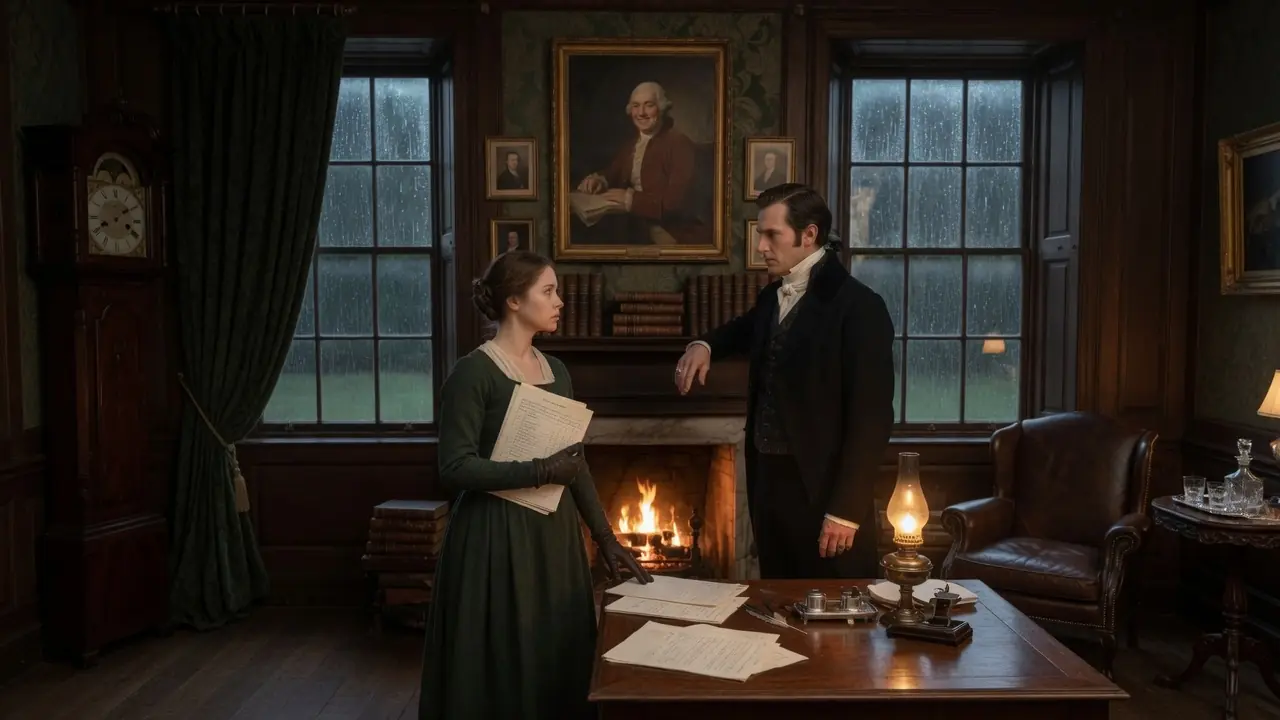
Then do it. Her quiet reply echoed in the silent room. It was not an insult. It was a judgment. And she was right. A sudden, frantic urgency seized him. He looked at the clock on the mantelpiece. It was nearly six. The carrier, the public coach that passed through the village, left at seven. She would be on it. She would be gone. And with her would go the only person who had told him the unvarnished truth in five years, the only person who had seen the wound and not been afraid to name it.
He stood up, his limbs stiff. He did not bother to change his clothes or call for a servant. He walked out of the study, through the silent hall, past the portrait of the man he no longer knew, and out the great front door into the cold, damp morning air. He did not know what he would say. I'm sorry felt pathetic, inadequate. But he knew he had to try. He had to stop her. Not just for the estate, for himself.
He started walking, his pace quickening into a run down the long drive toward the village.
Helena had packed her single valise before dawn. There was not much to pack. A few plain dresses, her father's copy of Virgil, and the small portfolio of botanical drawings she made in her spare time. She had left the room as she had found it, neat and impersonal. She walked down the grand staircase, her footsteps echoing in the sleeping house.
Mrs. Finch was in the hall holding a small cloth-wrapped parcel. The housekeeper's face was unreadable, but her eyes were kind. "The carrier will not have food, miss," she said, pressing the parcel into Helena's hands. "It is still warm bread and cheese. And it is a long road to York." "Thank you, Mrs. Finch," Helena said, her throat tight. This small act of kindness felt monumental.
"You are a good woman, Miss Gascoinne," the housekeeper said quietly. "Some people are not ready for the truth, especially when it concerns their own blood." It was the closest the reserved woman had ever come to an overt opinion, and it was a comfort. Helena nodded, unable to speak. She gave the housekeeper's hand a brief squeeze and walked out into the misty dawn.
The village was a mile's walk. The air was cool and smelled of wet earth and wood smoke. The sky was lightening from gray to a pale luminous pearl. Helena walked with her head held high. She felt no regret. She felt a clean, sharp sadness, but also a sense of release. She had done the right thing. The consequences were not hers to control.
She reached the crossroads where the carrier stopped just as the old coach was rattling into view. A few other passengers were waiting, their breath pluming in the air. She took her place among them, her valise at her feet, and waited.
She did not see him until he was almost upon her, a figure running down the road from the direction of the manor. He was disheveled, his formal evening clothes creased, his hair uncombed. He was breathing heavily, his face pale with exertion, and something else, something she could not name.
The Duke of Blackwood slowed to a halt a few feet away from her. The other waiting passengers stared, their mouths agape at the sight of the Duke in his dinner attire, running on the public road at dawn. He ignored them. His eyes, no longer icy, were fixed on her. They were filled with a desperate, raw exhaustion.
He did not say he was sorry. He did not apologize for his words, for his anger. He just looked at her. And in that look, she saw the entire devastating story of his night. She saw the collapse of his world. "You were right," he said, his voice hoarse. That was all. Two words.
The carrier pulled to a stop, the driver calling out for passengers. The others began to board. Helena stood still, her heart pounding. "Don't go," the Duke said. It was not a command. It was a plea. "Stay." He took a breath, searching for the words. "Help me make it right. Help me make it right."
It was not an offer of employment. It was an invitation, an admission of need. He was no longer the cold, arrogant duke from the study. He was a man standing in the ruins of his own history, asking for help to rebuild. The coach driver shouted again impatiently. "Are you getting on or not, Miss?"
Helena looked at the coach, the symbol of her escape, of her return to a life of quiet obscurity. Then she looked back at the Duke. She saw the weight he carried, the shame, and the dawning resolution in his eyes. To leave now would be to abandon not just him, but the tenants of Blackwood, the very people she had sought to give a voice to. Her work was not finished. It had only just begun.
She turned to the driver. "No," she said, her voice clear. "I am not." She picked up her valise. The Duke made a move to take it, but she shook her head slightly. She would carry her own burdens. They walked back toward the manor in silence. The sun was rising now, breaking through the mist, casting long golden shafts of light across the fields. It felt like the first day of a new world.
The days that followed were unlike any that had come before at Blackwood. The Duke, Arthur, as he insisted she call him, did not retreat to his study. They worked together in the library, the scene of their confrontation, now the headquarters of their restoration. The great refectory table was covered not with Helena's neat cataloging notes, but with maps of the estate, copies of leases, and columns of figures.
Arthur canceled his trip to London. "A loan would be another lie," he said, staring at the numbers. "Borrowing money to pay back money that was stolen. It's a phantom chasing its own tail. We have to pay the debt from what we have." What they had was very little. The truth had a high price. To make restitution, to repay the tenants for two decades of systematic theft would mean selling off nearly everything that was not entailed with the estate. A townhouse in London, a collection of paintings, his mother's jewels, his father's prized collection of classical sculptures. Arthur did not hesitate.
He wrote the letters to his man of business with a grim, steady hand. Each sale was a blow to the family's prestige, a public admission of failure. But he did not flinch. "Let them talk," he said to Helena one evening as he signed away a portfolio of stocks. "Let them whisper. It is better than living a lie."
Helena's role shifted from archivist to adviser. She was the keeper of the truth. Her clear memory and organized mind the engine of their work. Together they calculated the debt owed to each family, factoring in the years, the lost potential, the quiet hardship. Then came the hardest part. They had to tell the tenants.
Arthur decided to do it himself. Face to face. He asked Helena to come with him. "I need you there," he said, his voice low. "As a witness. So they know it is not just another one of a duke's promises." They went from farm to farm. It was a pilgrimage of shame.
At each cottage, Arthur would stand before the tenant farmer, men with weathered faces and suspicious eyes, and he would confess. He did not make excuses. He did not soften the blow. "My father, the late Duke, stole from your family," he said to the elderly Mr. Albright, his voice devoid of its usual aristocratic cadence. "For twenty years, he took money that was rightfully yours. I am here to tell you the truth, and to begin to make it right."
The reactions varied. There was shock, disbelief, a deep, simmering anger that had been buried for a generation. One man whose father had lost his farm entirely simply stared at Arthur and then turned his back. He did not want the money. The wound was too old, too deep. But most listened. They listened to Arthur's quiet confession. And they looked at Helena standing beside him, her presence a silent confirmation of his sincerity. They saw a duke unlike any they had known, a man who was not hiding behind his title, but who was using his power to dismantle a lie.
Slowly, painstakingly, new leases were drawn up, fair leases, debts were forgiven. A portion of the stolen money was repaid with a promise of more to come as assets were sold. It was not a perfect solution. Money could not erase years of hardship or restore a lost generation's trust. But it was a beginning.
In the midst of this shared, difficult work, something began to shift between Helena and Arthur. The formal distance of employer and employee dissolved, replaced by the easy intimacy of partners. They ate their meals together, not in the cavernous dining hall with its long, lonely table, but in the small morning room, or sometimes on a tray in the library when they worked late.
Helena saw a different man emerge from the cold shell of the Duke. She saw his quiet determination, his unwavering commitment to this difficult path. She saw the flashes of dry wit that surfaced when he was exhausted. She saw the way his eyes would soften when he spoke of the land, of his hope for its future. He was not just a duke. He was Arthur, a man burdened and flawed, but a man of deep, abiding honor.
Arthur, in turn, saw the woman who had been invisible to him. He saw her fierce intelligence, her quiet strength, her profound compassion. She never judged him for his father's sins or for his own initial blindness. She simply stood with him, a calm, steady presence in the storm. She was the anchor that kept him from being swept away by the shame and the guilt.
One evening they were in the library, the last of the restitution papers signed and sealed. The London townhouse had been sold. The tenants had their new leases. The long, painful first step was over. A new, leaner, more honest era for Blackwood was beginning.
"It is done," Arthur said, leaning back in his chair. He looked utterly spent, but a faint, unfamiliar lightness was in his eyes. "It is begun," Helena corrected him softly. He looked at her across the table, at her calm face illuminated by the lamplight. Her work was finished. The archives were, in a way, settled. She was free to go. The thought sent a bolt of panic through him, sharp and unwelcome. The idea of this house, of his life, without her in it, was now unthinkable. It was a return to the silence, to the cold.
"What will you do now, Helena?" he asked, his voice careful. She met his gaze. "I have not thought that far ahead. I suppose I will look for another position, another library that needs sorting." I can hire fifty like you. The memory of his own cruel words twisted in his gut. He could hire fifty librarians perhaps. But there was only one Helena Gascoinne.
"I have another position in mind," he said, his heart hammering against his ribs. "If you would consider it." She waited, her expression calm, giving nothing away. "This house, this estate, it needs more than a duke. It needs a conscience. It needs a heart." He stood up and walked around the table to where she sat. He did not touch her. He simply stood before her, his vulnerability a raw, open thing. "I need you, Helena. Not as an archivist. Not as an employee. As my wife. As my partner. In this, in all of it."
Helena looked up at him. The great Duke of Blackwood asking, not commanding. The love she had quietly, unknowingly been cultivating for him bloomed in her chest, warm and certain. It was not a love born of ballrooms or flirtations. It was forged here in this dusty room, built on a foundation of shared work, mutual respect, and the slow, difficult pursuit of truth.
She did not answer with a flurry of words. She did not need to. She simply reached out her hand and placed it over his on the table. A small gesture that changed everything. He covered her hand with his other, his grip firm and warm. Something moved at the corner of his mouth. Not quite a smile. The almost. And in his eyes, the color of a winter sky, she saw the promise of a spring thaw.
Epilogue. One year later, the library at Blackwood Manor was no longer a tomb of forgotten secrets. Its windows were clean, and the afternoon sun streamed in, illuminating the spines of books that were now meticulously ordered. The long refectory table was still there, but it was now used for estate meetings, for planning the planting of new orchards, and the mending of old stone walls. The house was breathing again.
Helena, now the Duchess of Blackwood, stood by the window, looking out at the gardens. A year ago, they had been a wilderness of weeds. Now, under the care of two new gardeners, the rose bushes were pruned, and the first snowdrops were pushing their way through the cold earth. The recovery was slow, painstaking. Blackwood would not be a great and wealthy estate for a generation, if ever. The sales had curtailed their fortune significantly, but it was solvent. It was honest. It was healing.
She heard a footstep behind her and turned. Arthur stood in the doorway, shrugging off his heavy riding coat. He had been out with the tenants, inspecting the new drainage ditches in the low fields. His face was weathered by the wind, and his boots were muddy, but he had lost the haunted, driven look he had worn when she first met him. He looked like a man who belonged to his land.
He came to her and put his arms around her waist, pulling her back against his chest. He rested his chin on her shoulder, and together they looked out at the awakening garden. "Mr. Albright's son is getting married," he said, his voice a low rumble against her ear. "He asked if they could hold the celebration on the south lawn."
Helena smiled. "A year ago, the tenants would not have dared ask for such a thing. A year ago, the Duke would never have considered it." "And what did you say?" "I said we would be honored to attend." They stood in comfortable silence for a moment. The chill of the old house was gone, replaced by a quiet, settled warmth that had nothing to do with the fires in the hearths.
They had shortened the great dining table, selling off the extra leaves. Their dinners were no longer lonely affairs at opposite ends of a vast expanse of polished wood. They were conversations. "Do you ever regret it?" Arthur asked quietly, his gaze on the distant hills. "This life, it is not the one a duchess is meant to have. There is no London season, no grand balls."
Helena turned in his arms to face him. She put her hands on his chest, feeling the steady beat of his heart. She thought of the life she might have had, a quiet, lonely existence in the corner of someone else's house. Always on the periphery, always invisible. Here she was seen. She was known. She was loved. "I have never been happier," she said. And it was the simple, unvarnished truth.
He bent his head and kissed her. It was not a kiss of frantic passion, but of deep, abiding peace, a kiss of homecoming.
Later that evening, he found her back in the library, a familiar green leather ledger open on the table before her. He felt a momentary tightening in his chest, a ghost of the old shame. "Revisiting the past?" he asked softly. She looked up, a gentle smile on her face. "Creating a new one."
He came to look. She was not on the pages of leases and rents. She was at the back, on the clean, empty pages. In her clear, elegant hand, she had begun a new record. Blackwood Estate, 1817. Below it she had written: January - South lawn offered for the wedding of Thomas Albright and Mary Croft. And beneath that: February - First snowdrops appeared in the east garden. She was chronicling not the estate's finances but its life, the small moments of grace, of hope, of renewal. She was writing a new history for Blackwood, one of quiet dignity and chosen kindness.
He placed his hand over hers, his fingers intertwining with hers on the open page. The past was a scar that would always be a part of them, a bittersweet reminder of the cost of truth. But the future, the future was a clean page, and they would write it together.