“I can’t find the door.”
The old woman whispered it in the freezing rain, soaked and shaking, unable to remember even her own name.
Most people had walked right past her.
Seventeen-year-old Ethan Carter stopped.
He took off his only coat, wrapped it around her shoulders, and said, “It’s okay, ma’am. I’ve got you. I’ll find a door for you.”
He had no idea who she was. He only knew she would not survive the night.
The next morning, ten black limousines pulled up outside the poorest apartment building in South Philadelphia.
And what happened next, no one on that block would ever forget.
The Lincoln High Engineering Wing always emptied fast on Thursday afternoons, and Ethan Carter liked it that way.
He stayed behind at the drafting table near the window, where the light held longest, and let the building go quiet around him.
The other students in the advanced track had cars waiting, or parents who texted from the parking lot.
Ethan had a worn backpack, a bus pass, and a notebook he kept zipped inside a plastic sleeve so the rain would not get to it.
He was the only kid from his side of South Philadelphia in that classroom, and he had learned the math of that a long time ago. It meant he had to be twice as careful and half as visible.
So, he kept his best work hidden.
The notebook held drawings of bridges. Dozens of them, sketched in pencil that he sharpened down to stubs.
Suspension bridges. Footbridges. Spans that arced over highways and railyards, and the kind of empty lots that scarred his own neighborhood.
To Ethan, a bridge was not just a structure.
It was an argument.
It said that two things separated by a gap could still be joined. It said distance did not have to mean abandonment.
He had never told anyone that.
A boy from his block who talked that way got laughed at, and he had no appetite for being laughed at.
He drew until the window went gray, then packed up and caught the bus south toward home.
Home was a third-floor walk-up in a building that the city had stopped pretending to maintain.
The radiator clanked when it felt like it and stayed cold when it did not.
His grandmother, Margaret, had lived there for nineteen years, long enough to know which stairs to avoid and which neighbors to trust.
She worked at a commercial laundry six days a week, feeding hotel sheets through pressing machines until the steam soaked through her clothes.
Arthritis had bent her fingers into shapes that no longer straightened all the way, and on bad mornings she could not close her hand around a coffee cup.
She never complained where Ethan could hear her.
He heard her anyway through the thin wall, the small careful sounds a person makes when they think no one is listening.
The rent was two months behind.
The notice taped to their door had a date on it, and the date was getting close.
Ethan had taken a second job stocking shelves at a corner market to help, but the numbers never quite reached where they needed to go.
He had stopped showing Margaret the notices.
She had enough weight on her already.
Across the river, in a part of the city Ethan had never set foot in, sat the headquarters of Reynolds Group.
For three generations, the name had meant building.
The company had raised office towers and rail stations and the kind of civic projects that got ribbons cut around them.
The man who started it, Thomas Reynolds, had been an architect before he was anything else, and he had believed something simple and stubborn his whole life.
That a good structure was one that brought people toward each other instead of walling them apart.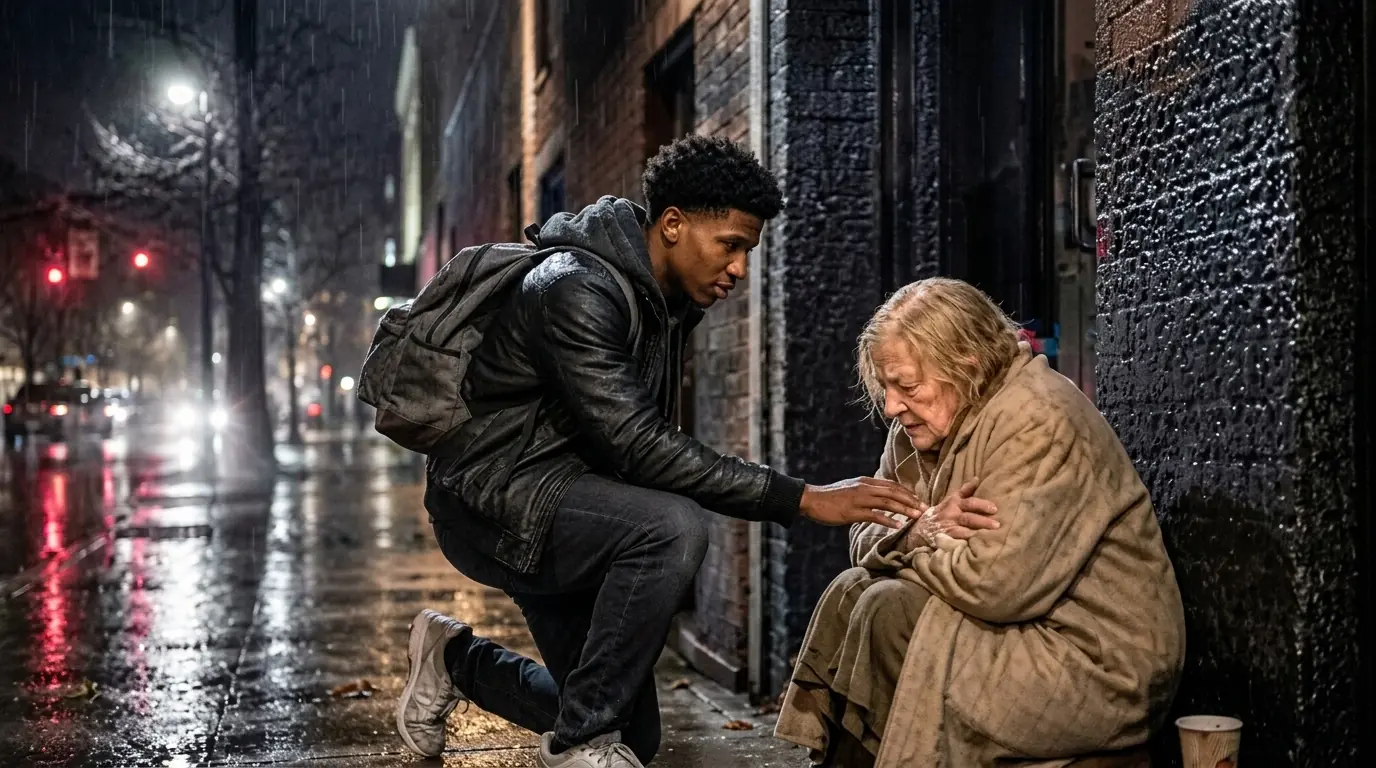
He used to say it at groundbreakings until the board grew tired of hearing it.
After he died, the saying died with him, and the company became what most companies become, a machine that measured everything in margin.
His widow still sat at the head of the table.
Evelyn Reynolds was seventy-one years old, and she carried her grief the way wealthy people are taught to carry everything, privately and without spilling it on anyone.
She had money enough to buy a small country and not one person who would sit with her in a quiet room.
Her late husband’s unfinished drawings were still in a drawer in her study, including the last one he had been working on the month he passed.
A footbridge meant to span the gap between the rebuilt riverfront and the neighborhoods the city had let rot behind it.
He had never broken ground on it.
She had never been able to throw it away.
That Thursday, Evelyn had gone to the cemetery alone.
She did this more than her doctors liked.
She had skipped lunch to go, which mattered more than she understood because the medication she took for her blood sugar did not forgive a missed meal.
The sky had been threatening all afternoon.
Now it opened.
What happened next was not something Evelyn would ever be able to describe clearly, because she was not fully present for it.
Low blood sugar, dehydration, and the cold did something to the wiring of her mind.
The world came loose from its labels.
She got out of the stalled car for a reason that made sense to her in the moment and made no sense at all, and she started walking.
Within two blocks, she could not have said her own name if a stranger had asked.
The rain came down in sheets.
Her thin coat soaked through.
The smart band on her wrist, the one her assistant insisted she wear, had a button that would have summoned help in seconds. But the rain had worked its way under the casing, and the wet got into the contacts. Somewhere in those drenched streets, the little screen flickered and shorted out.
Even if it had worked, the signal would have struggled.
The buildings down there were old and built thick, and they swallowed signals the way they swallowed everything else the city sent their way.
Ethan was walking home from the market when he saw her.
She was halfway down the block near the mouth of an alley, down on the wet pavement with one hand braced against a brick wall, as if the wall were the only thing in the world she still trusted.
An old woman, soaked to the skin, shaking hard enough that he could see it from thirty feet away.
His first instinct was the one his neighborhood had trained into him, which was to keep walking.
A teenager like him, poor and tired and alone, found near a fallen wealthy elderly woman in a storm, was a story that could end very badly for the teenager.
He knew that the way he knew his own address.
He kept walking anyway, just not in the direction his caution wanted.
He went to her.
“Ma’am.”
He crouched down, keeping a little distance so as not to frighten her, raising his voice over the rain.
“Ma’am, are you hurt? Can you hear me?”
She turned her face up toward him, and what he saw there stopped the breath in his chest.
There was nothing in her eyes that knew where she was.
She looked at him the way a small child looks at a room full of strangers, searching for one familiar thing and finding none.
“I can’t find the door,” she said.
Her voice was thin, genteel, and completely lost.
“I’ve looked everywhere. I can’t find the door.”
“Okay.”
He kept his tone even.
“It’s okay. What’s your name? Can you tell me your name?”
Her mouth worked, but no name came.
Something behind her eyes flickered and went out like a bulb trying to catch.
She started to cry.
Not loudly.
Just a quiet, helpless leaking that was somehow worse than sobbing.
Ethan looked up and down the empty street.
There was no one.
No car. No neighbor. No patrol that he would have wanted to flag down even if one had been there.
Her purse, if she had ever had one, was gone.
Her phone, when he gently asked and she fumbled it out of her coat, was a dead black rectangle that the rain had killed.
He pressed the only button on her wristband and got nothing.
He understood his choices with the cold clarity that hard situations always gave him.
He could leave her, and she would not last the night out here, not at her age, not this cold and this wet.
He could call for the authorities and stand beside her until they came, which meant explaining himself, a poor teenage boy and a confused wealthy woman, to people who might arrive already deciding what kind of scene they had walked into.
Or she might end up in some county holding facility for the night, alone and terrified, a frightened old woman parked on a plastic chair under fluorescent lights while a system that did not know her name decided what to do with her.
None of those choices were good.
One of them was at least warm.
“All right,” he said, more to himself than to her.
He shrugged out of his coat, the only one he owned, and draped it over her trembling shoulders.
The rain found him immediately, and he ignored it.
“I’m going to get you somewhere dry. You’re going to be okay. Can you stand up for me? I’ve got you. I’ve got you.”
She let him help her up.
She weighed almost nothing.
She leaned into him as if she had decided, in whatever was left of her judgment, that this stranger was safe.
That small, unearned trust did something to Ethan that he could not have explained.
He put one arm around her to keep her upright, and together they made their slow way down the flooding street toward the only door he could actually find for her, which was his own.
He talked to her the whole way, low and steady, the way Margaret used to talk to him when he was small and the city outside their window got loud.
He told her they were almost there.
He told her the stairs were coming and to take them slow.
He did not tell her his name because she would not have kept it, and he did not ask for hers again because the asking only made her cry.
By the time they reached the third floor, he was carrying most of her weight.
He freed one hand and knocked on the door of apartment 3C with his knuckle, then pushed it open with his shoulder.
Margaret was at the stove.
She turned, and the look on her face moved through several things very fast.
Surprise.
Confusion.
Then something close to fear before it settled into the particular stillness she got when a situation had turned dangerous.
“Ethan,” she said, keeping her voice low and careful. “Who is that?”
“I found her down on Mercer. She’s lost, Grandma. She doesn’t know her own name. She would have died out there.”
Margaret crossed the small room and got a closer look, and her face changed again.
The woman in the doorway was elderly and soaked and shaking, and she was also unmistakably wealthy and well-dressed under all that water, the kind of woman who did not belong within a mile of this building.
Margaret had lived long enough to read the whole equation in a single glance.
“Lord, Ethan,” she whispered. “Do you know what this looks like? A woman like this in our home. You found near her, soaking wet, no purse, nothing on her that anybody can explain. You know how this goes for boys from places like this.”
“I know exactly how it goes.”
He guided the woman to the sofa and eased her down onto it.
“I thought about it out there on that corner. I thought about every single way it could come back on me. And then I looked at her, and she was just an old lady who couldn’t find a door, and I couldn’t make my feet walk away.”
He looked at his grandmother.
“You raised me. You’re the one who told me a person is a person before they’re anything else. I was just doing the thing you taught me.”
Margaret stood over the two of them, her bent hands pressed together in front of her, and Ethan watched the fear in her face lose its argument with something older and deeper.
She had spent her whole life afraid of the right things and doing the kind thing anyway.
It was the central fact of her, and her grandson had just held it up to her like a mirror.
The fight went out of her shoulders.
“Get the gray blanket out of my closet,” she said. “The dry one. And put the kettle back on.”
She knelt down in front of the stranger slowly, because her knees did not bend the way they once had, and took one of the woman’s frozen hands between both of her own ruined ones.
Then she began to chafe some warmth back into it.
“There now,” she murmured, in the voice she had used on Ethan his whole childhood. “There now. You’re inside. You’re with people. Nothing’s going to get you in here.”
The woman on the sofa looked at the old woman holding her hand, and for one moment the lost terror in her face eased into something like peace.
Outside the window, the storm kept hammering the glass, drowning the city.
Inside the small cold apartment, three people who had never met now shared the only warmth on the block.
None of them knew yet what the morning would bring.
Ethan certainly did not.
He was only seventeen, soaked through, his teeth starting to chatter as the heat left his own body, and the most pressing fact in his world was the kettle climbing toward a whistle, and the stranger who needed it more than he did.
He could not have imagined the ten black cars.
He could not have imagined the men who would climb the stairs to his door before the rain even stopped.
He could not have imagined the suspicion they would carry up with them.
He only knew that he had found a door for her.
The rest of it, all of it, was still on its way.
The kettle reached its whistle, and Margaret made tea the way her own mother had taught her, strong and sweet, with a knob of ginger she kept in the ice box for the days her joints ached worst.
She pressed the warm mug into the stranger’s hands and folded the woman’s stiff fingers around it.
The old woman drank in small, uncertain sips, watching the two of them over the rim as though she were still deciding whether the room was real.
Ethan peeled off his soaked shirt and pulled on the dry one Margaret handed him, but the cold had already gotten into him.
He could feel it sitting in his chest, heavy, and a low ache had started behind his eyes.
He ignored it.
There was a pot of soup on the stove, the kind Margaret stretched across three days when the money was thin, and there was exactly enough for one bowl left.
He ladled it out, blew on it, and carried it to the sofa.
“Here you go, ma’am. It’s hot. It’ll help.”
The stranger looked at the bowl and then at him, and her eyes filled again.
“You’re a good boy,” she said, with the sudden clear conviction that came and went in her like weather. “Thomas, you were always a good boy.”
Ethan glanced at his grandmother.
Margaret gave a small shake of her head, the kind that meant, let her have it. Don’t correct her. It costs us nothing.
“That’s right,” he said gently.
He sat on the floor beside the sofa so she would not have to look up.
“Eat now. Slow.”
She ate.
Color came back into her face by degrees, and the violent shaking eased to an occasional shiver.
Somewhere in the middle of the bowl, she began to talk the way the very tired and the very lost will talk, not to anyone in particular, words drifting up out of some deeper room in her.
“The bridge isn’t finished,” she said. “You said you’d finish it. You promised me. You drew it and drew it, and you never put a single stone in the ground.”
Her voice wavered.
“All those people on the wrong side of the water. You said a bridge was a promise. You said it right to my face, and then you went and left before you kept it.”
Neither Ethan nor Margaret understood a word of what she was grieving, but grief needs no translation, and they both felt the shape of it fill the little room.
Ethan did not try to answer her.
He only stayed where he was, close, so she would not be talking to an empty space.
When the bowl was empty, Margaret took it from her hands, and the old woman’s eyes began to drift closed.
The warmth and the food and the safety had finally outweighed the fear.
Margaret tucked the dry gray blanket up to her chin.
It was then that the stranger’s hand found the notebook.
Ethan had set it on the low table beside the sofa when he came in, out of habit, the way another boy might set down keys.
The plastic sleeve had kept it dry.
Half asleep, the woman’s fingers closed on it and drew it into her lap. Before Ethan could decide whether to take it back, she had opened the cover and was turning the pages.
He went very still.
No one had ever looked inside that notebook.
Not Margaret.
Not a teacher.
No one.
He had to fight the urge to snatch it away.
She turned the pages slowly, and the strangest thing happened to her face.
The lostness lifted, not into the present, but into some other place entirely.
Her thumb traced one of his drawings, a long low footbridge with a span that curved like something growing rather than something built.
Her hand began to tremble.
This time, it was not the cold.
“This is his line,” she whispered. “This is Thomas’s line. The way the curve carries the weight. He drew it just like this.”
Her eyes lifted to Ethan’s face, and for one suspended moment they were entirely clear, clearer than they had been all night.
She looked at him as if she were seeing a ghost and was glad of it.
“How do you have this? How could you possibly have this?”
“It’s just mine,” Ethan said softly. “I made it up. It’s just something I draw.”
She did not seem to hear him.
The clarity was already sliding away again, the light bulb catching and failing.
“He never finished it,” she murmured, and her chin sank toward her chest. “He never finished it.”
And then she was asleep, the notebook open across her lap, her hands going slack around the edges of it.
Ethan lifted it free gently and closed it.
He sat back against the sofa, and only then did he let himself feel how sick he had become.
The ache behind his eyes had spread into his whole skull.
His skin felt both burning and freezing at once.
He had given away his coat and his soup and the dry warmth of his own body, and now the cold was collecting what it was owed.
He meant to get up to check the locks, to tell Margaret to go to bed.
Instead, his eyes closed where he sat on the floor beside the sleeping stranger, and the fever pulled him down into a thick gray sleep.
The storm went on without him.
Morning came hard and bright, the way it does after a storm has spent itself.
The streets steamed.
At twenty minutes past eight, the residents of the block looked up from their stoops and their windows to see something none of them had words for.
A line of black limousines, ten of them long and gleaming and impossibly clean, came down the broken street one after another and stopped in a row outside the building.
They did not belong there the way a yacht does not belong in a drainage ditch.
Doors opened.
Men in dark suits stepped out, scanning the building with the flat professional eyes of people who had been given a location and a problem to solve.
The smart band had come back to life.
Sometime in the night, with the rain stopped and the wet finally drying out of its contacts against the warmth of Evelyn’s wrist, the little device woke up and pushed out the location it had been trying to send for hours.
Reynolds Group Security had been searching the whole city in a panic since midnight.
Now the blinking dot on their screens had finally given them an address.
The thing about the men who came up those stairs was that they already knew what they would find before they found it.
They had been told that the chairwoman of Reynolds Group was missing, last seen in a rough part of town.
The picture had assembled itself in their minds on the drive over.
A wealthy old woman, vulnerable and confused.
A neighborhood like this one.
The math to them only added up one way.
They reached the third floor and pounded on the door of apartment 3C. When Margaret opened it on the chain, they pushed straight through it.
Ethan came awake to shouting and hands.
The fever had him so deep that the world arrived in fragments.
Men filling the small room.
A voice barking, “Who has her? Where is she?”
Then those hands hauling him up off the floor by his arms.
He could not get his legs under him.
He could not make his mouth form a sentence fast enough.
Somewhere far away, Margaret was crying out, begging them to stop, telling them he was sick, telling them they had it all wrong.
The men were not listening because they had already decided what this was.
To them, it was simple.
A confused rich woman, a poor household, a boy.
They thought they were rescuing a hostage.
“Please,” Margaret was saying over and over, her bent hands pressed to her chest. “Please. He saved her. He saved her. Please don’t hurt my grandson.”
“Stop.”
The single word cut across the room with enough authority to freeze everyone in it.
A man had come through the doorway behind the others, older, silver-haired, dressed with a precision that made even the security detail look rumpled.
This was Mr. Abernathy, who had managed Evelyn Reynolds’s household for thirty years, and who had spent the night more frightened for her than he would ever admit.
He had come up the stairs braced for the worst.
What he saw stopped him cold.
He saw the chairwoman of Reynolds Group asleep on a threadbare sofa, dry, clean, her hair gone soft and loose, wrapped to the chin in the best blanket the apartment owned.
He saw a bowl on the table, scraped empty.
He saw an ancient space heater glowing on the floor, turned deliberately so its warmth pointed at the sofa and not at anything else in the room.
He saw an old woman with hands twisted by arthritis trying to put her body between these large strangers and a half-conscious, feverish boy.
And he understood all at once and completely that he had walked into the exact opposite of the story everyone downstairs had agreed upon.
No one had taken Evelyn Reynolds.
Someone had saved her life.
“Let go of the boy,” Abernathy said.
His voice had gone quiet, which was somehow worse than shouting.
“Let go of him this instant. Look at this room. Look at it. Does this look like a kidnapping to you? That woman is warmer and better cared for than she would have been at the hospital. Step back, all of you. Now.”
The hands released Ethan, and he sagged against the sofa, his head swimming.
Margaret got to him at once, folding him against her, and he could feel her whole body shaking.
It might have ended there in apology and gratitude, except that another man came through the door.
He was younger than Abernathy, somewhere in his forties, expensively dressed in a way that announced itself. He wore the expression of a man who had already calculated what a situation could be worth to him.
This was Preston Reynolds, the late Thomas’s grandnephew, vice president of the company, and in his own private accounting, its rightful future.
He had spent years watching his great-aunt sit in the chair he believed should be his, watching her keep the company tethered to her dead husband’s sentimental ideas instead of letting it grow the way it should.
Her disappearance the night before had not frightened Preston the way it had frightened Abernathy.
It had interested him.
He looked at the sleeping old woman, and at the worn-down apartment, and at the sick boy, and the weeping grandmother.
Where Abernathy had seen the truth, Preston saw an opportunity so clean it was almost beautiful.
“Thank God she’s safe,” he said first, because Preston was a man who understood the value of the right words spoken in front of the right people, and there were a great many ears in that room.
He crossed to the sofa and looked down at his great-aunt with an expression of tender concern that would have convinced anyone who did not know him.
Then he turned, and what he said next he kept softer, framed as worry rather than accusation, deniable if it ever needed to be denied.
“Found like this, out of her mind, unable to say her own name, in the care of people none of us have ever met. It breaks my heart. It also tells us something, doesn’t it? She can’t protect herself anymore. The board is going to have to have a very difficult conversation about whether she should still be carrying all of this.”
His eyes moved to Ethan, cool and assessing under the concern.
“And we’ll want to understand exactly what happened in here overnight. An old woman with no idea where she was. A household with every reason to see a stranger like her as a windfall.”
“Mr. Preston.”
Abernathy’s voice was sharp with warning.
“That is not what happened here, and you know it.”
“I don’t know anything yet,” Preston said pleasantly. “That’s rather the point.”
He misjudged the room only in one respect, which was Abernathy.
He had assumed the old servant’s loyalty ran to whoever held power, not to the woman herself, and he would learn otherwise soon enough.
Preston gave a small nod, and one of his own men, not Abernathy’s, stepped forward and drew out a thick fold of bills.
“For your trouble,” Preston said.
The man laid the money on the table beside the empty soup bowl.
It was a great deal of cash, more than Ethan had ever seen at once.
Easily five thousand dollars.
“For looking after my aunt. We’re grateful, truly.”
The word came out polished and empty.
“Take it, and we’ll consider the whole thing settled. No need for anyone to discuss it further. No need to talk to anyone about any of it. You understand me? You take the money, and last night never happened.”
Ethan looked at the stack of bills.
He thought for one ugly, honest second about the notice taped to the door downstairs.
About the date that was almost here.
About his grandmother’s hands, and the hotel sheets, and the rent that never quite got paid.
Five thousand dollars would fix all of it and then some.
The money was right there.
All he had to do was reach out his hand.
He reached out his hand and pushed the stack back across the table.
“No,” he said.
His voice was rough with fever and rougher with something else.
“I didn’t help her for this. I helped her because she was a person freezing to death, and I had a door. That’s all it was. You can’t pay me for that because it wasn’t for sale.”
He had to stop to breathe.
The room kept tilting.
“And whatever you’re trying to make this into, mister, I want no part of it. Take your money and go. Please, just go.”
Something flickered across Preston’s face, and it was not respect.
It was the recognition of an inconvenience.
A boy who took the money was a boy who could be managed.
A boy who refused it, who said it out loud in front of witnesses, was a different kind of problem.
“Suit yourself,” Preston said lightly, scooping the bills back up. “I did try.”
They woke Evelyn then, and she came up out of her sleep slow and disoriented, the night gone from her memory the way a dream goes the instant you reach for it.
She let the doctors who had waited downstairs help her to her feet.
She looked at Ethan and Margaret with no recognition at all, only a vague, troubled sense that she ought to know them, and the not knowing made her anxious.
They hurried her out before the anxiety could turn into anything.
Ethan watched her go from the floor where he sat.
He wanted to call out something to her, though he did not know what.
The door closed.
He heard the cars start up in the street below, ten engines turning over at once, then pulling away one after another.
The silence they left behind was enormous.
He should have felt good.
He had done the right thing twice over, saved her and then refused to be bought. He had his grandmother’s arms around him, and the worst of the night was over.
Instead, he felt like something terrible was only getting started.
He could not have said why.
He just knew the way an animal knows weather.
He was right.
By that afternoon, the story was loose in the world, and it did not resemble the truth in any particular.
Preston Reynolds was a careful man, and careful men do not say cruel things where they can be traced back to them.
They simply make sure a story finds the kind of soil where it will grow on its own.
A few curious neighbors had seen the cars. A few had heard a version of events. Somewhere, a post went up. Then another.
The story that traveled was not, boy saves dying woman.
The story that traveled was, poor kid kept a confused rich widow in his apartment overnight.
The comment sections did what comment sections do.
They filled fast with people who had never been within a hundred miles of South Philadelphia and were certain they knew exactly what had happened in that apartment.
The things they wrote about Ethan, about his neighborhood, about poor kids from blocks like his, did not need to name what they were.
The meaning sat plainly underneath every word.
The phone calls came before the day was over.
The corner market let him go, regretful but firm.
They could not have the attention, they said, not with things being said.
A message arrived from the school, careful and bureaucratic, using words like pending review and student conduct, and the meaning under those words was as plain as the meaning under the comments.
In the early evening, a courier climbed the stairs to apartment 3C, the same stairs the security men had climbed that morning, and delivered a crisp envelope.
Inside was a letter on the letterhead of a law firm that represented certain interests of the Reynolds family.
It was full of long sentences that circled their point without landing on it, but the point was there if you read it twice.
It suggested that serious questions remained about the events of the previous night.
It suggested that Ethan would be wise to say nothing to anyone.
It used the phrase potential liability in a way that was meant to be read as a threat, and it was.
Ethan read it twice lying on his bed with the fever still in him, and then he let it fall to the floor.
Margaret picked it up and read it, and he watched her face go gray.
He hated, in that moment, every good thing he had done.
He had given his coat to a freezing woman.
He had carried her up three flights of stairs.
He had fed her his own supper and given her his bed.
He had refused to take a dollar for any of it.
And the world had taken all of that and turned it into a thing that could cost him his school, his work, and maybe more.
“I don’t understand,” he said to the ceiling.
His voice cracked.
“I did everything right, Grandma. I did exactly what you taught me. So why does it feel like I’m the one who’s going to pay for it?”
Margaret sat down on the edge of the bed and laid one of her bent hands against his burning forehead the way she had when he was small.
She did not have an answer for him because there was not one that would have helped.
So, she gave him the only thing she had.
“Doing right and getting rewarded for it,” she said quietly, “those are two different roads, baby. They cross sometimes, but they’re not the same road. You did right. Don’t you let anybody anywhere take that from you. Whatever this costs us, you did right, and I have never in my life been prouder to be your grandmother.”
He turned his face away so she would not see it crumple.
Outside the window, the cleared sky was going dark again.
Somewhere across the river, in a quiet study lined with books, an old woman was beginning very slowly to remember.
Memory did not come back to Evelyn Reynolds all at once.
It returned the way light returns to a room when the shades are drawn up slowly, one inch at a time.
By Friday night, resting in her own bed with fluids in her arm and proper food in her again, she remembered the cemetery and the stalled car in the rain.
By Saturday morning, she remembered the rest.
And the rest would not let her rest at all.
She remembered a thin dry shirt being pulled over a boy’s shoulders while he shivered.
She remembered a bowl of soup, the last in the pot, pressed into her hands by someone who clearly had little and gave it anyway.
She remembered an old woman with ruined hands chafing warmth back into hers and murmuring, there now, there now, in the dark.
And she remembered, with a clarity that made her sit straight up against her pillows, a notebook full of bridges and a single drawing whose line had been so much her late husband’s line that her heart had nearly stopped at the sight of it.
She rang for Abernathy.
Abernathy, who had been waiting up two floors below for exactly this, came at once and told her everything.
He told her what the room had looked like when he walked into it.
He told her how the boy had been pulled off the floor by men who thought they were heroes.
And because thirty years of service had taught him that the chairwoman was owed the truth even when it was ugly, he told her about the money and the boy pushing it back across the table.
He told her what Preston had said while a sick child sat at his feet.
And he told her the things that had happened to that child in the hours since.
Evelyn listened to all of it without a word.
When Abernathy finished, the look on her face was one he had not seen in the years since her husband died.
It was not grief.
It was fury, the cold and patient kind that wealthy old women keep folded away for the rare occasions that truly require it.
“The boy’s name,” she said. “I want his name. I want his grandmother’s name. And I want to know exactly what my grandnephew has been doing with his afternoon.”
A single limousine came down the broken street on Saturday morning, and this time only one man stepped out of it.
Abernathy climbed the stairs to apartment 3C alone.
When Margaret opened the door, he removed his hat, which was a thing no one had done in that building in living memory, and asked with a deference that bordered on apology whether she and her grandson would consent to come with him to the offices of Reynolds Group.
“Mrs. Reynolds,” he said, “was asking for them by name. There is something she needs to set right, and it cannot be set right anywhere but in front of everyone.”
He added quietly that the young man should bring his notebook.
Ethan’s fever had broken in the night, leaving him hollow and unsteady.
He looked at his grandmother.
Margaret looked at the old man holding his hat in his hands.
And because the alternative was to sit in that apartment and wait for the next bad thing to climb the stairs, they went.
Ethan carried the notebook in its plastic sleeve under his arm.
The headquarters of Reynolds Group was a tower of glass on the far side of the river, in the part of the city Ethan had only ever drawn from a distance.
They were brought up to a wide room high above the streets, and the room was already full.
There were members of the board around a long table.
There were reporters along one wall, cameras and recorders, and the restless energy of people who had been promised something worth their morning.
Ethan stopped in the doorway, suddenly aware of his secondhand jacket and his worn shoes, his grandmother’s hand tightening on his arm.
Preston Reynolds was already there, and he had not come to lose.
He had spent his Friday well by his own measure.
He had a folder of documents prepared, a physician’s preliminary note about his great-aunt’s episode, and a carefully assembled timeline.
He had intended to use this gathering to make his case to the board that Evelyn was no longer fit to lead. That her wandering and her confusion proved what he had been saying for a year. That her judgment could no longer be trusted, as evidenced by whatever entanglement she had fallen into across the river.
The arrival of the boy and the old woman did not alarm him.
It delighted him.
They were, he believed, the clearest evidence of all.
“Aunt Evelyn.”
He rose smoothly as she entered.
“I’m relieved beyond words that you’re safe. But I think we all have to be honest about what this episode has revealed. You were found disoriented, unable to identify yourself, in the care of strangers who…”
He gestured almost gently toward Ethan and Margaret.
“Who I’m sure meant well. The point is that you could not protect yourself. The board has a duty here, for your own sake. We have to discuss whether you should still be carrying the weight of…”
“Sit down, Preston.”
Evelyn Reynolds had come into the room, and she was not the lost woman from the storm.
She was upright and clear-eyed and dressed for war.
The whole room felt the difference.
Preston, caught mid-sentence, sat.
She walked to the head of the long table, but she did not stop there.
She kept walking past the board, past the cameras, all the way across the room to where Ethan stood frozen in the doorway.
She took both his hands in hers and held them.
For a moment, she could not speak at all.
Then she turned, still holding onto him so that the cameras could see, and she began.
“Two nights ago,” she said, “I became, for a few hours, the most helpless person in this city. My mind left me. I did not know my own name. I sat down in the rain to die because I no longer understood that there was anywhere to go.”
Her voice was steady, and it carried.
“And a boy who had every reason in the world to keep walking did not keep walking. He gave me his coat, the only one he owned. He carried me up three flights of stairs to a home with almost nothing in it. And in that home, he and his grandmother gave me the warmest blanket they had, the last food in the pot, and the heat off their own bodies. When I was nothing, when I was no one, when I could not have repaid them a cent and they had no way of knowing I ever could, they treated me as though my life was worth saving.”
She looked around the room.
“His name is Ethan Carter. He is seventeen years old, and he is a better steward of what my husband believed than anyone who has ever sat at this table.”
The room had gone silent.
The reporters were writing.
“Yesterday,” she went on, and now the cold came into her voice, “while that boy lay sick in his bed, someone in this family made sure a story went out into the world that turned his kindness into a crime. He lost his job because of it. His school has threatened to expel him. A law firm that bills its hours to this company sent a frightened young man a letter designed to make him believe he could be prosecuted for saving my life.”
She turned and looked directly at Preston.
“And before any of that, in his home, with him half conscious on the floor, that same someone offered him five thousand dollars to keep his mouth shut and pretend the whole night never happened. He pushed it back across the table. A boy two months behind on his rent pushed away five thousand dollars because he would not let his kindness be turned into a transaction.”
Preston had gone very white.
“Aunt Evelyn, I don’t know what you’ve been told, but…”
“I’ve been told the truth, Preston, which I gather is unfamiliar territory for you.”
She let the documents in his hands go unmentioned.
She did not need them.
“You saw an old woman lose her way for one night, and instead of being frightened for me, you saw a chance. You wanted me declared unfit. You wanted this company. And when a poor boy’s good deed got in the way of that story, you tried to bury him under it.”
She turned back to the board.
“I am perfectly competent, as the last ten minutes should make abundantly clear. And the first competent thing I intend to do is ask this board to remove Preston from every position he holds, pending a full review of how he has used this firm’s lawyers and this firm’s name against a child. I expect that review to be thorough.”
No one at the table spoke for Preston.
That, more than anything, told him how it had gone.
He gathered his folder with hands that were not quite steady, and he left the room.
The cameras turned away from him before he had even reached the door, because there was a far better story standing in the center of the room.
Evelyn turned back to Ethan.
The fury had drained out of her, and what was left was something quieter and harder to look at.
“Now,” she said, “about what you’re owed.”
She caught the change in his face before he could speak, the way his jaw set, and she nodded slowly.
“Yes. I thought so. Abernathy told me you’d be like this, so let me say it plainly so there is no confusion. I am not going to insult you with a reward. You made it very clear in your own home what you think of being paid for kindness, and you were right. I will not dishonor that.”
She paused.
“This is something else.”
She let go of his hands and reached into a folder of her own.
What she drew out was not a check.
It was a single sheet of paper, old and soft at the folds from handling.
A pencil drawing of a long, low footbridge whose span rose in one clean, unbroken curve, the way a thing grows rather than the way a thing is assembled.
“My husband drew this the last month of his life,” she said.
Her voice was no longer steady, and she let it be unsteady in front of all of them.
“It was to be a footbridge across the river, joining the rebuilt waterfront to the neighborhoods this city left behind on the other side. He used to say a bridge was a promise. He said it so often the board begged him to stop.”
A breath.
“He died before he put one stone in the ground. I have not been able to throw this away in eleven years.”
She held it up beside the open page of Ethan’s notebook, which the boy had set on the table when she reached for his hands.
Even from across the room, the reporters could see it.
The two lines were the same line.
The same instinct.
The same belief, drawn eleven years apart by an old architect at the end of his life and a boy who had never known the man existed.
“You drew his bridge,” Evelyn said, “without ever knowing it existed. So, I am not going to give you money. I am going to give you his unfinished promise and ask you to help me keep it.”
She looked at the board, then at the cameras, then back at Ethan.
“Reynolds Group is going to build this bridge, and I want this young man on the design team as our youth design consultant, paid the proper fee for the proper work, his name on the project where everyone can see it. Not because he is poor and we are generous. Because he is gifted, and we would be fools to let that go to waste.”
Ethan’s throat had closed entirely.
He could not have spoken if his life had depended on it.
“There is a scholarship as well,” Evelyn went on more gently now, as if she understood he had reached the limit of what a person can absorb standing up. “Full, through whatever school will be lucky enough to have you, all the way to your architecture degree. Earned when you sit your exams and the offers come, which they will. Consider it the company investing in an architect it intends to employ for the next fifty years. There is no charity in it. It is the best business decision this firm has made in a decade.”
Somewhere in the room, someone began quietly to applaud.
Then it spread.
Ethan stood in the middle of it with his grandmother’s hand crushing his, and tears running down his face that he made no attempt to hide because there was nothing shameful in them.
Later, away from the cameras in a smaller room with the door closed, Evelyn Reynolds sat down across from Margaret Carter.
Two old women who had each spent a great many years being lonely in entirely different houses.
They did not talk about money.
Evelyn did not make Margaret a speech.
She only took one of Margaret’s bent and aching hands between her own and held it the way Margaret had held hers in the dark.
She said that she had arranged for the finest specialist she knew to see about those hands.
She said the laundry would not be expecting Margaret on Monday or any Monday after.
She said this was not a gift. It was a debt.
And she would not hear another word about it.
Margaret, who had spent her whole life giving and almost none of it receiving, did not have the words to argue.
So, she simply held on.
The two of them sat that way for a long while, and neither felt the need to fill the quiet.
A year later, on a bright, clear morning with just the faintest mist hanging over the water, they cut the ribbon on the Storm Walker Bridge.
It curved across the river exactly the way it had been drawn twice, eleven years apart, joining the gleaming waterfront on one side to the neighborhoods on the other that the city had spent a generation forgetting.
People walked across it from both directions and met in the middle, which had been the entire point of it all along.
Ethan Carter stood at a podium at the foot of the bridge and spoke to the crowd without notes and without fear.
He was eighteen now, taller, steadier, with an acceptance letter to a university architecture program folded in his jacket pocket and his grandmother sitting in the front row with hands that no longer ached the way they once had.
“People keep asking me what made me stop that night,” he said, “like there had to be a reason, like I had to be calculating something. But there wasn’t a reason. There was just a person who needed help, and I had a coat and a door. That’s all it ever was.”
He looked out over the bridge, over the two sides of the city now joined by it.
“Kindness doesn’t check your address first. It doesn’t ask how much money is in your pocket. The night I helped Mrs. Reynolds, I didn’t know she was anybody. That’s the only reason it counted.”
When it was over and the crowd began to drift across the new span, a light rain started to fall.
Soft.
Nothing like the storm.
Ethan came down off the podium and walked out onto the bridge himself.
Partway across, he stopped.
A little way ahead of him, a boy he did not know, in clothes Ethan recognized because he had worn ones just like them, was holding a folded newspaper over the head of a stranger who had been caught without an umbrella.
He walked the man to the dry side, talking to him low and easy the whole way.
Ethan watched them go and smiled.
Then he lifted his own umbrella a little higher and let the rain fall on the rest of him so the person beside him could stay dry.
When you save someone with nothing to gain, the whole world does not always open immediately.
Sometimes it tests you first.
Sometimes it turns your kindness into suspicion.
Sometimes it makes you wonder whether doing right was worth the cost.
But true kindness, the kind chosen when no one important is watching, has a way of crossing distances people thought would stay divided forever.
Ethan Carter had not believed that once.
He believed it now.
And he had spent the past year learning the only thing about it that mattered.
The road did not end with him.
It went on across the water, from one outstretched hand to the next, for as far as anyone was willing to carry it.