“Mama, there are two G-Wagons outside our house.”
Essie Boateng looked up from the half-empty plate of Saturday morning jollof rice. Her knees hurt. Her back hurt. She was 59 years old, and she was thinking about whether she could afford to fix the leaking kitchen faucet before Christmas. She was not thinking about G-Wagons. She did not know what a G-Wagon was.
Her daughter, Akosua, was standing at the window of the small kitchen, her hand pressed flat against the cold glass, her breath fogging a small circle beside her palm. Thirty-three years old. Registered nurse at Detroit Receiving Hospital. The only child Essie had left in the world. She was staring at something outside with the face of a woman who had just seen something she could not translate into words.
“Mama, eh, come and see.”
Essie pushed herself up from the kitchen table slowly. The way you rise when your knees have spent 25 years on hospital floors, office building floors, church floors, and the floors of children who needed to be held.
She walked to the window. She looked out.
Two black SUVs were parked on Harper Street. Enormous. Square. The kind of vehicle that cost more than her house. Their engines were off. Their doors were opening.
Two men stepped out of the first SUV. Two more men stepped out of the second. Tall, wearing long charcoal overcoats over dark suits. They were walking toward her front porch.
No, not four men. Two men. Two men who looked exactly alike, and two other men who were clearly with them. A driver in a dark suit, another man carrying a leather folder.
Twin brothers.
And Essie’s hand went to her chest. Her other hand gripped the edge of the kitchen counter. Her legs started shaking.
“Akosua,” she whispered. “Akosua, it cannot be.”
“What, Mama?”
“Oh my God. Oh my God. It cannot be.”
The knock on the door.
To understand what was about to happen in that small kitchen in Hamtramck on a cold Saturday morning in December of 2024, and why a woman who had spent 25 years thinking no one was watching was about to find out that two 10-year-old boys had never stopped watching, we need to go back 25 years to the winter of 1999, to a tiny house on Harper Avenue on Detroit’s East Side, and to a knock on a different door.
Winter, 1999. Detroit, Michigan.
The temperature was 17°F at 6:00 p.m. Essie Boateng was 34 years old. Ghanaian. Widowed 2 years earlier when her husband, Kwame, was crushed by a machine at the tool and die factory where he worked the night shift.
She lived in a narrow rented house on Harper Avenue with her 8-year-old daughter, Akosua. She worked two jobs. Hospital laundry at Henry Ford Hospital from 6:00 a.m. to 2:00 p.m. Janitor at a downtown office building from 4:00 p.m. to 11:00 p.m.
On Saturdays, she picked up extra shifts cleaning for a wealthy family in Grosse Pointe. On Sundays, she cooked jollof rice. Every Sunday. Because her mother in Kumasi had taught her that Sunday food is how you remind God you are still alive.
That December, she had exactly $14 left until Friday. Rent was paid. Electricity was paid.
In the refrigerator, rice, three tomatoes, one onion, and a single chicken thigh she was saving for Akosua’s dinner. In the freezer, nothing. In the cupboard, half a bag of oats, a small bottle of palm oil, and a jar of peanut butter.
The knock on her door came at 7:14 p.m.
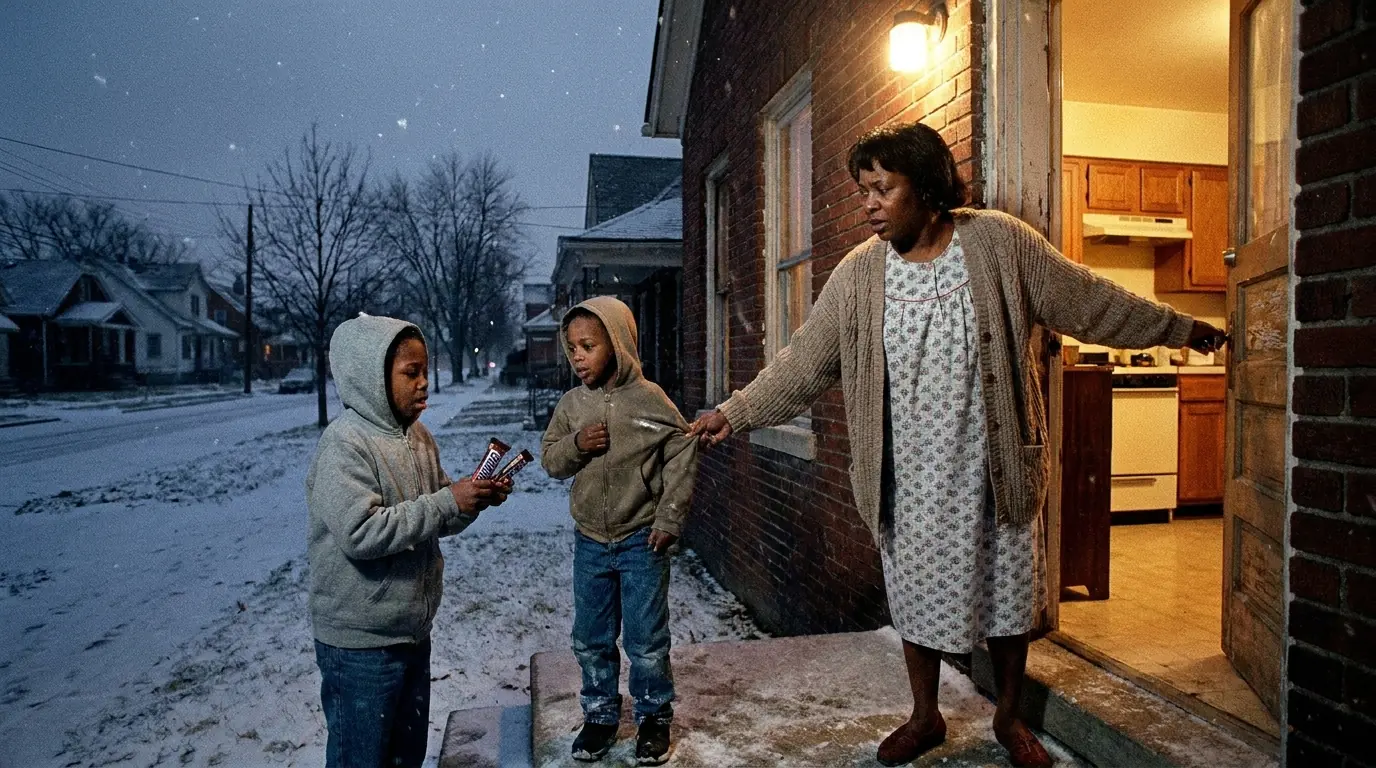
Two boys. African-American. Maybe 10 years old. Identical. Same height, same face, same short hair. They were wearing thin hooded sweatshirts that were too small for them. No coats. No gloves. Their lips were gray from the cold. The taller one, half an inch taller, was holding out two crumpled candy bars in his small hands.
“$2 for both, ma’am. Please. They’re Snickers. They’re not expired. I checked. $2.”
Essie looked at the candy bars. She looked at the boys. She looked at the hoodies. She looked at the gray lips. She looked at the street behind them. Dark. Empty. The kind of cold that kills people who do not get inside.
She did not say anything. She reached out and pulled them both inside by their thin sleeves.
“Come. Come inside. Come and sit.”
The shorter twin hesitated.
“Ma’am, we’re not begging. We can give you the candy.”
“Sit down.”
They sat at her kitchen table. The table was old, wooden, scarred, a gift from a church member when Kwame died. One of the legs was uneven, and Essie had wedged a folded piece of cardboard under it. The boys did not notice.
They were looking at the warmth of the kitchen the way you look at a fire when you have been in the dark for a long time.
Akosua came out of the bedroom in her pajamas and stood in the doorway. Eight years old. Two braids. A hand-me-down Barbie nightgown from a cousin in Atlanta. She did not say anything. She watched her mother.
Essie went to the refrigerator. She took out the chicken thigh. She went to the counter. She took out the rice from a ceramic jar. She went to the cupboard. She took out the palm oil, the last onion, and a small twist of paper with dried chili pepper ground fine.
She cooked.
She cut the chicken thigh in half, two halves, one for each boy, and fried it in palm oil with the onion and the dried chili. She steamed the rice with the two remaining tomatoes. She took the single plantain she had been saving for her own dinner on Tuesday out of the fridge and fried it in the same pan until the edges were brown and caramelized.
The kitchen filled with smells that had not been in that room since the morning. Chili, palm oil, onion, sweet plantain, the metallic smell of the pan itself.
She poured two tall glasses of hot tea with condensed milk from the tin on her counter. She set two plates in front of the twins. Full plates. More food than they had seen in one place in weeks.
The taller twin looked at his plate.
“Ma’am, all this is for me?”
“All this is for you.”
“By myself?”
“By yourself.”
He picked up his fork. His hand was shaking so badly the fork tapped against the plate. The shorter twin was already eating. Fast. Like the way you eat when you have learned that food can be taken away from you at any moment.
The taller twin ate slowly, carefully, chewing each piece as if he was trying to memorize the taste.
Akosua came to the table. She sat down next to them. She took her own fork and cut a piece of plantain off her brother’s plate. Essie had not noticed her bring the extra plate. No, Essie had set her daughter’s plantain next to the boys’ plates without thinking.
Akosua ate half of what her mother had made for her dinner. She gave the rest to the boys by putting it on their plates when they finished.
“Mama,” Akosua whispered later that night after Essie had put the boys to sleep on the living room floor with every spare blanket she owned. “Where are their parents?”
“I don’t know, my daughter.”
“Are we going to feed them again tomorrow?”
“Yes.”
“If they come back?”
“Yes.”
“And if we run out of food?”
Essie looked at her 8-year-old daughter. Akosua’s face was serious. The face of a child who already understood what $14 meant on a Wednesday when Friday was 2 days away.
“Then we will eat less, and we will feed them. That is what Sunday rice is for. To remind God we are still alive. If those two boys are still alive, they are our Sunday rice, too.”
Akosua nodded. She went to bed.
The twins came back the next night, and the next, and the next.
Sixty-three nights.
The older twin’s name was Marcus. The younger twin’s name was Malik, born 4 minutes later, a fact Malik mentioned every single time Marcus introduced himself first.
Their mother had died of an overdose 6 months earlier in a house on Mount Elliott Street. Their father was in prison 12 years for something they did not want to talk about. Their grandmother, Miss Ruby, had tried to keep them, but Miss Ruby lived in a one-bedroom apartment on Social Security and a bad hip. After 4 months, she had to let them go.
They had been drifting since. A shelter on Mack Avenue, the stairwells of abandoned buildings, the back of an old school bus parked behind a scrapyard, the heating grates outside the Greektown Casino on the nights security did not chase them off.
They came to Essie’s door on Harper Avenue that first night because a woman at the Ford Motor Assembly Plant soup kitchen had told them, “There is a Ghanaian lady on Harper who might give you a plate. Try her, but do not beg. She does not respect beggars. Essie respects sellers.”
So, they found two candy bars in a CVS dumpster, and they went to sell them. They did not know her name.
Essie learned their story one meal at a time. She did not ask questions all at once. She had learned as a girl in Kumasi that people will tell you everything if you feed them enough and do not rush them.
By the end of the first week, she knew about Mount Elliott Street. By the end of the second week, she knew about their mother. By the end of the third week, Marcus told her about the day the police came and took their father, and Malik corrected one small detail about what their father was wearing that day.
Both boys started crying at the same table, and she held them both against her chest and said, “Shh. Shh. You are safe here. You are safe here for tonight.”
She lost weight that winter. Her cheekbones became sharper. Her hospital laundry uniform hung looser on her shoulders. The Ghanaian women at the Presbyterian church noticed.
Mrs. Adu-Gyamfi, who had never liked Essie much, cornered her after service one Sunday in February.
“Essie, people are talking. They say you are feeding street boys every night. They say you are starving your own child to feed children who are not yours.”
“My child is eating. My child is eating well, Mrs. Adu-Gyamfi.”
“That is not what I heard.”
“Then you heard wrong.”
“Essie, you have $14. You told me so yourself last month. You cannot feed three children on $14 and two jobs. Something will break.”
Essie looked at the older woman. She had not slept more than 4 hours a night for 2 months. Her back was in constant pain, and her daughter’s school shoes had a hole in them she could not yet afford to replace. She was tired in a way that went past her bones and into a place she did not have a name for.
“Mrs. Adu-Gyamfi, my mother in Kumasi used to say, ‘Sɛ w’onnye adwene obi, w’onnye m’ onnyankopon.’ If you do good to no one, you do good to no one but God. I do not know if those boys will remember me tomorrow. I do not know if they will survive the winter, but I know that tonight at my kitchen table, they ate a full meal, and that is the only thing I can control. Everything else belongs to God.”
Mrs. Adu-Gyamfi did not speak to her for the rest of the year.
On March 14th, 2000, social services came to Essie’s door. A white woman with a clipboard and a kind face. Someone at the twins’ old school had filed a report. They had been spotted at Essie’s address by a truant officer.
The woman explained that the twins would be placed in a state-certified foster placement in Flint. Essie was not a foster parent. Essie did not have legal custody. Essie could not keep them.
Essie asked if she could visit.
“Once a month,” the woman said. “Supervised visits. First Saturday of every month.”
The twins packed their things, a single backpack between them, a toothbrush each, and the two spare sweatshirts Essie had bought them from a Goodwill in January.
Marcus stood in her kitchen for the last time and looked at the table where they had eaten 63 meals.
“Mama Essie, are we going to come back?”
“I don’t know, my son.”
“Will you remember us?”
She put both her hands on his face.
“I will remember you every day until I die. Both of you. I will say your names every night before I sleep. Marcus, Malik, every single night. I promise you.”
He nodded. He did not cry.
Malik was crying quietly behind him. The social worker was waiting in the doorway.
They walked out.
Essie watched them get into the car. She watched the car pull away from Harper Avenue. She went inside. She closed the door. She went into the kitchen. She knelt on the linoleum floor beside her kitchen table.
She cried for 45 minutes, the only time Akosua ever saw her mother cry like that. And then she got up, made dinner for her daughter, and went to her night shift cleaning offices downtown.
She visited Flint on the first Saturday of every month for 2 years. She took a bus, 90 minutes each way. She brought jollof rice in a plastic container, and the twins would eat it in the group home common room under the supervision of a counselor.
Marcus got taller. Malik got taller. Their voices started to change. They told her about school. She told them about Akosua. They asked about Detroit. She asked about Flint.
On the first Saturday of March 2002, when Marcus was 12 and a half, Essie arrived at the group home and was told that the twins had been transferred to a different facility in Saginaw.
The new facility did not take visitors from non-family members. Essie was not family. The file marked her as an informal community contact.
She went to Saginaw once. They would not let her see them. She wrote letters. The letters came back. She went to the Ghanaian Presbyterian church and lit a candle. She said Marcus and Malik’s names every night before bed the way she had promised.
And she did not see them again for 22 years.
Twenty-five years is a long winter.
In 2003, Essie met a quiet man named Samuel Amoah at a Ghanaian Independence Day celebration at Hart Plaza. He was a carpenter, a widower, a decent man. They married in 2005. He was kind to Akosua. He rebuilt the leaking porch at the house on Harper Avenue. He brought home fresh fish every Friday.
Essie believed for 6 years that her second life was going to be softer than her first.
Samuel died of a heart attack in 2011. He was 54 years old. Essie was widowed for the second time. She stopped going to the Presbyterian church because the women there looked at her the way you look at people who carry invisible curses.
Essie moved to a smaller house in Hamtramck, the house where she now stood at the kitchen window on a Saturday morning in December 2024, watching two black SUVs and four men in overcoats walk toward her front porch.
In the 22 years between losing the twins and today, Essie’s life continued in the way that lives continue when no one is watching them.
Akosua graduated from Cass Tech and then from Wayne State University and became a nurse.
Essie retired from the hospital laundry at 60, but kept cleaning one office building at night because her Social Security check did not cover everything. She cooked jollof rice every Sunday. She said Marcus and Malik’s names every night before she slept. Every single night for 25 years. She did not miss one. Even on the night Samuel died. Even on the night her mother in Kumasi died. Even on the night she was hospitalized herself with pneumonia in 2019. She said their names.
Some nights she wondered if they were dead. She would wake up at 3:00 a.m. with the certainty that one of them, usually Marcus, had frozen on a street corner or been shot in a parking lot or overdosed the way their mother had.
On those nights, she would get out of bed, go to her kitchen, cook a small bowl of jollof rice, eat it standing at the counter, and pray the same prayer she had prayed for 25 years.
“God, if they are alive, let them know I did not forget. If they are dead, let me see them in the next life and let me explain why I could not keep them.”
She did not know that 512 miles south of her kitchen, in a glass tower in downtown Dallas, a 35-year-old man named Marcus Carter had been paying a private investigator $12,000 a year for 11 years to find a Ghanaian woman in Detroit whose first name sounded like Essie, who had made jollof rice for him and his brother in the winter of 1999.
She did not know that the woman who had finally found her 6 weeks ago was a Detroit hospital social worker named Vivian, who had cared for Akosua during a brief hospital stay 3 years earlier.
Vivian had heard Akosua, at 30 years old, talking through a fever about the two boys her mother had fed every night one winter when she was eight. About the blue head wrap her mother wore. About the way the taller twin had trouble holding his fork. About how her mother had said their names before bed for 25 years.
Three weeks ago, Vivian had been listening to a podcast about black business leaders. One of the guests was Marcus Carter. He said this sentence.
“The first full plate of food I ever ate was cooked by a Ghanaian woman in a blue head wrap in a small kitchen on Harper Avenue in Detroit in the winter of 1999. My brother and I have been looking for her for 11 years. If she is still alive, we want her to know that she is the reason we are alive.”
Vivian pulled over. She was on Jefferson Avenue in a parked car outside a CVS. She listened to the sentence three times. She called Carter and Carter Logistics. She left a voicemail with the receptionist.
“I think I know who you’ve been looking for. I cared for her daughter 3 years ago. Her name is Essie Boateng. She lives in Hamtramck. Please call me back.”
Six weeks of verification. Background checks. A photo confirmation.
Akosua had kept a single disposable-camera photograph from 1999 that showed her mother at the kitchen table with two small boys. Vivian had obtained a copy of it through Akosua without telling Akosua why.
Marcus had looked at the photograph for 11 minutes before he was able to speak.
Three days ago, Marcus and Malik Carter had boarded a private jet in Dallas. They had brought Twi language lessons with them. They had been learning one sentence for the entire 11 years they had been searching.
Today, Saturday, December 14th, 2024, at 10:47 a.m., they knocked on Essie Boateng’s front door in Hamtramck, Michigan.
Essie opened the door.
The two men on her porch were identical. Tall, 6 feet 1, wearing charcoal overcoats. Their faces were the faces of grown men, but she saw, even before her mind processed it, the ghost of two 10-year-old boys beneath the beards and the lines and the 25 years.
Marcus spoke first, in Twi, slowly, carefully, the way you speak a language you have been practicing for a decade for one conversation.
“Oba mami, yaa Akosua. Mother. We have come home.”
Essie’s legs stopped working. She did not fall. Akosua caught her from behind, both arms under her mother’s armpits, holding her up.
Essie’s mouth opened. No sound came out. She looked at Marcus. She looked at Malik. She looked at Marcus again.
Malik reached into his coat pocket. He took out a small leather wallet. He opened it. He removed a single photograph, old, faded, creased from being carried for 25 years. He held it up.
The photograph showed a woman in a blue head wrap at a kitchen table with two small boys. All three of them were smiling. The woman was holding a bowl of jollof rice. The boys were holding spoons. One of the boys, the taller one, was holding his spoon with the particular tightness of a child who had just learned that food was real and might disappear.
“Mama Essie,” Malik said, in English this time. His voice was breaking. “It’s us. It’s Marcus and Malik. We came back.”
Essie’s knees went down to the porch floor. Both men went down with her. Marcus caught her around the shoulders. Malik took her hands.
They held her on the cold wooden porch of a small house in Hamtramck on a December morning while the sky above Harper Street turned the particular gray of a Detroit winter that had brought them to her door 25 years earlier.
As Essie tried to speak, she could not. She tried again.
“Marcus, Malik, oh my God. Oh my God. You are alive. You are alive.”
“We’re alive, Mama. We’re alive because of you.”
Akosua was standing in the doorway with both her hands over her mouth. She had been 8 years old the last time she saw them. She was 33 now. She recognized them instantly.
They stayed on the porch like that for 7 minutes, holding each other, none of them speaking. The driver and the other man, an attorney it would turn out, stood respectfully on the walkway waiting.
A neighbor across the street, Mrs. Henderson, came out onto her own porch with a cup of coffee, saw the scene, slowly put her coffee cup down on the railing, pressed her hand to her own chest, and began to cry without knowing what she was crying for. Or she only knew that something she had never seen before was happening on Harper Street.
Finally, Essie pulled back. She looked at Marcus’s face. She touched his cheek with a hand that had not stopped shaking for 10 minutes. She looked at the small scar above his left eyebrow, the same scar he had gotten at 11 years old from a fall on an icy sidewalk, and she knew.
Before any of the documents, before any of the keys, she knew this was her boy.
“Come inside. Come inside, both of you. It is cold. Come. I will make you jollof rice. You must still remember jollof rice, yes?”
Marcus laughed, a short, broken laugh.
“Mama Essie, we remember everything.”
She cooked for them.
Fifty-nine years old, knees hurting, back hurting, hands still shaking. She cooked jollof rice for them on a Saturday morning in her small kitchen in Hamtramck.
Akosua helped.
The twins sat at her kitchen table the way they had sat in 1999 and watched her move between the stove and the counter the way they had watched her then.
When the food was ready, she placed two full plates in front of them.
Marcus looked at his plate. His hand started shaking on his fork the same way it had shaken 25 years ago.
“Mama Essie, all this is for me?”
“All this is for you.”
“By myself?”
“By yourself, my son.”
He started crying while he ate. Malik was already crying.
Essie sat across from them in a wooden chair and watched her boys eat jollof rice at her table 25 years after the last time, and she did not understand how she was still alive to see this morning.
When the plates were empty, Marcus reached into the inside pocket of his overcoat. He took out a leather folder, and he slid it across the table.
“Mama, we need to talk about why we came.”
“You came because you are alive.”
“We came because we owe you everything, and we owe you specifically in seven ways.”
He opened the folder.
Essie put on the reading glasses that hung on a chain around her neck.
Inside the folder, seven documents.
Marcus slid them across the table one at a time.
One, a key, silver, attached to a leather fob that said “Mercedes-Benz.”
“This is for the first G-Wagon. It is registered in your name. Insurance is paid for 5 years. It is the black one in the front.”
Two, a second key, identical fob.
“This is for the second G-Wagon. It is registered in Akosua’s name. We did not know if you drive, Mama. We wanted to be sure you have a way to move.”
Akosua’s hand went to her mouth. She started crying.
Three, a deed, a property deed.
“This is for 4829 Harper Avenue, the house where you fed us. We bought it at auction 3 years ago. We have been renovating it. It is yours now, Mama, forever. Your name is on the deed. If you want to move back or rent it or do anything with it, it is yours.”
Four, a bank statement.
“This is a savings account in your name. We have been depositing money into it for 11 years, every month, since the year we started making enough money to set something aside. We did not know if we would ever find you. We set aside anyway. The amount at the bottom of the statement is what is currently in the account.”
Essie looked at the bottom of the statement. She looked at Marcus. She looked back at the number.
She was 59 years old, and her brain was not processing numbers correctly right now. She had never in her life seen a number that large attached to her own name.
“Marcus, this is…”
“This is yours, Mama. It has always been yours. We have just been holding it for you.”
Five, a document titled Healthcare.
“This is a lifetime healthcare policy. Comprehensive. Everything. You, Akosua, and your future grandchildren, if Akosua has any. Paid for, forever. We will never let you wait in an emergency room again.”
Six, a framed photograph.
The same photograph Malik had shown her on the porch, but this version was restored, enlarged, and mounted behind glass. The woman in the blue head wrap, the two small boys, the bowl of jollof rice.
“This is for your wall, Mama. We want everyone who comes to your house to know who you are.”
Seven, a newspaper.
Tomorrow’s Detroit Free Press, still warm from the printer. An attorney had picked it up from the printing plant an hour earlier.
The front-page headline read, “The Essie Boateng Foundation Opens Its 31st Kitchen This Week.”
Below the headline, a photograph of Marcus and Malik standing in front of a building on Gratiot Avenue with a sign reading, “Mama Essie’s Kitchen, Detroit.”
Essie picked up the newspaper with hands that were shaking so badly the paper rustled. She read the headline. She read the article.
The article explained that for the past 4 years, Marcus and Malik Carter had been quietly funding a network of winter kitchens in every zip code in Detroit where at least one child had gone to bed hungry the previous winter. The kitchens served free hot meals 5 nights a week from November through March. Thirty-one locations, run by a board that included Akosua Boateng, Essie’s own daughter, who had received a phone call from an anonymous donor 3 years ago asking if she would serve on the board of a nonprofit that did not yet officially exist.
She had said yes without knowing who was behind it.
Akosua had been on the board of her mother’s foundation for 3 years without knowing it was her mother’s foundation.
Essie put the newspaper down. She looked at Marcus. She looked at Malik. She looked at Akosua, who was now crying into a dish towel at the kitchen counter.
“My sons,” she said. Her voice was very quiet. “My sons, I fed you dinner. I fed you some dinners. I did what my mother taught me to do. I did not do this. I did not earn this.”
Marcus reached across the table. He took both of her shaking hands in both of his.
“Mama, you did not earn this like you gave this 25 years ago. Every night for 63 nights, you gave us the thing we needed more than food. You gave us the experience of sitting at a table where somebody made us a full plate. We did not know when we were 10 years old that a full plate was the foundation for everything else. We did not know that every single thing we have built in the last 25 years, the company, the trucks, the employees, the houses, the foundation, all of it, started on your kitchen table on Harper Avenue. But we know now. And you deserve to know, too. Before we leave this table today, we need you to understand one thing. Everything you are looking at, every key, every deed, every document, is not a gift. It is a return.”
Essie closed her eyes. Her mother’s voice came back to her from Kumasi across 40 years, from a small kitchen in a two-room house behind a market stall.
“Sɛ wo nyɛ adwene nyɛ obi, wo nyɛ mma Onyankopon.”
“If you do good to no one, you do good to no one but God.”
She had believed that for 25 years. She had said Marcus and Malik’s names every night because she believed that God was the only one listening.
God had been listening.
But God had also been teaching two little boys to drive trucks, build companies, set aside money, and remember a woman in a blue head wrap on Harper Avenue.
She opened her eyes. She looked at her two sons.
“Eat more rice,” she said. “There is more on the stove.”
The Book of Galatians says, “Let us not grow weary in doing good, for in due season, we will reap if we do not give up.”
Essie Boateng did good in a season when nobody was watching. She did good when she had $14. She did good when she was widowed and tired and her daughter needed shoes. She did good when the church women whispered behind her back and called her foolish for feeding children who were not her own.
She did good for 63 nights in a Detroit winter in 1999 without knowing that 25 years later, the two small boys at her kitchen table would grow up, build a company, and search for her for 11 years because they never forgot the taste of her jollof rice or the feeling of sitting at a table where somebody made them a full plate.
The harvest came in two G-Wagons on a Saturday morning in December.
But the harvest was not the cars. The harvest was not the bank account or the healthcare policy or the deed to the old house on Harper Avenue.
The harvest was this.
A woman who had said two names every night for 25 years lived long enough to see those names walk through her front door in charcoal overcoats.
And a Ghanaian mother who had believed her kindness was a secret between her and God discovered that her kindness had been building something quietly across decades in a language she did not know how to read.
And that something was 31 kitchens in 31 zip codes, feeding children who would have gone to bed hungry.
Do not grow weary. The harvest is coming. You may not see it. You may not live to see it. But somewhere in a dumpster behind a CVS, there is a 10-year-old boy finding a candy bar and deciding to knock on your door tonight. And 25 years from now, that boy will come back in whatever vehicle the universe sends him.
And he will sit at your table.
And he will remember.