The morning bell rang through the hallways of Westbrook Elementary School, and children rushed to their classrooms with the usual chaos of a Tuesday morning. But in room 204, something different was happening.
Mrs. Patterson stood at the front of her music classroom, her arms crossed, waiting for the students to settle down. She was known throughout the school as the strictest teacher, the one who ran the music program like it was a military operation.
Today, there was a new face in the classroom.
Eight-year-old Lily sat in the back corner, her small frame almost disappearing behind the larger desk. She wore a faded blue sweater that had seen better days, and her sneakers had small holes near the toes. Her backpack, once probably a bright purple, had faded to a dull gray. She kept her eyes down, studying the scratches on her desk as if they were the most interesting thing in the world.
The other children noticed her immediately. They always did when someone new arrived. Whispers bounced around the room like ping-pong balls.
“Who’s that?”
“She looks weird.”
“Why is she sitting all the way back there?”
Mrs. Patterson cleared her throat loudly, and the whispers died down. She picked up her attendance sheet and began calling names. When she got to the new student, she barely glanced up.
“Lily Chen,” she said, pronouncing it wrong, making it sound harsh and foreign.
“It’s Chen, actually,” Lily said softly, trying to help. “Like Chen, with an N sound.”
Mrs. Patterson looked up this time, her eyebrows raised.
“That’s what I said, Chen.”
She said it the same way again, and a few students giggled. Lily’s cheeks turned pink, and she sank lower in her seat. She didn’t correct the teacher again. She’d learned in her last school that sometimes it was better to just stay quiet.
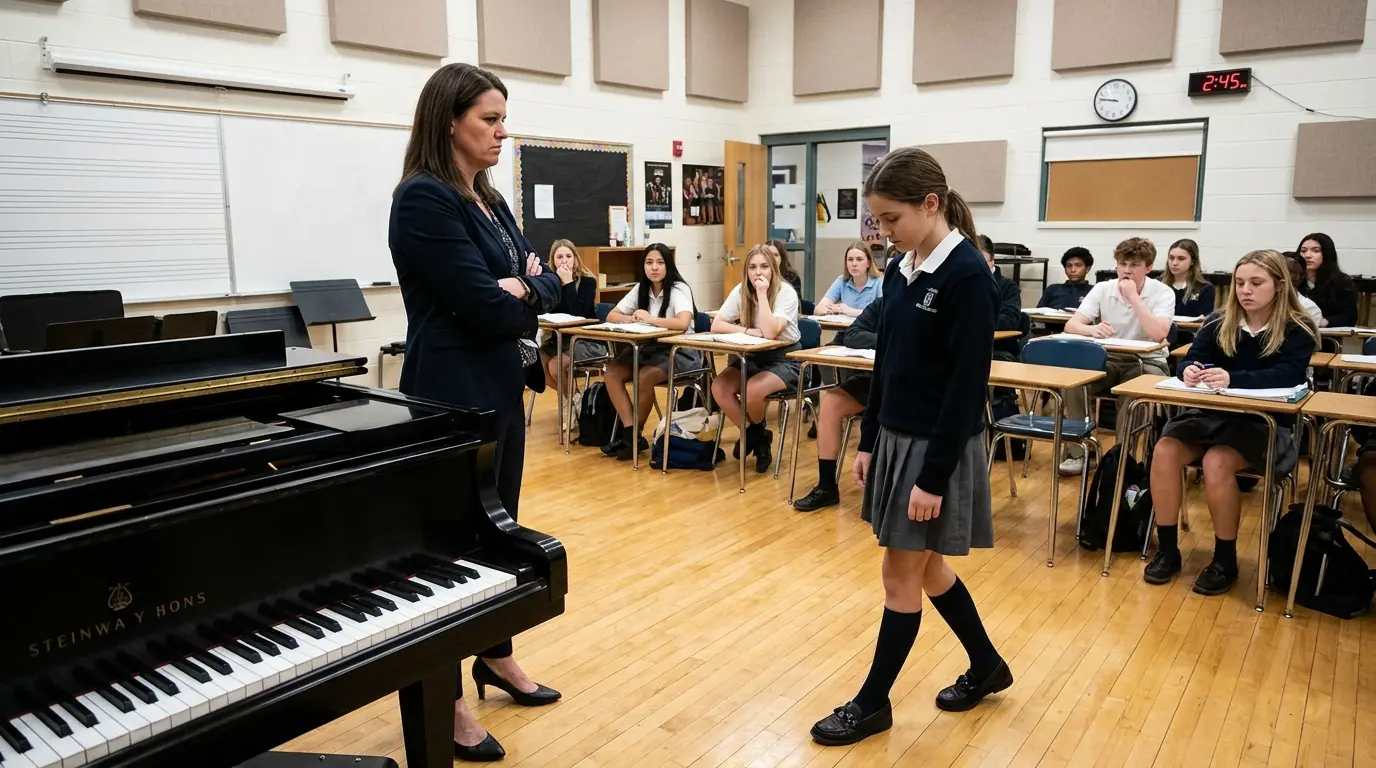
The music room was different from regular classrooms. Instead of rows of desks, there were instruments everywhere. Guitars hung on the wall like artwork. Drums sat in the corner. Xylophones lined the shelves, and in the center of it all, like a king on a throne, sat a beautiful grand piano. Its black surface was so shiny that Lily could see the ceiling lights reflected in it.
Mrs. Patterson walked to the front of the room, her heels clicking on the floor with each step.
“As you all know,” she announced, “the spring concert is only 6 weeks away. This is the most important event of the school year. Colleges look at these kinds of achievements. Your parents will be there. The whole community will be watching.”
She paused for effect, letting her words sink in.
“This year, I’ll be selecting students for solo performances. But not just anyone can perform a solo. Oh, no. Only the most talented, the most dedicated, the most deserving students will get that honor.”
Lily watched as several students sat up straighter, their faces eager. They wanted to be chosen. They wanted to be special.
Mrs. Patterson smiled at these students, the ones she clearly already had in mind. There was Timothy, who’d been playing violin since he was four. His parents were wealthy, always donating to the school. There was Rachel, whose perfect piano posture had been drilled into her by expensive private lessons. There was David, whose trumpet playing was actually quite good, though his confidence sometimes crossed into arrogance.
These were Mrs. Patterson’s favorites. Everyone knew it.
“Over the next few weeks,” Mrs. Patterson continued, “you’ll each have a chance to show me what you can do. I’ll be watching carefully, very carefully.”
The class began, and Mrs. Patterson started with warm-up exercises. The students sang scales, clapped rhythms, and practiced reading simple melodies. Lily participated quietly, blending into the background. She mouthed the words more than sang them. When it was time to clap the rhythms, her hands barely made a sound. Nobody noticed her. That was exactly what she wanted.
When Mrs. Patterson asked for volunteers to demonstrate a rhythm pattern, hands shot up all around the room. Timothy waved his hand so enthusiastically he almost fell out of his chair. Rachel sat perfectly still with her hand raised like she’d been taught in etiquette class. But Lily kept her hands folded on her desk, her eyes fixed on the floor.
“Timothy, show us,” Mrs. Patterson said with a warm smile.
Timothy jumped up and clapped out a complicated rhythm perfectly.
Mrs. Patterson beamed.
“Excellent. That’s exactly the kind of dedication I’m looking for.”
The class continued like this for 45 minutes. Mrs. Patterson praised her favorite students and barely acknowledged the others. When one boy in the middle row made a mistake reading the notes, she sighed loudly and moved on without helping him. When a girl asked a question about tempo, Mrs. Patterson acted like it was the silliest thing she’d ever heard.
And through it all, Lily remained invisible in the back corner.
But then something happened.
As the class was packing up their things, getting ready for the bell, Lily’s eyes drifted to the piano. Really looked at it. The way the light caught on its curves. The way the keys seemed to glow, ivory and ebony side by side. Her fingers twitched slightly like they remembered something her mind was trying to forget.
“Is there something interesting about that piano, Lily?”
The whole class turned to look. Lily’s face went bright red. She shook her head quickly and looked down at her desk again.
“No, ma’am. Sorry.”
Mrs. Patterson studied her for a moment with an unreadable expression. Then she turned away, dismissing the class.
As the students filed out, chattering about lunch and recess, Lily was the last to leave. She took one more glance at the piano before hurrying out the door. She didn’t see Mrs. Patterson watching her from behind the desk, a strange look on the teacher’s face. It wasn’t kindness. It wasn’t curiosity. It was something else entirely.
The rest of the school day passed slowly for Lily. She ate lunch alone, sitting at the end of a table while other kids laughed and talked around her. During recess, she stayed near the building, watching other children play games she didn’t know the rules to. In her other classes, she remained quiet, answering only when called on directly, never volunteering.
When the final bell rang, Lily gathered her worn backpack and headed for the exit. Other kids rushed past her, excited for the freedom of the afternoon. Some had parents waiting in nice cars. Others walked in groups, talking about going to each other’s houses or the park.
Lily walked alone, her thin sweater not quite warm enough for the chilly spring afternoon. She had a long walk ahead of her to the small apartment she and her father had recently moved into. It was temporary, they said. Everything had been temporary since her mom died.
She tried not to think about that as she walked. She tried not to remember the house they used to live in. The one with the piano in the living room. She tried not to hear her mother’s voice saying, “Hands curved, sweetheart, like you’re holding a small ball. That’s it. Beautiful.”
But sometimes, late at night, Lily would spread her fingers on her blanket and practice the movements. Her fingers remembered, even when she tried to forget. They remembered every scale, every chord, every piece her mother had taught her before everything fell apart.
The apartment building came into view, and Lily climbed the stairs to the third floor. Inside, a note from her father sat on the small kitchen table.
Working late tonight. Dinner in the fridge. Love you, sweetheart.
Lily heated up the leftovers and ate quietly, doing her homework at the table. And if her fingers occasionally tapped out silent melodies on the tabletop while she worked, well, nobody was there to notice.
Back at school, in the now-empty music room, Mrs. Patterson sat at her desk making notes about the spring concert. She wrote down names, assigning pieces and planning the program. When she was done, she looked up at the piano and remembered the way that new girl had stared at it.
The teacher’s lips curved into a cold smile.
She had an idea. An idea that would remind everyone in her class exactly who belonged and who didn’t. An idea that would put that quiet little girl in her place once and for all.
She had no way of knowing that her cruel plan was about to backfire in the most spectacular way possible.
Two weeks passed, and Lily became part of the furniture in Mrs. Patterson’s music class. She was just there, like the posters on the wall or the metronome on the shelf. Nobody really noticed her anymore. The other kids had stopped whispering about the new girl and gone back to their own lives.
Mrs. Patterson continued teaching as if Lily didn’t exist at all.
Every Tuesday and Thursday, Lily sat in her back corner seat and watched. She watched Timothy show off his violin skills. She watched Rachel play piano with her perfectly straight back and precisely curved fingers. She watched David make his trumpet sing. And she stayed silent, her hands folded on her desk, her eyes carefully neutral.
But something was happening that Lily didn’t realize. Mrs. Patterson was watching her, too.
The teacher had noticed how Lily’s eyes always drifted to the piano during class. How her fingers would sometimes move slightly when other students played, as if her hands were remembering something. How she would lean forward just a bit when someone played a particularly beautiful passage, then catch herself and lean back again.
It irritated Mrs. Patterson. There was something about this quiet girl that bothered her. Maybe it was the way Lily never tried to impress her. Maybe it was the worn clothes that reminded everyone that not all students came from the right families. Or maybe it was simply that Mrs. Patterson had built her entire career on knowing who had talent and who didn’t. And something about Lily didn’t fit into her neat categories.
One day after class, as students were packing up their things, Mrs. Patterson pretended to organize papers at her desk, but she was actually watching Lily through the corner of her eye. The other students filed out, laughing and talking, until only Lily remained.
The girl stood up slowly and started toward the door, but then she stopped. She glanced back at the piano, checking to make sure she was alone. Mrs. Patterson ducked her head down, pretending to be absorbed in her work.
Lily walked toward the piano like someone approaching something precious and fragile. She didn’t sit down. She just stood beside it, looking at the keys. Then, so quickly that someone might have missed it if they blinked, she reached out one finger and pressed a single key.
The note rang out in the empty room, pure and clear.
Middle C.
Lily’s eyes closed for just a second, and her whole face changed. The carefully blank expression melted away, replaced by something that looked like pain and joy mixed together. Then she pulled her hand back as if the piano had burned her, grabbed her backpack, and rushed out of the room.
Mrs. Patterson sat at her desk, a slow smile spreading across her face.
Oh, this was perfect. This was absolutely perfect.
The next Tuesday morning, Mrs. Patterson arrived at school earlier than usual. She had plans to make. She spent her first-period planning time writing notes and preparing. By the time her music class rolled around, she was ready.
The students settled into their seats, and Lily took her usual spot in the back corner. The morning started normally enough. They did their vocal warm-ups. They practiced rhythms. Mrs. Patterson talked more about the spring concert, dropping hints about who might be chosen for solos. Timothy practically glowed every time she looked his way.
Then, about halfway through the class, Mrs. Patterson’s voice suddenly cut through the room.
“Lily, come up here, please.”
Every head in the classroom turned. Lily looked up, her eyes wide with surprise. She pointed at herself as if maybe Mrs. Patterson meant a different Lily.
“Yes, you. Come to the front of the class.”
Lily stood up slowly, her legs feeling shaky. She walked down the aisle between the desks while everyone stared at her. Some kids looked curious. Others looked grateful it wasn’t them being called up. When she reached the front, she stood there awkwardly, not knowing what to do with her hands.
Mrs. Patterson smiled, but it wasn’t a kind smile. It was the smile of a cat that had just cornered a mouse.
“Class,” Mrs. Patterson announced, her voice carrying to every corner of the room, “I’ve made an interesting observation. It seems we have someone among us who has a special interest in the piano.”
Lily’s stomach dropped. She shook her head slightly, but Mrs. Patterson continued.
“Oh, yes. I’ve noticed how you watch the other students play. How you stare at the piano every single class. You’re practically fascinated by it.”
“I just… I like music,” Lily said quietly.
“Do you?” Mrs. Patterson’s eyebrows went up in exaggerated surprise. “Well, then this is wonderful because I believe that every student who shows interest should have an opportunity to demonstrate their abilities. Wouldn’t you agree, class?”
A few students nodded uncertainly. They didn’t know where this was going, but they could feel something strange in the air.
“So, Lily,” Mrs. Patterson gestured toward the piano bench, “why don’t you sit down and play something for us? After all, if you’re so interested in the piano, you must have something to share.”
Lily’s face went pale.
“I… I don’t…”
“Oh, come now. Don’t be modest.” Mrs. Patterson’s voice had an edge to it now. “You watched the other students so intently. Surely you’ve learned something. Unless,” she paused dramatically, “unless you were just pretending to be interested, because that would be dishonest, wouldn’t it?”
The other students shifted in their seats. Some of them looked uncomfortable. They might not have liked Lily, might not have even noticed her before, but this felt wrong somehow.
Even Timothy, Mrs. Patterson’s star pupil, frowned a little. But Rachel, who’d been taking piano lessons since she was five and thought she was the best pianist in the school, smiled. She’d seen the way Lily looked at the piano. She didn’t like it.
“Go on, Lily,” Mrs. Patterson said, her voice sickeningly sweet now. “Show us what you can do. Everyone’s waiting.”
Lily looked at the piano bench. Then at the classroom door. For a moment, it seemed like she might run. Her whole body was tense like a bird ready to take flight. Her hands were trembling at her sides.
“I really don’t think…” Lily started to say.
“Lily.” Mrs. Patterson’s voice turned sharp. “In my classroom, when a teacher asks you to do something, you do it. Now sit down at that piano.”
The room was completely silent now. Even the clock on the wall seemed to tick more quietly. Every eye was on Lily, watching and waiting. Some kids looked sorry for her. Others just wanted to see what would happen. And Mrs. Patterson stood there with her arms crossed, absolutely certain of how this would go.
The poor girl would sit down, maybe poke at the keys randomly, prove that she had no talent at all, and learn an important lesson about her place in this school.
It was perfect.
It would remind all the students that Mrs. Patterson could see right through anyone who tried to pretend they were something they weren’t.
Lily stood frozen for what felt like forever. Then slowly, she walked to the piano bench. She sat down carefully, her small frame looking even smaller against the grand piano. Her worn sneakers barely reached the pedals. Her faded sweater looked even more shabby next to the piano’s polished elegance.
Mrs. Patterson smiled triumphantly.
“Whenever you’re ready, dear. We’re all waiting to hear what you can do.”
Behind her, Rachel whispered to the girl next to her, “This is going to be embarrassing.”
Timothy looked down at his desk, unable to watch what was about to happen. The boy who sat in the middle row, the one Mrs. Patterson had sighed at for making a mistake, felt his stomach twist. He knew exactly what this felt like.
And in the back corner where Lily usually sat, her empty desk seemed to echo with all the days she’d spent trying to be invisible.
Lily’s hands hovered over the keys. They were shaking so badly that her fingers looked blurry. She closed her eyes and took a deep breath, then another. The classroom held its collective breath.
Mrs. Patterson glanced at the clock on the wall, already thinking about how much time this little lesson was taking. She’d give the girl another 30 seconds to fumble through something, then mercifully end this and move on with her real students.
But then something changed.
Lily’s hands stopped shaking. Her shoulders relaxed. She sat up a little straighter, and when her eyes opened, they weren’t frightened anymore. They were focused, determined, almost peaceful. She placed her hands on the keys with a gentleness that surprised everyone watching. Her fingers found their positions naturally, like they’d done this a thousand times before.
And in the split second before she began to play, Mrs. Patterson felt the first whisper of doubt creep into her mind.
What if she’d made a terrible mistake?
The room waited. The clock ticked. And Lily’s fingers pressed down on the first notes.
The first notes that came from the piano weren’t what anyone expected. They weren’t the hesitant, clumsy sounds of someone who didn’t know what they were doing. They were clear, confident, beautiful.
Lily began to play, and the entire room changed.
She started with a soft melody, gentle as a whisper. Her fingers moved across the keys like they were dancing. Each note flowed into the next as naturally as breathing. The music filled every corner of the classroom, wrapping around the students like a warm blanket on a cold day.
Mrs. Patterson’s smile faltered. She took a small step backward.
The melody began to build. Lily’s left hand joined in, adding depth and richness to the sound. Her hands moved independently, each one playing its own part, but together they created something that sounded impossibly complex. The music swelled and dipped, rushed forward and pulled back, told a story without using a single word.
Timothy’s mouth fell open. He played violin, had been playing for years, and he knew exactly how difficult this was. His eyes went wide as he watched Lily’s fingers fly across the keys, never hesitating, never stumbling.
Rachel sat frozen in her seat. She’d been taking piano lessons since kindergarten. Her parents had spent thousands of dollars on teachers and practice time. She could play well. Everyone said so. But this, this was something completely different. This wasn’t just playing notes correctly. This was making the piano sing.
The boy in the middle row, the one Mrs. Patterson had embarrassed weeks ago, felt tears prick his eyes. He didn’t know why. There was just something about the music that reached inside his chest and squeezed his heart.
And still Lily played.
Her whole body moved with the music now. She swayed slightly, leaning into the louder parts, pulling back during the quiet moments. Her eyes were closed, and there was an expression on her face that no one in that classroom had ever seen before. She looked free. She looked like she was somewhere else entirely, somewhere beautiful and safe.
The piece she was playing was Chopin’s Nocturne in E-flat Major. None of the students knew that, but they didn’t need to know the name to understand that they were hearing something special, something that didn’t happen every day in a middle school music classroom.
Mrs. Patterson stood completely still. Her face had gone from smug satisfaction to confusion to something that looked almost like fear. Her hands clutched the edge of her desk so tightly that her knuckles turned white.
This wasn’t supposed to happen. This quiet girl in her worn-out clothes wasn’t supposed to be able to do this.
The music grew more intense. Lily’s fingers moved faster now, cascading up and down the keyboard in runs that sounded like water flowing over rocks. Her right hand played a melody so sweet and sad that several students felt goosebumps rise on their arms. Her left hand provided a foundation underneath, steady and sure.
One girl in the front row had been recording the beginning of class on her phone before Mrs. Patterson had called Lily up. She’d forgotten to stop recording, and now she held her phone perfectly still, barely breathing, capturing every second of this impossible moment.
The piece shifted again. The urgency faded, replaced by a gentler section. Lily’s fingers moved more slowly now, each note given time to breathe, to resonate, to tell its part of the story. This section was almost unbearably tender, like a lullaby or a memory of something precious and lost.
Two minutes passed, then three. The entire class sat motionless, trapped in the spell of Lily’s playing. Nobody coughed. Nobody shifted in their seat. Nobody dared make a sound that might break this moment.
Even the sounds from outside the classroom seemed to fade away. The distant laughter of children at recess, the hum of the heating system, the footsteps in the hallway. Everything disappeared except the music pouring from the piano.
Mrs. Patterson’s face had turned red. Not with anger exactly, though that was part of it, more with the slow, creeping realization that she had made a catastrophic error in judgment. She had tried to humiliate this child, to put her in her place, to prove that she didn’t belong. Instead, she’d given her a stage, and Lily was shining on it so brightly that everyone else in the room looked dim by comparison.
The music built toward its conclusion. Lily’s hands moved with absolute certainty across the keys, playing phrases that required years of practice to master. The melody climbed higher and higher, reaching toward something beautiful and unreachable before finally beginning its descent.
The final section was quiet again, peaceful, like coming home after a long journey. Lily’s fingers moved more slowly, savoring each note. The music grew softer and softer until it was barely louder than a breath. And then, with one last gentle chord, she stopped.
Her hands remained on the keys for a moment, as if saying goodbye. Then she lifted them and placed them in her lap. She opened her eyes slowly, like someone waking up from a dream.
The silence that followed was absolute.
Nobody moved. Nobody spoke. They all just stared at the small girl sitting at the piano, trying to process what they had just heard.
Lily looked confused by the silence. She turned slightly on the bench, glancing back at the class with uncertain eyes. Had she done something wrong? Should she not have played that piece? Her cheeks started to turn pink again, the same way they had on her first day.
Then something happened that no one expected.
The boy in the middle row started clapping. It wasn’t polite, quiet classroom clapping. It was real applause, the kind you hear at concerts. His hands came together hard enough to echo in the room, and he stood up from his desk without even thinking about it.
Then Timothy jumped to his feet, applauding too. His face was full of genuine amazement. All thoughts of competition forgotten.
One by one, like dominoes falling, the other students rose from their desks. They clapped and clapped, some of them whistling, some of them shouting, “Woo!” and “That was amazing!”
The girl who’d been recording was clapping so hard she almost dropped her phone.
Even Rachel, after a long moment of inner struggle, stood up and clapped. She didn’t look happy about it, but she clapped.
The noise was incredible. Twenty-three students applauding like they were at a symphony hall instead of a school classroom. The sound echoed off the walls and probably could be heard all the way down the hallway.
Lily sat at the piano bench, her eyes wide with shock. She looked around at all the standing students, at their smiling faces and enthusiastic applause, and she seemed completely stunned. A small, hesitant smile started to form on her lips.
And Mrs. Patterson stood frozen at the front of the room, her face cycling through shades of red and white. Her mouth opened and closed, but no sound came out. She looked like someone had just pulled the ground out from under her feet.
The door to the classroom suddenly opened. Mr. Rodriguez, the school principal, stood in the doorway. He was a kind man in his 50s with gray hair and smile lines around his eyes. He’d been walking past the classroom when he heard the music and had stopped to listen.
“I apologize for the interruption,” he said, his voice carrying over the applause.
The students quieted down and sat back in their seats, though several of them kept grinning.
“But I heard the most extraordinary piano playing coming from this room. I had to know who it was.”
His eyes found Lily, still sitting at the piano bench, looking like she wanted to disappear.
“Was that you, young lady?” he asked gently.
Lily nodded, not trusting her voice to work.
Mr. Rodriguez smiled, but there was something serious in his eyes, too. He’d seen the whole classroom standing and applauding. He’d seen Mrs. Patterson’s face, guilty and angry at the same time. He’d been a principal long enough to recognize when something wasn’t quite right.
“That was absolutely beautiful,” he said to Lily. “I’d very much like to speak with you after class, if that’s all right. Perhaps in my office.”
He turned to Mrs. Patterson.
“With your permission, of course, Mrs. Patterson.”
It wasn’t really a request. Mrs. Patterson understood that. She nodded stiffly.
“Lily, you may return to your seat,” she said, her voice tight and controlled.
Lily stood up from the piano bench on shaky legs. As she walked back to her desk, several students smiled at her or gave her thumbs up. The boy in the middle row whispered, “That was incredible,” as she passed.
But all Lily could think about was what would happen in the principal’s office. Had she done something wrong by playing? Was she in trouble? Her heart hammered in her chest as she slid into her seat.
The rest of class passed in a blur. Mrs. Patterson tried to continue the lesson, but nobody was paying attention. Everyone kept looking at Lily, seeing her differently now. The invisible girl in the back corner had just become the most interesting person in the room.
When the bell finally rang, Mr. Rodriguez was waiting by the door.
“Lily, would you come with me, please?”
Lily gathered her things slowly, her hands trembling again. As she walked toward the door, she glanced back one more time at the piano. It sat there gleaming in the fluorescent lights, holding the echoes of the music she’d played. The music her mother had taught her. The music she’d been trying so hard to forget.
Lily followed Mr. Rodriguez down the hallway, her backpack hanging heavy on her shoulders. Each step felt like it took forever. Other students passed by heading to their next classes, but Lily barely noticed them. Her mind was racing with worries. What if she was in trouble? What if the principal called her dad? What if she’d somehow broken a rule she didn’t know about?
Mr. Rodriguez didn’t say anything as they walked. He just smiled kindly at her whenever she glanced up at him, which somehow made her even more nervous.
When they reached the principal’s office, he held the door open for her.
“Please have a seat,” he said, gesturing to a comfortable chair across from his desk.
The office was warm and filled with books. There were photos on the walls of students from years past, all smiling at school events. Lily sat on the edge of the chair, her hands gripping her backpack straps.
Mr. Rodriguez sat down behind his desk, but he didn’t look stern or angry. He looked curious, maybe even concerned.
“Lily,” he began gently, “you’re not in any trouble. I want you to know that right away. I asked you here because what I heard in that classroom was truly remarkable. I’ve been a principal for 20 years, and I’ve never heard a student play like that.”
Lily didn’t know what to say, so she stayed quiet.
“Can you tell me where you learned to play?” he asked.
Lily looked down at her hands. They were the hands that had just played Chopin. Small hands, worn hands, hands that used to be smoother back when she could practice every day.
“My mom taught me,” she said softly.
“Your mother must be a wonderful teacher,” Mr. Rodriguez said warmly.
Lily’s eyes filled with tears. She blinked hard, trying to keep them from falling.
“She was.”
The word hung in the air between them. Was. Past tense.
Mr. Rodriguez understood immediately, and his expression shifted to one of deep sympathy.
“I’m so sorry,” he said quietly.
There was a knock at the door. Mrs. Patterson stood in the doorway looking like she’d rather be anywhere else.
“You asked me to come, Mr. Rodriguez.”
“Yes, please come in. I think it would be good for you to hear this as well.”
Mrs. Patterson entered stiffly and stood near the wall, her arms crossed. She wouldn’t look at Lily.
Mr. Rodriguez turned back to Lily.
“Would you feel comfortable telling me more about your mother? Only if you want to.”
Lily took a shaky breath. She hadn’t talked about her mom to anyone at this school. Hadn’t talked about her much at all since it happened. But something about Mr. Rodriguez’s kind eyes made her feel like maybe it was okay.
“She was a concert pianist,” Lily began, her voice barely above a whisper. “She played in big halls with orchestras. People came from all over to hear her.”
“That’s incredible,” Mr. Rodriguez said.
“She started teaching me when I was three. Every day after breakfast, we’d sit at the piano together. She’d put my fingers on the keys and show me how to curve them just right. Like I was holding an egg, she’d say. Gentle but firm.”
A tear escaped down Lily’s cheek. She wiped it away quickly.
“We’d practice for hours, but it never felt like work. She made it fun. She’d make up stories about the music. She’d say, ‘This part sounds like rain on a window,’ or, ‘This part sounds like birds singing in the morning.’ She taught me to feel the music, not just play it.”
Mrs. Patterson shifted uncomfortably against the wall.
“What happened?” Mr. Rodriguez asked gently.
“She got sick 2 years ago. Cancer.”
Lily’s voice cracked on the word.
“She fought really hard. But 6 months later, she was gone.”
“Oh, Lily.”
Mr. Rodriguez pulled a tissue from the box on his desk and handed it to her.
“After she died, everything fell apart. Dad tried to keep working, but the medical bills were so expensive. We had to sell our house. We sold almost everything we had, including the piano.”
Her voice broke completely now, and the tears came faster.
“That was the worst part, watching them take Mom’s piano away. Dad cried when they loaded it onto the truck. I’d never seen him cry before. He said he was so sorry, that he’d get me another piano someday. But we both knew that wasn’t true.”
She wiped her eyes with the tissue, her hands shaking.
“We moved to a tiny apartment. Then we had to move again when Dad lost his job. Then we moved here a month ago because he finally found work. Every place we lived was temporary. We never had space for a piano, even if we could afford one.”
Mr. Rodriguez leaned forward, his eyes glistening with unshed tears.
“Lily, when did you last play a real piano before today?”
“14 months ago. Before we sold it.”
“14 months?”
He looked shocked.
“But you played today like you practice every single day.”
A small, sad smile appeared on Lily’s face.
“My dad drew me a paper keyboard. He measured it all out to be the exact size of a real one. He used a ruler and drew every single key. I taped it to the table in our apartment, and I practice on it every night. I do all my finger exercises. I play through all the pieces Mom taught me. But there’s no sound, just the tapping of my fingers on paper.”
Mrs. Patterson made a small noise. When everyone looked at her, her face had gone pale. She looked like she might be sick.
“I don’t talk about it at school,” Lily continued. “I don’t talk about Mom or the piano or any of it. It hurts too much. And also…”
She paused, looking down at her worn shoes.
“Kids don’t really like you when you’re poor. They already think I’m weird because my clothes are old and I don’t have a phone or anything. If I told them I used to play piano in recitals, they’d think I was making it up or showing off. So I just stay quiet.”
“Is that why you never volunteered in class?” Mr. Rodriguez asked. “Even though you clearly love music?”
Lily nodded.
“I thought if I stayed invisible, it wouldn’t hurt so much. If nobody knew about the piano, I wouldn’t have to think about Mom being gone. I wouldn’t have to remember what I lost.”
“But you looked at the piano in class,” Mr. Rodriguez said. “Mrs. Patterson noticed.”
“I couldn’t help it.”
Fresh tears spilled down Lily’s cheeks.
“It’s the same kind of piano Mom played. A Steinway grand. Sometimes I just look at it and remember her hands on the keys. Remember sitting next to her on the bench, trying to reach the pedals with my little feet. Remember her perfume and the way she’d hum along when I played something right.”
The room was silent except for Lily’s quiet crying. Mr. Rodriguez handed her more tissues. Mrs. Patterson stared at the floor, her face burning with shame.
“I’m sorry,” Lily said, wiping her eyes. “I know I shouldn’t have played today. I know Mrs. Patterson was trying to teach me a lesson about not pretending to be something I’m not. And she’s right. I’m not a pianist. Not anymore. I’m just a girl with a paper keyboard.”
“No.”
Mr. Rodriguez’s voice was firm.
“Lily, look at me.”
She looked up, her eyes red and swollen.
“You are absolutely a pianist. What you played today, what you’ve kept alive through practicing on paper for over a year, that’s not something you can fake. That’s real talent, real dedication, real love for music.”
He turned to Mrs. Patterson.
“Don’t you agree, Mrs. Patterson?”
Mrs. Patterson looked like she was being forced to swallow something bitter, but she nodded.
“Yes,” she said hoarsely. “It was exceptional.”
“Lily,” Mr. Rodriguez said, his voice warm and excited now, “I want to help you. I’m going to make some phone calls. There’s a music academy in town that offers scholarships. They should hear you play. And in the meantime, you should know that you can come to the music room anytime it’s not being used for class. Practice as much as you want.”
“Really?” Lily’s eyes widened.
“Really. Your mother gave you an incredible gift. You’ve honored her memory by keeping it alive, even when you had nothing but a paper keyboard. That takes courage and dedication that most adults don’t have.”
Lily started crying again, but this time they weren’t sad tears. They were grateful tears. Relieved tears. Tears of hope.
“Thank you,” she whispered.
Mr. Rodriguez smiled.
“No, Lily. Thank you for sharing your gift with us today.”
He paused, then added gently.
“I think your mother would be very proud of you.”
At that, Lily broke down completely, sobbing into her hands. All the grief she’d been holding in, all the loss and fear and loneliness came pouring out. Mr. Rodriguez came around the desk and put a gentle hand on her shoulder, letting her cry.
Mrs. Patterson stood against the wall, watching this broken child sob, and understood the full weight of what she’d tried to do. She’d tried to humiliate a grieving girl who’d already lost everything. She’d tried to crush someone who was already crushed.
The shame was overwhelming.
When Lily finally calmed down, Mr. Rodriguez called her father at work to explain what had happened. He assured him that Lily wasn’t in trouble, but that there was an opportunity they needed to discuss. Her father’s voice through the phone was thick with emotion when he said he’d come to the school right away.
As they waited, Mr. Rodriguez asked Lily about her favorite pieces, her practice routine, her dreams. And slowly, the invisible girl who’d tried so hard to disappear started to become visible again. Not because someone forced her into the light to mock her, but because someone saw her pain and chose to help instead.
The video started spreading before lunch was over. The girl who’d accidentally recorded Lily’s performance posted it on social media with a simple caption: You need to hear this.
Within an hour, it had been shared 50 times. By the end of the school day, hundreds of people had watched it. By evening, thousands. Comments flooded in.
“This gave me chills.”
“How is she only eight?”
“I literally started crying.”
“This girl needs to be on stage.”
Local musicians shared it. Teachers shared it. Parents shared it. The video of the small girl in the worn sweater sitting at a grand piano and making magic touched something in people’s hearts.
The next morning, Mr. Rodriguez’s phone started ringing before he even got to school. The first call was from the director of Westside Music Academy, one of the most prestigious music schools in the region. She’d seen the video and wanted to talk about Lily immediately.
“That child has a gift,” the director said. “We’d like to offer her a full scholarship. Lessons, practice room access, everything. No cost to the family.”
Mr. Rodriguez felt his eyes water.
“That’s incredibly generous.”
“It’s not generous. It’s necessary. Talent like that doesn’t come along often. We can’t let it disappear because of circumstances beyond her control.”
More calls came throughout the day. A local piano tuner offered his services for free. A music store wanted to donate books and supplies.
And then came a call that made Mr. Rodriguez actually gasp out loud.
Mrs. Helen Chen, no relation to Lily, was a retired concert pianist who lived in one of the old Victorian houses near downtown. She was 83 years old and had spent her life performing in halls across the country. Now she spent her days tending her garden and reading.
“I saw the video,” Mrs. Chen said, her voice clear despite her age. “That child plays like someone who’s been loved. Someone taught her that music is about emotion, not just technique. That’s rare.”
“Her mother was a concert pianist,” Mr. Rodriguez explained. “She passed away 2 years ago.”
There was a long silence on the other end.
“Then I have a piano, a Steinway upright. I don’t play anymore. My hands are too stiff with arthritis. That piano sits in my living room gathering dust. And every day I feel guilty about it. An instrument like that should be played.”
“Mrs. Chen, are you saying…”
“I’m saying that piano belongs with someone who will love it the way it deserves to be loved. If this child and her father want it, it’s theirs. I’ll even pay to have it moved and tuned.”
Mr. Rodriguez had to pause to collect himself.
“Mrs. Chen, that’s extraordinarily kind.”
“It’s not kind. It’s right. Tell them to come see me this weekend.”
When Mr. Rodriguez told Lily’s father about all of this over the phone, the man broke down crying.
“I don’t know what to say,” he kept repeating. “I don’t know what to say.”
At school, things changed for Lily. The story of what happened in music class had spread through the building faster than the video had spread online. Suddenly, everyone knew about the quiet new girl who could play piano like a professional.
Some kids started sitting with her at lunch. They asked her questions about music, about what it was like to play. They weren’t mean about her clothes anymore. They saw past them now, saw the person underneath.
Timothy found her by her locker one afternoon.
“Hey,” he said, looking almost shy. “I just wanted to say that what you played was incredible. I’ve been playing violin for 6 years, and I’ve never made my instrument sound like that. You’re really talented.”
Lily smiled.
“Thank you. You’re really good, too. I’ve heard you play.”
“Maybe we could play together sometime, like a duet or something.”
“I’d like that,” Lily said, and meant it.
Even Rachel approached her, though it clearly took effort.
“My piano teacher wants to know if you’d be interested in doing a joint recital,” she said stiffly. “She thinks we could learn from each other.”
Lily could see how hard this was for Rachel, admitting that someone might be better than her at something she’d always been best at. But she could also see that Rachel was trying.
“That sounds nice,” Lily said. “Thank you for asking.”
But not everything was easy. Mrs. Patterson had been called to a meeting with Mr. Rodriguez and the superintendent. The conversation was serious and uncomfortable. A teacher’s job was to encourage students, to help them grow, not to deliberately humiliate them.
Mrs. Patterson was required to write a formal apology to Lily and her father. She had to attend workshops on classroom management and understanding students from different backgrounds. She was told in no uncertain terms that her behavior had been unacceptable and that she was being closely monitored.
The apology came two days later. Mrs. Patterson called Lily to the front of the class, but this time it was different. Her face was tight, but her voice was genuine.
“Lily, I owe you an apology. What I did was wrong. I tried to embarrass you, to make you feel small, and that’s not what a teacher should do. You deserved better from me. I’m sorry.”
The class was silent. Lily looked at her teacher and saw something she hadn’t seen before. Mrs. Patterson looked smaller, somehow humbled.
“I accept your apology,” Lily said quietly.
Mrs. Patterson nodded and dismissed her. As Lily walked back to her seat, she noticed that Mrs. Patterson’s eyes were red.
Two weeks later came the big announcement. Mr. Rodriguez called a special assembly to talk about the spring concert. When he mentioned that Lily would be performing a solo, the entire student body erupted in applause. Lily, sitting in the audience, turned bright red but smiled.
The weeks leading up to the concert were a blur. Lily practiced in the school music room every day after classes. She went to Westside Music Academy twice a week for lessons with teachers who understood her talent.
And on a sunny Saturday morning, she and her father went to visit Mrs. Chen. The old woman’s house was beautiful, filled with photographs from her performing days. And there in the living room sat a gorgeous upright piano, its wood gleaming in the sunlight streaming through the windows.
“Go ahead,” Mrs. Chen said with a gentle smile. “Play something.”
Lily sat down and played the same Chopin nocturne she’d played that day in class.
When she finished, Mrs. Chen had tears running down her wrinkled cheeks.
“Yes,” she whispered. “This piano has found its home.”
Lily’s father couldn’t speak. He just hugged Mrs. Chen and cried into her shoulder while she patted his back.
Finally, the night of the spring concert arrived. The auditorium was packed. Parents, teachers, students, and even people from the community who’d seen the video online filled every seat. Mrs. Chen sat in the second row, having been given a seat of honor. Lily’s father sat in the very front, wearing his best shirt. His hands trembled as he held the program.
The concert began with group performances. The choir sang beautifully. The band played a medley of popular songs. Timothy performed a violin solo that was genuinely impressive.
But everyone was waiting for Lily.
Finally, Mr. Rodriguez walked to the microphone.
“Our final performance tonight is very special. This young lady has reminded all of us why we love music in the first place. Please welcome Lily Chen.”
The applause was thunderous as Lily walked onto the stage. She wore a simple dress that Mrs. Chen had given her, nothing fancy, but she looked beautiful.
She sat at the grand piano, the same one from the music room, and adjusted the bench. The auditorium fell silent.
Lily closed her eyes and thought of her mother. She could almost feel her sitting beside her on the bench, her hand on her shoulder, whispering, “You can do this, sweetheart. Just feel it.”
Then she began to play.
She played Clair de Lune by Debussy, her mother’s favorite piece. The music floated through the auditorium like moonlight, gentle and beautiful and sad and hopeful all at once. Every note was perfect. But more than that, every note meant something. You could hear the love in it. You could hear the loss. You could hear a daughter honoring her mother’s memory the only way she knew how.
In the audience, people cried openly. Lily’s father sobbed into his hands. Mrs. Chen smiled through her tears. Even Mrs. Patterson, sitting in the back row, wiped her eyes.
When the final notes faded away, there was a moment of pure silence. Then the entire auditorium rose to their feet. The standing ovation lasted almost 10 minutes. People cheered and applauded until their hands hurt.
Lily stood and bowed, tears streaming down her face. She looked out at the crowd, at all these people celebrating her, celebrating her mother’s gift, celebrating music itself. And for the first time since her mother died, she felt something that had been missing.
She felt whole.
After the concert, dozens of people waited to congratulate her. Students lined up to tell her how amazing she was. Parents asked about lessons. Mrs. Chen hugged her tight and whispered, “Your mother is proud of you. I know she is.”
Timothy gave her a high five.
“That was unbelievable. You made me cry, and I never cry.”
Even Rachel came up, and this time her smile was genuine.
“You’re incredible, Lily. Really.”
As the crowd finally thinned out, Lily’s father knelt down and pulled her into a hug.
“Mom would have loved this,” he said, his voice thick with emotion. “She always said you had something special. She was right.”
“I played it for her,” Lily whispered. “Every note.”
“I know, sweetheart. I know.”
They stood there in the emptying auditorium, holding each other, surrounded by the echoes of music and applause.
Lily had lost so much. Her mother, her home, her piano, almost everything that mattered. But she’d found something, too. She’d found her voice again. Not the voice that speaks, but the voice that plays. The voice her mother had given her. The voice that couldn’t be taken away by poverty or loss or people who didn’t understand.