Suffolk, September 1816. The letter had arrived on a Wednesday, which Corusanda Thorold would later consider appropriate, because Wednesdays had always been the day her father received bad news. Sir Hadwin Thorold read it at the breakfast table with the look of a man absorbing a blow he had been expecting for six months and then set it beside his toast rack and looked at his daughter with the attention of a man about to ask something he had no right to ask and knew it.
The letter was from Lady Dalworth, Sir Hadwin's eldest sister, who had spent three decades in Suffolk society, accumulating influence that required no title, because it operated on something more durable than rank. It operated on information. Lady Dalworth knew who owed what, who needed whom, and who could be persuaded to act against their own preferences if the practical case was made with sufficient care.
The Duke of Windmir required a wife. His first wife, Rosalind, had died four years ago. He had no heir. The estate, the largest in Suffolk, needed a household that functioned and a future that extended beyond the current generation. He was forty-four years old. He was not looking for affection. He was looking for someone capable.
Corusanda was twenty-two. She was the daughter of a baronet whose estate had been in decline since before she was born, managed into slow erosion by her grandfather's taste for London and her father's unwillingness to sell what remained of the land. She had been running the household since she was fifteen when her mother had died and left behind a gap that no one else in the family had the temperament to fill.
She could manage accounts, tenants, and rooms full of people who considered her family's situation unfortunate and said so with their eyebrows. She could not manage the fact that the Thorold estate would be sold within two years if something did not change. Her father slid the letter across the table. She read it twice.
"He is forty-four," she said. "Yes," her father said. "And he has selected me because Aunt Dalworth has told him I am capable and our situation makes me unlikely to refuse." Her father looked at his toast. He did not answer, which was its own answer.
Corusanda set the letter down. She looked at the September morning through the dining room window at the grounds that had been beautiful once and were still beautiful in the way of things declining gracefully, and she considered the word capable and what it meant when it was used in a letter about a marriage arrangement.
Then she folded the letter, placed it beside her plate and said, "When is the meeting?" The meeting was the following Tuesday at Windmir Hall. Corusanda traveled with her father in the Thorold carriage, which was fifteen years old, but well-maintained because Corusanda maintained things. It was what she did.
Windmir Hall was larger than she had prepared for. She had prepared for large. She had not prepared for the particular quality of a house that had been the center of its county for two hundred years and had settled into that fact the way old stone settles into the earth. She looked at the house and thought, "This is what permanence looks like." She looked at the Thorold carriage and thought, "This is what impermanence looks like." She did not feel sorry for herself. She felt precise.
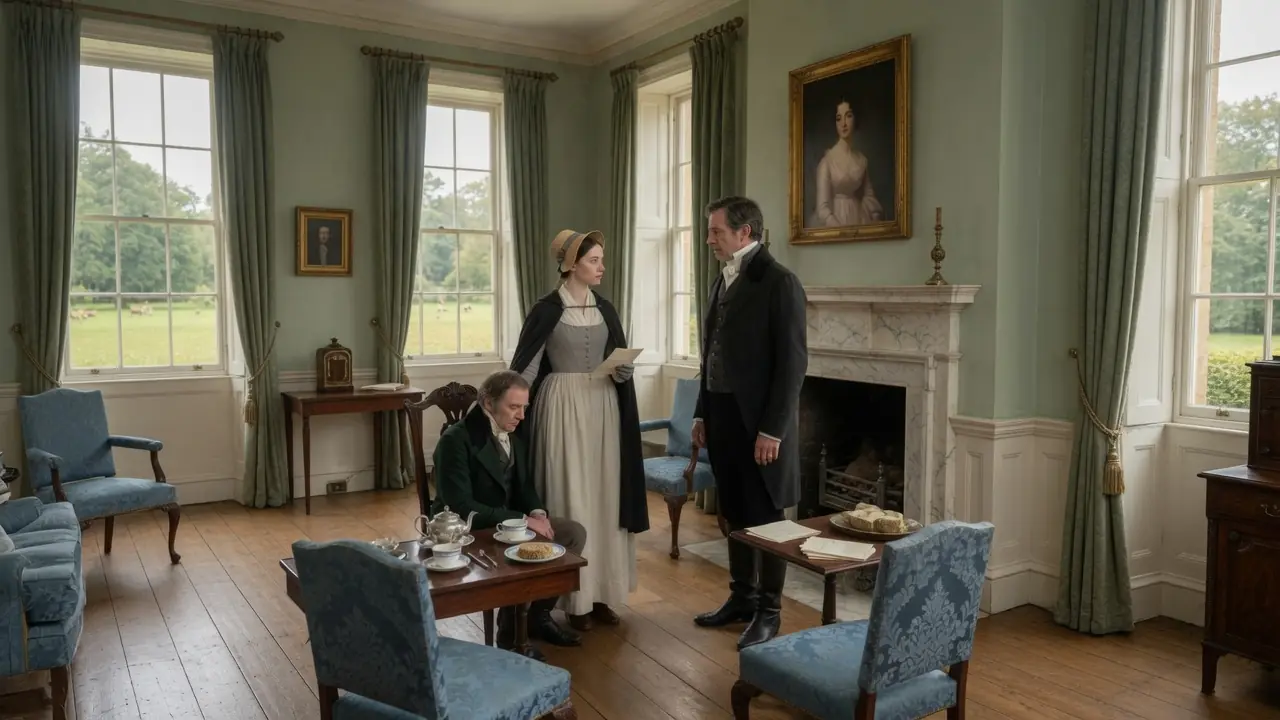
He received them in the south drawing room. He stood when they entered, which she noted because it was not required of a duke receiving a baronet's daughter. He was tall. His hair had gone gray at the temples, in a way that confirmed something about the kind of face it was, a face arranged by years rather than youth, and comfortable with the arrangement. His eyes were dark and settled, the eyes of a man who had stopped expecting rooms to surprise him, but still paid attention to them out of habit or principle.
"I will not waste your morning with performance," he said. "You have read the letter. You understand the arrangement. I would rather discuss it honestly than decorate it." She looked at the lines beside his eyes, the stillness in his hands, the way he held himself, not with arrogance, but with the discipline of a man who had been holding himself together for a long time and had become very good at it.
"I will be direct about what I am offering and what I am not," he said. "I am offering a household, a position, security for your father's situation, and a life that will be comfortable and ordered and entirely without pretense." He paused. "I am not offering what most women your age would expect from a marriage. I have had a marriage that contained everything expected, and I watched it become something neither of us survived intact. One of us did not survive it at all."
The room was very still. "I am not capable of offering you what I offered Rosalind," he said. "What I have is a house that needs someone to run it, and the honesty to tell you this is a practical arrangement, and I will not dress it as something else." Corusanda heard what he said. She also heard the space around what he said, the outline of a grief so thoroughly organized it had become structural, loadbearing, something the rest of his life had been built on top of.
She considered the word capable and the word practical, and the fact that this man had just told her he had nothing to offer her except a life and had meant it as a warning when most men would have meant it as a gift. "I accept," she said. He had not expected it to be that simple. She could see that clearly. It was not simple at all. But she had been making difficult decisions look simple since she was fifteen, and she was not going to stop now for the sake of a man who had just told her he could not love her, no matter how honestly he had said it.
The wedding was in October. It was small, efficient, and precisely what Lady Dalworth had arranged, which meant it was precisely what the county expected, and contained nothing anyone would remember for longer than a season. Corusanda wore ivory. It was her mother's dress, altered by a seamstress in Ipswich, who understood that some dresses carried more than fabric. Her father walked her to the front of the church with the steady grip of a man who had decided that steadiness was the last thing he could give her, and he was not going to fail at it.
Edmund stood at the front of the church and watched her walk toward him with the look she was beginning to catalog, the one that lived beneath his composed surface, and appeared only when he was not guarding it. She had seen it twice now. Once in the drawing room when she had said, "I accept," and he had looked at her as though she had done something he was not prepared for. And now, as she walked toward him in her mother's dress, and the October light came through the east window. They were married. The vicar spoke. They spoke. It was done with the economy of a thing agreed upon in advance. His hand was steady. Hers was steady. They were, she thought, two very steady people entering an arrangement that required steadiness above all else. And if there was something underneath that thought that felt like loss, she set it aside with the efficiency she brought to all impractical feelings.
By evening, the guests were gone. The house settled into its nighttime quiet, deeper and older than anything she had known, carrying the weight of a building that had seen two centuries of evenings, and had stopped counting. She was in the Duchess's chambers, sitting at the dressing table, brushing her hair, when she heard the knock. Two knocks measured with a pause between them that said, "I am here, but I am not assuming." She opened the door.
Edmund stood in the corridor in his shirt sleeves, which was the first time she had seen him without the full architecture of his clothing. And the effect was that he looked less like a duke and more like a man, which was a more complicated thing to stand in front of. He did not step forward. He stood at the threshold and looked at her with something older than tiredness and more deliberate than sadness. "I want to make you a promise," he said. She waited. "I will not come to your door unless you open it first," he said. "Not this door. Not any door between us. When you want my company, you will have it completely. Until then, you will have your privacy, your authority in this house and my respect." He paused. "That is not a negotiation. It is a promise."
She looked at him in the corridor light, this man who was twice her age and half her expectation, who had just given her the one thing no one had ever thought to give her, which was the right to choose when she was ready, without consequence and without pressure. "Thank you," she said. It was not enough. It was all she had. He nodded once, the way he nodded when something was settled. Then he turned and walked down the corridor toward his own rooms, and she stood in the doorway and watched him go, and thought about the promise and about a man who had just handed her a key to a lock she had not realized existed.
She closed the door. She sat on the edge of the bed and thought, "I do not understand this man." She thought, "I accepted this arrangement because I had no choice. He just gave me one." She did not sleep for a long time.
November at Windmir was a study in the mechanics of a marriage that functioned without friction and without warmth. They breakfasted together at eight because the household expected it and the household at Windmir operated on expectations established before either of them was born. The conversation was always civil. He asked about her plans. She asked about his. They exchanged information with the efficiency of two people running a shared enterprise, which was precisely what they were doing, and neither pretended otherwise.
She learned the house. She walked every room, every corridor, every outbuilding with the systematic attention of a woman taking inventory. The house was magnificent and neglected in the particular way of a house that had been maintained by grief. The plaster was sound. The accounts were exact. The staff were competent and cautious in the way of people who had served a man in grief and had learned to move quietly. She changed things. The morning room, which had been organized for a woman who was no longer there, she reorganized without asking permission. The kitchen accounts, which were precise but inefficient, she restructured in her first week.
Edmund noticed. He said nothing about most of the changes. On the third day, he came into the morning room and stood in the doorway, looking at the new arrangement. The writing desk moved to the window where the light was best, her books from the Thorold house on the shelf beside his. "You have rearranged," he said. "The light was wrong," she said. "The desk was facing the north wall. No one works well facing a north wall." He looked at the window. He looked at her books beside his. He looked at the room, which was no longer Rosalind's room, and was not yet Corusanda's, but was becoming something that belonged to the present rather than the past. "The light is better," he said. Then he left.
She sat at her desk and considered what she had seen in his face, which was not displeasure and not approval, but something more complicated. Something that lived in the territory of a man encountering evidence that the house was changing, and discovering that the change did not hurt the way he had expected. She had not opened his door. He had not come to hers. They existed in the same house with the courteous distance of two people who had agreed to share a life, but had not yet agreed on what the life would contain.
She wrote to her father every Sunday. "The house is well built. The staff are competent. The Duke is civil and correct and leaves me to my work." Her father read these letters in the Thorold study and noted what was present and what was absent and wrote back with the attention of a man who understood that his daughter communicated what she did not say more clearly than what she did. She did not write about the promise. She did not write about the door. She did not write about the look she had seen in the morning room, the one she kept returning to in the evenings when the house was quiet and November dark came early. "This is what I agreed to," she told herself. "This is sufficient. Sufficient has always been enough." She almost believed it.
It was on a Thursday evening in the last week of November that the arrangement first showed Corusanda something she had not accounted for. She had been working in the morning room past her usual hour because the tenant ledgers contained an error she had found at eight and could not leave unresolved. She was deep in the column when she heard the door. Not a knock, the sound of someone opening it with the familiarity of long habit.
Edmund stopped in the doorway. He had not expected her. She could see it in the half second before his face settled into its public register. But in that half second, she saw something she had not seen before, the look of a man who had walked into a room expecting emptiness and found presence and who had discovered that the presence was not unwelcome. It was gone before she could fully read it. But she had seen it.
"Forgive me," he said. "I did not realize you were still working." "The eastern cottages," she said. "The maintenance figures for Fenmore and Coltbridge have been transposed." He did not leave. He came into the room to the desk and looked at the ledger with the focused attention of a man who understood numbers the way she did, as things that told you the truth whether you wanted to hear it or not. He leaned over the page. His hand was beside hers on the desk, not touching, but close enough that she was aware of it in a way she had not been aware of anything in this house that wasn't work.
"There," he said, pointing. "The quarterly summary has Fenmore at fourteen pounds. The ledger has it at forty-one. The digits are reversed." She had been circling the error for twenty minutes, and he had found it in ten seconds. "You read ledgers upside down," she said. "I have been reading ledgers in this room for twenty years," he said. "Most of them were upside down relative to where I was standing."
She looked at him. He was close, closer than he had been since the wedding. And in the candlelight, the lines of his face were different, less guarded, more human. "You used to work here," she said. "In this room before." The composure returned, but slower than usual, as though it required more effort at this hour. "Rosalind preferred the upstairs sitting room," he said. "This room was mine in the evenings." She understood then he had come out of old habit expecting the room to be his. He had found her in it instead.
"I have taken your room," she said. "You have improved it," he said. "The desk is better by the window." Then he said good night and left. And she sat at the desk and thought about a man who had come to an empty room out of habit and found it occupied and had said the desk is better by the window and had meant something by it that was larger than furniture. He had not come to her door, but he had come to this one.
December arrived with the kind of storm that Suffolk produced once or twice a winter, the kind that began as wind and ended as damage. It struck on a Tuesday night and by dawn the scope was clear. Three tenant cottages on the eastern boundary had lost roofing. The lower field was flooded to a depth that would destroy the winter planting if not drained within the week. Two families with five children between them were sheltering in the estate barn.
Corusanda was dressed and in the kitchen by six, before Edmund, before the steward, before anyone had fully understood what had happened. Mrs. Palacer, the housekeeper, found her at the kitchen table with the estate map spread flat and a list already forming. "The families," Corusanda said. "The east wing has four rooms that are closed. Open two of them. Fires lit, beds made, breakfast sent up by eight." Mrs. Palacer, who had served Windmir for nineteen years and had carried the household through Rosalind's illness and death, looked at the new Duchess and saw something she had not expected. Not authority. She had seen authority, the particular quality of authority that came from someone who had been solving problems since before they were old enough to be asked. "Yes, Your Grace," she said, and went.
Edmund arrived at six. He looked at the estate map, the list, Corusanda standing over both with the focused energy of a woman in the middle of a problem she intended to solve before lunch. What crossed his face was not the guarded look or the brief unguarded one from the evening in the morning room. It was recognition. "The lower field," he said. "Flooded," she said. "The river has overrun the drainage channel. If it is not redirected within the week, the winter planting is lost." "Show me," he said.
They walked the lower field together in December mud. She showed him where the river had broken through. He listened with the complete attention that excluded nothing and assumed nothing. And when she finished, he said, "The channel needs to be widened here and diverted south. The original design is too narrow for the volume." "That was my assessment," she said. "Of course it was," he said. And there was something in his voice that was not surprise and not condescension, but the tone of a man confirming a fact he had already accepted.
They spent four days on the crisis, working side by side in a way the arrangement had not anticipated. She handled the families and the logistics. He handled the field and the laborers. They met twice a day in the morning room and reviewed progress with the efficiency of two people who had discovered that the enterprise worked better when both were fully present.
On the third day, a tenant's daughter, a girl of four named Belle, asked Corusanda whether the Duke was her grandfather. "No," Corusanda said. "He is my husband." "He is old," the child said. "He is experienced," Corusanda said. That evening she told Edmund about the exchange. It came out in the space between the drainage report and the supply inventory. The corner of his mouth moved, not a smile, the architecture of a place where a smile was under construction.
"Experienced," he said. "It was the most accurate term available," she said. He looked at the evidence of four days of shared work spread across the desk. "You have handled this better than I would have alone," he said. She wanted to say something composed, something that maintained the distance. What she said was, "Yes. I have." The almost smile completed itself briefly, the first full smile she had seen from him. It changed his face in a way she was not prepared for because it made him look like a man who had once smiled easily and had simply stopped and the return of the ability was not small. It was gone quickly. But she had seen it and she thought about it that night with a persistence she found difficult to dismiss. This was not part of the arrangement. She did not know what part it belonged to.
Christmas in Suffolk was a performance the county had been rehearsing for generations and the arrival of a new Duchess at Windmir gave the season a narrative it had not had in four years. The first event was a dinner at Ashwick House hosted by Lady Fenshaw who was sixty-one, widowed, childless and in possession of the kind of social intelligence that made her the unofficial narrator of everything that happened in the county. Lady Fenshaw had been Rosalind's closest friend, which gave the Ashwick dinner a weight that exceeded the usual occasion.
Corusanda wore dark blue. Simple. Correct. Her mother's pearls, which said, "I am here on my own terms, and I am not competing with a ghost." Edmund looked at her when she came down the stairs. He said, "You look very well, Your Grace." It was the first compliment he had given her. She noted it, set it aside, and got into the carriage.
Lady Fenshaw greeted her at the door. "Your Grace. Welcome to Ashwick. Rosalind loved this house." It was a test delivered with a smile and assessed by the response. "I can see why," Corusanda said. "The proportions are excellent." The test had been passed, or at least the first version of it. The dinner was thirty people, the core of Suffolk society.
Corusanda was seated beside Sir Kretton Vaughn, who was fifty-eight, and had the manner of a man who had inherited everything he possessed, and considered this evidence of personal merit. She was aware throughout the evening that Edmund, seated four places down, was watching her. He was not obvious about it, but she had developed a working sense of where his attention was directed, and it was with a frequency she was now tracking rather than ignoring directed at her. The second thing she was aware of was Lady Fenshaw, who was watching them both.
After dinner, Lady Fenshaw appeared beside her. "You are not what I expected," Lady Fenshaw said. "What did you expect?" "Someone younger." And then before Corusanda could respond, "Not in years. In the way she carried the room. You carry it as though you have been doing it for thirty years." Lady Fenshaw was quiet for a moment. "Rosalind never learned to carry a room," she said. "She was lovely. She was kind. She could not handle a dinner for twelve without being handled herself. It was not a failing. It was simply not her capacity."
She looked across the room at Edmund. "He is different with you," Lady Fenshaw said. "He is paying attention in a way he has not paid attention in four years." She paused. "Rosalind would want him to stop punishing himself for what he could not fix." "What could he not fix?" Corusanda said. Lady Fenshaw looked at her carefully. "That is his door to open," she said. "Not mine."
The word landed in Corusanda's chest like a stone dropped into still water. It was the word from the promise, the word she had been turning over since October, and hearing it from someone who had no way of knowing its significance, told her that the door was not just a metaphor Edmund had chosen for their arrangement. It was the way he had lived for four years. Every door closed, every threshold uncrossed, every room entered alone.
She looked across the drawing room at the Duke of Windmir and she thought, "What happened to Rosalind was not just grief. There is something he has not told me, and I am going to need to know what it is."
January brought the letter from the Thorold estate, and with it the first morning Corusanda could not hold steady. She received it at breakfast. The letter was in her father's hand, which was usually steady and was not steady now, and she knew before she opened it that something had changed because handwriting told you everything if you paid attention.
Sir Hadwin had taken ill. A fever settled in the chest that would not clear. The letter was factual because her father wrote the way she wrote, with precision, even when precision cost something. But beneath the facts, she could hear what he wasn't saying, which was that he was frightened. And her father did not frighten easily.
She set the letter beside her plate. She looked at the toast she was not going to eat, and the tea she was not going to drink. Edmund was watching her. "Your father," he said. She did not trust her voice. She nodded. He set down his cup. "I sent Hargrove this morning." She stared at him. Hargrove was his personal physician. "The express arrived at five," he said. "I saw the handwriting on the envelope and recognized the urgency. Hargrove left at five. He will be at the Thorold estate by this afternoon." He paused. "If you wish to travel, the carriage will be ready within the hour."
She looked at this man across the breakfast table who had read the handwriting on an envelope addressed to her at five in the morning and had sent his own physician before she had woken, before she had read the letter, before she had asked for anything at all. She had spent her entire life being the one who acted before anyone asked. She had been the one who saw the problem and solved it and told no one until it was done. She had never in twenty-two years been on the receiving end of that. She had never had someone read the urgency in a letter that was not theirs and rise in the dark and act. Not because they were asked, but because they were paying attention.
He did not come to my door, she thought. He went to my father's. "You did not wake me," she said. "You needed sleep more than you needed worry," he said. "Will you come with me?" she said. She saw the stillness, the half second of recalibration, the moment where his guarded manner encountered something it had not been designed to process. "If you wish it," he said. "I am asking," she said. "Then yes," he said.
They traveled to the Thorold estate that morning. He sat beside her in the carriage and did not speak unless she spoke and did not offer comfort she had not requested and was simply present in the complete and undemanding way she was beginning to understand was his version of care. The kind that did not announce itself. The kind that simply arrived and remained.
Her father recovered. Corusanda stayed three days. Edmund stayed for two of those three, which was longer than duty required and shorter than she wanted, and neither of them discussed the difference. On the carriage ride back, she sat beside him in the January dark and thought about doors. She had opened one, not the door from the promise, but a different one, the one that said, "I need you here, and I am not accustomed to needing anyone. And the fact that I asked is the most significant thing I have done since October." The space between them was smaller than it had been that morning. Neither of them moved to close it. Neither moved to widen it.
The winter assembly at Ashwick House was in the first week of February. Fifty people. Lady Fenshaw had decided the county needed an occasion. And when Lady Fenshaw decided something, the county discovered that it agreed. Corusanda arrived on Edmund's arm with the poise of a woman who had recently added a duchy to her portfolio. She wore the dark blue again because it worked.
Edmund looked at her when she came down the stairs at Windmir, and the quality of his attention had shifted from assessing to something more sustained, more present, more difficult to look away from. The evening proceeded. She talked with Lady Fenshaw about the spring planting. She talked with Mrs. Aldworth about the village school whose roof she had been considering replacing with Windmir funds. She was aware of Sir Kretton Vaughn from the moment he entered the room. She had developed a comprehensive understanding of the man over two months in Suffolk, which was that he believed the county was a hierarchy, and that the arrival of a new Duchess, who was twenty-two, and the daughter of a minor baronet represented a disruption to the order he had spent fifty-eight years depending upon. He had been circling since dinner. She had tracked him the way she tracked everything.
He arrived during the interval between the music and supper, the moment when the room was most relaxed and most exposed. "Your Grace," Sir Kretton said. "Windmir is looking well. The storm damage was handled efficiently." "Thank you," she said. "The drainage is repaired." "Remarkable," he said, turning to the two men beside him. "Remarkable efficiency for someone so new to the county and so young." He smiled. "One does wonder whether the improvements reflect the new Duchess's judgment or simply the inheritance of a household already well established. Rosalind, of course, had twenty years to learn the county. She understood its character." He paused with the calibrated timing of a man delivering a prepared conclusion. "It takes time to truly understand a place. A season is not sufficient. Experience cannot be purchased. It must be accumulated."
He smiled at the room. "And one hopes that the enthusiasm of youth does not outpace the wisdom of experience." The word enthusiasm did the work he had designed it to do. In a different mouth, it was neutral. In his, with his pauses and his audience and his smile, it meant she was a girl playing at being a Duchess in a house that required a woman. And everyone in this room knows it.
She heard what he was saying. The room heard what he was saying. He was saying she was too young, too new, too northern, and too purchased. And he was saying it with Rosalind's name in his mouth like a weapon. She had her response ready. She had spent years preparing responses to men like Sir Kretton, and she had a catalog of them, precise and devastating. She did not get the chance to deliver any of them.
Edmund's voice arrived from her right, and it was not the voice she knew from breakfasts and estate meetings and carriage rides. It was a different register entirely, lower, quieter, carrying the specific weight of a man who had been the Duke of Windmir for twenty-four years and understood exactly what that weight could do when applied to a single sentence. "The storm damage at Windmir," Edmund said, "was assessed, planned, and resolved in four days. The tenant families were housed in the east wing within three hours. The drainage redesign, which I had been considering for two years, was implemented in a week." He met Sir Kretton's gaze with the undivided attention of a man who did not need volume because he had something more effective. "These were not inherited efficiencies. They were the decisions of the current Duchess, made on her own judgment, executed under her own authority." He paused. "I was present for all of it. I can speak to the quality of the work with complete confidence."
The room recalibrated. Corusanda could feel it. Forty people updating their assessments simultaneously. Sir Kretton's face underwent a rapid revision. "Of course," he said. "I merely meant that one hopes the county—" Corusanda felt Edmund's hand briefly at the small of her back. Not possessive. Present. The kind of touch that said I am here which was different from I am protecting you and the difference mattered.
"We all hope the best for the county," Edmund said with the finality of a man closing a door. "I believe supper is being served." Sir Kretton found somewhere else to be after supper. In the hallway, Lady Fenshaw materialized at her elbow. "He has not spoken like that in public since Rosalind's funeral," Lady Fenshaw said. "He was correcting an inaccuracy," Corusanda said. "He was making a declaration," Lady Fenshaw said. "He simply made it in the language of estate work which is the only language he trusts." She paused. "He did not make it about you. Do you understand why?" "Because making it about me would have been patronizing," Corusanda said. "Because making it about you would have required him to say what he has not yet said to you," Lady Fenshaw said. "And he is not going to say it in a drawing room to correct Sir Kretton Vaughn. He is going to say it to you in private when he is ready. The question is whether you are ready to hear it."
Corusanda held her gloves and thought about the hand at the small of her back and the voice she had not heard before and the word declaration. She was going to have to open the door soon and she did not yet know what was on the other side.
He told her about Rosalind on a Wednesday evening in the second week of February. It was not a planned conversation, but the kind that arrives because the silence between two people has become the kind that cannot sustain itself much longer. They were in the morning room. The candles were low. They had been reviewing the spring accounts, which had become their evening habit, and the accounts were finished, and neither of them had moved to leave, and the room was warm, and the February dark was outside.
"Rosalind was not unhappy because of what I did," he said. Corusanda looked up. "She was unhappy because of what I did not do," he said. He was looking at the fire, not at her. His voice was the quiet one, the one that lived beneath all his public registers. "She was kind," he said. "She was warm. She wanted a marriage that was alive. And I gave her a marriage that was correct. She wanted to be known and I gave her a household. She wanted me to open doors and I kept them all properly maintained and uniformly closed."
"She asked me once in the fifth year whether I loved her. And I said that I valued her and respected her and was committed to our life. And she looked at me and said, 'Edmund, that is not what I asked.'" The fire moved in the grate. The room was very still. "She became ill the following winter," he said. "The illness was sudden and quick and there was nothing anyone could do. And I sat beside her for three weeks and held her hand and read to her. And on the last day she looked at me and said, 'You are here. You have always been here. I wish you had let me know.'"
He stopped. He looked at his hands which were still the way they were always still. And Corusanda understood that the stillness was not calm. It was the opposite of calm. It was what remained when a man had disciplined every outward sign of distress until the discipline itself became the distress.
Corusanda listened to this man tell her the thing he had been carrying for four years, the thing that had built the promise, the thing that had closed every door in his life. "She died believing I had not loved her," he said. "And the truth is that I do not know if she was right. I do not know if what I felt was love or the habit of responsibility."
He looked at the fire. "That is what I could not fix."
The weight of what he had said filled the space between them and Corusanda sat in it and did not look away from him because looking away would have been a kind of closing and she was done with closing. Corusanda set down the ledger carefully the way she set down everything with the deliberate attention of a woman who handled objects because handling objects was easier than handling what she was feeling.
"You made me a promise," she said. "On our wedding night." He looked at her. "You said you would not come to my door unless I opened it first," she said. "I understood it as a kindness, a courtesy extended to a woman who had entered a marriage without choice, giving her the one choice you could offer." She held his gaze. "It was not a kindness," she said. "It was a penance."
He did not deny it. He sat in the chair across from her desk with nothing guarded in his face. Nothing managed. Just the weight of something too heavy to carry and too honest to set down. "You gave me a door you would never walk through," she said. "Because you believe you failed a woman who asked you to walk through hers. You built the promise out of guilt, not generosity. And you have spent four months being the most considerate, most careful, most perfectly distant husband in Suffolk. And you have done it as punishment, not as principle."
The fire cracked. The February wind pressed against the windows. "Yes," he said. One word. No defense, no explanation, just the word and the weight of it, and the man sitting in her room admitting the thing he had not admitted to anyone, including himself.
She considered the morning room and the ledger and the unguarded look in the doorway, the storm and the field and the smile that had changed his face. The carriage to the Thorold estate and the physician sent before dawn and the hand at the small of her back at the assembly and the voice that had carried two hundred years of Suffolk in defense of a woman he had married for duty. She considered the promise. She considered the door. She had been waiting for him to open it. He had been waiting for her to open it. And neither of them had understood that the door did not belong to either of them. It belonged to both.
"Edmund," she said. He looked at her. She saw in his face the thing Lady Fenshaw had identified, the thing he had not yet said, the thing that lived in the language of estate work and drainage channels and physicians sent at five in the morning. "Rosalind asked you if you loved her," Corusanda said, "and you gave her an inventory instead of an answer." "Yes."
"I am going to ask you something different," she said. "I am not going to ask you if you love me. I am going to ask you to stop closing doors and calling it courtesy." She stood. She came around the desk and stood in front of him. Closer than they had been since the wedding. Closer than the arrangement permitted. Closer than the promise allowed. "The door is open," she said. "It has been open since January. I opened it in the carriage when I asked you to come with me. I opened it when I let you see that I was frightened. I opened it every morning at breakfast when I sat across from you and wondered what it would mean if this arrangement became something I chose rather than something I accepted."
"I am not Rosalind," she said. "I am telling you that the promise was enough to begin with and it is not enough anymore and I need you to walk through the door or tell me that you cannot and I will handle that too because I can handle anything but I would prefer not to handle this alone."
He stood slowly the way a man stands when the ground has shifted and he is finding his balance on the new terrain. He was taller than her by a full head, and his face in the firelight was the face of a man who had just heard the most important thing anyone had said to him in four years and was rearranging everything he believed in response.
He put his hand on her face. The first time he had touched her with intention rather than courtesy. "I have been walking toward the door since November," he said. "I have been standing outside it since December. I have been reaching for it since January," he paused. "I was afraid that if I walked through it, I would fail you the way I failed her. That I would give you maintenance instead of presence."
"You are not a penance," he said. "You are not a second attempt. You are not a correction. You are the most precise and formidable person I have ever encountered. And I have spent four months being shown that precision and formidability are not coldness, and that a woman who handles everything can also be the person who makes handling unnecessary."
"I am walking through the door," he said, "if it is still open." She put her hand over his. "It has been open," she said, "since you read the handwriting on my father's envelope at five in the morning and sent your physician before I woke. That was not duty, Edmund. That was love. You simply did not recognize it because it did not look the way you expected it to."
He kissed her. It was not tentative and it was not performed. It was the kiss of a man who had been standing outside a door for four months and had finally walked through it, and it carried the weight of everything he had not said in the morning room and at the breakfast table and in the carriage and at every dinner where he had watched her across the room and had not crossed the distance. She kissed him back with the precision she brought to everything that mattered and every true thing she had decided since October, and the room was warm and the accounts were on the desk and the fire was in the grate and none of it required any further handling.
When they separated, she kept her hand on his. She looked at him with the expression she wore when she was not performing anything at all, the one she had not known she possessed until this man and this room and this moment had shown it to her. "The spring accounts," she said, "are finished." "They are," he said. "The drainage report can wait." "The morning room," she said, looking at the room around them, "is still mine." "The morning room," he said with the corner of his mouth doing the things she had cataloged and was now permitted to respond to, "is indisputably yours. I have seen what happens to people who contest things with you."
The almost smile became a real one. Hers became a real one. And the evening continued, and neither of them left the morning room for a considerable time. And when they did, they left together, which was new, and which was going to become permanent, and which was the best decision either of them had made since October.
March came to Suffolk with the slow insistence of a season that would not be refused, and the county noticed what it had been watching for. The Duke and Duchess of Windmir were no longer performing a marriage. They were in one. The evidence was not dramatic. It showed in the quality of small things. The way he followed her words across a room. The way she stood beside him rather than near him. The way the space between them had changed from careful to chosen.
The household noticed first. Mrs. Palacer observed that the Duchess now took evening tea in the Duke's study, and the Duke now appeared in the morning room before breakfast to read the paper, while the Duchess reviewed accounts, and neither of them appeared to find these overlapping habits remarkable.
Lady Fenshaw noticed second at a dinner in the third week of March. "He listens to you," Lady Fenshaw said afterward. "He has always listened to me," Corusanda said. "No," Lady Fenshaw said. "He has always paid attention to you. That is different. Paying attention is assessment. Listening is presence." She paused. "Rosalind wanted him to listen. He paid attention instead. He did not know the difference. You have taught him the difference." "He taught himself," Corusanda said. "I simply refused to accept the alternative." Lady Fenshaw smiled, the real one. "He is happy," she said. "I have not said that word about him in five years." She paused. "You loved a man who did not believe he deserved it. That is not management. That is courage."
Her father visited in the last week of March. He was recovered, thinner than she liked, but steady. She showed him the house, the accounts, the kitchen, the village school whose roof she was replacing with Windmir funds. He looked at all of it. He looked at her showing it to him. He looked at the way she moved through the house, not as a guest and not as a functionary, but as a person who belonged to it.
Edmund joined them for dinner. Afterward in the library, Sir Hadwin looked at his daughter across the fire. "He is not what I expected," her father said. "What did you expect?" "A man who had purchased a solution." He paused. "He is a man who has been solved." "He is a man who stopped needing to be solved," she said. "I did not fix him. I refused to accept a version of this marriage that was less than what it could be, and he discovered that the version I was refusing was also less than what he wanted."
"Are you happy?" he said. She thought about the question with the honesty it required. She thought about October and the letter at the breakfast table and the word capable and the arrangement she had accepted because she had no choice. She thought about the promise and the door, about December and the storm and the smile, about February and the fire and the hand on her face and the man who had walked through the door. "I am," she said. "I am also still reorganizing his library, which has no logical system, and his rose garden, which is in the wrong beds, and three of his tenant leases, which are outdated. But yes, I am happy."
Her father laughed, the real one, the full one. "You are a magnificent Duchess," he said. "I know," she said. "I have been telling everyone."
Sir Kretton Vaughn called at Windmir the following week. He said the correct things with the calibrated grace of a man who had been corrected publicly and had spent two months recalculating. Edmund arrived midway through the call, sat beside his wife, and said nothing that was not civil and nothing that was not in its quiet way a statement. Sir Kretton left after twenty minutes.
Corusanda watched him go from the morning room window and thought, "That is settled." Edmund beside her said, "You did not need me for that." "No," she said. "I did not." He looked at her. "And yet?" "And yet," she said, "I find there is a difference between not needing someone present and preferring them present. I have been treating those as the same thing for a long time. They are not."
The spring in Suffolk was the county at its most itself. The fields coming in, the hedges filling. Corusanda stood in the east garden on a morning in the first week of April and looked at the rose beds she had spent March redesigning, the climbers on the south wall, the standards where the afternoon light reached them.
Edmund found her there. He came from the house in his practical morning coat, the one he wore when he was not being a duke, but simply a man who lived in a house with grounds and a wife who reorganized them.
"They are in the right beds," he said. "They are," she confirmed. He looked at the garden and then at the south field beyond it, green and dry after the drainage work, and then at the morning room window where the light fell on her desk, and then at her. "You have changed everything," he said. "Not everything," she said. "The house is the same house. The accounts are the same accounts with better organization."
He shook his head. "Not the house," he said. "I made you a promise," he said. "In October on a night when I believed I was offering a kindness and I was offering a prison. I told you I would not come to your door unless you opened it first. And I meant it as protection and it was a wall."
"I want to make you a different promise," he said. She waited. "Every door in this house is yours," he said. "Every room, every threshold. But I am not going to wait on the other side of them anymore. I am going to be in the rooms with you. Not because you opened the door, but because the doors are open. All of them. Permanently. Not because you asked, but because I have finally understood that a door you have to be invited through is not a door. It is a condition. And I am finished with conditions."
She looked at this man who was twice her age and who had spent four years closing every door in his life and who had just opened all of them in a garden on a Tuesday morning with the roses planted correctly around them. She considered October, the letter at the breakfast table and the word capable. The first night and the knock and the promise. November and the morning room and the look in the doorway. December and the storm and the field and the child who had asked if Edmund was her grandfather and the smile that had changed his face. January and the physician sent at five in the morning and the carriage ride and the question, "Will you come with me?" which had been the first door she opened. February and the assembly and the hand at the small of her back and the night he told her about Rosalind, and the night she told him the promise was not enough. March and the mornings and the evenings and the way the house had changed around them, not because either had demanded it, but because they had both stopped performing and started living.
She considered love and what she had believed about it in October, which was that it was a thing other people had the luxury of choosing and what she believed about it now, which was that it was not a luxury and not a choice, but a thing that arrived when you stopped closing doors and started walking through them together. She considered what Rosalind might think of this moment, this garden, this man standing in it with no doors between himself and the woman beside him. And she thought Rosalind would be glad. She thought Rosalind would say finally.
"Edmund," she said. "Yes." She took his hand. She held it the way she held everything that mattered. Firmly, deliberately. "I married you for duty," she said. "I stayed for the promise. I am here now because both of those things became something I did not expect and could not have willed into existence." She paused. "The best investments, my father always said, are the ones you understand better after you have made them than before. I understand this one completely," she said.
He covered her hand with his. "You are the most unmanageable decision I have ever made," he said. "And the best one." "The best one," he agreed.
The April morning continued around them, warm and unhurried, and the roses were in the correct beds, and the south field was dry, and the morning room window was open, and every door in Windmir Hall was open, which was new, and which was going to remain permanent, and which was not practical at all, and which was the truest thing she had ever understood about a house and a man and a marriage that had begun with a letter on a Wednesday and a word called capable and had become against every expectation she had brought to it the thing she would have chosen if choosing had ever been available. It was available now. She chose it. And the choosing, she understood at last, was not the end of the arrangement. It was the beginning of the one that mattered.