The fluorescent lights inside Maple and Maine Cafe buzzed with the same tired sound they made every morning.
After three years, Noah Bennett barely heard it anymore.
He knew that hum the way he knew the cracked tile behind the counter, the loose handle on the second coffee pot, and the exact second toast went from golden to ruined. He knew the cafe so well it had stopped feeling like a workplace and started feeling like a small room he had been sentenced to occupy.
It was 5:46 a.m. on a Tuesday in late October.
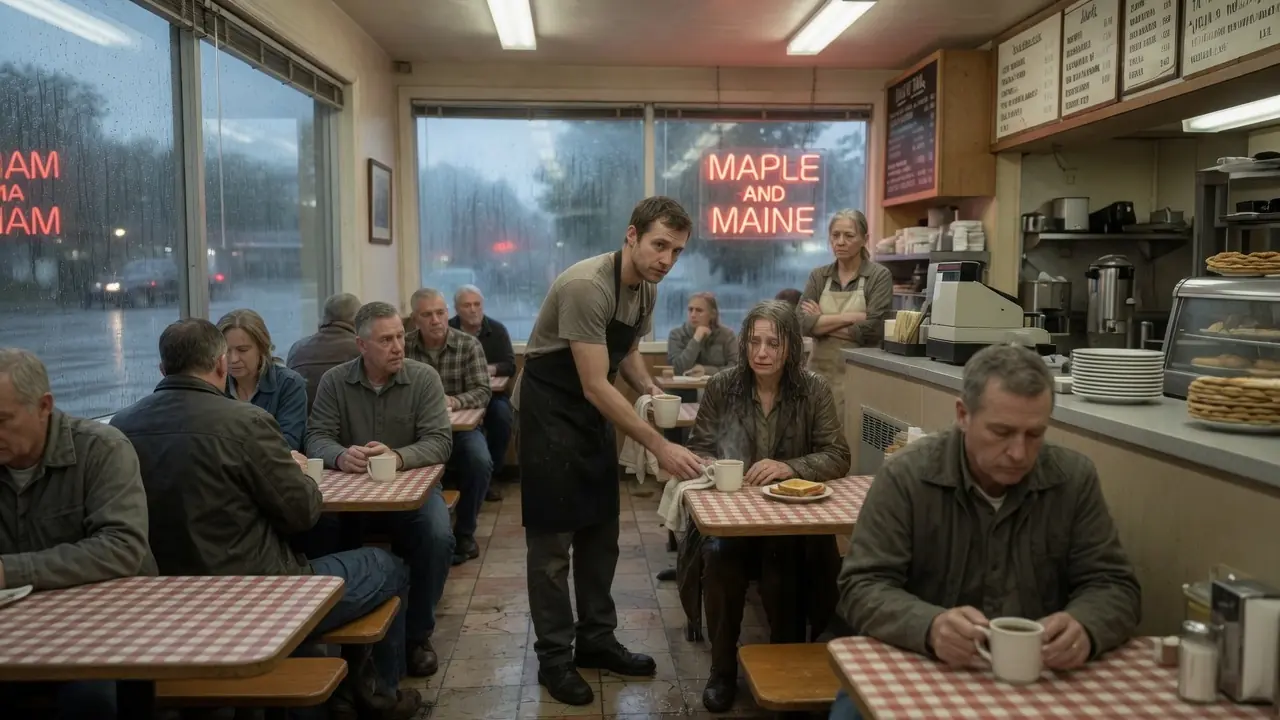
Outside, the street was still dark. Rain tapped softly against the front windows, turning the reflection of the neon sign into a trembling red smear on the glass.
Noah moved through his opening routine without thinking.
Coffee machines on.
Register drawer counted.
Napkin holders filled.
Bread stacked near the toaster.
Creamers lined up in their little metal tray.
Thirteen dollars and thirty cents an hour.
That was what the world had decided his time was worth.
After rent, groceries, the overdue electric bill, and the school expenses for his eight-year-old daughter, Ellie, Noah usually had less than forty dollars left at the end of the month. Sometimes less than twenty. Sometimes nothing at all.
He had done the math so many times at two in the morning that numbers followed him into sleep.
“You’re here early again.”
Noah looked up.
Martha Greene, the owner of Maple and Maine, pushed through the back door with her coat half buttoned and a paper bag tucked under one arm. She was sixty-four, sharp-eyed, and built of equal parts coffee, disappointment, and stubbornness.
“Couldn’t sleep,” Noah said.
Martha hung her coat on the hook outside her office.
“That child of yours sick?”
“Ellie’s fine.”
“Then you should sleep when you can. Sleep is free. Not much else is.”
Noah almost smiled.
“That your inspirational quote for the day?”
“I charge extra for inspiration.”
She tied on her apron and glanced toward the schedule taped near the pantry door.
“Denise called in sick. Again. You’re covering her tables until lunch.”
Noah felt the bad news settle into his shoulders.
Double duty.
Same pay.
More customers.
More running.
More chances for Martha to complain that he was moving too slowly.
“Sure,” he said. “No problem.”
Martha gave him a look that said they both knew it was a problem.
But she did not apologize.
Martha was not cruel, exactly. She had simply spent too many years fighting rent increases, broken equipment, bad reviews, health inspectors, and customers who treated waitresses like furniture. Whatever softness she had once owned had been worn down by decades of survival.
The cafe opened at six.
The first hour was always the same.
Construction workers needing coffee strong enough to hold them upright. Elderly regulars who ordered one egg, one toast, and sat for ninety minutes because home was too quiet. Office workers who looked at their phones instead of the people handing them food.
Noah served them all with practiced calm.
But his mind kept drifting to Ellie.
There was a field trip form on the kitchen counter at home. Twelve dollars for the science museum. She had not asked twice, which somehow hurt worse than begging would have. Ellie was already learning the shape of what they could and could not afford.
Her sneakers were wearing thin at the soles.
The heat in their apartment clicked before it worked.
And the landlord had taped a notice to the lobby wall about “upcoming rent adjustments,” which was a polite way of saying people like Noah should begin panicking now.
At 7:22 a.m., the bell over the door rang.
Noah looked up with the greeting already on his lips.
Then the words stopped.
A woman stood just inside the doorway.
She was soaked through.
She might have been forty.
She might have been fifty.
Hard living makes age difficult to read.
The cafe quieted.
Not completely. The coffee machine still hissed. A spoon still clinked against a mug somewhere near the window. But conversations thinned, and heads turned.
Noah knew the look.
People used it when they wanted someone to disappear without having to say the cruel thing aloud.
Martha came out from the back, saw the woman, and sighed.
“Oh, not this again.”
She started toward the door.
“No loitering. You can’t just come in here and drip all over the—”
“I’ve got it,” Noah said.
Martha turned.
“You’ve got what?”
“I’ll handle it.”
“Noah, we can’t start making this place a shelter.”
“I said I’ll handle it.”
His voice was quiet, but something in it made Martha stop.
She stared at him for a second, then threw up one hand and backed toward the counter.
“Fine. But if she scares off paying customers, that’s on you.”
Noah took a clean towel from the stack behind the counter and walked slowly toward the woman.
She flinched when he got close.
The movement was small, but Noah saw it.
The body remembers things the mouth will not explain.
“Hey,” he said softly. “You’re okay. I’m not going to touch you.”
He held out the towel.
“You’re soaked.”
The woman stared at it.
“It’s clean,” he added. “Promise.”
After a long moment, she reached for it.
Her fingers shook badly. Her nails were cracked and bitten close. She wrapped the towel around her hands first, then pressed it to her hair as if she had forgotten what to do with comfort.
“Thank you,” she whispered.
Her voice was dry and rough.
“There’s a booth in the back corner,” Noah said. “Heat vent’s above it. Why don’t you sit down? I’ll bring you coffee.”
She shook her head quickly.
“I don’t have money.”
“It’s on me.”
Her eyes lifted to his.
They were gray-green, startlingly clear despite the exhaustion. For one second, Noah saw not only hunger there, but suspicion. Fear. The learned caution of someone who had discovered that kindness sometimes came with hooks.
“Why?” she asked.
A small question.
A hard one.
Noah could have said because it was cold outside. Because no one should stand in a doorway shivering while people pretend not to see. Because coffee cost less than twenty cents to pour, and charging someone dignity for it felt obscene.
Instead, he said, “Because you look like you need it.”
She held his gaze.
Then she nodded and moved toward the back booth with slow, careful steps.
Noah felt the eyes of the cafe on him as he returned to the counter.
He poured coffee from the fresh pot, added two sugars because he had a feeling she could use them, and dropped two slices of bread into the toaster. When they popped up, he buttered them all the way to the edges.
That was how Ellie liked toast when she was sick.
When Noah brought the plate and mug to the back booth, the woman tried to lift the cup but her hands shook too badly. She set it down again, embarrassed.
“Here,” Noah said.
He slid into the seat across from her, picked up the toast, and placed one piece on a napkin near her hand.
“Careful. It’s hot.”
She took a bite.
Her eyes closed.
It was just bread and butter. The simplest food in the world. But her face changed as she chewed. Something inside her seemed to loosen and break at the same time.
When she opened her eyes, tears were running down her cheeks.
“I’m sorry,” she said quickly, wiping at them. “I’m sorry. I don’t usually—”
“You don’t have to apologize for being hungry.”
She looked at him as if he had said something in a language she used to know.
Noah should have gone back to work.
Martha was watching from behind the counter. Customers were whispering. Someone near the window gave a little disapproving sniff.
He stayed for another minute anyway.
“I’m Noah,” he said.
The woman held the toast in both hands.
“Claire,” she answered finally. “Claire Whitman.”
“That’s a good name.”
“My mother liked old-fashioned names.”
A faint smile touched her mouth.
“She said I was born looking like someone who would write letters in fountain pen.”
“Did you?”
“Write letters?”
“Yeah.”
“Once,” she said. “A long time ago.”
The sadness came back so quickly that Noah wished he had not asked.
Before he could say anything else, Martha’s voice cut across the cafe.
“Noah.”
He stood.
“I have to get back.”
Claire nodded.
“Of course.”
He hesitated.
“If you come by tomorrow, I’ll have coffee ready.”
Her eyes widened.
“You don’t need to do that.”
“I know.”
“Then why would you?”
He looked at her.
“Because sometimes people need somewhere warm to sit.”
He left before she could argue.
The rest of the day blurred into orders, refills, complaints, dirty dishes, and the endless rhythm of smiling when your feet hurt. By the time Noah clocked out, his back ached and his eyes burned.
He picked Ellie up from Mrs. Lowell’s apartment, two floors below theirs.
Mrs. Lowell was seventy-one, widowed, and suspicious of every modern invention except the microwave, which she treated as proof God still liked convenience. She watched Ellie after school in exchange for Noah doing her laundry and fixing whatever small things broke around her apartment.
“She ate the carrots,” Mrs. Lowell announced at the door.
Ellie looked betrayed.
“You said you wouldn’t tell.”
“I said no such thing. I am old, not corrupt.”
Noah looked down at his daughter.
“You ate carrots?”
“One carrot.”
“Half,” Mrs. Lowell corrected.
Ellie sighed.
“It was orange and aggressive.”
Noah laughed despite the exhaustion.
Their apartment was small, officially a one-bedroom, though Noah slept on the pullout couch so Ellie could have the room. Dinner was canned soup and toast because there was always more bread than anything else.
While Ellie did homework at the tiny table, she looked up and said, “Dad?”
“Yeah, bug?”
“Maddie said her mom makes a lot of money because she has an important job.”
“That’s good for Maddie’s mom.”
“She asked what your job is.”
Noah stirred the soup.
“What did you say?”
“I said you make people breakfast.”
“That’s true.”
“She said that’s not important.”
The spoon stilled.
Noah turned off the stove and crouched beside his daughter.
“What do you think?”
Ellie tapped her pencil against her notebook.
“I think people are nicer when they’re not hungry.”
Noah looked at her for a long second.
Then he kissed the top of her head.
“That might be the smartest thing anyone has said all day.”
That night, after Ellie fell asleep, Noah sat in the quiet and thought about the woman in the back booth.
Claire came back the next morning.
She stood outside before dawn, wrapped in the borrowed warmth of the cafe’s awning, rain misting around her like gray smoke.
“You’re early,” Noah said as he unlocked the door.
“You said tomorrow.”
“I did. But the coffee isn’t magic. I still have to make it.”
A small smile moved across her face.
“Then I’ll wait.”
She followed him inside and sat in the same corner booth. While he set up the cafe, she watched him with the cautious attention of a person learning whether safety could repeat itself.
He brought her coffee and toast.
Black coffee, two sugars.
Toast buttered to the edges.
She noticed.
“You remembered.”
“My daughter says bad toast is worse than no toast.”
“Your daughter sounds wise.”
“She’s eight and strongly opinionated.”
“What’s her name?”
“Ellie.”
Claire repeated it softly.
“Ellie.”
Over the next weeks, Claire became part of the cafe’s mornings.
She never asked for more than coffee and toast. Sometimes Noah added eggs when Martha was not looking. Sometimes Martha saw and pretended not to. The owner’s disapproval softened by degrees, though she would rather have burned the building down than admit it.
Noah and Claire talked in scraps between customers.
She told him she loved old music, especially piano pieces that sounded like rain on windows. She loved Russian novels because everyone in them suffered dramatically and still found time to discuss the soul. She watched pigeons in the park and gave them names.
“That one,” she said one morning, pointing through the window, “is Bernard. Retired judge. Very bitter. Still thinks about a woman he didn’t marry in 1972.”
Noah looked.
“It’s a pigeon eating a french fry.”
“Exactly. A man with regrets.”
He laughed.
She smiled then, truly smiled, and for a second he saw the person she must have been before life stripped her down to survival.
He told her about Ellie.
About her drawings, her stubbornness, the way she cried during nature documentaries if the prey animal looked “emotionally unprepared.” He told Claire about bedtime stories and overdue bills and the strange terror of being the only parent.
Claire listened like every word mattered.
That alone made Noah wary.
People rarely listened that carefully unless they wanted something or had lost so much that listening was all they had left.
One Saturday, Claire met Ellie at the small park near their apartment.
Ellie was suspicious at first. She had inherited Noah’s caution and turned it into a facial expression. But Claire pulled a square of paper from her coat pocket and asked, “Do you know how to fold a crane?”
Ellie shook her head.
“Is it hard?”
“Most magic is, until someone shows you the folds.”
Claire’s hands were steady that day. She folded the paper with practiced grace, turning it over, creasing, tucking, lifting, until a small paper bird sat in her palm.
Ellie’s mouth opened.
“That is actual magic.”
“No,” Claire said. “It’s patience disguised as magic.”
By the end of the hour, Ellie had made a crooked paper crane with one wing bigger than the other. She held it like treasure.
“If you make a thousand,” Claire said, “you get a wish.”
Ellie thought about that with deep seriousness.
“I’d wish for Dad to not be tired all the time.”
Noah looked away quickly.
Claire did not.
“That,” she said softly, “is a very good wish.”
Winter settled over the city.
Claire still came to the cafe every morning, but she was thinner now. Some days she coughed into her sleeve and smiled too quickly afterward, as if speed could hide weakness. Noah noticed. He noticed everything about people he cared for, and that frightened him more than hunger ever had.
One morning he brought her a coat.
It was his good winter coat, though he claimed he had another one.
She stared at it.
“Noah, I can’t take this.”
“You can. You will.”
“I have nothing to give back.”
“That isn’t why I’m giving it.”
Her eyes filled.
“You do not understand how rare you are.”
“I’m not rare. I’m tired and underpaid.”
“You are both,” she said. “And still kind.”
A week later, Noah came home to an envelope under his door.
Inside was five hundred dollars and a note in elegant handwriting.
For Ellie’s field trip, shoes, heat, and anything else that lets you breathe easier. You gave me coffee before I gave you anything. Please let me give something now. — C.
Noah sat on the floor by the door and cried.
The next morning, he tried to return the money.
Claire refused.
“I can’t take this from you,” he said.
“You already did.”
“You know what I mean.”
Claire wrapped both hands around her coffee.
“I wasn’t always without resources, Noah.”
He stared at her.
“What does that mean?”
“It means life is more complicated than what people see in doorways.”
“Claire—”
“You don’t need all of my story today,” she said gently. “Just accept that I gave it because I wanted to, and refusing would hurt me more than taking it.”
He accepted.
But unease stayed with him.
Three days later, Claire asked him a question he would remember for the rest of his life.
“If you could start over,” she said, “would you?”
They were sitting in the corner booth during the quiet hour between breakfast rush and lunch. Snow had begun to fall outside, soft and slow.
“Start over how?” Noah asked.
“Go back. Change the road that brought you here.”
He thought about Ellie’s mother leaving when their daughter was four months old. He thought about the jobs he never finished applying for, the school he never completed, the bills, the exhaustion, the shame of telling Ellie no when other children heard yes.
Then he thought of Ellie’s laugh.
Her drawings on the fridge.
Her hand in his when crossing streets.
This cafe.
The woman across from him asking questions like she was gathering pieces before goodbye.
“No,” he said finally. “I don’t think I would.”
Claire studied him.
“Even with the hard parts?”
“The hard parts led me to Ellie. And to here. To you. Maybe that’s foolish, but I think some meetings matter enough to make the road worth it.”
Claire’s eyes shone.
“You really believe that?”
“I’m trying to.”
She reached across the table and took his hand.
“Promise me something.”
His chest tightened.
“What?”
“Don’t let the world make you hard. Keep seeing people, even when it would be easier not to.”
“Claire, why does that sound like goodbye?”
She smiled, and it broke his heart before he understood why.
“I’ll see you tomorrow. Same time.”
But she did not come tomorrow.
Or the next day.
Or the day after.
On the fourth morning, Noah called the shelter she had once mentioned. No one would confirm anything. On the fifth, he walked the blocks near the cafe before dawn, asking after a woman with gray-green eyes and a too-large coat.
No one had seen her.
By the sixth morning, fear had become something heavy in his stomach.
At 7:22 a.m., the cafe door opened.
Noah looked up so fast his heart hurt.
It was not Claire.
Four men in dark suits entered first. They moved with controlled precision and took positions near the door and windows. Then came two lawyers, a woman and a man, both carrying leather briefcases.
The whole cafe went quiet.
The woman stepped forward.
“Noah Bennett?”
His mouth went dry.
“Yes.”
“My name is Elise Warren. This is my colleague, Thomas Hale. We represent the estate of Claire Evelyn Whitman.”
Estate.
The word made no sense.
Noah gripped the counter.
“What happened?”
Elise’s face softened.
“I am very sorry to inform you that Ms. Whitman passed away two nights ago.”
The room tilted.
Noah heard the coffee machine behind him, the scrape of a chair, someone whispering.
But none of it was real.
“No,” he said. “No, I just saw her.”
“I’m sorry.”
“She was homeless,” he said, because grief often reaches for the smallest wrong fact and holds it up as proof. “She didn’t have an estate.”
Elise and Thomas exchanged a look.
Then Elise said gently, “Mr. Bennett, Claire Whitman was worth approximately nine hundred million dollars.”
The world stopped.
Noah stared at her.
The woman he had given towels to.
The woman who cried over toast.
The woman who slept in shelters and taught his daughter paper cranes.
Nine hundred million dollars.
And gone.
Martha appeared from the back office, her face pale and confused.
“What in God’s name is going on?”
Noah did not answer.
He led the lawyers to Claire’s booth because there was nowhere else to put them. The bodyguards remained standing. Elise opened a folder, and piece by piece, she told him who Claire had been.
Claire Evelyn Whitman, only child of a technology magnate and a mother from old Boston money. Educated in Switzerland, Yale, and Oxford. Brilliant with languages. Once prepared to lead Whitman Systems before grief, betrayal, and illness broke the map of her life.
Her father died suddenly.
She inherited everything.
Then came Adrian Cross, a charming man who married her, isolated her, drained millions through shell companies, and taught her that money could make a person more alone than poverty ever could.
After the divorce, Claire disappeared.
She sold companies, liquidated assets, placed her wealth into trusts, and chose to live without her name, her comforts, or her protections. She wanted to know how the world treated people who had nothing. She kept journals about homelessness, hunger, invisibility, and the strange economy of human kindness.
Eight months earlier, she had been diagnosed with pancreatic cancer.
She chose not to pursue aggressive treatment.
She came to Columbus to spend her last months anonymously.
Then she walked into Maple and Maine Cafe in the rain.
“No,” Noah whispered.
His eyes burned.
“She knew?”
“She knew,” Elise said.
“All that time?”
“Yes.”
Noah covered his face with one hand.
Every cup of coffee.
Every piece of toast.
Every conversation about pigeons and books and paper cranes.
She had been dying.
“She didn’t tell me,” he said.
“She did not want to be treated as a tragedy,” Elise replied. “Or as a fortune. She wanted to be seen as a person. You gave her that.”
Thomas slid a sealed envelope across the table.
“She left this for you.”
Noah stared at his name written in Claire’s elegant hand.
He opened it with shaking fingers.
Inside was a letter and a check.
The check was for one million dollars.
Noah could not breathe.
“This is wrong.”
“It is not,” Thomas said. “There are no conditions.”
Noah unfolded the letter.
Dear Noah,
If you are reading this, I am gone.
I am sorry I did not say goodbye properly. I am sorry for the secrets. Most of all, I am sorry I will not get to watch Ellie grow up with her paper cranes and her brave little heart.
By now, you know who I was.
Maybe you are angry. Maybe you feel deceived. You would have every right.
But I hope one day you understand why I stayed silent.
All my life, people saw the money first. Some never saw past it. I began to believe kindness was always a bargain, that every open hand had a hook hidden inside it.
Then I walked into your cafe soaked, hungry, ashamed, and ready to disappear.
You gave me a towel.
You gave me coffee.
You buttered toast all the way to the edges.
You asked for nothing.
You did not know my name. Not my real one. You did not know my worth. You did not know there was anything to gain. You saw a person in need and treated her like she mattered.
Noah, you will never know what that gave back to me.
The money I leave you is not payment. Kindness cannot be bought after the fact. It is a door. A chance for you and Ellie to breathe. Pay your debts. Buy her shoes. Take her to museums. Rest without feeling guilty.
And when you are ready, use some of it to do for others what you did for me.
Not because you owe me.
Because you already know how.
Please do not let my death make you hard. Keep seeing people. Keep making the edges of the world softer where you can.
Thank you for the coffee, the toast, the stories, the laughter, and the morning when I remembered I was human.
With love and gratitude,
Claire
Noah read it once.
Then again.
By the third time, he could no longer see the words clearly.
Elise placed a small wrapped object on the table.
“She also left this for Ellie.”
Noah unwrapped it carefully.
Inside was a gold paper crane pendant, every fold preserved in delicate metal.
“She had it made months ago,” Elise said. “She said Ellie looked at her with wonder, not pity.”
Martha sat down across from Noah as if her legs had given out.
The owner of Maple and Maine, who had scolded him for letting Claire sit in the corner, stared at the letter, the check, and the little golden crane.
“I owe you an apology,” Martha said quietly.
Noah looked up.
“For what?”
“For seeing a problem where you saw a person.”
He had no answer.
So he held Claire’s letter and let himself grieve.
That night, after telling Ellie everything in the gentlest words he could find, Noah gave her the crane.
Ellie held it in both hands like something alive.
“Miss Claire was rich?”
“Yes.”
“But she didn’t act rich.”
“No.”
“Was she pretending?”
Noah thought about that.
“I think she was trying to find out who she was without the money.”
Ellie touched the crane.
“She was Miss Claire. That’s who she was.”
Noah pulled his daughter into his arms and cried into her hair.
Later, after Ellie slept with the pendant beside her pillow, Noah sat at the kitchen table with Claire’s letter spread before him.
The million dollars could change their life.
Debts paid.
A safer apartment.
New shoes.
School trips.
A real bed for him.
But Claire’s words kept returning.
Use some of it to do for others what you did for me.
He pulled out a sheet of paper from Ellie’s school notebook and wrote at the top:
The Claire Whitman Foundation.
The words looked too large for his small kitchen.
Too official.
Too impossible.
But the more he stared at them, the more they seemed to belong there.
He began writing.
Warm meals without questions.
Emergency shelter support.
Job training for single parents.
Counseling for people who had forgotten they were worth saving.
Paper crane workshops for children who needed wishes.
By sunrise, the table was covered in notes.
Ellie found him there, hair messy, eyes sleepy.
“Dad, did you stay up all night?”
“Yes.”
“Why?”
“Miss Claire gave me an idea.”
Ellie climbed into his lap and looked at the papers.
“Can I help?”
Noah held her close.
“I think she would want you to.”
The following weeks became a blur.
Elise Warren helped him find an attorney who specialized in nonprofit law. Martha, practical and sharp as ever, offered the cafe’s back office for early meetings and pretended not to be emotional about it. Mrs. Lowell revealed she had worked as a bookkeeper for thirty-five years and declared that no one was touching “that dead woman’s money” without proper ledgers.
The first office of the Claire Whitman Foundation opened above a dry cleaner two blocks from Maple and Maine.
The walls were stained.
The windows rattled.
The heat worked badly.
It was perfect.
Three months after the lawyers entered the cafe, Noah stood in front of a small crowd and told Claire’s story.
Not the whole of it.
Not the parts that belonged only to her.
But enough.
“She came into our cafe one rainy morning,” he said, voice shaking, “and I thought I was giving her coffee and toast. I did not know she was giving me a chance to become the man she believed I already was.”
Ellie sat in the front row wearing the golden crane pendant.
Martha cried and denied it afterward.
The foundation began small.
Meals.
Warm coats.
Shelter partnerships.
Support for single parents.
Then, after Claire’s estate released a larger endowment she had arranged in secret, it grew.
The Claire Whitman Foundation opened transitional housing units. It offered counseling, job placement, childcare assistance, and financial education. The Paper Crane Project became Ellie’s program, where children folded cranes and wrote wishes on the wings.
Every Saturday, Ellie taught anyone who wanted to learn.
“One thousand cranes means one wish,” she would say.
“What are you wishing for?” someone asked her once.
Ellie touched her golden pendant.
“That people remember to see each other.”
Years passed.
Noah never forgot the first morning.
Even after the foundation grew into a national organization, even after reporters wrote about Claire’s hidden life and Noah’s unlikely inheritance, even after donations came in from people who had never heard of Maple and Maine before, he still went back to the cafe.
He still sat in Claire’s booth.
And sometimes, when Martha let him behind the counter, he still made coffee and toast.
Butter all the way to the edges.
“Still wasting good butter?” Martha asked one morning.
Noah smiled.
“Not wasting it.”
“No?”
“No. Finishing the job properly.”
Martha shook her head.
But she smiled too.
On the foundation’s tenth anniversary, Ellie, now eighteen, stood beside Noah onstage. She still wore the golden crane. Behind them, a thousand paper cranes hung from the ceiling, each one carrying a name or a wish from someone the foundation had helped.
Noah looked out at the crowd and thought of Claire.
Her rain-soaked hair.
Her shaking hands.
Her first bite of toast.
Her question: If you could start over, would you?
He finally knew the answer better than he had that day.
No, he would not change the road.
Because it had led to the doorway of a small cafe on a rainy morning, where a dying woman walked in hoping only to be warm, and a tired father remembered that kindness does not wait until life becomes easy.
It begins where you are.
With what you have.
A towel.
A cup of coffee.
A piece of toast.
A person willing to see another person.
Years later, when Noah became a grandfather, Ellie named her first daughter Claire.
The baby was born on a spring evening with dark hair, tiny fists, and a cry strong enough to fill the room.
Noah held her gently and whispered, “You’re named after someone who changed the world by teaching us how to see it.”
The baby opened her eyes for half a second.
Noah smiled through tears.
Outside the hospital window, the sunset turned the city gold.
Somewhere in the vast quiet beyond what people can prove, Noah liked to believe Claire Whitman was smiling.
The story had begun with a homeless woman in the rain and a tired waiter with almost nothing to give.
But almost nothing, given with kindness, had become everything.
A home for his daughter.
A purpose for his life.
A foundation for the forgotten.
A legacy carried forward in paper cranes, buttered toast, warm coffee, and every person who learned to look at someone suffering and say without words:
I see you.
You matter.
Come in from the rain.