“Kids like you don’t get scholarships like this. They get a head pat and a participation ribbon. Sit back down.”
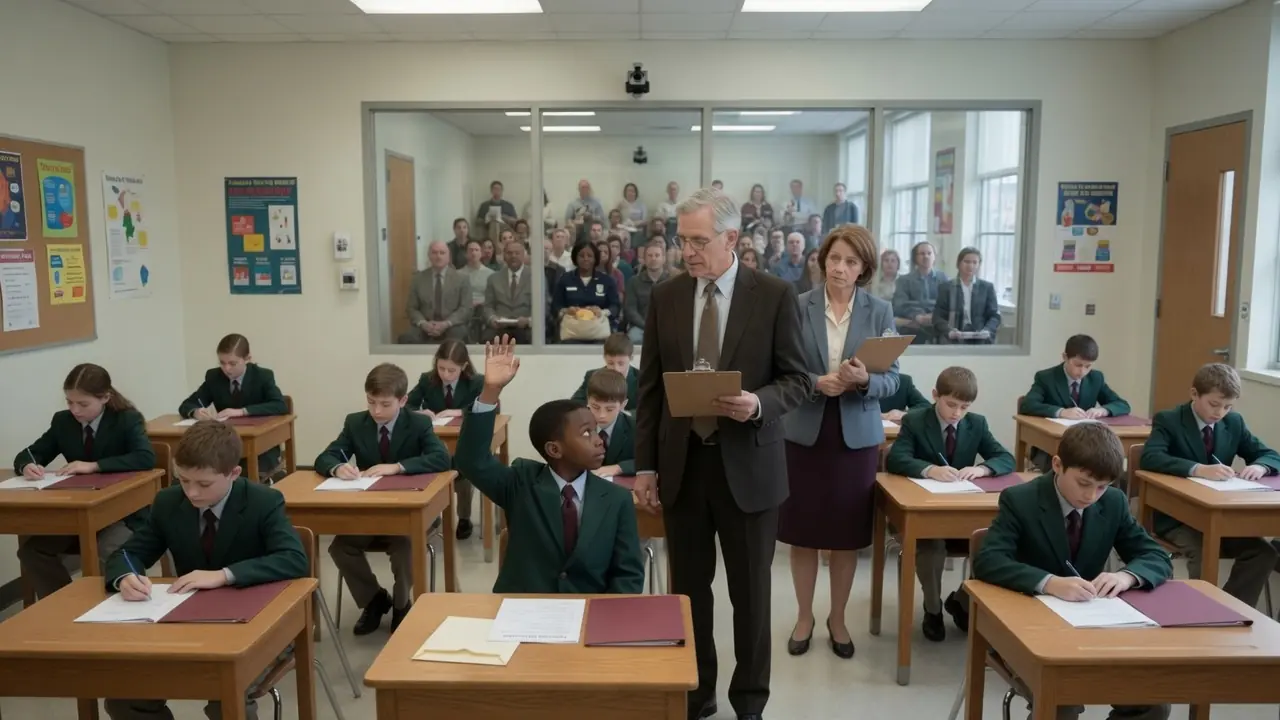
Gregory Thornfield said it the way a man comments on the weather. The four other children at the four other desks pretended very hard to be reading their first problem. The ten-year-old in the navy blazer kept his hand in the air.
The blazer was two sizes too large in the shoulders. His mother had folded the cuffs back at his wrist that morning in their kitchen at 5:15 a.m.
Thornfield walked over. He crouched. He patted the boy’s head twice. The second pat was longer than the first.
“Try not to cry on the paper, kiddo. Cameras go live in three minutes.”
Vice Principal Marin Sutcliffe found something fascinating on her clipboard.
Nobody in that room had any idea what the small Black boy in the secondhand blazer was about to do with the next fifteen minutes of his life.
6:22 a.m. The Massachusetts Transit Authority Depot on Albany Street.
Naomi Mosley clocked out from her overnight shift. The dispatch supervisor on duty was a man named Foley, who had been giving her the harder routes for nine years and pretending it was the rotation.
She handed in her route sheet. She did not look at him. He did not look at her.
In the women’s locker room behind the dispatch office, she did not change out of her uniform.
She had thought about it on the drive in and had decided against it. The blazer she had pressed for the morning was hanging in a garment bag in the back of the car.
If she changed out of the uniform now, she would have to change back into it for the second shift this afternoon, and she did not have the time or the energy to do both.
She would wear the uniform to the school. She would wear the badge.
They could decide what to do with that.
She splashed water on her face at the long row of sinks. She looked at herself in the mirror for one second.
She did not look for any longer than that.
She had been a single mother for nine years, and she had learned somewhere along the way that mirrors had a way of asking questions a tired woman did not have the time to answer.
In the car, she ate a piece of cornbread out of the plastic container she had baked at 4:00 a.m.
She did not finish it.
She left the rest for Theo.
6:55 a.m. The apartment on Wendover Avenue.
Theo was already dressed when she came in the door. The blazer she had pressed the night before, the white shirt, the borrowed tie, the dress shoes Naomi had polished on the kitchen floor at 11 p.m.
He was sitting at the kitchen table with the stapled photocopy in his hands.
The one with the coffee-stained corner. The one he had been reading for two years.
“Baby, you didn’t sleep.”
Naomi sounded concerned just like any mother would.
“I slept some.”
Tiredness still presented in his voice.
“How much?”
Naomi’s eyebrows furrowed.
“Enough.”
He folded the photocopy and slid it into the inside pocket of his blazer.
Naomi watched him do it. She did not tell him not to bring it. She did not tell him it was strange to bring a paper into an exam room.
She had stopped, three years ago, telling her son what was strange to bring with him into a room.
She set the plastic container of cornbread on the table.
“Eat. You need something in your stomach.”
He took a small piece. He chewed it slowly.
He did not look at her exactly, but he was aware of her the way a person is aware of weather.
She had not slept either.
She had come home, baked the bread, dressed for work, and gone back out into the dark.
She crouched to retie his shoe. The lace had come loose on the drive over.
She knotted it twice, once the regular way and once the second knot she had taught him when he was four.
He did not need her to tie his shoes anymore.
They both knew this.
She tied it anyway.
On the way out at the door, she stopped him with a hand on his shoulder.
She straightened his tie. She brushed something off his lapel that was not there.
She did the three small things mothers do when they cannot say the thing they actually mean.
Then she opened the door.
The hallway smelled like the upstairs neighbor’s bacon.
The elevator was broken again.
They took the stairs.
8:22 a.m. The marble lobby of Ardmore Preparatory Academy.
Their shoes made two different sounds on the stone. Theo’s dress shoes clicked. Her transit work flats padded, with a thin line of bus-stop mud still on the right heel.
A donor in a tuxedo passed them. He looked at Naomi’s transit badge still clipped to her collar and then at the floor in front of him.
He kept walking.
That was the glance.
The brass plaque on the east wall held twenty-seven names. Twenty-seven years of Halverson Excellence Fellowship winners.
Theo watched her read them.
He did not need to ask what she was looking for or whether she had found it.
She crouched down. The corner of his kindergarten photo laminated onto her transit badge caught the lobby light.
“Theo, look at me.”
He looked up.
“I was proud of you before you walked in here this morning. I’ll be proud of you when you walk back out. Nothing they do in that room changes that.”
A burst of laughter from somewhere down the corridor reached them and faded.
“You hear me?”
He nodded.
She kissed the top of his head.
She did not watch him walk in.
The Halverson Excellence Fellowship was the most coveted academic prize for a fifth grader in New England: eight years of mentorship with a sitting MIT professor, a $200,000 education trust, and a name on the lobby plaque for as long as the building stood.
In twenty-seven years, no Black child had ever won it.
This year, every page of every exam was being projected on a fifteen-foot screen above the public auditorium stage, live page by page.
Three hundred people sat in the hall.
Parents, donors, five MIT observers in the second row, James Conroy from the Boston Globe, Beatrice Stradling, the foundation chair, and Dr. Penelope Brennan, chair of the examination panel.
Naomi sat in the third row, tote bag on her knees.
Gregory Thornfield walked into the exam room at 8:53 a.m. with five envelopes, four maroon, one cream.
The exam room held five desks in a half circle. A camera above each desk fed the live broadcast.
Thornfield walked the half circle.
“Miss Whitcomb. Master Voss. Miss Pruitt. Master Faulk.”
A nod for each, the quiet warmth reserved for children whose surnames appeared on hospital donor walls.
He set the cream envelope on the fifth desk.
“Master Mosley.”
He looked at the desk surface as he said it.
Theo waited until Thornfield was back at the proctor’s chair. He glanced at the desks on either side.
Laya Whitcomb had her envelope open. Quadratic equation, standard fifth-grade material.
Henrik Voss, the same. Pruitt and Faulk, the same.
Theo opened his envelope.
Problem one was a limit. Problem two was a derivative. Problem three was integration by parts. Problem four, a continuity proof. Problem five, a convergence question about operator sequences in a Hilbert space.
It was a college sophomore final exam.
He read the cover page itself, not just what was printed on it.
Wrong watermark. Wrong margin width.
And in the bottom right corner of page one, in faint gray ink: MP-2003-S2-04.
Ardmore’s internal exam serials had begun with the prefix AP for forty years. He had verified that himself in the records cabinet two months earlier on a Saturday afternoon when the lobby was empty.
This packet did not begin with AP.
The institution stamp on the cover had been scraped off with something, a thumbnail maybe.
Whoever did it had thought about the stamp.
They had not thought about the serial.
He raised his hand.
The first head pat had happened then.
The microphones above his desk caught the sound of palm meeting hair twice, the second time longer than the first.
The red light on the camera turned on at 9:03.
The screen above the public hall stage filled.
Three hundred faces lifted to it at once.
Naomi gripped both straps of her tote bag.
She did not understand calculus.
She understood the geometry of her son’s posture, and she understood that for the first ninety seconds of the live feed, he did not write.
He read the whole exam before he touched the pencil.
In the fifth row, a woman with a pearl and onyx brooch, Laya Whitcomb’s aunt, leaned toward her sister.
“This is what happens when you let them in for optics. They take the seat. The skill is somebody else’s problem.”
She did not lower her voice enough.
Naomi heard her.
Her shoulders did not move.
In the second row, Dr. Mira Lensky, who held a chair in operator theory at MIT, was watching Theo’s head tilt to one side.
She had stopped pretending to take notes.
At the two-minute mark, Theo set the pencil down.
He stared at the ceiling for three seconds.
Problem two had a contradiction.
Continuous on the closed interval from zero to one. Derivative equal to 1/x.
1/x is undefined at zero.
The two conditions could not both be true.
It was the kind of error a senior calculus student might catch on a careful third pass.
He decided the order.
Three first, then one, then four, then two in both versions, then five last, because five was the one that mattered.
He began to write, round, even, careful.
The handwriting of a child told his whole short life that his work had to be twice as clean to be considered half as good.
At the six-minute mark, Theo raised his hand.
Thornfield exhaled with the patience of a man being interrupted at dinner.
He walked over.
“Yes, Master Mosley. Restroom?”
Theo kept both hands folded.
“Sir, problem two has an internal contradiction.”
He looked directly into Thornfield’s eyes, the way someone does when they are absolutely certain about what they are saying.
“The function can’t be continuous on the closed interval and have a derivative of 1/x. 1/x isn’t defined at zero. I can solve both versions. I just wanted to know which the panel will accept.”
The microphone caught every word.
Naomi did not breathe.
Thornfield’s smile did not move. His eyes did a half-second flick toward Sutcliffe, then back.
“Master Mosley, if a problem appears to exceed a candidate’s ability, the honest answer is to write cannot solve. I won’t reward creative excuses.”
A pause.
“That’s not what this fellowship is about.”
In the panel section, Dr. Brennan opened her own copy of the exam packet.
She read problem two.
She made a small mark in pencil next to it.
Two rows behind her, James Conroy circled the words both versions three times in his notebook.
“I can solve it, sir. I’m only asking which version the panel will accept.”
Thornfield walked away.
In the second row, Dr. Lensky’s hand had moved to the bridge of her nose.
She did not let go for almost a minute.
By the eight-minute mark, Theo had finished problem three and problem one.
Thornfield stopped deliberately behind Theo’s chair.
“Master Mosley, from this point forward, I want every algebraic step on the page. No shortcuts. If I can’t see the work, I won’t count the answer.”
A pause.
“That standard applies to you exactly as it applies to anyone else.”
Sutcliffe studied her clipboard.
She had been studying it for forty minutes.
Thornfield had not asked Whitcomb to show her algebra. He had not asked Voss to annotate his polynomial.
He had asked the one Black child in the room.
Theo gripped the pencil a quarter inch tighter and started writing smaller.
Every substep, every theorem he invoked, he annotated in the margin.
By the chain rule.
By the fundamental theorem.
The projector technician adjusted the live feed zoom twice to keep up.
In the second row, Dr. Lensky said one word out loud into the row in front of her, to nobody in particular.
“Christ.”
In the fourth row, a small girl in a cream-colored dress turned to her father and tugged on his sleeve.
She had a question.
He bent down. She whispered it into his ear.
He looked at the screen and back at her and answered the question.
The girl turned her face back to the boy on the screen and did not tug on the sleeve again for the rest of the morning.
What she had asked her father in a whisper at the eight-minute mark of the live broadcast was, “Daddy, why does the man not want him to win?”
To understand what was about to happen at minute eleven, you have to understand two afternoons.
The first one: Dudley Street Public Library, two years ago, October.
The kind of Saturday afternoon when the sun comes through the high library windows in long yellow rectangles on the carpet.
Theo, eight years old, was in the return-bin corner.
His mother had picked up a fourth bus shift that week to cover a winter coat, and she was an hour late, which meant he had been at the library since one.
The head librarian, Mrs. Whitaker, no relation to anyone in this story, had stopped trying to tell him he could not read the donated college textbooks from the back shelf.
She brought him a glass of water at three.
She did not say anything when she set it down.
In the return bin between a paperback mystery and a children’s picture book, Theo found a stapled photocopy.
The corner had a brown circular stain from a coffee cup.
The title page read, “Tensor Decomposition in Hilbert Space Operators, by G. Thornfield and R. Calicott, 1998, Journal of Functional Analysis.”
He took it to the table.
He read for twenty-three pages before he understood that he did not understand any of it.
He read for another fifteen pages before he understood that he understood the elementary lemma in chapter two completely.
He read those four paragraphs in chapter two three more times, until he could close his eyes and see them.
Naomi came in at 4:12. She was still in uniform. She had cornbread crumbs on her sleeve from her break.
“Baby, you ready?”
He held up the photocopy.
“Can I take this home?”
She looked at the title page.
She did not understand it. She had stopped, two years ago, asking what the words on her son’s pages meant.
She nodded.
He folded the photocopy and put it in his backpack.
It went into the top drawer of his desk that night, and it stayed there for two years.
The second afternoon: Sunday, two nights before the Halverson exam, 4:11 a.m.
Naomi had come home from a double shift. The kitchen smelled like burnt coffee Theo had tried to make himself and given up on.
Around him on the table were photocopied old exams, three legal pads, and the stapled paper with the coffee-stained corner.
“Baby, it’s four in the morning.”
“Mom, I think they’re going to try something on Tuesday.”
She set her bag down.
She pulled out the chair across from him.
“Why?”
“Because Mr. Thornfield doesn’t lose. I read his last six published papers this week. He doesn’t lose.”
She did not tell him he was imagining it.
She had watched her son watch the world for ten years.
She had learned to trust what he saw before he could say it out loud.
“What do you want to do, baby?”
“I want to be ready.”
She nodded.
She put on a fresh pot of coffee.
She opened the first container of cornbread of the week and set a piece on a saucer in front of him.
She did not understand a single equation on the table.
She understood her son.
At minute eleven, Theo turned to problem five.
Problem five asked for a convergence proof. To solve it cleanly, the candidate needed an intermediate result, a small technical lemma that was not stated anywhere in the exam packet.
The only way to know the lemma was to have read a specific paper.
The paper had been published in 1998.
The first author was the man at the back of the room with his arms crossed.
Thornfield was, for the first time in twenty minutes, relaxed.
He was as certain as he had ever been that no human under the age of twenty in North America had read his 1998 paper.
He was wrong.
Theo did not try to reproduce the entire proof from memory.
He had not memorized the entire proof.
He was ten years old. He had been awake since 4:00 a.m.
And a sixty-page paper on functional analysis is a long thing.
He wrote what he had. He set up the problem cleanly. He invoked the lemma where the lemma needed to be invoked.
And then, at the line where the final step of the proof would normally appear, his pencil stopped.
He sat there for one breath, maybe two.
He wrote in the margin in handwriting so small the camera technician had to zoom one more notch.
Step requires Lemma 2.3 per Thornfield and Calicott, 1998. Citation provided. Full step not reproduced from memory. Recommend panel verify against published proof.
It was honest.
It was clean.
At the panel table, Dr. Brennan had her own auxiliary monitor mirroring each candidate’s projection.
She read the margin note.
She lifted her head and looked directly at Thornfield across the room.
Thornfield did not see the look.
At 9:18, Theo set the pencil down.
None of the other four children had finished problem one.
He stood up. He walked the packet to the panel table and set it down in front of Dr. Brennan.
He bowed his head slightly the way his mother had taught him to greet grown-ups and walked back to his desk.
Naomi pressed both hands to her face.
Her tote bag slid off her lap.
Thornfield crossed the room in four long strides.
“Already, then? It’s wrong. Every page.”
He reached for the packet.
Dr. Brennan’s hand reached it first.
“I’ll grade this one, Gregory.”
Her palm stayed flat on the cover.
Thornfield’s fingers hovered an inch above her wrist, then withdrew.
She opened the packet.
She read the cover page.
In the doorway, Sutcliffe finally lifted her head from the clipboard.
Whatever she had been pretending to read on the page was no longer interesting enough to pretend about.
Brennan’s voice, when it came, was not quite steady.
“Gregory.”
A pause.
“This isn’t an Ardmore exam.”
She turned the packet so the cover faced him.
“This is the Real Analysis II packet from Merit Polytechnic from 2003. I taught from this packet. I helped write it.”
She stopped.
She did not finish the sentence she had started.
Three hundred people in the public hall made the same sound at the same time.
It was not a gasp.
It was the noise a room makes when it realizes it has been watching one thing and was supposed to be watching another.
Thornfield did not deny it.
He pivoted.
“If the examination materials are in question, and that is a serious allegation,” his voice caught on the continent, “then the result of this morning is invalid. We cannot, in good conscience, award a fellowship of this magnitude on a contaminated test. Master Mosley must be re-evaluated orally on the public stage in twenty minutes, or his candidacy is regrettably forfeit.”
A pause aimed at the donors in the front row.
“This isn’t about the boy. This is about the integrity of an institution that has stood for seventy-two years.”
By the rules of the Halverson Foundation written in 1956, Thornfield had the right to demand it.
Dr. Brennan stepped off the panel platform and found Theo at the side entrance.
She crouched on one knee.
“Theo, listen to me. You can say no. You don’t owe this room anything. We settle this with a board vote tomorrow. You go home with your mother right now.”
He looked past her shoulder.
Third row, navy coat, transit badge.
“Twenty minutes in the study room, then I’ll go up.”
In the study room next to the auditorium, Naomi opened the tote bag.
She set the cornbread on the small table.
She broke a corner off a piece and held it out.
Theo took it.
He did not bite.
“Mom, what if I lose?”
She looked at him for a long time, long enough for the cornbread in his hand to cool.
“Theo, I was proud of you before you walked in this morning. I’ll be proud of you when we walk out tonight.”
Outside in the corridor, a donor in a tuxedo passed without looking in.
“The man on the stage, the panel, the brass plaque, that is their business. Walking out of this building on our own two feet is ours. You go up if you want to. You stay down here if you want to. Either way, we eat lunch after.”
A soft knock.
Dr. Brennan let herself in.
“Theo, what is Gregory Thornfield best at?”
“Tensor decomposition. Hilbert Space Operators, 1998.”
Brennan nodded once and walked out.
Naomi picked up the cornbread again.
“Eat it. You’re going to need steady hands.”
He ate it.
At 9:43, the hall was fuller than at 9:03.
Faculty from neighboring buildings had crossed the quad. Two more reporters had slipped in.
Thornfield walked to the lectern.
“To resolve any irregularity, Master Mosley will solve one problem of my choosing on the board in twenty minutes. We begin now.”
Theo walked toward the stage.
He stopped on the bottom step.
He did not climb the rest.
“Sir, I’ll do it.”
A beat.
“On one condition.”
Thornfield’s smile sat on his face like a tooth that had been loosened.
“Name it.”
“If I solve your problem in the time you give me, you grade my original written exam in front of this hall. Page by page. Live.”
Thornfield could not refuse.
He swallowed once.
The microphone caught it.
“Agreed.”
Gregory Thornfield turned to the whiteboard and wrote a problem in deliberate, sweeping strokes.
It was a senior-level tensor decomposition.
To anyone in the audience who knew the field, it was unmistakably the central application of his 1998 paper.
Theo walked up to the board.
He did not pick up the marker.
He turned his back to the board and faced the audience, his hands folded behind him.
“Before I solve this, I’d like to say one thing for the record.”
A pause.
“This is not a random problem. This is the central application of a paper called Tensor Decomposition in Hilbert Space Operators, published in 1998. The first author of that paper is the gentleman standing right there.”
He turned his head slowly until he was facing the back of the auditorium.
Three hundred faces pivoted in a single motion.
Theo picked up the marker.
He did not solve the whole problem.
He worked through the structural setup, identified the form of the decomposition, and built the proof to the point where the central operator inequality became visible on the board.
He stopped.
He capped the marker.
He turned to the audience.
He took one breath.
He glanced once at his mother in the third row.
“I’m ten years old. I can’t reproduce a six-month paper on a board in twenty minutes. Nobody can. But I can tell this room what the problem on this board is asking. I can tell this room the form of the solution. I can tell this room which paper it came from. And I can tell this room,” he turned to Thornfield, “that I knew what was on the board before I walked up to it.”
He set the marker down.
In the second row, Dr. Lensky had stopped breathing.
She remembered to breathe.
Her hand was over her mouth.
Theo walked back to the panel table. He picked up his original written exam packet.
He carried it onto the stage.
He placed it on the lectern in front of Gregory Thornfield with both hands.
Theo looked at the projector technician.
“Bottom right corner of page one. Could you bring the camera in, please?”
The technician obeyed.
The screen filled with a single faint printed string.
MP-2003-SR-2-04.
For three full seconds, the hall did not understand.
Then James Conroy, who had been on his feet for twelve minutes, took two steps forward.
“Ardmore exam serials begin with AP. This one begins with MP. Merit Polytechnic. Real Analysis II, spring 2003, exam number four.”
He paused.
He turned to face the audience.
“The stamp on the cover was scraped off with a thumbnail. The serial in the margin wasn’t.”
In the front row, two of the donors Thornfield had been laughing with thirty minutes earlier studied the carpet between their shoes.
Dr. Brennan rose from the panel table.
“Mr. Thornfield, will you confirm into this microphone, on the record, that Master Mosley’s solutions to the four problems he completed on the written exam are mathematically correct, and that his work on the fifth shows full comprehension of the question?”
Thornfield’s jaw worked.
He looked at the microphone the way a defendant looks at a witness stand.
“Yes.”
“Louder, please.”
“Yes, the work is correct.”
Three hundred people exhaled at the same time.
In the third row, Naomi pressed both hands to her face and bent forward in her seat.
The Halverson Foundation board did not need ninety minutes.
It did not need ninety seconds.
The serial code was on the screen behind them. Brennan’s testimony was on the record. Thornfield’s confirmation was on the record.
Beatrice Stradling polled the board.
The fellowship was awarded to Theodore Mosley.
Unanimous.
Gregory Thornfield was stripped of any future role with the foundation.
Unanimous.
The chair of Ardmore Preparatory’s board of trustees, Marguerite Easterbrook, requested his resignation letter on her desk by 5:00 p.m.
The fellowship was renamed by acclamation.
From this morning forward, it would be called the Halverson-Mosley Excellence Fellowship.
In the front row, a man named Walter Peyton Hale, fourth-generation Boston, sixty-eight-year-old principal of a philanthropic family that had given the Halverson Foundation just under two million dollars over the last fifteen years, turned to his lawyer in the seat beside him and said very quietly, “Two words. Pull it.”
His lawyer did not ask what.
The lawyer understood.
He took out his phone.
By the time the applause ended, two of the seven major Halverson donors had instructed their family offices to suspend further gifts pending what one of them, in an email at 10:11 that morning, called a complete review of institutional culture.
A third, the one Thornfield had been laughing with in the hallway thirty minutes earlier, did not pull anything.
He doubled his pledge for the coming fiscal year and asked in writing that the increase be earmarked for the new Halverson-Mosley Fellowship’s scholar mentor stipends.
He did not put his name on the gift.
He asked again in writing that it be anonymous.
Peyton Hale’s family office reinstated their gift four months later after a closed-door meeting that nobody who attended ever discussed publicly.
By 11:00 a.m., the clip of Theo’s “I knew what was on the board before I walked up to it” had been shared on social media platforms eighty-two thousand times.
By noon, the number was one hundred ninety thousand.
By 3:00 p.m., the foundation’s communications director, a woman who had taken the job in 2022 precisely because the Halverson Foundation never made the news, had received fourteen interview requests, six podcast invitations, and a voicemail from a producer at 60 Minutes who said she was prepared to fly to Boston that evening.
The producer did not fly to Boston that evening.
The Mosley family had requested through Dr. Brennan as an intermediary that they not be contacted directly until Monday.
The request used the word please three times.
The producer waited until Monday.
Gregory Thornfield walked out of the auditorium through the side door at 9:58 a.m.
The side door opened onto a service corridor that ran the length of the east wing.
Linoleum floor. Fluorescent lights, two of which had started flickering the previous winter and had not been replaced. A janitor’s cart parked against the wall.
The smell of industrial floor wax and the cafeteria’s breakfast service from three doors down.
He walked twenty-two paces.
Then he stopped.
He did not stop because he had reached a destination.
He stopped because his legs decided, without consulting the rest of him, that they had carried him far enough.
Behind him, through the closed door, he could hear the sound of three hundred people standing up.
The applause did not start at once.
There was a beat of silence first, three, maybe four seconds, and then the clapping began.
It built.
It did not crest.
By the time the sound reached the door, it was already steady.
The kind of applause that does not stop because nobody in the room wants to be the first to stop.
He looked down at his hands.
The right hand, the one that had patted the boy’s head, was trembling.
The left hand was not.
He had spent thirty-eight years at Ardmore Preparatory. He had co-authored a paper that had been cited approximately twelve hundred times. He had served on six committees.
He had been called Gregory by three sitting United States senators at fundraising dinners.
In the corridor alone, he was not called anything.
Halfway down the corridor, the door to a supply closet was open.
A janitor was inside restocking paper towels.
She did not look up when he passed.
He had walked past her, by his own estimation, at least three hundred times in the last nineteen years.
He had no idea what her name was.
He had never asked.
He took the back stairwell to the parking lot.
He drove home.
He did not return to the building.
Dr. Brennan invited Theodore Mosley up to the podium one last time, not to solve anything, just to speak.
Theo walked up.
There was a small wooden box behind the lectern left over from the morning’s rehearsal.
He stepped onto it so his head cleared the microphone.
In his right hand was the piece of cornbread his mother had given him in the study room.
He set it down on the corner of the lectern where the camera could see it.
He looked out at the hall.
He did not have notes.
“I didn’t beat anyone today. I read a paper and I remembered it and I showed my work.”
A pause.
He glanced once at the third row.
“My mother drove a night shift last night. She traded another shift to be here this morning. She baked the bread on this lectern at 4:00 a.m.”
He stopped.
He looked down at the cornbread.
He looked back up.
“She is the reason I knew every day of my life that somebody was already proud of me.”
He picked the cornbread back up.
“Please clap for her.”
The hall stood.
All three hundred.
They turned in a single motion to face the third row.
Naomi Mosley shook her head. She put a hand up.
They did not stop.
She stood last, slowly, one hand against her mouth, the other clenched around the strap of her tote bag like it was the only thing keeping her connected to the floor.
James Conroy raised his camera.
He took the photograph that ran on the front page of the Sunday Boston Globe, two columns wide above the fold, under a single line of type: A Mother Standing.
The applause did not end.
It changed shape.
At some point, Theo could not have said exactly when, Dr. Brennan put a hand on his shoulder and guided him gently off the stage, down two steps into the wings, where the curtains were heavy and dust-smelling, and the noise of the hall came through them as a single sustained pressure rather than as sound.
Naomi was already there.
He did not know how she had gotten there.
She was just there the way mothers are always just there.
She did not say anything.
She did not have to.
She put her arms around him, and she held him the way she had held him at the bus stop when he was four, when he had counted down past zero into negative numbers.
She had not understood what he was doing, but she had understood that whatever it was, it was his.
He pressed his face into the navy coat.
The coat smelled of cornbread and of diesel fuel from the depot and of the laundry detergent she had used since he was six.
It smelled, in other words, of home, which is to say, of the only place in the world where Theodore Mosley had ever been allowed to be exactly as much as he was, and not a single decimal less.
He did not cry.
He had not cried all morning, and he was not going to start now.
He just stood there for a long time with his face in the coat, while three hundred people in an auditorium he could not see clapped for a woman who could not hear them through the curtain.
Sunday, 6:12 a.m.
The kitchen on the third floor of the apartment building on Wendover Avenue smelled like coffee and cornbread.
The window over the sink looked out onto a row of brownstones and the back end of a city bus stop.
The Sunday Boston Globe was on the kitchen table.
Theo had run downstairs in his pajamas to get it from the lobby the moment he heard the delivery thump.
Naomi was still in her transit uniform.
She had worked the overnight Saturday into Sunday shift. She had come home at 5:45.
She had not yet taken her badge off.
She unfolded the front page.
She set it flat on the table.
Above the fold, two columns wide, was the photograph: her hand at her mouth, her transit badge legible on her collar, her tote bag held tight against her side.
The blur of three hundred people standing behind her was indistinct.
She looked at it for a long time.
Theo watched her look at it.
She did not cry.
She had cried in the auditorium and she had cried in the car on the way home, and now she was, for the moment, finished.
“They got the badge in the picture.”
Theo nodded.
She turned the page.
The article continued on page seven.
She read it twice.
The article was twenty-three column inches long.
The first paragraph quoted Theo’s “I read a paper and I remembered it” line.
The second paragraph quoted the woman with the pearl and onyx brooch, not by name, just as an attendee in the fifth row.
The article did not editorialize on the quote.
It did not need to.
The quote sat in the second paragraph the way a smudge sits on a clean window.
The seventh paragraph was about Naomi.
The article called her Mrs. Mosley, which she was not because she had been Miss Mosley for nine years.
She did not write a letter to the editor.
She would later that month write one.
She did not write it for that.
He noticed the second time she read the article that her hands shook very slightly on the corners of the page.
He had not seen them do that since the morning his grandmother had passed away three years ago, on the other end of a phone call she had taken standing up in the kitchen.
He did not say anything.
He pretended briefly to be very interested in his juice glass.
She folded the paper.
She set it on top of the toaster where it could not be easily knocked into a coffee spill.
At 6:41, Theo’s laptop pinged from the bedroom.
He went and got it.
He brought it back to the kitchen table.
He opened the message in front of his mother.
The sender’s address ended in @mit.edu.
He did not recognize the name on the account at first.
Then he did.
“Mom.”
“Yes, baby?”
“It’s one of the MIT observers from yesterday. The one in the second row. She runs a research group in operator theory. She’s asking if I’d want to sit in on her graduate seminar this spring as an auditor. She says she’ll arrange transportation.”
He read further down.
“She says she wants to meet on Wednesday.”
Naomi did not say anything for a moment.
She got up. She walked to the toaster. She picked up the folded newspaper.
She brought it back to the table and set it down between them.
She put one hand on the newspaper.
She put one hand on the laptop.
“This,” she said with her left hand on the paper, “is what they did yesterday.”
She lifted her right hand from the keyboard.
“This is what comes next.”
She reached across the table and put her hand on the back of his.
“You ready, baby?”
Theo looked at the photograph of his mother on the front page. He looked at the email. He looked at the cornbread on the counter.
“Yeah, Mom.”
A pause.
“I’m ready.”
At 7:06, the kitchen phone rang.
The kitchen phone almost never rang.
The kitchen phone was a beige plastic landline mounted on the wall next to the refrigerator that had come with the apartment in 2021, and that Naomi had kept on the line because her mother in Charleston refused to learn how to use a cell phone.
Theo got it on the second ring.
It was Mrs. Adelaide Peterson, his second-grade teacher from the public school in Roxbury.
The one who, three years ago, had walked Naomi out to the parking lot after a parent conference and told her quietly, in a voice that was almost an apology, that her son’s mind was a thing that needed to be protected and that the public school system was not the place to protect it.
Mrs. Peterson had been the one who put Theo’s name forward for the Ardmore scholarship interview that fall.
He had not spoken to her in eighteen months.
He listened.
He said, “Yes, ma’am.”
And, “Yes, ma’am.”
And, “One moment, please.”
Then he held the phone out to his mother.
“Mom, it’s Mrs. Peterson.”
Naomi took the phone.
She listened for almost two minutes without saying anything.
She nodded twice.
She said at the end, “Thank you, Adelaide. I’ll tell him. Yes, yes, I will. Thank you for calling.”
She hung up the phone.
She did not move from the wall for a moment.
“What did she say, Mom?”
“She said she saw the front page.”
Naomi did not answer right away.
She walked back to the table.
She sat down.
She put her hand back on top of his.
“She said she always knew.”
2:00 p.m. The Massachusetts Transit Authority Depot on Albany Street.
Naomi clocked in for the second-shift rotation.
She wore the same uniform she had worn that morning.
She had not taken the badge off.
Foley, the dispatch supervisor, was off rotation that afternoon.
The supervisor on duty was a woman named Rebecca Chen, who had been a friend of Naomi’s for six years and had covered her shift on the day of the Ardmore exam without asking why she had wanted it.
Rebecca did not say anything when Naomi clocked in.
She handed her the route sheet.
Route 28.
The same route Naomi had been driving for nine years.
The route that went past the Dudley Street Public Library four times in each direction over the course of an eight-hour shift.
Naomi looked at the sheet.
“Becca, you gave me 28.”
“I gave you 28.”
“It’s not my rotation this week.”
“It is now.”
Naomi looked up.
Rebecca did not say anything else.
She did not have to.
She was already walking back to dispatch.
Naomi drove Route 28 that afternoon, past the library eight times.
Fifteen minutes.
That was the time.
Not because Theodore Mosley was a genius, though he was, but because he had been preparing his entire short life for a room that was not ready for him.
The brass plaque in the Ardmore lobby reads Mosley this year, and the year after, and the year after that.
Three blocks away, on the third floor of a walk-up on Wendover Avenue, a mother in a transit uniform put the Sunday paper on the toaster and asked her son if he was ready for what came next.
He was.
He had been ready for ten years.
They tried to make him fall.
They are the ones still falling.
The boy did the math.