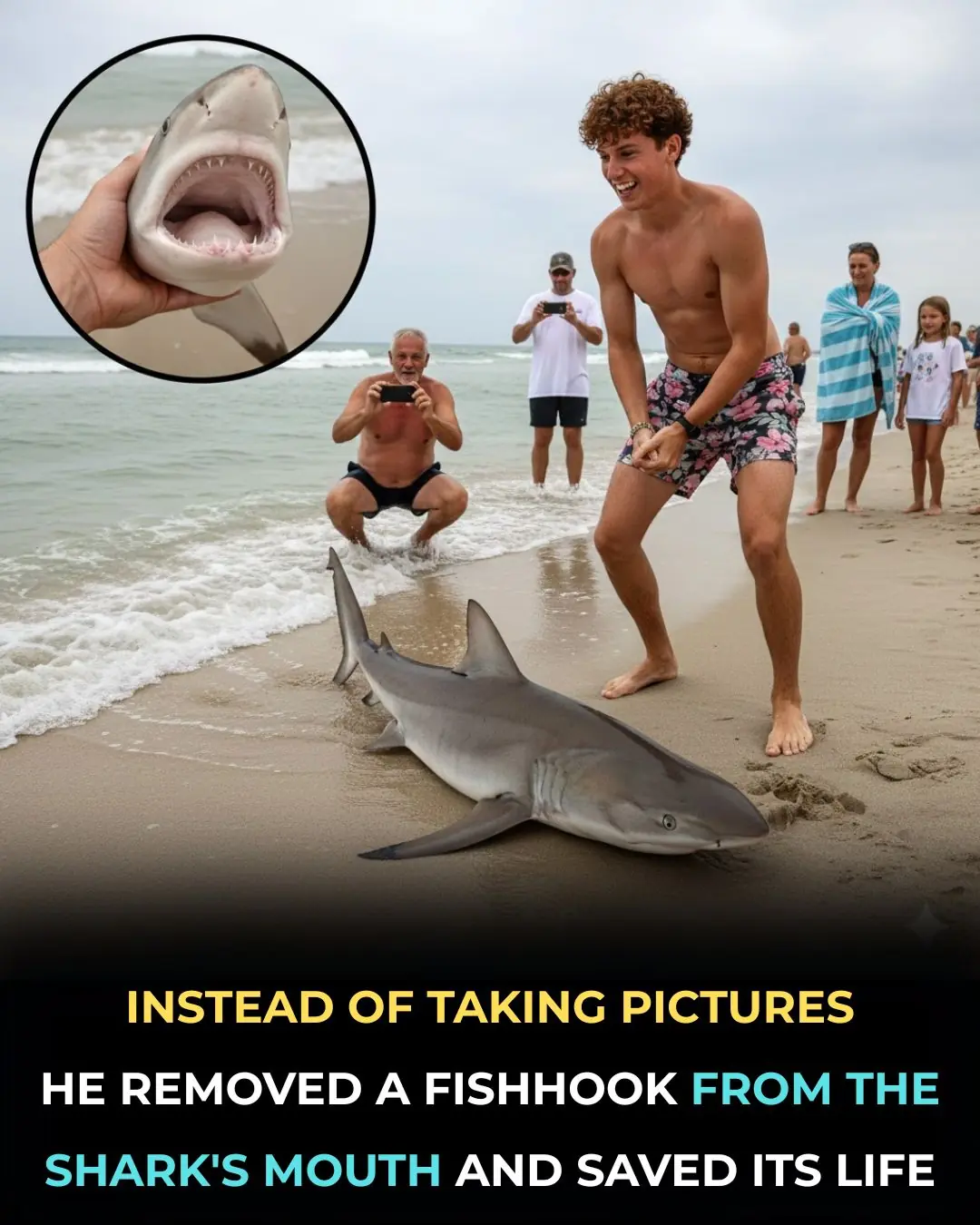
Choosing Compassion Over Cameras: A Young Man Saves a Shark by Removing a Fishhook
News 17/01/2026 21:49
The Greenland shark (Somniosus microcephalus) is considered one of the most mysterious and long-lived creatures in the ocean. According to scientific research, some Greenland sharks alive today may be over 400 years old, meaning they were born around the year 1620 and are still swimming in the cold, deep waters of the Atlantic Ocean. This astonishing discovery has transformed our understanding of animal longevity and marine biology.
Greenland sharks inhabit the deep, icy waters of the North Atlantic and Arctic Oceans, often at depths of more than 2,000 meters. Due to the extreme cold and darkness of their environment, these sharks grow extremely slowly—on average less than one centimeter per year. This slow growth rate is believed to be a key factor contributing to their exceptional lifespan.
In 2016, a groundbreaking study published in the journal Science used radiocarbon dating of eye tissue to estimate the age of Greenland sharks. Researchers analyzed the radiocarbon levels in the eye lenses of 28 sharks and concluded that the oldest individual was approximately 392 years old, with a possible age range extending beyond 400 years. This makes the Greenland shark the longest-living vertebrate ever recorded by science.
Despite their enormous size—some individuals can grow up to seven meters long—Greenland sharks are not aggressive toward humans. They are slow-moving scavengers, feeding on fish, squid, and even carrion, including the remains of marine mammals. Due to their sluggish nature and deep-sea habitat, encounters with humans are extremely rare.
Another fascinating aspect of Greenland sharks is their delayed sexual maturity. Scientists estimate that they do not reach reproductive age until they are around 150 years old. This late maturity makes the species particularly vulnerable to overfishing and environmental changes, as population recovery takes centuries rather than decades.
Unfortunately, Greenland sharks face increasing threats from climate change, bycatch, and industrial fishing. Rising ocean temperatures may disrupt their cold-water habitat, while accidental capture in fishing gear continues to pose a serious risk. Conservationists stress the importance of protecting this ancient species, as losing them would mean the extinction of a living link to the early modern era of human history.
The existence of a shark that has lived through the rise and fall of empires, the Industrial Revolution, and the modern digital age is a powerful reminder of how little we still know about the deep ocean. The Greenland shark is not only a biological marvel but also a symbol of the ocean’s hidden history—one that has survived for centuries beneath the waves.