The Duke of Lindon agreed to marry the most overlooked woman in London on the kind of wager that a sober man does not make. He was not sober. He was not, however, entirely as drunk as his friends believed. By morning, the wager was in the newspapers. By the end of the week, he had married her. And by the following Thursday, the three men who had laughed loudest at the wager in the smoking room of White's were each discovering, separately and to their great inconvenience, that a woman no lord in London had noticed for three seasons was a woman the whole of London could not now stop looking at.
This is the story of Adair, a bride, a Yorkshire estate that no one at the club had heard of, and a punishment that turned out, by all accounts, to be the best thing that had ever happened to Oliver Redgrave, eighth Duke of Lindon, though it took him rather longer than his wife to say so.
It began in the smoking room at half past eleven on a Tuesday evening in late October, 1824. Oliver had come up from Hertfordshire that afternoon after three weeks of unbroken fox hunting, smelling faintly of damp wool and winter grass, and had allowed himself to be carried along by Lord Bertram Horsley and Viscount Dunmore into an evening that contained rather more brandy than it ought to have. The season was over. The great houses of Mayfair were half shuttered. The club was emptier than it had been in September. And the three of them had claimed the broad leather bench nearest to the fire as though it were a garrison.
Bertram had been losing at piquet. Bertram generally lost at piquet. He compensated for this by making louder and louder observations about the other members, which was a habit his friends endured because Bertram, for all his faults, kept them entertained. At eleven twenty-seven, Bertram's observation was the following. "Lindon, old friend, you have had the most disgusting run of luck this season. I count three heiresses, a widow, and whatever that business at the Conisbrough Ball was."
"Mathematics was never your strength, Bertram," Oliver said without opening his eyes. "I submit," Bertram continued because he had not come to the point yet, "that in the interests of cosmic fairness, you owe the rest of us a disappointment, a visible one, something to shore up the general morale." Dunmore, who was quieter but not more sober, laughed. Oliver opened one eye. "What did you have in mind?"
Bertram sat forward. He had that look he wore when he was about to be clever, which meant that whatever came next would be stupid in a decorative way. "A wager," he said. "You are to marry, by, let us say, the end of next week. The bride is to be the most overlooked woman in London. A lady, of course, gentleman's daughter, not below, but plain, dowryless, the kind of young woman who has sat against the wall for three seasons without being asked to dance. You will propose. You will be accepted. You will marry her by special license, and you will present her at the first assembly of November. If you do, the Irish hunter you admired in my stables last spring is yours. If you refuse, the forfeit is your Irish hunter transferred to me."
"The bay?" "The bay." Oliver laughed. It was a short, reckless laugh of a man who had been a duke too young, was unused to being told no, and had not yet, at eight and twenty, learned to distrust his own laughter. "Witnesses," he said. Dunmore raised his glass. "Present."
Young James Morwood, who was twenty-two years old and had his cousin Henrietta's long memory for the exact words of a conversation, did not interrupt. He finished his single glass of port. He rose quietly twenty minutes later. He walked back to his lodgings in German Street. He wrote his cousin a letter. The letter was delivered to Miss Henrietta Morwood at her uncle's house in Great Ormond Street at seven the next morning along with the second post.
Henrietta read it over her toast. She set the letter down. She picked up her tea. She looked out of the breakfast room window at the thin October sunlight on the plane trees of the square, and she allowed herself, for exactly one minute, to be angry. Then she set the anger aside, where she kept such things, and began to think. Her uncle, the Reverend Dr. Theophilus Morwood, sat opposite her with his Hebrew grammar and did not notice that she had gone very still. The Reverend Dr. Morwood rarely noticed anything about his niece after the first pouring of tea, which was when he considered her part of his morning complete.
Henrietta was twenty-six. She had been in London for three seasons. She had not once been engaged, had not once been in love, and had attended a total of forty-one balls, suppers, musical evenings, and routs without being asked to dance more than thrice at any of them. And those had been charity dances arranged by kindly aunts, which she had learned to decline on principle after the second season. She was not beautiful in the sense that London used the word. She was slender, upright, dark-haired in a plain Yorkshire way, with eyes the color of wet slate, a high intelligent forehead, and a mouth that, when it was amused, could rearrange her whole face into something no one had ever quite cataloged.
Three months ago, her great uncle, Sir Edmund Morwood of Brambling Hall in the North Riding, had died. She had been his only heir. The probate had cleared the previous Tuesday. No one in London knew. She had come to London that particular autumn, after the season, deliberately, to visit her uncle Theophilus and to make certain arrangements privately with the family solicitor at Lincoln's Inn. She was to return to Yorkshire in a fortnight. She would not, under ordinary circumstances, have been at any gathering where the Duke of Lindon might find her. Ordinary circumstances, however, had just altered.
Henrietta took her pen and her pocketbook, and she wrote down, in her very small, scholarly hand, the following. The assembly at Lady Conisbrough's tomorrow evening. The musical soirée at Mrs. Fortescue's on Thursday. And then a third line, underscored once for emphasis. Do nothing. Because Henrietta Morwood was not a woman who charged her own wedding, she intended to let the Duke of Lindon find her. He did.
Lady Conisbrough's assembly, Wednesday evening, a house on the south side of Berkeley Square, a small amateur soprano straining her way through an Italian aria of indifferent provenance, the chairs arranged in uneven rows as though the hostess had not quite decided how many people she wished to insult by inviting. Henrietta sat toward the back in a pewter gray watered silk with a narrow band of crimson at the hem and sleeves. She had chosen the color with deliberation. A woman who is to be overlooked does not wear gray. She wears rose or primrose or pale blue or any of the pastel shades in which a young lady performs invisibility. Henrietta had done her invisibility in pastel for three seasons. She was done.
Tonight, she wore slate, the color of her eyes, with a single thread of blood red silk that said, "I am here. Notice it or do not." A book was open on her lap. She was not reading it. The Duke of Lindon, following her cousin's quietly worded hint, had arrived at twenty past eight. He was wearing a dark green tailcoat over a cream silk waistcoat, buff breeches, polished Hessians. His dark chestnut hair had been trimmed that afternoon. His steel blue eyes, which had been the subject of a great many private speculations in every drawing room within two miles of Hanover Square for the last seven years, were, for the first time in his adult life, looking for one particular woman in a room. He found her inside ninety seconds.
He made his way toward her, not quickly. He was still the Duke of Lindon. He did not hurry through a room for any woman, but without any of the diversionary stops he usually made along the way. He passed Lady Conisbrough with a single polite bow. He passed the Miss Felthams, who rose three inches in their chairs in evident hope. He did not stop. He arrived at the empty chair next to Miss Morwood as the soprano, in a final aria, reached for a high C that had been promised but not, in the event, delivered.
"Miss Morwood," he said. Henrietta looked up from her book. "Your Grace?" "I believe," Oliver said, "we have been introduced. Twice, Your Grace. Once at Lady Forster's in June of '22, once at the Royal Academy in March of last year. On both occasions, you bowed pleasantly and moved on within seven seconds. I timed you on the second occasion out of mild scientific interest."
Oliver stared at her. And then, to his own astonishment, he laughed. Once, briefly, a wholly undignified bark of a laugh that drew the attention of three neighboring dowagers and caused the soprano in her third verse to audibly lose her place. "I am not," Henrietta observed, "doing this for the attention, Your Grace." "I believe you are." "I believe," Oliver said when he had recovered, "I deserved that."
"Deserved is a strong verb, Your Grace." "Earned, perhaps." "Earned, then. May I ask why you are sitting beside me?" She said this entirely without coquetry, looking at him the way a scholar looks at an unfamiliar footnote, with interest but no urgency. Oliver, for the first time in a great many years, felt the effort of answering a woman honestly. "Because," he said, "I've been a fool for three seasons." "That is not in dispute, Your Grace."
"And," he continued, recovering, "because I've been informed by a reliable source that you read Schelling." "I read a great many things, Your Grace. What are you reading this evening?" She turned the book's spine toward him. He glanced. It was a German edition of the Phenomenology, opened to a page in the middle of the discussion of master and servant. "Ah," he said. "Yes," she said.
"Your Grace," she added, after a moment in which the soprano began another aria and several members of the audience visibly considered leaving. "If you have come to sit beside me out of pity, you will oblige me by rising within sixty seconds and wasting no further evening of mine. If you have come to sit beside me for any other reason, I am prepared to hear it." Oliver was silent for a full twenty seconds. He was aware, with an unwelcome sharpness he was not accustomed to, of three separate things. That she was, in fact, the woman he had agreed to marry. That she spoke German to a standard that would humiliate him if he attempted it. And that he had noticed, against all his ordinary filters, the curious fact that her eyes were precisely the color of the Lindon slate roof at dusk in November.
He said, quietly, "Miss Morwood, would you do me the honor of permitting me to call upon your uncle tomorrow afternoon?" Her gaze did not falter. "For what purpose, Your Grace?" "A formal conversation, with his leave." "About what subject, Your Grace?" Oliver inhaled. "About," he said, "whether I might, with your permission, begin the process of paying you a call of rather more than a scholar's interest."
She considered him for another moment. Her face did not change. The soprano, unsupported, stumbled. "You may call, Your Grace," she said. "Tea is at four. My uncle is deaf on his left side. Do not sit at his left or you will waste the afternoon shouting." "Thank you," said the Duke of Lindon. "Your Grace," she said as he rose. "Yes." "Do not," she said, quietly, "undertake this if you are doing it for a wager."
Oliver, halfway to standing, became very still. "I beg your pardon," he said. "You heard me perfectly well, Your Grace. I have the misfortune of a cousin with a good memory who was in the club last night. I will not repeat the word. I will only tell you, plainly, that if this is a continuation of that conversation, we will not have another. And my uncle will not be at home tomorrow at any hour you may name."
Oliver sat down again. He sat for a full minute without speaking. Then he said, very quietly, and with an expression his closest friends would not have recognized, "Miss Morwood, I made that wager. I accepted it. I have come here tonight, tonight in particular, because the wager gave me a reason to look where I should have looked three seasons ago. I have sat beside you for seven minutes. I am no longer making the wager. I am asking."
She studied him. "That," she said, "is a distinct improvement, Your Grace. Thank you. And you will not," she continued, "discharge the wager by pretending that you have not made it. If this proceeds, you will, on our first morning as a married couple, tell me about it in full and in your own words. And we will speak of it together and decide what is to be done about Lord Horsley, who seems to me to have the manners of a boy who has never lost at anything that mattered. Do you understand me, Your Grace?"
"I understand you, Miss Morwood." "Then you may call tomorrow. Four o'clock, my uncle's drawing room. Do not bring flowers. My uncle is allergic to hothouse roses, and I myself am tiring of gentlemen who use them as a substitute for a sentence." Oliver stood. "Miss Morwood." "Your Grace?" He bowed. He walked out of Lady Conisbrough's drawing room, a different man from the one who had walked in. Which was a transformation Lady Conisbrough's soprano could not claim to have produced in anyone else present. He was not, it must be said, yet a good man. But he had just, for the first time in his life, been spoken to as though he could become one.
The Reverend Doctor Theophilus Morwood received the Duke of Lindon at four the following afternoon in his drawing room in Great Ormond Street, seated in his most comfortable chair with his niece to his right, a tea service between them, and a deeply incurious expression on his face, which Oliver had been warned of and which Oliver, within three minutes, began to understand. Doctor Morwood drank two cups of tea, ate three pieces of shortbread, made a single observation about the rainy weather, and mentioned in passing that his niece was a woman of independent judgment, and that he did not consider it his business to manage her on this point, as he had not managed her on any other for some years, and had, he believed, been wise in his neglect. Doctor Morwood then excused himself to his study to resume his Hebrew grammar. Henrietta and Oliver were left alone with the tea service and the light of a gray October afternoon.
He sat forward. He set his cup down. He said, "Miss Morwood, I have thought about nothing since last night." "That is a very short interval, Your Grace." "It is a truthful one." "It is also," she said, "a sentence a great many gentlemen have said to a great many young women in the last seventy years, and it has not, on the whole, been an accurate predictor of anything." "Miss Morwood." "Your Grace." "Will you," he said, "marry me?"
She did not answer immediately. She set her cup down. She folded her hands on her lap in the way of a woman who had rehearsed her answer and was now determining the order of its clauses. "Yes," she said. "I will marry you, Your Grace, upon six conditions." "Name them."
"One. We will marry by special license within seven days, because your wager gives me no better leverage than the present moment, and I intend to use it. Two. You will inform Lord Horsley of the marriage personally before the announcement is printed and in my hearing. Three. We will sign, before the wedding, a settlement that leaves me in full independent possession of any property I currently hold or may later inherit. Four. We will have separate bed chambers in every house we occupy until such time as either of us wishes otherwise, at which point the one who wishes it will ask the other in plain English, and the other will answer in plain English. Five. We will not lie to one another, Your Grace, on any subject of importance, from the smallest domestic preference to the largest political question. And six. I will go to Brambling Hall, my estate in the North Riding, for not less than four months each year, and you will come with me for at least two of those, and you will not complain of the roads."
She paused. "Do you agree, Your Grace?" Oliver, who had come to the house expecting to spend the afternoon persuading her, realized that he had been already accepted, conditionally, and that his remaining task was to assent. "I agree," he said, "to all six conditions." "Then I will marry you, Your Grace." "Miss Morwood." "Oliver." "Henrietta." "That is better."
They married four days later at a parish church in Hanover Square on a damp morning with her uncle, her cousin James, two elderly Morwood aunts, Oliver's valet, Oliver's man of business, and Oliver's groomsman, who was an old Eton friend called Charles Eldridge, not Bertram, not Dunmore, in attendance. She wore ivory silk with a single band of ruby red velvet at the waist, a small lace veil, no flowers, a plain gold band. He wore a dark blue coat and a cream waistcoat, and a cravat that his valet had, for the first time in four years, not had to tie twice. They walked out into the October rain together and climbed into a closed carriage that took them back to Lindum House in Grosvenor Square, where breakfast was served at eleven in the small breakfast room, which faced the garden, and which had, that morning, been laid with white hothouse chrysanthemums, because Oliver had remembered, against his usual run of memory, that she had said nothing against chrysanthemums.
She sat across from him and observed this. She smiled once and did not mention it. She poured the coffee. She said, "Oliver." "Henrietta." "I have three pieces of information for you. I believe this is the appropriate moment, and our settlement is signed, so there is no longer any reason to defer." "Go on."
"My great uncle, Sir Edmund Morwood, died in July. I was his only heir. Probate cleared last Tuesday. I'm in full possession of Brambling Hall, a country seat of some ten thousand acres in the North Riding of Yorkshire, with a stone library that housed his personal collection of Greek and German manuscripts, and an annual income from the estate of seven thousand eight hundred pounds." Oliver's hand, which had been raising a spoon toward his coffee, stopped halfway. "Henrietta."
"I am not," she said mildly, "finished. Please. Second, I have been in London this autumn, after the season, specifically because I had business with my solicitor at Lincoln's Inn. I have no dowry on paper because I did not wish to have one. I do not wish to be married for an income of mine. I do not, in general, wish to be managed." "Understood."
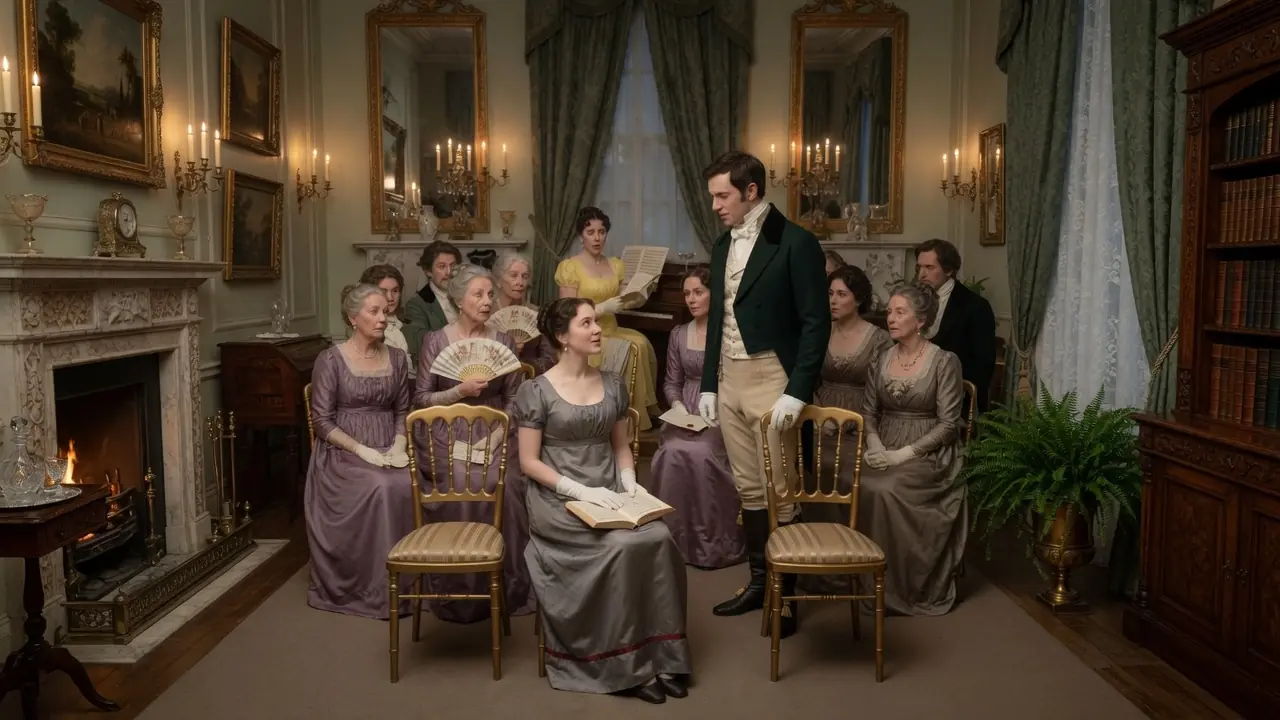
"Third," she drank a small sip of coffee, "I have known about Lord Horsley's wager since the morning after it was made. My cousin James wrote to me. I came to Lady Conisbrough's specifically because I wished to see, with my own eyes, what kind of man you would be when you looked for me. I had determined, before you arrived, that I would accept you if you sat down and spoke to me as a reasonable adult, and decline you if you did not. You sat down. You spoke to me as a reasonable adult within three sentences. You asked for my uncle's leave within seven minutes. Therefore, I accepted."
Oliver was silent for what felt, to him, like a very long time. "Henrietta." "Oliver." "I have been," he said, "profoundly underestimating you." "A great many people have, Your Grace. Do not feel singled out. It is a common error." "Is this a—" He hesitated. "Is this a punishment?" "Oh, no, Oliver." Her eyes did not change, but her mouth, her extraordinary mouth, which he had not yet properly learned to read, rearranged her face. "It is not a punishment. It is a project." "A project?" "Yes." "Of mine or yours?" "Both." "Finish your coffee. We are at home to callers between one and three. I have replied to Lady Conisbrough's card. I expect Lady Farthing's within the hour. We will also, by my reckoning, receive an invitation to your Aunt Augusta's supper by late afternoon. Now, shall we begin?"
They began. The announcement appeared in the Morning Post that morning. By one, Lord Bertram Horsley, who had been asleep until eleven and was hung to the back of his neck, received the news from his valet. By two, Bertram was in a hansom cab on his way to White's to discover what else he had missed. By four, he had begun, in the low, cautious manner of a man testing the room, to suggest to the gentlemen present that the marriage was the consequence of a wager. He did not name the wager. By six, he had named it to three separate men in three separate corners of the club.
By ten, because Charles Eldridge, Oliver's friend and groomsman, had been in the club since eight and had been listening, Oliver received a very quiet note. He read it. He folded it. He put it in his waistcoat pocket. He said to Henrietta, "Horsley is telling them about the wager." "At White's?" "Yes." "Are you going?" "I am." "Do you want me to come?" "No." "Then I will be in the library when you return. Do not, Oliver, strike him. It is not worth the fine, and my aunt will not receive a husband who has engaged in a fight in a club. My Aunt Octavia does not receive anyone who has struck anyone for any reason at any time in her life. She is eighty-four and has never revised the policy." "Noted."
He arrived at White's at half past ten. He did not remove his hat in the entrance. He walked into the card room. Bertram was at the corner table with Dunmore, Pelham, Carstairs, and a dapper young Harrovian called Mowbray, whose opinion, two days earlier, had mattered to no one, and now, somehow, mattered. Oliver did not sit. "Horsley." Bertram looked up. He was an inch shorter sitting than Oliver was standing. This was always the case, and Oliver had always, in his own way, enjoyed it. "Lindon, old fellow. Congratulations."
"Horsley, I have been told that you have, in this room, in the last four hours, informed five gentlemen that my marriage is the consequence of a wager." "I—No, no, that is—" "Do not, Horsley, add the further indignity of a lie to this particular piece of business." Bertram's color rose. Oliver continued in the voice he had used twice in his life, in the House of Lords, and never louder than this. "The wager, to the extent that any wager was made in this room on Tuesday, ended when I walked out of this building at one on Wednesday morning. The marriage that followed was entered into freely and soberly by two persons of age and capacity upon terms which you, sir, have no right to know and no business discussing. I have won, as you yourself witnessed, the bay hunter. It will be delivered to Lindum Park by the end of the week. Any gentleman who repeats, after this moment, the fiction that the Duchess of Lindum is a consequence of a gaming debt, I shall know it from his lips by morning, and I shall deliver the bay hunter to his stables with my compliments and a packet of Horsley's unpaid vowels for bedding."
He did not raise his voice. He did not need to. The silence in the card room was the silence of five gentlemen calculating, in rapid succession, that the Duke of Lindon had just, politely, without striking anyone, burned Lord Horsley to the waterline in front of witnesses, and that the only correct response was to pretend that no such conversation had ever been proposed. Mowbray, the Harrovian, coughed. He said, "Splendidly put, Your Grace." Pelham, who had been loyal to Bertram for nine years, looked once at his cards, once at Oliver, and, with an accuracy of wind reading that did his Eton education credit, said, "I never heard of any wager, personally. Strikes me as the sort of gossip the servants invent." Dunmore, in whose mouth the wager had been toasted four nights earlier, said, "Inclined to agree." Carstairs, more honest, said nothing. Bertram opened his mouth. He closed it. He rose. He bowed, a short, hard bow, and he walked out of the card room with the particular gait of a man who has not decided yet whether he is going to cry. He went, as it happened, straight home.
Oliver stayed at White's for one more quarter of an hour, long enough to drink a single glass of port, accept the Harrovian's evident admiration with a level nod, and exchange two sentences about the weather with Sir Robert Peel, who was passing through, and then he left. He walked home to Grosvenor Square through a very light drizzle. He found Henrietta in the library reading, a single oil lamp on the table, her slippered feet tucked up under her on the sofa, the ruby velvet band still at her waist. "You did not strike him," she said without looking up. "I did not strike him." "Your Aunt Octavia's supper is on Friday. You are formally in good standing." "Henrietta." "Oliver." "I do not know how it happened," he said. "But I'm now, at eight and twenty, about to become, for the first time in my life, a man worth sitting in a library with. But I'm glad of it."
She looked up. "That," she said, "is a perfectly adequate opening sentence." She set down her book. "Come and sit by the fire, Oliver. It is cold." He came and sat by the fire. They did not touch. They spoke quietly for an hour about his Aunt Octavia, about the acre at Brambling Hall that she wished to drain, about the Bay Hunter, which, in fact, she proposed they rename, and about the two footmen of Oliver's who she believed were too handsome to be kept in the front hall, on the logic that she had seen Mrs. Brownlow's daughter come to call specifically in order to stare at them. At midnight, she rose. She gave him her hand. "Good night, Oliver." "Good night, Henrietta." "I meant," she added from the doorway, "what I said at breakfast. I do not wish to be managed, but I am, as it happens, capable of wishing. If and when I do, you will know." He bowed. She went up. He stayed in the library until the fire was ash, and then he went up himself, and he did not, that night, sleep for some time.
Lady Augusta, Dowager Duchess of Westmarch, at sixty-four, was Oliver's mother's elder sister and his godmother, and was, by common consent, the most terrifying woman in the county of Middlesex. She was also his closest surviving relative on his mother's side, and she had not spoken kindly to him for six months. Her supper on Friday was, therefore, the first true test. Henrietta wore for this occasion a peacock blue velvet evening gown of a shade her new Parisian maid, Marie, had identified within seven minutes of examining her coloring, and which Marie described, in her careful French, as the only possible color for a woman whose eyes were in open dispute with the rest of her face. With it, she wore a simple gold locket that had been her mother's, a pair of garnet ear drops, and her hair dressed high and smooth in a style Henrietta had never attempted in London, and which rearranged her face into something very nearly arresting. Oliver, who had never seen her in velvet, forgot, briefly, how to tie his own cravat.
Aunt Augusta's dining room held sixteen. The supper was for twelve. Oliver, Henrietta, Aunt Augusta herself, three of Aunt Augusta's ancient contemporaries whose collective weight of reputation could sink a small ship, the Bishop of London, Lady Farthing, a young poet, two widowed Viscountesses of opposite politics, and Charles Eldridge, who had been included at Oliver's quiet request. Aunt Augusta received Henrietta at the door with a look that could have scored glass. "So," she said, "you are the one." "I am, Your Grace." "I have been given to understand that you read German." "I do, Your Grace." "I have been further given to understand that you read the modern Prussian theologians." "I have read some of them, Your Grace." "Name three."
Aunt Augusta, in making this demand, had the faint, private satisfaction of a woman who had not read any of them. Henrietta did not blink. "Schleiermacher, particularly the lectures of 1821, Hegel, the Berlin addresses, and of course the earlier Jena work, and Bauer. Though I should say that Bauer is disputed, and that the disputed essay of last year on the Pauline question has not been received by his Tübingen colleagues as he hoped." Aunt Augusta stared at her for a long moment. Aunt Augusta was not a woman who had been stared down in her own house in thirty years. Aunt Augusta, Oliver saw the precise instant it happened, laughed. "Well," she said, "come in, child. Sit on my right. You shall correct me for the rest of the evening, and no one else shall speak above a whisper."
Henrietta, inclining her head, said, "With respect, Your Grace, I would prefer to correct you only on matters where you are wrong, which I suspect will not constitute the bulk of the evening." "Come in," said Aunt Augusta, already smiling. They went in. Over the soup, Aunt Augusta corrected Henrietta once on a point of the Hebrew Masoretic, which was Aunt Augusta's own field. Henrietta conceded the correction gracefully. Over the fish, Henrietta corrected Aunt Augusta once on a matter of German verbal aspect, very quietly, with half a smile. Aunt Augusta, to the astonishment of two widowed Viscountesses and the Bishop of London, accepted the correction with both hands raised.
By the time the port was set, Aunt Augusta had invited Henrietta to read the Phenomenology with her on Tuesdays. By the time Henrietta rose with the ladies, the widowed Viscountess of conservative politics had privately decided to invite her to a small supper of her own. The widowed Viscountess of liberal politics had privately decided the same. The Bishop of London had decided that the Duke of Lindon was a more serious man than he had previously credited, and the young poet had decided to write a sonnet. Charles Eldridge, at the port, said quietly to Oliver, "I have never seen your aunt enjoy herself." "Neither," said Oliver, "have I." He watched his wife cross the dining room with the widowed Viscountesses, and he saw, with the clarity that he would later identify as the clarity of a man just falling in love, that Henrietta Morwood, now Duchess of Lindon, was the center of gravity of that room, and that he had never, in his eight and twenty years, been the center of anything. It was, he later realized, the finest possible outcome of an evening that might have ended his social life.
It did not end Lord Bertram Horsley's social life, precisely, but it began the long, slow erosion of it. Three days after the supper, Bertram published, under a thinly disguised nom de plume, a paragraph in a gossip sheet that named the new Duchess of Lindon as the Duke's penitent bride, rescued from an obscurity so thorough that three seasons could not disturb it, and installed in Grosvenor Square by the terms of a drawing-room wager. Aunt Augusta read the paragraph over her morning chocolate. She did not send a note. She sent a carriage. The carriage collected Oliver at half past eleven. It took him to his aunt's drawing room. She was already seated. She did not rise.
"Lindon." "Aunt." "I have, as you know, three nephews, of which you are the least disappointing. I'm prepared to exert myself on your behalf." "Aunt." "You will bring an action against Lord Horsley for libel. You will name me as a character witness. You will name, further, the Bishop of London, Lady Farthing, Mrs. Eldridge, who married your late father's cousin and is the only woman in the county who will say the word fibber in polite company, and Sir Robert Peel, whom I have already consulted by note. I have further consulted Mr. Wainwright of the Middle Temple. He will act. The fine will be eight hundred pounds, and the two clubs will eject him without further review. You have my permission to fight this in my name as well as your own." "Aunt." "Do not, Lindon, tell me that you have considered and rejected this course of action. I am in no humor." "I was," Oliver said, "going to thank you." "Ah." She looked at him for a long moment. "You are fortunate, Oliver. You have married above yourself." "I am aware, Aunt." "Well, Mr. Wainwright will call at three."
Mr. Wainwright called at three. The action proceeded. It was heard the following month at the Court of King's Bench before a judge who had been educated with the Bishop of London, and who did not, in general, have patience for gossip sheet libel. The fine was eight hundred pounds. Lord Horsley, who had been elected to White's in 1819 and to Boodles in 1820, was requested to withdraw from both. He withdrew. By Christmas, he had removed himself to a small estate in Northumberland belonging to his maternal grandmother, where he remained, with visible reluctance, for eleven months. He was, two years later, to marry a country heiress of good name and modest fortune, and to become, to general surprise, a perfectly competent landowner. But he did not, after 1824, return in any serious way to London.
The Bay Hunter, delivered to Lindum Park by the end of the original week, was renamed Phenomenology, and was, on Henrietta's instructions, trained to jump the stone wall at Brambling. She and Oliver went north in the middle of November. The roads were poor. Oliver did not complain. They reached Brambling Hall at dusk on the third day with the lanterns just lit in the courtyard and Henrietta stepped down from the carriage into a grey frost that lay in the lee of the south wall and was, he could see, the precise color of her eyes.
She took him first, not into the house, but through the small door in the east garden. "The library wing," she said, "was my great-uncle's life's work. It is mine now. I wish you to see it on the first evening." He followed her. The wing was a long stone gallery with a high timbered ceiling lit by two oil lamps his housekeeper had prepared. The shelves, floor to ceiling, both sides, held books in such numbers that he could not immediately count them. On the end wall hung a small portrait of an austere old gentleman with slate-colored eyes, which was her great-uncle Edmund and which Henrietta looked up at with the particular face of a person silently reporting back to a man she had loved.
She said, "This is where I grew up in summers. Uncle Edmund taught me. He taught me Greek and he taught me German and he taught me to ride and he taught me, above all, to listen to a conversation carefully enough that I would not need to speak first. He died in July in his own chair by the south window with his spectacles still on his nose. I have not been back since the funeral." Oliver was silent. Henrietta looked at him. "You are," she said, "the first other person I have brought into this room since July, Oliver." "Henrietta." "I did not intend." She paused. "I did not expect to want to tell anyone what this wing has been to me. I find, however, that I wish to tell you." "Thank you." "You are welcome, Oliver."
A silence. He took her hand. She did not withdraw it. "I wish to tell you something else, Henrietta." "Go on." "I am aware that our marriage began as a wager. I am aware that I walked into your uncle's drawing-room with a debt of honor to you which I have not yet finished paying. I am aware that you have been, throughout, the cleverer of the two of us and that you have built, out of my foolishness, a partnership which I did not, two months ago, deserve." "Go on, Oliver." "I am in love with you."
She looked at him for a long moment. She did not smile, but her face, her whole scholar's face, which he had learned to read by stages over six weeks, rearranged itself with a softness he had not yet seen. "Oliver," she said, "that is a problem in domestic philosophy which I shall need your help working out." "Henrietta." "Because," she continued, "I find that I am in love with you as well and we are therefore in a situation the settlement does not anticipate and which will require certain amendments." "What amendments?" "An amendment to Article Four for one." "Henrietta." "Yes." "Shall we go in?" "We shall, Oliver." "There is a fire. The housekeeper has laid a supper. I have asked her to open the claret my great-uncle kept for his own nameday which I think, on balance, he would wish us to drink."
They went in. Spring, 1825. Brambling Hall, the morning room facing the south lawn, rain on the windows, a fire in the grate, a small tartan rug on the hearth, and on the rug, a three-month-old infant in a white cotton gown sleeping with the absolute confidence of a creature who has not yet met anyone who does not love her. Her name was Susanna. She had been born in February. She had Henrietta's slate-colored eyes and Oliver's chestnut hair and she already, at three months, seemed to be working out the precise moment at which a silence required her intervention.
Henrietta sat on the sofa with a book. Oliver sat in the armchair opposite with a pile of estate accounts and a pair of her reading glasses perched ridiculously on his nose. "Oliver." "Henrietta." "Lord Horsley has married." "I had heard. Miss Appledore, I believe. Durham family." "A good match. I understand she is very sensible." "Poor Bertram." "Do not say poor Bertram, Oliver. He has been handed, by marriage, a wife considerably above his station. It is the second instance this year." Oliver laughed. She turned a page. "Your Aunt Augusta has written. She proposes a joint Tuesday on Hegel beginning in May with Lady Farthing and the Bishop. She proposes that Susanna be carried in for twenty minutes of each session from June onwards on the basis that she believes the auditory effect of infant company is salutary for elderly scholars." "Extraordinary." "She is not a sentimental woman, Oliver. If she says it is salutary, it is salutary." "Very well."
A silence. The rain. The fire. Henrietta set her book down. "Oliver." "Henrietta." "I have been turning over, once again, the original wager." "Must you?" "One last time." "Go on." "I think, on reflection, Lord Horsley was right about one thing. You did owe the world a punishment. You had had too much luck. You had been too much admired and you were in danger of becoming, by thirty, a dull kind of man." "Your point?" "My point, Oliver, is that the punishment worked. He simply failed to estimate its duration or its scope."
Oliver laughed. He set down the accounts. He rose. He crossed the room. He sat on the arm of the sofa. He looked at his daughter on the rug and then at his wife and then at the rain on the windows. "Henrietta." "Yes." "We have had," he said, "a remarkably productive punishment." She looked up and her mouth, her extraordinary mouth, rearranged her whole face into a smile he could not, by now, live without. "Oliver," she said, "we are not finished yet."
The rain continued. The baby slept. The fire settled. In the portrait of the austere old gentleman on the library wall, three rooms away, the slate-colored eyes of the late Sir Edmund Morwood watched the house with the steady patience of a man who had always known precisely who he was leaving it to.