By six o’clock that morning, the snow had buried every sidewalk in Alder Creek beneath nearly a foot of white. Wind pushed through the narrow streets hard enough to shake porch signs and send loose trash cans rolling into the road. Most families stayed inside, watching the storm from warm kitchens while coffee brewed and heaters clicked beneath the windows. But seven-year-old Caleb Turner was already outside, pulling a red wagon filled with newspapers through the darkness.
The wagon had belonged to his father, though it had never been meant for newspapers. Years earlier, Daniel Turner had used it to carry gardening tools, bags of soil, and Caleb when his small legs became tired during walks. One wheel now leaned slightly to the left, causing the wagon to scrape against the curb whenever Caleb lost his grip. That morning, the sound followed him through the empty neighborhood like a warning.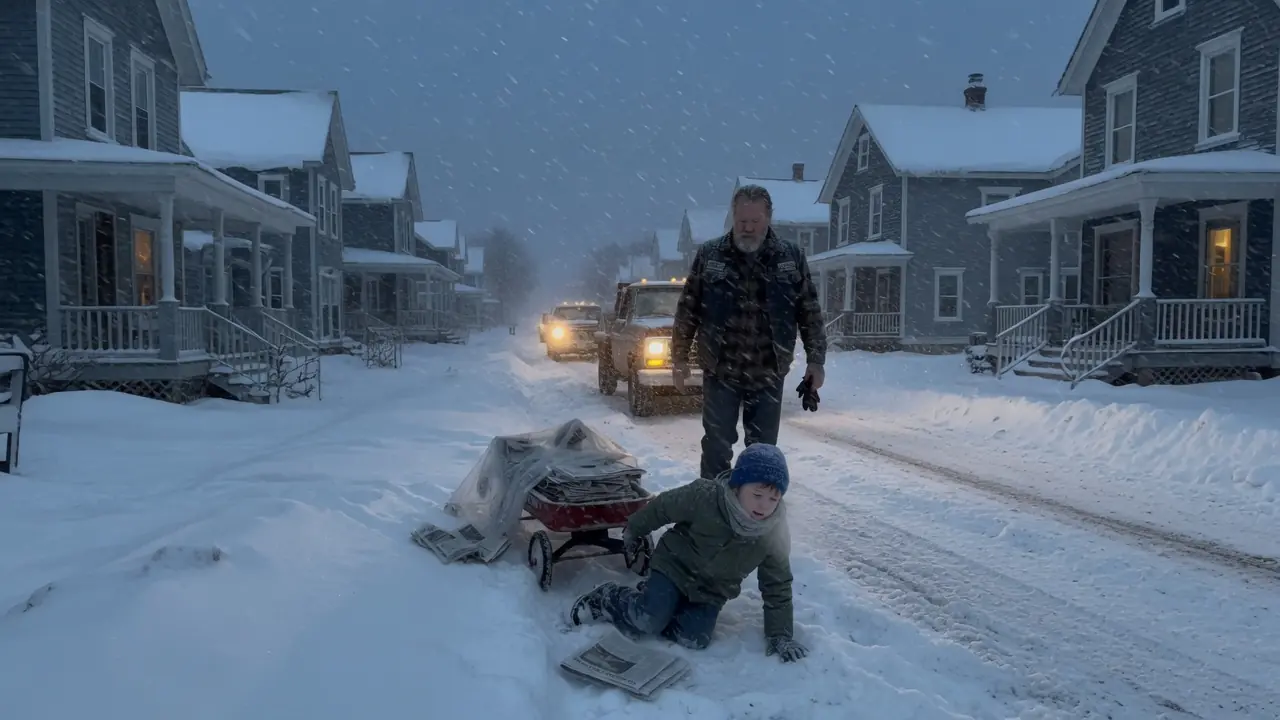
Caleb wore two sweaters beneath a green winter coat that had become too small across the shoulders. A knitted blue hat covered most of his light brown hair, and a scarf was wrapped around his face until only his tired gray eyes showed. His gloves were thin, the kind sold in packs near grocery-store checkout lines, and snow had already soaked through the fingertips. Every few houses, he tucked his hands beneath his arms and waited for the burning cold to ease.
There were forty-three homes on the route. His mother normally drove slowly beside him while he carried each copy of the Alder Creek Journal from their old station wagon to the front porch. They had turned the work into a game, counting porch lights and guessing which dogs would bark before Caleb reached the steps. But his mother was not beside him that morning.
Lena Turner had been sick for four days. What began as a cough had become a fever, chills, and a weakness that left her dizzy whenever she tried to stand. She had refused to visit a clinic because their insurance had lapsed three months earlier when the sewing factory cut her hours. The money from the newspaper route was supposed to cover groceries and part of the heating bill.
The night before, Caleb had heard her calling the distribution manager from the bedroom. She asked whether someone else could cover the route for one morning and promised she would return as soon as she recovered. The man told her that several carriers had already called out because of the storm. If the papers were not delivered, customers would complain, and she might lose the route permanently.
“I’ll find a way,” Lena had whispered.
Caleb stood outside her half-open door and listened. He knew that sentence because adults used it when they did not have an answer but did not want children to be afraid. His father had once said the same thing after the hospital sent a bill they could not afford. Three weeks later, Daniel died from complications following a workplace accident, leaving Lena to find every way alone.
Caleb waited until his mother’s breathing became slow and steady. Then he slipped into the kitchen, found the handwritten route list beside the telephone, and placed it inside his backpack. He set his alarm clock for four-thirty and packed two granola bars, a small flashlight, and the house key. Before leaving, he wrote a note in the careful block letters he had learned at school.
MOM, I AM HELPING WITH THE PAPERS. DO NOT WORRY. I KNOW THE HOUSES.
He placed the note beside her medicine and covered it with a saltshaker so it would not blow away when the heater started. Then he pulled the wagon from the garage and walked nearly half a mile to the newspaper distribution shed. No one questioned him when he arrived because workers were rushing to load vehicles before the roads became worse. A tired employee simply pointed toward the bundles marked TURNER and returned to his clipboard.
The newspapers were heavier than Caleb expected. He lifted them one bundle at a time, using both arms, and stacked them inside the wagon until the rear wheels sank into the snow. By the time he began the route, his back hurt and his socks were wet. Still, he believed he could finish before his mother woke.
The first ten houses went well. Caleb remembered which customers wanted papers beside the garage and which complained if the copies were not placed beneath the porch roof. He even remembered to double-bag the newspaper for Mrs. Atwood, whose driveway sloped toward the street and collected water near the steps. Each successful delivery made him feel older.
At the eleventh house, the wagon wheel became trapped in a bank of plowed snow. Caleb pulled until his shoulders shook, but the wheel only sank deeper. He set the remaining papers on the ground, dug with his hands, and tried again. When the wagon finally broke free, he fell backward and landed hard in the street.
The impact knocked the breath from him. For several seconds, he lay in the snow, staring upward as flakes landed on his eyelashes. No cars passed, no porch lights came on, and no one opened a door. Caleb sat up, rubbed his lower back, and whispered the words his mother always used when things went wrong.
“It’s okay. We’ll find a way.”
Across town, Grant Mercer had been awake since before the storm began. At fifty-four, he no longer slept through heavy wind, aching knees, or the old memories that visited when the world became quiet. He lived above Mercer Cycle and Repair, a brick motorcycle shop near the abandoned feed mill. The apartment was warm, but the silence inside it felt colder every winter.
Grant had owned the shop for twenty-six years. He repaired motorcycles, snowmobiles, generators, and nearly anything with an engine small enough to fit through the garage doors. His beard had gone mostly silver, and the faded tattoos on his forearms had softened with age. To strangers, he looked severe, but everyone in Alder Creek knew he kept dog treats behind the counter and never charged stranded travelers for emergency repairs.
He was also president of the Iron Pine Riders, a local motorcycle club made up of mechanics, veterans, electricians, nurses, and retired factory workers. During summer, they organized charity rides and collected school supplies. During winter, the motorcycles stayed parked, but the riders still met every Saturday for breakfast at Mae’s Diner. That morning, Grant had planned to clear the shop entrance before joining them.
His old pickup started on the second try. He drove slowly through the storm, using the truck’s headlights to follow the faint edges of the road. Near Cranberry Lane, something small and red appeared ahead of him. At first, Grant thought someone had abandoned a child’s wagon in the street.
Then the wagon moved.
Grant eased off the accelerator. A small figure leaned forward against the wind, pulling the wagon with both hands. Newspapers were stacked beneath a plastic sheet, though several had slid sideways and were collecting snow. Grant stared through the windshield, unable to understand why a child was outside alone before sunrise.
He stopped several yards behind the wagon and turned on his hazard lights. The boy looked back, startled, and immediately stepped toward the sidewalk. Grant remained inside the truck for a moment because he knew his size and appearance frightened some children. He removed his leather gloves, opened the door slowly, and kept his hands visible.
“Morning,” he called over the wind. “You doing all right?”
Caleb nodded too quickly. “Yes, sir.”
Grant looked at the wagon, then at the child’s thin gloves. “You delivering those papers by yourself?”
“My mom usually comes.”
“Where is she?”
“She’s sick, but I know the route.”
Grant walked closer and noticed the boy’s lips trembling. Snow had crusted around the bottom of his jeans, and the sleeves of his coat stopped above his wrists. One shoelace dragged through the slush. The child looked determined, but determination was not the same thing as safety.
“What’s your name?” Grant asked.
“Caleb Turner.”
“I’m Grant Mercer. My shop’s over by the feed mill.”
“I know. You have the motorcycles in the window.”
Grant nodded. “That’s me.”
Caleb tightened his grip on the wagon handle. “I have to keep going.”
Grant glanced toward the road behind them. Wind had already erased most of the wagon tracks. “How many houses are left?”
Caleb removed the route list from his backpack. The paper had become damp along the edges. He counted the addresses twice before answering.
“Thirty-two.”
Grant looked at the sky, though there was nothing to see except snow. “You’re not finishing thirty-two houses on foot in this.”
“I have to.”
“No newspaper is worth getting hurt over.”
Caleb’s eyes filled with sudden fear. “If I don’t finish, my mom loses the route. She said we need it because the heat bill is late.”
Grant had heard adults speak with the same shame, but never a child. Caleb said it as though he had personally failed to keep the house warm. His small shoulders tightened beneath the coat, preparing for an argument. Grant realized that ordering him home would only make the boy run away or return later without help.
“Then we’ll finish it,” Grant said.
Caleb blinked. “We?”
“I’ve got a truck. You’ve got a list.”
“You don’t have to.”
“I know.”
Caleb studied him, uncertain. His mother had warned him never to get into a stranger’s vehicle, and Grant respected the hesitation. He pulled his phone from his coat and asked for Lena’s number so they could call her first. When the phone rang unanswered, Caleb’s face grew pale.
“She might be sleeping,” he said.
“Or she might need someone checking on her.”
Grant called Mae Donnelly, who owned the diner and had known nearly everyone in Alder Creek for decades. He explained the situation and asked her to contact Lena or send someone to the Turner house. Mae did not waste time asking unnecessary questions. She promised to call back within ten minutes.
Grant loaded the newspapers into the bed of his pickup while Caleb watched closely. He then placed the red wagon beside them and fastened everything with straps. Before allowing the boy into the cab, he took a photograph of his driver’s license and sent it to Mae with a message explaining where they were going. Caleb noticed.
“My mom says good people don’t get mad when kids are careful,” he said.
“Your mom is right.”
Inside the truck, warm air blew against Caleb’s face. His hands began hurting as they thawed, and he tried not to cry. Grant turned the heater lower because warming frozen fingers too quickly could make the pain worse. He found a clean shop towel behind the seat and wrapped it around Caleb’s hands.
“Nothing broken?” Grant asked.
Caleb flexed his fingers carefully. “No.”
“Any pain in your feet?”
“They’re just wet.”
Grant removed an unopened pair of thick wool socks from the emergency kit beneath the seat. He looked away while Caleb changed, allowing the boy to keep his dignity. The socks were far too large, but Caleb folded the tops until they fit inside his boots.
They started with the next address. Grant drove slowly while Caleb read the house numbers aloud. At each stop, Grant carried the paper to the porch, but Caleb insisted on accompanying him whenever the steps were clear. The arrangement took time, yet it allowed the child to feel that he was still completing the route rather than being rescued from it.
At house fourteen, an older man opened the door before they reached the porch. He stared at Grant’s leather vest and then at Caleb. “Where’s Mrs. Turner?”
“She’s sick,” Caleb said. “I’m doing it today.”
The man looked toward the heavy snow. “Alone?”
“Not anymore,” Grant replied.
The customer accepted the paper but did not offer further help. He closed the door quickly to keep cold air from entering his house. Caleb watched the warm light disappear behind the curtain. Grant saw the disappointment in his face.
“Some people don’t know what to do when they see a problem,” Grant said as they returned to the truck. “So they pretend they didn’t see it.”
“That’s not very nice.”
“No, it isn’t.”
At the seventeenth house, Mae called back. She had reached Lena through the neighbor who kept an emergency key. The woman was conscious, but her fever had worsened, and she could barely stand. Mae was driving her to the community medical center and had arranged for a neighbor to meet Caleb at the Turner house later.
Caleb’s face lost all color. “Is she going to die?”
Grant pulled the truck to the side of the road. He did not tell the boy that everything would be fine because adults had probably made too many promises they could not guarantee. Instead, he turned in his seat and spoke with quiet certainty. “Mae said your mom is awake and talking, and she’s taking her somewhere doctors can help her.”
“My dad went to a hospital.”
Grant understood the rest without hearing it. “That happened to your father, but it doesn’t mean the same thing will happen to your mother.”
“I should go with her.”
“You should, but she also knows you’re safe with me. Mae told her.”
Caleb stared down at his oversized socks. “Was she mad?”
“She was scared first. Then she said she was proud of you and wanted you warm.”
A tear rolled down Caleb’s cheek. He wiped it away with the back of his sleeve and looked at the remaining newspapers. “We should finish.”
Grant wanted to disagree, but he recognized what the route meant now. Finishing was not only about money. Caleb needed one part of the morning to end the way he had planned because everything else felt beyond his control.
“All right,” Grant said. “But we’re calling for reinforcements.”
He sent one message to the Iron Pine Riders’ group chat: FOUND A SEVEN-YEAR-OLD DELIVERING PAPERS ALONE IN THE STORM. MOTHER IS AT THE CLINIC. THIRTY MINUTES OF WORK LEFT. ANYONE AWAKE?
His phone began vibrating before he set it down.
The first to arrive was Rosa Delgado, an emergency-room nurse who rode a red touring motorcycle during warmer months. She appeared in an aging four-wheel-drive vehicle with two travel mugs and a bag of breakfast sandwiches. Behind her came Leonard “Lenny” Pike, a retired mail carrier wearing a bright orange hunting coat. Then came brothers Sam and Curtis Bell, both electricians, followed by Denise Walker, a school-bus driver who kept a shovel in her trunk all winter.
Caleb watched the vehicles gather around Grant’s truck. Large men and women in leather vests climbed out, pulling on hats and gloves. None of them had brought motorcycles, but the Iron Pine patches showed beneath their winter coats. To Caleb, they looked like a small army arriving without being asked.
Grant introduced him to everyone. No one called him brave in the exaggerated voice adults sometimes used with children. Rosa checked his hands and cheeks for signs of frostbite, then gave him hot chocolate and half a breakfast sandwich. Lenny examined the route list and divided the remaining addresses into sections.
“We’ll meet at the last house,” Lenny said. “Nobody leaves until every paper is dry and exactly where it belongs.”
The riders spread across the neighborhood. Sam and Curtis cleared porch steps before placing newspapers beneath doors. Denise used grocery bags to protect copies from the wet snow. Rosa stayed near Caleb, ensuring he ate and drank while helping with the homes closest to the road.
For the first time that morning, Caleb began to smile. He stood on the truck’s running board and handed papers to each rider as if directing an important operation. Grant noticed that the boy knew every customer by name. He warned them about the dog at number twenty-six and reminded Denise that Mrs. Atwood’s paper had to be double-bagged.
At number thirty, a golden retriever slipped through an open door and charged into the snow. Caleb shouted its name before the owner reacted. “Biscuit, stop!”
The dog stopped immediately and bounded toward him. Caleb buried both gloved hands in the animal’s fur while Biscuit licked snow from his scarf. The owner hurried down the porch, apologized, and asked why so many people were delivering the paper.
Caleb explained in one breath. The woman’s expression changed from confusion to concern. She went inside and returned with a new pair of insulated children’s gloves that had belonged to her grandson. They were still slightly large, but far better than the soaked pair Caleb had been wearing.
“Keep them,” she said. “And tell your mother not to worry about our paper until she’s well.”
At the next house, a customer gave them a box of hand warmers. Another brought out a thermos of coffee for the adults and warm cider for Caleb. Word began spreading from porch to porch, traveling faster than the storm. People who had ignored the sound of the wagon earlier now stepped outside and asked what they could do.
By seven-thirty, the final newspaper rested beneath the covered porch of a blue house at the edge of Juniper Road. Caleb checked the address against the list and drew a line through it with Grant’s pen. The paper tore slightly beneath the pressure. He looked up at the riders, his cheeks pink from cold and excitement.
“That’s all of them,” he said.
Lenny raised both arms. “Route complete.”
The riders cheered loudly enough to startle birds from a nearby tree. Caleb laughed, a clear, surprised sound that seemed too large for his small body. Grant had heard crowds roar during motorcycle rallies, but nothing had ever felt as important as that child’s laughter in the snow.
They gathered at Mae’s Diner because the medical center did not allow large groups in the waiting room. Mae had opened early and placed a handwritten sign on the door: CLOSED TO THE PUBLIC UNTIL NINE. Inside, she served pancakes, eggs, and bacon without writing down a single order. Wet coats hung across the backs of chairs, filling the diner with the smell of snow and leather.
Caleb sat beside Grant in a booth near the front window. He ate two pancakes, then slowed as exhaustion caught up with him. His head lowered until it rested against Grant’s arm. Grant stayed perfectly still, afraid movement might wake him.
Rosa returned from calling the clinic. Lena had pneumonia and severe dehydration, but the doctors expected her to recover. She would remain there for at least two nights. Caleb heard the word pneumonia and opened his eyes.
“Can I see her?”
“Mae is taking you after breakfast,” Rosa said. “Your mom asked for you.”
Caleb nodded, then looked around the diner. “What about the papers tomorrow?”
The adults became quiet. At seven years old, the boy was already planning how to protect his mother’s income while she lay in a clinic. Grant felt anger rise inside him, not toward Caleb or Lena, but toward every system that had convinced them missing one day of work could destroy their lives.
“We’ll handle tomorrow,” Grant said.
“And the day after,” Denise added.
“As long as she needs,” Lenny said.
Caleb looked from one face to another. “But you have jobs.”
“So does your mother,” Grant replied. “That’s why we’re helping her keep hers.”
After breakfast, Mae drove Caleb to the clinic. Grant followed in his truck, carrying the red wagon in the back. The snow had slowed, and daylight revealed how deeply it had covered the town. Plows worked along the main road while residents shoveled paths between homes.
Lena lay in a narrow hospital bed with oxygen tubes beneath her nose. Her dark hair was damp against her forehead, and an intravenous line ran into her hand. When Caleb entered, she began crying before he reached the bed. He climbed carefully beside her and wrapped his arms around her shoulders.
“I did the route,” he whispered.
“I know.”
“I’m sorry I left without asking.”
“I’m sorry you thought you had to.”
Grant remained near the doorway, uncertain whether he belonged inside. Lena noticed him and held out one hand. “Mr. Mercer?”
“Grant is fine.”
She gripped his fingers weakly. “Thank you for finding him.”
“He found us,” Grant said. “We just helped with the heavy part.”
Lena looked at Caleb’s new gloves and oversized wool socks. She tried to smile, but guilt filled her face. “I should have called someone.”
“You did,” Grant reminded her. “The person responsible for the route told you nobody was available.”
“He’ll replace me after this.”
“No,” Grant said. “He won’t.”
Grant rarely made threats, but he understood leverage. The Alder Creek Journal depended on subscriptions from nearly every family in town, and most customers had already heard what happened. Before leaving the clinic, he called the distribution office and asked to speak with the manager who had refused Lena’s request.
The man’s name was Russell Crane. He immediately claimed he had misunderstood the seriousness of Lena’s condition and would never have expected a child to complete the route. Grant told him the call had been placed on speakerphone, and Lena’s neighbor had heard every word. That detail was not entirely true, but it caused Russell’s confidence to disappear.
By noon, the newspaper publisher had contacted Lena personally. He promised that her route would remain secure, the missing workdays would be paid, and future emergency coverage would be mandatory. He also offered to reimburse her medical expenses related to the illness. Grant suspected the offer had more to do with preventing a public scandal than sudden compassion, but Lena needed help more than she needed a perfect apology.
The story still spread. A customer had photographed the riders carrying newspapers through the snow and posted it on the town’s online community page. Within hours, hundreds of people had shared the image. The photograph showed Caleb standing in Grant’s truck bed while six bikers waited below him for their assignments.
The caption read: THIS IS WHAT ALDER CREEK LOOKS LIKE WHEN A CHILD SHOULDERS AN ADULT’S BURDEN.
Donations arrived at Mae’s Diner by the end of the day. Some people left cash, while others brought groceries, heating oil vouchers, and children’s winter clothing. A retired contractor offered to inspect the Turners’ furnace. A local pharmacy agreed to cover Lena’s medication.
Grant refused to let anyone turn Caleb into a spectacle. When a regional television station called asking for an interview, he told them no. Caleb was not a symbol or a headline. He was a tired child whose family needed privacy.
The Iron Pine Riders delivered the newspaper route for six mornings. They worked in pairs, using trucks and cars because ice covered the roads. Each day, one rider stopped at the clinic afterward to bring Caleb and Lena breakfast. They never entered without asking, and they never treated the family as a charity project.
Caleb stayed with Mae while Lena recovered. She placed him in the apartment above the diner, where her grown children had once lived. Every night, he called his mother before bed and told her about school, Banjo, and the newspaper route. He always asked whether Grant had delivered the papers correctly.
On the third morning, Grant intentionally placed Mr. Atwood’s paper three inches too far to the left. Caleb noticed when they drove past the house after school. He crossed his arms and gave Grant a serious look.
“That isn’t where it goes.”
“I thought it looked fine.”
“He likes it beside the flowerpot.”
“Good thing I’ve got a supervisor.”
Caleb smiled. “You should listen better.”
When Lena returned home, the furnace was running properly, the refrigerator was full, and the walkway had been cleared. A stack of paid utility receipts rested on the kitchen table. No names were attached to them.
Lena stood in the doorway and covered her mouth with one hand. She had spent years believing that asking for help meant admitting failure. Daniel’s death had taught her to depend on no one because promises disappeared when life became difficult. Yet everything before her existed because strangers had chosen to keep a promise they had never been required to make.
Caleb led her to the garage. The red wagon stood beside the wall, cleaned and repaired. Sam and Curtis had replaced the bent wheel, strengthened the axle, and added a wooden cover to protect newspapers from rain and snow. On both sides, someone had painted a small green pine tree beneath the words TURNER DELIVERY SERVICE.
Lena laughed through her tears. “That is the finest newspaper wagon I’ve ever seen.”
“Grant said good machines should be ready for bad weather.”
“He’s right.”
The following Saturday, Lena and Caleb visited Mercer Cycle and Repair. It was Caleb’s first time inside the shop. Motorcycles stood in neat rows beneath bright lights, their chrome reflecting tools arranged along the walls. The smell of rubber, metal, and oil made Caleb stop in the doorway with wide eyes.
Grant showed him a small engine taken from an old dirt bike. He explained how fuel, air, and a spark worked together to create power. Caleb listened without interrupting, then asked questions so specific that Grant laughed. By noon, the boy’s hands were covered in harmless grease, and Lena had taken twenty photographs.
The Iron Pine Riders held their winter meeting in the shop’s back room. When Caleb entered, everyone applauded. He immediately hid behind his mother’s coat, embarrassed by the attention. Grant raised one hand, and the room became quiet.
“We’re not applauding because you went into a storm alone,” Grant told him. “That part was dangerous, and you are never doing it again.”
Several riders nodded firmly.
“We’re applauding because you cared about your mother and tried to help her. But the next time something feels too heavy, you call someone. Strength isn’t carrying everything alone.”
Caleb looked at the floor. “What if nobody comes?”
Grant removed a small patch from the table. It showed a green pine tree above a tiny red wagon. Beneath it were the words HONORARY ROAD CAPTAIN.
“Then you call us,” he said.
Lena sewed the patch onto Caleb’s backpack that evening. At school on Monday, children crowded around him, asking about the bikers and the snowstorm. Some wanted to know whether he had ridden a motorcycle. Others had seen the photograph online and called him famous.
Caleb told them he was not famous. He had simply delivered newspapers, and some people helped. He did not mention how frightened he had been when the wagon became stuck or how badly his fingers had hurt. Those memories belonged to him.
His teacher, Mrs. Harlow, asked him to speak during morning circle. Caleb stood before the class, holding the honorary patch between two fingers. He thought for a long time before deciding what to say.
“My mom says helping means you notice when somebody is trying too hard to do everything,” he began. “Mr. Grant noticed me.”
A girl raised her hand. “Are bikers scary?”
Caleb shook his head. “Some might be, but scary-looking and bad aren’t the same thing.”
“What does a road captain do?” another child asked.
“He makes sure nobody gets left behind.”
The answer traveled through Alder Creek more quietly than the photograph had. People began checking on elderly neighbors during storms. The school created an emergency family fund for parents who missed work because of illness. Newspaper customers volunteered to serve as backup drivers when carriers faced emergencies.
Russell Crane, the distribution manager, resigned two months later. The publisher replaced him with a woman who had spent years delivering rural routes herself. Her first policy required every route to have two trained emergency substitutes. She also banned children under thirteen from delivering without an adult present.
Lena returned to work but no longer took Caleb out before sunrise on school days. The newspaper company adjusted the route so she could complete it later, and Grant volunteered as her official backup. He pretended to complain about waking early, though everyone knew he enjoyed it.
On delivery mornings, Caleb sometimes joined them after the roads were safe. He sat between Lena and Grant in the pickup, reading addresses aloud and sipping hot chocolate. The repaired red wagon stayed in the garage except during spring and summer.
As months passed, Grant became part of the Turners’ ordinary life. He attended Caleb’s school play and sat through forty minutes of children dressed as vegetables. He repaired Lena’s station wagon twice and refused payment both times. He taught Caleb how to hold a flashlight properly and how to return every tool to its correct drawer.
Grant never tried to replace Daniel. He listened when Caleb spoke about his father and never became uncomfortable when old photographs appeared. On Daniel’s birthday, he helped Caleb build a small wooden box for his father’s watch. The two of them sanded it smooth and carved the initials D.T. into the lid.
“You knew my dad?” Caleb asked.
“No.”
“Would you have liked him?”
Grant considered the question. “He raised a boy willing to walk through a storm for his mother. I think I would have found something to like.”
Caleb carried that answer home carefully.
The following winter, snow returned to Alder Creek. It began in the afternoon and continued through the night, covering streets, roofs, and parked cars. Lena stood at the kitchen window watching it fall while Caleb slept upstairs. The weather report warned residents not to travel before the plows cleared the roads.
At five-thirty the next morning, headlights appeared outside. Grant’s pickup stopped near the mailbox, followed by Rosa’s vehicle and Lenny’s old station wagon. The Iron Pine Riders climbed out carrying shovels, coffee, and bags of salt.
Lena opened the door. “What are you all doing here?”
Grant looked toward the driveway as though the answer were obvious. “Bad weather.”
“The papers were canceled today.”
“I know.”
“Then why are you here?”
“Because your walkway still needs clearing.”
Caleb came running down the stairs in pajamas and pressed his face against the window. When he saw the riders, he waved both arms. Grant waved back before driving a shovel into the snow.
Within minutes, the driveway filled with voices and laughter. Rosa built a small snowman beside the porch while Lenny complained that its head was crooked. Sam and Curtis cleared the path to the garage, and Denise spread salt along the steps.
Caleb pulled on his coat, hat, and the insulated gloves he had received the year before. Lena allowed him outside only after checking every zipper twice. He grabbed a child-sized shovel and began working beside Grant.
“You don’t have to clear the whole town today,” Grant told him.
“I know.”
“Just this driveway.”
“I know.”
“And if it gets too heavy?”
Caleb looked toward the riders surrounding him. “I ask for help.”
Grant nodded. “That’s my road captain.”
The red wagon remained inside the garage, dry and quiet. It no longer carried the burden of keeping a family warm. It was only a wagon again, waiting for garden tools, summer picnics, and perhaps a tired seven-year-old who had finally learned he did not have to walk every difficult road alone.
Years later, Caleb would forget many details from that first storm. He would forget the names of some customers and the order of certain streets. He would forget exactly how many papers remained when Grant’s headlights appeared behind him.
But he would always remember the sound of the truck door opening.
He would remember a large biker standing in the snow, keeping his distance so a frightened child would feel safe. He would remember Grant saying, “Then we’ll finish it,” without asking what he would receive in return. Most of all, Caleb would remember that the storm did not end when the snow stopped falling.
It ended when someone finally noticed he was carrying too much.