The wind in Hollow Creek did not knock politely.
It slipped through wall cracks, lifted dust off the street, rattled windowpanes, and pressed against every tired soul in town as if testing what might break first. It smelled of dry grass, horse sweat, cold ash, and the kind of loneliness that settled over prairie towns when winter stood just beyond the hills.
Miriam Calloway arrived in that wind on the last wagon of the afternoon.
She had no trunk.
No husband.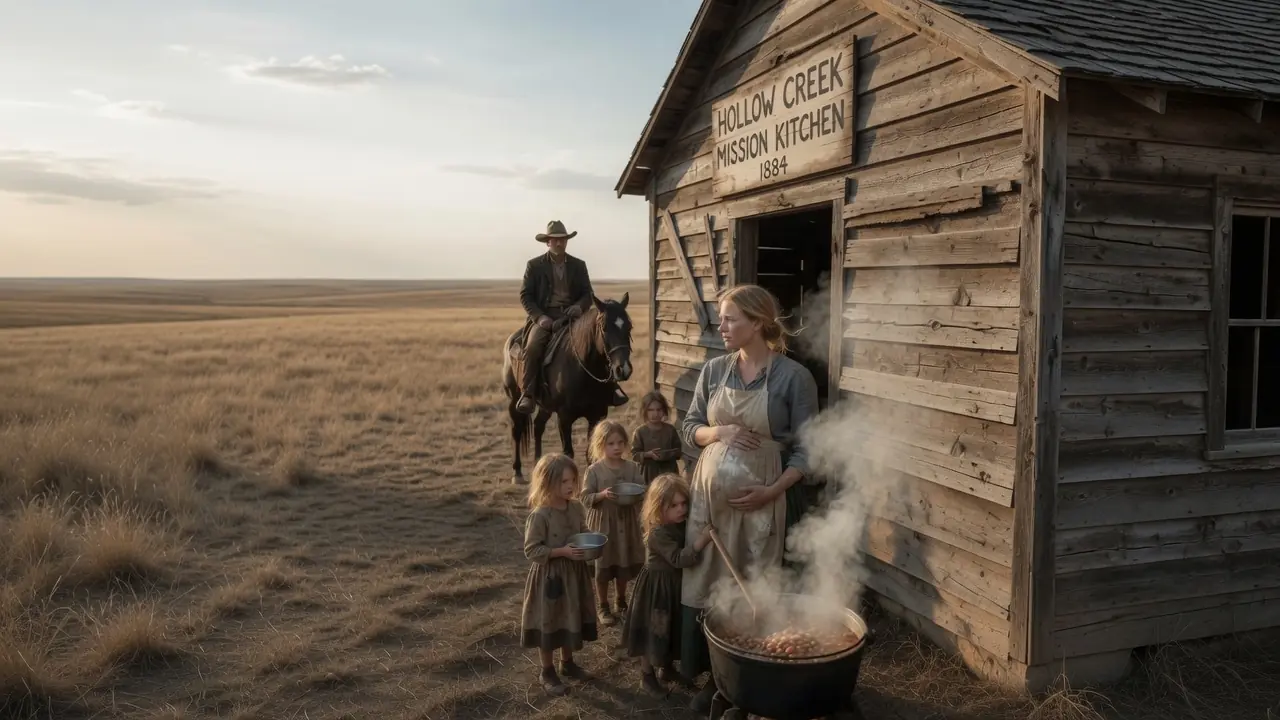
No family waiting with open arms.
Only a faded carpetbag, a Bible wrapped in cloth, a black iron skillet tied with rope, and one hand resting over the child beneath her heart.
Her husband, Samuel Calloway, had been dead for six weeks.
He had not died in war, or in a gunfight, or in any story men could make grand over whiskey. He had died beside a broken wagon wheel on a muddy trail east of Abilene, trying to help a family whose team had gone down in a storm. A flash flood tore through the crossing before anyone could shout a warning.
Miriam still dreamed of his fingers slipping from hers.
Still woke with his name in her mouth.
Still carried the sound of the water louder than any church bell.
After Samuel died, kindness came to her in thin pieces. A woman gave her bread. A farmer let her sleep one night in his hayloft. A preacher prayed over her and said the Lord would provide, then looked relieved when another wagon agreed to take her farther west.
Her husband’s aunt in Hollow Creek had promised shelter months earlier.
By the time Miriam reached town, that promise had turned into a letter left with the mercantile clerk.
Mrs. Calloway, the letter said, I regret that our circumstances have changed. It would not be proper for our household to receive a young widow in your condition. I pray you find suitable arrangements.
Suitable arrangements.
Miriam stood outside the mercantile holding the paper until the wind folded it against her palm.
She did not cry.
Not there.
Not with strangers watching from doorways, measuring the size of her belly and the cheapness of her coat.
She simply folded the letter, put it into her bag, and asked the clerk whether there was work in town for a woman who could cook, sew, wash, scrub, and keep children from killing one another before breakfast.
The clerk looked embarrassed.
Then he pointed toward the far edge of town.
“There’s the mission house,” he said. “Past the blacksmith, near the cottonwoods. Reverend might take help if you can take hardship.”
Miriam almost smiled.
Hardship was the one thing she did not need training in.
The Hollow Creek Mission House leaned against the prairie like it had lost an argument with the weather.
Once, it might have been white. Now the paint had gone gray, peeling in strips along the walls. The steeple tilted a little to the left. One shutter hung by a single hinge, and the front steps sagged so badly Miriam tested each board before trusting it with her weight.
A sign near the door read:
Hollow Creek Mission And Children’s Refuge.
The word refuge caught in her chest.
From inside came the sound of children trying to be quiet and failing.
Reverend Jonah Fields opened the door after her second knock. He was a narrow man in his late fifties, with tired blue eyes, ink-stained fingers, and a beard that looked as if he had trimmed it with a dull knife and a prayer. He looked at Miriam’s face first, then her belly, then the carpetbag at her feet.
For one awful moment, she thought he would say no.
Then he stepped aside.
“You must be Mrs. Calloway.”
“I am.”
“I received word you might come through.”
“Then you know I need work.”
His face softened.
“And I need help.”
That was how she entered.
Not as a guest.
Not as charity.
As someone needed.
The children were gathered in the back room, eleven of them around a long table made from boards that did not match. Their bowls were empty. Their eyes were not. Children who had known hunger always looked at new adults carefully, waiting to learn whether kindness had a price.
The oldest was a girl named Elsie, fifteen, tall and thin, with brown hair braided tightly down her back. She stood when Miriam entered, chin lifted like a little soldier.
“I keep the smaller ones in line,” she said.
“I can see that,” Miriam answered.
That earned the faintest flicker of surprise.
One by one, Reverend Fields introduced them.
Tom, thirteen, restless and sharp-eyed.
Lila, twelve, who carried a sewing needle tucked into the cuff of her sleeve.
The brothers, Ben and Abel, ten and nine, close enough in mischief to be twins though they denied it fiercely.
Martha, eight, serious as a judge.
Josie, seven, with freckles and a pocket full of string.
Little Ruth, six, who would not speak above a whisper.
Cal, five, who wanted to know if Miriam had ever ridden a train.
Annie, four, who held a cracked wooden doll with one painted eye.
And the youngest, a small boy named Tobias, barely three, who sat on Elsie’s lap and stared at Miriam’s belly as if another child arriving inside a woman was the strangest magic God had ever allowed.
Miriam looked around the room.
At the patched clothes.
At the thin blankets stacked near the stove.
At the cupboards that looked ashamed of how empty they were.
At the pot of watery beans simmering over a fire too weak for a November evening.
“What is supper?” she asked.
Reverend Fields sighed.
“Beans.”
“With what?”
“Faith.”
The children laughed softly because they loved him, not because it was funny.
Miriam set her carpetbag down.
“Faith needs salt.”
She rolled up her sleeves.
The pantry was almost an insult.
Cornmeal in a cloth sack. A strip of bacon rind. Half a jar of molasses. Dried beans. Two carrots bent with age. Three potatoes with eyes growing out of them. A handful of onions soft enough to bruise under her thumb.
Miriam looked at it all and felt something steady return to her hands.
Her mother had raised six children on less.
Hunger had never made the Calloway women elegant, but it had made them clever.
“Elsie, I need bowls washed.”
“They’re clean.”
“I need them cleaner.”
Elsie blinked, then nodded.
“Lila, can you slice onions?”
“Yes, ma’am.”
“Thin?”
“I can try.”
“Trying thin is better than doing thick with confidence.”
Tom snorted, and Miriam pointed at him.
“You. Kindling. Dry if the Lord has been generous, damp if He has been testing us.”
Tom grinned despite himself and ran outside.
“Ben, Abel, wash your hands. Both sides. If you come back with river mud under your nails, I will know.”
“How?” Abel asked.
“Because I was once a child and survived it.”
That made the room shift.
Just a little.
The children moved.
The mission house, which had felt dead with waiting, suddenly filled with purpose.
Miriam browned the bacon rind in her skillet until the fat loosened and the room began to smell almost rich. She fried the onions low and slow until they softened into sweetness. She chopped the potatoes small enough to fool the eye and added them to the beans with carrot shavings, salt, and a prayer that did not sound as hopeless as the reverend’s.
She mixed cornmeal with hot water and bacon grease, then fried little cakes crisp on the outside and tender in the middle.
Molasses thinned with warm water became a poor woman’s syrup.
By the time supper reached the table, it was still a meal made from scraps.
But it no longer tasted abandoned.
Cal took one bite, stopped, and looked at his bowl with wonder.
“It tastes like somebody came home.”
The room went quiet.
Miriam turned toward the stove and busied herself with the skillet.
She did not trust her face.
After supper, the children cleaned without argument, though they watched Miriam from the corners of their eyes. She knew that look. Children who had been left behind did not immediately trust arrival. Adults came and went. Promises entered through the front door and disappeared out the back before sunrise.
Tobias toddled to her carpetbag and touched the cloth-wrapped skillet.
“What’s this?”
“My skillet.”
“For food?”
“For starting over.”
He looked up at her.
“Can it start over here?”
Miriam rested one hand over the child inside her and looked around the broken room, the cracked stove, the patched children, the reverend who had been praying for help so long he no longer knew what help looked like when it stood in front of him.
“We can try,” she said.
And in Hollow Creek, that was as close to a miracle as anyone had heard all week.
She began the next morning before dawn.
There was no grand speech.
No declaration that everything would be different.
Miriam had learned that hard lives were not changed by speeches. They were changed by breakfast, clean socks, swept floors, fixed sleeves, warm water, and someone remembering which child hated turnips because turnips reminded him of the year his mother died.
She made corn mush and called it porridge because porridge sounded less poor.
She found mint growing near the creek and brewed tea.
She taught Lila how to turn a collar.
She taught Tom that chopping wood angry only made crooked pieces.
She made Ben and Abel empty their pockets before laundry and discovered three stones, a nail, two buttons, a dead beetle, and a folded paper with a drawing of a cow wearing a hat.
“Which of you drew this?”
Both boys pointed at each other.
Miriam kept it.
By the second week, the mission smelled different.
Less like damp wool, cold ashes, and old sorrow.
More like yeast, soap, coffee, woodsmoke, and children who had been made to wash behind their ears whether they believed God looked there or not.
The younger ones began staying close to her when she cooked.
Not getting in the way exactly.
Just near.
Annie would sit on a stool and hum while Miriam kneaded dough. Ruth helped count potatoes in a whisper. Cal asked questions until even Reverend Fields looked ready to confess sins just for quiet.
Elsie kept her distance the longest.
She had been old enough to remember being left.
Old enough to understand that adults could smile while preparing to leave.
Miriam did not chase her trust.
She simply kept making enough breakfast for her too.
One cold evening, Tobias climbed onto the bench beside Miriam and leaned against her arm.
“Mama Miriam,” he said sleepily.
The whole table froze.
Elsie’s spoon stopped halfway to her mouth.
Reverend Fields lowered his eyes.
Tobias sat up fast, suddenly afraid.
“I didn’t mean—”
Miriam touched his cheek.
“That is a powerful name.”
His bottom lip trembled.
“I forgot.”
“No,” she said softly. “Maybe your heart remembered something it needed.”
He stared at her.
“You mad?”
“I am honored.”
After that, the little ones began using the name.
Mama Miriam.
At first it came shyly.
Then naturally.
Elsie never said it.
But one night, when wind clawed at the walls and Miriam woke from a cramp in her back, she found the girl asleep in a chair near the stove with a quilt half-finished in her lap.
Watching over the house.
Watching over her.
Miriam covered Elsie’s shoulders with another blanket and whispered, “Rest, child.”
Elsie did not wake.
But her face softened in sleep.
Hollow Creek noticed the children before it noticed Miriam.
Their clothes were still patched, but the patches were neat. Their hair stayed combed past noon. Their faces slowly rounded out from meals that, while humble, arrived regularly. They walked into town with baskets and did not look like they were apologizing for needing space on the sidewalk.
Mrs. Alma Pritchard, who ran the mercantile, sniffed at them one morning and said, “That widow has put starch in your spines.”
Tom answered, “No, ma’am. Mostly beans.”
That story traveled by supper.
Not all the talk was kind.
Some women said a pregnant widow had no business managing a house full of orphans.
Some men said Reverend Fields had been taken in by sentiment.
Some asked where the money was coming from and whether feeding children too well might make them lazy.
People who had never gone hungry often had theories about what hunger taught.
Miriam heard enough to know.
Then she kept cooking.
The first time Gideon Hale came to the mission house, he arrived with a sick calf in the back of his wagon and an excuse nobody believed.
Gideon owned the largest ranch north of Hollow Creek, a spread of grassland, creek bottom, and cattle marked with the H-bar brand. At forty, he was already considered one of the wealthiest men in the county. He had dark hair, a quiet face, and shoulders made by ranch work rather than vanity.
He was known in town as hard.
Fair, sometimes.
Generous, rarely.
Lonely, always, though no one said that part where he could hear.
His wife had died nine years earlier of winter fever. Their infant daughter followed three days later. After that, Gideon closed most of the house, kept only three hands on through winter, and turned Hale Ridge Ranch into a profitable silence.
He brought the calf because, as he told Reverend Fields, “It won’t last the week on my place, and the children might learn something trying.”
Miriam watched him lower the animal from the wagon.
No man carried a useless calf that gently.
The children gathered around the straw bed in the shed, whispering.
The calf’s breathing was shallow. Its eyes were dull. Its legs shook when it tried to rise and failed.
Miriam knelt beside it.
Gideon frowned.
“You know cattle?”
“I know hunger.”
“That wasn’t my question.”
“It is the answer.”
She ran her hand along the calf’s neck, felt the bones beneath the hide, the weakness more than sickness.
“It needs warmth. Milk. Patience.”
“Patience doesn’t save everything.”
“No,” Miriam said. “But neither does giving up early.”
She put Elsie in charge of warming milk, sent Tom for clean rags, and asked Lila to fetch the smallest bottle they had. The children moved like a little army. Gideon stood back, silent, watching the room come alive around a creature he had pretended not to care about.
At first, the calf refused the bottle.
Then its mouth moved once.
Then again.
Annie gasped as if the animal had spoken.
Cal whispered, “It wants to live.”
Miriam smiled.
“Most things do.”
Gideon looked at her then.
Really looked.
Not at her belly.
Not at her widow’s black dress.
At her.
Later, outside near his wagon, she said, “Thank you for bringing it.”
He tightened the reins.
“It was dying.”
“And yet you drove six miles with it wrapped in two blankets.”
His eyes narrowed slightly.
“You always speak plainly?”
“Only when people lie poorly.”
For half a second, she thought he might be offended.
Then the corner of his mouth moved.
Almost a smile.
“You got a name for that calf?”
“Not yet.”
“Don’t name it unless it lives.”
Miriam touched her belly without meaning to.
“We name things so they have a reason to.”
The smile faded from his face, but not into anger.
Into memory.
He nodded once and climbed into the wagon.
Two days later, supplies arrived from Hale Ridge Ranch.
Flour.
Oats.
Potatoes.
A sack of coffee.
Two sides of bacon.
A crate of apples.
And enough lumber to fix the mission steps.
A note sat on top.
Excess stores.
Miriam read it twice.
Then looked at the amount of coffee and laughed.
Reverend Fields found her in the pantry holding the note.
“Should I send thanks?”
“Send a Bible,” she said. “Mr. Hale needs help with honesty.”
Gideon came the next week to check the calf.
Then again to repair the steps because, he said, “Lumber left alone rots.”
Then again because the shed roof needed patching.
Then because Tom had asked about saddle repair.
Then because Tobias had named the calf Button and insisted Mr. Hale needed to know.
He told himself he came for tasks.
The children knew better.
Children always know when a lonely adult is pretending not to need a chair near the stove.
Gideon taught Tom how to mend a harness and did not laugh when the boy’s first attempt looked like a snake had attacked it. He showed Ben and Abel how to stack firewood so the pile did not collapse on innocent passersby. He carved Annie a little wooden lamb after noticing the doll’s other eye had come off. He brought Ruth a ribbon the exact blue of her dress and seemed confused when she cried over it.
Tobias attached himself to Gideon with the fearless devotion of small children and dogs.
One evening, after supper, the boy fell asleep against Gideon’s knee.
The rancher sat stiff as a fence post, afraid to breathe.
Miriam watched from the stove.
“You may put your hand on his head,” she said.
Gideon looked at her.
“He won’t break?”
“No. But you might.”
His face changed.
Then, carefully, he rested one big hand over Tobias’s hair.
The boy sighed in his sleep.
Gideon looked away quickly.
Not before Miriam saw the tears in his eyes.
Their affection grew the way prairie grass returns after fire.
At first, small enough to miss unless one was looking.
Then everywhere.
Gideon began washing his hands before entering the kitchen. He pretended it was because Miriam scolded him about dirt near bread dough. Miriam began wearing her soft brown shawl when she knew he was coming. She pretended it was because the draft near the door had worsened.
Elsie saw through them both.
“He likes you,” she said one morning while kneading biscuits.
“He likes supper.”
“He looks at supper with gratitude. He looks at you like he’s afraid he’ll scare you away.”
Miriam pressed dough flat.
“That is a great deal of wisdom from someone with flour on her chin.”
Elsie wiped the wrong side of her face.
“I’m not wrong.”
No.
She was not.
That frightened Miriam.
Hope felt disloyal at first.
As if loving Samuel meant she had to keep every door inside herself locked forever. But grief, she slowly learned, was not a house with one room. It could hold sorrow and tenderness at once. It could keep the dead beloved without refusing the living entirely.
Then the notice came.
It arrived on a Tuesday when the sky was low and the children were making paper chains from old newspaper.
The county clerk handed Reverend Fields an envelope stamped with a legal seal. The reverend read it at the kitchen table, and the color left his face so quickly that Miriam took the paper from his hand.
She read the words.
Then read them again.
Land reversion.
Unrecorded church trust.
Owner of legal title: Gideon Hale.
Miriam felt the room tilt.
The mission house.
The kitchen.
The shed.
The yard.
The patch of garden she had coaxed from mean soil.
The place where eleven children had begun to believe they could stay.
All of it belonged, legally, to Gideon Hale.
He arrived that afternoon carrying a box of nails and a bolt of oilcloth for the windows.
Miriam met him in the yard.
He saw the notice in her hand and stopped.
So did she.
For a moment, neither spoke.
“You knew,” she said.
Gideon closed his eyes.
“Yes.”
The word struck harder than any lie.
“You let me think these children had a roof held by the church.”
“My father intended to give the land to the mission. He never filed the papers. Reverend Fields knew.”
“Did I?”
Gideon’s jaw worked.
“No.”
“Why?”
“I thought if you knew, every kindness from me would feel like rent.”
Miriam stepped back as if the words had hands.
“And now?”
His face tightened.
“Now I know keeping it hidden made it worse.”
“That is a small truth arriving very late.”
“I was going to fix it.”
“When? After I trusted you? After the children did? After I let myself—”
She stopped.
The children had gathered at the kitchen door, silent.
Gideon looked at them, then back at her.
“Miriam, I have never intended to take this place.”
“Intention does not erase power.”
The sentence landed.
She saw it hit him.
Good.
“I need you to leave,” she said.
“Miriam—”
“Please.”
That word hurt him more than anger would have.
He nodded once, set the nails and oilcloth by the porch, and left.
For three weeks, Gideon did not come.
The calf lived and grew bold enough to chew Tobias’s sleeve whenever possible. Supplies ran thin. The wind sharpened. The children tried not to ask why Mr. Hale had stopped visiting, and Miriam tried not to answer the question they were kind enough not to speak.
Then sickness came for Ruth.
A fever first.
Then coughing.
Then little blue shadows beneath her eyes that made Miriam’s blood turn cold.
For two nights, Miriam did not sleep. She cooled Ruth’s face, brewed willow bark tea, warmed cloths, whispered prayers, and ignored the cramps that came whenever she stood too fast. The baby inside her shifted heavy and low, as if reminding her that one body could only carry so much before breaking.
On the third morning, Ruth’s fever eased.
Miriam walked outside into the cold and gripped the porch rail until the world stopped spinning.
She needed help.
Not pride.
Help.
So she sent Tom to Hale Ridge with a note.
The children need you. Come if your promise was ever true.
Gideon came before noon.
His horse was lathered, his coat buttoned wrong, and his face looked like a man who had ridden through fear rather than weather.
“Who is sick?”
“Ruth. Fever broke.”
Relief nearly knocked him backward.
He removed his hat.
“And you?”
“Tired.”
“That is not an answer.”
“It is the only one I can afford.”
She brought him inside.
The children watched from corners, hopeful and wary.
Gideon did not try to win them back with smiles. He went first to Ruth’s bed, knelt beside it, and placed the blue ribbon he had brought weeks before on the blanket.
“I hear you worried us,” he said softly.
Ruth whispered, “I didn’t mean to.”
“I know.”
Then he stood and turned to Miriam.
“I brought something.”
He pulled folded papers from inside his coat and set them on the table.
Miriam did not touch them.
“What are they?”
“Transfer papers. The land goes to the mission outright. Filed with the county this morning. No reversion. No claim. Not mine. Not ever again.”
Reverend Fields took the papers with shaking hands.
Miriam stared at Gideon.
“You did this before I sent for you.”
“The day after you told me to leave.”
“Why didn’t you bring them sooner?”
“Because you asked me to stay away.”
That answer went deeper than any apology.
He had respected the boundary even when fixing the damage might have helped him.
“I was wrong to hide it,” he said. “I had power and pretended I did not because I did not mean harm. But power does not become harmless because the man holding it feels gentle.”
Miriam’s throat tightened.
“I don’t know how to trust you.”
“I know.”
“The papers fix the roof. They do not fix my heart.”
“I know that too.”
Before either could say more, wagon wheels stopped outside.
Mrs. Beatrice Lark from the church auxiliary stepped down with two women and a county official named Mr. Hollis Wynn. Beatrice wore a black bonnet, a pinched expression, and the satisfied concern of someone who had been waiting for a righteous reason to interfere.
“We received complaints,” Mr. Wynn said, removing his hat.
“About what?” Miriam asked.
“The condition of the children’s refuge. Questions of oversight. Property uncertainty. Winter readiness.”
Beatrice looked at Miriam’s belly.
“And moral suitability.”
Gideon moved one step forward.
The room felt it.
Mr. Wynn held up a hand.
“We are only here to assess.”
Miriam stood straight.
Her back ached.
Her hands trembled.
But her voice did not.
“These children are fed, clothed, warm, taught, prayed over, and loved. If anyone in Hollow Creek believes that is unsuitable, they are welcome to explain which part offends them.”
Beatrice’s nostrils flared.
“A pregnant widow cannot be mother to eleven orphans.”
A tiny voice came from the doorway.
“Yes, she can.”
It was Tobias.
He stood barefoot, clutching his wooden lamb, hair sticking up from sleep.
“She’s Mama Miriam.”
The room went still.
Then Ruth, pale but awake on the cot, whispered, “She’s mine too.”
One by one, the children moved closer.
Not hiding behind Miriam.
Standing with her.
Elsie stepped forward last.
“She is the first grown person who came here and stayed,” the girl said. “If that is not suitable, then I don’t know what the word means.”
Beatrice looked uncomfortable.
Mr. Wynn looked at the children, then at the stove, the clean floor, the mended clothes, the sleeping calf visible through the window, and the transfer papers Reverend Fields now held out.
Gideon spoke then.
“The property issue is resolved. The mission owns the land. Supplies for winter will be provided by Hale Ridge until the school board and church can establish proper funding.”
Beatrice narrowed her eyes.
“On what authority?”
Gideon looked at Miriam.
Not taking over.
Waiting.
She understood what he was offering.
Support.
Not command.
She turned back to Mr. Wynn.
“On the authority of a community that should have helped before it was embarrassed into doing so.”
Reverend Fields coughed into his hand to hide something that sounded almost like a laugh.
Mr. Wynn folded the papers.
“I see no cause for removal at this time.”
Beatrice stiffened.
“Mr. Wynn—”
“No cause,” he repeated.
The women left offended.
Mr. Wynn left thoughtful.
The children cheered after the wagons rolled away, but Miriam barely heard them because a pain had taken hold low in her body and would not let go.
She gripped the table.
Gideon saw immediately.
“Miriam?”
Another pain came.
Stronger.
Her breath caught.
“Oh,” she whispered.
Elsie’s eyes went wide.
“The baby?”
Miriam nodded.
“Now.”
The house erupted.
Reverend Fields ran for the midwife with more speed than dignity. Elsie took command of the children. Lila boiled water because that was what every birth story seemed to require whether the water helped or not. Gideon carried Miriam to the small room off the kitchen, his arms steady, his face pale.
The labor came hard and fast.
Mrs. Ada Crane arrived with snow on her shawl and the calm, bossy manner of a woman who had pulled half the county into the world. She sent Gideon out twice. Miriam called him back both times. By the third, Ada gave up and told him if he fainted she would step over him.
Hours blurred.
Pain rose and broke.
Miriam clung to Gideon’s hand, cursed once loudly enough to make Reverend Fields pray in the next room, then apologized between contractions.
Gideon bent close.
“You have nothing to apologize for.”
“If I die, I will haunt you for saying calm things.”
“You are not dying.”
“You don’t know that.”
“No,” he whispered. “But I am asking God with everything in me.”
Near midnight, a cry filled the room.
A girl.
Small, furious, alive.
Ada placed her on Miriam’s chest, and the whole world narrowed to the warm weight of that tiny body, the fists, the wet dark hair, the angry little mouth protesting its first minute on earth.
Gideon stood beside the bed with tears running openly down his face.
Miriam looked up at him.
“Would you like to hold her?”
His breath shook.
“May I?”
She nodded.
He took the baby as if receiving fire.
The child quieted almost immediately, turning her face toward the sound of his heartbeat.
“Hello,” he whispered. “You came to quite a house.”
Miriam smiled through exhaustion.
“What should we call her?” he asked.
She looked toward the doorway, where eleven children were trying and failing not to crowd into the room.
“Grace,” she said.
Gideon looked at her.
“There is already a Ruth and an Annie and a Tobias. We can afford a Grace.”
He laughed softly.
“Yes,” he said. “We can.”
They were married in spring, not because scandal demanded it, though Beatrice Lark certainly tried to sound as if heaven itself were waiting on the paperwork.
They married because Miriam chose it.
That mattered to her.
Gideon had given the land away before asking for anything in return. He had come when called. He had stood beside her without standing over her. He had shown her that apology could become action if a man was humble enough to let it cost him.
The wedding took place in the repaired chapel with sunlight spilling through newly washed windows.
Miriam wore a blue dress Lila and Elsie had altered by candlelight. Baby Grace slept through most of the ceremony in Reverend Fields’s arms. Tobias objected quietly because he thought babies should stay awake for important things. Ben and Abel argued over who got to hold the ring until Miriam threatened to make the skillet choose.
Gideon’s hand trembled when he placed the ring on her finger.
Miriam let it.
Trembling was honest.
She could live with honest.
By summer, the mission house had changed beyond recognition.
The steps were strong.
The roof no longer leaked.
The garden grew beans, squash, onions, and stubborn tomatoes that Miriam claimed had inherited her temper.
A schoolroom opened in the back, with slates, benches, and books donated by people who had finally discovered charity worked better when it arrived before crisis.
The calf named Button turned into a rude young steer who still believed the kitchen belonged to him.
Hale Ridge Ranch remained Gideon’s, but the mission became something else entirely.
A home.
Not perfect.
Never quiet.
Rarely clean for more than ten minutes.
But full.
Children laughed in the yard. Bread rose near the stove. Baby Grace grew fat-cheeked and beloved. Elsie began to smile without looking surprised by it. Tom became serious about ranch work. Lila mended so beautifully that women in town began paying her for small repairs.
Reverend Fields said the mission had been revived.
Miriam disagreed.
It had been re-familyed.
One evening, after the wheat-colored light of August settled over the prairie, Miriam stood on the porch with Grace asleep against her shoulder.
Gideon came up beside her and leaned one hand against the rail.
The children were scattered across the yard. Tobias chased Button with no success. Annie sang to her doll. Ruth and Josie gathered wildflowers. Elsie sat beneath the cottonwood reading aloud to Cal, who pretended not to care while listening with his whole face.
Miriam watched them.
“I came here with nothing,” she said.
Gideon looked at the skillet hanging near the kitchen door.
“You had that.”
“A skillet and stubbornness.”
“That is not nothing.”
She smiled.
“No. I suppose not.”
He was quiet for a moment.
“Do you ever wish you had gone somewhere easier?”
She thought of Samuel.
Of the flood.
Of the letter that turned her away.
Of the first night in the broken mission when a little boy asked whether a skillet could make a home.
“No,” she said.
“Not even after all my foolishness?”
She glanced at him.
“Your foolishness was expensive.”
“I know.”
“But you paid it honestly.”
He accepted that with a nod.
Around them, the Kansas wind moved through the cottonwoods and across the repaired porch. It no longer sounded like something trying to get in. It sounded like something passing through, finding no crack large enough to break what had been built there.
Gideon slipped one arm around her shoulders.
“Thank you,” he said.
“For what?”
“For teaching me a house can be full without being loud, and loud without being disorderly, and broken without being beyond repair.”
Miriam leaned against him.
“That sounds like something Reverend Fields would put in a sermon.”
“He can have it.”
“For a donation.”
Gideon laughed.
The sound still surprised her sometimes.
A year earlier, she had arrived in Hollow Creek as a pregnant widow with a skillet, a carpetbag, and nowhere else to go. The town saw burden. The church saw need. The children saw another adult who might leave.
But life, stubborn as prairie grass, had done what it often does when given even a little care.
It rooted.
The mission became a refuge.
The widow became a mother to more children than she had expected.
The hard rancher became a husband, a father, and a man who understood that owning land was not the same as making a home.
And the children, who had once eaten beans thin enough to count as water, now sat every evening at a long table built by Gideon’s hands, eating whatever Miriam’s skillet had turned into supper.
Sometimes stew.
Sometimes bread.
Sometimes beans again.
But always with enough.
Always with someone counting heads.
Always with someone saying, “Wash your hands.”
Always with someone staying.
Years later, people in Hollow Creek would tell the story differently depending on who was doing the telling.
Some said Miriam Calloway saved the mission house with a skillet.
Some said Gideon Hale saved it with his money.
Some said Reverend Fields prayed it back to life.
Elsie, grown by then and teaching in the mission school, always corrected them.
“No,” she would say. “We saved one another.”
That was the truest version.
Because home is rarely built by one person alone.
It is built by the hand that cooks, the hand that repairs, the hand that signs away power, the hand that wipes fever from a child’s face, the hand that reaches back after being hurt and decides, carefully, whether to trust again.
Miriam knew that better than anyone.
She had come to Hollow Creek looking for shelter.
What she found was a broken chapel, eleven hungry children, a lonely rancher with secrets, and a life that asked more of her than she thought she had left to give.
And somehow, in giving it, she became whole.
Not the same as before.
Never that.
Loss had taken too much to pretend.
But whole in a new way.
A wider way.
With room for Samuel’s memory, Grace’s laughter, Gideon’s steady hand, and every child who had ever sat at her table and called her Mama Miriam as if the name had always belonged to her.
The wind still blew through Hollow Creek.
It always would.
But inside the mission house, bread cooled on the table, a baby laughed in her cradle, children argued over chores, and a woman who had once arrived with nothing stood in the middle of it all holding a skillet that had done exactly what her husband once promised.
It had helped make a home out of almost anywhere.