Imagine walking into the most exclusive private club in Chicago, where the chandeliers cost more than most people’s homes, where every smile is calculated and every silence is deliberate, and where no one, not a single person in that gilded room, bothers to look at the little girl sitting alone in the corner.
She doesn’t cry. She doesn’t reach for anyone.
She sits perfectly still, like a child who has already learned, at far too young an age, that asking for help is a language no one around her speaks.
Renee Caldwell saw her the moment she walked in.
And unlike everyone else in that room, she didn’t look away.
What happened next would cost Renee her job, shatter the carefully controlled world of one of the most powerful men in the country, and bring to light a secret so dark that years of money and silence had barely been enough to keep it buried.
This is a story about what happens when a child who has forgotten how to speak finds the one person who already knows the language of silence. And what happens when two people, broken in completely different ways, are forced to choose between the walls they’ve built and the life that is waiting for them on the other side.
The Whitmore Club had existed at the corner of Michigan Avenue and East Erie Street since 1923.
It had survived two recessions, one prohibition, and one pandemic. And through all of it, the building had maintained a particular, impervious quality of a place that has decided it will simply outlast whatever comes.
The marble floors were original. The oak paneling in the third floor dining room had been polished so many times over the decades that it had developed a warmth that looked almost alive in candlelight.
The club smelled of old wood and good leather, and the faint residue of a century of expensive decisions.
Renee Caldwell had been working there for 14 months.
She had started as a banquet server and worked her way to the private dining floor, which came with a modest raise and the understanding that discretion was not optional, but structural. It was built into the job the way plumbing was built into the walls, invisible and essential.
She knew which members preferred their sparkling water still and which preferred it cold enough to make the glass sweat. She knew the difference between a table that wanted to be left alone and a table that wanted to feel attended to.
She had developed the particular fluency of service workers who must read rooms without ever appearing to be reading them, and she had made a private discipline of caring exactly as much as the job required and not a molecule more.
She had been protecting herself with that discipline for 4 years. It had become so natural she barely noticed she was doing it anymore.
That discipline came apart on a Thursday evening in March.
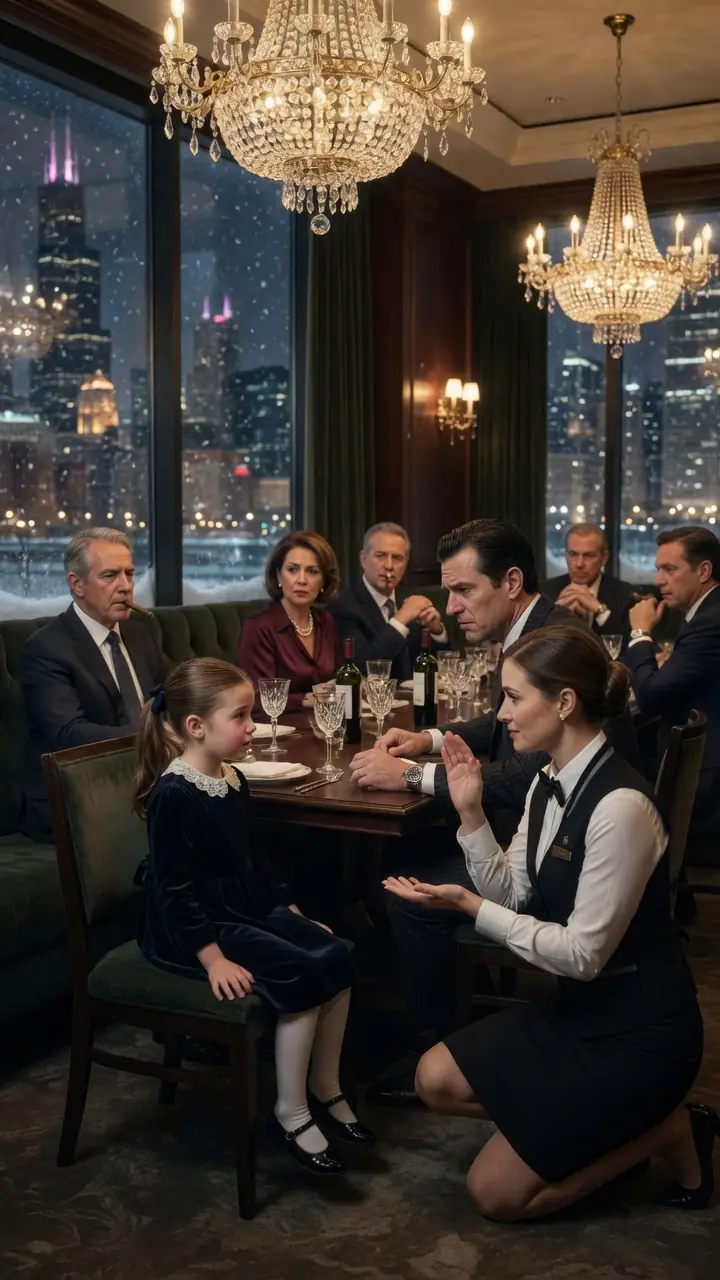
The third-floor private dining room had been reserved for a Korean investment group. 12 covers, white orchids, the good crystal, a menu that the kitchen had spent 3 days refining.
Renee had done the setup herself. She was pouring the first round of sparkling water when the double doors opened and Eugene Baek walked in.
She had heard the name before, in the way that people who pour water for the powerful hear names, carried on the underside of other conversations, attached to numbers that didn’t feel real.
Baek Capital.
17 billion in managed assets.
Offices in Seoul, London, and now a new Chicago headquarters whose lease had apparently been the most expensive commercial transaction in the city that quarter.
He was 40 years old.
He moved through the room the way powerful men move when they’ve stopped needing to perform power. Not slowly, not with drama, simply with the absolute assumption that the space would arrange itself around him.
He was also holding the hand of a small girl.
The child was perhaps 7 years old, slight, with dark eyes that moved in slow arcs around the room, the way an animal assesses new territory.
Not frightened. Not curious in any ordinary sense, but conducting a careful, systematic inventory.
She wore a navy dress and white stockings, and her hair had been pulled back with a precision that suggested someone else had done it for her with great care.
She walked beside her father without expression, neither resisting nor leaning into him, present in the room, but somehow sealed off from it, as if she had learned to keep herself in a separate container from whatever was happening around her.
Renee watched the room respond.
The investment associates found their seats with the practiced efficiency of people accustomed to these evenings. The senior managers moved toward Eugene with a particular warmth that proximity to money inspires.
And the little girl, quietly, without drama, without anyone acknowledging it was happening, was released from her father’s hand and guided to a chair at the far end of the table, near the window, at the edge of the conversation.
Not a real seat at the table. A place that said:
“You are here, but you are not part of this.”
Two other servers moved around the table, filling glasses, presenting bread.
Renee noticed how they adjusted their routes near the far end. Small, instinctive calibrations, the kind of rerouting people do when something makes them uncertain and they don’t know why.
The girl made people uncomfortable.
They couldn’t have explained it. They only knew they didn’t have the right tools for it, so they chose not to try.
Renee set her tray down on the sideboard.
She crossed the room.
She crouched down beside the chair until she was at eye level with the girl, which required a genuine effort given the heels she was required to wear.
And she looked at her directly.
Not with the sideways, slightly avoidant look that adults give children they’re uncertain about, but fully, openly, the way you look at someone you intend to speak to.
Up close, the child’s stillness was even more striking than it had appeared from across the room.
It was not the stillness of obedience or shyness.
It was the stillness of someone who had, at a very young age, developed a sophisticated system for processing the world from a protected distance.
She had learned to make herself very quiet inside the noise.
Whatever was going on behind those dark eyes was active and sharp and entirely her own.
Renee raised her right hand.
She formed the sign, simple and clear.
The flat B hand at her chin, moving outward.
In American Sign Language, the universal opening.
Hello.
The girl’s eyes sharpened immediately.
Her body did not move, not a centimeter, but something behind her face did.
A rapid interior rearrangement, as if someone had turned a light on in a room that had been dark.
She stared at Renee’s hand, then, slowly, at Renee’s face.
Back to the hand.
As if she was calibrating something, checking a reading she hadn’t expected to get.
Renee signed again, slower this time.
My name is Renee. What is yours?
The girl’s lips did not open.
But her right hand lifted just slightly from her lap, the movement barely perceptible, as if she wasn’t sure yet whether she was permitted to make it, and formed a single letter against her chest.
The letter S.
It was not a full answer, but it was an answer.
The first voluntary response to another person that Sena Baek had produced in this building in months.
Renee was still holding the smile when she became aware of the shadow falling across her from behind.
She stood.
Eugene Baek stood close enough that she had to look up, and he was looking at her with a particular expression of a man who has been trained to make decisions very quickly and is currently making one.
His jaw was set. His eyes were controlled, but underneath the composure, visible only because it moved before the composure could close over it, was something that looked very much like terror.
It was gone in less than a second.
If she hadn’t been looking directly at him, she would have missed it entirely.
“What do you think you’re doing?”
It was not a question. It was a statement arranged in the shape of one.
“I was saying hello to your daughter.”
“She doesn’t communicate with strangers.”
“She started to—”
The thing moved across his face again, sealed itself over.
“You are a server in this club. Your function is the table. You do not approach my daughter without my explicit permission. And you certainly do not—”
“I understand.”
She kept her voice completely level.
Not cold. Not apologetic. Level.
“She signed the letter S. I believe she was beginning to tell me her name.”
The silence that followed had a complicated texture.
Every person at that table was studying the tablecloth with extraordinary concentration.
Renee held his gaze for exactly one beat longer than was comfortable, then picked up her tray and returned to her station.
The manager’s summons came 11 minutes later.
When she walked out of the Whitmore Club that night, it was with an empty envelope where her next paycheck would have been, and the residue of a feeling she couldn’t name.
Not quite regret. Not quite rightness.
Something in between that she would think about on the bus home and still not be able to categorize.
Renee’s apartment in Pilsen was on the third floor of a building whose landlord described it as “full of character” and which Renee described as “cold for most of the year and very hot for the part that wasn’t.”
She had lived there for 3 years.
She knew which floorboards to avoid after 10:00 p.m., and which radiator pipe knocked at 2:00 in the morning, and which neighbor’s dog would bark at exactly 6:45 whether or not anyone had rung the bell.
It was small and imperfect and she had made a home of it through sheer insistence.
She sat at the kitchen table that Thursday night and ran the numbers she already knew by heart.
The way you return to a problem hoping the math has changed while you weren’t looking.
Rent was due in 11 days.
The invoice from the Northshore Rehabilitation Center in Evanston, her mother’s facility, the only one with the specific combination of neuro-rehabilitation and aphasia therapy that Diane Caldwell needed, was sitting on the counter with the total circled in the automatic red of a thing past due.
She had been working double shifts for 8 months to stay ahead of it.
She had believed, in a way she now recognized as fragile, that staying ahead was the same as being safe.
She had learned at 23 that safety was not a state you achieved.
It was a practice you maintained, and it required more than you expected, and it cost more than was fair, and it demanded the things you had set aside for yourself.
Her mother, Diane Caldwell, was 63 years old.
She had been a school librarian for 27 years in the Chicago public school system.
She had raised Renee alone after Renee’s father left when Renee was four, and she had done it with a kind of cheerful, unsentimental competence that Renee had spent years trying to understand and was still working on.
Two years ago, at 61, Diane had suffered a hemorrhagic stroke in the parking lot of the Jewel-Osco on Cermak Road.
A stranger had called the ambulance.
By the time Renee reached the hospital, her mother was in surgery.
The stroke had left Diane with significant mobility impairment on her left side and moderate aphasia, a condition that attacked the architecture of language specifically, leaving the person fully present in their own mind while making that mind difficult for others to access.
Renee knew the neuroscience of it in exact clinical detail.
She had studied it.
She had studied it because she had spent two years in the pre-med program at the University of Illinois-Chicago with the intention of becoming a neurologist before the stroke happened, and she sat in a hospital conference room and listened to a discharge planner explain the level of care her mother would need and calculated, in the space of that conversation, that she could not sustain a medical student’s income and her mother’s rehabilitation costs simultaneously.
The math had not been close.
She had withdrawn from UIC at 23.
She was 27 now.
The textbooks were in a sealed box in the closet.
She didn’t open the closet unless she needed her winter coat, and even then she kept her eyes on the coat.
The sign language was a remnant.
A clinical elective in her second year, a course designed for medical students who wanted to serve deaf and hard-of-hearing patients.
She had been genuinely good at it.
Her professor had told her she had unusual fluency for a hearing student. Something about the quality of attention she brought to what hands communicated when voices went quiet.
She hadn’t signed anything in 4 years.
The knowledge had lived somewhere below the level of conscious access.
The way the body holds things the mind releases.
And it had surfaced tonight without warning or intention.
Called up by the sight of a child sitting alone in a gilded room.
She visited her mother the next morning.
Diane was in her chair by the window, watching the street with the patient absorption of someone who had learned to find a whole world in a small frame.
She looked up when Renee came in.
And her face did the thing it always did when she saw her daughter.
A warmth so complete and uncomplicated that it sometimes felt like more than Renee knew what to do with.
They sat together for 2 hours.
Renee didn’t mention the job.
She talked about the spring starting. About a book she’d been working through. About a cardinal she’d seen on the fire escape that week.
Her mother listened and occasionally squeezed her hand.
And on a good language day, which this was, moderately, offered fragments in return.
Words that arrived in the right order or in a different but still navigable order.
Building meaning from the available materials.
They had developed, over 2 years, a fluency in each other’s gaps.
It was its own kind of language.
On the bus back to Pilsen, her phone rang with a number she didn’t recognize.
She almost didn’t answer.
She almost let it go to voicemail.
Which would have meant a different story.
But something, the quality of the silence from the night before, the letter S forming slowly against a small chest, made her pick up.
He was standing on the sidewalk in front of her building when she arrived home.
Which meant he’d been waiting.
He had not sent a representative or an assistant or a car.
He had come himself, which she noted and did not quite know what to do with.
In the gray morning light of a Pilsen street, Eugene Baek looked different than he had in the Whitmore dining room.
Not diminished, exactly, but reconfigured.
The authority was still present, structural, the kind you don’t put on and take off, but the smooth executive finish had worn thinner overnight.
There were marks under his eyes that spoke to no sleep.
His posture, still precise, was working harder than it had been the night before.
He spoke before she could.
“I want to hire you as a caregiver for my daughter. Live-in arrangement, Monday through Friday. The compensation—”
“No.”
A beat of surprise.
A man who rarely encountered that syllable.
“You haven’t heard the figure.”
“You humiliated me in front of 12 people because I said hello to a child who was being ignored at her own father’s table. I don’t need to hear a figure.”
He looked at her for a moment with something she couldn’t categorize.
It lived in the neighborhood of discomfort and something adjacent to respect.
“12,000 dollars per month. Full health coverage, including for one dependent.”
Renee kept her face completely still.
$12,000 a month was more than 14 months of what she had been making.
Health coverage for a dependent was her mother’s rehabilitation costs removed from the hemorrhaging category and placed somewhere manageable.
She let none of this reach her expression.
“Why me?”
“It’s not about the money.”
He was quiet for a moment.
What came next had the quality of a man reading from a script he finds personally humiliating, but has decided to read anyway because the alternative is worse.
“My daughter’s name is Sena. She is 7 years old. She has not produced voluntary speech since she was 3. I have engaged 14 specialists across three countries. Every intervention has produced no sustainable response.”
He stopped.
Something moved in his throat.
“Last night was the first time in 8 months that she offered a communication to another person without being directly prompted.”
“You produced that in under 40 seconds.”
Renee looked at him.
Past the posture. Past the control.
“What happened to her?”
“When she was 3.”
The composure sealed over something immediately.
Like watching a window close.
“That information is classified for the purposes of this conversation.”
“It isn’t classified for me. If you want me working with her, I need to understand what I’m working with.”
“Ms. Caldwell.”
The weight of his voice when he wanted to end a discussion was considerable.
“My daughter requires someone who can communicate with her. I am offering you the means to care for whoever you were visiting this morning in Evanston.”
He paused on that, letting her know he had done his research, done it overnight, done it before coming here.
“One condition. You operate within the therapeutic protocols that Dr. Park has established. You do not freelance. You do not discuss her history externally.”
“One condition from me.”
Renee kept her voice level.
“You don’t supervise how I connect with her. What happened last night, whatever that was, it happened because I wasn’t performing for an audience. You want that for Sena? You give me the room to do it.”
The look on his face was that of a man swallowing something large and dry.
“Agreed.”
“I’ll start Monday.”
She went inside without looking back.
She sat at her kitchen table for a long time afterward.
Not doing anything.
Just sitting with the particular feeling of a door opening onto a room whose contents she couldn’t yet see.
The Baek residence sat on 14 acres along the North Shore of Lake Michigan, hidden behind wrought iron gates and a tree line deliberately cultivated to make the property invisible from the road.
It was less a house than an ecosystem of wealth.
Three structures connected by glass corridors. Limestone exterior. Floor-to-ceiling windows that somehow managed to feel both open and fortified.
Renee arrived Monday morning at 7:12 carrying one overnight bag and a level of self-awareness she found irritating.
She knew exactly how she looked walking toward that front entrance.
Working-class woman from Pilsen stepping into a world designed by people who had never once checked a bank balance before buying groceries.
She had spent enough years moving through wealthy spaces professionally to recognize the architecture of exclusion when she saw it.
Nothing in the Baek house was accidental.
Not the silence. Not the lighting. Not the distance between rooms.
Even the air smelled curated.
A housekeeper named Marta led her through the main hall with the brisk efficiency of someone who had learned not to linger in rooms she did not belong to.
“Mr. Baek leaves for the office at eight. Sena’s breakfast is usually at seven-thirty. Dr. Park arrives Wednesdays and Fridays.”
Marta glanced at her briefly.
“The child does not respond well to sudden noise.”
“The child has a name,” Renee said calmly.
Marta blinked once, then looked forward again.
“Yes. Of course.”
They passed a music room no one seemed to use, a dining room large enough to host diplomatic negotiations, and a library with shelves so pristine Renee knew immediately that most of the books had been selected by an interior designer rather than a reader.
The house felt occupied but not lived in.
Like a museum preserving the idea of a family.
Marta stopped outside a set of double doors.
“Sena’s suite.”
Suite.
Not bedroom.
Renee nodded once and entered quietly.
The room surprised her.
Not because it was luxurious, though it was, but because it contained actual evidence of a child.
Books stacked unevenly beside the bed. Colored pencils sorted by shade. A partially completed puzzle on the floor near the windows.
Tiny signs of private systems.
Sena sat cross-legged on the rug in front of the puzzle wearing soft gray leggings and a navy sweater.
She did not look up immediately when Renee entered.
But Renee saw the awareness happen anyway.
The small shift in posture. The recalibration.
“She remembers you,” a voice said from behind.
Renee turned.
Dr. Hannah Park stood near the doorway holding a tablet.
Late forties. Immaculately dressed. Controlled in the particular way high-performing clinicians often are when they have spent years managing other people’s emotional catastrophes.
“She remembers everything,” Dr. Park continued. “She simply chooses very selectively what she responds to.”
Renee looked back at Sena.
The child had lifted one hand slightly from the puzzle.
Watching.
Waiting.
Renee crouched slowly to the floor again.
No sudden movements.
No performance.
Just presence.
She signed carefully.
Good morning.
Sena’s eyes sharpened instantly.
Three seconds passed.
Then, slowly, Sena signed back.
Morning.
The movement was small, economical, but unmistakable.
Dr. Park went completely still behind them.
Renee kept her face neutral even though something moved sharply through her chest.
Because this was no longer accidental.
Sena knew ASL.
Not fluently perhaps, but intentionally.
Which meant someone had taught her.
Which meant someone had decided communication mattered once.
Renee signed again.
Did you sleep okay?
Sena looked at her hands before answering.
Then:
No nightmares.
Dr. Park inhaled sharply behind them.
“You’ve never signed that to me before,” she said quietly.
Sena’s body tightened immediately.
The shutdown happened so fast Renee almost missed it.
Shoulders locking.
Hands withdrawing.
The room temperature emotionally dropping ten degrees.
Renee stood smoothly before Dr. Park could continue.
“She’s telling you something important.”
Dr. Park frowned slightly.
“What?”
“That she doesn’t feel safe being observed while communicating.”
Silence.
Dr. Park’s expression cooled almost imperceptibly.
“I’ve worked with selective mutism and trauma adaptation for 19 years, Ms. Caldwell.”
“I know.”
Renee kept her tone respectful.
“But right now she’s not responding to expertise. She’s responding to pressure levels.”
Dr. Park studied her carefully now.
Evaluating.
Possibly irritated.
Possibly intrigued.
“What exactly are your qualifications?”
Renee met her gaze evenly.
“Two years pre-med at UIC before my mother’s stroke.”
A beat.
“Neurology track.”
Something shifted in Dr. Park’s expression.
Not respect exactly.
Recognition.
“You left the program.”
“My mother needed care.”
Dr. Park nodded once slowly.
The conversation paused there because both women understood the shape of sacrifice too well to require explanation.
Behind them, Sena quietly moved one puzzle piece into place.
The soft click sounded unnaturally loud in the room.
Renee turned back toward her.
And for the first time noticed the puzzle itself.
Not cartoon animals. Not landscapes.
Human anatomy.
Specifically the neural pathways of the brain.
A seven-year-old child assembling synaptic structures in silence.
Renee felt cold suddenly.
She signed gently.
Who gave you this puzzle?
Sena’s hands hesitated.
Then:
Mom.
The room stopped.
Dr. Park looked down immediately.
Renee felt something shift hard beneath the surface of the conversation.
Because Eugene Baek had never mentioned Sena’s mother.
Not once.
And the way Dr. Park suddenly avoided eye contact told Renee exactly one thing.
The mother was not absent in any ordinary way.
Before she could ask another question, footsteps approached down the hallway.
Measured. Precise.
Eugene.
Sena heard them too.
The transformation was immediate.
The child’s entire body folded inward emotionally before the man even entered the room.
Not fear exactly.
Anticipation.
Like someone bracing for weather.
Eugene appeared in the doorway adjusting the cuff of his watch.
His eyes moved first to Sena, then to Renee, then finally to Dr. Park.
“What happened?”
Dr. Park answered carefully.
“She signed voluntarily again.”
A pause.
Eugene looked at Sena.
Not smiling.
Not warm.
But something inside his face loosened fractionally.
Then he looked at Renee.
“She ate?”
“Not yet.”
“I’ll stay for breakfast.”
The sentence changed the room instantly.
Dr. Park looked surprised.
Marta nearly stopped walking in the hallway outside.
Sena’s hands froze over the puzzle pieces.
Renee understood immediately.
He never stayed.
Breakfast was served in a smaller private dining room overlooking the lake.
Sena sat at one end of the table.
Eugene at the other.
Too much distance between them for a room that small.
Renee sat quietly beside Sena while staff moved in near silence around them.
Eugene read emails from a tablet while drinking black coffee.
Sena picked apart toast methodically into perfect squares she never actually ate.
No one spoke.
Not because conversation had ended.
Because it had apparently never existed here to begin with.
Renee watched them carefully.
The child stealing tiny glances toward her father when she thought no one noticed.
Eugene never looking up long enough to catch them.
A family orbiting grief without language for it.
Finally Renee signed softly beneath table level where only Sena could see.
Do you want jam?
Sena looked at her.
Then nodded once.
Renee reached for the jar and handed it over casually.
Tiny accommodation.
Tiny recognition.
But Sena’s fingers paused around the jar like someone unaccustomed to being noticed before needing to ask.
Across the table, Eugene finally looked up.
His eyes landed on Sena’s hands.
Then on Renee.
And for one brief unguarded second, Renee saw something underneath all the control.
Not coldness.
Exhaustion.
The profound exhausted terror of a man losing his child one silence at a time while having absolutely no idea how to reach her.
Eugene left for the office at 8:17.
Renee noticed because the house changed the second he was gone.
Not visibly.
Energetically.
The staff exhaled. Doors opened more freely. Marta even hummed once under her breath while clearing breakfast plates before catching herself and stopping immediately.
Sena noticed too.
The child’s shoulders lowered almost imperceptibly after the front doors closed.
Renee pretended not to see it.
She had learned years ago that children trusted you faster when you didn’t force them to defend their coping mechanisms.
Dr. Park stayed another hour reviewing schedules and therapeutic structures.
Speech intervals.
Sensory regulation windows.
Controlled exposure exercises.
Everything color-coded and clinically pristine.
Renee listened carefully.
The systems themselves weren’t bad.
That was the strange part.
Nothing in the Baek household appeared intentionally cruel.
It was simply optimized to death.
Every emotional interaction filtered through management strategies until no one remembered how to behave naturally anymore.
When Dr. Park finally left, the house became quiet in a more honest way.
Just Renee and Sena in the enormous lake-facing sitting room.
Rain had started outside.
Thin gray streaks against the glass.
Sena sat on the floor drawing with charcoal pencils.
Not children’s sketches.
Architectural lines.
Windows. Hallways. Staircases.
The same house over and over from different angles.
Renee watched for a while before speaking.
“You like maps.”
Sena’s pencil paused.
Then her hands moved carefully.
Not maps.
Exits.
The word hit Renee harder than she expected.
She crouched slowly nearby.
“Exits from what?”
Sena stared at the paper.
No answer.
But her fingers tightened slightly around the charcoal.
Renee let the silence breathe.
After nearly a minute, Sena signed again.
Loud voices.
Something cold moved through Renee’s stomach.
“Does your father yell?”
Immediate head shake.
Too fast.
Not fear.
Correction.
Then Sena signed:
Not anymore.
Renee stayed very still.
Children rarely volunteered information in straight lines.
Trauma came sideways.
In fragments.
In nervous system leaks.
She signed gently.
Who yelled?
Sena’s pencil snapped in her hand.
The sound was tiny but sharp.
Her entire body froze afterward.
Eyes distant suddenly.
Gone somewhere else.
Renee recognized it immediately.
Dissociation.
Not dramatic.
Not cinematic.
Quiet disappearance.
The kind that happens when a nervous system leaves before the body can.
Renee shifted closer slowly but didn’t touch her.
“Hey.”
Nothing.
“Sena.”
The child’s breathing had changed.
Too shallow.
Renee lowered herself fully to the floor beside her.
Then very calmly signed one thing.
Look at me.
Three long seconds.
Then Sena blinked hard once and returned.
Like surfacing through water.
Tears stood suddenly in her eyes, though she didn’t seem aware of them yet.
Renee handed her the clean cloth from the art tray without comment.
No fuss.
No “it’s okay.”
Children who lived inside control often panicked when adults made emotions too visible.
Sena wiped her face mechanically.
Then signed without looking up:
Sorry.
Renee frowned softly.
“For what?”
Making problems.
The sentence was so practiced it hurt to see.
Renee leaned back against the sofa quietly.
“Who taught you that?”
Sena didn’t answer.
Because she didn’t need to.
The house had.
That evening, Renee found the first photograph by accident.
She was helping Marta organize the upstairs linen cabinets when a storage box slipped sideways from the top shelf.
Photographs scattered across the hardwood floor.
Marta swore softly under her breath and immediately crouched to gather them.
Too quickly.
Renee caught one before she could.
A woman holding Sena as a baby near Lake Michigan.
Dark hair.
Sharp intelligent eyes.
Laughing directly at the camera.
Not posed.
Real joy.
The kind wealthy families almost never captured honestly because they were too busy curating themselves.
Sena’s mother.
Renee looked down at the bottom corner.
The date.
Four years earlier.
Which meant the mother had not died when Sena stopped speaking.
Interesting.
Marta reached for the photo too fast.
“Please.”
Renee looked up.
Marta’s face had gone pale.
“Mr. Baek does not like staff discussing Mrs. Baek.”
“Where is she?”
“I shouldn’t say.”
“Is she alive?”
Marta hesitated.
That was answer enough.
Renee carefully handed the photograph back.
“Marta.”
The older woman looked exhausted suddenly.
Like someone carrying knowledge too heavy to hold comfortably anymore.
“She left the house three years ago,” Marta whispered finally.
“After the accident.”
Renee felt her pulse sharpen.
“What accident?”
Marta immediately shook her head.
“I already said too much.”
But Renee’s mind was already moving.
Sena stopped speaking at three.
The mother disappeared around the same time.
And nobody in this house used her name aloud.
Not grief.
Erasure.
Very different thing.
That night, after Sena fell asleep, Renee walked past Eugene’s office on her way to the guest wing.
The door stood partially open.
Inside, Eugene sat alone at his desk in near darkness except for the glow of one lamp.
Not working.
Just sitting there staring at something in his hands.
Renee almost kept walking.
Then she saw what he was holding.
A child’s hair ribbon.
White silk.
Tiny.
His entire posture looked different when he thought no one could see him.
Not powerful.
Devastated.
The sound of the floorboard betrayed her.
Eugene looked up instantly.
Everything closed again.
Controlled. Composed.
“Couldn’t sleep?” he asked.
Renee leaned lightly against the doorway.
“Your daughter dissociated today.”
Something flickered behind his eyes.
“What triggered it?”
“She mentioned loud voices.”
Silence.
Lake rain tapped softly against the windows.
Eugene set the ribbon down carefully on the desk.
“She used to speak constantly,” he said quietly.
Renee stayed still.
“She spoke three languages before kindergarten.”
His voice sounded strange now.
Like someone walking barefoot across broken glass internally.
“And then one day…”
He stopped.
Couldn’t finish.
Renee looked at him carefully.
“What happened in this house?”
The silence stretched so long it almost became its own answer.
Finally Eugene spoke without looking at her.
“Have you ever loved someone enough to become dangerous?”
Renee frowned slightly.
“That depends what you mean by dangerous.”
A humorless smile touched his mouth briefly.
“Yes.”
Then he looked up fully.
And for the first time since meeting him, Renee saw the truth beneath all the control.
Not arrogance.
Punishment.
A man who had built an empire because empires were easier to manage than grief.
“I made one mistake,” Eugene said softly.
“And my daughter has been living inside the consequences ever since.”
Renee did not sleep much that night.
The guest room overlooked the lake, and sometime after midnight she gave up pretending rest was coming and sat beside the window watching rain move across the black water.
One mistake.
People always said sentences like that when the truth was too large to carry whole.
By morning, the house had resumed its careful choreography.
Marta preparing breakfast.
Staff moving silently through hallways.
Eugene already dressed for work in another immaculate suit that looked engineered rather than tailored.
And Sena sitting at the breakfast table folding the corner of a napkin into increasingly smaller triangles.
Renee watched her quietly.
Children told the truth with their hands long before they trusted their mouths.
Eugene drank coffee while reviewing documents on a tablet.
No conversation.
No acknowledgment of the previous night.
Until suddenly Sena signed beneath the table toward Renee.
You asked too many questions.
Renee blinked once.
Then signed back.
About your mother?
Tiny nod.
Renee glanced briefly toward Eugene.
He hadn’t seen.
Or pretended not to.
She looked back at Sena.
Do you miss her?
The child’s fingers froze against the napkin.
For one awful second, Renee thought she’d pushed too hard.
Then slowly, carefully, Sena signed:
I remember her voice more than her face now.
Renee felt her chest tighten painfully.
Because no seven-year-old should know that sentence.
Across the table, Eugene looked up suddenly.
Not because he understood the signing.
Because he understood his daughter’s expression.
“Sena.”
The child immediately withdrew her hands into her lap.
Gone again.
Eugene’s jaw tightened.
“What did she say?”
Renee held his gaze for a moment.
“She misses her mother.”
Silence.
Heavy enough to alter the room temperature.
Eugene looked down at the untouched breakfast in front of his daughter.
Then quietly:
“She has a tutor arriving at ten.”
And just like that, the wall returned.
Deflection through scheduling.
Control through structure.
Renee almost said something sharper than she should have.
Instead she asked calmly:
“Why does nobody in this house say your wife’s name?”
Eugene stood slowly from the table.
The movement alone carried warning.
But beneath it, exhaustion again.
Not anger.
The fatigue of a man holding shut a door that wanted desperately to burst open.
“Because every time my daughter hears it,” he said quietly, “she stops eating for three days.”
Then he walked out.
The front door closed seconds later.
Sena stared down at the folded napkin in her hands.
Renee waited.
Eventually the child signed very small:
That part is true.
The tutor arrived at exactly ten.
Olivia Mercer.
Early thirties. Expensive coat. Smile calibrated to reassure wealthy parents.
She greeted Sena brightly enough that Renee knew immediately Sena hated her.
Not because Olivia was cruel.
Because children who had experienced trauma developed near supernatural sensitivity to performance.
And Olivia performed warmth instead of inhabiting it.
“Sena, ready for vocabulary review today?”
No response.
Olivia continued anyway.
“Wonderful.”
Renee sat quietly near the windows pretending to organize reading materials while observing the lesson.
Thirty minutes later she understood the problem.
Everyone around Sena treated communication as achievement.
A thing to extract.
A symptom to improve.
No one treated it as relationship.
Olivia held up flashcards.
“What emotion is this?”
Sena stared silently.
“Happy?”
Nothing.
“Sad?”
Nothing.
Olivia’s smile tightened microscopically.
Renee recognized the exact moment professional patience begins slipping toward frustration.
Then Olivia tried the wrong thing.
“Sena, if you participate, maybe your father will stay home for dinner tonight.”
The room changed instantly.
Sena’s entire body locked.
Renee stood immediately.
“Stop.”
Olivia blinked.
“What?”
“You just turned affection into a reward system.”
Olivia’s face hardened slightly.
“I’m following behavioral reinforcement protocol.”
“You’re weaponizing attachment.”
Silence.
Olivia laughed once in disbelief.
“I’m sorry, are you the clinician now?”
“No.”
Renee kept her voice calm.
“But I know what happens when children start believing love has to be earned through performance.”
Sena had gone completely motionless now.
Eyes distant again.
Olivia crossed her arms.
“Mr. Baek approved these methods.”
“That doesn’t make them healthy.”
The tension stretched.
Finally Olivia gathered her materials sharply.
“I’ll discuss this directly with Dr. Park.”
“Good.”
After Olivia left, the room stayed quiet for a long time.
Rain moved softly across the lake outside.
Then Sena signed without looking up:
You fight adults a lot.
Renee almost smiled.
“Only the wrong ones.”
That earned the faintest twitch at the corner of Sena’s mouth.
Not quite a smile.
But close enough to matter.
Later that afternoon, Renee found the second fracture in the story.
She was helping Sena shelve books in the library when the child suddenly pulled one volume halfway free, then froze.
Renee looked closer.
Inside the book, hidden flat between pages, was a photograph.
Not posed.
Security camera quality.
Blurry.
Eugene standing in what looked like a hospital corridor holding Sena tightly against his chest while she screamed.
Not crying.
Screaming.
The timestamp read:
October 14th — 11:43 PM.
Three years earlier.
Renee’s pulse sharpened.
“Sena.”
The child immediately tried taking the photo back.
Too late.
Renee had already seen the woman in the background.
Dark hair.
Hospital gown.
Being physically restrained by two orderlies.
Sena’s mother.
Alive.
Fighting.
Renee looked slowly at Sena.
“What happened that night?”
The child’s breathing changed immediately.
No answer.
Then quietly, trembling slightly:
Mommy tried to leave.
Cold moved through Renee’s entire body.
“Leave where?”
Sena’s eyes filled instantly.
Not with confusion.
Memory.
Then came the sentence that changed everything.
Dad said she wasn’t safe anymore.
The library suddenly felt airless.
Renee stared at the child in front of her.
At the carefully controlled house.
At the silence around the missing mother.
And for the first time since arriving, a thought entered her mind fully formed and terrifying:
What if Eugene Baek wasn’t protecting his daughter from trauma?
What if he was protecting himself from the truth about what he had done?
Renee spent the next two hours functioning normally through pure force of training.
Dinner with Sena at six.
Reading interval at seven.
Sensory decompression exercises before bed.
Externally, nothing changed.
Internally, every piece of information she’d collected since entering the Baek house had begun rearranging itself into a shape she did not like.
Missing mother.
Hospital restraint.
A child who stopped speaking immediately afterward.
A father who monitored every variable except grief itself.
And underneath all of it, the unmistakable emotional atmosphere of a house built around an event no one was allowed to describe honestly.
At 8:14 p.m., Sena fell asleep on the window seat in the library with a book open against her chest.
Renee carefully lifted the book away.
The child stirred slightly but didn’t wake.
Up close in sleep, Sena looked younger.
Trauma aged children strangely when they were awake.
It made them carry too much architecture internally.
Renee draped a blanket gently over her and turned off the reading lamp.
She was halfway down the hallway when Eugene’s voice stopped her.
“You’ve changed her schedule.”
He stood near the staircase in shirtsleeves instead of his usual suit jacket.
One hand loosened at his collar.
Still controlled. Still intimidating.
But tired enough now that the edges showed.
“I moved the language drills.”
“You removed two entirely.”
“They were increasing anticipatory stress.”
Silence.
“You’ve been here four days.”
“And in four days she’s voluntarily signed more than your records show in the previous six months.”
The words landed harder than Renee intended.
Eugene’s eyes sharpened slightly.
Not anger.
Defensiveness.
The kind powerful people develop when competence becomes inseparable from identity.
“You believe everyone around her is failing her.”
“I think everyone around her is trying so hard to fix her that no one notices she’s adapting exactly the way traumatized children adapt when adults refuse to tell the truth.”
That hit.
Directly.
Renee saw it.
The smallest shift in breathing.
Eugene looked away first.
Toward the dark windows overlooking the lake.
“You don’t know what happened.”
“No,” Renee said quietly. “Because nobody will say it.”
Silence stretched.
Then Eugene asked something unexpected.
“Do you know what the worst part of power is?”
Renee folded her arms lightly.
“Enlighten me.”
“It creates the illusion that if you make enough correct decisions, tragedy becomes negotiable.”
His voice sounded distant now.
“You begin believing competence can outrun catastrophe.”
Renee stayed still.
“And then one day you discover there are some things intelligence cannot save.”
The house felt enormous around them.
Empty in all the expensive ways loneliness becomes when wealth amplifies it.
Finally Renee asked carefully:
“Did your wife hurt Sena?”
Eugene’s head turned sharply.
“No.”
Immediate.
Absolute.
The strongest emotional reaction she had seen from him yet.
Renee watched closely.
“Did she hurt herself?”
That one took longer.
Not because he didn’t know.
Because he did.
And knowing cost him.
“She was diagnosed bipolar at 29,” he said quietly.
“She hid the severity for years.”
Renee’s chest tightened slightly.
“She had episodes?”
“Yes.”
His jaw worked once before continuing.
“The night everything changed, she stopped taking medication.”
The air in the hallway suddenly felt thinner.
“She became convinced people inside the house were watching Sena.”
Renee frowned.
“What people?”
“She couldn’t explain coherently.”
His eyes darkened with memory.
“She thought security cameras were hidden in the walls. That staff members were reporting on Sena’s behavior. That someone intended to take her away.”
Renee felt cold again.
Because paranoia explained some things.
But not all things.
“And what happened?”
Eugene closed his eyes briefly.
“When I got home, she was trying to leave the property with Sena at nearly midnight during a manic episode.”
His voice roughened.
“She drove through the front gate.”
Renee’s stomach dropped.
“The accident.”
“Yes.”
Another silence.
Longer now.
“The car flipped near Sheridan Road.”
Renee stared at him.
“Sena was inside.”
Eugene nodded once.
“She survived physically.”
The sentence itself carried unbearable weight.
“And your wife?”
This time he didn’t answer immediately.
When he finally spoke, the words came almost mechanically.
“She survived the crash.”
Something inside Renee tightened hard.
Not because of what he said.
Because of what he didn’t.
Survived.
Present tense absent.
“She’s institutionalized,” Renee said quietly.
Eugene looked at her sharply.
Not surprise.
Recognition.
“You investigated.”
“I listened.”
The lake water outside moved black beneath the moonlight.
Finally Eugene spoke again.
“She attempted suicide twice after the accident.”
Renee closed her eyes briefly.
“Jesus.”
“She cannot legally care for Sena.”
The way he said it sounded rehearsed.
Courtroom language.
Medical language.
Protective language.
Not husband language.
Not grief language.
Renee opened her eyes again slowly.
“And Sena blames you.”
Something fractured visibly across his expression then.
Tiny.
Fast.
But devastating.
“She watched them take her mother away.”
Now the truth finally sat fully in the room between them.
Not hidden anymore.
Not erased.
A seven-year-old child had watched adults physically separate her from her mother after a traumatic accident.
And afterward, every adult in her life had decided silence was safer than explanation.
No wonder she stopped speaking.
Renee leaned lightly against the staircase railing.
“You know what selective mutism often is?”
Eugene looked exhausted suddenly.
“What?”
“A nervous system deciding language is dangerous.”
The sentence landed deep.
Because it was true for more than just Sena.
Eugene stared toward the dark hallway leading to his daughter’s room.
“When she stopped talking,” he said quietly, “I thought if I controlled everything tightly enough, eventually she’d feel safe again.”
Renee’s voice softened despite herself.
“But control isn’t safety.”
He laughed once under his breath.
No humor in it.
“I know that now.”
The problem was, Renee realized suddenly, Eugene Baek loved his daughter desperately.
That was not the issue.
The issue was that powerful men often confused protection with possession.
He had tried to build walls strong enough to prevent further damage.
And accidentally trapped his daughter inside them.
Upstairs, a floorboard creaked softly.
Both of them looked up instinctively.
Sena stood halfway down the staircase in oversized pajamas holding the blanket around herself.
She had heard enough.
Her eyes moved between Renee and her father carefully.
Then, slowly, trembling slightly, Sena signed something toward Eugene directly.
The first sign she had ever voluntarily offered him in front of another person.
Eugene froze.
Renee translated quietly.
“She said…”
Her own throat tightened unexpectedly.
“She said she wants her mom.”
The silence afterward nearly broke the house apart.
Eugene stood perfectly still at the bottom of the stairs while his daughter looked at him with years of grief trapped behind her eyes.
And for the first time since the accident, there was nowhere left for the truth to hide.
Nobody moved.
The house held its breath around them.
Sena stood frozen halfway down the staircase, small hands clenched tightly in the blanket, dark eyes fixed on her father with the terrifying stillness of a child who had finally risked wanting something out loud.
Eugene looked like he’d been physically struck.
Not dramatic.
Not cinematic.
Just the quiet devastation of a man realizing the wall he built to protect his daughter had become the exact thing separating her from the one thing she still needed.
Renee stayed completely silent.
Some moments collapse if another person touches them too quickly.
Sena signed again, slower this time.
Please.
The movement of her hands trembled near the end.
Eugene’s throat worked visibly.
“She can’t see her right now.”
Renee closed her eyes briefly.
Wrong answer.
Sena’s face changed immediately.
Not tantrum. Not anger.
Withdrawal.
The emotional door slamming shut in real time.
She turned to go back upstairs.
“Wait.”
Eugene’s voice cracked on the word.
That seemed to surprise him as much as anyone.
Sena stopped halfway up the stairs but didn’t turn around.
Eugene stood there looking at the child he loved more than anything in the world and realizing love by itself had not been enough to save either of them.
“When your mother left the house that night…”
He stopped.
Restarted.
“She wasn’t trying to leave you.”
Sena stayed motionless.
Eugene’s hands tightened at his sides.
“She thought she was protecting you.”
The silence deepened.
Renee watched Sena carefully.
The child’s breathing had changed.
Small. Shallow.
Listening with her entire body now.
Eugene spoke slowly, like every sentence had to force its way through years of concrete.
“I told you she was sick because I thought that would make it easier.”
His voice roughened.
“But the truth is…”
He swallowed hard.
“The truth is she was scared.”
Sena turned slightly then.
Not fully.
Enough.
Eugene looked up at her.
“And after the accident, I was scared too.”
There it was.
Not polished. Not managed.
Truth.
Raw enough to finally breathe.
“I thought if I kept everything controlled, if I kept every routine perfect, if I removed anything unpredictable…”
His eyes filled unexpectedly.
“…then maybe nothing bad would happen again.”
Renee felt something shift in the house itself.
As if honesty altered the architecture.
Sena signed one word.
Why?
Eugene frowned slightly.
Renee translated quietly.
“She’s asking why her mother couldn’t come home.”
The pain that crossed his face then looked ancient.
Because how do you explain institutionalization to a seven-year-old when you barely survived understanding it yourself?
Finally he answered honestly.
“Because your mother became too sick to know when things were real.”
Sena stared at him.
Then slowly signed:
But she still loved me.
Eugene closed his eyes.
“Yes.”
Immediate.
Certain.
“She loved you every second.”
The child’s face crumpled instantly after that.
Not loudly.
No dramatic crying.
Just silent tears sliding down while she stood gripping the stair railing like the world had tilted under her feet.
And Eugene finally moved.
Not carefully.
Not strategically.
Just instinct.
He crossed the room and dropped to his knees at the bottom of the staircase directly in front of her.
Same eye level.
Same height.
No power.
No distance.
“I’m sorry,” he whispered.
Renee felt her own throat tighten unexpectedly.
Because some apologies arrive years late but still matter.
Sena stared at her father for a long moment.
Then very slowly descended the remaining stairs.
One at a time.
Until she stood directly in front of him.
Eugene looked terrified suddenly.
Not of her.
Of failing again.
Then Sena did something Marta later claimed she had not seen in over three years.
She reached for him first.
Tiny arms around his shoulders.
Tentative.
Fragile.
But voluntary.
Eugene broke.
Completely.
Not loudly.
The worst grief rarely is.
He buried his face against his daughter’s shoulder while his entire body shook once with the force of everything he had spent years refusing to feel.
Renee quietly turned away toward the windows.
Privacy disguised as professionalism.
Outside, Lake Michigan moved dark and endless beneath the night sky.
Behind her, Sena signed something softly against her father’s shoulder.
Eugene pulled back slightly.
“What did she say?”
Renee looked over.
Sena’s eyes were red but steady now.
“She said…”
Renee smiled faintly through the ache in her chest.
“She doesn’t want everyone pretending her mother disappeared anymore.”
Silence followed.
Not suffocating this time.
Clearing.
Like a storm finally exhausting itself.
Eugene nodded slowly.
“Okay.”
The word sounded unfamiliar in his mouth.
Like surrender.
Like relief.
The next morning, for the first time in three years, someone in the Baek household spoke Mina Baek’s name out loud at breakfast.
Marta dropped a spoon when it happened.
Dr. Park went completely still.
Sena looked up sharply from her cereal.
Eugene kept his eyes on the table as he said it.
“Your mother liked that jam too.”
Simple sentence.
Nothing dramatic.
But the emotional impact moved through the room like an earthquake.
Because erased people do not stop existing.
They simply haunt every silence louder and louder until someone finally says their name again.
Sena signed it immediately after.
Mom.
Then, carefully:
Mina.
Renee watched the child’s shoulders lower afterward.
A nervous system unclenching one truth at a time.
That afternoon, Eugene canceled every nonessential meeting and stayed home.
Not hovering.
Not managing.
Present.
He sat on the library floor while Sena worked on her anatomy puzzle.
At one point she silently handed him a piece without looking up.
He took it like someone being trusted with something sacred.
Renee stood in the doorway pretending not to notice the tears gathering briefly in his eyes.
Later, while Sena napped, Eugene found Renee in the kitchen making tea.
“She asked to visit her mother.”
Renee looked up.
“And?”
“She hasn’t asked directly in almost two years.”
The lake sunlight moved softly across the marble counters.
Eugene leaned against the island heavily.
“I don’t know if seeing Mina helps her heal or destroys the progress she’s making.”
Renee stirred the tea quietly.
“You keep talking like healing is fragile.”
He looked tired enough now to tell the truth.
“Isn’t it?”
Renee thought about her mother relearning words after the stroke.
About Sena relearning trust.
About herself quietly burying medical school because survival had required it.
Then she shook her head.
“No.”
She handed him the tea.
“Healing’s actually brutal.”
Eugene looked at her carefully.
“What does that mean?”
“It means real healing survives honesty.”
The words settled deep.
Because somewhere underneath all the wealth and power and control, Eugene Baek had spent three years trying to protect his daughter from reality itself.
And reality had nearly swallowed her anyway.
That evening, Sena signed a full sentence to her father for the first time since she was four years old.
It happened quietly while the three of them sat near the lake windows watching rain move across the water.
No audience.
No therapist.
No pressure.
Sena looked at Eugene and signed carefully, slowly, with trembling concentration:
Did you miss her too?
Eugene stared at his daughter like his heart had stopped.
Then, after a long moment, he answered the only way that mattered.
Honestly.
“Every day.”
And for the first time since entering the Baek house, Renee realized something extraordinary.
The silence inside this family had never been emptiness.
It had been grief waiting for permission to speak.
The psychiatric facility sat 40 minutes north of Chicago behind iron fencing and carefully landscaped trees designed to soften the reality of what the building was.
Institutions always tried to look gentler from the outside.
As if architecture could negotiate with grief.
Sena sat in the back seat beside Renee during the drive, hands folded tightly in her lap the entire way.
She had not spoken.
Not signed much either.
But the silence felt different now.
Not shut down.
Preparing.
Eugene drove.
Both hands fixed at ten and two on the steering wheel like maintaining physical control might prevent emotional collapse.
Renee watched him carefully from the passenger seat.
He had barely slept.
Again.
But something fundamental had shifted since the night on the staircase.
The control was no longer airtight.
Cracks had formed.
And through those cracks, actual humanity was finally entering the house.
The facility itself was immaculate.
Private funding.
Discreet security.
Soft music in the lobby.
The kind of place wealthy families selected when they needed suffering handled elegantly.
A nurse led them through two secured doors and down a long corridor lined with watercolor paintings clearly chosen by committee.
Sena slowed slightly near room 214.
Not resisting.
Bracing.
Eugene noticed immediately.
“You don’t have to do this if you’re not ready.”
Sena looked up at him.
Then signed carefully:
I’ve been ready.
The sentence hit hard enough that Eugene physically looked away for a second.
The nurse opened the door quietly.
Mina Baek sat beside the window reading.
Not staring blankly. Not restrained. Not visibly unstable.
Reading.
A paperback novel folded open in one hand.
She looked up at the sound of the door and froze instantly.
The book slipped from her fingers onto the blanket.
For one suspended impossible second, nobody moved.
Mina looked thinner than the photographs.
Older too.
Not physically.
Soul-deep older.
But her eyes, the same sharp intelligent eyes Renee had seen in the hidden pictures, locked onto Sena with such raw love that Renee felt it from across the room.
“Sena?”
Her voice broke immediately.
The child stood completely still.
Mina looked at Eugene then.
Not hatred.
Not fear.
Something infinitely sadder.
Recognition between two people who had once loved each other enough to build a child and then survived becoming each other’s catastrophe.
Eugene spoke quietly.
“She asked to come.”
Mina’s eyes filled instantly.
Sena took one step forward.
Then another.
Then stopped again.
Because memory complicated movement.
Mina carefully set the book aside.
No sudden motions.
Like approaching a frightened animal.
“I kept drawing you.”
The sentence came out softly through trembling breath.
Sena blinked.
Mina reached slowly toward the bedside table and picked up a sketchbook.
Inside were pages and pages of Sena.
Older versions guessed from memory.
Aging through imagination because Mina had not been allowed to watch it happen in real time.
Birthday sketches.
Winter sketches.
Imagined missing teeth.
Imagined taller hands.
Renee looked away briefly because the intimacy of it hurt to witness.
Sena stared at the drawings like someone seeing proof of love physically preserved.
Then very slowly she signed:
Why didn’t you come home?
The room stopped breathing.
Mina looked at Eugene first.
Not accusing.
Asking permission.
And for the first time, Eugene gave it.
He nodded once.
Truth.
Mina looked back at her daughter.
“Because I got sick in a way that made my brain scary sometimes.”
Sena’s eyes filled immediately.
Mina’s voice shook harder now.
“I thought I was protecting you.”
The exact same sentence Eugene had used.
Renee felt cold all over again.
Two parents.
Same love.
Same mistake.
Different forms.
Mina swallowed painfully.
“After the accident, I needed help getting better.”
Sena signed with trembling hands:
Are you better now?
Silence.
Then the bravest thing anyone in the room had said yet.
“Some days.”
Honest.
Not polished for comfort.
Not fake reassurance.
Just true.
Sena looked down at her hands.
Then:
Did you stop loving me?
Mina made a sound Renee would remember for the rest of her life.
Not quite a sob.
The sound a human being makes when grief physically tears through them too fast for dignity to keep up.
“No.”
Immediate.
Violent in its certainty.
“Never.”
Sena moved then.
Straight across the room into her mother’s arms.
Mina collapsed around her instantly, shaking with the force of holding her child again after years of institutional distance and supervised limitations and legal paperwork and shame.
Eugene sat down hard in the chair near the wall like his legs had stopped functioning properly.
Renee quietly moved toward the window to give them space.
Outside, thin snow had begun falling across the facility gardens.
Behind her, Mina cried into her daughter’s hair.
“I’m so sorry.”
Sena held onto her tighter.
Not fixing anything.
Not resolving years of damage in one cinematic moment.
Just reconnecting.
That was the miracle.
Not healing.
Connection.
Eugene finally spoke after a long time.
“She asks about you every day.”
Mina looked up slowly.
“You told her that?”
“No.”
His voice cracked slightly.
“That was the problem.”
The silence afterward carried years inside it.
Then Mina looked at Renee for the first time fully.
“You’re the one.”
Renee blinked slightly.
“The one who signed hello.”
Mina smiled through tears.
“Sena used to sign constantly when she was little.”
Renee glanced down at the child curled against her mother.
“She remembers more than people think.”
“Yes,” Mina whispered. “That’s what terrified everyone.”
A nurse appeared quietly at the doorway 40 minutes later to signal visiting hours ending.
Sena immediately stiffened.
Panic flashing across her face.
Mina felt it too.
“It’s okay.”
No, it wasn’t.
But mothers said that anyway sometimes because love reached for comfort before accuracy.
Sena signed frantically now.
Can I come back?
Mina looked toward Eugene.
Everything in the room hinged there.
On him.
Old control or new honesty.
Fear or trust.
Eugene stood slowly.
Then walked toward the bed.
Toward his wife.
Toward the ruins they had both survived separately.
And quietly, with the exhaustion of a man finally surrendering to truth instead of fighting it, he said:
“Yes.”
Sena burst into tears immediately.
Relief tears.
The body’s way of releasing terror after safety finally arrives.
Mina covered her mouth crying harder now.
Renee watched Eugene carefully.
He looked devastated.
But lighter too somehow.
Because carrying the truth hurt less than carrying silence.
On the drive home, Sena fell asleep curled against the car window clutching the sketchbook her mother had given her.
Eugene drove quietly through the falling snow.
After nearly twenty minutes, he finally spoke.
“I thought keeping them apart would protect her.”
Renee looked out at the dark road ahead.
“I know.”
His hands tightened on the steering wheel.
“But I was really protecting myself from watching them hurt each other.”
Renee nodded slowly.
“That too.”
The city lights appeared gradually in the distance.
Then Eugene asked quietly:
“Do you think she can forgive me?”
Renee looked back at Sena sleeping peacefully for the first time since she’d entered the Baek house.
Then at the man beside her who had spent years confusing control with love because fear had hollowed him out from the inside.
Finally she answered honestly.
“I think children forgive people every day.”
A pause.
“The harder question is whether you can forgive yourself.”
Eugene said nothing after that.
Because some questions were too accurate to answer quickly.
The next weeks altered the rhythm of the Baek house so completely that even the staff moved differently.
Not happier exactly.
Safer.
Like everyone inside the walls had been unconsciously holding their breath for years and only now realized oxygen was available again.
Sena visited her mother twice a week after that first reunion.
Then three times.
Eventually every evening Eugene’s schedule allowed.
The visits were not magical.
That was the important part.
Healing rarely looked magical in real life.
Some days Mina was sharp and warm and fully present, laughing softly while Sena showed her anatomy puzzles or signed stories about the lake.
Other days the medication exhaustion sat heavy behind her eyes and conversations drifted sideways halfway through sentences.
But the truth stayed intact now.
No more disappearance.
No more pretending.
And because the adults finally stopped lying around the grief, Sena slowly stopped organizing her entire nervous system around silence.
The first spoken word happened accidentally.
Renee was in the kitchen one rainy Thursday afternoon helping Marta make soup while Sena sat at the island drawing.
Eugene had not come home yet.
The house smelled like garlic and rosemary.
Normal smells.
Human smells.
Marta handed Renee another carrot without looking up.
“Knife.”
And quietly, absentmindedly, Sena answered aloud.
“Here.”
Everything stopped.
The knife slipped slightly in Marta’s hand.
Renee turned too quickly.
Sena froze instantly.
Shock crossing her own face now.
Like she hadn’t realized the word would come out before it did.
The silence stretched painfully.
Then Marta started crying.
Actually crying.
One hand over her mouth while tears rolled down her cheeks.
“My God.”
Sena looked alarmed immediately.
Renee moved calmly before the moment could collapse under pressure.
No celebration.
No spotlight.
She simply took the knife gently from Sena’s hand and said naturally:
“Thank you.”
That was all.
The child stared at her for a long moment.
Then slowly looked back down at her drawing.
But Renee saw the tiny tremor in her fingers.
Hope.
Terrifying thing.
That night when Eugene got home, Marta told him in the front hallway before he’d even removed his coat.
He stood perfectly still listening.
Then looked toward the kitchen where Sena sat reading beside Renee.
He didn’t rush toward her.
Didn’t overwhelm the moment.
Good.
He was learning.
Instead he crossed the room quietly and sat beside his daughter on the sofa.
For several minutes he simply read the same book she was reading.
No agenda.
No expectation.
Then finally, softly:
“Marta told me what happened today.”
Sena’s fingers tightened slightly on the page.
Eugene kept his voice steady.
“I’m proud of you.”
The child looked up at him carefully.
Waiting for pressure.
For celebration too large to survive.
Instead Eugene just touched the top of her head gently once and continued reading beside her.
Renee looked away toward the windows because suddenly her chest hurt.
Not from sadness.
From witnessing someone choose correctly after years of choosing wrong.
Later that week, Dr. Park requested a private meeting with Renee.
They sat in the glass sunroom overlooking the lake while snow moved softly outside.
Dr. Park folded her hands carefully.
“I owe you an apology.”
Renee blinked once.
“That’s unexpected.”
A faint smile touched the older woman’s mouth.
“Yes. I’ve been told I struggle with flexibility.”
“You built therapeutic systems around stabilization,” Renee said calmly. “That’s not the same as cruelty.”
“No,” Dr. Park admitted. “But I became too invested in symptom management and not invested enough in emotional truth.”
She looked out toward the lake.
“I treated silence as pathology instead of communication.”
The honesty surprised Renee.
Dr. Park turned back toward her.
“What exactly did you do differently?”
Renee thought for a moment.
Then answered simply:
“I treated her like she was already a person before she got better.”
The sentence settled quietly between them.
Dr. Park nodded slowly.
“Yes.”
Almost to herself.
“Yes, I think that’s exactly it.”
Meanwhile, outside the careful emotional reconstruction happening inside the house, the world had begun noticing changes too.
Eugene Baek missed meetings now.
Left work early.
Turned down international expansion trips for the first time in his company’s history.
Financial media called it strategic recalibration.
His board called it concerning.
The truth was simpler.
A man who almost lost his daughter was discovering there were some forms of wealth that money could not negotiate back once gone.
One Friday evening, three months after Renee arrived, Eugene found her in the library packing books into storage boxes.
He frowned slightly.
“What’s this?”
Renee taped one box shut before answering.
“My apartment lease ends next week.”
“And?”
“And I’m not renewing it.”
A pause.
Eugene looked at the boxes.
Then at her.
“You’re leaving.”
Not accusation.
Something closer to panic carefully disguised as observation.
Renee leaned lightly against the bookshelf.
“I always intended this to be temporary.”
The room went very quiet.
Because suddenly the possibility of her absence existed inside the house for the first time.
And the house reacted to it immediately.
Footsteps upstairs stopping.
Marta hovering too long near the doorway.
Even Eugene’s posture shifting subtly like the foundation beneath him had moved.
“Sena doesn’t know.”
“She’s a child, Eugene. Not a hostage negotiation.”
His jaw tightened slightly.
“That’s not what I meant.”
“I know.”
Renee softened her voice a fraction.
“But she deserves honesty before transitions happen. Especially after everything else.”
Eugene looked down at one of the packed boxes.
“You changed this house.”
The words came quietly.
Without performance.
Renee almost laughed softly.
“No.”
“I think the house was waiting to change.”
Before he could answer, Sena appeared silently in the doorway.
She looked from Eugene to the boxes immediately.
Children always knew.
Her face changed.
Not dramatic.
Worse.
Controlled.
The careful emotional shutdown of someone preparing for abandonment before it officially arrives.
Renee felt her stomach drop.
“Sena—”
The child signed too quickly now.
You’re leaving because I’m difficult.
Renee crossed the room instantly.
“No.”
Sena stepped backward.
Eyes already distant.
The old reflexes returning under stress.
“No,” Renee repeated firmly. “Do not build a story that hurts you when the truth already exists.”
Sena froze slightly at the tone.
Renee crouched to eye level.
“I was planning to leave because I thought this family didn’t need me anymore.”
The child’s breathing shook.
Then very small:
We do.
The sentence nearly destroyed Eugene where he stood.
Renee looked at Sena carefully.
“What do you think needing someone means?”
Silence.
Then:
Wanting them to stay.
Renee smiled sadly.
“That’s part of it.”
She reached gently for Sena’s hands.
“But real love also means people get to choose freely. Not because guilt traps them.”
Sena stared at her.
Trying to understand.
Eugene finally spoke quietly behind them.
“What if we’re asking freely?”
Renee looked up slowly.
The room held still around the question.
Not employment anymore.
Something else.
Something more dangerous.
Family beginning accidentally.
And suddenly Renee realized the thing frightening her most was not the possibility of staying.
It was how badly some part of her already wanted to.
Renee did not answer Eugene that night.
Not because she didn’t have one.
Because she had spent most of her adult life learning that wanting something and trusting it were two very different skills.
After Sena went to bed, she stood alone in the library staring out at Lake Michigan while snow drifted softly beyond the glass.
Behind her, the house moved quietly through its evening routines.
Dishes.
Footsteps.
Muted conversations from distant hallways.
Normal sounds.
The kind that had once felt impossible inside this place.
“You’re afraid.”
Renee glanced back.
Mina stood in the doorway.
Not supposed to be there.
At least not according to the treatment schedule.
But she looked steadier than before. Clear-eyed. Wrapped in a dark wool coat with snow melting slowly at the shoulders.
Eugene appeared a second later behind her.
“She signed herself out for supervised evening release.”
Mina smiled faintly.
“Psychiatrists eventually become curious when patients improve.”
Renee looked between them carefully.
The emotional atmosphere had changed again.
Not fixed.
Never fixed.
But honest now.
Mina stepped further into the room.
“You’re afraid if you stay, this becomes your life.”
Renee crossed her arms lightly.
“And if I leave?”
Mina tilted her head slightly.
“Then you’ll spend years wondering why safety felt more believable than happiness.”
The sentence landed too accurately.
Renee looked away toward the lake.
“You barely know me.”
Mina laughed softly.
“No. I know exactly your type.”
She moved slowly through the library touching the back of a chair absentmindedly.
“Women who become caretakers before they become people.”
Silence.
Eugene stayed near the doorway wisely saying nothing.
Mina looked back at Renee.
“You built your entire adult life around surviving catastrophe.”
Her eyes softened.
“So did I.”
That stopped Renee cold.
Because suddenly she saw it clearly.
Not just the illness. Not just the damage.
Recognition.
Mina Baek had once been a brilliant woman who mistook endurance for identity until her own mind finally collapsed under the pressure of carrying everything alone.
Renee spoke carefully.
“I’m not mentally ill.”
“No,” Mina agreed softly. “But you are exhausted in the exact same way.”
The library fell quiet again.
Then Mina smiled slightly.
“You know the first thing Sena told me after you arrived?”
Renee frowned.
“What?”
“That you looked at her like she was already there.”
Emotion moved unexpectedly through Renee’s chest.
Mina’s expression warmed.
“Most people meet wounded children by staring at the wound.”
“She said you met her.”
Behind them, Eugene finally spoke quietly.
“She did the same thing to me.”
Renee looked over.
He held her gaze steadily now in a way he hadn’t when they first met.
Less controlled.
More dangerous for exactly that reason.
Because vulnerability from powerful people carried unusual force.
“You’re the first person who’s walked into this house and treated us like human beings instead of problems to manage.”
The honesty in his voice made the room feel suddenly smaller.
Renee exhaled slowly.
“This still isn’t my world.”
Mina smiled faintly.
“No.”
She glanced around the enormous library.
“It isn’t ours either half the time.”
That made Eugene laugh once unexpectedly.
A real laugh.
Brief but genuine.
And hearing it startled all three of them slightly.
Because joy had become such an infrequent visitor here that the sound felt unfamiliar.
Upstairs, footsteps suddenly pounded across the hallway.
Fast.
Then Sena appeared at the top of the staircase in mismatched socks and oversized pajamas.
She froze seeing her mother.
Then immediately looked at Renee.
Checking.
Real?
Renee nodded once.
Real.
Sena flew down the stairs.
Not careful.
Not quiet.
A child finally outrunning caution.
She crashed directly into Mina’s arms while laughing aloud for the first time since Renee had known her.
The sound stopped everyone.
High. Bright. Shockingly normal.
Mina burst into tears instantly.
Eugene looked like someone had reached into his chest and physically restarted his heart.
And Renee—
Renee had to look away entirely because suddenly her own eyes burned.
Sena pulled back after a moment and looked toward Renee again.
Then, carefully, deliberately, she spoke.
Not signed.
Spoke.
“Stay.”
One word.
Small voice rough with disuse.
But spoken.
The room went perfectly still.
Sena swallowed hard.
Then again, stronger this time:
“Please stay.”
Renee felt something inside herself crack wide open.
Because no one had ever asked her to stay before without also asking her to disappear inside the process.
She looked at the child.
At Mina holding her tightly.
At Eugene standing silent and terrified and hopeful all at once.
A family built from damage and survival and imperfect people trying again.
Not polished.
Not healed.
Real.
And suddenly Renee understood the truth she’d been circling for weeks.
Love was not the absence of brokenness.
It was the decision to remain anyway.
Mina wiped tears from her face laughing softly through them.
“Well,” she said gently, “I think the child has formally submitted her request.”
Renee laughed unexpectedly.
The sound shaky around the edges.
Then Sena spoke one more time.
Very carefully.
“We’re better when you’re here.”
Silence followed.
But not empty silence.
The kind that arrives after truth finally settles into place.
Renee looked at Eugene slowly.
“What exactly are you asking me?”
He met her eyes without hiding now.
“Not employment.”
The answer came immediately.
Certain.
Mina smiled faintly at that.
Eugene stepped closer.
“I’m asking whether you think people like us…”
He glanced toward Sena.
Toward Mina.
Then back at Renee.
“…get to build something after surviving the worst version of ourselves.”
Renee stared at him for a long moment.
Then finally answered honestly.
“I think surviving means you’re responsible for what comes next.”
Outside, snow continued falling softly across the lake.
Inside, for the first time in years, nobody in the Baek house felt alone inside their silence anymore.
Six months later, the Whitmore Club lost three discrimination lawsuits and quietly replaced nearly its entire executive hospitality structure.
Dr. Park launched a national trauma communication initiative for selectively mute children.
Mina Baek transitioned into a supervised outpatient treatment program and began teaching art classes twice a week at the facility she once thought would erase her completely.
Eugene reduced his corporate schedule by almost half and shocked the financial world by declining a major international acquisition, telling his board simply:
“There are investments more important than expansion.”
And Sena—
Sena spoke in full sentences now.
Not constantly.
Not perfectly.
Healing did not move in straight lines.
But she laughed more.
Slept through most nights.
Stopped drawing exits.
One snowy evening in December, Renee found her in the library working quietly on a new puzzle.
Not anatomy this time.
A world map.
Sena looked up as Renee entered.
Then smiled softly.
“Want to help?”
Renee crossed the room and sat beside her.
Outside, Lake Michigan moved dark and endless beneath the winter sky.
Inside, the house that had once been built around silence slowly learned something gentler.
That people do not heal because pain disappears.
They heal because someone finally stays long enough to help them carry it.