Malik Jordan wasn’t doing anything out of the ordinary, just walking home after hanging out with his friend Jayden. A little backpack over his shoulder, some leftover candy stuffed in his pocket, and his mind halfway on the new video game he was saving up for.
Malik wasn’t the kind of kid who liked trouble. He wasn’t loud, wasn’t the type to backtalk, wasn’t even tall enough yet to look like a real threat to anybody. He just moved through life carefully, like his dad had taught him.
“Keep your head up, son. Shoulders back. Always walk like you belong.”
And Malik believed he did belong.
Until a police cruiser pulled up slowly beside him.
Officer Bryce Ketterman leaned out the window, sunglasses low on his nose. He looked Malik over the way you’d look at something stuck to your shoe.
“Hey you,” Ketterman said, voice too casual to be friendly. “What are you up to?”
Malik froze.
Not because he was guilty, but because he knew the rules. His dad had drilled them into him.
Stay polite.
Don’t argue.
Speak clearly.
Hands where they can see.
So he gave a small half-smile even though his stomach knotted tight.
“Just walking home, sir.”
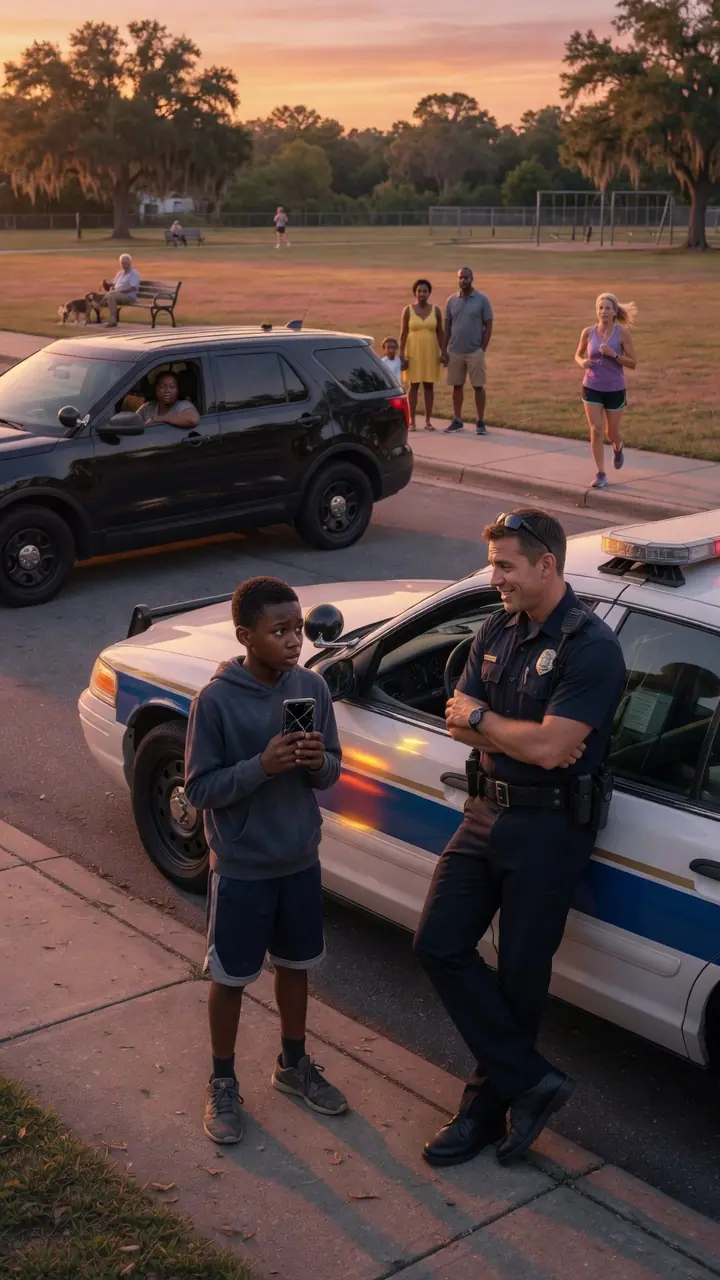
“From the park?”
The officer stepped out of the cruiser now, one hand hovering near his belt.
“Got any ID on you?”
Malik’s throat went dry. What kid carried ID to the park?
“No, sir,” he said carefully, tightening his grip on his backpack straps. “But I live just down the block. My dad’s home if you need to.”
“Yeah?” Ketterman cut him off with a smirk. “What’s your dad do, huh?”
And right then, Malik made the mistake of telling the truth.
“He’s in special forces,” he said quietly but proudly. “Army.”
The words barely left his mouth before Ketterman laughed.
Not a little chuckle.
A loud laugh that made two teenage girls passing nearby glance over.
“Special forces?” the officer repeated, shaking his head. “Kid, you watched too many movies.”
Malik felt heat crawl up his neck.
He wanted to explain, wanted to talk about the medals on his dad’s wall, the training exercises that kept him gone for months at a time, the stories his father only sometimes shared.
But the words got stuck.
Because he could already see it in Ketterman’s face.
He wasn’t going to listen.
But things were about to shift in a way Ketterman didn’t see coming.
Malik stood there swallowing hard against the lump forming in his throat. He didn’t move. He didn’t speak. His dad’s voice echoed in his mind.
“Sometimes silence is louder than anything you could ever say.”
But Officer Ketterman wasn’t done. He stepped closer, towering over Malik like a bully who finally found an easy target.
“What’s next, kid? Going to tell me your mom’s a Navy SEAL too?”
He snorted loud enough for a few more people at the park to turn their heads.
Malik clenched his fists, stuffing them into his pockets before the officer could think he was doing something wrong. He kept his gaze low, staring at the crack in the sidewalk by his shoe.
“Where’s this special forces daddy of yours now?” Ketterman pressed, voice dripping sarcasm.
“At home,” Malik mumbled. “Just a few blocks over.”
“Uh-huh.”
The officer didn’t even try to hide the doubt in his voice. He turned toward his partner, Officer Dean Harlow, who had stayed leaning against the cruiser with folded arms.
“You hear that, Dean? We got ourselves a little GI Joe here.”
Dean gave a half smile but said nothing.
Malik wanted to run. Wanted to scream. Wanted to disappear. But he knew better. Running only made things worse.
Instead, he pulled out his old scratched-up phone, hands trembling slightly.
“I can call him,” he said, forcing his voice steady. “He’ll come.”
Ketterman laughed again.
“Yeah, sure, kid. Why don’t you go ahead and do that? I’d love to meet the superhero dad of yours.”
The words were sharp, mocking. They clung to Malik’s skin like burrs, and even though every part of him wanted to stay calm, his hands betrayed him.
The phone slipped from his sweaty fingers and cracked against the sidewalk.
The crack sliced straight across the screen like a wound opening up.
For a moment nobody spoke. Just the sound of wind moving leaves and the faint bounce of a basketball somewhere in the distance.
Then Ketterman muttered softly:
“Figures.”
Malik bent down slowly and picked up the broken phone. His knees felt weak now, like they could barely hold him up anymore.
Still, he tapped his dad’s contact.
The call button glowed weakly through the shattered screen.
But the real shock wasn’t the call going through.
It was who was about to answer it in person.
The phone barely rang twice before Malik heard the familiar steady voice that always seemed capable of calming storms.
“Malik? You good, son?”
Malik swallowed hard.
“I’m at the park,” he said quickly, glancing toward Ketterman. “They… they want to talk to you.”
For the first time since the cruiser pulled up beside him, Malik’s heartbeat steadied a little.
Ketterman leaned down slightly, smirking.
“Oh, we’re doing this now? All right then. Let’s meet the legend.”
Malik held out the phone with both hands, but Ketterman waved it away lazily.
“You can tell him yourself when he gets here.”
Malik stayed quiet.
His dad was still on the line.
“Stay right there, Malik. I’m coming.”
Malik nodded before realizing his father couldn’t see him.
Five long minutes crawled by beneath the heat of the afternoon sun. More kids passed through the park throwing curious looks toward the scene. Ketterman lounged casually against the cruiser talking with Dean about fishing and golf like there wasn’t a humiliated 12-year-old standing nearby trying not to fall apart.
Then Malik heard Ketterman mutter quietly:
“Kid probably doesn’t even have a dad.”
This time Dean didn’t laugh.
He just scratched the back of his neck awkwardly.
Malik bit the inside of his cheek so hard he tasted blood.
And then something shifted.
The air changed before the sound even registered.
A black Ford Explorer rolled silently to the curb.
No screeching tires.
No dramatic entrance.
Just quiet control.
The driver’s door opened.
And out stepped Nathaniel Jordan.
He wasn’t wearing a uniform.
Didn’t need to.
The way he carried himself — straight spine, calm eyes, quiet strength — told you everything before he ever opened his mouth.
Malik felt relief hit him so hard it almost hurt.
Nathaniel closed the car door and started walking toward them with deliberate calm.
Dean noticed him first.
His posture straightened instantly.
“Uh… Bryce.”
“What?” Ketterman snapped.
Dean nodded toward Nathaniel.
Ketterman turned lazily at first.
Then the smirk disappeared from his face completely.
Because walking toward him was a man whose eyes said one thing very clearly without ever raising his voice:
You have about five seconds to get this right.
Nathaniel Jordan stopped a few feet from the cruiser, close enough that nobody had to guess who he was.
Malik saw it immediately — the slight dip of his dad’s chin, the way his eyes locked onto Ketterman, measuring him without a single wasted word.
Nathaniel didn’t shout. Didn’t puff up his chest or throw around credentials.
He simply asked, in a voice so even it almost sounded calm:
“Is there a reason my son’s being detained?”
Ketterman opened his mouth, but for the first time since pulling over, he looked unsure of himself.
Dean shifted awkwardly beside the cruiser.
“Well, sir,” Ketterman finally said, clearing his throat, “we got a call about suspicious activity. Just doing a routine check.”
Nathaniel’s expression never changed.
“You got a call about a 12-year-old walking home from the park?”
Ketterman flinched slightly, like he hadn’t expected it to sound that stupid out loud.
Nathaniel glanced briefly toward Malik.
One look was enough.
The cracked phone.
The stiff posture.
The shame sitting heavy on his son’s shoulders.
Nathaniel turned back to Ketterman.
“Name?” he asked simply.
Ketterman hesitated.
“Officer Bryce Ketterman. Stockton PD.”
Nathaniel’s jaw flexed once.
His hands stayed relaxed at his sides.
“Well, Officer Ketterman,” Nathaniel said slowly, “you’re about two minutes away from a very different kind of conversation.”
Ketterman stiffened.
“Sir, there’s no need for threats.”
Nathaniel cut him off immediately.
“Not threatening you. Educating you.”
For the first time all afternoon, Malik felt something rise inside his chest.
Hope.
Nathaniel reached slowly into his back pocket and pulled out a small leather wallet.
Inside wasn’t a driver’s license.
Wasn’t even a standard military ID.
It was something smaller, heavier, laminated.
Dean’s eyes widened immediately the second he saw it.
Ketterman squinted in confusion.
Then realization hit him hard.
Master Sergeant Nathaniel Jordan.
United States Army Special Forces.
Clearance level classified.
Nathaniel tucked it away casually like it meant nothing.
“You don’t get to make my son feel like a criminal because you don’t believe who his family is,” he said quietly.
“You don’t get to humiliate a child because your ego’s too big to fit inside your badge.”
Ketterman opened his mouth again.
Then closed it.
For once, no sarcastic comment came out.
No laughter.
Nothing.
Malik watched with wide eyes as his father motioned him closer.
Malik moved instantly, stepping beside him while Nathaniel rested one steady hand on his shoulder.
Nathaniel looked down at Ketterman one final time.
“I suggest you get better at telling real threats from the ones you invent,” he said calmly.
Then he turned toward the Explorer with Malik beside him.
But Ketterman still couldn’t let it go.
“You know,” he barked after them, “not everybody’s impressed by a uniform.”
Nathaniel stopped.
He didn’t turn around right away.
Malik felt his father’s hand tighten slightly on his shoulder.
Then Nathaniel turned just enough for Ketterman to see his face.
“You think this is about uniforms?” he asked quietly.
“This is about a grown man thinking it’s funny to humiliate a child for telling the truth.”
A few joggers and parents had stopped nearby now pretending not to stare while hearing every word.
Nathaniel stepped a little closer.
Not threatening.
Just solid.
“My son is 12,” he said. “He’s old enough to know when someone’s laughing at him. He’s old enough to know when respect is missing.”
Ketterman tried to recover some authority.
“We have procedures,” he muttered. “We have to make sure—”
“You don’t humiliate children to make sure,” Nathaniel interrupted calmly.
“You listen. You observe. You act like you’ve got some sense.”
Dean finally stepped forward and touched Ketterman lightly on the arm.
“Bryce,” he said quietly, “let it go.”
It wasn’t a suggestion.
It sounded like a warning.
The whole street seemed to pause waiting to see what would happen next.
Finally, Ketterman exhaled sharply through his nose and backed down.
Nathaniel watched him silently for one long second.
Then he looked down at Malik.
“You all right, son?”
Malik nodded even though his throat still hurt too much to speak.
Nathaniel opened the passenger door for him.
As Malik climbed into the Explorer holding his broken phone carefully in both hands, he realized something important:
His father hadn’t won because he yelled louder.
He won because he never needed to.
The drive home was quiet at first.
The air inside the Explorer felt heavy, like it was holding its breath.
Malik sat staring out the window while broken yellow road lines blurred past. He wanted to say something, wanted to explain how embarrassed he’d felt standing there while grown men laughed at him, but he didn’t know where to begin.
Nathaniel finally broke the silence.
“You did everything right.”
His voice stayed calm, but underneath it Malik could hear something tighter, something raw.
Malik shrugged slightly.
“Didn’t feel like it.”
Nathaniel nodded slowly.
“That’s because sometimes doing the right thing doesn’t stop other people from doing the wrong thing.”
Malik stayed quiet.
Nathaniel reached over and tapped his knuckles lightly against the back of Malik’s hand.
“Listen to me,” he said.
Malik looked up.
“There are people in this world who will try to make you feel small because they don’t understand you. Because they’re uncomfortable with what you represent.”
He paused at a stoplight and turned fully toward his son.
“But you do not shrink for them.”
“You don’t lie.”
“You don’t hide.”
“You don’t get smaller just so they can feel bigger.”
Malik blinked hard trying to keep the tears from spilling over.
Nathaniel smiled faintly, but sadness sat behind it.
“I spent most of my career walking into rooms where people doubted me before I ever opened my mouth,” he said quietly.
“Didn’t change who I was.”
“And it won’t change who you are either.”
The light turned green.
They kept driving.
Malik rested his hand lightly on the cracked screen of his phone.
“I guess we’re gonna have to fix this now,” he muttered.
Nathaniel laughed softly for the first time all afternoon.
“Yeah,” he said. “But the important stuff? That’s not broken.”
For the first time since the cruiser pulled beside him at the park, Malik felt the tight knot inside his chest loosen slightly.
They weren’t just driving home.
They were driving forward.
But while Malik slowly started healing from the humiliation, Officer Bryce Ketterman was about to face consequences of his own.
By the next morning, word had spread across Stockton fast.
Parents talked.
Witnesses shared clips online.
Two teenagers who filmed part of the confrontation uploaded the video overnight.
And when the official complaint reached Stockton PD — not only from Nathaniel, but from multiple witnesses — Ketterman suddenly found himself sitting in front of his captain trying to explain why a 12-year-old boy had been treated like a suspect for walking home from the park.
The video showed enough.
The laughing.
The mocking.
The sarcasm.
All of it.
Clear as day.
Ketterman was suspended pending investigation.
Dean Harlow received a formal warning too for standing there and letting it happen.
When Malik heard about it later that night, he didn’t celebrate.
Didn’t smile.
Didn’t brag.
Because this was never really about revenge.
It was about respect.
It was about teaching kids like Malik that truth still matters even when people laugh at it first.
Later that evening, Nathaniel and Malik sat together at the kitchen table eating bowls of melting ice cream while soft music played from the living room radio.
Nathaniel looked over at him quietly.
“You don’t have to yell to be heard,” he said.
“Sometimes standing your ground is enough.”
Malik nodded slowly because now he understood.
He’d seen his father face down a man with a badge and gun without ever raising his voice once.
He’d seen how dignity could silence mockery better than anger ever could.
And somewhere deep inside himself, Malik realized something important:
People might doubt him.
Laugh at him.
Try to make him feel smaller than he was.
But he could choose how he answered them.
With truth.
With pride.
With the kind of strength nobody could take away from him.
Because respect isn’t something you beg for.
It’s something you carry.
Years later, long after the video stopped circulating online and the headlines disappeared, Malik still remembered one tiny detail from that afternoon more clearly than anything else.
Not the badge.
Not the suspension.
Not even the moment his father stepped out of the Explorer.
It was the moment Nathaniel placed a hand on his shoulder beside that cruiser.
Steady.
Certain.
Protective.
Like nothing in the world was going to let harm reach him while his father stood there.
That feeling stayed with Malik.
Through high school.
Through college.
Through every room where somebody underestimated him before he spoke.
Sometimes because of his age.
Sometimes because of his skin.
Sometimes simply because people only saw what they expected to see.
But every single time, he remembered his father’s words.
“You do not shrink for them.”
Nathaniel retired from the military two years later.
No giant ceremony.
No dramatic farewell.
Just a quiet transition into civilian life.
But around Stockton, people slowly began recognizing him anyway.
Not because he bragged.
Because of the way he carried himself.
The same calm strength that shut down an armed officer without ever raising his voice became the same presence that coached youth basketball on weekends, mentored kids from the neighborhood, and quietly stepped in whenever somebody needed help.
Malik used to laugh watching grown men straighten their posture the second Nathaniel entered a room.
“Dad,” he joked once, “why does everybody act nervous around you?”
Nathaniel smiled while flipping burgers in the backyard.
“Because discipline makes people uncomfortable when they don’t have any.”
Malik carried that line with him for years.
And slowly, he began understanding something deeper about what happened that afternoon at the park.
His father didn’t protect him by humiliating Officer Ketterman back.
He protected him by refusing to become him.
That mattered more.
Anyone can lose control.
Anyone can scream.
Anyone can throw anger around.
But dignity under pressure?
That takes strength.
Real strength.
By the time Malik turned 18, he stood taller now. Strong shoulders. Calm eyes like his father’s. The kind of presence people noticed before he even spoke.
One evening, while helping Nathaniel clean out old boxes in the garage, Malik found the cracked phone from that day sitting inside a storage bin.
He picked it up carefully and laughed.
“You kept this?”
Nathaniel glanced over from across the garage.
“Of course.”
“Why?”
Nathaniel wiped dust from his hands slowly.
“Because that was the day you learned something important.”
Malik looked down at the shattered screen.
“What?”
Nathaniel smiled faintly.
“That people can question who you are all they want.”
He pointed toward Malik’s chest again, same way he had years earlier at the kitchen table.
“But none of it means anything if you already know.”
And standing there in the fading evening light of the garage, holding that broken phone in his hands, Malik finally realized the truth about that entire afternoon:
Officer Ketterman thought he was teaching a scared 12-year-old boy a lesson about authority.
But the real lesson belonged to Malik all along.
Respect that comes from fear disappears the moment power leaves the room.
But respect earned through character?
That stays long after people forget your name.