“We don’t serve your kind here,” Vidian said, her voice sharp as cracked glass.
Conversations froze.
A patron whispered, “Did she actually say that?”
Alistair Finch, coat worn and boots scuffed, paused midstep. He looked like a drifter. Yet his stillness carried a weight that unsettled the room.
From behind the counter, floor manager Jax smirked.
“Relax, Vidian. He probably can’t pay anyway.”
Their shared laughter scratched the air like sandpaper.
Alistair laid a crisp twenty on the counter. He said nothing, only met Vidian’s stare with calm that hinted at storms long survived.
She snatched the bill as if it were refuse.
“Just coffee. Guess we’re a charity now.”
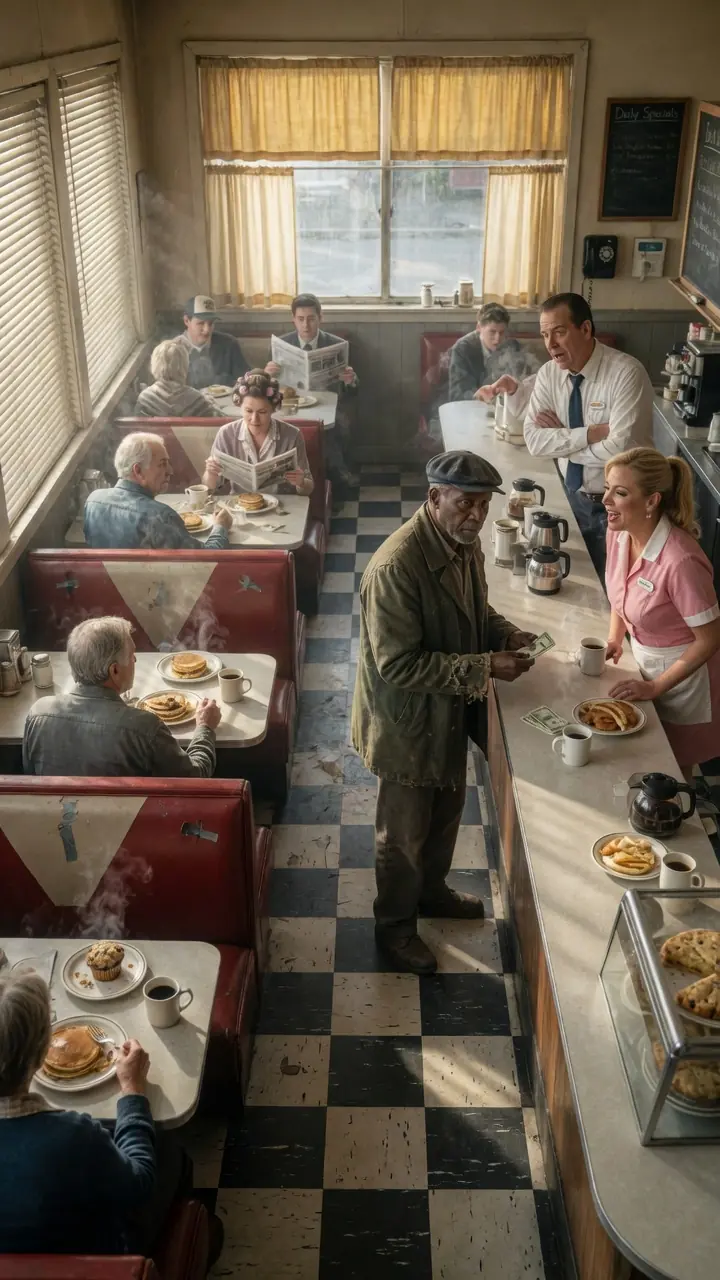
Directed toward a shadowed corner booth, Alistair slid into the seat like a seasoned captain in hostile waters. His fingers brushed faint carvings, initials he’d once etched when this place was a kitchen, his mother’s dream.
Vidian approached with a dismissive slap of the menu.
“You do have money, I trust.”
“Club sandwich, black coffee. Rye, if you have it,” he answered, voice low and resonant.
She scribbled hard and turned away.
Moments later, a blonde couple received warm smiles and the coveted window seat.
“The better clientele get the better seats,” Jax muttered loudly to a young server named Ree, ensuring Alistair heard.
Silence, Alistair knew, was discrimination’s oldest accomplice.
He pulled a cracked phone from his pocket, fingers moving with deliberate precision.
Vidian noticed, whispering to Jax, who puffed up like a rooster.
Sunlight spilled across the checkered floor, ghosting memories of his mother’s kindness.
Twenty-five minutes later, Vidian slammed down a pale flattened sandwich and a lukewarm cup slick with oil.
“This coffee seems old,” Alistair said evenly.
“What do you expect for cheap prices? This isn’t fine dining,” she snapped.
Jax loomed beside her.
“Is there a problem, sir?”
“I’m only asking about freshness,” Alistair replied, unshaken.
Jax sneered.
“People like you should be grateful. Do you know how many real customers we have?”
“Spoiled.”
He photographed it calmly.
“What do you think you’re doing?” Vidian barked, snatching the plate.
“If you don’t like it, leave. We don’t need your kind here.”
“My kind?”
His eyes darkened with quiet disappointment.
He typed: Phase one complete. Document spoilage. Prepare legal entry.
“I’d like the manager,” he said.
“You’re looking at him,” Jax bragged. “Now pay for what you ruined and get out.”
The door chimed.
Estrea and her teenage son entered, sensing the tension.
“You can’t treat customers like this,” she said sharply.
“You want to join him outside?” Jax snarled.
Vidian brandished her phone.
“Security’s coming. Both of you leave.”
Alistair rose slowly.
Vidian blocked the exit.
“You haven’t paid for that spoiled food.”
Jax lunged, ripping Alistair’s wallet and scattering its contents in a humiliating metallic rain.
“Pick it up.”
Alistair knelt, gathering coins with unbroken dignity.
Founder and hidden CEO of the Elders Hospitality Group.
He was reclaiming money on the floor of his own property.
Standing, he texted: Execute Plan B. All teams now.
He placed a fresh twenty on the counter.
“You have no idea what you’ve just done.”
“Is that a threat?” Jax’s hand hovered near pepper spray.
“No,” Alistair said softly. “A promise.”
The bell rang.
Three uniformed security officers entered, followed by two Ethelberg police officers.
“These individuals are trespassing,” Jax announced, pointing.
Officer Krell stepped forward.
“Sir, you need to leave. Private property.”
“On what grounds?” Alistair asked.
Before Krell could answer, the door burst open again.
Five figures in tailored suits strode in, their synchronized presence commanding the room. Their polished shoes struck the tiles like a verdict, their eyes locked on Alistair.
The diner seemed to hold its breath, the hum of the lights suddenly ominous.
Jax’s confidence faltered, a flicker of doubt betraying him.
Vidian’s phone slipped slightly in her grip.
Ree, silent till now, took a cautious step back.
The suits stopped at the counter.
One tall silver-haired woman scanned the scene with cold precision.
Alistair met their gaze without moving, the corner of his mouth hinting at the faintest unreadable smile.
The Summit Grill, his mother’s legacy, their latest acquisition, and the stage for this quiet reckoning, waited for its next move.
The fluorescent hum grew louder, like a storm building behind the walls, and the town of Ethelberg, still clutching its coffee cups, sensed that the morning had only just begun.
The lead figure, an imposing woman in a charcoal-gray power suit, held up a badge.
“Attorney Theresa Vance, chief legal counsel for Elders Hospitality Group. Remove your hands from Mr. Alistair Finch immediately.”
Krell’s grip loosened in confusion.
“Finch?”
Vidian’s face went white.
Jax’s phone, still broadcasting its livestream, trembled in his hand.
Dr. Theresa’s voice was a sharp blade.
“Mr. Finch, per your instructions, we have documented 17 health code violations, nine instances of overt racial discrimination in the last 90 minutes alone, and have 27 affidavits regarding systematic bias under current management.”
She turned to the police.
“Officers, you are about to arrest the owner and founder of this entire chain. I suggest you reconsider unless you want the inevitable federal lawsuit to name you personally.”
Another suited figure stepped forward.
The regional health inspector.
“Based on preliminary findings triggered by Mr. Finch’s report, I am shutting this location down immediately. The level of spoilage is a public health hazard.”
Alistair straightened his coat, his dignity now fully restored.
“Yes,” he said, his voice filling the stunned silence. “Alistair Finch. The man who built this chain to honor his mother’s legacy of service. The man you just tried to throw out of his own restaurant.”
The silence became a thick blanket of collective shame and shock.
“My mother,” Alistair began, his voice taking on the weight of history, “was refused service in this very building in 1958. She sat for four hours waiting for a cup of coffee that never came.”
“I bought this place so that no one ever would be denied the simple dignity of a meal.”
Theresa connected her laptop to the diner screen, and security footage began to play.
Weeks of Jax and Vidian’s casual cruelty documented in high definition.
Jax intentionally serving spoiled food only to minority patrons.
Vidian adding phantom service fees to certain bills.
“We have been investigating for six months,” Theresa stated. “Mr. Finch went undercover in his establishments after receiving multiple complaints that current management dismissed as disgruntled customers.”
Police officer Kowalski looked aghast.
“Mr. Finch, sir, we didn’t—”
“Couldn’t you?” Alistair asked quietly. “Or did you simply see what you expected to see? A man in worn clothes, and therefore automatically the problem?”
Jax finally found his voice, a high-pitched squeak.
“You can’t do this. This is entrapment.”
“No,” Alistair corrected, his eyes locking on Jax. “This is accountability.”
“You see, if I had walked in here wearing my Brioni thousand-dollar suit, you would have danced for me. But that would not have shown me the truth.”
“The truth is what you do when you think no one important is watching.”
Estrea stepped forward.
“Mr. Finch, thank you. This happens everywhere.”
“I’m sorry,” Alistair told her. “My failure was trusting the wrong people with my mother’s legacy.”
A different set of police officers, called by Theresa, entered.
Jax was placed under arrest.
Charges read: assault, civil rights violations, and food safety crimes.
Vidian tried to flee, only to trip over the exact spot where she had forced Alistair to kneel.
“Samantha Miller, Jax Thompson, you are terminated. Effective immediately,” Alistair announced.
“Officer Krell, your security company’s contract with Elders Hospitality Group is severed. You’ll be hearing from my legal department.”
“I have kids,” Vidian wailed from the floor.
“The mothers you refused to serve properly have children too,” Alistair replied, his tone factual, devoid of either cruelty or mercy. “They also needed to be treated with dignity.”
He addressed the remaining patrons, the silent witnesses.
“Every one of you who saw this and said nothing, you are complicit. Every time you choose comfort over conscience, you water the seeds of hatred.”
Jax was led out in handcuffs, his livestream still rolling, now broadcasting his humiliation to thousands.
“This is America. I’ll sue you for everything,” he shouted.
“Yes,” Alistair replied, a profound finality in his voice. “It is America, where actions have consequences, even for those who thought they were untouchable.”
The Obsidian Ledger was now balanced.
Justice, though often slow, had arrived with the sudden undeniable force of a corporate restructuring.
The silence that followed was not one of defeat, but of a dawn breaking over something profound and long overdue.
The diner remained frozen long after Jax disappeared through the doors in handcuffs.
Nobody reached for their coffee.
Nobody spoke above a whisper.
The livestream still running from abandoned phones captured something rarer than scandal.
Shame.
Real shame.
Alistair Finch stood in the center of it all with the quiet stillness of a man who had spent decades learning that power didn’t need volume.
Attorney Theresa Vance closed her laptop slowly.
“Corporate response teams are already on the way,” she said. “Media containment has begun. We’ve also suspended every manager tied to the complaints database.”
Alistair nodded once.
“Good.”
Ree, the young server who had remained silent through most of the confrontation, stepped forward hesitantly.
Her hands shook.
“Mr. Finch…”
He turned toward her.
“I tried to report them.”
Her voice cracked immediately.
“No one listened.”
Theresa’s expression softened slightly.
“You documented incidents?”
Ree nodded quickly.
“In notebooks. Dates. Customers they targeted. Food they switched.”
Alistair studied her for a long moment.
“And you stayed.”
Tears welled in her eyes.
“I needed the job.”
The answer hung painfully in the air because everyone in the diner understood it.
Survival makes cowards out of good people sometimes.
Alistair walked toward her slowly.
“No,” he said gently. “Survival makes people endure things they should never have been forced to endure.”
Ree started crying outright then.
Not dramatic.
Exhausted.
Like someone who had spent too long carrying guilt that never belonged to them.
Theresa stepped beside her.
“We’ll need copies of everything you documented.”
Ree nodded immediately.
“I kept backups.”
For the first time that morning, the faintest hint of approval touched Alistair’s face.
“Good.”
Outside, the first news vans began arriving.
Word traveled fast when scandal involved wealth, race, police, and livestreams.
Especially livestreams.
Officer Kowalski removed his hat slowly.
“Mr. Finch…”
Alistair looked at him.
“I owe you an apology.”
“Yes,” Alistair replied calmly. “You do.”
The honesty hit harder than anger would have.
Kowalski swallowed visibly.
“I saw the coat. The boots. The wallet on the floor.”
“And you decided who I was before asking a single question.”
Kowalski lowered his eyes.
“Yes, sir.”
Alistair glanced around the diner.
“That instinct destroys more lives than hatred ever will.”
Silence followed again.
Heavy.
Educational.
The health inspector began taping closure notices across the windows while kitchen staff stood nearby pale-faced and speechless.
One cook quietly removed his apron and left through the back without a word.
Another sat down in a booth staring at nothing.
Years of normalized cruelty collapsing in under an hour.
Estrea approached Alistair carefully with her son beside her.
The teenage boy looked overwhelmed.
“Mr. Finch,” Estrea said softly, “my son asked me something earlier.”
Alistair waited.
“He asked why nobody helped you sooner.”
The diner grew even quieter somehow.
Children had a way of asking questions adults spent entire lives avoiding.
Alistair looked at the boy.
“What’s your name?”
“Malik.”
Alistair nodded slowly.
“Well, Malik…”
He glanced around the room at the silent customers.
“Most people believe cruelty has to look violent to count.”
He pointed gently toward the empty booths.
“But usually it looks like people watching something wrong happen and deciding it’s safer not to interfere.”
Malik frowned slightly.
“That’s cowardly.”
A few adults visibly shifted uncomfortably nearby.
Alistair smiled faintly.
“Yes.”
“It is.”
Outside, camera flashes now lit the diner windows every few seconds.
Theresa checked her phone.
“The livestream has crossed twelve million views.”
Jax Thompson’s humiliation was now national entertainment.
Alistair’s expression darkened slightly at that.
“Make sure legal distinguishes justice from spectacle,” he said quietly.
Theresa nodded immediately.
“Yes, sir.”
Because unlike Jax, Alistair Finch took no pleasure in public destruction.
This had never been revenge.
It was correction.
A difference too many powerful people forgot.
One of the officers approached awkwardly.
“Sir… reporters are asking for a statement.”
Alistair looked around the diner one final time.
The cracked checkered floor.
The faded booths.
The counter where his mother once sat unwanted for four hours.
So much pain living inside one small building.
Finally he spoke.
“Tell them this.”
The room listened carefully.
“My mother taught me that dignity is not something reserved for wealthy people, educated people, or comfortable people.”
His voice stayed calm.
“Dignity belongs equally to the tired waitress, the immigrant family, the old man in worn boots, and the child watching adults decide what kind of world they will inherit.”
Outside, reporters scribbled furiously as officers relayed the words.
Alistair continued.
“When businesses forget humanity in pursuit of status, profit, or comfort, they stop being businesses.”
“They become machines that sort human worth.”
The fluorescent lights hummed softly overhead.
“And once a society starts sorting people by appearance instead of character…”
He paused.
“It begins teaching cruelty as culture.”
Nobody in the diner moved.
Even Theresa Vance looked shaken now.
Alistair adjusted the cuffs of his worn coat slowly.
Then looked toward the old corner booth where he had sat earlier.
His mother’s booth.
“When my mother left this building in 1958, she cried in the parking lot because someone convinced her she was less deserving of kindness.”
His jaw tightened slightly.
“I bought this restaurant chain so no one would ever feel that way again.”
The emotion in the room shifted then.
Not outrage anymore.
Grief.
Collective grief for all the small humiliations people survived quietly every day.
Ree wiped her eyes.
Malik stared at Alistair like he’d never seen an adult speak that honestly before.
And outside, beyond the flashing cameras and gathering crowds, the town of Ethelberg slowly realized the story spreading across America was no longer about a rude waitress or a corrupt manager.
It was about the terrifying damage caused when people stop seeing humanity in each other.
Theresa touched Alistair’s arm gently.
“The car is ready, sir.”
Alistair nodded.
He started toward the exit, then paused beside Ree.
“Effective immediately,” he said calmly, “you are interim floor manager until corporate appointments are finalized.”
Ree blinked in shock.
“I… what?”
“You documented wrongdoing when others stayed silent.”
Alistair’s eyes held steady on hers.
“That tells me more about your qualifications than any resume.”
She burst into tears again.
This time from relief.
Alistair stepped outside into the explosion of cameras and microphones.
Questions flew instantly.
“Mr. Finch, were you intentionally testing your employees?”
“Is this part of a larger discrimination investigation?”
“Will more arrests follow?”
“Sir, do you forgive them?”
Alistair stopped at the top of the diner steps.
The entire crowd leaned forward waiting.
Finally he answered quietly:
“Forgiveness is personal.”
His eyes drifted back toward the diner windows.
“But accountability…”
A long pause.
“Accountability is necessary.”
The cameras flashed harder.
And somewhere deep inside the old building behind him, generations of silence finally began to crack.