There are secrets a woman buries so deeply that she forgets for long stretches of ordinary life. Margaret Smith had buried hers in the winter of 1809 on a night when the snow came without warning and the world went white and muffled and merciful.
She had told no one.
She had returned to Wiltshire in the spring with her composure intact, her reputation unscathed, and a hollowness behind her ribs that she had learned over six quiet years to mistake for peace.
She was twenty-three now, the youngest daughter of a modest baronet, possessed of no great fortune and no particular prospects, and perfectly content.
She had decided to remain that way.
Her cottage at the edge of the Smith estate was small and full of light and answerable to no one.
And if the village occasionally whispered that a woman of her age ought to have married by now, she found she could bear the whispers.
What she could not have anticipated on the gray October morning that changed everything was the boy.
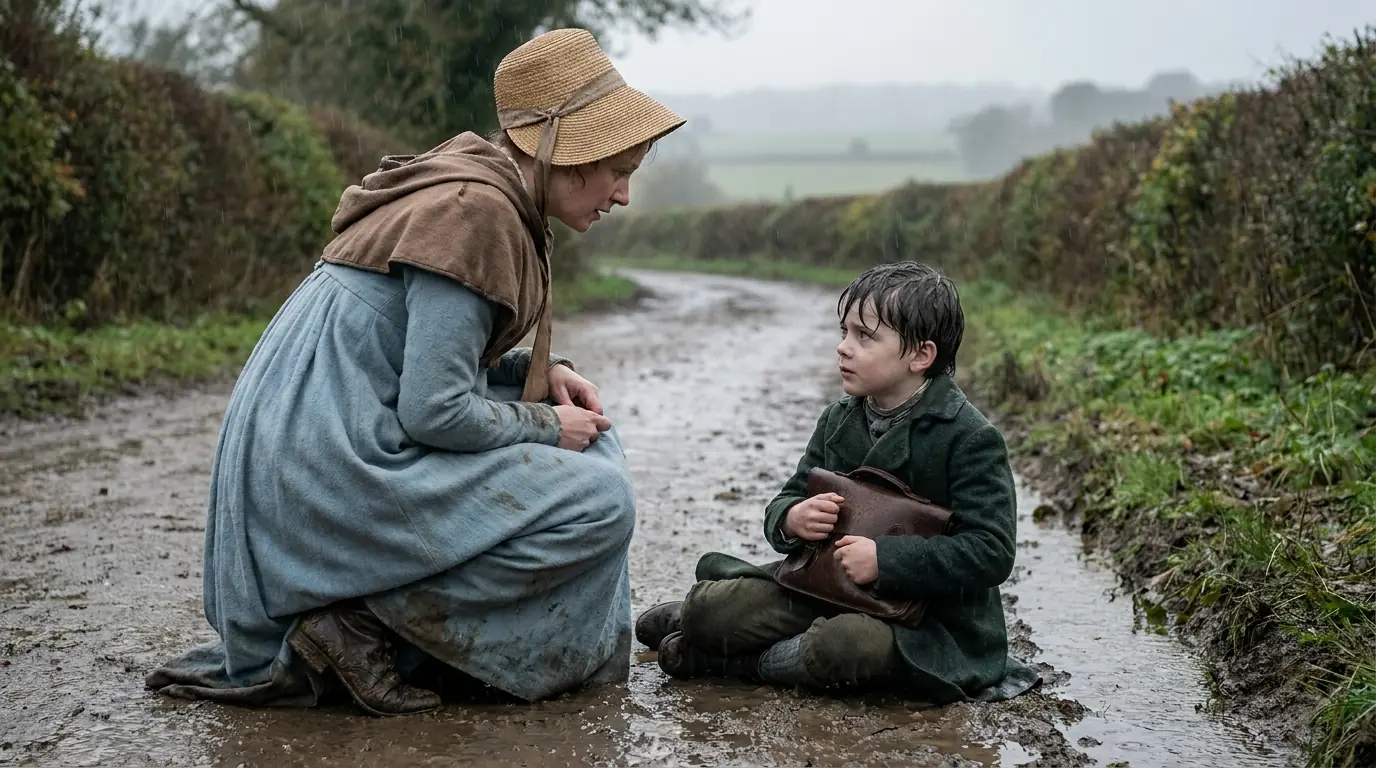
He was perhaps six years old, sitting in the ditch at the edge of the south lane, with his knees drawn to his chest and his eyes wide and watchful as a creature that has learned not to make a sound when it is afraid.
His coat was fine. That was the first thing she noticed, cut from wool that had no business on a child wandering alone through the Wiltshire lanes. His dark hair plastered flat with rain. His boots caked with the kind of mud that spoke of a very long walk from somewhere very far away.
He had nothing with him but a small leather satchel drawn tight against his chest as though it contained something worth dying for.
Margaret knelt in the wet grass beside him. She asked his name.
He told her, and she felt the blood leave her face so completely that for a moment the gray sky and the gray lane and the boy's gray eyes all blurred together into something she could not read.
Because the name he gave her was not a common name.
It was old and particular and attached in the memory she had spent six years learning to forget to only one man in all of England.
A man who was not, as far as society knew, the father of anyone at all.
The boy's name was Edmund Cavendish.
She had not misheard it.
She turned it over in her mind, the way one tests ice before trusting it with one's full weight, searching for some other interpretation, some harmless explanation, and found none.
There was only one family in England who bore that name with such casual ownership as though the word itself were an estate, and they its hereditary tenants.
The Duke of Hartwell, Julian Cavendish, a man she had not spoken aloud in six years, and whose face she could still reconstruct in the dark without trying.
She brought the boy inside because it was raining, and because his lips were going blue, and because standing in the lane staring at him would not, she told herself firmly, serve any useful purpose.
She set him by the fire.
She brought him bread and warm milk.
She watched him consume both with the focused efficiency of a child who has been hungry for longer than a few hours.
And she sat across from him and tried to think clearly, which was proving extraordinarily difficult.
How did you come to be on the south lane, Edmund? she asked, keeping her voice easy, the voice of a woman who asked questions of lost children every day and found nothing remarkable in any of it.
His eyes were gray, precisely, unmistakably gray, with that particular quality of stillness that she recognized, that she had spent six years learning to unrecognize in every face that wore it.
I walked, he said.
From where?
He considered this for a moment with the gravity of someone who has decided that certain information is only to be surrendered selectively.
Far, he said.
Then, as though offering a concession, My satchel has important things in it.
I see, Margaret said. And will you tell me what they are?
Not yet, he said politely, but with absolute finality.
She nearly smiled despite herself.
It was the kind of answer a Duke's solicitor might give.
She poured him more milk and told herself she was not noticing the shape of his jaw, the precise angle of his brows, the way he held himself even slumped with exhaustion, as though posture were not a habit but a birthright.
She sent a note to her sister Catherine who lived in the village because she needed someone to think with and could not trust her own mind that morning.
Then she waited, and while she waited, she looked at the boy.
And while she looked at the boy, she thought about a winter she had promised herself was finished with her.
It was not apparently finished with her yet.
Catherine arrived within the hour with the expression of a woman who had read the note three times and drawn her own conclusions from it.
She took one look at Edmund, now dry and drowsy by the fire, with his satchel still clutched to his chest, and pulled Margaret into the kitchen with a grip that left no room for negotiation.
Who is he? she said very quietly.
He says his name is Edmund Cavendish.
Catherine's face went through several things in rapid succession.
The Dukes, I don't know, Margaret said. He said nothing about his parentage. He said almost nothing at all.
Margaret, Catherine's voice dropped further, took on the weight of someone carrying a thing they had been carrying for a long time. He looks—
I know what he looks like, Margaret said. I have eyes, Catherine.
Her sister was quiet for a moment.
The rain made its indifferent argument against the window glass.
Then carefully, Does he look like Julian or does he look like—
Don't. The word came out faster than she intended with a force that surprised them both.
Margaret pressed her fingertips to the edge of the kitchen table and waited until her breathing was orderly.
Do not say that to me. Not today.
Catherine did not say it, but she stayed.
And that was its own kind of answer, and Margaret was grateful for it in the way you are grateful for things that cost the other person something to give.
Edmund slept that afternoon curled on the settee with the boneless trust of a child who has decided on whatever internal evidence children consult that this is a safe place to be.
Margaret sat and watched him sleep and did not examine too closely what it felt like to have a dark-haired child sleeping in her cottage.
She had learned six years ago how expensive that kind of examination could be.
The knock came on the second morning.
She knew before she opened the door.
She could not have explained how.
It was something in the quality of the silence before the knock, a density, a weight, as though the air itself had rearranged in recognition of someone it had accommodated before.
Or perhaps she was being ridiculous.
She opened the door and had precisely three seconds to prepare herself before the past walked in wearing riding clothes and a look she had not seen in six years.
The look of a man who had been afraid and was managing the fear through sheer application of will.
Julian Cavendish, Duke of Hartwell, was thirty-one years old and considerably more dangerous to her equilibrium than she had hoped he might be.
He had changed.
That was the first thing she registered factually at a remove she was constructing in real time.
The easy confidence of the young man she had known had been replaced by something denser, more deliberate.
The authority of someone who had grown into the full weight of himself, and found it heavier than expected.
There were lines at the corners of his eyes that had not been there before.
His jaw was the same.
His eyes were the same, gray still, and at this precise moment, doing what she had last seen them do on a snow-covered evening in 1809, which was looking at her with an openness that he was clearly furious with himself for being unable to conceal.
Miss Smith, he said.
His voice was what she remembered, low, unhurried, built for consequence.
Your Grace, she replied, and her own voice was admirably level.
She credited herself for that and held the door open with the arm that was not shaking.
You had better come in.
He stepped inside and his eyes found Edmund before anything else in the room.
Edmund, who had been eating his breakfast with a methodical focus he applied to all things, looked up and something moved across the boy's face.
Not the expression of a child who has been found.
The expression of a child who has been preparing for this moment and is running its script now, checking each line against what he rehearsed.
Hello, sir, Edmund said.
Edmund. Julian's voice did something then that it had not done since he walked through her door.
It became simpler, younger.
The ducal scaffolding dropped away from it, and what was underneath was just a man talking to a child, and not entirely certain of his footing.
Are you well?
I am well, Edmund said, with the careful courtesy of a child reciting a lesson.
Then, after a beat, with rather more feeling, I found her on my own. I told you I could, sir.
Margaret looked at the boy, then at the Duke.
You knew he was coming here.
Julian met her gaze.
His jaw was set in the manner she had cataloged over two days of looking at Edmund, as the Cavendish expression for composure under pressure.
Not precisely here. He had the name of the village. I have been searching since Tuesday.
He looked back at Edmund.
He had made it rather clear that if he were going to run away, he intended to do it properly.
And the destination? Margaret kept her voice very even. Was this destination his idea?
The question hung in the room.
Julian held her gaze for three full seconds, and in those three seconds something moved through his expression that she did not have the luxury of reading.
It was, he said carefully, though I confess I am still determining the full reasoning behind it.
Margaret looked at the boy.
Edmund had resumed eating his breakfast, apparently satisfied that the opening negotiations had concluded satisfactorily.
His satchel sat beside his plate.
He had not yet opened it for her, though she had stopped asking after the first morning, having determined that pressing Edmund Cavendish on matters he considered private was an enterprise of strictly limited productivity.
She put the kettle on because her hands needed occupation.
She was aware of the Duke standing in her small parlor taking up a disproportionate amount of its air, and she was aware of herself being aware of him, which was the thing she had most dreaded and was now simply required to manage.
There is something you are not telling me, she said, her back to him, attending to the kettle.
There is a great deal I am not telling you, he said. I am attempting to determine the correct order in which to tell it.
She turned to face him.
Then I would suggest starting with why a six-year-old boy would walk across Wiltshire alone to arrive at my door specifically when by his account he was directed here by you and when by all visible evidence he has never set foot in this county before.
Julian looked at her steadily.
Then he looked at Edmund.
Would you give us a moment, Edmund?
Edmund climbed down from his chair with the dignity of someone who has agreed to a concession rather than been dismissed.
He took his satchel.
He went upstairs with the tread of a child listening very hard from the staircase, and Margaret let him because she suspected he had earned the right to whatever information he could gather by those means.
When the creak of the stairs had settled, Julian spoke.
He is not my son by blood, he said.
Margaret kept very still.
He was placed in my care fourteen months ago by his mother, a woman named Clara Vane, who died of a fever in Bath.
She had no family living.
Edmund had no one.
He looked at the fire.
She left a letter.
In it, she identified his father.
A beat.
She identified me.
But you said—
I am not his father by blood, he repeated, and something in his voice made the words careful and particular, as though they had been chosen from a larger collection and set aside from it deliberately.
I have reason to believe the letter was not entirely accurate.
But Edmund was five years old and without a guardian, and the practical question of his parentage was somewhat outweighed by the practical question of where he was going to sleep.
Margaret sat down, not because she had decided to sit, but because her legs reached their own conclusion.
And you took him in.
I did. And I have been for fourteen months attempting to determine the truth of what Clara Vane wrote in that letter.
He looked at her directly for the first time since the kettle had given her a reason to look away.
The truth, Miss Smith, brought me eventually to Wiltshire. And Edmund, who had been listening at doors rather more assiduously than I had appreciated, arrived rather before I did.
The room was very quiet.
Margaret could hear the wind in the chimney, and the distant settling of the house, and the absolute silence from the staircase that meant Edmund Cavendish was listening with every atom of his small, clever person.
What truth did you find in Wiltshire? she said, and her voice was barely sound at all.
Julian opened his mouth.
And then, before he could answer, Edmund came back down the stairs.
He came with his satchel open and a piece of paper in his hand, folded and refolded to the consistency of cloth, softened at the creases by what looked like considerable handling.
He walked to Margaret and held it out with the solemnity of a child performing an act he had rehearsed and decided upon alone, in the particular way of children who understand more than adults intend them to.
I've been carrying it since Mama died, he said. I think it belongs to you.
Margaret took it.
Her hands were steady, which surprised her.
She unfolded it.
The ink was faded and the paper was thin with age and the handwriting was not one she knew, but the name at the top was hers.
And the date was the fourteenth of December 1809.
And the first line read, By the time you read this, Margaret, I expect you will have been told your child did not survive.
The room disappeared for a moment.
She was aware of Julian moving, of him crouching beside her chair, of his voice saying her name, and of herself sitting in the cold, clear wreckage of six years of grief rearranging itself with the merciless efficiency of a truth that has been patient and will not be patient any longer.
She read the letter three times, not because she misunderstood it, but because understanding it required more than one pass.
Clara Vane had been her companion during those months in Bath during the confinement that Margaret's mother had arranged in terror and secrecy and dispatched her daughter to endure alone.
Clara had been there when the child was born.
Clara had been there when Margaret's mother arrived and made the arrangements.
Clara had been told, as Margaret had been told, that the infant had not survived the night.
Clara had not told the truth.
The child had survived.
He had been placed quietly, efficiently, in the care of a Bath solicitor, who had passed him to a woman in Gloucestershire, who had kept him for three years until Clara Vane, whose conscience had apparently been mounting a sustained campaign against her, had taken the boy herself, had raised him, and had written dying a letter that she had folded into his satchel and told him to find the woman whose name was written at the top.
Margaret looked up from the letter.
Edmund was watching her with his gray eyes, with that careful, particular stillness that was not peace, but something more effortful than peace, something chosen.
Julian was beside her, and she could not look at him yet.
She could not look at anything except the boy who was six years old and had walked across Wiltshire with this letter in his satchel and had sat in her kitchen eating soft bread and milk and had let her brush the mud from his coat and had not told her, had waited, had given her two days to know him before he gave her the truth.
Edmund, she said, and her voice came out in two parts, the first steadier than she expected, the second not at all. Come here.
He came.
She put her arms around him with the care of someone who is not certain a thing will hold and finds to her astonishment that it holds completely.
He was solid and warm and smelled of her soap and the rain and something underneath both that she had no name for yet and did not need.
He did not pull away.
She was not proud of what came next, which was weeping.
She had made herself a private rule about weeping, and she broke it entirely.
And Edmund, small and serious and enormously composed for a child being wept upon, simply stayed very still and allowed it, which she would think about for the rest of her life.
Julian did not speak.
He stood at the edge of the room and gave them the full length of it.
It was the right thing to do.
She filed that away.
There were complications, of course.
Life in 1815 did not reorganize itself around the truth without requiring considerable assistance.
Margaret's mother had to be confronted, which was a conversation that took place in the Smith drawing room on a Tuesday morning with a ferocity that rattled the china.
Mrs. Smith wept.
She justified.
She constructed from her considerable talent with selective recollection a version of events in which everything she had done had been undertaken for Margaret's protection.
Margaret listened to all of it with the patience of a woman who has had six years of grief as preparation and said when her mother had finished that she accepted the explanation without mistaking it for an absolution and that she intended to keep her son.
The word son landed in the drawing room like a stone dropped into still water, sending rings outward in all directions.
Society would be the second complication.
Margaret was twenty-three, unmarried, of modest family, and proposing to raise as her own a child whose origins were a documented scandal away from becoming Wiltshire's most consuming entertainment.
She was not ignorant of this.
She had spent the three days since Edmund's letter in a sustained and methodical assessment of her options and had arrived at a conclusion that she communicated to Julian on the Thursday standing in her garden with the autumn light making a tolerable effort at warmth.
I am going to keep him, she said. Whatever the mechanics of that require, I am not giving him up a second time.
Julian looked at her.
He had been at the cottage every day.
He had not pressed her, had not moved toward anything she had not invited, had sat across from her each evening while Edmund slept and talked carefully at first and then less carefully about the fourteen months of searching and the letter and the solicitor's trail and all the slow, painstaking work of a man trying to undo something that had been buried with professional thoroughness.
I know, he said. I would not ask you to.
I am also aware, she said carefully, that a single woman claiming an illegitimate child is a rather different undertaking from a married woman establishing a ward.
He held her gaze.
Yes.
I am not, she said with more composure than she felt, suggesting an arrangement of convenience. I have been in arrangements of convenience by proxy, and they are, in my experience, catastrophic for everyone involved.
No, Julian agreed. I did not imagine you were.
She looked at him.
The man standing in her garden was not the young lord she had loved at seventeen, the one who had held her hand in the snow and told her that whatever the world required of him, he was certain of her, certain of them.
He was someone heavier and more carefully made, who had spent six years of his own carrying the absence of something he could not entirely name.
She had not known until Edmund that the something had a shape.
She knew now.
Tell me what you want, she said.
Not an invitation.
A requirement.
She was done, she had decided, with people wanting things and communicating them through arrangements and intermediaries and letters given to the wrong hands.
Julian looked at her for a long moment.
Then he said, with the unvarnished simplicity of a man who has burned all his prepared remarks and is speaking from whatever is underneath them, I want to not have lost six years.
I want Edmund to grow up knowing both his parents.
I want to sit across from you every evening for the rest of my life and tell you things I have been waiting without knowing I was waiting to tell someone who could actually hear them.
He stopped.
His jaw was doing its composed, effortful work.
And I want, he said quietly, to be worthy of you this time, whatever that takes, however long it requires.
Margaret looked at him.
She thought about a girl who had gone to Bath in secret and returned to Wiltshire in pieces and built from her father's library and her own considerable stubbornness a life that was small and full of light and answerable to no one.
She thought about six years of a hollowness she had learned to mistake for peace.
She thought about a boy who had walked across Wiltshire with a letter in his satchel and the patience of someone who understood at six years old that the important things required time.
She thought about the cost of things given back, the interest they accrued.
You had better come inside, she said. Edmund will want his supper, and I expect you to argue with him about the correct navigational use of the North Star, which he has opinions about that I am entirely unqualified to address.
The ghost of something crossed Julian's face, not quite a smile, the approaching weather of one.
I have opinions of my own about the North Star, he said.
I know, she said. That is precisely why I'm sending him to you.
They were married in the village church on a morning in February when the frost lay on the Wiltshire fields like a blessing given without ceremony.
It was small.
The people present were the ones who had earned the right, and Margaret had been precise about that, and Julian had understood without being told.
Edmund served as witness with an air of vast personal satisfaction, wearing his good coat, holding his satchel, and watching the proceedings with the proprietary contentment of an architect surveying a building that has been completed according to plan.
The letter from Julian's cousin, Lord Ashfield, arrived the following week, expressing polite concern about the match's implications for the Hartwell succession.
Julian read it at breakfast in a voice of such perfect neutrality that Margaret was obliged to develop a sudden interest in the view from the window.
He then folded it, set it beside his plate, and said that he intended to reply that the Hartwell succession was in excellent health, having added one excellent heir of six years, who had already demonstrated a capacity for strategic long-term planning that put most of the lords of the realm to considerable shame.
Edmund, who was listening, looked up from his porridge and said that he had also been working on a theory about the navigational unreliability of clouds.
And would the Duke like to hear it?
I would, Julian said, very much.
The theory lasted through breakfast and into a walk along the south lane, Edmund between them, narrating with one hand gesturing at the sky and the other swinging between their clasped ones in the unthinking way of a child who has located the center of his world and sees no reason to be uncertain about it.
Margaret thought about a ditch in October rain and a boy with gray eyes and a satchel of important things.
She thought about the letter that had been waiting six years for the right hands.
She thought about the cost of kindness and how she had once calculated it and arrived at the wrong total.
She had missed the compounding.
She had not known then that what you lose and grieve and carry can accumulate interest.
That the things you love do not stop in your absence.
That the ground beneath your feet, even when it turns out not to be solid, can sometimes be remade into something better than the original.
Not always.
She was not naive enough to address it as an inevitability.
But sometimes.
Edmund stopped in the lane and pointed at a cloud formation and said that it was a completely useless navigational marker.
And Julian said with great seriousness that he agreed entirely, but that it looked rather like a horse.
And Edmund considered this for a full five seconds and then conceded that yes, it did somewhat resemble a horse.
And they continued walking while the Wiltshire sky did its unhurried best above them.
Margaret held her husband's hand.
She held her son's.
She did not look for the hollowness.
It was at last entirely gone.