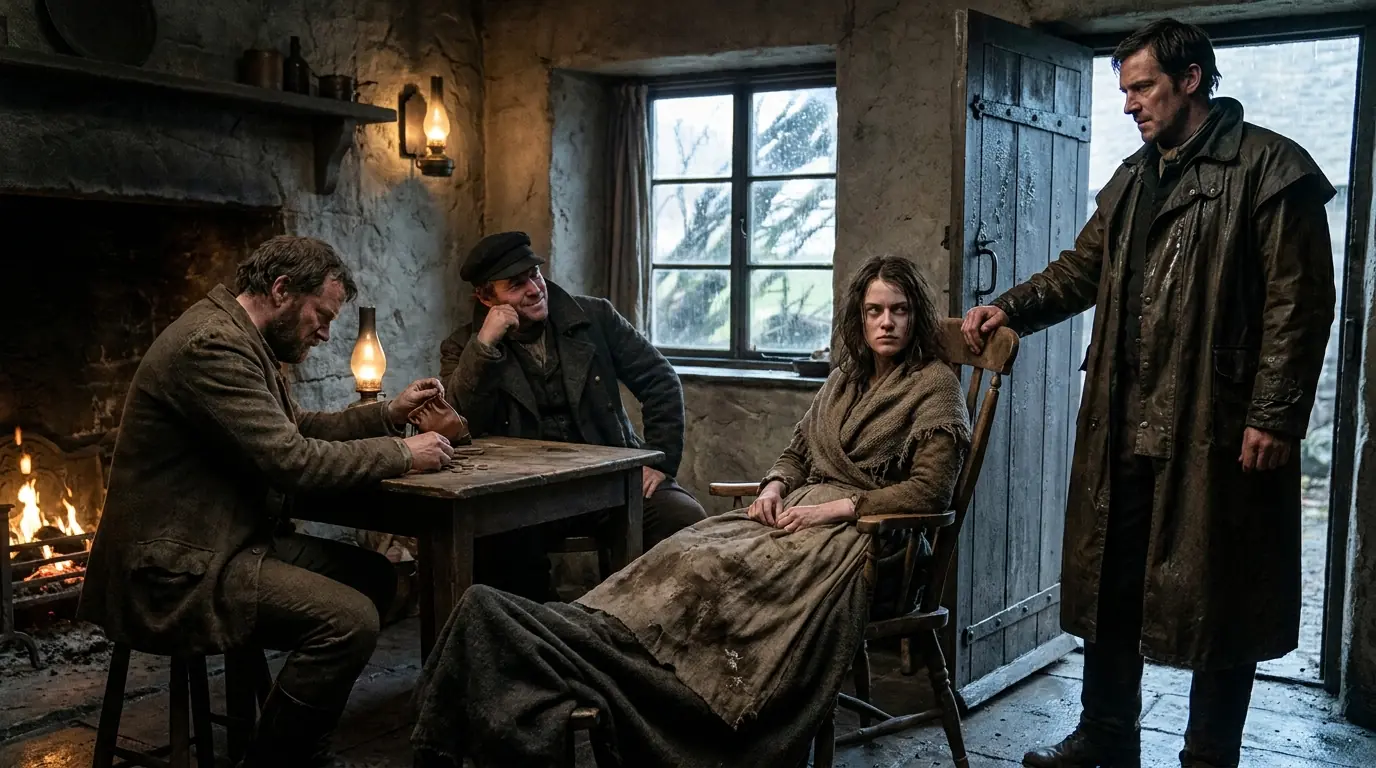
Eleanor Vance drove her fist into the oak door and felt the skin split across her knuckles. The blood came immediately, warm against the cold of her hand, and she struck again because there was nowhere left to crawl. Behind her, the October night pressed close, wet leaves on stone, the iron smell of coming frost, and three miles of darkness she had dragged herself through on hands and bleeding knees.
Her legs hung useless beneath her muddy skirt as they had hung since she was seven years old. And the men who had paid twelve pounds for her at the Ipswich crossroads were not far behind.
The door opened.
The man who stood in the frame was tall enough that the lamplight behind him made him a silhouette, broad-shouldered, dark-haired, his shirt sleeves rolled to the elbow as though he had been working late. His eyes moved from her face to her hands to her legs, and she watched him perform the calculation that everyone performed. Broken, helpless, pitiful.
She spoke before he could. I need a room. One night. She pressed her bleeding knuckles against her skirt to stop the trembling. I can pay. Not in coin, but I can pay.
Can you? It was not a question. His voice was low and unhurried, the voice of a man who was not accustomed to being surprised at his own door. He leaned against the frame and studied her with the careful attention of someone examining a map he did not yet understand.
I can draw, she said. Maps, boundaries, coastlines. I can make what is contested certain.
The silence that followed had texture, the crackle of a fire somewhere deep in the house, the drip of rain from the eaves, the distant call of an owl across the grounds.
He looked at her legs again, and this time she saw something shift behind his eyes. Not pity. Something sharper.
He asked who was following her. She asked whether it mattered, and he said it did. If they intended to knock on his door next, he wanted to know what he was closing it against.
The exchange was brief, practical, the kind of negotiation between two people who understood that sentiment costs time, and time was something she did not have.
Two men, a cart driver and a workhouse overseer named Pew. She kept her voice flat, the way she kept everything flat when the alternative was breaking. My uncle sold me this morning. I was not consulted.
He straightened. The casual lean vanished, replaced by something harder. His jaw tightened, and his hand moved to the edge of the door as though he were considering whether to close it or open it wider.
He opened it wider.
He asked if she could hold on, and before she could ask to what, he stepped forward, bent, and lifted her from the stone step with the ease of a man picking up a stack of ledgers. One arm beneath her knees, one behind her back, and she was off the ground before she could protest.
Her hand found his shoulder by instinct. The muscle beneath his shirt was solid and warm, and she hated that she noticed.
I didn't ask to be carried.
You didn't ask for a great many things tonight, I suspect.
He stepped through the doorway and kicked the door shut behind them with his heel.
The hallway was paneled in dark oak, lit by a single lamp on a side table. Portraits lined the walls, stern men in elaborate coats, women with jeweled throats, and the air smelled of beeswax and wood smoke and something sharper, like old paper.
I'm Hale. I manage the estate.
Eleanor Vance.
Miss Vance. You are bleeding on my shirt.
She looked down. The blood from her knuckles had left a dark smear across his collar.
Add it to my debt.
Something happened at the corner of his mouth, not quite a smile, but the ghost of one.
He carried her up a staircase without effort, his boots steady on each step, and she fixed her eyes on the wall because looking at his face at this distance felt dangerous. The portraits watched her pass with painted indifference.
He set her down on a bed in a room that smelled of lavender sachets and unused linen. The mattress was thick, the sheets were clean, and the window looked out over grounds she could not see in the dark. It was not a servant's room. She noticed this immediately.
This is a guest room.
It is a room.
He straightened and rolled his shoulders as though carrying her had cost him nothing, but he wanted her to know he was aware of it.
Mrs. Lennox will bring you something to eat, water for washing, clean bandages.
Who is Mrs. Lennox?
The woman who will decide whether you stay or go. I suggest you be civil.
He moved toward the door, then paused. His hand rested on the frame, and she saw the lamplight catch the edge of a ring on his smallest finger, heavy gold, engraved with something she could not read at this distance. Not the ring of an estate secretary.
Miss Vance.
Mr. Hale.
Those men, Pew and the cart driver. His back was to her, and she could see the tension across his shoulders, the stillness in his hands that suggested he was choosing his next words with care.
If they come to this door, what would you have me do?
Tell them I'm not here.
And if they don't believe me?
She looked at him, this stranger who had lifted her from the cold, who had blood on his collar and questions in his voice, and a ring that did not belong to a secretary.
Then be convincing.
He left without answering.
The door closed behind him, and Eleanor sat in the borrowed bed with her knees drawn sideways and her bleeding hands pressed together. And she listened to his footsteps descend the stairs until the house swallowed the sound.
She did not sleep. Instead, she studied the room the way she studied terrain. The angle of the ceiling beams, load-bearing, original construction at least a century old, the quality of the plaster work, smooth, not limewashed, which meant wealth, the view from the window as dawn crept in, rolling parkland, a lake, a tree line that suggested deliberate landscaping.
The estate was large, larger than anything a mere secretary would manage alone.
She found paper and a charcoal pencil in the writing desk beside the window and began to draw. The view first, the lake's curvature, the grade of the land, the position of the tree line relative to the ridge beyond. Her hand moved from memory and observation simultaneously, the way it always had, and the act of drawing steadied something in her chest that had been shaking since the cart.
A knock. Not Hale. The knock was brisk, practical, impatient.
The door opened to a woman in her fifties with iron gray hair, a starched apron, and a face that suggested she had already decided her opinion, and it was not favorable.
I'm Mrs. Lennox.
She set a tray on the side table, bread, cold beef, a pot of tea, a basin of water. Her eyes moved to Eleanor's legs, then to the charcoal sketch on the desk, then back to Eleanor's face.
Mr. Hale says you're to stay.
That's generous of him.
He is not a generous man. He is a practical one.
Mrs. Lennox placed the clean bandages beside the basin and folded her hands.
The housekeeper asked whether she could feed herself, and Eleanor told her she had managed since the age of two.
Could she wash?
Since three. The answers were delivered with the clipped efficiency of a woman who had been asked these questions a hundred times by a hundred different people who assumed that legs that did not work meant a body that could not function, and who had learned that the fastest way to end the interrogation was to answer so precisely that no follow-up was possible.
The ghost of something, not approval, but the absence of active disapproval, crossed the housekeeper's face.
Breakfast is at seven. If you can get yourself to the stairs, Thomas will help you down.
The boy who will carry your tray. I suggest you be civil.
So I've been told.
Mrs. Lennox's lips thinned.
She left the tray and closed the door, and Eleanor reached for the bread with her bandaged hands and ate methodically because she had learned years ago that survival was a series of small, deliberate acts, and the first was always eating when food was offered.
Thomas arrived forty minutes later, a boy of perhaps eleven with red hair that stood at alarming angles and a face that broadcast every thought before his mouth caught up.
He stopped in the doorway and stared at her with the frank, unguarded curiosity that only children could manage.
You're the lady who can't walk.
I am.
Thomas shifted his weight from foot to foot and announced, with the particular solemnity of a child reciting instructions, that Mr. Hale had told him to help her and to be respectful, though the specificity of the instructions suggested that respect was not his natural register.
He wanted to know if she was going to live here. The question asked with the urgent intensity of someone who had been bored long enough to welcome any disruption, even a woman who arrived bleeding in the dark.
She told him that remains to be seen.
And his face brightened rather than fell, as though uncertainty was more interesting than a definitive answer.
He declared it had been dead boring since the last tutor left. And his eyes landed on the charcoal sketch on the desk with the kind of genuine curiosity that could not be performed.
Is that a map?
The beginning of one. Of everything I can see from this window.
She folded the paper and tucked it into the pocket of her borrowed dress.
Now, the stairs.
Thomas was stronger than he looked and more practical than she expected. He offered his shoulder without making it a production. And together they navigated the staircase in a series of controlled movements that left her breathless, but upright.
The hallway at the bottom was long, oak floored, and lined with more portraits. And at the far end, a door stood open onto a room filled with morning light.
Hale was inside. He stood at a long table covered in papers, his back to the door. And the sunlight through the tall windows caught the breadth of his shoulders and the dark of his hair. And the fact that he was wearing a coat today, tailored, well cut, the kind of coat that cost more than most secretaries earned in a year.
He turned when he heard her. And she watched his eyes perform the same rapid calculation as the night before. Her legs, her hands, her face.
Miss Vance, you found the stairs.
With help.
She leaned against the doorframe, breathing carefully. Thomas hovered at her elbow.
Is this the library?
It was. Now it's where I keep things I can't solve.
He gestured at the table. Maps, dozens of them, layered and crumpled and annotated in multiple hands. The room smelled of dust and old ink and the faint sharp tang of frustration. Bookshelves lined three walls, but the volumes were untouched. It was the table that had been used and used hard.
Eleanor's eyes found the maps the way a compass found north. She could not help it. Even from the doorway, she could see the coastline rendering on the nearest sheet was wrong. The angles suggested a surveyor who had measured from a single vantage point instead of triangulating.
Those maps are inaccurate, she said.
Hale's eyebrows rose. You can tell from the doorway?
I can tell from the doorway that whoever drew them didn't know the difference between a magnetic bearing and a true bearing. The coastal curve is off by at least seven degrees.
He was quiet for a moment.
Then he pulled out a chair, a heavy oak thing with arms, and positioned it at the near end of the table.
Come, look.
She moved to the chair with Thomas's help, and the boy departed with the specific urgency of someone who had been told to make himself scarce.
Eleanor settled herself, adjusted her skirts over her useless legs, and pulled the first map toward her. Her fingers found the paper's grain, the ink's weight, the faint indentations where the surveyor's compass had pressed.
These were stories told in line and angle. And she could read them the way other people read letters.
This river, she traced the blue line with her fingertip. It hasn't run here in forty years. See the curve? Rivers don't bend at right angles unless they've been diverted. This map shows the original course, but the land has changed.
Hale leaned over the table, close enough that she caught the scent of shaving soap and wool, and something darker beneath. Ink, perhaps, or the particular smell of a man who had been awake since before dawn.
How do you know where the river runs now?
Because the vegetation pattern tells me. She pointed to the margin where someone had sketched the tree line. Willows follow water. If the willows are here, she tapped a point southeast of the drawn river, then the water moved southeast. Probably after the floods of '91.
You know about the floods of '91.
I know about every flood that altered a major waterway in southern England since 1780. It's what I do.
She looked up at him. His face was closer than she had expected. Close enough to see the flex of amber in his dark eyes, the faint scar above his left eyebrow, the way his jaw held a tension that did not match his casual posture.
What exactly do you do, Mr. Hale, as a secretary?
She asked him what he managed, and he offered the kind of answer designed to close a conversation rather than open one.
Everything that needed managing, he said. With the particular vagueness of a man who was either hiding something or so accustomed to authority that he had forgotten how to explain it.
She told him how specific that was. And he replied with half a smile that he found specificity overrated.
He straightened and moved to the window, putting distance between them. The morning light outlined him in gold. The set of his shoulders, the length of his arms, the way he held his hands behind his back as though he did not trust them to be idle.
These maps are part of a boundary dispute. The northern edge of this estate is contested by a neighboring landowner. If the maps are wrong, we lose four hundred acres of productive farmland.
And you need someone to prove they're wrong.
I need someone to prove what's right.
Eleanor looked at the maps again. The layers of inaccuracy were almost beautiful in their consistency. Each one building on the errors of the last, a cascading architecture of wrong answers. Whoever had drawn them had been either incompetent or dishonest. And the precision of the wrongness suggested the latter.
She listed what she would need. Access to the land itself, and better paper, because this ledger stock absorbed the ink unevenly, and any serious cartographer would refuse to work with it.
He agreed to each without hesitation, his responses so immediate they were almost reflexive, as though he had been waiting for her to name her conditions, and had already decided to meet every one.
And I'll need to be carried to the land since I cannot walk there. She said it flat, without self-pity, without challenge. A fact. The sky is blue. The river moved southeast. I cannot walk.
She watched his face for the thing she always watched for. The flinch, the pity, the careful rearrangement of features into something that pretended not to mind. She had seen it a thousand times on a thousand faces. And she could catalog the variations the way she cataloged soil types.
He did not flinch. He did not rearrange.
He looked at her legs and then at her hands, the bandaged knuckles, the charcoal stains on her fingertips, the steadiness that had not wavered since she'd arrived.
And he said, tomorrow morning, six. Dress warmly. The frost comes early here.
He left the library, and Eleanor sat among the wrong maps with autumn sunlight pooling on the table, and the smell of dust and old ink filling her lungs. And she thought, he did not look away.
The next morning was silver with frost.
Eleanor was awake before dawn, dressed in a borrowed gown that Mrs. Lennox had left outside her door. Wool, dark green, practical, and slightly too long, which did not matter because her feet would never touch the ground.
She braided her hair without a mirror, counting the plaits by touch the way she counted latitude lines. And when Thomas knocked at her door, she was already at the top of the stairs with her satchel of charcoal pencils and the compass her father had given her three days before he died.
The compass was brass, dented at the north point where she had dropped it as a child, and the needle still swung true. She kept it in the pocket of every dress she wore, every skirt she owned. And when the uncle had sold her, she had hidden it inside her shift because it was the one thing in the world that was hers and could not be taken.
Thomas helped her down the stairs. He was learning her rhythms, where to hold, when to step, how to match her pace without rushing or hovering.
At the bottom, Hale was waiting with a horse. Not a cart. A horse. A tall bay gelding with a patient eye and a saddle that had been modified. She could see the work, fresh leather, a higher cantle, a strap across the front that would hold her in place. Someone had been up since before dawn making those changes.
She told him she didn't ride. And he answered that she did now. The certainty in his voice leaving no room for the kind of argument she might have won on any other ground.
He lifted her without asking this time, and she let him because the alternative was arguing on the ground while the frost melted and the light changed.
He placed her in the saddle, secured the strap, and swung up behind her. His arms came around her to take the reins, and she was enclosed, his chest against her back, his thighs bracing hers, the heat of him cutting through the October chill like a coal in her pocket.
He asked if she was comfortable.
She said no, and he told her that was good. Comfortable people didn't notice details. The observation was practical, not cruel. And she filed it alongside the other contradictions she was cataloging about this man. Hands too refined for a secretary. A coat too expensive for his supposed station. And a habit of treating her limitations as logistics rather than tragedy.
They rode north along the estate's edge as the sun came up through the trees. The land unfolded beneath a sky the color of hammered pewter. Rolling fields golden with stubble. Hedgerows blazing with autumn color. A distant church spire rising through morning mist.
Eleanor's hands moved constantly, sketching in the air, tracing sight lines, measuring angles with the compass balanced on her palm.
Hale watched her the way a man watches a musician play. With the quiet fascination of someone witnessing a skill they could not replicate.
She pointed to a line of stones running across a hillside. And asked if that was the claimed boundary.
He confirmed it, according to Blackwell's surveyor.
Eleanor studied the stones with the focused attention of a woman reading a sentence written in a language only she could speak.
It's wrong. The stones have been moved. See how the lichen grows on the south face only? That means they were positioned facing north originally. Someone rotated them to change the apparent line. And the spacing is wrong. Traditional boundary stones are set at chain lengths. These are at irregular intervals.
He was quiet for a long time. The horse walked steadily beneath them. And Eleanor could feel his breathing change. The slow intake that meant he was thinking. The held breath that meant he was deciding.
He asked how long it would take to survey the full boundary.
She estimated three weeks, four if the weather turned.
He asked what she needed. And she listed it with the precision of a woman who had planned this in her head since the moment she first saw the wrong maps. Paper, ink, a measuring chain, a theodolite if you had one. And someone willing to carry her to every point she needed to reach.
I have all of those things. Including the last.
His arms tightened fractionally around her. The movement was small, almost imperceptible. But she felt it through every layer of wool between them.
Including the last.
They worked.
For two weeks they worked with the single-minded intensity of people who have found the thing they were meant to do. And the person they were meant to do it with. Though neither of them said this aloud.
Every morning at six, Hale carried her to the horse. And they rode the boundary. Every evening she spread her drawings across the library table. And he stood behind her chair while she explained what the land was telling her.
The library changed. It was no longer a room of abandoned books and wrong maps. She filled it with her own drawings, pinned to the shelves, layered across the table, stacked on the floor. The dust retreated. Ink replaced the smell of neglect.
Thomas began bringing tea without being asked. And Mrs. Lennox stopped watching Eleanor with suspicion. And started watching her with something closer to respect.
You've remapped the entire northern border, Hale said one evening, standing over the table where twenty sheets of paper formed a continuous survey of four hundred acres.
The fire crackled behind them. And the windows were dark with early nightfall. Autumn was deepening. The leaves were nearly gone. And the first true cold had arrived.
Not quite. There's a section near the river that I can't reach by horse. The bank is too steep.
I'll carry you down.
It's a thirty-foot descent.
I've carried heavier.
She looked up at him. The firelight caught one side of his face and left the other in shadow. And she could see the amber in his eyes. And the tension in his jaw. And the way his hand rested on the back of her chair. Not touching her. But close. Close enough that she could feel the warmth of his fingers.
Why do you do that? she asked.
Do what?
Offer to carry me as though it costs you nothing.
Because it doesn't.
Everything costs something, Mr. Hale.
He looked at her hand on the map. The ink-stained fingers. The compass beside her wrist. The steadiness that never wavered.
And he said, Not everything.
She turned back to the map because looking at him had become a problem.
She had cataloged every physical detail the way she cataloged terrain. The scar. The jaw. The shoulders that filled every doorway he entered. The way he rolled his sleeves when he was working. And left them buttoned when he was performing the role of secretary. The way his voice dropped half a register when he spoke to her alone. As though they shared a frequency no one else could hear.
She traced a line on the map with her fingertip. A nervous habit. Running her nail along drawn boundaries when her mind was working too fast for her hands to keep still.
He watched the movement.
She pretended not to notice.
Thomas interrupted from the doorway. Mrs. Lennox says if you two are going to work through supper again, she's feeding yours to the dogs.
We're coming, Hale said.
She also says, Thomas shifted his weight. That you should probably know the drawing room chimney is smoking again. And she blames you for not calling the sweep.
Tell Mrs. Lennox I'll call the sweep tomorrow.
She says you said that last week.
Thomas.
I'm going.
The boy vanished. And Eleanor heard him thunder down the corridor with the particular energy of an eleven-year-old who had successfully delivered someone else's displeasure.
He's not afraid of you, Eleanor observed.
No one in this house is afraid of me. It's a persistent problem.
Perhaps you should try being more frightening.
I'm told I was once. Before a woman arrived on my doorstep and started correcting my maps.
She did not smile. She almost did. And that was worse. Because the almost was visible. And he saw it. And the corner of his mouth did the thing again. The ghost smile that was not a smile but the space where a smile would live if he allowed it.
That night she could not sleep.
The house settled around her. The creak of old timber. The tap of a branch against the window. The distant sound of a clock striking eleven.
She lay in the dark and thought about boundaries. Not the land's boundaries, which were measurable and provable. And subject to the honest testimony of stone and soil. The other kind. The kind that existed between a woman in a borrowed bed. And a man who carried her as though she weighed nothing. And looked at her maps as though they were the most important thing he had ever seen.
She rolled to the edge of the bed. Lowered herself to the floor. And began the slow process of crossing the room on her hands. The stone was cold through her nightgown. Her arms were strong. They'd been strong since childhood. Since her legs had decided to stop working and her arms had decided to compensate.
And she reached the door in under a minute.
The hallway was dark and quiet. And the library was on the ground floor. Which meant the stairs.
She took them one at a time. Sitting and lowering herself step by step. The way she had taken the three miles of road to Ashford Hall. Slowly. Deliberately. Because the alternative was staying in bed with her thoughts. And her thoughts were becoming ungovernable.
The library door was ajar. The fire had burned to embers. And the room glowed with the faint orange of dying coals.
She pulled herself to the table. And hauled herself into her chair. And in the ember light. She saw what she had missed during the day. A stack of papers at the far end of the table. Half hidden beneath the leather folio.
Legal documents.
She pulled them toward her.
The Blackwell claim. Filed by Lord Blackwell of Thornbury. Contesting the northern boundary of the Ashford estate. On the basis of a survey conducted in 1822.
The survey maps were attached. And they were the same maps she had been correcting for two weeks. The same wrong maps.
She read faster. The claim was aggressive, well-funded, and accompanied by testimony from three surveyors who all agreed on the boundary line. Three surveyors who were all wrong in exactly the same way.
These maps are forged, she said aloud. Because saying it made it real.
I know.
She turned sharply.
Hale stood in the library doorway in short sleeves. A candle in his hand. His hair disordered as though he too had been unable to sleep.
The candlelight caught the planes of his face. And the gold of his ring. And the look in his eyes. Which was not surprise. He had known she would come. He had known she would find the papers.
You left them for me to find, she said.
I left them where a curious woman with excellent night vision might encounter them.
Why not show me directly?
He entered the room. And set the candle on the table. The flame steadied. And his face resolved into something clearer. Tired, guarded, but beneath the guard, a current of something that looked very much like hope.
Because I needed you to see the forgery yourself. Without my interpretation, without my bias. I needed to know that what I suspected was real.
It's real.
She spread the survey maps flat and pointed. These angle measurements are impossible. No sextant in England could produce readings this precise from these positions. They were calculated backward from the desired result, not measured in the field. And the ink. Look here.
She held the paper to the candle light. Two different ink batches. Someone redrew sections of this map after the original survey was filed.
He sat down across from her. The table between them was covered in her honest maps and his forged ones, and the contrast was stark. Her clean lines against the deceit.
Who are you? she asked.
He was still. Completely still. The way she was still. And she recognized it. The stillness of someone who has been deciding for a long time and is finally arrived at the moment of choosing.
I'm Alexander Hale, he said. Duke of Ashford.
The words landed like stones in water. She felt each one. Alexander, which she had not known. Duke, which she had suspected. Ashford. Which meant that the house she was sitting in, the land she had been mapping, the boundary she was defending, all of it was his.
He was not the secretary. He had never been the secretary. He was the man who owned everything she could see from every window. And he had lied about it from the first moment.
She was quiet for a very long time. The fire collapsed into itself, sending a shower of sparks up the chimney. Outside, an owl called twice and received no answer.
How long were you planning to maintain the performance? she asked. Her voice was level. A listener would think she felt nothing. She felt everything.
He said it wasn't a performance.
She told him he had told her he was a secretary.
He corrected her with the precision of a man who had rehearsed this defense in his own mind. He had told her his name was Hale. And everything else she had assumed. The distinction was technically true and emotionally dishonest. And the space between those two things was exactly the space in which he had been hiding for two weeks.
She pointed out that he had let her assume. And he admitted it with a single word that fell into the silence between them like a stone into deep water.
She asked him why.
He leaned forward. His elbows rested on the table and his hands were open, palms up, empty, as though he was showing her he carried no weapons.
Because the last three people I brought here to help with the maps left within a week. They bowed. They agreed with everything I said. They produced maps that told me what I wanted to hear instead of what was true.
I needed someone who would argue with me, not perform for me.
So you chose the woman who couldn't leave.
The words hit him. She saw it. The flinch he had never shown before. The tightening around his eyes that meant the shot had landed exactly where she aimed it.
Good. She wanted it to land.
That's not—
What? What is it not?
She leaned forward, too. And her hands were flat on the table, pressing against the maps as though she could anchor herself to something solid.
I crawled three miles to reach your door. I had nowhere else to go. And you—you used that. You knew I was trapped and you played the humble secretary because it suited your purposes.
I played the humble secretary because every person who learns my title stops speaking to me and starts performing. You were the first person in three years to tell me my maps were wrong while looking me in the eye.
I was looking at a man I believed to be an equal.
You were looking at a man who is your equal. The title changes nothing.
The title changes everything and you know it. Or you wouldn't have hidden it.
He stood. The chair scraped back on the stone floor. And he walked to the window and stood with his back to her. His hands gripping the sill. The muscles in his forearms were taut beneath the rolled shirt sleeves. And she could see the rhythm of his breathing. Controlled. Deliberate. The breathing of a man who is not accustomed to being dismantled by someone sitting at his own table.
You're right, he said. I should have told you. I was afraid that if I did, you would leave and I couldn't—
He stopped.
Couldn't what?
He turned. The candle light was behind him now. And his face was in shadow. And his voice, when it came, was stripped of everything except the truth beneath it.
I couldn't lose the only honest person in this house.
Eleanor sat in the silence that followed. And felt the anger drain out of her in a slow tide. Leaving behind something more complicated. And considerably more dangerous.
He had lied. He had used her circumstances. And he was standing in his own library at midnight. Telling her she was the only honest person he had.
And the worst part. The truly unforgivable part. Was that she believed him.
I will not work for a duke's convenience, she said.
Then don't work for the duke. Work for the land. The land doesn't care about my title.
And what does the duke care about?
He was quiet. The clock ticked. The fire hissed.
At this particular moment. Whether you're going to stay.
She looked at the forged maps on the table. The real ones, hers, were pinned to the shelves around the room. Evidence of two weeks of honest work in a house built on a lie she had just uncovered.
She could leave. She could ask Thomas to help her to the door in the morning and drag herself back into the darkness and find some other door to knock on.
But the maps were wrong. And someone needed to prove it. And she was the only person in this room, in this county, possibly in this country, who could do it properly.
New terms, she said.
He told her to name them and she did. With the precision of a contract being drafted aloud.
Proper compensation. Forty pounds for the completed survey. Not a shilling less.
Her name on the maps written in full. Eleanor Vance, cartographer. Not buried beneath the estate's title as though her work were the institution's rather than her own.
He agreed to each condition without hesitation. Without negotiation. Without the reflexive resistance of a man accustomed to being the one who set terms. Each acceptance came faster than the last. As though the terms were not concessions, but corrections to an error he should have addressed from the beginning.
A chair that reaches the high shelves. This one is useless.
Something crossed his face. Relief, perhaps. Or the particular expression of a man who has been given a second chance he knows he doesn't deserve.
I'll have one built.
And you will never lie to me again. Not by commission. Not by omission. Not by letting me assume. If I ask a question, you answer it truthfully or you say nothing. Those are my terms.
He asked if those were all of them.
She confirmed they were. And he agreed to every one. The words carrying the weight of a man who understood that this was not generosity. But the minimum required to keep the only honest person in his house from leaving it.
She held out her hand.
He crossed the room, took it. And the handshake lasted exactly one second longer than it should have. His palm warm and rough against her ink-stained fingers. His grip firm enough to mean something. Careful enough to mean something else entirely.
Good night, your grace.
Hale. If we're being honest. My friends call me Hale.
We are not friends, your grace. We are colleagues with a boundary dispute.
She turned her chair toward the door. And he watched her go without offering to carry her. She had not asked. And he was learning.
The chair arrived two days later. Not the rough, practical thing she had expected. It was mahogany with wheels that moved as smoothly on stone as on wood. A seat that could be raised and lowered by a brass lever. Armrests curved to support a drawing elbow. And a small shelf built into the right side. Exactly the right size for a compass and an inkwell.
It was the most beautiful thing she had ever owned. And she sat in it without thanking him. Because thanking him would acknowledge that it meant something. And acknowledging that it meant something would open a door she was not ready to open.
He appeared in the library doorway and asked her assessment with a single word.
She told him it functioned. And the delivery. Flat. Unadorned. Deliberately unimpressed. was itself a language she was learning to read.
He called it high praise.
She told him she would let him know if the chair deserved higher, and the exchange was conducted with the careful precision of two people who understood that her refusal to thank him was not rudeness, but a boundary, and that boundaries between them had begun to function as a form of intimacy.
They returned to work with the careful formality of people rebuilding something that had been broken. The lie stood between them like a cleared debt, acknowledged, settled, but not forgotten.
She called him your grace in company, and Hale when they were alone. And the shift between the two names became a barometer of intimacy that they both pretended not to notice.
He carried her to the northern boundary four more times. Each ride was a negotiation conducted in silence. How close his arm held her, where her hands rested, whether she leaned back against his chest or held herself rigid.
By the third ride, she leaned back. By the fourth, his chin rested near her temple, and she could feel his breath stir her hair. And neither of them mentioned it, because mentioning it would require them to decide what it meant.
One morning, riding along the river that Blackwell's maps had placed in the wrong position, she felt his hand move from the reins to the compass that sat in the hollow of her collarbone, where she'd tucked it inside her dress.
He did not touch the compass. He touched the chain, one finger tracing the brass links, and the contact was so light she almost believed she had imagined it.
He asked if it had been her father's, and she confirmed it. The single syllable carrying within it the weight of a man who had died, and a daughter who had kept his compass the way other people keep prayers, as something to hold when the darkness is complete and the direction is unclear.
He asked if it still pointed true, and she told him always. The word absolute, unreserved, the kind of certainty she permitted herself only when speaking of instruments that could not lie.
He said nothing more, and his hand returned to the reins. And Eleanor sat very still in the saddle and stared at the horizon, because the sensation of that single finger on the chain against her throat had traveled through every nerve she possessed, and settled somewhere beneath her ribs like a small, contained fire.
The survey was nearly complete when the letter arrived.
Thomas brought it to the library, his face unusually solemn, and Eleanor took it from him and recognized the handwriting immediately. The slanted, cramped scrawl of her uncle, Mr. Horace Vance, who had sold her for twelve pounds, and evidently wanted a return on his investment.
She read it in silence.
Hale read her face. He asked what it was, and the question was unnecessary. He could read the answer in the stillness that had overtaken her. The particular quality of silence that descends when a body braces for impact.
Her uncle, she said, and set the letter on the table and pressed her palms flat on either side of it, the way she pressed maps flat when the edges curled. He claims I am his legal ward and demands my return. He also claims that my departure constitutes theft, as I took with me, and I quote, 'articles of value belonging to the household.'
Her hand found the compass in her pocket.
He means this.
A compass, he said, as though the word itself were absurd, as though the idea of pursuing a woman across county lines over a brass instrument were the kind of pettiness that did not deserve to share a room with serious conversation.
Her father's compass, she told him quietly. The only thing she had taken.
Hale picked up the letter and read it.
She watched his face change, not gradually, but all at once, the way a sky changes when a storm front crosses the ridge. His jaw locked. His eyes went hard. The muscles in his hand tightened until the paper crinkled.
And when he set it down, his voice carried the flat precision of a man who was selecting exactly which bone to break.
Your uncle sold you to a workhouse.
Yes.
For twelve pounds.
Yes.
And he now demands your return on the grounds that you are his property.
That appears to be his position.
Eleanor.
It was the first time he had used her given name without the miss, and the sound of it in his voice, low, rough, vibrating with controlled fury, landed somewhere in her chest and stayed there.
You are not property. You are not a ward. You are a grown woman who was sold illegally, and your uncle has no claim to you or to anything you carry.
I know that.
Then why are your hands shaking?
She looked down. They were. The tremor was small, barely visible, but he had seen it. He saw everything.
She pressed her hands harder against the table, and the tremor stopped.
Because the last time someone came for me, I crawled three miles in the dark. I would rather not do it again.
He sat down across from her. The table between them held maps and the letter and the remains of that morning's tea. And his hand reached across it and covered hers, fully, deliberately, the warmth of his palm over her cold fingers.
She did not pull away. She did not move.
She sat in the beautiful chair he had built for her and let his hand anchor her to the table while the letter from her uncle lay between them like a dead thing.
No one is coming for you, he said. I'm going to write your uncle two sentences. You will never hear from him again.
What two sentences?
The first will remind him that the sale of an adult woman is a criminal act under English law. The second will inform him that the Duke of Ashford's solicitor is prepared to pursue prosecution at his earliest convenience.
You don't need to.
I am aware of what I need and do not need to do. This is something I am choosing to do.
He did not let go of her hand.
Is that acceptable?
She looked at their hands on the table. His was twice the size of hers, the fingers broad and capable, the grip steady without being tight. Her ink-stained fingers disappeared beneath his palm, and the warmth was spreading up her wrist and into her arm. And she needed to stop noticing these things, because noticing them was leading somewhere she could not yet follow.
It is acceptable, she said.
Good.
He wrote the letter that evening. She never saw it, but no more correspondence arrived from Horace Vance.
And Thomas reported, with the particular relish of a boy who has overheard something thrilling, that Mrs. Lennox had told the kitchen maid that Mr. Hale's letter had been the most polite act of violence she'd ever witnessed.
Three days later, Lord Blackwell arrived at Ashford Hall.
He came with his solicitor, a thin man named Craw, who carried a leather case and moved with the particular energy of someone expecting to win.
Blackwell himself was tall, gray-haired, and handsome in the way of men who have never been told no, a square jaw, cold blue eyes, and a smile that functioned as a warning.
He entered the great hall with the confidence of someone visiting a property he already considered his own.
The hearing was held in the morning room before a magistrate named Cope, who had traveled from Ipswich for the occasion. Ashford's solicitor, Mr. Whitmore, sat at the far end of the table with a stack of documents that included Eleanor's survey and the proof of the forged maps.
Alexander carried Eleanor into the room.
The silence that followed was the loudest thing she had ever heard.
Blackwell's eyes moved from the Duke to the woman in his arms to the wheeled chair that Thomas pushed in behind them. And the calculation that crossed his face was the same one everyone performed. Broken, helpless, pitiful.
Except that Blackwell's version included an additional variable. Contempt.
Good God, Ashford. Blackwell did not rise from his seat. When they told me you'd found a surveyor, I expected someone who could at least stand upright.
The room went very still. Magistrate Cope's pen stopped moving. Mr. Whitmore's hand tightened on his papers.
Alexander's arms tensed around Eleanor. She felt the muscles lock beneath his coat, felt the heat of his anger through layers of wool and linen.
And she placed one hand on his shoulder and pressed, gently, the way a rider steadies a horse.
Put me down, she murmured.
He set her in the chair. Thomas adjusted the wheels. Eleanor arranged her skirts, opened her satchel, and withdrew the survey maps, her maps, drawn in clean, honest lines over three weeks of work, and placed them on the table with the precise deliberation of a woman who had been underestimated her entire life and had learned to use it.
Lord Blackwell, she said. Her voice carried the flat, measured calm that was her greatest weapon. Not loud, not sharp, but so controlled that it commanded the room by contrast with everything around it.
I understand you've submitted a boundary claim based on a survey from 1822.
I have, conducted by licensed surveyors.
May I examine their work?
It's already been submitted to the court.
I have a copy.
She unfolded Blackwell's survey and placed it beside her own. The two maps covered the same territory, and the difference between them was the difference between a lie and the truth.
Lord Blackwell, are you familiar with the principle of triangulated surveying?
I am not a cartographer.
No, you are not.
She traced a line on Blackwell's map. This survey claims to have been conducted using three fixed reference points, but the angles recorded here, she tapped a column of figures, are mathematically impossible from the positions described. The cosine of this bearing, taken from this elevation, cannot produce this distance. It is not a matter of interpretation. It is arithmetic.
Blackwell's solicitor leaned forward. Miss Vance, I hardly think—
I was not finished.
She did not raise her voice. She did not need to. The room was listening.
Furthermore, the ink used in sections three and seven of this survey differs from the ink used in the remainder. Under magnification, which I have performed, the original lines show a consistent stroke weight, while the altered sections show a heavier hand. Someone redrew portions of this map after the original filing.
She turned to Blackwell. His face had lost its easy confidence. The blue eyes were narrow, the jaw tight, and his solicitor was writing something on a slip of paper and sliding it across the table.
Lord Blackwell, would you like me to continue?
She met his eyes and held them.
I have the geological survey of the riverbed, which proves the waterway's true course. I have the lichen analysis of the boundary stones, which proves they were repositioned. I have the tree ring data from the oak stand at the disputed corner, which establishes a growth pattern consistent with the Ashford boundary, not yours.
I have all of it.
Would you like me to present it in full, or would you prefer to withdraw your claim while it still appears you did so voluntarily?
The silence that followed was immense.
Magistrate Cope looked at Blackwell.
Blackwell looked at his solicitor.
His solicitor looked at the table.
The claim is withdrawn, Craw said quietly.
Noted, said Magistrate Cope, and the scratch of his pen was the only sound in the room.
When it was over, when Blackwell had left without shaking anyone's hand, and the magistrate had filed his ruling, and Mr. Whitmore had begun packing his case with the particular satisfaction of a solicitor who had not needed to speak, Eleanor sat in her chair at the table and pressed her hands flat on the maps.
The tremor was back, small, contained, invisible to anyone who was not looking for it.
Alexander was looking for it.
You're shaking, he said.
They were alone. Thomas had closed the door behind the last visitor, and the morning room was quiet except for the fire and the rain that had started against the windows.
She admitted it without pretense. Yes, she was shaking.
He told her she had been extraordinary, and she replied that she had been terrified, the two truths existing side by side without contradiction, the way bravery and fear always coexist in people who choose to act despite knowing what they risk.
She pressed harder. The tremor subsided.
He looked at me the way my uncle looked at me, the way the workhouse overseer looked at me, as though I were a thing to be moved, not a person to be heard.
He knelt beside her chair, not kneeling to propose, not kneeling to beg, kneeling because she was seated, and he wanted to meet her eyes, and meeting her eyes required him to lower himself.
His face was level with hers, and at this distance she could see everything, the amber flecks, the scar, the jaw that had been clenched for the last hour and was only now beginning to release.
They heard you, he said. Every person in that room heard you, and they will not forget it.
She looked at him, this man who had carried her through his own door, who had lied and been caught and had rebuilt the trust brick by brick, who had built her a chair and written a letter and knelt on the floor of his morning room because it was the only way to look at her without looking down.
Thank you, she said, and it was the first time she had thanked him for anything, and they both knew it.
He held a ball three weeks later to celebrate the ruling, he told her, which was true in the way that a compass is true, pointing in the correct direction while leaving out the terrain between here and there.
The real reason was simpler and more dangerous. He wanted them to be seen together, and Eleanor, who had spent her life avoiding being seen, agreed because refusing would have meant admitting she was afraid of what people would think, and she had decided, somewhere between the forged maps and the morning room, that she was finished being afraid of people who thought less of her than she deserved.
Mrs. Lennox produced a gown. It was the color of autumn leaves, deep amber silk that caught the candlelight and turned it to fire, and it fit as though someone had measured Eleanor's exact dimensions while she slept.
She suspected Thomas, who had a talent for observation and no concept of privacy.
Alexander carried her down the staircase, and the ballroom, which she had never entered, which she had not known existed, opened before her in a blaze of candlelight and crystal and the warm golden glow of fifty lamps reflecting off polished wood.
The guests turned, all of them, and the calculation began again, rippling through the room like wind across water. Her legs, her chair, her useless, beautiful, broken body in its amber gown.
She lifted her chin and observed that they were staring, every face in the room performing the same calculation she had endured since childhood, the one that began at her legs and ended at whatever conclusion the observer found most comfortable.
He told her to let them.
She warned him they would talk.
He said they already were, and the way he said it, with neither defiance nor indifference, but the calm certainty of a man who has already decided that the opinions of other people are no longer relevant to his choices, made her believe, for the first time since she had crawled through his door, that the staring might not matter.
He sat her in the chair and stood beside her, one hand resting on the chair's back with the casual possessiveness of a man who has decided something and intends the world to know it.
The guests approached in careful pairs, curious, polite, performing the elaborate dance of social judgment that English society had perfected over centuries of practice.
Lady Thornton, Blackwell's wife, was the first to test her. She arrived in dove gray silk with a smile that did not reach her eyes and a voice pitched to carry.
Miss Vance, how charming that you could join us. Such a brave thing to appear in company.
Brave?
Eleanor's hands were folded in her lap, still as stone.
Why brave, Lady Thornton?
Well, one's condition in such a public setting, it must require courage.
My condition is that I am an excellent cartographer with a completed survey and a favorable ruling. Which aspect of that requires courage?
Lady Thornton's smile became fixed.
She excused herself.
Alexander's hand on the chair's back pressed slightly, and Eleanor felt the warmth through the mahogany.
Remind me never to argue with you in public, he said.
You may argue with me anywhere. I will simply win.
He laughed. It was the first time she'd heard him laugh, a real laugh, low and startled, the sound of a man who had forgotten he knew how, and the guests nearest them turned to look, and Eleanor felt something shift in the room's atmosphere, like the moment the wind changes direction and the clouds begin to break.
The music had shifted, the opening set pieces giving way to something slower, more deliberate, a waltz that moved through the candlelit air like a current through still water.
Dance with me, he said.
She told him she couldn't dance, and he answered that she could if he held her. The exchange was brief and certain, and carried beneath its surface the accumulated weight of every time he had lifted her, from the doorstep, onto the horse, into the hearing room, each instance quietly redefining what the word hold could mean between two people who had spent weeks pretending they did not understand what was building between them.
She looked at him. His hand was extended, palm up, and his face held the same expression it had held the first night. The assessment. The interest. The calculation.
Except that now, she knew what it contained. Not pity. Not curiosity. Something else entirely.
If you drop me, I will remap your entire estate with the deliberate errors.
I would expect nothing less.
He lifted her from the chair, and the music started. A waltz, slow and deliberate. As though the musicians had been instructed to play for two people instead of fifty.
His left arm encircled her waist. His right hand held hers. Her feet did not touch the ground. They hung above the polished floor like pendulums at rest. And he held her weight as though it were nothing, turning in slow circles while the room watched and the candles flickered. And the music wrapped around them like something warm and golden. And inevitable.
She murmured that people were definitely staring.
And he said they were envious.
She asked of what? A duke dancing with a woman who could not feel her own feet?
The question was meant to deflect, to diminish, to force him to see what the room saw.
But he answered as though the room did not exist. As though the only audience that mattered was the woman in his arms.
Of a duke dancing with the woman who defeated Blackwell.
You made him look like a fool in front of a magistrate.
Half this room has wanted to do that for twenty years.
She rested her forehead against his shoulder, because the alternative was looking at his face. And looking at his face at this distance, in this light, in this dress, with his arm around her and the music in her ears and the warmth of his body against hers, would undo every careful boundary she had drawn.
He bent his head. His lips were near her temple, and his breath stirred the loose curl at her ear. And he said, very quietly, so that only she could hear,
I have never carried anything so important.
The terrace was cold and dark and October and perfect.
He carried her through the glass doors and set her on the stone railing, her back against the column, her legs hanging over the edge. The night sky above them scattered with stars. The ballroom glowed behind the glass. And the music was muffled, and the air smelled of frost and dying roses, and the particular sharpness of autumn turning toward winter.
She kissed him first. Not gently. Not tentatively.
She pulled him toward her by the lapels of his coat and kissed him with the deliberate precision of a woman who had decided something and did not intend to ask permission.
His hands found her waist, her hips, the curve of her back where the amber silk met bare skin. And he kissed her the way a man kisses when he has been holding himself still for weeks. And the stillness has finally, catastrophically, broken.
When they stopped, her hands were shaking again. His were, too.
He told her that had not been in their terms.
She told him to consider it an amendment.
He asked what the new terms were. And she did not answer immediately. Because the answer was forming in a place beneath language. In the place where the compass needle swings before it settles. And she was not ready to name it yet.
She pressed her forehead against his and closed her eyes. The stars were still there behind her eyelids. Silver and cold and impossibly far away.
Give me time.
All of it, he said. Every minute I have.
But time, like boundaries, is contested territory. And Lord Blackwell was not finished.
The notice arrived the following week. A legal challenge filed in the county court claiming that Eleanor Vance was an indentured servant who had absconded from her contracted placement. And that her testimony in the boundary dispute was therefore invalid.
The challenge further claimed that as an indentured person, she was subject to return to her contracted employer, the workhouse overseer, Pew. And that any person harboring her was liable for damages.
Alexander read the notice aloud in the library, his voice flat and controlled. And Eleanor watched his knuckles whiten on the paper and thought, There it is. The third blow. First the maps, then the hearing. And now this.
Blackwell had lost the land, so he was attacking the person who had proved him wrong.
If Eleanor was property, her testimony was void. If her testimony was void, the ruling collapsed. If the ruling collapsed, Blackwell got his four hundred acres.
Eleanor studied the notice with the same methodical attention she brought to forged maps.
Blackwell was no longer after the land, she said. He was after her.
Alexander's response was immediate and absolute.
Blackwell would not get her.
The certainty in his voice was not reassurance, but declaration. The kind of statement that leaves no space for the possibility it names.
She acknowledged the sentiment, but pressed past it to the practical reality.
If this challenge succeeded, two things followed. The ruling was reversed, and she was returned to a workhouse. Both outcomes were unacceptable.
She pulled the notice from his hands and read it again. Slowly. With the same precision she brought to forged maps.
But the claim is weak. An adult woman cannot be sold as an indentured servant without her own signature on the contract.
I never signed anything. My uncle's transaction was illegal, which means Pew's claim to me was never valid. Which means I cannot have absconded from a contract that did not exist.
He told her she would need a solicitor.
She told him she needed herself and a courtroom.
He started to say her name, the way he said it now, with the weight of everything that had shifted between them.
And she stopped him before the protectiveness in his voice could build into a plan that did not include her standing at the center of her own defense.
I will not be defended from a chair while men speak about me in the third person.
She set the paper down and looked at him with the flat, measured certainty that had dismantled Blackwell once. And would dismantle him again.
I will speak for myself. In court. Under oath. And I will say what no one in that room expects a woman like me to say.
He looked at her for a long time. The fire crackled. The rain fell. The library held them both in its changed air. Warm now. Filled with her maps and his honesty and the accumulated weight of everything they had built together.
What do you need? he asked.
She told him what she needed. The contract itself. Pew's original document. If it did not bear her signature, the entire case collapsed. A house of cards built on a foundation that had never existed.
He told her Whitmore could subpoena it, and she told him to do it. The two words carrying the compressed energy of a woman who had just transformed from a person under threat into a strategist preparing her field of battle.
The hearing was held on a Tuesday in November.
The courtroom was cold. The magistrate was new, a man named Fletcher, who wore spectacles and took precise notes. And Lord Blackwell sat in the gallery with the particular expression of a man watching a fire he had set.
Alexander carried Eleanor to the witness chair.
The room was silent.
She sat, arranged her lap, and waited.
Craw, Blackwell's solicitor, approached first. His voice carried the clipped confidence of a man who believed the outcome was already determined. And the hearing merely the mechanism by which it would be announced.
He put it to her directly.
Did she claim to be a free woman?
I do not claim it. I'm stating a legal fact.
Craw outlined the basis of his challenge. Her uncle had entered into a contract with Pew for her services, and the document was in the court's possession.
Eleanor asked to examine it, and the request moved through the room with the quiet formality of legal proceedings. From Craw's hand to the magistrate's. From the magistrate's to Eleanor. Each transfer a small acknowledgement that this woman in a wheeled chair had taken control of the courtroom's attention. As completely as she had taken control of the boundary hearing weeks before.
Craw produced the contract and handed it to the magistrate. Who passed it to Eleanor.
She held it up. She read every line. She turned it over and examined the signatures.
Mr. Craw. How many signatures appear on this document?
He answered without hesitation. Two. Mr. Vance and Mr. Pew.
She asked how many parties the contract purported to bind, and he said two again. With the slight impatience of a man being led through terrain he considered obvious. He did not yet see the ground shifting beneath him.
Three.
Eleanor set the document on the railing in front of her.
This contract purports to bind three parties. Mr. Vance, Mr. Pew, and myself. My uncle sold my labor. Mr. Pew purchased it. But I—the person whose body and time and skills were the subject of this transaction—did not sign. Was not asked. Was not present. Was, in fact, asleep when the agreement was made.
The courtroom was very quiet.
Under the Indentured Servants Act of 1799, she continued, her voice carrying the same flat, devastating calm that had destroyed Blackwell's maps. An indenture requires the signature or mark of the bound party. A third person may not bind another adult without their written consent.
This contract is not an indenture. It is a bill of sale. And the sale of an adult Englishwoman is not a legal transaction. It is a crime.
She looked at Blackwell in the gallery.
He met her eyes.
She met his.
Lord Blackwell, you filed this challenge knowing it would fail. You filed it because you hoped the process itself would be punishment enough. That the humiliation of a courtroom, the threat of a workhouse, the spectacle of a woman in a wheeled chair defending her own freedom would break me into silence.
She did not raise her voice. She did not need to.
I will not be broken. I will not be silenced. And I will not be sold. Not by my uncle, not by a workhouse overseer, and not by you.
Magistrate Fletcher removed his spectacles, cleaned them, and replaced them.
He looked at the unsigned contract.
He looked at Eleanor.
He looked at Craw.
The challenge is dismissed, he said. The boundary ruling stands. And I will be forwarding the matter of Mr. Vance's illegal transaction to the Crown's Prosecutor for investigation.
Blackwell left the courtroom without speaking.
Craw followed, his leather case swinging at his side.
The gallery murmured, then buzzed, then broke into something that sounded remarkably like applause.
Alexander was beside her before the sound faded.
He did not speak. He did not need to.
He placed both hands on the arms of her chair and leaned down until his forehead touched hers.
And they stayed like that, breathing together, foreheads touching, his thumbs running circles on the mahogany, while the courtroom emptied around them.
You terrify me, he said.
She told him good. The single word carrying more warmth than any endearment she had ever heard. Because it meant she understood that being terrified by someone's strength was not the same as being afraid of them. And the difference was everything.
He asked her to come home.
And the question contained within it the admission that the word home had changed meaning for him. Had expanded to include a woman in a wheeled chair who argued about rivers and corrected his maps and refused to thank him for anything.
I've been home for weeks, she said. I've just been too stubborn to say it.
He carried her out of the courtroom and into the November afternoon, where the sky was clear and cold and the last leaves were falling from the elms along the courthouse road.
Thomas was waiting with the carriage and Mrs. Lennox was waiting inside it. And the look on the housekeeper's face, the look that was finally, unmistakably, approval, was worth every mile Eleanor had crawled in the dark.
He asked her in the library. Not on a Tuesday, not at any particular time.
He came in while she was working, spreading the final draft of the northern boundary survey across the table, checking each line against her field notes.
And he stood in the doorway, the way he had stood the first morning, except that everything about the room had changed. The shelves held her maps. The desk held her inkwell. The chair by the fire was his. And the chair at the table was hers. And the space between them was measured in the particular units of a distance that had been closing for weeks and was about to close entirely.
He told her he had a question.
And she replied that he always had questions.
He said this one was different.
And something in the way he said it, the weight of it, the way it settled into the room like a change in atmospheric pressure, made her set down her pen.
He crossed the room and sat on the edge of the table, not in a chair, not across from her, but beside her. Close enough that his knee touched the arm of her wheelchair and his hand rested on the map she had been drawing.
Ask it properly, she said.
Will you stay?
His voice was low, rough, stripped. Not because you need shelter. Not because you need work. Not because Blackwell might come back or your uncle might write. But because this house, this library, this table, none of it means anything without your ink on every surface and your arguments about river formations at breakfast and the sound of your chair wheels on the stone at three in the morning when you can't sleep.
Is that a proposal?
It is the truest thing I've ever said.
Then say the rest of it.
He took her hand. The same hand he had held across the table when her uncle's letter arrived. The same ink-stained fingers. The same compass callus on her right palm.
I love you, he said. I've loved you since you struck my door with a bleeding fist and told me you could pay. I love your maps and your questions and your refusal to thank me for anything. I love that you argue with me about rivers. I love that you terrify Lord Blackwell. I love that you crawled three miles in the dark and arrived angry instead of broken.
He lifted her hand to his mouth and pressed his lips to the compass callus.
Marry me. Set whatever terms you want. I will agree to all of them.
She was quiet for exactly as long as it took to memorize the moment. The firelight, the maps, the pressure of his lips on her palm, the amber in his eyes.
She was committing this to the same precision she committed latitude lines and boundary markers, because this was a coordinate she intended to remember for the rest of her life.
Terms, she said.
Name them.
My name on every map I draw. Eleanor Vance. Not Hale, not Duchess. Vance.
Agreed.
My own study. With a window facing north for the light.
Agreed.
No one carries me who has not been invited. Not a footman, not a servant, not you, unless I ask.
Agreed.
And you will teach Thomas to read a compass properly, because his current technique is an insult to navigation.
He laughed. The real laugh. The low, startled, incandescent one that she had heard once at the ball and had been working to hear again ever since.
Agreed, he said. Every term, every condition. Anything else?
She pulled him toward her by his lapels. The same gesture she had used on the terrace the night of the ball, the night the stillness broke.
And she kissed him in the library, surrounded by honest maps and the smell of ink and the fire's warmth.
And this time, neither of them was shaking.
Yes, she said against his mouth.
Yes, there are more terms? Or yes?
Yes.
They were married in the chapel at Ashford Hall on the first day of December, with frost on the windows and holly on the altar. And Thomas serving as ring bearer with the solemn concentration of a boy performing a task of national importance.
Mrs. Lennox wept. Mr. Whitmore smiled.
Eleanor wore the amber dress because it was the dress she had worn when she first danced in his arms.
And Alexander carried her up the chapel steps and set her in the wheeled chair at the altar.
And the vicar pronounced them married while the winter sun came through the stained glass and painted them both in gold.
Six months later, the library was unrecognizable.
Maps covered every wall. Not just the northern boundary, but the entire Ashford estate, the surrounding counties, the coastal surveys she had been commissioned to complete by three separate landowners who had heard about the woman who had defeated Blackwell's forgeries.
She had two apprentices now, young men from the village who sat at a second table and learned triangulation and lichen analysis and the art of reading a landscape the way a musician reads a score.
Eleanor sat in her mahogany chair at the main table, a compass in one hand and a pen in the other, drawing the coastline north of Felixstowe from memory.
The spring sun came through the north-facing window of her study, the study Alexander had built for her during the winter, with bookshelves to the ceiling and a fire that he kept stoked himself because he said the apprentices never got it right.
Thomas appeared in the doorway.
He was twelve now, an inch taller, and he carried a letter.
Post from London, ma'am.
From whom?
The Royal Geographical Society.
He set it on the table and lingered because Thomas always lingered when he suspected news.
Eleanor opened the letter.
She read it twice.
Then she folded it, placed it on the table, and traced a line on the map with her fingernail. The old habit. The compass line gesture that meant her mind was moving faster than her hands could follow.
What does it say? Thomas asked.
It says they would like to publish my survey of the Ashford boundary with my name on it in their quarterly journal.
Thomas grinned.
Shall I tell the Duke?
He's not here. He's in the garden. He said he'd be back in—
The door opened.
Alexander stood in the frame, broad-shouldered, dark-haired, his shirt sleeves rolled to the elbow because he had been working in the garden and had not bothered to change. Mud on his boots, sunlight behind him.
The same silhouette she had seen the first night except that now it was spring and the light was warm and the man in the doorway was hers.
The roses are blooming early, he said.
The Royal Geographical Society wants to publish my survey.
He crossed the room in three strides, lifted her from the chair without asking. She did not protest because some invitations are standing and permanent and do not require repetition and held her against him with both arms while Thomas quietly backed out of the room and pulled the door shut behind him.
Eleanor Vance, Alexander said into her hair.
Eleanor Vance, she confirmed. Cartographer. Published.
He set her down in the chair and knelt beside it the way he had knelt in the morning room after the first hearing.
His hand found the compass in her pocket. Her father's compass, the dented brass, the true needle.
And he held it in his palm.
Does it still point true? he asked.
The same question he had asked on the horse months ago when his finger had traced the chain at her throat.
She looked at the library, her library now, filled with her maps and her apprentice's careful work and the accumulated evidence of a life that had begun with a fist on a door and had arrived through stubbornness and precision and the refusal to be sold here.
To this room.
To this man.
To a chair by a window that faced north for the light.
Always, she said.
She placed her hand over his on the compass.
It always points home.