The rain had been falling over Nashville, Tennessee, since late afternoon, turning the sidewalks slick and black beneath the streetlights. By nine o’clock, most people had already hurried home, but seventy-eight-year-old Harold Bennett was still sitting beneath the cracked glass shelter at the bus stop on Jefferson Street, holding a paper bag with one sandwich inside.
Harold was a thin old man with silver hair, a deeply lined face, tired blue eyes, and hands that had grown rough from forty years of repairing furniture. His brown coat was old but clean, his shoes polished though the soles were worn, and his gray scarf had been knitted by his late wife, Margaret, almost twenty years earlier.
He had missed the earlier bus after visiting the clinic. His knees ached, his back hurt, and the rain made every old injury feel awake again. Still, he did not complain. Complaining had never fixed a thing.
The sandwich in his paper bag was supposed to be his dinner. Turkey, cheese, and mustard from the discount counter at the corner market. Nothing special, but enough.
Then he heard a small cough.
Harold turned.
At the far end of the bus shelter sat a little girl, no more than nine years old. She was curled against the glass wall with a purple backpack hugged to her chest. Her hair was dark and tangled from the rain, her yellow hoodie was soaked at the sleeves, and her sneakers were muddy. She kept staring at the paper bag in Harold’s lap, then quickly looking away.
Harold’s heart tightened.
“Evening,” he said gently.
The girl stiffened. “I’m not bothering you.”
“I didn’t say you were.”
“I’m waiting for the bus.”
“So am I.”
She looked toward the empty road. “Good.”
For a while, they sat in silence. Rain tapped against the shelter roof. Cars passed, throwing pale light across the wet street.
Then the girl’s stomach growled.
She pressed both arms around her backpack and looked down, ashamed.
Harold looked at his paper bag.
He thought of his empty kitchen at home. One can of soup. Half a loaf of bread. Coffee. He thought of how tired he was, how little money remained from his monthly check, and how good that sandwich had looked when he bought it.
Then he looked at the child.
“What’s your name?” he asked.
She hesitated. “Maya.”
“Maya. I’m Harold Bennett.”
She nodded but did not look at him.
“Have you eaten tonight?”
“I’m fine.”
Harold gave a small smile. “That is what people say when they are not fine.”
Her lips pressed together.
He opened the paper bag, took out the sandwich, and carefully broke it in half.
Maya’s eyes widened. “No.”
“Yes.”
“I didn’t ask.”
“I know. That makes it easier.”
“I can’t take your food.”
“You’re not taking it. I’m sharing it.”
She stared at the half sandwich in his hand.
“I don’t have money.”
“I didn’t ask for money.”
“Why are you doing this?”
Harold looked at the rain beyond the bus shelter. “Because an old man can be hungry for an hour. A child shouldn’t have to be.”
Maya’s face changed. The hardness around her eyes cracked for a second, then returned.
Slowly, she took the sandwich.
She ate carefully at first, then faster, turning slightly away as if hunger were private. Harold ate his half slowly, pretending not to notice.
When she finished, she whispered, “Thank you.”
“You’re welcome.”
He reached into his coat pocket and found two peppermints from the clinic reception desk. He gave her one.
She looked at it with surprise. “You carry candy?”
“Only for emergencies.”
“This is an emergency?”
“Any night with rain, hunger, and no dessert is an emergency.”
A tiny smile appeared on her face.
Then headlights appeared at the curb.
A bus pulled up, brakes hissing.
Harold stood slowly, wincing as his knees protested. Maya did not move.
“You getting on?” he asked.
She looked at the bus, then at the ground.
“I don’t have fare.”
Harold paused.
The driver opened the door. “You coming, sir?”
Harold touched the few coins in his pocket. Enough for one fare. Not two.
He looked at the little girl again.
“Where are you trying to go?” he asked.
She shrugged. “Somewhere warm.”
The driver sighed. “Sir, I need to keep moving.”
Harold reached into his pocket and paid one fare.
Then he looked at Maya.
“Come on.”
She shook her head. “That’s your fare.”
“No,” Harold said. “It’s ours.”
The driver looked at them, then at the rain, then waved a hand. “Just get on.”
Harold nodded gratefully. Maya climbed the steps first, gripping her backpack tightly. They sat near the front, where the heater rattled beneath the seats.
For ten minutes, Maya said nothing.
Then Harold asked, “Where is your family?”
Her fingers tightened on the backpack straps.
“My mom died.”
Harold’s eyes softened. “I’m sorry.”
“My aunt took me in. Then her boyfriend said I was too much trouble.”
“Where are they now?”
She looked out the window. “Gone.”
“Gone where?”
“They moved yesterday. I was at school. When I came back, the apartment was empty.”
Harold felt the words like a blow.
“They left you?”
Maya nodded, but her face stayed flat, as if she had already used up the tears.
“I slept behind the church last night,” she said. “Tonight I was going to find the shelter downtown, but I got lost.”
Harold closed his eyes briefly.
He could have called someone from the bus. He should have. But first, he needed to make sure she did not run. Fearful children could vanish faster than help could arrive.
“You’re not sleeping outside tonight,” he said.
She looked at him sharply. “I don’t know you.”
“That is true.”
“I’m not stupid.”
“I didn’t think you were.”
“People act nice and then they’re not.”
Harold nodded. “Some do.”
“So why should I trust you?”
“You don’t have to trust me all at once,” he said. “Just enough to come with me to the church office on Maple Street. Pastor Ellis will know who to call. He knows me. He’ll know you’re safe.”
Maya studied his face.
“You promise?”
Harold’s throat tightened. “Yes.”
When they got off the bus, Harold walked slowly through the rain with Maya beside him. She stayed a few steps away, still cautious, still ready to run. At the church office, the lights were still on because a winter donation drive was being sorted in the basement.
Pastor Ellis opened the door and looked from Harold to the soaked little girl.
“Harold?”
“This is Maya,” Harold said. “She needs help tonight.”
Within an hour, calls were made. A social worker arrived. Maya was given dry clothes, soup, and a blanket. Harold stayed beside her the whole time because every time someone new entered the room, Maya looked for him.
When the social worker explained that Maya would need emergency placement for the night, her face went pale.
“I didn’t do anything wrong,” she whispered.
Harold sat beside her. “No, sweetheart. You did nothing wrong.”
“Then why doesn’t anybody keep me?”
The question broke something inside him.
Harold had no children. He and Margaret had wanted them, but life had not given them any. After Margaret passed, Harold’s house had become painfully quiet. He repaired chairs, swept floors, made coffee, and spoke aloud sometimes just to hear a voice.
Now a little girl sat beside him, asking why no one kept her.
He looked at Pastor Ellis.
The pastor understood before Harold spoke.
By morning, temporary arrangements were made through proper channels. It was not simple, and it was not instant, but Harold agreed to become an approved emergency caregiver while the county searched for a longer-term placement.
Maya stayed with him for three nights.
Then a week.
Then longer.
At first, she slept with her backpack in the bed. She hid crackers under the pillow. She flinched when doors closed too loudly. Harold never scolded her. He simply left food where she could see it, kept the hallway light on, and told her every night, “You’re safe here until morning.”
One morning became another.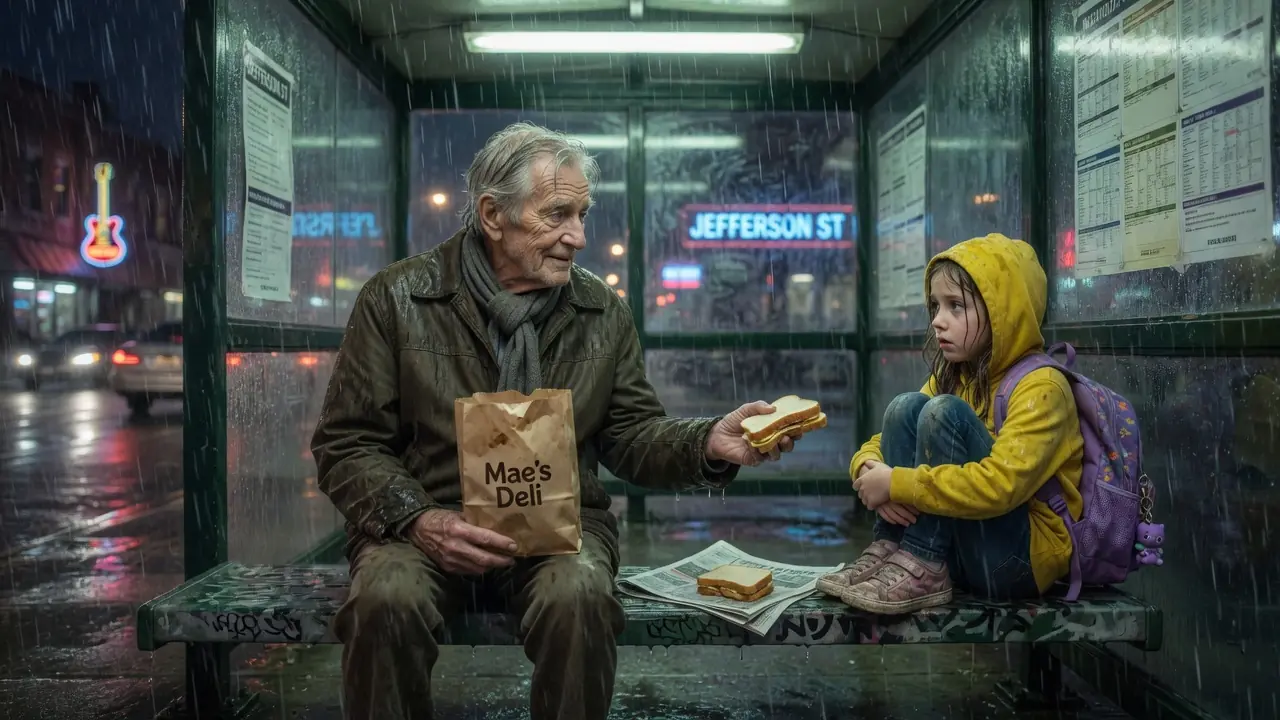
Maya began helping him sand old chair legs in the workshop behind the house. She liked the smell of wood and varnish. She liked seeing broken furniture become useful again.
“Can people be fixed like chairs?” she asked one afternoon.
Harold looked at her over his glasses. “Not fixed exactly. But they can be cared for until they stop feeling broken.”
She nodded as if storing the words somewhere important.
Months later, a foster family was found. Good people. Kind people. They lived across town and promised Maya could keep visiting Harold.
Still, when the day came, Maya stood on Harold’s porch with tears in her eyes.
“You’ll forget me,” she said.
Harold reached into his pocket and gave her a small wooden heart he had carved from leftover walnut.
“No,” he said. “And if I ever get foolish enough to try, this will remind you to come scold me.”
She held the wooden heart in both hands.
“I’m going to pay you back one day.”
Harold smiled. “For half a sandwich?”
“For staying.”
She hugged him hard, then left with the foster family.
But she did come back.
Every Saturday at first. Then holidays. Then school breaks. Harold taught her how to sand, stain, repair joints, tighten screws, and polish wood until it shone. Maya grew taller, steadier, and less afraid of silence. She did well in school, especially in design and math. By sixteen, she could restore an old rocking chair better than many adults Harold had known.
“You’ve got hands that listen,” he told her.
She smiled. “That makes no sense.”
“It does to furniture.”
Years passed.
Maya earned a scholarship to study architecture and community design. She left Nashville but called Harold every Sunday. She sent him sketches of houses, shelters, libraries, and small rooms meant for children who needed safety. She kept the wooden heart on her desk.
Harold grew older.
His workshop became harder to manage. His hands shook. His roof leaked. His property taxes rose. The city began buying up houses nearby for redevelopment, and a developer offered him money for the house. Not enough to buy peace, but enough to make him wonder if staying was selfish.
He did not tell Maya.
She found out from Pastor Ellis.
Three days later, she appeared on Harold’s porch.
She was twenty-eight now, tall, confident, with her dark hair pulled back and the same serious eyes he remembered from the bus shelter. She held a folder under one arm and the wooden heart on a chain around her neck.
“You were going to sell the house?” she asked.
Harold sighed. “Hello to you too.”
“Answer me.”
“I’m old, Maya.”
“That’s not an answer.”
“The roof leaks. The workshop needs repairs. I can’t keep up.”
“You should have called me.”
“You have important work.”
“You are important work.”
He looked away.
Maya stepped inside and placed the folder on the kitchen table.
“I’ve been designing something for two years,” she said. “I was waiting until it was ready.”
“What is it?”
She opened the folder.
Inside were drawings of Harold’s house, repaired and expanded, with the old workshop transformed into a training space. The spare rooms were updated. The kitchen widened. The porch rebuilt. Behind the house was a small new building with bedrooms, a common room, and a bright workshop.
Harold stared.
“Maya…”
“It’s called The Bennett House,” she said. “A short-term home and skills center for homeless children and teens. Safe beds. Meals. Counseling partners. Woodworking classes. Design classes. A place where kids can stay until morning and then learn they can build beyond it.”
His eyes filled.
“No.”
“Yes.”
“I gave you half a sandwich.”
“You gave me the first place that didn’t disappear.”
Maya sat across from him.
“The nonprofit is funded. The church is partnered. The county approved the program. The house stays yours for life. Repairs start next month. You don’t have to run anything alone. But the workshop stays. Your name stays. Your lessons stay.”
Harold covered his face with both hands.
“I’m too old for this.”
“No,” Maya said softly. “You’re exactly old enough. You know how to make broken things useful again.”
The renovation took six months.
Harold complained about the noise, the new windows, the safety rails, the young workers moving his tools, and the fact that everyone kept telling him not to climb ladders.
Maya ignored all ladder-related complaints.
When the work was finished, Harold stood outside beneath a new wooden sign.
THE BENNETT HOUSE
Safe Until Morning. Strong Enough For Tomorrow.
He touched the sign with trembling fingers.
Children arrived that winter.
Not many at once. Never too many. Each came through proper support services. Some stayed one night. Some stayed a week. Some returned for woodworking classes even after finding stable homes.
Harold sat in the workshop teaching them how to sand with the grain, how to repair a loose chair leg, how to measure twice before cutting once.
And always, when a child arrived frightened and hungry, Maya made sure there were sandwiches in the kitchen.
One night, years after the house opened, Harold saw a little boy sitting at the kitchen table, staring at a plate but not eating.
He walked over slowly with his cane.
“You don’t like turkey?”
The boy whispered, “I don’t have money.”
Harold sat across from him.
“I didn’t ask for money.”
Maya stood in the doorway, tears shining in her eyes.
The boy picked up the sandwich.
Harold smiled.
On Harold’s eighty-ninth birthday, The Bennett House held a small dinner. Former children returned as teenagers, young adults, students, workers, artists, and carpenters. They brought cards, repaired furniture, photographs, and stories.
Maya stood at the front of the room.
“No speeches,” Harold warned.
“You say that every year,” she replied.
“And nobody listens.”
Everyone laughed.
Maya held up the wooden heart he had carved for her.
“When I was nine,” she said, “I sat at a bus stop in the rain with no food, no home, and no reason to believe anyone would stay. Harold Bennett shared his last sandwich with me. Then he gave me safety, patience, and a workshop where broken things became beautiful again.”
Her voice trembled.
“I built this house because of him. But really, he started building it the night he said a child shouldn’t be hungry.”
Harold wiped his eyes.
Later, after everyone left, Harold and Maya sat on the porch. The house glowed behind them, full of warmth and quiet voices. The workshop smelled of fresh wood. The kitchen light was on.
“I thought I was just feeding a hungry girl,” Harold said.
Maya leaned her head against his shoulder. “You were.”
He looked at the sign near the road.
“And this?”
She smiled. “This is what happens when kindness keeps growing.”
Harold closed his eyes.
Long ago, he had shared half a sandwich at a rain-soaked bus stop.
He had thought it was too little to matter.
But that half sandwich became a promise.
The promise became a home.
And the homeless girl he once helped became the woman who made sure other children would never have to wonder if anyone would keep them until morning.