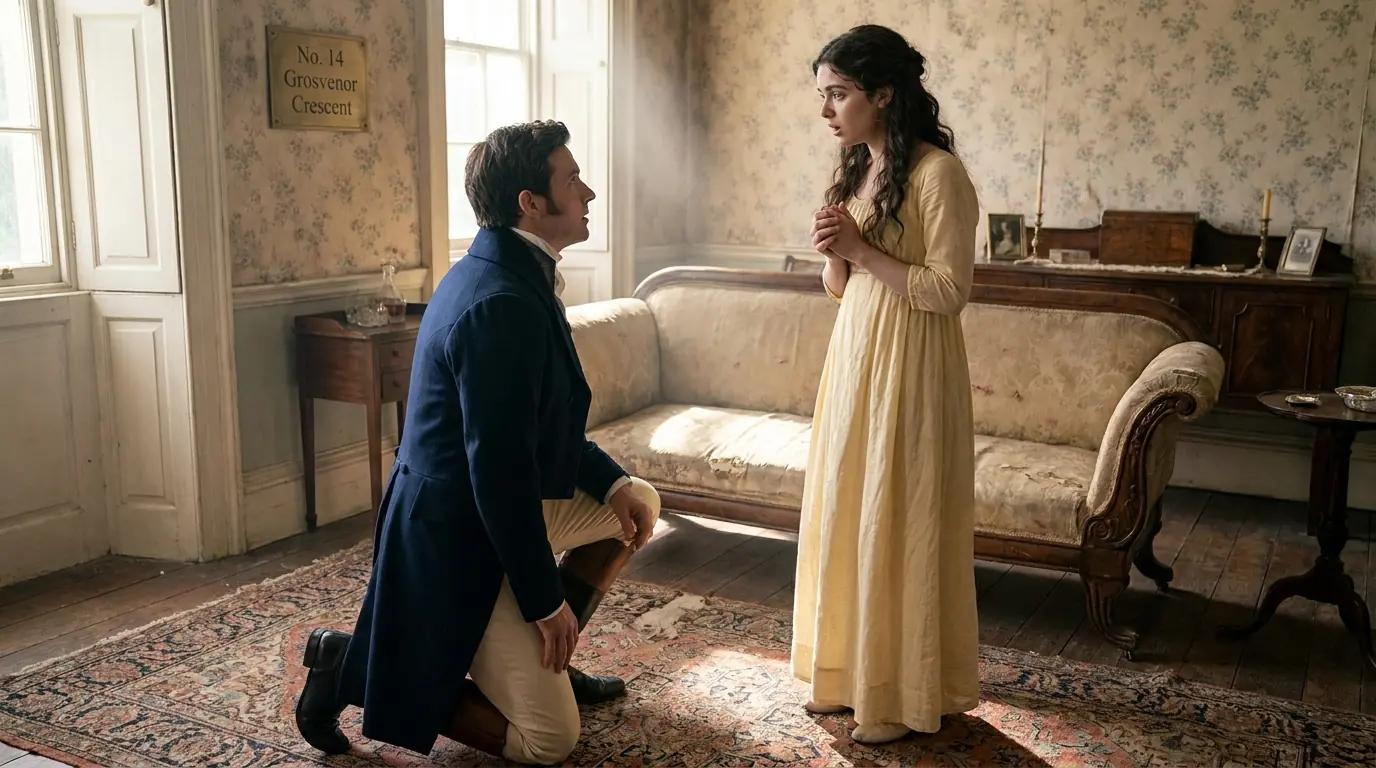
The Duke of Hadley went down on one knee on the wrong carpet, spoke the proposal he had rehearsed for another woman, and three sentences in realized with perfect clarity that the woman staring down at him was not the one he had come to marry. He completed the sentence anyway.
He had rehearsed the words on the carriage ride from Hadley House to Mayfair. Not out loud. A man did not rehearse out loud the sentence that would reshape his household, but silently, turning each clause like a ledger entry until the phrasing balanced.
He was to enter number 14, Grosvenor Crescent. He was to be announced. He was to kneel because his mother had asked for it in the same dry breath she had asked for the physician, and he had promised her he would kneel. He had promised he would bring home the girl before the first cherry blossom fell in the lower garden.
The cherry blossom had begun to fall yesterday.
The butler at Grosvenor Crescent opened the door with a startled reverence reserved for unexpected callers of the first rank. Julian presented his card, ivory, engraved, the Hadley crest cut so deep a fingertip could read it blind, and was shown into a morning room where a young woman in a daffodil yellow muslin stood at the window, laughing into the crook of her arm as though she could not contain the laugh any other way.
She turned. She saw him. She pressed a hand to her chest as though to still something unruly there.
Your Grace, she said. I was not expecting you.
I was not expecting any of this, either, Julian heard himself say, and he did not know what he meant by it, because he had expected all of it, had expected her, this house, this hour. But the words were already out, so he continued.
He knelt.
The rug was Persian, crimson, thinning at the edge where the door had scuffed it over three generations of morning callers. He registered this because a Duke of Hadley, trained to register such things the way a soldier trained to register a threat.
The rug beneath his knee was the wrong rug, the wrong rug for the wrong drawing room. And yet his mouth was opening, and the sentence he had rehearsed was climbing out of him as though he had practiced it for her specifically all his life.
Madam, he said, I have come with an unfashionable question. I have come to ask for your hand.
Silence in the room. Real silence. The kind that made the ticking of the mantel clock audible, and then the fire crackling, and then, somewhere beyond the wall, a pianoforte being played badly by someone who had stopped caring.
The young woman in daffodil yellow stared down at him with lips parted. Her hand was still pressed to her chest. It was trembling there.
Your Grace, she said. May I ask on what grounds?
It was not the question he had rehearsed answers to. Lady Arabella Carver, his mother had assured him, was a practical girl. Lady Arabella would accept, perhaps with an arched eyebrow and a condition or two about her pin money. Lady Arabella would not ask for grounds.
On the grounds, Julian said, and then his mouth, which had betrayed him once already, did so again. On the grounds that I've spent my whole life doing what was required of me, and this morning something in your drawing room felt, for the first time, like something I wanted.
The butler, who had been lingering in the doorway, made a small strangled sound and retreated.
The young woman did not retreat. She came three steps closer so that he had to lift his chin to meet her eyes. They were gray-green, flecked, amused, careful.
Your Grace, she said gently. I think there has been some misunderstanding. I am not Lady Arabella Carver. Lady Arabella lives at number 16. This is number 14. I am Miss Cordelia Vane, companion to Mrs. Harriet Vane, who is my mother, and I was laughing at the window because a pigeon had got trapped in our upstairs flue and has been making the most indignant speech through the chimney for the last quarter hour.
Julian considered this. He remained on one knee.
I see, he said.
Do you? she said.
Her mouth had begun to tremble, not with hurt, with the effort of not laughing.
Because you have not yet stood up.
No, I am aware.
Your Grace.
Miss Vane.
She crouched then, actually crouched in her daffodil muslin on the Persian rug, so that their faces were level, and he could see a freckle at the corner of her mouth, and a small scar on her chin that must have been from childhood.
Your Grace, she said again, very quietly. I believe the correct step now is for you to stand, apologize for the intrusion, allow my butler to show you next door, and pretend this never happened. I shall certainly pretend it never happened. I shall forget the unfashionable question entirely.
I cannot, Julian said.
You cannot stand, Your Grace, or cannot apologize?
I cannot pretend it never happened. I spoke. A man's word is the only thing he owns that no one can take from him. I will not take it back.
She was silent for a full breath. Then she said, Your Grace, I think you are being ridiculous.
Probably.
I think your mother will be very cross.
Yes.
I think Lady Arabella Carver at number 16 will be considerably crosser.
Almost certainly.
And yet?
And yet.
She tilted her head. A curl had come loose at her temple, the color of dark honey. She considered him the way a scholar considered a badly miscataloged book.
Then, to his astonishment, she said, Well, how unsporting of you, really. You have left me with two options. Either I refuse you and you return to Hadley House in the full embarrassment of a public rejection to a mother who expected a bride, or I accept you provisionally, on terms, for a period of time to be mutually agreed until you come to your senses, in which case I have committed myself to being engaged to a man I met twelve minutes ago, whose first act in my drawing room was to kneel on my great-aunt's carpet and confess that doing what was required of him has apparently exhausted him. Is that a fair summary?
Remarkably fair, Miss Vane.
I accept, Cordelia Vane said. Provisionally. Now, for the love of God, please stand up. My cat is about to walk across your boot.
Julian looked down. A large orange cat was inspecting his left Hessian with the proprietary air of a magistrate.
He stood. Cordelia Vane stood. Between them, the cat sat and looked at them both as though he had arranged the entire interview.
Your Grace, Cordelia said. I must ask one question before we conclude.
Yes.
Do you want to go next door?
Julian thought about this. He thought about the rehearsed sentence and the cherry blossom and his mother in her gray shawl at the window of the room that smelled of lavender and the faint medicinal sweetness he had come to associate with her illness. He thought about the drawing room at number 16 that he had never seen and the girl who was supposed to have been waiting in it, whose practical face he had memorized from a miniature he had carried in his waistcoat pocket for a week. He thought about Cordelia Vane's freckle and her daffodil muslin and the cat.
No, he said. Not particularly.
I thought not, Cordelia said. In that case, Your Grace, we have a great deal to discuss. Would you like tea? It is not very good tea. My mother insists on economizing on the leaves, but it is hot, and there are sandwiches left from yesterday's failed morning callers, and I can promise that neither of us will recite poetry at the other, which I understand is a mercy in a new acquaintance.
Tea, said the Duke of Hadley, would be a kindness.
She poured. Her hands were steady. Not a duchess's steadiness, not the trained, practiced economy of a woman raised to pour for nobility, but the self-taught steadiness of someone who had learned to be still because moving too much might spill what little was left.
The tea ran pale amber into the cup, the color of weak honey held against a window. A single dry leaf missed in the strainer spiraled briefly on the surface and sank. The kettle had been kept too long on the hob. Julian could hear the faint metallic sigh of the tin against its rest.
Outside, a coal cart clattered the length of Grosvenor Crescent, and farther off, a dog that had been barking intermittently since he had arrived now decided to stop.
The morning room was not a grand room. The ceiling was low, the cornicing was chipped above the door, the fireplace had been swept within the last hour, but a ghost of old wood smoke lingered at the mantle that suggested the chimney was inefficient, and that Miss Cordelia Vane had long ago accepted the chimney as it was.
Julian watched her and thought, She's twenty-five, perhaps twenty-six, and she has not had a new gown this season, and the daffodil muslin has been turned once at the hem, and she is not afraid of me.
He thought, The chair she has given me is the best chair in the room.
He thought, The cup she has given me is the least chipped of the three on the tray.
He thought, A woman who has nothing and gives first the best of it is either a fool or the sort of person his mother had, in a paragraph of fourteen words, understood at sight.
This last observation unnerved him more than the misadventure itself.
Dukes, in his experience, produced one of three effects on young women of modest fortune. They produced awe, which was tolerable. They produced terror, which was not. Or they produced calculation, which was worst of all. The slow inventory in the eyes, the visible appraisal, the woman beginning at once to count his acres and divide them by the probable duration of his mother's remaining years.
Cordelia Vane had done none of these things. She had crouched on the carpet. She had addressed him as though he were a neighbor's son who had taken a wrong turn on the way to luncheon.
Your Grace, she said, handing him a cup, I must confess a curiosity.
Please.
How exactly does one arrive at the wrong house to propose? I should have thought a man in your position would have a factotum for such matters, a secretary, a butler, a great uncle on standby.
My great uncle is ninety-one and believes it is 1787.
Ah.
My secretary is in Dover on the question of the harbor tax.
Unfortunate.
And my mother gave me the address herself.
That, Cordelia said thoughtfully, is the most interesting part.
Julian set down his tea. How so?
Your mother, forgive me, I am speaking about my station, but your mother gave you the number fourteen.
She did.
You are certain?
I have the letter in my breast pocket.
Oh, bring it out.
He found himself producing it before he had decided to.
She read it. Her lips moved very slightly as she read. At one point she smiled. At another she tilted the page as though considering an angle.
Then she handed it back.
Your Grace, she said, you are not a fool. I know this because a fool cannot look the way you did on your knees. A fool is ridiculous. You were not ridiculous. You were frightening.
I was not frightening.
You were frightening to me. I should like to know why.
Julian could not answer this. The fire popped. Outside, somewhere beyond the window, a carriage rattled up Grosvenor Crescent and passed number 16.
And he imagined, briefly and vividly, the front door of number 16 opening for someone else, and the sensation was not loss, but something nearer to relief, which was an absurd sensation. It was an unfaithful sensation.
He was the Duke of Hadley, and he had, twenty minutes ago, been contracted in intention to Lady Arabella Carver, and he had no right to feel relief.
Miss Vane, he said, do you have a mother still living?
I do.
Is she ill?
She is unwell, not dying, tired. The positions are mostly useless and expensive, and so we do without them and make do with beef broth and the pianoforte.
Cordelia Vane set down her teacup. Your Grace, that would be very unusual.
Yes.
Are you asking?
I am asking. Not because I require her approval, because I imagine she is the person on this earth who most requires your safety. And if I am to be in your drawing room, she should know who I am.
Cordelia Vane looked at him for a long time. He did not know what she was looking for. He hoped she was finding it.
This way, Your Grace, she said.
Mrs. Harriet Vane was in the upstairs drawing room. The drawing room was small, smaller than Julian's dressing room at Hadley, and filled with an astonishing quantity of books. Books on the tables, books on the floor beside the fire, books on the piano bench, arranged so that a person sitting there could not sit without first moving a dissertation on geology.
A thin woman with Cordelia's gray-green eyes and a cap of silver hair sat in a high-backed chair with a shawl over her lap. She looked up.
Cordelia, she said, there is a duke in my house.
There is, Mama.
Why?
It is a long story. He asked to meet you.
Mrs. Vane inspected Julian as though he were a first edition of dubious provenance.
Sit, Your Grace. Not there. The tabby sleeps there. That chair, yes. Cordelia, the shortbread.
Julian sat.
Mrs. Vane tilted her head. You look, she said, like a man who has made an interesting mistake.
I have, madam.
Good, Mrs. Vane said. Too many young men make dull ones. What was the mistake?
Julian considered. He considered a dozen answers. In the end, he chose the one that was true.
I proposed marriage to your daughter, he said. I ought to have proposed to the young lady at number 16. I realized my error mid-sentence. I completed the sentence anyway.
Mrs. Vane absorbed this with perfect composure.
Cordelia, returning with the shortbread, froze in the doorway.
And your daughter, Julian continued, provisionally accepted.
Mrs. Vane looked at Cordelia. Did you, dear?
It was more complicated than that, Mama.
I see.
I was going to explain.
Cordelia, her mother said, shortbread. Come, sit. Your Grace, I apologize that we have no sherry. We have some rather excellent Madeira, but a doctor convinced me two years ago that it was killing me, which it almost certainly was not.
Now, Cordelia has provisionally accepted. On what terms, Your Grace?
We have not yet agreed on terms, madam.
Then we shall agree on them now, Mrs. Vane said, because I am an ill woman, and I do not have the luxury of waiting for young people to mismanage things at their own pace. Sit forward, both of you.
They sat forward.
Julian found himself suppressing a smile. He could not remember the last time he had been spoken to with such unhurried autocracy. His mother spoke to him with affection. His steward spoke to him with deference. Mrs. Harriet Vane spoke to him as though he were a clever boy who must now pay attention.
Term the first, she said. You will not, Your Grace, publicly announce your engagement until this mistake of yours has been considered carefully by all three parties here, and by Lady Arabella Carver, to whom I gather some kind of apology is owed.
Agreed, Julian said.
Term the second. You will call here three times a week, as is proper, for a period of one month. If, at the end of that month, you still believe you have proposed to the correct woman, you will deliver a formal notice to my solicitor. His name is Mr. Peabody, and he is cheap and honest, which is very rare. And only then shall the engagement be announced.
Agreed.
Term the third. Here Mrs. Vane's voice softened very slightly. You will not, during this month, treat my daughter as a salvage operation. She is not a compromise. If at any point you find you were quite right to go to number 16 after all, you will go there like a man, and you will tell Cordelia plainly, and you will not make a great Dickensian tragedy of it. She will survive. She has survived worse.
Cordelia made a small sound, a half laugh cut off.
Julian looked at her. There was a softness in her eyes now that had not been there before.
Agreed, he said.
Mrs. Vane nodded. Good. Now, shortbread. And you must tell me, Your Grace, about your own mother, because if she is ill, I shall have a great deal of sympathy for her. And if she is merely bored, I shall have none at all.
She is ill, Julian said.
Then we shall sympathize, Mrs. Vane said. And she reached across the tray and pressed his hand once with a grip like a bird's, light, precise, surprising, and then let go.
Cordelia, the shortbread is rather dry, but it is the best we have.
Julian did not go next door.
He walked home to Hadley House by a route that was neither direct nor decorous. He went along Grosvenor Crescent to Upper Grosvenor Street and then east to the park.
And in the park, he walked two full circuits of the Serpentine in a slate gray morning rain that fell so finely it was less rain than suspended weather. And he saw, twice, the same pair of swans quarreling over a strip of floating reed.
By the time he reached Hadley House, his coat was heavy at the shoulders and his boots were slick inside. And the porter gave him a look of such restrained reproach that Julian, handing over his gloves, said only, I am aware, Bellamy. Do not trouble yourself.
He went upstairs to his mother's room.
She was sleeping.
He stood at the foot of the bed for perhaps three minutes without moving.
Then he went down to the library, shut the door, and did not emerge for eleven hours.
What he did in the library he did not, for months, tell anyone. He wrote four letters to Lady Arabella Carver and burned each of them in turn in the grate. He wrote three letters to his mother and sealed them, unsent, in a drawer of his desk.
He stood at the long south window for a considerable time watching the rain fall on the small formal garden that nobody ever sat in because nobody had ever quite worked out what the garden was for.
He thought about his father. He thought about his father's hands which had been larger than his own and about the particular way his father had said the word enough when a conversation had gone on too long.
He thought about the cherry blossom at Hadley which would be at its peak in four days and which his mother might or might not live to see again.
He thought about Cordelia Vane's laugh at the window and the pigeon speech through the flue and the cat.
He ate nothing. He drank half a glass of port at some unidentified point between six and seven.
At ten, he sent for pen and fresh paper.
He told his secretary who had returned from Dover with the pinched look of a man who suspected catastrophe that the matter with Lady Arabella Carver was to be handled by letter, not by visit, and that the letter was to be written by Julian himself with no assistance, no stylistic improvements, and no softening of the essential fact, which was that the proposal had not occurred.
This last was a lie that was also, in a sense, a truth. The proposal had occurred. It had simply occurred at the wrong address.
Julian did not think Lady Arabella Carver required that level of detail.
He wrote and tore up. He wrote again and tore up again. The discarded drafts accumulated in a small gray drift at the corner of the desk. And the footman who came to clear the grate the following morning would carry them out to be burned without reading them because Bellamy had trained the staff of Hadley House over fifteen years not to read the Duke's discarded paper.
In the end, Julian settled on seven sentences of ruthless clarity, sealed the letter, and sent it by the hand of a groom on horseback at half past eleven. The groom had specific instructions to hand the letter to the butler at number 16 and not to wait for a reply.
That afternoon he called at number 14.
Cordelia received him in the morning room and she was not in daffodil. She was in green, a soft, muted sage green that made her gray-green eyes look almost the color of water under leaves. And her hair was up in a manner that suggested someone had helped her this time.
Your Grace.
Miss Vane.
You came.
Did you think I would not?
I thought there was a fair probability. Three days is a long time to consider an impulse.
She gestured at a chair. Sit. I have sent the cat upstairs.
I did not mind the cat.
He minded you, which is what matters.
Julian sat. Cordelia sat opposite him. Between them, the morning light fell across the low table in a clean honey-colored band.
And for a moment, he could not think of anything he had rehearsed.
I have written to Lady Arabella Carver, he said.
Oh?
I told her that I have engaged my word to you.
Cordelia blinked. Then she laughed, a short, startled laugh, and her hand flew to her mouth as though she had not expected the laugh to escape.
Your Grace, that is that is either the bravest letter of the season or the most reckless.
Both, I think.
You will be the talk of three drawing rooms by suppertime.
Four, surely.
Four, if Lady Farthing hears of it.
She will hear of it.
Then four.
Cordelia studied him for a moment. Your Grace, why did you do that? It would have been easier to say nothing, to let the matter drift. Engagements unformed do not officially require unforming.
Miss Vane, he said, I have been doing what was easier for seven years. I have done it well. I would like, for a single month, to attempt something more difficult.
She was silent. Then she said, Seven?
I beg your pardon.
You said seven years. I should have guessed rather more.
I am twenty-six, Miss Vane.
Ah. She tilted her head. You are younger than I took you for. I thought Dukes were required by statute to be at least forty.
It is a common misapprehension.
How did you come to be a Duke at twenty-six?
Julian paused. This was not a question he was often asked. Most people already knew. In the circles his mother had cultivated for him, the dates of his father's death and his own accession were common knowledge, a small, dark fact everyone observed and no one discussed.
But Cordelia Vane did not move in those circles. Cordelia Vane had no idea. She was asking because she wished to know.
My father died when I was nineteen, he said, of a fall from a horse. He was fifty-two. He had been in excellent health. My mother was thirty-nine and pregnant with my youngest sister. I was at Cambridge. I was sent for. By the time I arrived, he had been dead for nine hours. My mother asked me in the same breath with which she told me whether I thought my father had been a good man.
I said, Yes.
She said, Then you have six days to become one.
Cordelia sat very still.
I became one, Julian said, approximately. I have been becoming one for seven years. It occupies most of the hours of the day. Miss Vane, I tell you this because I believe you asked and because I find that I would prefer you knew. I'm not in the habit of telling it.
I imagine you are not.
No.
She was looking at him with a steady attention that he did not know how to receive. It was not the attention of awe or calculation or the polite boredom of a well-bred girl. It was the attention of someone who had been listening to voices for a long time and had learned to hear which ones were telling the truth.
Your Grace, she said at last. May I ask a cheerful question?
Please.
Do you prefer currants in a scone or raisins?
Currants.
Good. You shall have currants. My mother insists on raisins, but she is upstairs writing a scathing letter to our apothecary and will not know.
Shall I ring?
Please, Julian said.
And he felt, absurdly, impossibly, as though he had been rescued from something he had not known he was drowning in.
The first three weeks passed in a choreography neither of them had designed. Spring arrived in Mayfair the way spring always arrives in Mayfair, politely, without committing to anything until the last of the garden parties had been canceled on account of a late frost.
The hawthorns along the western railings of the park came into white first in the week of the eleventh, followed by the chestnuts on the fifteenth, which opened their pink and cream candles in a single morning and filled the air under them with a sweet, drowsy, almost sticky scent that Cordelia had always associated, improbably, with her father.
He had been a man who wore a chestnut flower in his buttonhole every May of his married life and had stopped the practice only when the family fortune failed and had not resumed it after.
The hawthorn scent was the cleaner one. The chestnut scent carried for her an old private sorrow that she did not admit to anyone.
Julian called on Tuesdays, Thursdays, and Saturdays. He drank Mrs. Vane's economical tea. He read aloud from a treatise on Italian drainage that Mrs. Vane was engaged in correcting, a thin octavo in calf, printed in Turin in 1811, which Mrs. Vane's late husband had acquired at an auction for a shilling, and which Mrs. Vane had been annotating for eleven years on the conviction that the author, a Piedmontese engineer named Colombo, had misunderstood the hydrostatic principles underlying his own proposed canal.
Julian read each paragraph slowly, as Mrs. Vane instructed, and paused at the points where she wished to dictate a correction, and wrote the correction in pencil in her margin in a firm, clear hand that was rounder than his regular script.
Mrs. Vane had, by the end of the first Tuesday, revised her initial paragraph about Dukes. She had revised it to include the sentence, This one, at least, can spell.
He allowed the orange cat to sit on his boots.
On Saturdays, he escorted Cordelia to Hyde Park for what she called, with a straight face, a walk appropriate to my station, which is to say, a walk that does not require a second pair of gloves.
They walked at the unfashionable hour, not Rotten Row at five, when the beau monde paraded, but at eleven in the morning, when the paths were populated chiefly by nursery maids, elderly gentlemen with their physicians, and the occasional wild-eyed poet in search of a rhyme for fidelity.
Cordelia began, during these walks, to keep a ledger, not on paper, in her head. She had kept ledgers in her head for a long time, household expenditures, her mother's daily medicines, the exact number of times a dress had been turned, and she had a good memory for categories.
The ledger she now kept was labeled, privately, Things about the Duke of Hadley that do not add up.
Entry one. His hands. They were a gentleman's hands in their care, but there were pale calluses along the index and middle finger of the right hand that did not belong to a man whose only occupation was signing his name. They were a rider's calluses, which was respectable, but also, lower down, at the base of the thumb, a rougher patch that she could not place.
She watched it for a week before she understood. It was the callus of a man who used a shovel. A Duke did not use a shovel.
Entry two. His conversation. He could discuss the political economy of the Rhineland with absolute precision. He could also, when coaxed, identify the probable species of a shrub by glancing at its bark, which was not a dukish accomplishment.
Once, in the park, when a small boy ran into his legs and began to cry, Julian had crouched. Dukes did not crouch. And produced from some invisible pocket a small, grubby wooden top, which he had wound for the boy and spun on the gravel.
The boy had stopped crying. Julian had returned to his feet as though the interlude had not occurred.
Cordelia had filed this away under entry two and said nothing.
Entry three. His silences. He had a habit, when a question cut too close, of going very still. Not the polite stillness of a man rehearsing an answer, a deeper stillness, like a landscape holding its breath before a change of weather.
She had cataloged it three times. Once, when she asked about his sister. Once, when she asked what he did when he was not in London. Once, most interestingly, when she asked why he had been at number 14 at nine in the morning, when a gentleman paying a call of consequence was expected to arrive after noon.
That last silence had lasted eleven seconds. She had counted.
You were early, she had said, finally.
I was early.
Why?
Miss Vane, he had said, I do not know that I wish to answer that.
Then do not, but file it with the rest, please, so that when you are ready to answer, you may do so in chronological order.
He had laughed. Not the polite laugh of a Duke caught out, a real laugh, short and surprised, the laugh of a man who has not been asked to account for himself in exactly this tone for perhaps years.
She had fallen half in love with that laugh.
She was not, and this was important to her ledger, pretending. She knew she was meant to be engaged provisionally, and she was committed to the letter of that arrangement, but she had not agreed, in any clause of her mother's terms, to refrain from taking an interest.
She was taking an interest. She was taking, in fact, rather more interest than she had intended to.
The wound beneath the interest she did not examine. The wound was old. The wound had a name she did not say, and a date she did not commemorate. It had the shape, if one drew it, of a young man with a good laugh and a better horse, who had made certain specific promises at a certain specific garden gate when Cordelia was twenty-two, and had then married a wine merchant's daughter with eleven thousand pounds, having decided, on balance, that Cordelia's father's ruined investments made her an imprudent attachment.
Cordelia had learned, in the four years since, to laugh about this. She could make Mrs. Vane laugh about it. She could, on a good day, make the vicar laugh about it, which was the hardest audience.
She made a point of laughing about it in the mirror every morning, so that the wound did not forget it had been laughed at.
What she did not do was compare the young man at the garden gate to anyone. She had a strict rule. She did not compare.
The Duke of Hadley was stretching her rule.
The Duke of Hadley had, last Saturday, taken off his glove to retrieve a fallen glove of hers from the gravel, and she had seen the shovel callus for the second time, and had not asked about it, because she was afraid that if he answered, she would like him more than the ledger permitted.
Miss Vane, he said, now, on the gravel path on a morning of unfallen rain, you are frowning.
I am thinking.
About?
About a category, she said, that I have not yet invented.
The revelation arrived, as revelations often do, by letter.
It was a Wednesday morning. Cordelia had been helping her mother shell peas, a late spring ritual that Mrs. Vane insisted upon because a woman who cannot shell a pea has no business correcting a treatise on drainage.
And the post had come.
There were three letters. One from Cordelia's aunt in Bath, which was expected. One from the apothecary, which was also expected, and which contained the apothecary's apology, which was funny.
And one in a hand Cordelia did not recognize, addressed in a neat, small, feminine script to Miss Cordelia Vane, number 14, Grosvenor Crescent.
Cordelia opened it with the garden knife, not with her fingers, because she had learned from her mother that an unknown hand on an unknown letter deserved the dignity of a tool.
The letter read,
Miss Vane,
you do not know me, and I do not know you, and I have spent two weeks, at my mother's insistence, refraining from writing this. I write it now because I cannot, in good conscience, allow matters to continue without your possessing certain information.
I am Lady Arabella Carver, of number 16, Grosvenor Crescent. The Duke of Hadley was, on the morning of the seventh of April, expected at my mother's drawing room to tender an offer of marriage, which, I gather from his subsequent letter to me, he tendered to you instead.
I understand the intention had been for him to arrive shortly after noon. He arrived at number 14 at nine.
I wish to make the following plain, because I believe, from my own observation of the Duke across four seasons in London, that he is a man who does not make random errors.
Miss Vane, the Duke of Hadley's mother, the Dowager Duchess, instructed me, in a private conversation, three weeks before the seventh of April, that her son would call in the morning. That was her word, morning.
I took it to mean early. My mother, who is more optimistic and more fashionable, took it to mean noon.
The Dowager Duchess said morning because she meant early, and because she did not wish me, specifically, to be ready.
I do not wish to marry the Duke of Hadley. I wished, four seasons ago, to marry his cousin, Mr. Peregrine Ashworth, who has no fortune and no prospects, and an unfashionable enthusiasm for bees.
My aunt's family has used the Hadley matter as a lever against me throughout those four seasons.
The Dowager Duchess, for reasons I cannot entirely account for, appears to have decided to release me from the lever.
Forgive me for the directness.
I write because you are, I suspect, being courted under a false understanding of how you came to be chosen.
You were not chosen by accident.
You were chosen by a dying woman's small, quiet intervention.
And by her son's apparent willingness, when the moment came, not to correct her.
I bear you no ill will.
I bear him no ill will.
I bear my own cousin considerable ill will.
But that is a separate correspondence.
Yours sincerely,
Arabella Carver.
Cordelia read the letter twice.
She folded it.
She set it on the hall table.
She went upstairs.
She sat on the edge of her mother's bed for a long time without speaking until Mrs. Vane, who had been half asleep, opened one eye and said, What is it, dear?
Mama, Cordelia said, I have been an idiot.
In what way?
I had thought I was being chosen at random by a kind man who had lost his way. It now appears I was chosen deliberately by the Dowager Duchess of Hadley through the agency of her son, who knew perfectly well where number 14 was, and who walked into my drawing-room at nine in the morning because his mother had arranged for him to do so.
Mrs. Vane opened the other eye.
Interesting.
Interesting.
Yes, dear. That is very interesting indeed.
Does it please you?
Does it Cordelia began and stopped.
She did not know what to say.
She'd been prepared to be furious.
She'd been prepared to march downstairs, write a devastating letter of her own, and send the Duke of Hadley back to number 16 with instructions to apologize on behalf of his entire family.
But something in the pragmatic curve of her mother's eyebrow suggested there was a question embedded in her own outrage.
It does not displease me, Cordelia said slowly. That is the problem.
Ah.
It makes me feel watched.
You have been watched, dear. A young woman of your quality with a sick mother in a rented house on Grosvenor Crescent is visible to any person with a tolerable view of the neighborhood. The question is not whether you were watched. The question is by whom and with what intent.
Cordelia laughed. You are being very calm.
I'm ill, dear. I have no energy left for the other pastures.
Mrs. Vane reached for her daughter's hand.
Tell me, when you next see him, and you will see him on Saturday because Saturdays are walking days, what will you say?
Cordelia thought.
The thinking took a long time.
I think I shall ask him, she said at last, why he did not tell me.
Good, Mrs. Vane said. That is the right question. Do not ask the wrong one.
What is the wrong one?
Whether he meant it.
Cordelia looked at her mother.
Her mother looked back.
He meant it, Mrs. Vane said. He meant it on the carpet, Cordelia. I have had twenty-eight years of marriage, not all good ones, and I can tell a man's meaning when he kneels.
Your question is not whether.
Your question is why he did not trust you with the whole of it.
Cordelia nodded slowly.
She folded the letter once more.
She slipped it into her bodice, where it rested against her heart like a small, sharp bone.
Saturday was the twenty-eighth of April.
The cherry blossom, which had begun to fall on the sixth, was long gone.
In its place, the pear trees along the railings of Hyde Park had opened into their second, smaller, whiter flowering, and the air had a green, sappy quality that made Cordelia's nose itch.
She had slept badly.
The letter from Lady Arabella Carver had spent the night on the table beside her bed, folded, silent.
In the dream that had woken her at four in the morning, she had been a girl at a garden gate again, twenty-two years old, explaining to a young man with a good laugh that her father's investments were not, in fact, as ruined as the town supposed.
The young man in the dream had not been the young man at the gate.
He had been Julian.
The dream had ended before she could hear what he said.
She had dressed by candlelight, carefully, and had gone down to the kitchen and made her own tea.
A small rebellion, because Mrs. Banks, the cook who'd stayed on at half wages, hated to find a member of the family in the scullery before dawn.
She had sat in the kitchen until it was time to dress for the day, watching the copper pan on the hob pop and hiss through its slow rewarming, and had rehearsed what she intended to say.
In the rehearsal, she had been admirable.
She had spoken in paragraphs.
She had forgiven nothing and conceded nothing, and at the climactic moment, had walked calmly away from him down the gravel path without looking back.
She suspected, even in the kitchen, that the rehearsal would not survive contact with the man himself.
Julian arrived at number 14 at half past ten.
He was in a coat he had not seen before, a deep slate gray that made his shoulders look broader than she remembered.
And he was carrying a small parcel wrapped in brown paper.
For your mother, he said. Crystallized ginger. Mrs. Bellows at Hadley House swears by it for a weak chest.
Your Grace, that is very kind.
Your Grace, I have decided, Cordelia said, that today we shall be formal.
She saw it register.
His face did not change. His face rarely changed.
But something in his shoulders did.
He inclined his head.
Of course, Miss Vane. Shall we walk?
We shall.
They walked.
For the first quarter of the walk, they said nothing.
A kind of silence she had not experienced with him before.
Not the companionable silence of Tuesdays.
Not the concentrated silence of a man attending to a problem.
But the silence of a man bracing.
At Hyde Park Corner, she stopped.
She turned to face him.
Your Grace, she said, I have received a letter from Lady Arabella Carver.
Ah.
Ah.
I had wondered if she would write.
You had wondered? Cordelia repeated. Do you mean to say you expected it?
I expected she might. Her situation is complicated. She is an honest woman.
Your Grace, Cordelia took a breath. She'd rehearsed this on the walk from Grosvenor Crescent, and in the rehearsal, she'd been brisk and slightly amused.
Now, she was neither.
Your Grace, you knew. You knew from the first sentence you spoke on my carpet that I was not Lady Arabella Carver. You'd been told by your own mother that number 14 was where a certain Miss Cordelia Vane, who was I, would be at nine in the morning. You did not mistake the house. You did not mistake the woman. You walked in having been prepared to propose to me, and you allowed me to believe for three weeks that you had blundered.
Julian did not move.
He stood very still on the gravel path at Hyde Park Corner, and a young nursery maid with a pram had to edge around them to pass, and he did not appear to notice her.
Yes, he said.
Why?
Miss Vane, why? Why did you let me think you were a fool who had knelt on the wrong rug? Why did you let me feel sorry for you, Your Grace, for three weeks? I sat across from you and drank my mother's bad tea and thought, What a kind, lost, embarrassed man. Do you know how kind it made me feel to be kind to you?
I know.
You know?
I counted on it, Miss Vane.
She was so angry, she could not, for a moment, speak.
The pear blossom above them released a handful of petals, and these settled on his shoulders, and she had the ludicrous impulse to brush them off.
Explain, she said.
Julian took a breath.
He let it out slowly, a man steadying himself on the bridge of a long sentence he had not written in advance.
My mother, he said, has been ill for sixteen months. She has been deliberate about her illness, as she has been deliberate about everything.
Four months ago, she gave me a list. It contained seven names, seven young women she had observed over the course of two years in drawing-rooms, in parks, at modest assemblies, in charity meetings.
She had ranked them.
Each name had a short paragraph attached.
Your paragraph, Miss Vane, was the shortest. It read,
Cordelia Vane, number 14 Grosvenor Crescent, companion to her own mother, takes in mending, laughs at the wrong moments.
The only girl I have observed in two seasons who made me think, If she loved him, he would survive me.
Cordelia pressed her gloved hand to her mouth.
She had been watching you, Julian said. Your name was at the top.
I did not know it was at the top until the morning I walked into your drawing room.
I had thought, because I am, Miss Vane, on some matters genuinely stupid, that I was calling at number 16 for Lady Arabella.
I believed my mother and I had agreed on Lady Arabella for practical reasons, land, dowry, proximity.
It was my mother who, a week before, asked me to stop by number 14 first.
She said there was a book she wanted returned.
I believed her.
I am, Miss Vane, my mother's son.
When she asks me to stop somewhere, I stop.
He paused.
I walked into your morning room.
You were laughing at a pigeon.
I looked at you, and I knew why the paragraph had said what it said.
I knew in four seconds, Miss Vane.
I knelt, and I proposed, not to the wrong woman, but to the woman my mother had chosen three months before I had the courage to know she had chosen her.
I have been keeping that truth from you for three weeks, because I did not know how to tell you without making you feel like a prize in a contest you had not entered.
I was wrong to keep it.
I am sorry.
Cordelia did not know what to do with her hands.
She put them, finally, in the pockets of her pelisse.
Your Grace, she said. You are an impossible man.
I am aware.
You walked into my house under a falsehood.
The falsehood was by omission, Miss Vane. The proposal was not.
And yet, you let me think.
I let you think I was ridiculous.
I did so because you laughed at me with real kindness, and kindness has been in short supply in my life, and I was greedy for three weeks for more of it.
It was selfish.
I see that now. I should have told you on the second Tuesday.
Yes, she said. You should have.
A silence.
The nursery maid was far down the path now, unaware she had skirted a small catastrophe.
Cordelia watched her go.
Your Grace, she said. I have a question.
Please.
Did your mother order you to propose to me?
No.
Did she suggest it?
She put the name on a list. She made the list.
She invited me to number 14 to see.
She did not make me kneel, Miss Vane.
I did that.
Have you been keeping anything else from me?
Julian considered.
Yes.
What?
My mother is unlikely to live past midsummer.
I've told no one outside the household this.
I tell you now because I will not see you again, which I accept is your right to refuse me, on the basis of another omission.
Cordelia looked at him.
The slate gray coat, the broad shoulders, the pear petals still on one shoulder, the shovel callus on the thumb of the hand that had, three weeks ago, trembled very slightly as he held out Lady Arabella's letter for her inspection, the steady, watchful stillness of him.
She put the letter in her pocket.
She stepped closer.
Your Grace, she said. I'm going to tell you something, and I would ask that you do not repeat it in any drawing room. Never.
I'm not angry that your mother chose me.
I'm flattered that your mother chose me.
I am, in fact, suspiciously pleased that your mother chose me, and I will require several days to examine that pleasure to be certain it is not vanity.
I am angry. I am still angry that you did not trust me with it, and I will remain angry about that for some days.
But I want you to know that my anger is not the kind that unmakes a thing.
It is the kind that requires the thing to be remade, more carefully, with more honesty.
I accept that, Miss Vane.
On Tuesday, you will come to number 14, and we will speak again, and you will begin from the beginning to tell me about your mother, not as a duke, as her son.
Yes.
And you will address me by my Christian name.
Cordelia.
Good.
She took his arm.
It trembled very slightly under hers.
Now walk me home, Your Grace. I have spent my anger for the morning, and my boots are beginning to pinch.
Monday was a day Cordelia would not remember for its events, because it contained no events.
It contained, instead, a particular quality of light through a particular window of her mother's drawing room, in which Cordelia sat for perhaps three hours with her mother's commonplace book open on her lap, reading neither the entries on the page, nor the entries in her own head, but letting the two sets of sentences stand quietly in the same room.
At intervals, Mrs. Banks brought up small trays of food, a triangle of toast at eleven, a bowl of broth at one, a piece of bread with cheese at four, and Cordelia ate without noticing.
At six, her mother came down from upstairs and sat opposite her, and did not ask what she was thinking, because Mrs. Vane had a long-established policy in the family of never asking what anyone was thinking, on the grounds that any answer given under questioning was unlikely to be the real answer.
Mrs. Vane picked up her own book, a volume of sermons she did not intend to finish, and read in companionable silence until suppertime.
At suppertime, they ate cold mutton and boiled potatoes.
At bedtime, Mrs. Vane said from the doorway, You are making a large, quiet decision today, Cordelia. I do not mean to rush it. I mean only to say that I trust whatever you decide, and you should trust it, too.
Cordelia did not answer.
On Tuesday, Julian did not come to number 14.
He sent a carriage instead.
The carriage had a crest on the door and a coachman with very white gloves, and the coachman delivered to Mrs. Vane a small, quite crumpled note that read,
Mrs. Vane,
may I impose on your permission to borrow your daughter for the afternoon?
My mother has asked to meet her. The Dowager Duchess does not move about well and cannot call on you.
If you are reluctant, say so, and I will find another solution.
H.
Mrs. Vane read the note.
She handed it to Cordelia.
Go, she said.
Mama.
Go, dear. I shall be perfectly fine. I have the cat. I have a treatise to correct. I have the ginger, which is very good.
Go and meet the woman who has been watching you for two years.
I will want every detail.
Cordelia went.
Hadley House was in Grosvenor Square, not Grosvenor Crescent, a walk of eleven minutes, a world of difference.
The gate was iron.
The footman wore livery the color of a winter sea.
The hall was marble, and the marble was cold under Cordelia's pelisse hem, and the Duke of Hadley was waiting for her at the foot of the great stair.
Cordelia.
Julian.
It was the first time she had used his Christian name aloud.
It felt in her mouth like a coin she had been carrying for weeks without knowing it was there.
He offered his arm.
He took her up the great stair.
On the landing, he paused outside a door that was merely a door, not grand, not ornamented, a plain, white-painted door with a brass handle,
and he said,
She is very tired today.
She will not rise.
She will apologize for this.
Please do not accept the apology too readily.
It embarrasses her to be treated as an invalid.
I understand.
He opened the door.
The room smelled of lavender, of beeswax candles, and of that faint, medicinal sweetness he had learned to recognize at seven paces.
A small woman was in a large bed under a pale gray coverlet.
Her hair was white.
Her eyes were the same gray-green as Julian's, which Cordelia had not expected, because she had assumed Julian had his father's eyes.
Your Grace, Cordelia said, and she curtsied, properly, fully, the curtsy she had learned at fourteen and only rarely used since.
Miss Vane, the Dowager Duchess said. Come closer, please. Julian, a chair.
Julian brought a chair.
Cordelia sat.
The Dowager Duchess reached out one thin, pale hand and took Cordelia's gloved one, and looked at her with the attention of a woman who had been waiting for this particular face for some time.
I watched you, she said, at the Wexford Charity Musical in November.
You sang a Thomas Moore song.
You sang it badly in the sense that your voice is not a drawing-room voice, but you sang it as though you meant it, which is the only way Moore should be sung.
I thought, That girl does not yet know what she is.
I have been thinking about her ever since.
Cordelia's eyes pricked.
She had not expected this.
Your grace, do not apologize for your voice. It was not the voice I was listening to.
I was listening to the pause before the last verse.
You hesitated for half a beat.
A well-trained girl does not hesitate.
You hesitated because the line you were about to sing was true, and you did not want to sing it lightly.
That hesitation told me something about you.
I have been cataloging such things about young women in this city for two years.
Yours was the one I kept returning to.
She paused for breath.
It was an effortful pause.
Cordelia saw, for the first time, how small the dowager duchess's chest was under the coverlet, and how much work the small chest was doing.
My son, the dowager duchess said, is a good man.
He is also a man who has been dutiful since he was nineteen.
Duty is a serviceable replacement for a life for a time, but it is not a life.
I have been trying, Miss Vane, to give him a life.
I have been doing so quite clumsily, and in a manner that has, I gather, given you some offense, and for that I apologize without reservation.
I was running out of time to be subtle.
Your grace, I I have one question, Miss Vane.
I will not ask more than one.
Will you answer it honestly?
Yes, your grace.
The dowager duchess tightened her grip.
The grip was light, as light as Mrs. Vane's had been a fortnight before, but it was precise.
Do you think, she said, that you could be happy with him?
Cordelia did not answer immediately.
She did not answer quickly.
She thought of the shovel callus, the little wooden top, the dry shortbread, the pear petals on the slate gray coat, the letter against her heart, the half laugh she had not expected to give, the pause before she had let him take her arm again,
and the sensation, the following evening, of writing her own name in her private book in a way she had never written it before.
Yes, your grace, she said. I think I could.
I think, in fact, I am already a considerable way along.
The dowager duchess smiled.
It was a small smile, but the smile changed the room.
Good, she said.
Julian, bring the small box from the second drawer.
He did.
It was a plain wooden box, no larger than a pair of snuffboxes.
The dowager duchess opened it with some difficulty.
Inside, on faded blue velvet, lay a ring.
Not a large ring, a pearl, an oval pearl, flanked by two tiny emeralds.
Nothing grand, nothing a herald would notice.
This, the dowager duchess said, was my mother's.
It was not the Hadley ring. The Hadley ring is ostentatious, and you shall receive it in due course for public purposes.
This was my own.
I wore it at the dinners where no one was watching, because it was the one I loved.
I should like you to have it, not as an engagement, as a welcome.
You may wear it or not wear it.
Julian will fuss if you do not wear it.
I shan't.
She pressed it into Cordelia's palm.
Cordelia closed her fingers on it.
She did not trust her voice.
Thank you, your grace, she managed.
Thank you, Miss Vane.
You have made an ill woman's week.
You may go.
Julian, walk her to the hall.
I shall sleep now.
The effort has been considerable, and rewarding.
A fortnight passed, in which the arrangement at number 14 settled itself, without fanfare, into a shape that had not existed a month before.
Mr. Peabody of Lincoln's Inn was consulted.
Mrs. Vane was consulted.
A physician of Julian's personal acquaintance, a Scottish doctor of about forty named McIntyre, who had no London practice, and who was willing to come down from Edinburgh at Julian's expense, examined Mrs. Vane one afternoon in her upstairs drawing-room,
and emerged with the same quiet verdict the previous physicians had offered.
No identifiable disease,
a weak chest,
a fatigue deeper than the chest.
McIntyre added, however, a sentence the previous physicians had not added.
He said,
Mrs. Vane, your body is not what is ill.
Your circumstances are ill.
Remove the circumstances,
and we shall see what remains.
Mrs. Vane had received this with the exact same expression she had received the apothecary's letter two weeks before, which was to say, with a single raised eyebrow,
The dowager duchess, from her upstairs room at Hadley House, wrote Cordelia three letters during the fortnight, each of them short, each of them addressing a different small practical question,
a question about a gown,
a question about a dinner,
a question about a particular piece of family lace that had belonged to Julian's grandmother,
and that Cordelia might wish to examine at her leisure.
Cordelia understood, on the third letter, that the dowager duchess was not writing about gowns or dinners or lace.
The dowager duchess was writing in order to keep a thread between them,
to establish, by increments, a correspondence that did not rely on Julian.
Cordelia was moved by this.
She replied with equal brevity and equal small practical attention in her own hand,
and the two women, who had met precisely once, conducted, through the medium of ivory notepaper, a quiet acquaintance that ripened, within a fortnight, into something that was almost not yet friendship, and almost not any longer politeness.
Lady Farthing's May Ball was the second largest squeeze of the season,
and the dowager duchess's quiet approval had turned Cordelia Vane overnight, almost literally overnight, from an invisibility at number 14 into the most discussed young woman in Mayfair.
She did not enjoy this.
She attended because Julian asked her to, and because the dowager duchess, whose energy was a daily fluctuating quantity, had insisted she wear the emerald green silk that had been commissioned and delivered in a hurry.
The silk was the color of deep water at dusk,
and Cordelia, examining herself in the looking-glass before departure, had murmured,
I look like a trout.
You look, Mrs. Vane had replied from her chair by the fire, like a woman who is about to be looked at by two hundred forty people, half of whom will dislike her on principle.
The silk will do much of the work for you.
Walk slowly. Do not answer questions you have not been asked. Do not apologize for your mother's absence.
Your mother is ill at her own pace, and that is no one's business but ours.
The ball was in the long gallery of Farthing House, which had been built in 1743 by a Farthing who had won a great deal of money at whist, and lost his only daughter to smallpox in the same month, and which retained, two generations later, the melancholy grandeur of a house that had outlived its occasion.
The candles were immense. The floor was polished within an inch of its life.
The orchestra was in a gallery above.
Julian met her at the door.
Cordelia.
Julian.
You look Please do not say that I look like a trout.
I was going to say precisely that you look like nothing I have ever seen before, and that I am having the strange sensation of not being quite able to remember my own name, which is inconvenient, because the announcer is about to ask for it.
She laughed.
Then the announcer was saying it, and then they were in.
She felt the turn of the room.
It was a real thing, one hundred eighty heads turning with the coordination of a flock of starlings, and one hundred eighty private calculations beginning in one hundred eighty minds at once.
Cordelia, who had spent four years learning not to flinch at being overlooked, had less practice in not flinching at being seen.
She did not flinch.
They danced twice, a minuet, which was short, and a country dance, which was long.
Between dances, Julian introduced her to his sisters, who were three, and to his uncle, the bishop, who was kindly and deaf,
and to the Countess of Ashby, who had been his mother's closest friend, and who took Cordelia's face in both of her gloved hands and said, very quietly,
Anne would have liked you enormously, my dear.
And Cordelia did not trust her voice for the next quarter hour.
It was in the quarter hour that Sir Miles Carver appeared.
He had been drinking.
Not enough to be obvious, just enough to have lost the last thin layer of his self-command.
He came at them sideways across the ballroom floor, past the edge of a quadrille,
and he wore his dislike of Julian Ashworth like a badly tailored coat, visible at every seam.
Your Grace, he said.
Miss Vane, good evening.
Sir Miles, Julian said.
And Cordelia felt the muscle in his forearm under her glove go still.
I hear, Sir Miles said, smiling, that congratulations are in order.
That, Cordelia said, is premature.
Oh?
Sir Miles, we have announced no engagement. My mother's terms do not permit it for another fortnight.
Your mother's terms?
Sir Miles repeated the phrase as though it were a small, amusing object.
Your Grace, forgive me.
I had thought your mother's terms were the relevant ones.
Or is it to be, going forward, your mother-in-law's?
Cordelia felt, she could not help it, Julian's arm tense.
Sir Miles, Julian said, you are tiresome.
I am puzzled, Your Grace.
You were to come to my cousin on the seventh of April.
You did not.
You came instead to Miss Vane, who is a charming person about whose circumstances I make no comment, except that her father, the late Mr. Christopher Vane, left his daughter and his invalid widow with debts of a nature which I am certain the Dowager Duchess was not aware of when she wrote her paragraph.
The ballroom did not stop, but a radius of perhaps ten feet around them went quieter.
Cordelia felt the quiet as a physical thing.
Go on, Sir Miles, she said, because the alternative was to let him continue with Julian's silence as his canvas.
Miss Vane, Sir Miles's smile did not waver.
Your father owed my father, and now owes me, the sum of three thousand four hundred pounds.
I have the papers.
I had intended to be discreet.
I'm still inclined to be discreet.
But a duke marrying into a debt of that magnitude, merely through love, merely through a chance encounter on a carpet, is a curious thing.
And the world will be curious.
Curious on your behalf, of course.
Of course.
Julian opened his mouth.
Cordelia pressed his arm once, a signal, a small one,
and he closed it.
She turned to face Sir Miles.
Sir Miles, she said, pleasantly, I am delighted you have raised the question of my father's debts in a public ballroom, because it permits me to respond publicly, which my mother would otherwise have forbidden.
A few heads, already turned toward them, turned fully.
My father did owe your father three thousand four hundred pounds, Cordelia said.
He owed it at the rate of five percent compounded annually, payable on demand.
He also owed your father, this is in the same set of papers, Sir Miles, I'm sure you have examined them, the balance of a note of hand executed on the twelfth of November, 1818, in the amount of five hundred pounds, which your father lost to mine at whist at White's on the eighteenth of the same month, and which remained, by the rules of gentlemen's accounting, unpaid at your father's death, which postdated my father's by six weeks.
Sir Miles's smile flickered.
Miss Vane, the net debt, Sir Miles, is two thousand nine hundred pounds, not three thousand four hundred.
I have copies of the relevant papers.
I've always had them.
I offered, by letter, in the autumn of 1823, to settle the net sum at twenty-five pounds per annum, which your father had accepted before his death.
I understand you have since refused the terms your father accepted.
The silence around them had widened to about fifteen feet.
Miss Vane, you would not.
I would, Sir Miles.
I have the Morning Post's address.
I have a pen.
I am in want of very little of the world's good opinion.
And what I want, I have discovered, I can earn without your help.
Do you accept?
Sir Miles looked, for the first time, at Julian, as though for assistance, as though for a duke's steadying intervention.
Julian's expression had not changed since the beginning of the exchange.
He was watching Cordelia.
He was watching her, she noticed, with the exact same stillness he had shown on the gravel path at Hyde Park Corner three weeks before.
The stillness of a man who has been told something he is still deciding how to receive.
Sir Miles, Julian said softly, I recommend you accept.
I, twenty-five pounds per annum, Sir Miles.
The Morning Post does not accept advertisements past ten in the morning.
If you refuse, she will miss tomorrow's edition, but not Friday's.
Sir Miles nodded once, tightly.
I accept.
Thank you, Sir Miles, Cordelia said.
And she smiled at him.
And the smile was the smile of a woman who has not, in fact, spent her anger.
She has merely saved it for when it could do the most work.
Good evening.
Sir Miles withdrew, not elegantly.
The crowd parted.
It closed.
Julian looked at Cordelia.
Cordelia looked at Julian.
Your Grace, she said, very low, I should like a glass of ratafia.
And then I should like to be walked out of this ballroom with as much dignity as we can both muster, because my knees have, without my permission, become rather unreliable.
Cordelia, please.
He gave her his arm.
He walked her to the refreshment room.
He procured a glass.
She drank it too quickly.
The ratafia was too sweet and too warm.
It tasted of almonds and of a kitchen somewhere down a long corridor where someone had scorched the bottom of a pan an hour earlier.
She could hear the orchestra above, a waltz with a wandering violin, and the laughter of two women close by who had not yet noticed her,
and the light, regular ping of a glass being tapped against another glass in some distant, casual toast.
She could feel the silk of her gown against the back of her neck where it was slightly damp.
She could feel, under her glove, the small pulse at Julian's wrist, which was going considerably faster than hers.
The observation surprised her.
She had thought her knees were the only unreliable thing in the room.
She understood now that his hands were lying, and had been lying since Sir Miles had opened his mouth.
He procured her another.
She walked, on his arm, with perfect dignity, out of the Farthing Ballroom and into a small, adjoining morning room that had, mercifully, been emptied of all persons except an elderly spaniel asleep in a chair.
The morning room had been furnished, in a previous generation, in the expectation that daughters would sit in it to embroider, and had never quite outgrown the shape of that expectation.
The hearth was narrow.
The carpet was rose.
The candles had been allowed to gutter out.
Only two of the six in the candelabra on the mantel were still burning,
and one of those was guttering along the base, sending a faint thread of smoke up toward a ceiling that had been plastered and painted cream in 1780, and had not been disturbed since.
A book, Cowper's letters in calf, lay open on a side table at a page Cordelia would later remember, although she had not consciously read it, as a paragraph about a tame hare.
The silence after the ballroom was a physical thing.
It rested on her shoulders like a second cloak.
She felt herself begin, for the first time since Sir Miles had spoken, to shake.
She sat down.
She looked at him.
Julian, she said.
Cordelia.
I have been angry for four years.
I did not know, until tonight, that I had been angry for four years.
I think you have earned the anger.
I earned it.
But I ought to have spent it.
I saved it, Julian.
I kept it in a drawer.
It had begun to smell.
She laughed, a short, helpless laugh.
Tonight I spent the whole of it at once in a single five-minute fit at a man who did not quite deserve all of it for a debt that could have been settled quietly by Mr. Peabody at any time since 1823.
You were magnificent.
I was terrifying.
My mother will say I was vulgar.
Your mother will be proud.
Cordelia put her hand flat against the arm of the chair.
Julian knelt again at her side.
The spaniel opened one eye, evaluated the situation, and closed it.
Cordelia, he said, I should like to ask you something.
I've been waiting to ask.
I could not ask in a ballroom because I would not have you accept in front of three hundred witnesses and a quadrille.
I could not ask last Tuesday because you were still partly angry with me, and rightly.
I cannot ask this in the grand way the Dowager Duchess will expect me to because I am not grand.
I am, for all my title, a man who got up yesterday morning and pitched manure out of a stable yard because one of my stable boys has pneumonia.
That is the shovel callus, by the way.
I have been waiting to tell you about it.
Cordelia began to cry, which she had not done in a ballroom or adjacent room for four years, and had not planned to do tonight.
I should like, Julian said, to marry you, not as the Duchess of Hadley, as Cordelia Vane, who tells me whenever I am ridiculous that I am ridiculous.
Will you have me?
Yes, on terms. Your terms. Tell me.
Cordelia wiped her eyes with the back of her glove.
Julian, she said, I have three.
Please.
First, you will never lie to me by omission. Small omissions are the worst kind.
Second, you will allow me to continue to laugh at you. It is how I love. I have no other mode. I do not know how to love quietly. It will always come out as a laugh.
Accepted.
Third, you will make your mother, your mother, know daily, until she cannot be made to know anything, that she chose well.
She is to know this from you in words, plainly, from tomorrow until the end.
Do you understand?
I understand.
Do accept with all of it.
Yes.
She reached for him.
She took his face in her hands the way the Countess of Ashby had taken hers in the ballroom an hour before, and she kissed him lightly once because the spaniel was still in the chair, and she was still wearing the emerald green silk, and three hundred people were a wall away.
The emerald green silk, the Dowager Duchess had told her during the fitting, was expensive enough to pay Mr. Peabody's fees for a year.
Cordelia had thought it vulgar to discuss the price of a gown at its first wearing.
She took the thought back now.
The gown had done its work.
The weeks between the ballroom and the wedding ran for Cordelia at a speed that did not match any clock she had previously owned.
The days were long and full, and occurred in the wrong order.
She would sit down to breakfast and rise, it seemed to her, at supper.
She would walk from the library to the garden and find, on the way, that she had written three letters, tried on a gown, held a conversation with a modiste about a hem, and composed, mentally, the first stanza of a poem she did not intend to write down.
The poem concerned a cat.
She kept the poem in the end because Julian requested it.
He framed the lines on a piece of card and put the card in a drawer of his study desk beside the letter from his mother of the sixth of April.
He did not tell her he had done this.
Mrs. Vane discovered it much later by accident and did not mention it to Cordelia for a full year.
Mr. Peabody of Lincoln's Inn drew the papers for the Carver debt.
Sir Miles signed them at a counter in a clerk's office in Chancery Lane, observed by two witnesses and a plain small terrier who belonged to the clerk.
He did not look Cordelia in the eye.
He did not need to.
The matter was closed on the seventeenth of May by the simple mechanism of a quarterly warrant of twenty-five pounds drawn on Cordelia's own modest account at Hoare's,
and the first warrant cleared on the twenty-third.
She watched the notation come back from the bank,
a small blue stamp, the date, a clerk's initials,
and felt something that she had not expected to feel,
which was not triumph,
and not grief,
and certainly not release.
She felt, mostly, tired.
Four years of anger spent in five minutes and a single warrant turned out to weigh more in the week afterward than the carrying of it had ever weighed.
Lady Arabella Carver called at number 14 on the twenty-fourth of May.
She was a pale, serious young woman of twenty-three with very clear gray eyes and a beautifully direct manner,
and she sat for twenty minutes in Mrs. Vane's drawing room drinking tea without saying anything of any consequence at all.
At the end of the twenty minutes, she set down her cup, looked at Cordelia, and said,
I thought you would be more frightening.
I'm glad you are not.
Good day.
She rose, put on her gloves, and left.
Mrs. Vane, from her chair by the window, remarked, after a long pause, that it had been one of the most satisfactory calls of her life.
They were married in September in the small family chapel at Hadley because the Dowager Duchess had lived, to her son's astonishment and Cordelia's private prayer, through June and July and the cool beginning of August,
and she had asked to see the wedding, and the wedding had been brought forward by three months so that she might.
She saw it from a chair on the chapel's side aisle.
She wore a deep gray silk, the color of a dove's breast, which she had not taken out of its cedar box in nine years,
and the slightest pearl combs in her white hair,
and she sat between Julian's three sisters who held one of her hands between them in a rotation they had privately agreed upon.
Mrs. Harriet Vane, who was well enough to travel for the week, and who, Julian's physicians had privately and improbably determined, was not, in fact, dying.
She was merely stubbornly exhausted, a condition that was not, it turned out, terminal, and that responded well to the steady consumption of Hadley beef, a warmer fire, and a daughter who was not disappearing into the wallpaper,
sat on the other aisle in dark plum,
and held her own hand because she had never much liked her hand held by anyone else.
The vows were brief.
Cordelia's voice did not tremble.
Julian's did on the second line of his.
Cordelia, hearing it, laughed, short, startled, helpless,
which caused the vicar to pause,
and the Dowager Duchess, listening, to smile.
They said the words that come after the vows, which do not matter.
And then Julian took Cordelia's hand, turned it in his, pressed his lips to the inside of her wrist, which was not in the prayer book,
and said, quite audibly in a small chapel that carried sound the way a shell carried the sea,
I love you.
It was the first time he had said it aloud.
He had been saving it.
He had been saving it, Cordelia understood, for this, for the one moment in which saying it could not be mistaken for anything else.
Oh, for heaven's sake, Cordelia said, through a throat that was suddenly not working, I love you, too, Julian.
Now kiss me properly.
The vicar is going to combust.
He kissed her.
The first months of their marriage were, for Cordelia, a quiet astonishment consisting largely of rooms she had not previously entered and people she had not previously known, arranged in an order that had been optimized over two hundred years by housekeepers of formidable competence,
and then, at Julian's request, quietly rearranged to accommodate one young woman who had no particular wish to be waited on.
The household adjusted.
The housekeeper, a Mrs. Fellows, adjusted first, having identified within a week that the new Duchess took her morning tea weak, preferred to walk in the lower garden before breakfast rather than after,
and would not tolerate being woken by the drawing of curtains.
The butler adjusted second.
The cook adjusted last,
and only after Cordelia had appeared in the kitchen on the fourth morning to borrow, specifically, a small copper pan for the purpose of heating her own milk,
a request that had so offended the cook that the cook had not spoken to Cordelia for three days and had, thereafter, in a gesture of reconciliation, taught her the particular method by which Hadley's kitchen prepared shortbread with currants.
Mrs. Vane had come for the summer and stayed into October.
And Julian had observed he had not remarked on it aloud, but he had observed that she was walking farther each week and that the cough she had brought down from London had, by the first frost, gone entirely.
He had written a quiet note to his physician at Hadley inquiring whether it was possible for a woman previously described as dying to recover in a countryside diet.
And the physician had replied equally quietly that it was not only possible but common in cases where the original diagnosis had been, in his considered view, mostly a diagnosis of hunger and cold air.
The physician had added in a postscript that he would not be repeating this observation to Mrs. Vane herself, who would find it disobliging.
The Dowager Duchess had lived out the autumn.
She had, in November, asked to be moved from her own bedchamber to a smaller, sunnier room at the east corner of the house where the morning light fell clean through an undraped window and where she could watch from her bed the particular chestnut tree she had planted in 1794 to mark her betrothal.
She had asked for no visitors except Julian, Cordelia, and her own long-time maid.
She had asked Cordelia, one morning in late November, to read her a paragraph from Mrs. Vane's treatise in progress on the Piedmontese Canal.
She had laughed once at the margin note in Julian's rounder hand.
And then she had slept.
She had not, afterward, woken.
It had been, Julian said to Cordelia on the day of the funeral, the manner she had chosen.
A manner of small corrections to the end and a rest accepted in its hour.
The pear trees along the railings of Hadley's lower garden were flowering when Cordelia walked into the library one afternoon in late spring and found Julian asleep in an armchair with a three-month-old child face down on his chest.
The child was called Anne after his mother.
The name had been his suggestion.
It had been his only insistence about the name.
Cordelia paused in the doorway.
She did not wake them.
She did not move.
Through the high window, the orange tabby, fetched up from Grosvenor Crescent on the day of the wedding, at his own insistence, as no one had dared pack him, and yet he had climbed into a basket and refused to be removed,
was inspecting the gravel walk outside with the proprietary calm of an animal that had arranged the entire domestic situation.
On the low table beside Julian's chair was a book.
Not the book he had been reading.
A smaller book bound in plain calf.
Cordelia recognized it.
It was her mother's commonplace book.
The one in which Mrs. Harriet Vane had, for twenty-eight years, recorded the passages she wished to keep.
Mrs. Vane had presented it to her at the wedding in lieu of a dowry.
You may add your own entries, she had said, but only the ones you would like your daughter to find.
Cordelia crossed to the table.
She picked up the book.
She opened it to the last entry, which was in her own hand, added three weeks earlier.
It read from a letter of the Dowager Duchess of Hadley to Julian Ashworth, written on the sixth of April, 1824, and by him preserved in his breast pocket since that date.
My son,
when you go to Grosvenor Crescent tomorrow morning,
do not take the weight of what you are doing to number 16.
Take the weight of it to number 14 first.
If you find you can set it down there,
you will not need to carry it farther.
Your mother,
Anne.
Cordelia read it twice.
She closed the book.
She set it down.
The baby Anne stirred on her father's chest.
Julian opened his eyes, first one, then the other, in the order in which he always woke,
and focused on Cordelia and smiled.
How long have you been standing there? he said, very softly, so as not to wake the child.
Long enough.
Long enough to Long enough to be entirely, absurdly sure.
Cordelia.
Julian.
I'm going to ring for tea.
The shortbread will have currants in it.
I have trained three cooks on this point.
Do not move. Do not even shift.
I shall bring it to you.
She kissed his forehead once, lightly.
The cat in the garden beyond the window turned to watch.
The pear petals fell.