She was always invisible, even as she cleaned the hallways where the future walked. But that day, her quiet daughter revealed a gift no one expected. And within minutes, what had been silence became courage, and that courage became a revolution.
The morning started just like any other. A gray sky over the big city, a crowded bus swaying down the avenues, people in a hurry getting off before their actual stop.
Maria held her daughter Laura's hand tightly as she carefully descended the bus steps, balancing a worn out purse on her shoulder and trying not to trip.
The girl was nine. Nine years of dark, quiet eyes, the kind that seemed to hold more thoughts than words.
The backpack on her shoulders was faded, patched in two places with thread that didn't match the fabric, but it still worked. It still held on, just like the two of them.
Maria looked at the mirrored skyscraper in front of her, that glass giant that reflected the sky without ever truly touching it, and felt the familiar tightness in her chest.
Almost 10 years working there. 10 years entering through the service door, pushing the cleaning cart through empty hallways before the executives arrived, wiping away traces of meetings she would never attend, emptying trash cans full of papers that decided fates that would never include hers.
She existed in that building the way walls do. Necessary, ignored, invisible.
But today was different.
Today Laura was with her.
The school had closed for the day due to structural cracks and Maria had no one to leave her daughter with.
She tried her neighbor who works during the day. She tried her cousin who was out of town. She even tried calling her mother who lived far away and could barely take care of herself.
Nothing.
So she made the only possible decision, the one that filled her with equal parts shame and fear.
She brought Laura to work.
They entered through the service entrance as always. The narrow hallway smelled of disinfectant and stale coffee.
Maria greeted the security guard with a timid nod, and he barely looked up from his phone.
She went up to the locker room, changed her shirt for that navy blue uniform that was so washed out it had lost its color, and tied her hair in a tight bun.
Laura sat there on the wooden bench, quiet, waiting.
She didn’t complain.
She never complained.
Maria went down to the supervisor's office, knocked twice before entering, and was already apologizing as she walked in.
“Sorry to bother you. Sorry for the situation. Sorry for being an inconvenience.”
The man, Mr. Henderson, a man in his 50s with a tired expression and slumped shoulders, listened without interrupting.
When she finished, he sighed deeply, ran a hand over his face, and said it was fine.
The girl could stay, but on one condition.
She couldn’t be seen, couldn’t make a sound, couldn’t get in the way.
Maria thanked him three times in a row as if she had received a miracle and left feeling like she owed him a piece of her own dignity.
She took Laura up to the 12th floor, the one that was still empty at that hour.
The breakroom was small, with a little table against the wall, two old chairs, and a refrigerator that hummed softly.
Maria set up one of the chairs in a corner away from the door and asked her daughter to stay there.
Laura took a notebook from her backpack, opened it to a page marked with a strip of paper, and started to write.
Maria looked at those small hands holding the worn down pencil, at that brow furrowed in concentration, and felt her chest tighten again.
Her daughter deserved more than this.
She deserved a real desk, a school without cracks, a world that saw her as a person and not a problem.
But there was no time to think about that now.
Maria grabbed the cleaning cart and started her routine.
First floor, conference rooms.
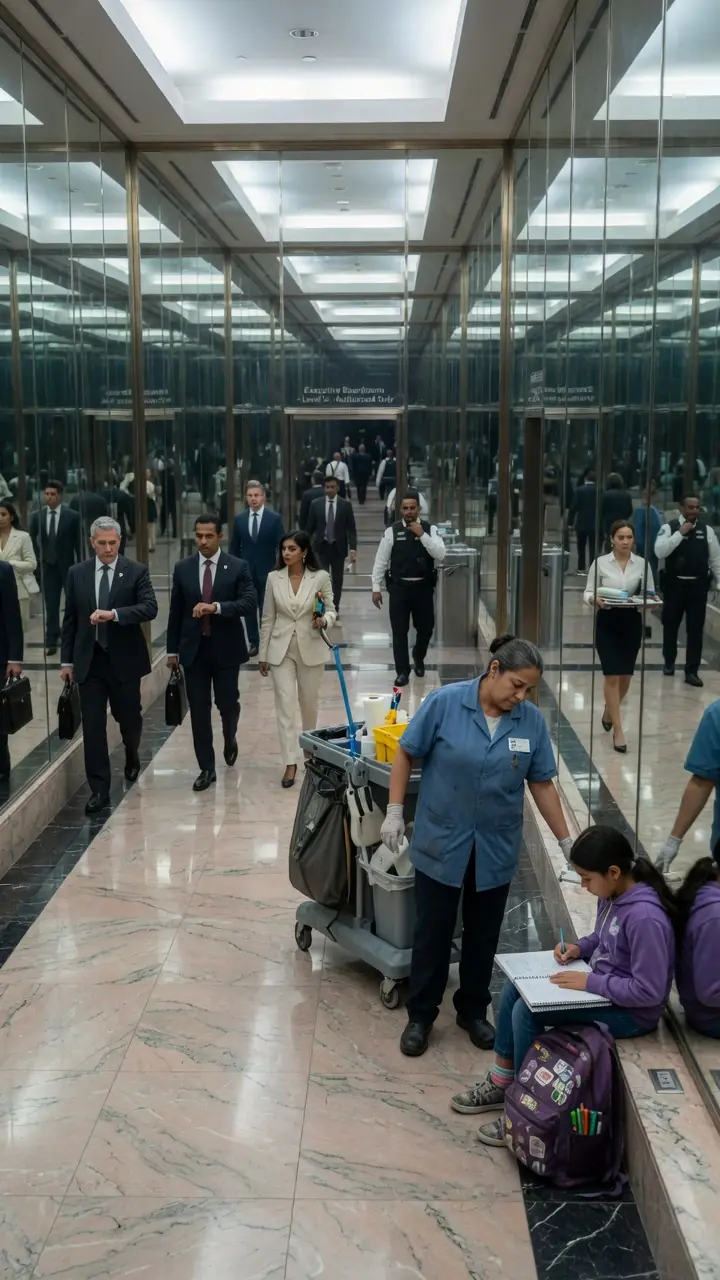
She wiped down the glass tables, arranged the chairs, emptied the trash cans.
Second floor, hallways and bathrooms.
She scrubbed the scuff marks off the floor, replaced the paper towels, cleaned the mirrors.
Third floor, break rooms and common areas.
She washed the mugs left in the sink, cleaned the splatter-filled microwave, swept the crumbs from under the tables.
And so it went, floor by floor, hour after hour, as the building slowly woke up around her.
People arriving, elevators filling up, voices echoing through the halls.
She remained invisible as always.
Every so often, she would go up to the 12th floor to check on Laura.
The girl was still there, quiet, studying.
Maria would bring a cookie from home or a cup of juice she'd sneak from the breakroom.
And Laura would smile, thank her softly, and go back to her notebook.
That notebook.
Maria had never paid much attention to it, thinking it was just homework.
But now, looking closely, she saw something different.
Words in languages she didn’t recognize. Lists of phrases. Strange drawings that looked like letters but weren’t. Symbols. Arrows connecting one thing to another.
It was as if Laura were building a map of something Maria couldn’t see.
Around 10:00 in the morning, the mood in the building shifted.
Maria noticed it right away.
Assistants rushing around with folders under their arms. Security guards positioning themselves by the elevators. That buzz of low urgent voices.
Something important was about to happen.
Maria tried to stay out of the way as always, but curiosity led her to the 15th floor where the main conference rooms were.
There were people in impeccable suits, women in high heels, men in expensive ties.
And there were also people she didn’t recognize. Foreigners, judging by their faces and attire.
An international meeting, she concluded. The kind that decides multi-million dollar contracts, that moves money from one side of the world to the other, that changes the destinies of entire companies.
Maria pushed her cart slowly, trying not to draw attention.
She passed by one of the conference rooms with the door slightly ajar and heard voices.
Voices in different languages. English maybe, or French. She couldn’t tell.
And there was a man translating everything into English with a firm professional voice.
She stopped for a second just to listen because there was something fascinating about it.
People from different parts of the world sitting at the same table trying to understand each other through someone else’s words.
It was as if the interpreter were a bridge. A living bridge.
That’s when she felt a presence beside her.
Laura.
The girl had left the breakroom and was standing there looking at the half-open door with an expression Maria had never seen before.
Maria motioned for her to go back, but Laura didn’t move.
It was as if she were hypnotized by the sound of those voices, of those words dancing between languages.
Inside the room, a man was speaking in a guttural language full of harsh sounds.
The interpreter was translating, explaining figures, deadlines, conditions.
The American executives nodded, took notes, asked questions.
Everything seemed to be flowing smoothly until Laura, very quietly, almost in a whisper, murmured something.
Maria didn’t understand what it was.
She didn’t recognize the words, but inside the room, someone heard.
A man in a dark suit with perfectly combed gray hair and an ice cold expression raised his hand and called for silence.
Everyone stopped talking.
He turned toward the door and asked in heavily accented English who was out there.
Maria’s heart sank.
She pulled Laura back, tried to move away, but it was too late.
The door swung open forcefully, and a tall man in a gray suit with a furious expression appeared in the hallway.
Maria recognized him immediately.
Richard Thompson.
An executive director. One of the company’s top bosses.
The kind of man who looks at people and decides in half a second who deserves respect and who deserves contempt.
And in that moment, his gaze was pure contempt.
He saw Maria, the cleaning cart, the worn out uniform.
He saw Laura, the old backpack, the frightened eyes.
And something in him twisted with disgust, as if poverty were a contagious disease.
“What are you two doing here?” he asked.
But it wasn’t a real question.
It was an accusation.
Maria tried to explain, tried to say she was just passing by, that she wasn’t listening to anything, that her daughter had come with her because she had nowhere else to go.
But the words came out jumbled, weak, powerless.
Fear was swallowing her whole.
Richard didn’t care.
He started speaking loudly so everyone in the room could hear.
He said this was a confidential meeting, that sensitive information was being discussed, that their presence was a serious breach.
He said Maria was spying, that she was jeopardizing multi-million dollar contracts, that she would be fired on the spot.
His voice was a razor cutting slowly with pleasure.
Maria trembled.
Her legs felt weak.
She thought about the late rent, the nearly empty refrigerator, the bills she couldn’t pay.
She thought about Laura, about school, about a future that was already so uncertain.
And she couldn’t say anything.
She just stood there, head down, waiting for the final blow.
That’s when Laura took a step forward.
It wasn’t an act of rebellion. Not insolence.
It was instinct.
An instinct to protect her mother, to not let her stand alone in the face of that humiliation.
The gray-haired man, the foreign investor, came out of the room and approached.
He looked at Laura with curiosity, like someone looking at a puzzle.
“Was it you who spoke?” he asked in his thick accent.
Laura looked at her mother, asking for permission with her eyes.
Maria didn’t know what to do.
She just wanted it to be over.
Richard laughed.
A mocking, venomous laugh.
“This is a circus,” he said. “A child? Seriously? Are we going to waste time on this?”
The entire room waited.
Waited for the shame, the embarrassment, the confirmation that people like Maria and Laura didn’t belong there.
But then Laura opened her mouth.
And what came out was something no one expected.
She spoke in the investor’s own language. Fluent, clean, without a stutter.
She said there was an error in the translation.
That the figures were swapped.
That it wasn’t 15, it was 50.
That the mistake was in the numbers and could destroy the deal.
The silence that fell over the hallway was as heavy as lead.
The interpreter turned pale.
Richard tried to laugh again, but the sound came out strangled.
The investor couldn’t take his eyes off Laura.
He asked her to repeat it.
And she did.
Then she switched languages.
English to summarize.
French to elaborate.
German to discuss deadlines.
And then others.
Mandarin.
Japanese.
Russian.
Italian.
Spanish.
One by one, with clarity, with context, with intent.
This wasn’t memorization.
It was real understanding.
The room that had been laughing was now holding its breath.
Richard tried to interrupt, to call it a fraud, a performance.
But the investor raised a hand, and he fell silent.
The man knelt in front of Laura, getting down to her level, and asked how she had learned all of this.
Laura looked at her mother again.
Maria, her eyes filled with tears, nodded.
And then Laura told them.
She told them she had learned on her own.
That she used the free internet at the public library 15 minutes at a time because that was the limit.
That she studied every day after school, repeating words, writing sentences, memorizing sounds.
That she would get back in line, wait again, and study for another 15 minutes.
That she had been doing this for years without stopping, without giving up.
And she told them why.
She said she wanted to work for international organizations when she grew up.
That she wanted to be a bridge between people who fight because they don’t understand each other.
That she wanted to give a voice to those no one listens to.
And then she delivered the line that tore the room in two.
She said she was studying so her mother wouldn’t be invisible forever.
Because she wanted that one day, someone somewhere would look at the two of them and see who they really were.
Not a janitor and her daughter, but two people. Two lives. Two entire worlds.
The investor stood there for a long time.
Then he got up, went back into the room, and announced that the meeting was suspended for an hour.
He said in front of everyone that here in this company, in this country, competence has no social class.
That Maria had done nothing wrong.
That she should get back to work.
And that he wanted to speak with the mother and daughter after the meeting.
Richard stood frozen, his face red with rage.
But he said nothing.
He couldn’t say anything.
Not then.
Maria walked away, pulling Laura by the hand, not knowing if she had been saved or condemned.
Her legs were shaking so much she could barely walk.
Laura held her mother’s hand tightly, trying to give her strength, trying to say without words that it was okay, that they would be okay.
But inside the little girl’s chest, there was fear.
Fear of what would come next.
Because she knew, even as a child, that she had just challenged a powerful man.
And powerful men don’t forgive challenges.
Richard Thompson stood alone in the hallway, his fists clenched.
In his mind, this couldn’t be the end of it.
He wouldn’t let it be.
He wouldn’t allow a janitor and her daughter to humiliate him in front of important people.
He was going to put a stop to this.
He would prove it was all a lie, a setup, a scam.
And he would make them both pay.
He would make them regret ever daring to exist in his world.
The war had begun, and Maria didn’t even know it.
The rest of that morning was a blur.
Maria tried to go back to work, tried to focus on her tasks, but her hands were shaking so much she dropped the bottle of disinfectant twice.
Laura stayed quiet in the break room, staring at her notebook without being able to read the words.
They both knew something was about to happen.
They could feel it in the air, in that heavy silence that comes before a storm.
And then it happened.
Two hours later, Maria’s phone buzzed.
It was a text from human resources.
Immediate summons. Room 305. Urgent matter.
Her heart sank.
She put away her cleaning cloth, took off her gloves, straightened her uniform.
She walked down to the third floor on wobbly legs.
Each step a monumental effort.
She knocked on the door and heard a curt voice tell her to come in.
The room was all glass and steel.
A huge desk. Leather chairs. Air conditioning that chilled the soul.
Sitting behind the desk was Sonia Reed, the HR manager.
A middle-aged woman with a face as hard as stone and eyes that didn’t blink.
Next to her, Richard Thompson.
And on the other side of the desk, an empty chair for Maria.
A chair that looked like a defendant stand.
“Sit down,” Sonia said without looking at her.
Maria sat.
She felt the cold leather through her uniform.
Richard was looking at her with that same old contempt.
But now there was something more.
Satisfaction.
As if he had already won before the fight even began.
Sonia opened a folder, took out some papers, and placed them on the desk.
“Maria Miller,” she began in a bureaucratic tone, “you’ve worked here for 9 years and 8 months, correct?”
Maria nodded.
Her voice wouldn’t come out.
Sonia continued.
“During all that time, you’ve always been a discreet employee. No disciplinary issues, no complaints until today.”
Maria swallowed hard.
“What happened today was extremely serious,” Sonia went on.
“You brought a child into the workplace without prior authorization. Worse, that child gained access to confidential information from a strategic international meeting. This could be construed as corporate espionage.”
The words fell like stones.
Espionage.
Maria tried to speak to defend herself, but Richard cut her off.
He leaned forward, resting his elbows on the table, and spoke with that venomous voice he used so well.
“We know it was all a setup, Maria. Nobody believes that a 9-year-old girl, a janitor’s daughter, speaks all those languages. You trained her, didn’t you? You used her to infiltrate, to gain an advantage, to pull some kind of scam. We don’t know what your game is yet, but we’ll find out.”
Maria felt tears burning in her eyes, but she refused to let them fall.
“That’s not true,” she said, her voice trembling. “My daughter learned on her own. She studies at the library. She’s smart. She deserves respect.”
Richard laughed.
A short, sharp laugh.
“Respect? You want to talk about respect? You who crashed a confidential meeting, who jeopardized a multi-million dollar contract, who used your own daughter as a tool? You don’t even deserve to be here.”
Sonia raised a hand, cutting him off.
“The decision has been made,” she said. “You are suspended for one week without pay while we investigate the incident. If any wrongdoing is confirmed, termination for cause will be inevitable. You may go.”
Maria was paralyzed.
A week without pay.
A week with no money.
Rent due. The electric bill overdue. An empty fridge.
What was she going to do?
How would she survive?
She stumbled out of that room, her legs failing, her vision blurry.
She went up to the 12th floor where Laura was waiting.
The girl saw her mother’s face and understood everything.
She ran to her, hugged her tightly, tried to hold back her tears, but couldn’t.
The two of them stood there clinging to each other in the middle of that cold break room, crying softly, trying to give each other strength.
“What are we going to do, Mom?” Laura asked, her voice choked with tears.
Maria didn’t know.
She only knew she had to protect her daughter.
That she had to find a way.
That she couldn’t give up.
But in that moment, holding her daughter in a corner of a company that treated her like trash, she felt more tired than she had ever felt in her life.
Tired of fighting.
Tired of being invisible.
Tired of not being enough.
Meanwhile, on another floor of the building, the foreign investor, Victor Anderson, was sitting in the office the company had provided for him.
A tall man with light eyes and an expression that rarely betrayed emotion.
He had built an empire from nothing, survived business wars, seen the best and worst of human nature.
But what he had seen that morning bothered him in a way he hadn’t felt in years.
Anger.
Anger at seeing someone crushed just for being poor.
Anger at seeing talent wasted because of prejudice.
Anger at seeing a man like Richard use power to humiliate those who couldn’t defend themselves.
He called his assistant, Marcus, an efficient young American who had worked with him for 3 years.
“Marcus,” Victor said, “I need you to investigate a few things for me.”
“First, I want to know everything about that girl. Laura, that’s her name. Talk to her school, the library, neighbors, teachers. I want proof that what she said is true.”
“Second, investigate Richard Thompson. Contracts he’s approved, suppliers he’s chosen, everything. If there’s something dirty, I want to know.”
Marcus nodded and left.
Victor was left alone in the office, looking out the window at the city below.
He knew what it was like to be judged by your origins.
He had grown up poor on the outskirts of Copenhagen, the son of immigrants, speaking Danish with a foreign accent.
He had been rejected, humiliated, underestimated until someone gave him a chance.
A single chance.
And he didn’t waste it.
Now, decades later, he could do the same for someone else.
He could be the chance someone needed.
The new school was everything Laura had never imagined. A huge white painted building with green lawns that looked like carpets, classrooms with air conditioning, smartboards, computers for every student, a library with thousands of books, a covered gym, science labs. It was like stepping into a dream. But dreams sometimes have nightmares hidden inside them.
On the first day, Maria walked Laura to the gate. They hugged tightly, and Maria whispered in her daughter’s ear, “You deserve to be here. Never forget that.”
Laura nodded and went inside. The worn out backpack felt heavy on her shoulders, but she kept her head held high. She walked through the wide hallways, observing the other children. Designer clothes. Expensive sneakers. Backpacks that cost what Maria earned in a month.
Laura felt the chasm between her and that world. A chasm that no scholarship could fill.
The teacher introduced her to the class.
“This is Laura, our new classmate. Let’s give her a warm welcome.”
Polite applause. Plastic smiles.
Laura sat at the desk she was assigned, took her pencil case out of her backpack, and tried to focus on the lesson, but she felt the stares. Stares that judged, that measured, that weighed.
During recess, she stood alone in a corner of the playground. No one approached her. No one offered a conversation.
She was a foreign body in that perfect organism.
And foreign bodies are always rejected.
In the following days, the situation worsened. The children, sons and daughters of executives, doctors, and lawyers began to repeat what they heard at home. Distorted stories about the janitor who used her daughter to trick important people. About the girl who pretended to know languages. About the scam that almost worked.
Richard had done his groundwork.
He had planted the seeds of prejudice, and they were sprouting.
Laura, sitting alone at lunch, heard the whispers.
“Look at her clothes.”
“They must be hand-me-downs.”
“I bet she doesn’t even shower.”
“They say her mom cleans toilets. Gross.”
The words were little knives, cutting slowly, accumulating wounds.
Laura ate the sandwich her mother had made, simple bread and butter, and pretended not to hear.
But she heard every word. Every laugh. Every look of contempt.
One day during English class, the teacher asked Laura to read a text aloud. Laura read fluently, with perfect pronunciation, without stumbling.
The teacher praised her, impressed.
But when Laura returned to her desk, she found a crumpled note inside her backpack.
“You must have memorized it. Trying to fool us again.”
She put the note in her pocket and continued with the class, but her hand was shaking.
The situation reached a breaking point on a rainy Tuesday.
Laura had left her backpack in a corner of the classroom while she went to the restroom.
When she came back, she found her notebooks thrown on the floor, pages torn, the old dictionary that was her treasure stomped on, its cover smeared with mud.
Three girls were standing nearby laughing.
“Look, it’s broken. Just like her story.”
“It’s all fake.”
Laura bent down, picked up the pieces, tried to hold back her tears.
Teachers walked by in the hallway, but they didn’t see. Or they pretended not to because deep down they also had their doubts. They also thought Laura didn’t belong there.
That night, Maria noticed the change.
Laura, who always talked about school, now answered everything with monosyllables.
“Is everything okay, honey?”
“Yeah.”
“How was school?”
“Good.”
“Made any friends?”
“No.”
The answer came out dry, emotionless.
Maria tried to press, but Laura said she was tired and went to her room.
She lay on her bed, hugged her pillow, and cried softly so her mother wouldn’t hear.
She cried for the injustice, for the loneliness, for the feeling of never being enough.
She cried because she had proven she was capable, but the world still treated her like an impostor.
Maria stayed in the living room, staring at the closed bedroom door, her heart aching.
She knew something was wrong.
She knew her daughter too well not to notice.
But she didn’t know how to help. How to protect Laura from an invisible enemy that was inside that school disguised as education and opportunity.
The days dragged on.
Laura kept going to school, but every morning was a battle.
She would wake up early, put on her uniform, pack her bag, and leave the house with a weight in her chest that no 9-year-old should have to carry.
Maria would walk her to the gate, hug her tight, and say the same words.
“You deserve to be here.”
But the words were starting to sound empty because Laura didn’t feel like she deserved anything.
She just felt tired.
A week later, the situation exploded.
Laura was in the school library studying alone when a group of boys approached.
They had heard their parents talking about the scandal at the company. About the janitor and her daughter. About the investor who had fallen for the scam.
One of the boys, the son of an executive who was friends with Richard, poked Laura in the shoulder.
“Hey, faker. How much is your mom making off this?”
Laura didn’t answer.
She just kept looking at her book.
But the boy persisted.
“I bet she trained you, right? Forced you to memorize everything so you could get rich. You’re parasites.”
Laura slammed the book shut.
She stood up, looked at the boy, and said in a firm voice:
“My mother never trained me. I learned on my own, and we’re not parasites. We are hard workers.”
The boy laughed.
“Hard workers? Your mom cleans toilets. That’s not work. That’s failure.”
Laura felt something snap inside her.
She raised her hand and slapped the boy across the face.
It wasn’t hard.
It was instinctive.
But it was enough.
The boy yelled.
Teachers came running.
Laura was taken to the principal’s office.
Maria was called.
When she arrived at the school, she found her daughter sitting in a chair, her eyes red and her face shut down.
The principal explained what had happened.
“Violence is not tolerated here,” she said in a harsh tone. “Laura will be suspended for 3 days.”
Maria tried to explain, to tell her about the bullying, about the taunts, but the principal cut her off.
“The reason doesn’t matter. Violence is violence.”
Maria left, holding Laura’s hand, shaking with anger and helplessness.
They walked home in silence.
When they entered the small room that was their world, Laura finally broke down.
“I’m sorry, Mom. I’m sorry I hit him. I’m sorry I failed.”
Maria hugged her daughter tightly and said:
“You didn’t fail. You defended yourself, and that will never be wrong.”
But that night, while Laura slept, Maria made a decision.
She sat at the small kitchen table, a cup of cold tea in her hands, and thought about everything. The humiliation. The suspension. The bullying. Her daughter’s loneliness.
And she came to the conclusion that it wasn’t worth it.
She would rather have poverty with peace than victory with suffering.
She would rather have Laura happy in a public school than broken in an elite one.
The next day, she would call the investor’s assistant and turn down the scholarship.
She would take Laura out of that place.
She would protect her, even if it meant giving up the brilliant future they had been offered.
But before she could make the call the next morning, her phone rang.
It was a number from the company.
Maria answered with a racing heart.
A polite female voice said that she and Laura were to report to the company at 10:00 a.m.
“Attendance is mandatory. Urgent matter.”
Maria asked why, but the woman just repeated:
“Attendance is mandatory.”
And hung up.
The fear returned.
Maria looked at Laura, who was eating breakfast, and thought:
Now what?
What do they want?
Are they going to sue us over the slap?
Are they going to take away the scholarship?
Are they going to blame us for everything all over again?
She had no answers.
Only fear and exhaustion, and the feeling of being pushed toward a cliff without knowing what was at the bottom.
The two of them got ready in silence.
Maria put on the nicest clothes she had. A pair of black pants and a simple white blouse.
Laura wore her school uniform because she didn’t have any other nice clothes.
They took the bus to the building.
They entered through the front door again, but this time without hope.
Only resignation.
The security guard directed them to the main auditorium on the 22nd floor.
When they got there, Maria froze.
The auditorium was packed.
Executives. Managers. International delegations. People in suits. Important people. People who decided big things.
And at the center of it all, on the stage, was Victor Anderson.
He saw them enter and motioned for them to come closer.
Maria held Laura’s hand and walked down the center aisle, feeling the weight of all those eyes on them.
They sat in the chairs Marcus pointed to in the front row.
Laura was trembling.
So was Maria.
What was happening?
Why so many people?
Why all the drama?
Victor stepped up to the microphone and began to speak.
“Ladies and gentlemen, we have a problem.”
“The final meeting to close the international contract is in one hour. Our official interpreter is not here. He had an emergency and couldn’t make it.”
“We need someone to fill in. Someone who speaks multiple languages fluently. Someone reliable.”
A murmur went through the auditorium.
Richard, sitting in one of the middle rows, stood up.
“We can postpone the meeting,” he suggested, his voice tense. “We can’t risk a contract of this size with improvisation.”
Victor looked at him with those cold eyes.
“Improvisation?”
“Interesting that you use that word.”
“An hour ago, you were calling this girl a fraud. Now you’re saying she’s not capable.”
“Which version is the truth, Richard?”
The auditorium fell silent.
Richard turned pale.
He tried to answer, but the words wouldn’t come.
Victor continued.
“I believe in giving real opportunities. In testing competence without prejudice.”
“And for that reason, I am inviting Laura to be our interpreter today, if she accepts.”
Of course, all eyes turned to the girl.
Laura looked at her mother, her own eyes wide with fear.
Maria held her daughter’s face in her hands and said, her voice choked with emotion:
“You can do this, my love. I know you can.”
“And I’m right here. I’ll always be right here.”
Laura took a deep breath.
She looked at Victor.
She looked at the auditorium full of people doubting her.
And then, in a trembling but firm voice, she said:
“I accept.”
The auditorium erupted in murmurs.
Richard tried to protest, but Victor raised a hand and silenced him.
“The meeting begins in 30 minutes.”
“Laura will have access to the documents now to prepare.”
“And then we will see once and for all if competence has a social class or not.”
Marcus took Laura to a room on the side, handed her the negotiation documents, and explained the context.
Laura read everything carefully, taking notes, memorizing technical terms.
Thirty minutes later, she returned to the auditorium.
And the impossible began.
For over an hour, Laura translated negotiations between American executives, European investors, and Asian representatives.
English. French. German. Mandarin.
She switched between languages naturally, maintained context, captured nuances, adjusted her tone.
It wasn’t robotic.
It was precise.
The foreign executives began to look at each other, impressed.
One of them, an elderly Japanese man with white hair, asked Laura a technical question directly in Japanese, testing her.
Laura answered fluently with the appropriate cultural respect.
The man smiled and nodded in approval.
The meeting flowed.
Numbers were discussed.
Clauses adjusted.
Deadlines agreed upon.
And in the end, the contract was signed.
Tens of millions of dollars signed with the help of a 9-year-old girl the world had tried to erase.
When the last signature was on the paper, the foreign executives stood up and applauded Laura.
One by one, they shook her hand, thanked her, praised her.
The entire auditorium rose to its feet.
Even those who had doubted now applauded.
All except one.
Richard Thompson.
He remained seated, his face white, his fists clenched, knowing he had lost.
Laura came down from the stage and ran to her mother.
They hugged, crying, laughing, shaking.
Maria whispered in her daughter’s ear:
“I always knew. I always knew you were special.”
Laura buried her face in her mother’s shoulder and said:
“I just wanted you to be proud.”
And Maria, her voice breaking, replied:
“I’ve always been proud from the very first day.”
Victor asked all the foreign guests to leave.
When the auditorium had emptied, leaving only the company’s employees, he had the doors closed.
“Now,” he said, his voice sharp, “we will address another matter.”
And Richard, who was already getting up to leave, felt the floor disappear from under his feet.
The war was over.
And he had lost.
The projector lit up, illuminating the huge screen behind Victor.
The room went dark, and the silence that settled was thick, heavy with anticipation and fear.
Richard remained standing, frozen in the middle of the aisle between the rows of chairs, as if he had forgotten how to move.
Victor looked at him for a long moment.
And in that look was something everyone recognized.
Justice was coming.
“Over the past two weeks,” Victor began, his voice calm but cutting, “my team has investigated some irregularities that caught my attention.”
“Contracts approved without proper bidding.”
“Phantom suppliers receiving multi-million dollar payments.”
“Over invoicing for construction projects that were never completed.”
“And all of it linked to one person.”
He pointed to the screen.
The first document appeared.
A contract signed by Richard Thompson approving the purchase of equipment for three times its market value.
Richard tried to speak, but his voice came out choked.
“That’s a lie. It’s been manipulated.”
Victor didn’t even look at him.
He continued.
“The supplier for this contract,” he said, pointing to the name on the screen, “is a company that exists only on paper. It has no physical address, no employees, and no history.”
“But it has received $15 million over the last 2 years.”
“And do you know who the real owner of this company is?”
Another document appeared.
Bank records. Wire transfers. Names.
One of them was Richard’s cousin.
Another, a former business partner.
All connected to him.
The auditorium was in shock.
Executives who had once laughed and agreed with Richard now looked at him with disgust and suspicion.
Victor continued, exposing document after document.
Fraudulent contracts.
Embezzled funds.
Approvals that bypassed all protocols.
And at the center of it all, Richard Thompson and Sonia Reed, the HR manager, working together to profit at the company’s expense.
Sonia, who was sitting three rows back, tried to get up and leave, but security guards blocked the exit.
She stood there pale, trembling.
Victor showed the text messages exchanged between her and Richard.
Conversations about how to hide their schemes, how to silence anyone who got suspicious, how to use their power to crush any threat.
And there was more.
Messages about Maria and Laura.
Plans to defame them, to spread lies, to destroy their reputations before anyone could believe the girl’s story.
“Look at what was said here,” Victor read aloud, pointing to a message on the screen.
“If we let this janitor and her kid win, it sets a precedent. Others will want to move up too. We have to shut this down now. We have to make them look like scammers, like they set the whole thing up. No one can believe them.”
Victor stopped reading and looked directly at Richard.
“You weren’t afraid of a scam.”
“You were afraid of the truth.”
“Afraid that a poor girl could be more competent than you.”
“Afraid the world would find out that social class doesn’t define value.”
Richard tried to defend himself.
He started talking fast, uncontrollably, making excuses, blaming others, trying to downplay it.
But every word that came out of his mouth only made things worse.
Victor waited for him to finish.
Then, with that terrifying calm, he said:
“Richard Thompson, you are fired for cause effective immediately.”
“Criminal charges will be filed against you and Sonia Reed.”
“The authorities have already been notified.”
“Security, please escort these two people out of the building.”
Richard was paralyzed.
He looked around searching for support, for someone to say this was an overreaction, that he didn’t deserve this.
But no one spoke.
No one stood up for him.
Because they all knew.
They had all seen the proof.
And many, deep down, were relieved that someone finally had the courage to do what was right.
Security guards approached.
Richard was escorted out, stumbling, his face red with rage and humiliation.
Sonia followed, crying, trying to hide her face with her hands.
When the doors closed, Victor turned to the rest of the auditorium.
“Now,” he said, his voice softer, “let’s talk about change.”
“This company has tolerated prejudice, abuse of power, and corruption for far too long.”
“That ends today.”
“From now on, competence will be the only criterion that matters.”
“I don’t care where you come from, how much money your parents have, or what your last name is.”
“I care about what you can do.”
“And anyone who disagrees with that can leave now.”
No one moved.
No one left.
Victor looked at Maria, who was sitting in the front row with Laura beside her.
“Maria Miller,” he said, “for 9 years you have cleaned this building with dedication, without complaint, without asking for recognition.”
“But I saw something in you that many did not.”
“Persistence. Dignity. Love for your daughter.”
“And for that, starting today, you will no longer be on the cleaning staff.”
“You will lead this company’s general services team with a proper salary, full benefits, and the respect you should have always received.”
Maria couldn’t believe it.
She looked at Victor, then at Laura, then back at him.
“Are you serious?” was all she could manage to ask.
Victor smiled.
“Completely serious.”
“You’ve proven you deserve it.”
“And your daughter has proven that talent doesn’t have a zip code.”
“You both deserve to be seen.”
“And now you will be.”
The auditorium applauded.
It wasn’t the polite fake applause from before.
It was real applause.
From people who had witnessed something rare.
Justice happening in real time.
Laura hugged her mother so tightly she almost knocked her out of the chair.
They cried again, but this time they weren’t tears of pain.
They were tears of relief. Of victory. Of finally being able to breathe without fear.
Maria whispered in her daughter’s ear:
“We did it, my love. We did it.”
And Laura, her voice choked with emotion, replied:
“No, Mom. You did it.”
“You were always the strong one.”
“I just learned from you.”
In the days that followed, their lives changed.
Maria started her new position, and though it was scary at first, she discovered she had a talent for leadership.
She knew every corner of that building. Knew every member of the cleaning staff. Knew what needed to be improved.
And for the first time, she had the power to make those improvements.
She raised wages, improved working conditions, created training programs.
The team that was once invisible was now valued.
And it was all because someone had finally given Maria the chance to show what she was capable of.
Laura went back to the private school.
But this time, it was different.
Victor had spoken personally with the principal, making it clear that bullying would not be tolerated.
Some students still kept their distance, still looked at her with suspicion, but others began to approach her.
A girl named Beatrice, the daughter of a businessman who had silently watched everything Laura went through, finally found the courage to apologize.
“I was a coward,” she said, her voice trembling. “I saw what they did to you, and I did nothing. I’m sorry.”
Laura looked at her for a long moment.
Then, with a small but sincere smile, she said:
“It’s okay. But now you can do things differently.”
“You can help when you see someone else suffering because staying silent is also a choice.”
Beatrice nodded, and from that day on, she became Laura’s friend.
It wasn’t an easy friendship because they came from different worlds, but it was real.
And gradually, other children joined them.
Laura went from being a lonely target to a symbol.
Not of a miracle, as some tried to paint it, but of opportunity.
Of what happens when talent finds the chance it deserved all along.
Months passed.
Victor created a scholarship program for low-income children in partnership with public schools and libraries.
The program was called Bridges because the idea was to build bridges between worlds that had always been separate.
Laura was chosen as its ambassador.
On a rainy Saturday, she stood on the stage of an auditorium filled with students, teachers, and parents and told the story of the 15 minutes of internet.
She told them about the line at the library, about the crumpled notebook, about the dream that seemed too big for a small room.
And then she delivered the line that was etched into the memory of everyone there.
“Talent exists everywhere. In the projects, in the inner cities, in the places no one looks.”
“But opportunity doesn’t.”
“And that’s what needs to change.”
“I’m not special because I speak languages.”
“I’m lucky because I had the chance to learn.”
“And that luck should be everyone’s right.”
The audience rose to its feet and applauded for five straight minutes.
Maria, sitting in the front row, was crying so hard she could barely see her daughter on stage.
But they weren’t tears of sadness.
They were tears of pride.
Of seeing her daughter being seen, being heard, being respected.
The years went by.
Laura continued to study, expanding her languages, learning about cultures, about diplomacy, about how to be a bridge between people who don’t understand each other.
She traveled, saw places she had only seen on maps, spoke at international conferences.
But she always came back.
She came back to the library where it all began to teach other children.
She came back to her community, to that tree where she taught classes with pieces of cardboard because she knew that the great turning point in her life wasn’t speaking languages.
It was refusing the destiny of invisibility they had tried to impose on her.
Maria grew professionally, but she never lost the steady hands of someone who had been through the worst.
She knew where she came from.
Knew what it was like to be afraid of not having food the next day.
Knew what it was like to be treated as less than nothing.
And she used that memory not for revenge, but to be better.
To treat those just starting out with kindness.
To give chances to those who never had one.
To be the open door she herself had once needed.
Victor, who had been judged for his own origins decades ago, saw in Laura a chance to give back to the world what had once saved him.
The first open door.
He knew he couldn’t change the whole world, but he could change a few individual worlds.
And sometimes that was enough.
Years later, when Laura entered international youth programs, when she began working as an official interpreter at UN conferences, when she became a leading voice in intercultural communication, Victor was there in the audience, applauding, knowing he had made the right choice.
Richard Thompson, on the other hand, carried the weight of what he had done.
Far from power, far from the spotlight, he lived in a small town in the Midwest, working a regular job, being a regular person.
There was no cinematic punishment, no decades in prison.
But he lost everything that mattered to him.
Reputation. Respect. Power.
And most importantly, he lost the chance to have been part of something beautiful.
Some nights, he would wake up in a cold sweat, remembering Laura’s eyes in that hallway.
The eyes of a 9-year-old girl who had more courage than he would ever have.
And that memory hurt more than any lawsuit.
The story of Maria and Laura spread not as a legend, but as a reality.
It became an example in schools, a topic for essays, an inspiration for other mothers who clean floors and other children who study in secret.
Because the message was simple and powerful.
You don’t ask for dignity.
You earn it.
And talent has no zip code, no last name, no address.
It has will.
It has persistence.
It has fire.
Years later, on a hot summer afternoon, Maria and Laura returned to that mirrored skyscraper where it all began.
Not through the service entrance.
Through the front.
They went up to the 12th floor, to that break room where Laura had hidden, quiet, studying in a corner.
The breakroom was still there.
But now it had a small plaque on the wall.
The Laura Miller Educational Support Center.
The space had been transformed into a place where employees could study, take courses, and seek training.
All free. All accessible.
All so that no one else would have to hide in a corner to learn.
The two of them stood there side by side, looking at that place that held so much pain and so much fear.
But now it also held hope.
“Do you remember when I first brought you here?” Maria asked, her voice soft.
Laura nodded.
“I remember.”
“I was so scared of bothering you, of getting in your way, of being a problem.”
Maria held her daughter’s hand.
“And look where we are now.”
“Not because we were lucky, but because we didn’t give up.”
“Because we refused to disappear.”
Laura looked at her mother with that smile that still had a bit of a child in it.
“And because you taught me the most important thing, Mom.”
“That we don’t need to ask for permission to exist.”
“We already exist.”
“And that’s enough.”
The two of them hugged there in that breakroom that was no longer a hiding place, but a symbol.
A symbol that change is possible.
That justice sometimes wins.
That love, courage, and persistence can tear down walls that seemed eternal.
And when they left that building hand in hand, the sun hit their faces with a good kind of strength.
The kind that warms you from the inside.
Maria was no longer invisible.
Laura was no longer the hidden girl.
They were two women.
Two forces.
Two lives that proved that the world can be cruel.
But it can’t take away what is essential.
Dignity.
Because dignity isn’t given.
It isn’t lent.
It isn’t negotiated.
It simply is.
And no one ever can erase it.