1. I Learned How to Regulate Myself First
For years, I focused almost entirely on the child’s behavior.
Why would they not listen? Why were they crying again? Why did they have to argue about everything? Why could they not simply do what I asked?
I thought the child was creating the entire problem. I rarely paused to notice what was happening inside me.
Then I began paying attention to my own body before I yelled. My jaw tightened. My breathing became shallow. My chest felt hot. My words came faster. I stopped listening and started preparing to overpower the situation.
By the time I raised my voice, my body had already entered a state of alarm.
This was an important discovery because it meant I had a moment of choice before the yelling began. The choice was not always easy, and sometimes the window was very small, but it existed.
I learned that I could not help an overwhelmed grandchild become calm while I was becoming more overwhelmed myself. Telling a child to calm down while shouting only taught them that the person with the most power did not have to practice the self-control being demanded from everyone else.
Regulating myself first did not mean pretending I was not angry. It meant noticing the anger before allowing it to control my behavior.
Sometimes I placed both feet firmly on the floor and took one slow breath. Sometimes I lowered my voice deliberately, even when every part of me wanted to become louder. Sometimes I said, “Grandma is getting frustrated, and I need a moment before I answer.”
This felt strange at first. I worried that pausing would make me look weak. In reality, it taught my grandchildren something far more useful than yelling ever had.
It showed them that strong feelings can be handled without becoming frightening.
There were times when I needed to step into another room briefly, provided the children were safe. I might wash my hands, drink water, or look out the window for a few seconds. I was not abandoning the problem. I was preventing my frustration from becoming the problem.
Regulation also required caring for my physical needs. I noticed that I became much less patient when I was hungry, in pain, overstimulated, or exhausted. This did not excuse yelling, but it helped me prepare.
If the grandchildren were visiting for a long afternoon, I could keep the schedule simpler. I could ask for help rather than trying to prepare an elaborate meal while supervising several children. I could sit down when my body needed rest instead of pushing until resentment built.
Older adults are often expected to possess unlimited patience simply because we have lived longer. But age brings its own challenges. Our energy may be lower. Noise may feel more intense. Physical pain can make small frustrations harder to tolerate.
Honesty about those limits is healthier than pretending they do not exist.
I began saying, “Grandma needs ten quiet minutes, and then we can play again.” This taught the grandchildren that people can set boundaries around their energy without rejecting one another.
Regulating myself first also meant examining the stories I told myself in difficult moments. When a grandchild ignored me, I often thought, “They do not respect me.” That thought made my body react as though I were under attack.
Sometimes the reality was simpler. The child was absorbed in play. They did not hear me. They needed the instruction repeated more clearly. They were struggling to transition. They understood the words but lacked the impulse control to respond quickly.
When I changed the story from “This child is challenging my authority” to “This child needs help following through,” my body softened. I could still require cooperation, but I no longer felt that I had to win a personal battle.
Calm began with me.
Not because the child was always innocent or the behavior was always acceptable, but because I was the person with the more developed brain, more life experience, and greater responsibility.
My grandchildren were not supposed to regulate me. I was supposed to provide the steadiness they were still learning to create for themselves.
2. I Stopped Seeing Behaviors as Disrespect
This was one of the hardest changes because I had been taught to interpret many childhood behaviors as personal disrespect.
A child who did not answer immediately was ignoring me. A child who argued was challenging me. A child who cried after hearing no was being manipulative. A teenager who rolled their eyes was deliberately insulting me.
Sometimes behavior is disrespectful and should be addressed. Children need to learn manners, boundaries, and consideration for others. But when I treated every difficult behavior as a moral attack, I responded far more harshly than the situation required.
I began asking a different question: “What skill is this child missing right now?”
A grandchild who interrupted repeatedly might not be trying to communicate that my words were unimportant. They might be excited, anxious, or still learning how to wait.
A child who screamed when playtime ended might not be trying to control the household. They might be struggling with transitions.
A teenager who answered sharply might be behaving inappropriately, but the tone could also be covering embarrassment, exhaustion, social pressure, or fear.
Looking for the missing skill did not remove the boundary. I could say, “I will listen to what you want to tell me, but I will not continue while you speak to me that way.”
That response protected respect without turning the child into an enemy.
When I saw only disrespect, my goal became stopping the behavior and proving my authority. When I saw a developing child, my goal became teaching.
Teaching takes longer than frightening someone into silence.
It requires repetition. It requires explaining what respectful communication sounds like, allowing practice, and following through consistently.
A child who speaks rudely may need to try the sentence again. “I can hear that you are upset. Say it again without calling names.”
A child who grabs may need to return the object and ask appropriately. A child who interrupts may need Grandma to place a hand gently on their arm as a signal that they have been noticed and will receive a turn.
These responses are not dramatic. They may not produce instant perfection. But they build skills the child can use even when Grandma is not present.
I also learned to separate behavior from identity. “That was disrespectful” is not the same as “You are disrespectful.” One describes a choice that can change. The other defines the child.
Children often grow into the labels adults repeat. A grandchild who constantly hears that they are rude, selfish, difficult, or out of control may begin to believe that change is impossible.
I wanted my words to leave room for growth.
“You made a poor choice, but you can repair it.”
“You are angry, but you can still speak respectfully.”
“You forgot the rule. Let’s try again.”
These phrases held the child accountable without making love feel conditional.
Grandmothers should also be careful about demanding a kind of respect that flows in only one direction. Children should respect adults, but adults must also respect children’s dignity, bodies, feelings, and limits.
I could not insist that a grandchild speak calmly to me while I shouted over them. I could not demand that they apologize while refusing to acknowledge my own mistakes. I could not call them oversensitive and then expect them to care about my feelings.
Respect is taught through experience.
When I listened, kept my promises, apologized, and stopped using embarrassment as discipline, I became more worthy of the respect I wanted.
The goal was no longer to make my grandchildren fear disappointing me. It was to build a relationship in which they valued our connection enough to care how their choices affected it.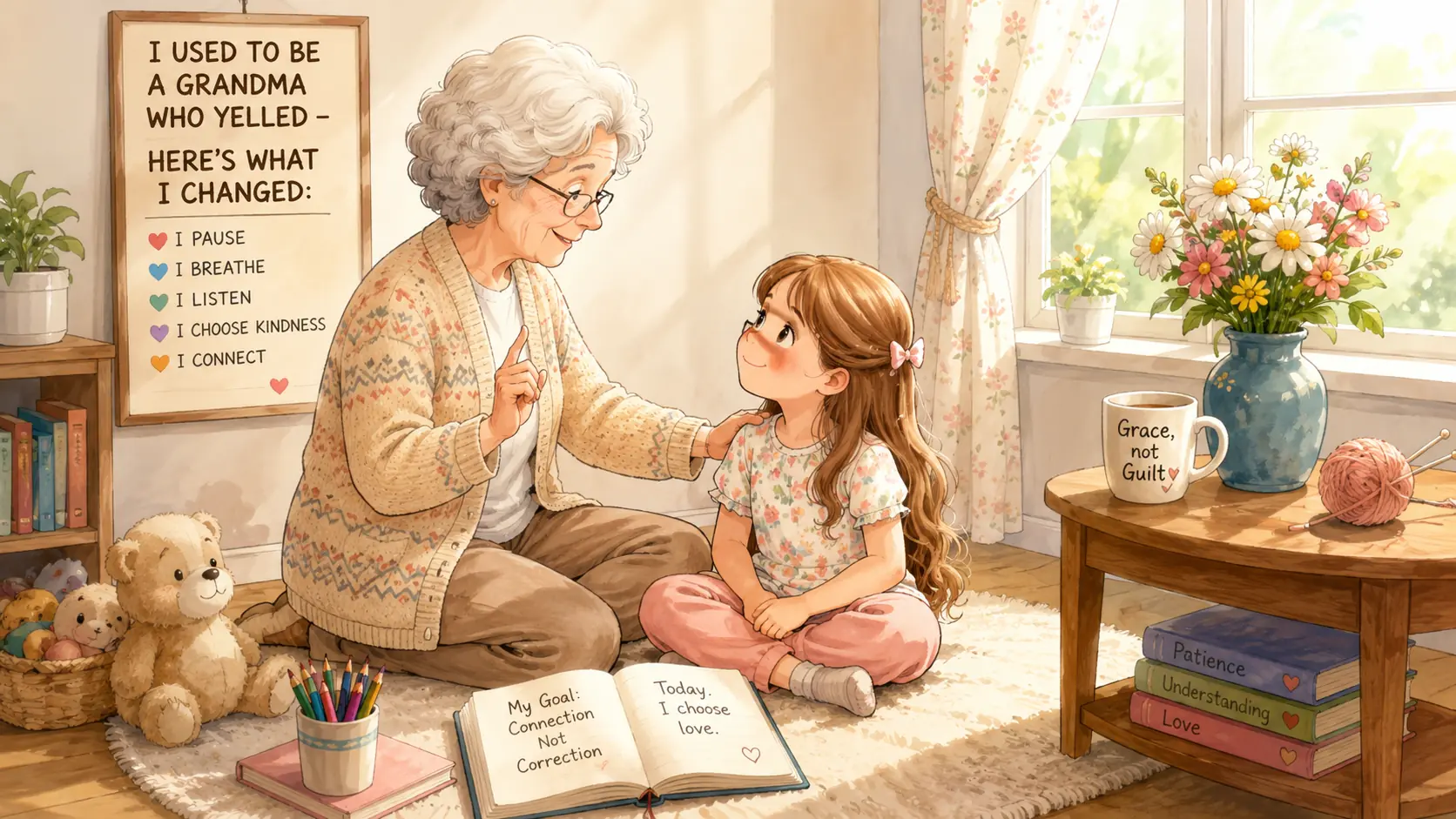
3. I Learned to Pause Instead of React Immediately
Yelling often happens in the space between surprise and thought.
Something spills. A child hits a sibling. A rule is broken. A teenager says something shocking. Before the adult has understood the situation, the reaction has already begun.
I used to believe immediate reaction showed strength. If I did not respond instantly, I feared the grandchildren would think the behavior did not matter.
But speed did not always produce wisdom.
Sometimes I misunderstood what happened. I blamed the wrong child. I assumed intention where there had been an accident. I issued consequences that were too severe because I was responding to my anger rather than to the actual behavior.
The pause gave me time to gather information.
“What happened?”
“Is anyone hurt?”
“Whose turn was it?”
“What did you hear me ask you to do?”
These questions did not guarantee honest answers, but they prevented me from beginning with an accusation.
Pausing was especially important when I felt embarrassed in front of other people. Public behavior used to make me react more strongly because I imagined everyone judging me.
At a store, restaurant, church gathering, or family event, a grandchild’s meltdown felt like a public announcement that I had lost control.
But discipline driven by embarrassment is rarely fair.
The child’s need did not change simply because people were watching. If anything, a crowded environment might be part of why the child was overwhelmed.
I learned to focus on the grandchild instead of the audience.
Sometimes that meant moving to a quieter place. Sometimes it meant ending an activity. Sometimes it meant saying very little until both of us could think clearly.
The pause also allowed me to choose whether the moment needed correction immediately or conversation later.
If someone was in danger, I acted at once. If a child was hitting, running toward traffic, or damaging property, safety came first.
But not every problem was an emergency.
A disrespectful tone could be addressed after everyone calmed. A disagreement about chores did not require a full lecture in front of siblings. A teenager’s poor decision could be discussed after I had spoken with their parents and understood the facts.
I learned to say, “We are going to talk about this, but not while we are both upset.”
That sentence preserved accountability without inviting escalation.
The pause also protected me from saying words that would outlive the behavior.
A mess can be cleaned. A broken object may be repaired or replaced. But a sentence such as “I cannot stand being around you” can remain in a child’s memory for years.
Words spoken at the height of anger often contain exaggerations we do not truly mean.
“You always ruin everything.”
“You never listen.”
“You are just like…”
The pause gave those words time to lose their power before they reached the child.
Pausing did not make me passive. It made my response more intentional.
Instead of reacting to release my emotion, I responded to teach the child.
There were still consequences. Toys thrown in anger were removed. Hurtful behavior required repair. Agreements that were broken affected privileges.
But the consequences became connected to the behavior rather than designed to make the child suffer because I had suffered.
I began asking, “What will help this grandchild learn responsibility?” instead of “How can I make sure they never do this again?”
Fear can stop a behavior temporarily. Understanding, practice, and consistent boundaries are more likely to create lasting change.
4. I Realized My Grandchild Needed Guidance, Not Fear
For a long time, I confused fear with respect because fearful children often look obedient.
They become quiet. They stop arguing. They move quickly. The adult feels powerful, and the room appears controlled.
But fear-based obedience has limitations.
A child may follow the rule only while the frightening adult is present. They may hide mistakes, lie to avoid punishment, or become skilled at appearing compliant without developing inner responsibility.
Guidance asks more of the adult.
It requires explaining, modeling, practicing, and following through. It means helping the child understand not only what the rule is, but why it exists and what to do instead.
If a grandchild hit another child, yelling “What is wrong with you?” might frighten them into stopping. Guidance sounded different.
“I will not let you hit. Hitting hurts people. Tell me what happened, and then we are going to help your cousin.”
The child still faced accountability. They might need to return a toy, offer an apology when ready, get ice, or help repair what was damaged.
But the purpose was not to make them feel like a bad person. It was to help them understand the impact of the choice and practice a better response.
Guidance also meant teaching emotional language.
Instead of assuming a child knew what to say, I could offer words.
“You can say, ‘I was using that. Please give it back.’”
“You can say, ‘I need a break.’”
“You can tell me, ‘I am angry,’ without screaming in someone’s face.”
Children are not born knowing how to negotiate conflict. They learn from watching and practicing with adults.
When I used fear, I was teaching that the most powerful person could control the room through intimidation. When I used guidance, I was teaching problem-solving.
I also became more careful about threats.
Adults sometimes make threats they cannot or should not carry out: “You will never come to Grandma’s house again,” “I am throwing away every toy,” or “Wait until your parents hear how terrible you were.”
These statements may frighten a child, but they also make love and belonging feel uncertain.
A consequence should be realistic, related, and calmly enforced.
“If the game pieces continue to be thrown, the game will be put away.”
“If you cannot stay beside me in the parking lot, you will need to hold my hand.”
“If the device is used against the rules, it will be returned to your parents.”
The child knows what will happen, and Grandma does not have to become terrifying to follow through.
Guidance includes warmth, but it is not permissiveness. I did not say yes to everything. I did not allow grandchildren to insult me, ignore safety rules, or mistreat one another.
I simply stopped believing that fear was necessary to make a boundary real.
A calm no can remain no.
A kind consequence can still be uncomfortable.
A loving adult can be deeply serious.
Grandchildren need to know that Grandma’s warmth is not weakness and her boundaries are not rejection. They can feel disappointed, angry, or unhappy with a decision while still feeling secure in the relationship.
That combination—firmness and safety—is what helps external guidance become internal character.
5. I Stopped Trying to “Win” Every Power Struggle
A power struggle begins when the original issue becomes less important than proving who is in control.
The child refuses to put on a coat. Grandma insists. The child becomes louder. Grandma becomes firmer. Soon, the conversation is no longer about the weather. It is about who will surrender first.
I entered many of these struggles because I feared that backing down on anything would teach children they were in charge.
But not every preference required my control.
I learned to distinguish between a boundary and a personal preference.
Safety was a boundary. Kindness was a boundary. Respecting property was a boundary. Following the parents’ important rules was a boundary.
Whether the child wore the blue shirt or the green shirt was usually a preference. Whether they wanted their sandwich cut into squares or triangles did not require a battle. Whether homework happened at the kitchen table or the desk might be flexible if the work was completed.
Children need some appropriate control over their lives. They spend much of the day following adult schedules and decisions. Small choices help them develop independence and cooperation.
I began offering limited options.
“Would you like to clean up the blocks or the art supplies first?”
“You need a coat. Would you like to carry it or wear it?”
“It is time to leave. Would you like to walk to the car or hold my hand?”
Both choices were acceptable to me, and the larger requirement remained.
This reduced many arguments because the child gained agency without taking over the situation.
I also stopped arguing endlessly after a decision had been explained.
A child may believe that continued debate will eventually exhaust the adult into changing the answer. Sometimes I strengthened the power struggle by offering new explanations every minute.
I learned to say, “I have listened to your opinion. The answer is still no.”
Then I stopped defending the boundary.
Children are allowed to be unhappy with a decision. Grandma does not have to eliminate every complaint before moving forward.
Winning also became less important when I considered the long-term relationship.
I could force a child to hug me, but what had I won? A physical gesture without genuine affection.
I could demand an apology while the child was still furious, but what had I won? Words without understanding.
I could embarrass a teenager into silence during a family gathering, but what had I won? Public obedience at the cost of trust.
Sometimes the wiser choice was to protect the relationship and return to the lesson later.
This did not mean avoiding difficult conversations. It meant choosing the time, tone, and setting most likely to help the child learn.
I also stopped using my years of experience as a weapon. Saying, “I am the adult, so I am automatically right,” prevented me from recognizing when a grandchild had a reasonable point.
Adults can misunderstand. Rules can need adjustment. A child can communicate poorly and still have something important to say.
Listening did not require surrendering authority. It made the authority more thoughtful.
When I stopped trying to win every struggle, home felt less like a courtroom. We still had rules, but every disagreement no longer became a test of loyalty or respect.
The goal was not for Grandma to defeat the grandchild.
The goal was for both of us to move through the problem without damaging the relationship.
6. I Started Learning How to Apologize and Repair
I once believed apologizing to a child would weaken my authority.
I worried they would use my admission against me or believe the entire correction no longer counted. Adults in my childhood rarely apologized. If an adult overreacted, everyone usually moved on without discussing it.
But the absence of an apology did not mean the hurt disappeared.
Children remember unfairness. They remember being blamed incorrectly, embarrassed publicly, or spoken to harshly. When adults refuse to acknowledge those moments, the child learns that power determines whose pain matters.
I began apologizing clearly.
“I was right to stop you from hitting, but I was wrong to yell in your face.”
“I misunderstood what happened and blamed you before listening. I am sorry.”
“I called you a hurtful name. That was unacceptable.”
A real apology does not contain an excuse disguised as responsibility.
“I’m sorry, but you made me so angry” places the burden back on the child. My emotion belonged to me. Their behavior could require correction, but it did not force me to become cruel.
Repair also involved asking whether there was anything the grandchild needed to say.
Sometimes they told me my voice had scared them. Sometimes they said they felt I always believed another sibling first. Their perspective was not always completely accurate, but it was still valuable.
Listening did not mean agreeing with every accusation. It meant caring about how the interaction felt from their side.
Then we discussed what both of us could do differently.
“I will work on lowering my voice. You still need to come when I call because we were leaving.”
“I should not have embarrassed you in front of everyone. We still need to address the broken rule privately.”
Repair held two truths at once: I had made a mistake, and the grandchild still had responsibility.
This is an important model for children. They need to see that apologizing does not destroy dignity. It restores trust.
If adults never apologize, children may learn to defend every mistake, blame others, or believe saying sorry is a form of defeat.
When Grandma apologizes and changes her behavior, the child sees accountability in action.
Repair also meant reconnecting after conflict. Sometimes we talked, hugged if the child wanted, read a book, prepared a snack, or returned to an ordinary activity together.
The message was not, “The problem never happened.” It was, “The problem does not have to permanently separate us.”
Children need to know that relationships can survive mistakes. They also need proof that love returns after correction.
Apology without change is incomplete. If I yelled, apologized, and repeated the same pattern constantly without effort, the words would eventually lose meaning.
Repair required practice.
I might tell the grandchildren, “I am working on not shouting. You can respectfully remind me by saying, ‘Grandma, your voice is getting loud.’”
This did not make them responsible for my behavior. It simply allowed the family to recognize the new pattern together.
Sometimes hearing those words helped me stop before going further.
My grandchildren learned that adults are works in progress too.
That truth did not make them feel unsafe. It made honesty safer.
7. I Worked Through My Own Triggers
Not every reaction begins in the present moment.
Sometimes a grandchild’s behavior awakens an old memory, fear, or wound the child knows nothing about.
A dismissive tone might remind me of a relationship in which my voice was ignored. A child’s crying might make me uncomfortable because I was punished for crying. Disorder might trigger anxiety because I grew up in a home where mistakes brought severe consequences.
I used to believe the intensity of my reaction proved the seriousness of the child’s behavior. Eventually, I realized that some reactions were intense because they were connected to much more than the current situation.
This did not mean the behavior was acceptable. It meant I needed to distinguish between what belonged to the grandchild and what belonged to my history.
I began asking myself, “Why does this particular behavior affect me so strongly?”
The answers were not always comfortable.
Sometimes I expected immediate obedience because questioning adults had never been safe for me. Sometimes I interpreted a child’s independence as rejection. Sometimes noise made me feel out of control because calm had once been connected to survival.
Understanding a trigger did not excuse my response. It gave me a chance to change it.
I could tell myself, “This is my grandchild, not the person who hurt me. This is a disagreement, not a threat. I can set a boundary without reliving the past.”
Some patterns required deeper reflection, honest conversations, journaling, spiritual guidance, or professional support. Seeking help was not a sign that I had failed as a grandmother.
It was a way of refusing to hand an unhealed wound to another generation.
Grandmothers often carry experiences that were never openly discussed. We lived through family conflict, financial hardship, grief, discrimination, difficult marriages, loss, and expectations to remain strong regardless of how we felt.
Strength helped us survive.
But strength can also include finally looking at what survival required us to bury.
When I worked through my triggers, I became less likely to make the grandchildren responsible for feelings they had not created.
I also became more compassionate toward the parents. My adult children had their own triggers, many of which may have developed in the home I created.
That realization brought humility.
Instead of criticizing their parenting from a distance, I could ask how to support them. I could acknowledge where my own past behavior had caused pain without demanding that they quickly forgive or reassure me.
Breaking patterns across generations requires honesty from everyone, but older adults can set a powerful example by going first.
I could not change what I did decades ago. I could change how defensively I responded when someone described its impact.
Working through triggers did not make me endlessly calm. It made my reactions more connected to the actual moment.
The grandchild no longer had to carry the emotional weight of every person and experience who came before them.
8. I Stopped Grandmothering in Exhaustion and Survival Mode
Yelling often appeared at the end of my energy.
It happened when I had tried to do too much, ignored my physical limits, and expected myself to create a perfect visit. I cooked, cleaned, planned activities, managed disagreements, and refused help until one small problem became the final burden.
Then a cup spilled or a child complained, and I reacted as though they had destroyed everything.
The cup was not the true cause.
Exhaustion was.
Parents of young children often live in survival mode because daily responsibilities cannot easily be reduced. Grandparents may have more choice about how much we take on, yet many of us feel pressure to prove that we can still do everything.
We may hesitate to admit that caring for several children at once is harder than it used to be. We want to remain useful. We do not want our families to think we are becoming old or incapable.
But denying our limits does not serve the grandchildren.
A tired grandmother who accepts help can provide a safer, warmer experience than an exhausted grandmother trying to be everything.
I simplified visits.
We did not need a complicated craft, a homemade meal, an outing, and a perfectly clean house in the same day. Children often enjoyed simple things more: making toast, walking outside, looking through old photographs, coloring at the kitchen table, or helping water plants.
I planned quiet periods. After an active morning, we might read, listen to music, or watch something together. Rest was not wasted time. It protected everyone’s nervous system.
I also communicated more clearly with the parents. I could say, “I would love to spend time with them, but I can manage one overnight rather than the whole weekend,” or “I need you to pick them up by five because my energy drops in the evening.”
Boundaries allowed me to keep my promises without becoming resentful.
I learned that saying no to an arrangement was sometimes a way of saying yes to the relationship.
Grandmothers should not feel ashamed of needing medication schedules, rest, accessible activities, or support with transportation. Children can learn compassion by seeing that bodies have different needs.
We can explain simply: “Grandma’s back needs a rest, so let’s choose something we can do while sitting.”
This does not burden the child when communicated calmly. It teaches them that love includes respecting limits.
Survival mode also involved emotional overload. Sometimes family conflict, financial worry, grief, or caregiving responsibilities consumed my patience before the grandchildren arrived.
I did not need to share adult details with them, but I could acknowledge my state.
“Grandma has had a hard day. It is not your fault, and I am going to take a few minutes to settle myself.”
That sentence prevented children from assuming my mood was caused by them.
Stopping survival-mode grandmothering did not require a life without stress. It required recognizing that constant depletion made kind responses harder and adjusting what I could.
Calmness needs support.
Rest, realistic expectations, boundaries, cooperation, and honest communication are not selfish luxuries. They are part of creating an emotionally safe home.
9. I Realized Calm Grandmothering Is a Skill, Not a Personality Trait
I used to look at calm adults and assume they were simply born patient.
They must have easier personalities, quieter families, or grandchildren who listened more quickly. I told myself, “I have always had a strong voice,” as though yelling were an unchangeable part of who I was.
That belief protected me from failure because it meant I did not have to practice anything different.
Then I began treating calmness as a skill.
Skills are learned through repetition. They are awkward at first. They do not work perfectly every time. Improvement happens gradually.
I practiced lowering my voice when I wanted to raise it. I practiced walking closer instead of shouting instructions from another room. I practiced using fewer words.
Instead of giving a five-minute lecture, I might say, “The rule is that toys stay inside. Please bring it back now.”
Long explanations often appeared when I was trying to release frustration. Clear language worked better.
I practiced preparing children for transitions.
“Ten more minutes, then we will clean up.”
“After this chapter, it is time for bed.”
“We are leaving after you go down the slide two more times.”
Warnings did not prevent every protest, but they reduced the shock of sudden change.
I practiced playful cooperation when appropriate. A cleanup song, a silly race, or pretending the shoes were calling for the child could move a young grandchild through a task without turning everything into a command.
Play did not replace boundaries. It simply used the language children naturally understand.
I practiced noticing my successes. If I handled one difficult moment without yelling, that mattered. I did not dismiss it because another moment had gone poorly.
Change grew through small victories.
Calmness also became easier when I prepared phrases in advance.
“I can see you are upset, and the answer is still no.”
“I will listen when your voice is respectful.”
“You are not in trouble for having a feeling. We need to talk about what you did with it.”
“I need a moment before I respond.”
Prepared language gave me something to reach for when my mind was stressed.
I learned that calm does not always feel calm inside. Sometimes my heart was pounding while my voice remained steady. That still counted.
Self-control is not the absence of emotion. It is the ability to choose behavior while emotion is present.
I also stopped demanding perfection from myself. The belief that I must never yell again created shame whenever I failed. Shame made me defensive and less willing to keep learning.
A healthier goal was progress, repair, and greater awareness.
I could say, “That was not how I wanted to handle it. I will try again.”
Grandchildren benefit from seeing that growth remains possible at every age.
A woman in her sixties, seventies, or eighties can learn new ways of communicating. We are not imprisoned by how our parents raised us or how we raised our own children.
Age can make change slower, but it can also make it more meaningful.
When a grandmother chooses to grow, she teaches the family that love is not too proud to learn.
10. I Learned to Recognize the Need Behind the Behavior
Every behavior communicates something, even when the communication is clumsy, disruptive, or unacceptable.
A child who clings may need reassurance. A child who becomes controlling may feel anxious. A child who provokes a sibling may be seeking connection in the only way they currently know. A teenager who withdraws may need privacy, or they may be afraid of judgment.
Recognizing the need did not mean granting every request.
A child crying for another dessert may want sugar, but the deeper need could be comfort, attention, or difficulty ending a pleasant experience. The answer to the dessert could remain no while the emotional need received a response.
“You really enjoyed it, and you wish there were more. We are finished with dessert, but you can sit beside me while we clean the kitchen.”
The limit stayed intact. Connection remained available.
A grandchild demanding that I play immediately might need attention, but I did not always have to stop what I was doing.
“I hear that you want time with me. I am finishing this call, and then we can have fifteen minutes together.”
Recognizing the need helped me respond intentionally rather than simply silencing the behavior.
I began looking for patterns.
Did meltdowns happen before meals? Did conflict increase when cousins competed for attention? Did the child become defiant when a visit was ending? Did a teenager become irritable after spending too much time online or before an important event?
Patterns gave us clues.
A child who behaved badly at the end of every visit might be struggling with goodbye. We could create a predictable departure ritual, offer a warning, and talk about when we would see each other again.
A grandchild who became loud when adults were talking might need reassurance that they would receive attention. We could set a timer or create a signal showing that Grandma had noticed them.
Not every need could be met immediately, and some behavior still required consequences. But understanding the need allowed the consequence to teach rather than merely punish.
If a child lied because they feared my reaction, I still addressed the dishonesty. I also examined whether my past responses had made truth feel unsafe.
“I am disappointed that you lied. I also want you to know that you can tell me the truth, even when it is difficult. We will deal with the mistake, but honesty helps us solve it.”
If a child hurt someone to gain attention, I did not reward the harm. I helped them repair it and taught a safer way to seek connection.
Recognizing needs also helped me notice when behavior required more support than Grandma alone could provide. Persistent aggression, extreme anxiety, withdrawal, major changes in mood, or struggles that affected daily life needed to be shared with the parents.
My role was not to diagnose or secretly solve everything. It was to observe, listen, support the family, and take concerns seriously.
Most importantly, seeing the need behind the behavior helped me remember the child beneath the difficult moment.
The screaming grandchild was still the child who wanted to feel secure.
The argumentative teenager was still trying to understand who they were.
The child who pushed everyone away might still be asking, “Will you stay?”
Behavior needed guidance, but the relationship needed protection.
That was the change beneath all the other changes.
I stopped asking only, “How do I make this behavior stop?”
I began asking, “What is this child trying to communicate, and what do they need to learn?”
What Changed When I Stopped Using Yelling as My First Tool
My grandchildren did not become perfectly obedient.
They still argued, forgot rules, resisted transitions, cried over disappointment, and made choices that required consequences. Calm grandmothering did not remove the normal work of guiding children.
What changed was the atmosphere.
The children became more willing to tell me what had happened. They were less focused on protecting themselves from my reaction. They could admit mistakes more honestly because a mistake no longer guaranteed humiliation.
I also became more capable of hearing them.
When I was not using all my energy to defend my authority, I could notice the actual problem. Sometimes the child needed correction. Sometimes I had misunderstood. Sometimes both of us needed to repair something.
Our relationship became less about control and more about trust.
Trust did not mean the grandchildren always liked my decisions. They could still be angry when I turned off a device, ended an activity, or enforced a safety rule.
But they were learning that Grandma’s boundaries were dependable and her love remained present inside them.
I also discovered that a quieter voice often made children listen more closely. Yelling had become background noise. Calm firmness signaled that I was serious without flooding the room with fear.
There were still moments when I raised my voice, especially in danger or surprise. A loud “Stop!” may be necessary when a child is about to run into the street.
The difference was that shouting no longer became the normal language of conflict.
When I failed, I repaired.
When I felt overwhelmed, I paused.
When a behavior confused me, I became curious.
When a boundary mattered, I held it without trying to destroy the child’s will.
That is not weakness.
It is disciplined love.
The Hard Truth Many Grandmothers Carry
Some of us may read these ideas and feel regret.
We remember yelling at our own children when they were small. We remember sentences we wish we could take back. We may see our adult children struggling with anger and wonder how much of it began in the atmosphere we created.
Regret can become heavy, especially when the years cannot be repeated.
But regret does not have to become hopelessness.
We can acknowledge the past without pretending it was harmless. We can apologize to our grown children without demanding immediate forgiveness.
“I have been thinking about how often I yelled when you were young. I know that may have hurt or frightened you. You did not deserve some of the ways I spoke. I am sorry.”
The response may be emotional. Our adult child may remember more than we expect. They may not be ready to reassure us.
An apology is not a request for them to remove our guilt. It is an offering of truth.
We can listen.
We can change how we interact now.
We can support their parenting without acting as though we have suddenly become experts who never made mistakes. Humility is more healing than advice delivered from a position of superiority.
Grandmotherhood can become a season of repair, but only when we resist using grandchildren to rewrite our history or compete with their parents.
Our grandchildren are not second chances in the sense that we get to take over and parent again according to our new wisdom. Their parents remain the parents.
Our opportunity is to become a healthier presence within the family.
We can honor the rules of the household, ask how the parents want certain situations handled, and share what we are learning without criticism.
We can say, “I am working on responding more calmly. What language do you use when she is overwhelmed?”
This creates partnership.
The goal is not to prove that Grandma has changed more than everyone else.
The goal is to help build a family culture in which no one is too old to grow, apologize, or learn.
What I Hope My Grandchildren Remember
One day, my grandchildren will be grown.
They may not remember the specific argument about cleaning up toys. They may forget the day a drink spilled, the afternoon someone refused to leave the playground, or the reason two cousins were fighting.
But they may remember the feeling of my voice.
They may remember whether they could bring me the truth.
They may remember whether anger made me unsafe or whether I remained strong enough to guide them without frightening them.
I hope they remember that Grandma was not perfect, but she was willing to change.
I hope they remember hearing me say, “I was wrong.”
I hope they remember that their feelings were allowed, their behavior was guided, and their belonging was never placed in doubt.
I want them to carry an inner voice that sounds calmer than the one many of us inherited.
When they make a mistake, I hope that voice says, “Take responsibility and repair it,” not, “You ruin everything.”
When they feel overwhelmed, I hope it says, “Pause and breathe,” not, “What is wrong with you?”
When their own children struggle, I hope they become curious about the need beneath the behavior.
This is how patterns change.
Not because one generation becomes perfect, but because one person recognizes the harm, chooses a different response, and practices it long enough for kindness to become familiar.
I used to be a grandma who yelled.
I thought my volume proved that I was in control. I thought silence after shouting meant the lesson had been learned.
Now I understand that true control begins with regulating myself. True respect grows through trust. True discipline provides guidance, boundaries, repair, and emotional safety.
I still say no.
I still hold grandchildren accountable.
I still expect kindness, honesty, and respect.
But I no longer believe I must make a child afraid in order to be heard.
My grandchildren do not need a grandmother who wins every struggle. They need one who can lead without losing herself, correct without humiliating, and love them steadily through the moments when they are hardest to understand.
The greatest change was not simply that I lowered my voice.
It was that I stopped seeing the child in front of me as an opponent.
I began seeing a developing human being who needed my calm more than my control.
And every time I choose to pause, listen, guide, apologize, and try again, I am teaching them something I wish every child could learn early:
Love can be firm without being frightening.
Authority can be calm without becoming weak.
And no family pattern is too old to change while someone is brave enough to begin.